Telecom Optical Filters Market, Trends, Business Strategies 2025-2032

Telecom Optical Filters Market was valued at 845 million in 2024 and is projected to reach US$ 1363 million by 2032, at a CAGR of 7.1% during the forecast period

PDF Icon Download Sample Report PDF
  • Quick Dispatch

    All Orders

  • Secure Payment

    100% Secure Payment

Price range: $1,500.00 through $4,250.00

Clear

MARKET INSIGHTS

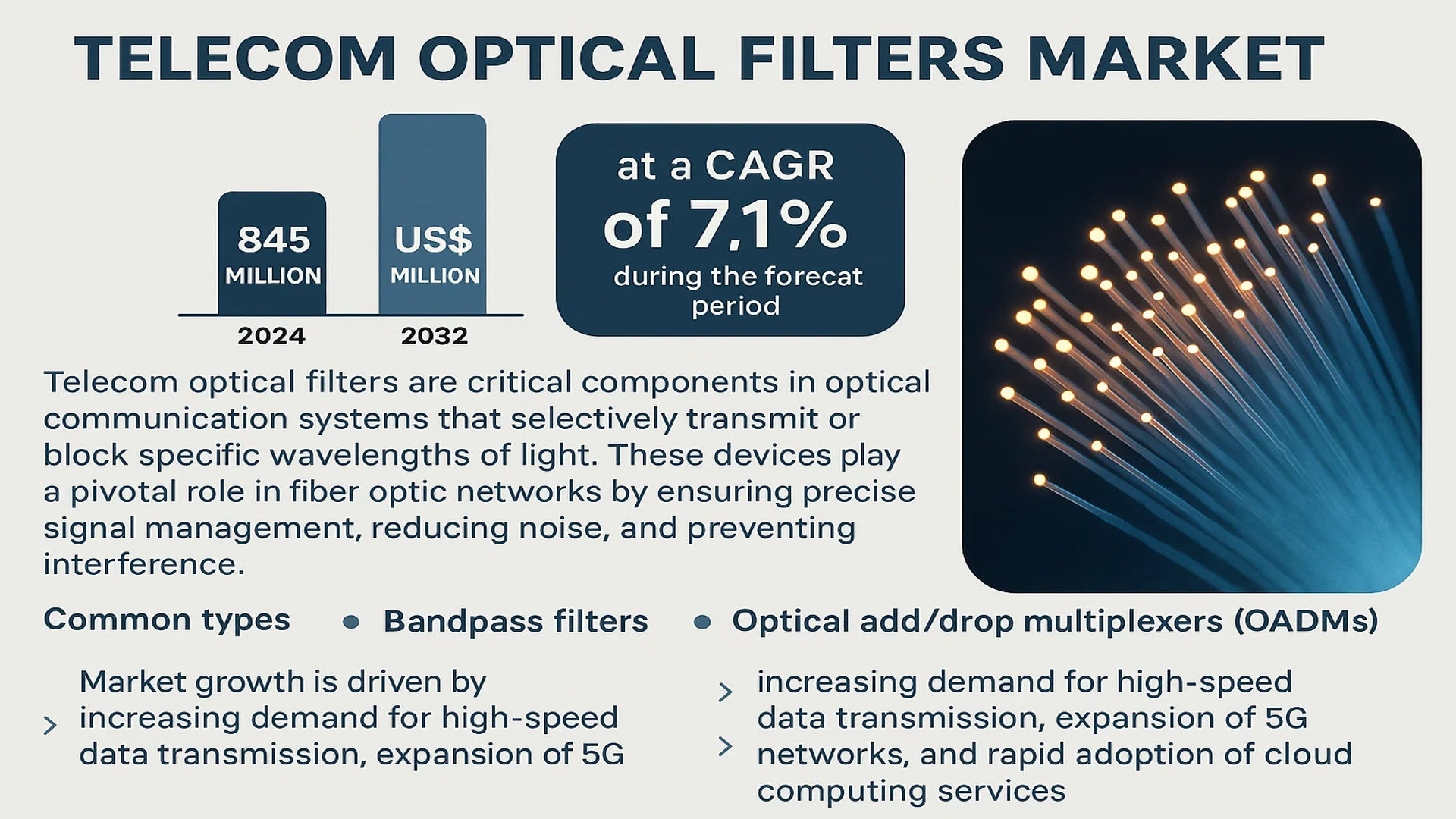
The global Telecom Optical Filters Market was valued at 845 million in 2024 and is projected to reach US$ 1363 million by 2032, at a CAGR of 7.1% during the forecast period.

Telecom optical filters are critical components in optical communication systems that selectively transmit or block specific wavelengths of light. These devices play a pivotal role in fiber optic networks by ensuring precise signal management, reducing noise, and preventing interference. Common types include bandpass filters, notch filters, and optical add/drop multiplexers (OADMs), which are widely used in wavelength division multiplexing (WDM) systems to enhance network capacity and efficiency.

The market growth is driven by increasing demand for high-speed data transmission, expansion of 5G networks, and the rapid adoption of cloud computing services. Furthermore, advancements in dense wavelength division multiplexing (DWDM) technologies and investments in next-generation optical networks are accelerating industry expansion. Key players such as Coherent, Edmund Optics, and Iridian Spectral Technologies are focusing on innovation to meet the rising demand for high-performance optical filters in telecommunications, data centers, and satellite communications.
Telecom Optical Filters Market

MARKET DYNAMICS

MARKET DRIVERS

Explosive Growth in 5G Deployment to Accelerate Telecom Optical Filters Demand

The rapid global rollout of 5G networks is driving significant demand for telecom optical filters. With over 300 commercial 5G networks deployed worldwide as of early 2024, the need for advanced optical components that can handle higher bandwidth and lower latency has intensified. Optical filters play a critical role in 5G fronthaul and backhaul networks by enabling efficient wavelength division multiplexing and signal processing. Carriers are investing heavily in dense wavelength division multiplexing (DWDM) systems that rely on high-performance optical filters to maximize fiber capacity, with DWDM-related expenditures expected to grow nearly 9% annually through 2030.

Data Center Expansion Fueling Optical Filter Adoption

Massive growth in cloud computing and hyperscale data centers is creating substantial opportunities for optical filter manufacturers. The global data center colocation market surpassed $55 billion in 2023, with projections indicating continued 12% CAGR growth. Optical filters enable critical functions in data center interconnect (DCI) applications, where they help manage multiple wavelengths across fiber links. With major cloud providers expanding their global footprints and upgrading to 400G and 800G deployments, demand for precision optical filters that can handle these high-speed transmissions while minimizing signal loss has increased dramatically. This trend is particularly strong in North America and Asia-Pacific regions where hyperscale data center construction is most active.

Advancements in Filter Technologies Expanding Application Scope

Continuous innovation in optical filter designs and manufacturing techniques is opening new market opportunities. Thin-film filter (TFF) technology has seen particular advancement, with new multilayer dielectric coatings achieving sub-nanometer wavelength accuracy and improved temperature stability. These improvements have enabled optical filters to meet the stringent requirements of coherent optical communication systems. Additionally, the development of reconfigurable optical add-drop multiplexers (ROADMs) with software-controlled filter functions is transforming network architectures, allowing carriers to dynamically adjust bandwidth allocation without physical reconfiguration.

MARKET RESTRAINTS

High Development Costs and Complex Manufacturing Processes Limit Market Expansion

The specialized manufacturing requirements for telecom-grade optical filters create significant barriers to market growth. Producing optical filters with the required precision often requires expensive vacuum deposition equipment and cleanroom facilities, with capital expenditures for a production line frequently exceeding $10 million. The complex multilayer coating processes demand exacting environmental controls and extensive quality testing, resulting in relatively low production yields typically between 60-75% for high-performance filters. These factors contribute to high per-unit costs, particularly for customized filter solutions needed in advanced telecommunications applications.

Other Restraints

Supply Chain Vulnerabilities
The optical filter market remains susceptible to disruptions in the global supply chain for specialized materials. Many high-performance filters depend on rare earth oxides and ultra-pure silica substrates with limited global sourcing options. Recent geopolitical tensions have highlighted the risks of over-reliance on single-source suppliers for critical optical coating materials.

Technology Transition Risks
The rapid pace of optical communication technology evolution creates uncertainty for filter manufacturers. Emerging technologies such as silicon photonics and integrated photonic circuits could potentially disrupt the market for discrete optical filters, requiring manufacturers to continuously adapt their product portfolios.

MARKET CHALLENGES

Intense Price Competition Squeezes Manufacturer Margins

The telecom optical filter market faces growing pricing pressures as network operators demand higher performance at lower costs. Chinese manufacturers have gained significant market share by offering aggressively priced components, forcing global suppliers to reduce prices by 15-20% over the past three years. This price erosion coincides with rising material and labor costs, particularly for specialized thin-film deposition technicians who command premium salaries. Many mid-sized filter manufacturers are finding it challenging to maintain profitability while investing in next-generation product development.

Other Challenges

Technical Performance Demands
As optical networks push toward terabit capacities, filter specifications become increasingly stringent. Modern DWDM systems require optical filters with insertion losses below 0.5 dB and polarization-dependent loss under 0.1 dB, parameters that challenge even established manufacturers. Meeting these specifications consistently across high-volume production runs remains an ongoing challenge for the industry.

Standardization Issues
The lack of global standards for certain optical filter specifications complicates product development and verification. Different network equipment manufacturers often have unique performance requirements, forcing filter suppliers to maintain numerous product variants and custom solutions, which increases inventory costs and production complexity.

MARKET OPPORTUNITIES

Emerging Space and Defense Applications Create New Growth Avenues

The increasing deployment of low-earth orbit (LEO) satellite constellations presents significant opportunities for optical filter manufacturers. These satellite networks require highly reliable optical components that can withstand extreme environmental conditions while maintaining precise wavelength selectivity. The global space-based optical communication market is projected to grow at over 20% CAGR through the decade, with optical filters serving critical functions in intersatellite links and ground station communications. Similarly, defense applications including secure optical communication systems and infrared sensing are driving demand for specialized optical filters with niche performance characteristics.

Integration with Silicon Photonics Opens New Possibilities

The convergence of optical filter technologies with silicon photonics platforms creates opportunities for innovative hybrid solutions. While silicon photonics excels at integration and miniaturization, it often requires external optical filters for wavelength management. Developing compact filter solutions that can be monolithically integrated with silicon photonic circuits represents a promising technical frontier. Several leading photonic component suppliers are investing heavily in this area, with prototypes demonstrating the potential for significant size and cost reductions compared to traditional discrete filter implementations.

Expansion in Emerging Markets Presents Geographical Growth Potential

Developing economies in Asia, Latin America, and Africa are investing heavily in optical network infrastructure to support digital transformation initiatives. Countries like India, Brazil, and Indonesia have announced ambitious fiber rollout plans that will require substantial quantities of optical components including filters. These markets often prioritize cost-effective solutions, creating opportunities for manufacturers who can balance performance with affordability. Localized production and partnerships with regional network operators are proving effective strategies for accessing these growth markets while navigating their unique regulatory and logistical challenges.

TELECOM OPTICAL FILTERS MARKET TRENDS

Adoption of WDM Technology Driving Optical Filter Demand

The widespread adoption of wavelength division multiplexing (WDM) technology has emerged as a key driver for the telecom optical filters market. Optical filters play a critical role in WDM systems by enabling multiple optical signals to be transmitted simultaneously over a single fiber, effectively increasing bandwidth capacity. As network operators continue to expand fiber-optic infrastructure to meet rising data traffic demands, the need for high-performance optical filters in dense wavelength division multiplexing (DWDM) and coarse wavelength division multiplexing (CWDM) applications continues to grow. Recent advancements in filter technology have improved channel spacing precision to as little as 0.4nm, allowing for more efficient spectrum utilization in modern optical networks.

Other Trends

5G Network Deployments Fueling Market Growth

The ongoing global rollout of 5G networks is creating significant opportunities for the telecom optical filters market. 5G fronthaul and backhaul networks rely heavily on optical filtering solutions to manage the high-speed data transmission between base stations and core networks. The implementation of 5G networks requires precise wavelength management to support increasing data rates that can exceed 10Gbps per channel, driving demand for advanced optical filtering technologies. This trend is particularly strong in urban areas where network densification is creating a need for more sophisticated optical filtering capabilities.

Evolution Towards High-Speed Data Centers

The rapid expansion of cloud computing and hyperscale data centers is transforming requirements for optical filters in telecommunications applications. Modern data centers are migrating towards 400G and 800G optical transceivers, necessitating optical filters with superior thermal stability and minimal insertion loss. This shift is driving innovation in thin-film filter technology, with manufacturers developing solutions that can withstand the demanding environmental conditions of high-density data centers. The trend towards disaggregated optical network architectures is further accelerating the need for advanced filtering solutions that can support flexible channel allocation and dynamic bandwidth provisioning.

COMPETITIVE LANDSCAPE

Key Industry Players

Innovation and Strategic Partnerships Drive Market Leadership

The global telecom optical filters market is characterized by a dynamic competitive environment with prominent players vying for market share through technological advancements and strategic expansions. Coherent emerges as a dominant force, leveraging its extensive product portfolio in optical communications and strong foothold across North America and Europe. The company’s focus on R&D has enabled it to develop cutting-edge filter solutions for DWDM and CWDM applications, making it a preferred supplier for telecom operators worldwide.

Iridian Spectral Technologies and Omega Optical maintain significant market positions, with their reputation for high-precision filters that meet stringent industry requirements. These companies benefit from increasing demand for wavelength-division multiplexing solutions as network operators expand fiber optic infrastructure globally. Their ability to deliver customized solutions for specific network requirements gives them a competitive edge in this technical market segment.

Market competition continues to intensify as players invest in next-generation optical filter technologies. Newport Corporation and Edmund Optics have been particularly active in launching new product lines, focusing on improving signal isolation and insertion loss characteristics. Such innovations are critical as 5G deployments and data center interconnects demand higher performance from optical components.

Emerging players like Apogee Optocom and Optowide Technologies are disrupting the market with cost-effective alternatives, particularly in price-sensitive regions. While these companies currently hold smaller market shares, their aggressive pricing strategies and focus on manufacturing efficiency make them formidable competitors. Established players are responding through strategic acquisitions and vertical integration to maintain their leadership positions.

List of Key Telecom Optical Filter Companies Profiled

Segment Analysis:

By Type

DWDM Filter Segment Leads Due to High Demand in Large-Scale Fiber Optic Networks

The market is segmented based on type into:

  • CWDM Filter
  • LWDM Filter
  • DWDM Filter

By Application

Telecommunications Sector Dominates Owing to Growing Need for High-Speed Data Transmission

The market is segmented based on application into:

  • Telecommunications
  • Data Communications
  • Satellite Communications

By Technology

Thin-Film Filters Gain Prominence for Their High Precision and Reliability

The market is segmented based on technology into:

  • Thin-Film Filters
  • Fiber Bragg Gratings
  • Liquid Crystal Tunable Filters
  • Acousto-Optic Tunable Filters

By End User

Network Operators Contribute Significantly to Market Growth Through Infrastructure Development

The market is segmented based on end user into:

  • Telecom Service Providers
  • Network Operators
  • Data Center Operators
  • Government & Defense

Regional Analysis: Telecom Optical Filters Market

Asia-Pacific
Asia-Pacific dominates the Telecom Optical Filters market, accounting for the largest revenue share globally, driven by rapid fiber-optic network expansion and massive investments in 5G infrastructure across China, Japan, and South Korea. China alone contributes over 40% of regional demand, supported by its ambitious “Broadband China” strategy and extensive deployments of DWDM (Dense Wavelength Division Multiplexing) systems by telecom giants like Huawei and ZTE. India’s market is growing at a high CAGR due to rising data consumption and increasing submarine cable installations, while Southeast Asian nations benefit from cross-border fiber projects like the Asia-Africa-Europe-1 (AAE-1) cable system. Local players such as Optowide Technologies leverage cost advantages, though international firms like Coherent maintain strong positions in high-performance filter segments.

North America
North America’s market is characterized by advanced R&D and early adoption of cutting-edge optical filtering technologies, particularly in the U.S., where major cloud providers (e.g., AWS, Microsoft Azure) drive demand for hyperscale data center interconnects. The U.S. holds an estimated 28% of global revenue, with Coherent and Edmund Optics leading innovation in tunable filters for dynamic wavelength management. Canada’s market benefits from collaborative research initiatives, such as the Ciena-led fiber-optic testbeds, though regulatory delays in spectrum allocation occasionally hinder 5G rollouts. The region prioritizes energy-efficient filters to align with sustainability goals, pushing suppliers to develop low-loss, high-precision components.

Europe
Europe’s Telecom Optical Filters market thrives on stringent quality standards and the EU’s focus on Open RAN (Radio Access Network) architectures, which require advanced optical filtering for interoperability. Germany and the U.K. are key hubs, with Exail and Iridian Spectral Technologies providing specialized filters for defense and satellite communications. The region’s emphasis on reducing network latency has accelerated investments in OADM (Optical Add-Drop Multiplexer) filters, particularly for offshore wind farm monitoring systems. However, high manufacturing costs and reliance on imports for raw materials like germanium limit margins for local suppliers.

Middle East & Africa
The MEA market is nascent but exhibits strong growth potential, fueled by smart city projects in the UAE (e.g., Dubai’s 5G rollout) and terrestrial fiber expansions in Saudi Arabia. South Africa’s demand is rising due to submarine cable landings like Google’s Equiano system. While cost sensitivity favors Chinese suppliers, local partnerships, such as Apogee Optocom’s collaborations with Etisalat, aim to enhance regional capabilities. Challenges include limited technical expertise and a fragmented supply chain, though initiatives like the Middle East Cloud Alliance are expected to spur long-term demand.

South America
South America lags in adoption due to economic constraints but shows gradual progress, with Brazil leading in CWDM (Coarse Wavelength Division Multiplexing) filter deployments for metro networks. Argentina’s renewable energy projects drive niche demand for optical filters in grid monitoring, while Chile’s data center growth benefits suppliers like Omega Optical. Currency volatility and underdeveloped last-mile infrastructure remain hurdles, but regional trade agreements could improve access to advanced components over the forecast period.

Report Scope

This market research report provides a comprehensive analysis of the global Telecom Optical Filters market, covering the forecast period 2024–2032. It offers detailed insights into market dynamics, technological advancements, competitive landscape, and key trends shaping the industry.

Key focus areas of the report include:

  • Market Size & Forecast: Historical data and future projections for revenue, unit shipments, and market value across major regions and segments. The market was valued at USD 845 million in 2024 and is projected to reach USD 1,363 million by 2032, growing at a CAGR of 7.1%.
  • Segmentation Analysis: Detailed breakdown by product type (CWDM, LWDM, DWDM filters), application (telecommunications, data communications, satellite communications), and end-user industry to identify high-growth segments.
  • Regional Outlook: Insights into market performance across North America, Europe, Asia-Pacific, Latin America, and the Middle East & Africa. The U.S. and China are key growth markets.
  • Competitive Landscape: Profiles of leading market participants including Coherent, Edmund Optics, Chroma Technology, Alluxa, and Omega Optical, covering their product portfolios, R&D investments, and strategic developments.
  • Technology Trends & Innovation: Assessment of emerging optical filtering technologies, integration with 5G networks, and advancements in wavelength division multiplexing systems.
  • Market Drivers & Restraints: Evaluation of factors including growing fiber optic network deployments, increasing data traffic, along with challenges like high manufacturing costs.
  • Stakeholder Analysis: Strategic insights for optical component manufacturers, network equipment providers, telecom operators, and investors.

The research methodology combines primary interviews with industry experts and analysis of verified market data to ensure accuracy and reliability.

FREQUENTLY ASKED QUESTIONS:

What is the current market size of Global Telecom Optical Filters Market?

-> Telecom Optical Filters Market was valued at 845 million in 2024 and is projected to reach US$ 1363 million by 2032, at a CAGR of 7.1% during the forecast period.

Which key companies operate in Global Telecom Optical Filters Market?

-> Key players include Coherent, Edmund Optics, Chroma Technology, Alluxa, Omega Optical, Newport, and Iridian Spectral Technologies.

What are the key growth drivers?

-> Key growth drivers include 5G network deployments, increasing fiber optic adoption, rising data center investments, and growing demand for high-speed communication.

Which region dominates the market?

-> Asia-Pacific leads in market share due to rapid telecom infrastructure development, while North America remains a key innovation hub.

What are the emerging trends?

-> Emerging trends include tunable optical filters, silicon photonics integration, and AI-driven network optimization solutions.

Telecom Optical Filters Market, Trends, Business Strategies 2025-2032

Get Sample Report PDF for Exclusive Insights

Report Sample Includes

  • Table of Contents
  • List of Tables & Figures
  • Charts, Research Methodology, and more...
PDF Icon Download Sample Report PDF

Download Sample Report

Table of Content

1 Introduction to Research & Analysis Reports
1.1 Telecom Optical Filters Market Definition
1.2 Market Segments
1.2.1 Segment by Type
1.2.2 Segment by Application
1.3 Global Telecom Optical Filters Market Overview
1.4 Features & Benefits of This Report
1.5 Methodology & Sources of Information
1.5.1 Research Methodology
1.5.2 Research Process
1.5.3 Base Year
1.5.4 Report Assumptions & Caveats
2 Global Telecom Optical Filters Overall Market Size
2.1 Global Telecom Optical Filters Market Size: 2024 VS 2032
2.2 Global Telecom Optical Filters Market Size, Prospects & Forecasts: 2020-2032
2.3 Global Telecom Optical Filters Sales: 2020-2032
3 Company Landscape
3.1 Top Telecom Optical Filters Players in Global Market
3.2 Top Global Telecom Optical Filters Companies Ranked by Revenue
3.3 Global Telecom Optical Filters Revenue by Companies
3.4 Global Telecom Optical Filters Sales by Companies
3.5 Global Telecom Optical Filters Price by Manufacturer (2020-2025)
3.6 Top 3 and Top 5 Telecom Optical Filters Companies in Global Market, by Revenue in 2024
3.7 Global Manufacturers Telecom Optical Filters Product Type
3.8 Tier 1, Tier 2, and Tier 3 Telecom Optical Filters Players in Global Market
3.8.1 List of Global Tier 1 Telecom Optical Filters Companies
3.8.2 List of Global Tier 2 and Tier 3 Telecom Optical Filters Companies
4 Sights by Product
4.1 Overview
4.1.1 Segment by Type – Global Telecom Optical Filters Market Size Markets, 2024 & 2032
4.1.2 CWDM Filter
4.1.3 LWDM Filter
4.1.4 DWDM Filter
4.2 Segment by Type – Global Telecom Optical Filters Revenue & Forecasts
4.2.1 Segment by Type – Global Telecom Optical Filters Revenue, 2020-2025
4.2.2 Segment by Type – Global Telecom Optical Filters Revenue, 2026-2032
4.2.3 Segment by Type – Global Telecom Optical Filters Revenue Market Share, 2020-2032
4.3 Segment by Type – Global Telecom Optical Filters Sales & Forecasts
4.3.1 Segment by Type – Global Telecom Optical Filters Sales, 2020-2025
4.3.2 Segment by Type – Global Telecom Optical Filters Sales, 2026-2032
4.3.3 Segment by Type – Global Telecom Optical Filters Sales Market Share, 2020-2032
4.4 Segment by Type – Global Telecom Optical Filters Price (Manufacturers Selling Prices), 2020-2032
5 Sights by Application
5.1 Overview
5.1.1 Segment by Application – Global Telecom Optical Filters Market Size, 2024 & 2032
5.1.2 Telecommunications
5.1.3 Data Communications
5.1.4 Satellite Communications
5.2 Segment by Application – Global Telecom Optical Filters Revenue & Forecasts
5.2.1 Segment by Application – Global Telecom Optical Filters Revenue, 2020-2025
5.2.2 Segment by Application – Global Telecom Optical Filters Revenue, 2026-2032
5.2.3 Segment by Application – Global Telecom Optical Filters Revenue Market Share, 2020-2032
5.3 Segment by Application – Global Telecom Optical Filters Sales & Forecasts
5.3.1 Segment by Application – Global Telecom Optical Filters Sales, 2020-2025
5.3.2 Segment by Application – Global Telecom Optical Filters Sales, 2026-2032
5.3.3 Segment by Application – Global Telecom Optical Filters Sales Market Share, 2020-2032
5.4 Segment by Application – Global Telecom Optical Filters Price (Manufacturers Selling Prices), 2020-2032
6 Sights by Region
6.1 By Region – Global Telecom Optical Filters Market Size, 2024 & 2032
6.2 By Region – Global Telecom Optical Filters Revenue & Forecasts
6.2.1 By Region – Global Telecom Optical Filters Revenue, 2020-2025
6.2.2 By Region – Global Telecom Optical Filters Revenue, 2026-2032
6.2.3 By Region – Global Telecom Optical Filters Revenue Market Share, 2020-2032
6.3 By Region – Global Telecom Optical Filters Sales & Forecasts
6.3.1 By Region – Global Telecom Optical Filters Sales, 2020-2025
6.3.2 By Region – Global Telecom Optical Filters Sales, 2026-2032
6.3.3 By Region – Global Telecom Optical Filters Sales Market Share, 2020-2032
6.4 North America
6.4.1 By Country – North America Telecom Optical Filters Revenue, 2020-2032
6.4.2 By Country – North America Telecom Optical Filters Sales, 2020-2032
6.4.3 United States Telecom Optical Filters Market Size, 2020-2032
6.4.4 Canada Telecom Optical Filters Market Size, 2020-2032
6.4.5 Mexico Telecom Optical Filters Market Size, 2020-2032
6.5 Europe
6.5.1 By Country – Europe Telecom Optical Filters Revenue, 2020-2032
6.5.2 By Country – Europe Telecom Optical Filters Sales, 2020-2032
6.5.3 Germany Telecom Optical Filters Market Size, 2020-2032
6.5.4 France Telecom Optical Filters Market Size, 2020-2032
6.5.5 U.K. Telecom Optical Filters Market Size, 2020-2032
6.5.6 Italy Telecom Optical Filters Market Size, 2020-2032
6.5.7 Russia Telecom Optical Filters Market Size, 2020-2032
6.5.8 Nordic Countries Telecom Optical Filters Market Size, 2020-2032
6.5.9 Benelux Telecom Optical Filters Market Size, 2020-2032
6.6 Asia
6.6.1 By Region – Asia Telecom Optical Filters Revenue, 2020-2032
6.6.2 By Region – Asia Telecom Optical Filters Sales, 2020-2032
6.6.3 China Telecom Optical Filters Market Size, 2020-2032
6.6.4 Japan Telecom Optical Filters Market Size, 2020-2032
6.6.5 South Korea Telecom Optical Filters Market Size, 2020-2032
6.6.6 Southeast Asia Telecom Optical Filters Market Size, 2020-2032
6.6.7 India Telecom Optical Filters Market Size, 2020-2032
6.7 South America
6.7.1 By Country – South America Telecom Optical Filters Revenue, 2020-2032
6.7.2 By Country – South America Telecom Optical Filters Sales, 2020-2032
6.7.3 Brazil Telecom Optical Filters Market Size, 2020-2032
6.7.4 Argentina Telecom Optical Filters Market Size, 2020-2032
6.8 Middle East & Africa
6.8.1 By Country – Middle East & Africa Telecom Optical Filters Revenue, 2020-2032
6.8.2 By Country – Middle East & Africa Telecom Optical Filters Sales, 2020-2032
6.8.3 Turkey Telecom Optical Filters Market Size, 2020-2032
6.8.4 Israel Telecom Optical Filters Market Size, 2020-2032
6.8.5 Saudi Arabia Telecom Optical Filters Market Size, 2020-2032
6.8.6 UAE Telecom Optical Filters Market Size, 2020-2032
7 Manufacturers & Brands Profiles
7.1 Coherent
7.1.1 Coherent Company Summary
7.1.2 Coherent Business Overview
7.1.3 Coherent Telecom Optical Filters Major Product Offerings
7.1.4 Coherent Telecom Optical Filters Sales and Revenue in Global (2020-2025)
7.1.5 Coherent Key News & Latest Developments
7.2 Edmund Optics
7.2.1 Edmund Optics Company Summary
7.2.2 Edmund Optics Business Overview
7.2.3 Edmund Optics Telecom Optical Filters Major Product Offerings
7.2.4 Edmund Optics Telecom Optical Filters Sales and Revenue in Global (2020-2025)
7.2.5 Edmund Optics Key News & Latest Developments
7.3 Chroma Technology
7.3.1 Chroma Technology Company Summary
7.3.2 Chroma Technology Business Overview
7.3.3 Chroma Technology Telecom Optical Filters Major Product Offerings
7.3.4 Chroma Technology Telecom Optical Filters Sales and Revenue in Global (2020-2025)
7.3.5 Chroma Technology Key News & Latest Developments
7.4 Alluxa
7.4.1 Alluxa Company Summary
7.4.2 Alluxa Business Overview
7.4.3 Alluxa Telecom Optical Filters Major Product Offerings
7.4.4 Alluxa Telecom Optical Filters Sales and Revenue in Global (2020-2025)
7.4.5 Alluxa Key News & Latest Developments
7.5 Omega Optical
7.5.1 Omega Optical Company Summary
7.5.2 Omega Optical Business Overview
7.5.3 Omega Optical Telecom Optical Filters Major Product Offerings
7.5.4 Omega Optical Telecom Optical Filters Sales and Revenue in Global (2020-2025)
7.5.5 Omega Optical Key News & Latest Developments
7.6 Newport
7.6.1 Newport Company Summary
7.6.2 Newport Business Overview
7.6.3 Newport Telecom Optical Filters Major Product Offerings
7.6.4 Newport Telecom Optical Filters Sales and Revenue in Global (2020-2025)
7.6.5 Newport Key News & Latest Developments
7.7 Iridian Spectral Technologies
7.7.1 Iridian Spectral Technologies Company Summary
7.7.2 Iridian Spectral Technologies Business Overview
7.7.3 Iridian Spectral Technologies Telecom Optical Filters Major Product Offerings
7.7.4 Iridian Spectral Technologies Telecom Optical Filters Sales and Revenue in Global (2020-2025)
7.7.5 Iridian Spectral Technologies Key News & Latest Developments
7.8 Exail
7.8.1 Exail Company Summary
7.8.2 Exail Business Overview
7.8.3 Exail Telecom Optical Filters Major Product Offerings
7.8.4 Exail Telecom Optical Filters Sales and Revenue in Global (2020-2025)
7.8.5 Exail Key News & Latest Developments
7.9 Apogee Optocom
7.9.1 Apogee Optocom Company Summary
7.9.2 Apogee Optocom Business Overview
7.9.3 Apogee Optocom Telecom Optical Filters Major Product Offerings
7.9.4 Apogee Optocom Telecom Optical Filters Sales and Revenue in Global (2020-2025)
7.9.5 Apogee Optocom Key News & Latest Developments
7.10 Doti-Micro
7.10.1 Doti-Micro Company Summary
7.10.2 Doti-Micro Business Overview
7.10.3 Doti-Micro Telecom Optical Filters Major Product Offerings
7.10.4 Doti-Micro Telecom Optical Filters Sales and Revenue in Global (2020-2025)
7.10.5 Doti-Micro Key News & Latest Developments
7.11 Optowide Technologies
7.11.1 Optowide Technologies Company Summary
7.11.2 Optowide Technologies Business Overview
7.11.3 Optowide Technologies Telecom Optical Filters Major Product Offerings
7.11.4 Optowide Technologies Telecom Optical Filters Sales and Revenue in Global (2020-2025)
7.11.5 Optowide Technologies Key News & Latest Developments
7.12 Hubei W-olf Photoelectric
7.12.1 Hubei W-olf Photoelectric Company Summary
7.12.2 Hubei W-olf Photoelectric Business Overview
7.12.3 Hubei W-olf Photoelectric Telecom Optical Filters Major Product Offerings
7.12.4 Hubei W-olf Photoelectric Telecom Optical Filters Sales and Revenue in Global (2020-2025)
7.12.5 Hubei W-olf Photoelectric Key News & Latest Developments
8 Global Telecom Optical Filters Production Capacity, Analysis
8.1 Global Telecom Optical Filters Production Capacity, 2020-2032
8.2 Telecom Optical Filters Production Capacity of Key Manufacturers in Global Market
8.3 Global Telecom Optical Filters Production by Region
9 Key Market Trends, Opportunity, Drivers and Restraints
9.1 Market Opportunities & Trends
9.2 Market Drivers
9.3 Market Restraints
10 Telecom Optical Filters Supply Chain Analysis
10.1 Telecom Optical Filters Industry Value Chain
10.2 Telecom Optical Filters Upstream Market
10.3 Telecom Optical Filters Downstream and Clients
10.4 Marketing Channels Analysis
10.4.1 Marketing Channels
10.4.2 Telecom Optical Filters Distributors and Sales Agents in Global
11 Conclusion
12 Appendix
12.1 Note
12.2 Examples of Clients
12.3 DisclaimerList of Tables
Table 1. Key Players of Telecom Optical Filters in Global Market
Table 2. Top Telecom Optical Filters Players in Global Market, Ranking by Revenue (2024)
Table 3. Global Telecom Optical Filters Revenue by Companies, (US$, Mn), 2020-2025
Table 4. Global Telecom Optical Filters Revenue Share by Companies, 2020-2025
Table 5. Global Telecom Optical Filters Sales by Companies, (K Pcs), 2020-2025
Table 6. Global Telecom Optical Filters Sales Share by Companies, 2020-2025
Table 7. Key Manufacturers Telecom Optical Filters Price (2020-2025) & (US$/Pcs)
Table 8. Global Manufacturers Telecom Optical Filters Product Type
Table 9. List of Global Tier 1 Telecom Optical Filters Companies, Revenue (US$, Mn) in 2024 and Market Share
Table 10. List of Global Tier 2 and Tier 3 Telecom Optical Filters Companies, Revenue (US$, Mn) in 2024 and Market Share
Table 11. Segment by Type – Global Telecom Optical Filters Revenue, (US$, Mn), 2024 & 2032
Table 12. Segment by Type – Global Telecom Optical Filters Revenue (US$, Mn), 2020-2025
Table 13. Segment by Type – Global Telecom Optical Filters Revenue (US$, Mn), 2026-2032
Table 14. Segment by Type – Global Telecom Optical Filters Sales (K Pcs), 2020-2025
Table 15. Segment by Type – Global Telecom Optical Filters Sales (K Pcs), 2026-2032
Table 16. Segment by Application – Global Telecom Optical Filters Revenue, (US$, Mn), 2024 & 2032
Table 17. Segment by Application – Global Telecom Optical Filters Revenue, (US$, Mn), 2020-2025
Table 18. Segment by Application – Global Telecom Optical Filters Revenue, (US$, Mn), 2026-2032
Table 19. Segment by Application – Global Telecom Optical Filters Sales, (K Pcs), 2020-2025
Table 20. Segment by Application – Global Telecom Optical Filters Sales, (K Pcs), 2026-2032
Table 21. By Region – Global Telecom Optical Filters Revenue, (US$, Mn), 2025-2032
Table 22. By Region – Global Telecom Optical Filters Revenue, (US$, Mn), 2020-2025
Table 23. By Region – Global Telecom Optical Filters Revenue, (US$, Mn), 2026-2032
Table 24. By Region – Global Telecom Optical Filters Sales, (K Pcs), 2020-2025
Table 25. By Region – Global Telecom Optical Filters Sales, (K Pcs), 2026-2032
Table 26. By Country – North America Telecom Optical Filters Revenue, (US$, Mn), 2020-2025
Table 27. By Country – North America Telecom Optical Filters Revenue, (US$, Mn), 2026-2032
Table 28. By Country – North America Telecom Optical Filters Sales, (K Pcs), 2020-2025
Table 29. By Country – North America Telecom Optical Filters Sales, (K Pcs), 2026-2032
Table 30. By Country – Europe Telecom Optical Filters Revenue, (US$, Mn), 2020-2025
Table 31. By Country – Europe Telecom Optical Filters Revenue, (US$, Mn), 2026-2032
Table 32. By Country – Europe Telecom Optical Filters Sales, (K Pcs), 2020-2025
Table 33. By Country – Europe Telecom Optical Filters Sales, (K Pcs), 2026-2032
Table 34. By Region – Asia Telecom Optical Filters Revenue, (US$, Mn), 2020-2025
Table 35. By Region – Asia Telecom Optical Filters Revenue, (US$, Mn), 2026-2032
Table 36. By Region – Asia Telecom Optical Filters Sales, (K Pcs), 2020-2025
Table 37. By Region – Asia Telecom Optical Filters Sales, (K Pcs), 2026-2032
Table 38. By Country – South America Telecom Optical Filters Revenue, (US$, Mn), 2020-2025
Table 39. By Country – South America Telecom Optical Filters Revenue, (US$, Mn), 2026-2032
Table 40. By Country – South America Telecom Optical Filters Sales, (K Pcs), 2020-2025
Table 41. By Country – South America Telecom Optical Filters Sales, (K Pcs), 2026-2032
Table 42. By Country – Middle East & Africa Telecom Optical Filters Revenue, (US$, Mn), 2020-2025
Table 43. By Country – Middle East & Africa Telecom Optical Filters Revenue, (US$, Mn), 2026-2032
Table 44. By Country – Middle East & Africa Telecom Optical Filters Sales, (K Pcs), 2020-2025
Table 45. By Country – Middle East & Africa Telecom Optical Filters Sales, (K Pcs), 2026-2032
Table 46. Coherent Company Summary
Table 47. Coherent Telecom Optical Filters Product Offerings
Table 48. Coherent Telecom Optical Filters Sales (K Pcs), Revenue (US$, Mn) and Average Price (US$/Pcs) & (2020-2025)
Table 49. Coherent Key News & Latest Developments
Table 50. Edmund Optics Company Summary
Table 51. Edmund Optics Telecom Optical Filters Product Offerings
Table 52. Edmund Optics Telecom Optical Filters Sales (K Pcs), Revenue (US$, Mn) and Average Price (US$/Pcs) & (2020-2025)
Table 53. Edmund Optics Key News & Latest Developments
Table 54. Chroma Technology Company Summary
Table 55. Chroma Technology Telecom Optical Filters Product Offerings
Table 56. Chroma Technology Telecom Optical Filters Sales (K Pcs), Revenue (US$, Mn) and Average Price (US$/Pcs) & (2020-2025)
Table 57. Chroma Technology Key News & Latest Developments
Table 58. Alluxa Company Summary
Table 59. Alluxa Telecom Optical Filters Product Offerings
Table 60. Alluxa Telecom Optical Filters Sales (K Pcs), Revenue (US$, Mn) and Average Price (US$/Pcs) & (2020-2025)
Table 61. Alluxa Key News & Latest Developments
Table 62. Omega Optical Company Summary
Table 63. Omega Optical Telecom Optical Filters Product Offerings
Table 64. Omega Optical Telecom Optical Filters Sales (K Pcs), Revenue (US$, Mn) and Average Price (US$/Pcs) & (2020-2025)
Table 65. Omega Optical Key News & Latest Developments
Table 66. Newport Company Summary
Table 67. Newport Telecom Optical Filters Product Offerings
Table 68. Newport Telecom Optical Filters Sales (K Pcs), Revenue (US$, Mn) and Average Price (US$/Pcs) & (2020-2025)
Table 69. Newport Key News & Latest Developments
Table 70. Iridian Spectral Technologies Company Summary
Table 71. Iridian Spectral Technologies Telecom Optical Filters Product Offerings
Table 72. Iridian Spectral Technologies Telecom Optical Filters Sales (K Pcs), Revenue (US$, Mn) and Average Price (US$/Pcs) & (2020-2025)
Table 73. Iridian Spectral Technologies Key News & Latest Developments
Table 74. Exail Company Summary
Table 75. Exail Telecom Optical Filters Product Offerings
Table 76. Exail Telecom Optical Filters Sales (K Pcs), Revenue (US$, Mn) and Average Price (US$/Pcs) & (2020-2025)
Table 77. Exail Key News & Latest Developments
Table 78. Apogee Optocom Company Summary
Table 79. Apogee Optocom Telecom Optical Filters Product Offerings
Table 80. Apogee Optocom Telecom Optical Filters Sales (K Pcs), Revenue (US$, Mn) and Average Price (US$/Pcs) & (2020-2025)
Table 81. Apogee Optocom Key News & Latest Developments
Table 82. Doti-Micro Company Summary
Table 83. Doti-Micro Telecom Optical Filters Product Offerings
Table 84. Doti-Micro Telecom Optical Filters Sales (K Pcs), Revenue (US$, Mn) and Average Price (US$/Pcs) & (2020-2025)
Table 85. Doti-Micro Key News & Latest Developments
Table 86. Optowide Technologies Company Summary
Table 87. Optowide Technologies Telecom Optical Filters Product Offerings
Table 88. Optowide Technologies Telecom Optical Filters Sales (K Pcs), Revenue (US$, Mn) and Average Price (US$/Pcs) & (2020-2025)
Table 89. Optowide Technologies Key News & Latest Developments
Table 90. Hubei W-olf Photoelectric Company Summary
Table 91. Hubei W-olf Photoelectric Telecom Optical Filters Product Offerings
Table 92. Hubei W-olf Photoelectric Telecom Optical Filters Sales (K Pcs), Revenue (US$, Mn) and Average Price (US$/Pcs) & (2020-2025)
Table 93. Hubei W-olf Photoelectric Key News & Latest Developments
Table 94. Telecom Optical Filters Capacity of Key Manufacturers in Global Market, 2023-2025 (K Pcs)
Table 95. Global Telecom Optical Filters Capacity Market Share of Key Manufacturers, 2023-2025
Table 96. Global Telecom Optical Filters Production by Region, 2020-2025 (K Pcs)
Table 97. Global Telecom Optical Filters Production by Region, 2026-2032 (K Pcs)
Table 98. Telecom Optical Filters Market Opportunities & Trends in Global Market
Table 99. Telecom Optical Filters Market Drivers in Global Market
Table 100. Telecom Optical Filters Market Restraints in Global Market
Table 101. Telecom Optical Filters Raw Materials
Table 102. Telecom Optical Filters Raw Materials Suppliers in Global Market
Table 103. Typical Telecom Optical Filters Downstream
Table 104. Telecom Optical Filters Downstream Clients in Global Market
Table 105. Telecom Optical Filters Distributors and Sales Agents in Global Market

List of Figures
Figure 1. Telecom Optical Filters Product Picture
Figure 2. Telecom Optical Filters Segment by Type in 2024
Figure 3. Telecom Optical Filters Segment by Application in 2024
Figure 4. Global Telecom Optical Filters Market Overview: 2024
Figure 5. Key Caveats
Figure 6. Global Telecom Optical Filters Market Size: 2024 VS 2032 (US$, Mn)
Figure 7. Global Telecom Optical Filters Revenue: 2020-2032 (US$, Mn)
Figure 8. Telecom Optical Filters Sales in Global Market: 2020-2032 (K Pcs)
Figure 9. The Top 3 and 5 Players Market Share by Telecom Optical Filters Revenue in 2024
Figure 10. Segment by Type – Global Telecom Optical Filters Revenue, (US$, Mn), 2024 & 2032
Figure 11. Segment by Type – Global Telecom Optical Filters Revenue Market Share, 2020-2032
Figure 12. Segment by Type – Global Telecom Optical Filters Sales Market Share, 2020-2032
Figure 13. Segment by Type – Global Telecom Optical Filters Price (US$/Pcs), 2020-2032
Figure 14. Segment by Application – Global Telecom Optical Filters Revenue, (US$, Mn), 2024 & 2032
Figure 15. Segment by Application – Global Telecom Optical Filters Revenue Market Share, 2020-2032
Figure 16. Segment by Application – Global Telecom Optical Filters Sales Market Share, 2020-2032
Figure 17. Segment by Application -Global Telecom Optical Filters Price (US$/Pcs), 2020-2032
Figure 18. By Region – Global Telecom Optical Filters Revenue, (US$, Mn), 2025 & 2032
Figure 19. By Region – Global Telecom Optical Filters Revenue Market Share, 2020 VS 2024 VS 2032
Figure 20. By Region – Global Telecom Optical Filters Revenue Market Share, 2020-2032
Figure 21. By Region – Global Telecom Optical Filters Sales Market Share, 2020-2032
Figure 22. By Country – North America Telecom Optical Filters Revenue Market Share, 2020-2032
Figure 23. By Country – North America Telecom Optical Filters Sales Market Share, 2020-2032
Figure 24. United States Telecom Optical Filters Revenue, (US$, Mn), 2020-2032
Figure 25. Canada Telecom Optical Filters Revenue, (US$, Mn), 2020-2032
Figure 26. Mexico Telecom Optical Filters Revenue, (US$, Mn), 2020-2032
Figure 27. By Country – Europe Telecom Optical Filters Revenue Market Share, 2020-2032
Figure 28. By Country – Europe Telecom Optical Filters Sales Market Share, 2020-2032
Figure 29. Germany Telecom Optical Filters Revenue, (US$, Mn), 2020-2032
Figure 30. France Telecom Optical Filters Revenue, (US$, Mn), 2020-2032
Figure 31. U.K. Telecom Optical Filters Revenue, (US$, Mn), 2020-2032
Figure 32. Italy Telecom Optical Filters Revenue, (US$, Mn), 2020-2032
Figure 33. Russia Telecom Optical Filters Revenue, (US$, Mn), 2020-2032
Figure 34. Nordic Countries Telecom Optical Filters Revenue, (US$, Mn), 2020-2032
Figure 35. Benelux Telecom Optical Filters Revenue, (US$, Mn), 2020-2032
Figure 36. By Region – Asia Telecom Optical Filters Revenue Market Share, 2020-2032
Figure 37. By Region – Asia Telecom Optical Filters Sales Market Share, 2020-2032
Figure 38. China Telecom Optical Filters Revenue, (US$, Mn), 2020-2032
Figure 39. Japan Telecom Optical Filters Revenue, (US$, Mn), 2020-2032
Figure 40. South Korea Telecom Optical Filters Revenue, (US$, Mn), 2020-2032
Figure 41. Southeast Asia Telecom Optical Filters Revenue, (US$, Mn), 2020-2032
Figure 42. India Telecom Optical Filters Revenue, (US$, Mn), 2020-2032
Figure 43. By Country – South America Telecom Optical Filters Revenue Market Share, 2020-2032
Figure 44. By Country – South America Telecom Optical Filters Sales, Market Share, 2020-2032
Figure 45. Brazil Telecom Optical Filters Revenue, (US$, Mn), 2020-2032
Figure 46. Argentina Telecom Optical Filters Revenue, (US$, Mn), 2020-2032
Figure 47. By Country – Middle East & Africa Telecom Optical Filters Revenue, Market Share, 2020-2032
Figure 48. By Country – Middle East & Africa Telecom Optical Filters Sales, Market Share, 2020-2032
Figure 49. Turkey Telecom Optical Filters Revenue, (US$, Mn), 2020-2032
Figure 50. Israel Telecom Optical Filters Revenue, (US$, Mn), 2020-2032
Figure 51. Saudi Arabia Telecom Optical Filters Revenue, (US$, Mn), 2020-2032
Figure 52. UAE Telecom Optical Filters Revenue, (US$, Mn), 2020-2032
Figure 53. Global Telecom Optical Filters Production Capacity (K Pcs), 2020-2032
Figure 54. The Percentage of Production Telecom Optical Filters by Region, 2024 VS 2032
Figure 55. Telecom Optical Filters Industry Value Chain
Figure 56. Marketing Channels