Tank Type SF6 Circuit Breaker Market Insights
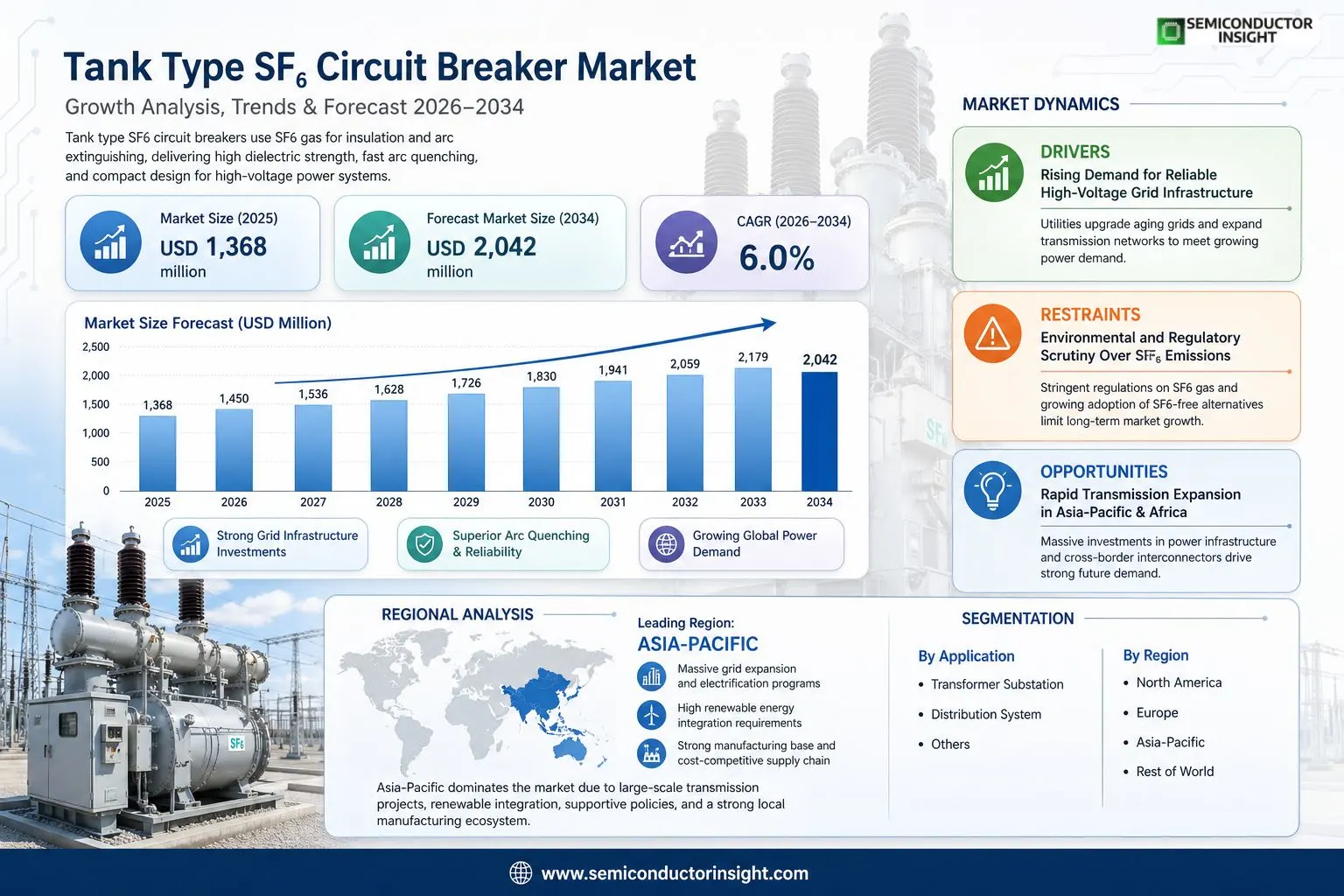
Global Tank Type SF6 Circuit Breaker market size was valued at USD 1,368 million in 2025. The market is projected to grow from USD 1,450 million in 2026 to USD 2,042 million by 2034, exhibiting a CAGR of 6.0% during the forecast period.
Tank type sulfur hexafluoride (SF6) circuit breakers are a specialized category of high-voltage switching equipment that utilize SF6 gas as both the insulation medium and the arc extinguishing medium. SF6 gas possesses exceptionally high dielectric strength, enabling significant reductions in the external dimensions and overall footprint of electrical equipment compared to conventional alternatives. Its arc extinguishing performance is particularly noteworthy , the dielectric insulation strength recovers after current zero crossing with a time constant approximately 100 times faster than air, giving tank type SF6 circuit breakers a commensurately superior arc extinguishing capability. Structurally, these breakers are classified into ceramic pillar type and tank type variants, while by operating mechanism they are divided into double pressure and single pressure designs. The double pressure configuration employs a low-pressure gas system of 200–300 kPa for internal insulation and a high-pressure system of approximately 1,400 kPa dedicated to arc extinguishing, delivering strong breaking capacity and rapid operation.
The market is supported by expanding power infrastructure investment globally, growing demand for reliable high-voltage grid protection, and the increasing deployment of transformer substations and distribution systems across emerging economies. Key manufacturers operating in Tank Type SF6 Circuit Breaker Market include GE Grid Solutions, Siemens, Hitachi, ABB, Mitsubishi Electric Corporation, CG Power and Industrial Solutions Limited, Fuji Electric, Toshiba, MEIDENSHA CORPORATION, and Rockwill, among others, collectively holding significant revenue share in Global competitive landscape.
MARKET DRIVERS
Rising Demand for Reliable High-Voltage Grid Infrastructure
Global tank type SF6 circuit breaker market is experiencing sustained growth driven by accelerating investments in high-voltage transmission infrastructure across emerging and developed economies. Utilities and grid operators are actively upgrading aging electrical networks to meet rising electricity consumption and improve grid reliability. Tank type SF6 circuit breakers, widely deployed at voltage levels ranging from 72.5 kV to 1,100 kV, play a critical role in protecting transmission lines and substation equipment from fault currents. Their robust enclosed design and superior arc-quenching properties make them the preferred choice for outdoor high-voltage substation applications where environmental exposure is a concern.
Expansion of Renewable Energy Integration and Grid Modernization Programs
Large-scale integration of renewable energy sources such as wind and solar power is generating significant demand for advanced switching equipment capable of managing variable load conditions and grid instability. Governments across Asia-Pacific, Europe, and North America are rolling out grid modernization programs that require the installation of reliable high-voltage switchgear, including tank type SF6 circuit breakers, to manage complex power flows. Countries such as China, India, and the United States are investing heavily in ultra-high-voltage and extra-high-voltage transmission corridors, which directly supports the deployment of tank type SF6 circuit breakers at key substations along these corridors.
➤ Grid modernization initiatives and renewable energy integration programs are collectively positioning tank type SF6 circuit breakers as indispensable components in next-generation high-voltage substations globally.
The superior dielectric and thermal properties of sulfur hexafluoride gas enable tank type SF6 circuit breakers to interrupt fault currents efficiently under extreme operating conditions. This technical advantage, combined with a compact footprint compared to air-blast alternatives, continues to drive their adoption in space-constrained urban and industrial substations. Ongoing investment in cross-border power interconnection projects across Southeast Asia, the Middle East, and Africa further reinforces the long-term demand trajectory for this equipment segment.
MARKET CHALLENGES
Environmental and Regulatory Scrutiny Over SF6 Gas Emissions
One of the most pressing challenges confronting Tank Type SF6 Circuit Breaker Market is the growing regulatory pressure associated with sulfur hexafluoride, a potent greenhouse gas with a global warming potential approximately 23,500 times that of carbon dioxide over a 100-year period. Regulatory authorities in the European Union have introduced increasingly stringent regulations governing the use, handling, and disposal of SF6 gas in electrical equipment. The European Commission’s F-Gas Regulation and subsequent revision proposals have placed SF6-based switchgear under heightened scrutiny, compelling manufacturers and utilities to evaluate alternative technologies. Compliance with evolving environmental standards introduces significant operational and capital expenditure burdens for utilities relying on existing tank type SF6 circuit breaker fleets.
Other Challenges
High Initial Capital and Maintenance Costs
Tank type SF6 circuit breakers involve considerable upfront capital expenditure due to the complexity of their enclosed pressurized designs, specialized gas handling systems, and the requirement for trained personnel during installation and maintenance. SF6 gas leak detection, periodic density monitoring, and gas recovery during servicing add recurring operational costs. For utilities in price-sensitive developing markets, these cost considerations can delay procurement decisions and slow market penetration despite the technical superiority of these devices.
Supply Chain Vulnerabilities and Long Lead Times
The manufacturing of tank type SF6 circuit breakers depends on specialized raw materials, precision-engineered components, and proprietary SF6 gas handling systems that are sourced from a limited number of qualified suppliers globally. Disruptions in global supply chains, as experienced during recent years, have resulted in extended lead times for critical components and project delivery delays. This challenge is particularly acute for large infrastructure projects with fixed commissioning timelines, where equipment delays can trigger contractual penalties and additional project costs.
MARKET RESTRAINTS
Emergence of SF6-Free and Eco-Efficient Alternative Technologies
A significant restraint on the long-term growth of Tank Type SF6 Circuit Breaker Market is the accelerating development and commercialization of SF6-free switchgear alternatives. Leading manufacturers have introduced high-voltage circuit breakers utilizing alternative insulating media such as clean air, vacuum interrupters, and fluoronitrile-based gas mixtures, which offer substantially lower global warming potential. As these alternatives achieve broader voltage range coverage and gain regulatory and utility acceptance, they present a credible substitution threat, particularly in European markets where environmental compliance mandates are most stringent. Utilities embarking on new substation projects are increasingly evaluating SF6-free options as part of long-term asset lifecycle planning.
Saturation in Mature Markets and Replacement Cycle Dynamics
In developed markets such as Western Europe, Japan, and North America, the transmission grid infrastructure is largely built out, and new greenfield substation projects represent a smaller share of overall market activity. The dominant demand driver in these regions is equipment replacement and refurbishment of aging installed bases, which follows extended lifecycle intervals of typically 25 to 40 years. This replacement-driven demand pattern results in a relatively stable but limited volume of procurement activity, constraining market growth rates compared to high-growth developing regions. Additionally, budget constraints faced by regulated utilities in mature markets can further defer capital investment in switchgear replacement programs.
MARKET OPPORTUNITIES
Rapid Electrification and Transmission Expansion in Asia-Pacific and Africa
The Asia-Pacific region, led by China, India, and Southeast Asian nations, represents the most dynamic growth frontier for Tank Type SF6 Circuit Breaker Market. Massive investments in ultra-high-voltage direct current and alternating current transmission networks, coupled with national electrification programs targeting rural and peri-urban populations, are generating substantial procurement volumes for high-voltage switchgear. China’s ongoing development of its national power grid and inter-regional transmission backbone continues to be a major demand driver for tank type SF6 circuit breakers at the highest voltage classes. Similarly, African nations are investing in regional power pool interconnection projects and new generation capacity additions that require robust high-voltage switching solutions.
Digitalization and Smart Substation Integration
The growing adoption of digital substation architectures presents a significant opportunity for manufacturers of tank type SF6 circuit breakers to differentiate their offerings through embedded smart monitoring and diagnostic capabilities. Integration of intelligent electronic devices, partial discharge sensors, SF6 gas density monitors, and condition-based maintenance systems directly within circuit breaker assemblies enables utilities to transition from time-based to predictive maintenance strategies, reducing total cost of ownership. Manufacturers investing in digital-ready tank type SF6 circuit breaker designs are well-positioned to capture premium market segments among utilities prioritizing operational efficiency and asset management optimization. This convergence of high-voltage switching technology with digital intelligence aligns with broader smart grid investment priorities globally.
Growth in Cross-Border Power Interconnection and HVDC Projects
The expansion of high-voltage direct current transmission projects and cross-border power interconnection initiatives across Europe, the Middle East, and Asia creates incremental demand for specialized tank type SF6 circuit breakers capable of operating under the unique electrical and environmental conditions associated with these projects. Converter stations, reactive power compensation installations, and long-distance overhead transmission corridors all require high-performance outdoor circuit breakers with proven reliability under demanding fault current interruption scenarios. As regional energy trading and grid integration accelerate, infrastructure development to support these power exchanges will continue to provide sustained procurement opportunities for tank type SF6 circuit breaker manufacturers and their distribution partners.
Tank Type SF6 Circuit Breaker Market Trends
Rising Demand for High-Voltage Grid Infrastructure Drives Tank Type SF6 Circuit Breaker Market
Tank Type SF6 Circuit Breaker Market is experiencing significant momentum as power utilities and grid operators worldwide prioritize the modernization and expansion of high-voltage transmission infrastructure. Tank type SF6 circuit breakers, which utilize sulfur hexafluoride gas both as an insulation medium and arc extinguishing medium, have gained considerable traction due to their compact footprint and superior dielectric recovery speed , approximately 100 times faster than air. This performance advantage makes them particularly well-suited for transformer substations and high-capacity distribution systems where reliability and rapid fault interruption are critical operational requirements. As countries in Asia, the Middle East, and North America accelerate grid expansion programs, demand for tank type SF6 circuit breakers across both single pressure and double pressure configurations continues to strengthen across utility and industrial segments.
Other Trends
Double Pressure Configuration Gaining Preference in High-Capacity Applications
Within Tank Type SF6 Circuit Breaker Market, the double pressure segment is witnessing growing adoption in ultra-high-voltage applications. Double pressure SF6 circuit breakers operate with a dual system , a low-pressure gas system in the range of 200–300 kPa for internal insulation, and a high-pressure arc extinguishing system at approximately 1400 kPa , delivering strong breaking capability and fast action speeds. While their more complex structure results in higher initial investment, grid operators managing large-scale transmission networks increasingly favor this configuration for its robust fault interruption performance. This trend is particularly visible in rapidly industrializing economies where new substation projects demand equipment capable of handling elevated fault current levels.
Competitive Consolidation Among Global Manufacturers
Tank Type SF6 Circuit Breaker Market is characterized by a moderately consolidated competitive landscape, with global players such as GE Grid Solutions, Siemens, ABB, Hitachi, Mitsubishi Electric Corporation, Fuji Electric, and Toshiba holding substantial combined revenue share. Regional manufacturers, including Henan Pinggao Electric, Sieyuan Electric, and CHINA XD ELECTRIC, are expanding their presence particularly in Asia-Pacific markets by offering cost-competitive solutions aligned with local grid standards. Strategic investments in product development, capacity expansion, and distribution partnerships are defining the competitive strategies of both multinational and domestic players in this space.
Expansion of Transformer Substations and Distribution Systems Sustains Long-Term Market Outlook
Application-wise, transformer substations represent a dominant end-use segment for Tank Type SF6 Circuit Breaker Market, driven by ongoing investments in grid reliability and load management infrastructure. Distribution system upgrades, particularly in emerging markets transitioning from aging switchgear technologies, are also contributing to sustained procurement activity. Manufacturers are aligning product portfolios to address the dual need for performance and environmental compliance, as regulatory discussions around SF6 emissions continue to shape long-term product development strategies across the industry. The combined effect of infrastructure investment cycles, urbanization, and industrial electrification is expected to support healthy demand continuity for tank type SF6 circuit breakers across major global regions through the forecast period.
COMPETITIVE LANDSCAPE
Key Industry Players
Global Tank Type SF6 Circuit Breaker Market – Competitive Dynamics and Leading Manufacturers
Global Tank Type SF6 Circuit Breaker market is characterized by a moderately consolidated competitive landscape, with a handful of multinational conglomerates commanding a substantial share of the market. Industry titans such as ABB, Siemens, GE Grid Solutions, Hitachi, and Mitsubishi Electric Corporation collectively accounted for the majority of global revenue in 2025, leveraging their advanced R&D capabilities, extensive distribution networks, and established relationships with utility operators and grid infrastructure developers worldwide. These leading players continue to invest heavily in product innovation , particularly in high-voltage, high-performance tank-type configurations , as grid modernization initiatives and the expansion of transformer substations and distribution systems across North America, Europe, and Asia drive sustained demand. The market was valued at approximately USD 1,368 million in 2025 and is projected to reach USD 2,042 million by 2034, reflecting a steady CAGR of 6.0%, underscoring the competitive imperative for both incumbents and challengers to scale operations and strengthen technological differentiation.
Beyond Global tier-one players, a growing cohort of regional and niche manufacturers is intensifying competition, particularly across Asia-Pacific markets. Chinese manufacturers such as Henan Pinggao Electric, Sieyuan Electric, Changgao Electric International, and CHINA XD ELECTRIC have emerged as formidable participants, capitalizing on cost-competitive manufacturing, domestic grid expansion programs, and increasing export activity. Companies like CG Power and Industrial Solutions Limited, Fuji Electric, Toshiba, and MEIDENSHA CORPORATION occupy significant mid-tier positions, offering specialized product portfolios across single-pressure and double-pressure SF6 circuit breaker configurations tailored to transformer substation and distribution system applications. Smaller players including Rockwill, Boerstn Electric, and MVT continue to carve out targeted market niches by addressing specific regional requirements and offering competitive pricing, further intensifying the overall competitive environment across all geographic segments.
List of Key Tank Type SF6 Circuit Breaker Companies Profiled
- GE Grid Solutions
- Siemens
- Hitachi
- ABB
- Mitsubishi Electric Corporation
- CG Power and Industrial Solutions Limited
- Fuji Electric
- Toshiba
- MEIDENSHA CORPORATION
- Rockwill
- Boerstn Electric
- MVT
- Henan Pinggao Electric
- Sieyuan Electric
- Changgao Electric International
- CHINA XD ELECTRIC
Segment Analysis:
| Segment Category | Sub-Segments | Key Insights |
| By Type |
|
Double Pressure SF6 circuit breakers represent the leading segment within Tank Type SF6 Circuit Breaker Market, owing to their superior arc extinguishing capability and robust breaking performance.
|
| By Application |
|
Transformer Substation is the dominant application segment for Tank Type SF6 Circuit Breakers, driven by the critical need for high-performance switching and fault protection in power transmission networks.
|
| By End User |
|
Electric Utilities & Power Generation Companies constitute the primary end user base for Tank Type SF6 Circuit Breakers, as they are responsible for operating and maintaining the high-voltage transmission and distribution infrastructure where these devices are most extensively deployed.
|
| By Voltage Rating |
|
Extra High Voltage (above 245 kV) is the leading voltage rating segment for Tank Type SF6 Circuit Breakers, as the unique insulating and arc extinguishing properties of SF6 gas make it the preferred technology for applications in this demanding voltage range.
|
| By Installation Type |
|
New Installation represents the dominant installation type segment, fueled by large-scale greenfield transmission and substation development projects across rapidly industrializing economies and regions with underserved electricity access.
|
Regional Analysis: Tank Type SF6 Circuit Breaker Market
Asia-Pacific
Asia-Pacific governments are channeling significant capital into upgrading aging transmission infrastructure and building new high-voltage corridors. The demand for tank type SF6 circuit breakers is directly tied to these grid expansion projects, where reliable fault interruption and long operational lifespan are non-negotiable requirements for transmission system operators across the region.
The rapid scaling of solar and wind energy capacity across Asia-Pacific necessitates robust switching and protection equipment. Tank type SF6 circuit breakers play a critical role in ensuring grid stability as intermittent renewable sources are integrated at high-voltage substations, making them an essential component of the region’s clean energy transition strategy.
Asia-Pacific hosts a well-developed manufacturing base for high-voltage switchgear, including tank type SF6 circuit breakers. Local producers benefit from cost-efficient supply chains, government-backed industrial policies, and strong technical expertise, enabling them to competitively serve both domestic demand and export markets across emerging economies globally.
While regulatory scrutiny around SF6 emissions is gaining momentum globally, Asia-Pacific markets are advancing adoption of best-practice gas management protocols. Utilities in the region are investing in SF6 recovery and recycling infrastructure, ensuring continued regulatory compliance while maintaining the operational benefits of tank type SF6 circuit breakers in critical grid applications.
North America
North America represents a mature yet consistently active market for tank type SF6 circuit breakers, underpinned by the ongoing need to replace aging high-voltage infrastructure across the United States and Canada. The region’s power grid, much of which was constructed decades ago, is undergoing a phased modernization effort that prioritizes reliability, resilience, and integration of distributed energy resources. Utility-scale renewable energy projects, particularly wind farms in the central and western United States, require robust substation protection solutions that tank type SF6 circuit breakers reliably deliver. Regulatory frameworks set by federal and state-level energy authorities continue to shape procurement decisions, encouraging utilities to adopt equipment with extended service intervals and proven performance records. Canada’s expanding hydroelectric and clean energy infrastructure further contributes to sustained regional demand. Environmental regulations surrounding SF6 gas handling are among the most stringent globally in this region, prompting utilities to adopt advanced gas management practices alongside their equipment investments in Tank Type SF6 Circuit Breaker Market.
Europe
Europe occupies a pivotal position in Tank Type SF6 Circuit Breaker Market, characterized by a unique tension between continued operational reliance on SF6-based equipment and a robust regulatory push toward alternative insulation technologies. The European Union’s F-Gas Regulation and evolving restrictions on SF6 usage in new electrical equipment are reshaping procurement strategies, yet existing installed base maintenance and refurbishment activities sustain near-term demand. Countries such as Germany, France, the United Kingdom, and Scandinavia are actively investing in grid upgrades to accommodate cross-border energy trading and offshore wind integration. European utilities and transmission system operators maintain high standards for equipment reliability and safety, ensuring that tank type SF6 circuit breakers with proven performance credentials retain a competitive position. The region also serves as a global technology development hub, with leading switchgear manufacturers headquartered here actively exploring SF6-free alternatives, a trend that will gradually influence the long-term trajectory of Tank Type SF6 Circuit Breaker Market across Europe.
South America
South America presents a steadily growing opportunity within Global tank type SF6 circuit breaker market, driven by infrastructure development needs and expanding energy access programs across the continent. Brazil, the region’s largest economy, leads demand through its extensive transmission network expansion and hydroelectric power development programs that require high-performance switching solutions. Chile, Colombia, and Peru are investing in grid infrastructure to support mining sector power demands and emerging renewable energy projects, particularly large-scale solar installations in high-irradiance regions. The region’s relatively nascent industrial base for high-voltage switchgear means that tank type SF6 circuit breakers are predominantly sourced through imports from established global manufacturers, making competitive pricing and after-sales service capabilities key differentiators. Improving economic stability in select markets and multilateral development bank financing for energy infrastructure are expected to gradually unlock broader deployment of tank type SF6 circuit breakers across South American utility networks throughout the forecast period.
Middle East & Africa
The Middle East and Africa region is emerging as a notable growth frontier in Global tank type SF6 circuit breaker market, supported by ambitious energy infrastructure projects and expanding electrification programs across both sub-regions. Gulf Cooperation Council countries, including Saudi Arabia and the UAE, are channeling substantial investment into grid expansion, smart city development, and large-scale renewable energy projects such as solar mega-farms that require reliable high-voltage protection equipment. Africa’s growing urbanization and industrialization are generating sustained demand for grid infrastructure investment, with the continent’s vast unelectrified population representing a long-term driver for utility asset deployment, including tank type SF6 circuit breakers. South Africa remains the continent’s most developed market for high-voltage switchgear, while East and West African nations are attracting international development financing for transmission infrastructure. The region’s market growth will be closely linked to improving investment climates, energy policy reforms, and the pace of international development aid channeled into power sector modernization.
Report Scope
This market research report provides a comprehensive analysis of Tank Type SF6 Circuit Breaker Market, covering the forecast period 2026–2034. It offers detailed insights into market dynamics, technological advancements, competitive landscape, and key trends shaping the industry.
Key focus areas of the report include:
- Market Overview: The report begins with an overview outlining its current market scenario, key growth indicators, and industry transformation drivers. It discusses macroeconomic factors, demand–supply balance, regulatory landscape, and the strategic role of Tank Type SF6 Circuit Breakers in powering advancements across industries such as energy transmission, transformer substations, distribution systems, and industrial automation.
- Market Size & Forecast: Historical data and future projections for revenue, unit shipments, and market value across major regions and segments.
- Segmentation Analysis: Detailed breakdown by product type (Double Pressure, Single Pressure), application (Transformer Substation, Distribution System, Others), and end-user industry to identify high-growth segments and investment opportunities.
- Regional Insights: Insights into market performance across North America, Europe, Asia-Pacific, Latin America, and the Middle East & Africa, including country-level analysis where relevant.
- Competitive Landscape: Profiles of leading market participants, including their product offerings, R&D focus, manufacturing capacity, pricing strategies, and recent developments such as mergers, acquisitions, and partnerships.
- Technology Trends & Innovation: Assessment of emerging technologies, integration of AI/IoT, SF6 circuit breaker design trends, arc extinguishing advancements, and evolving industry standards.
- Market Drivers & Restraints: Evaluation of factors driving market growth along with challenges, supply chain constraints, regulatory issues, and market-entry barriers.
- Stakeholder Insights: Insights for component suppliers, OEMs, system integrators, investors, and policymakers regarding the evolving ecosystem and strategic opportunities.
Primary and secondary research methods are employed, including interviews with industry experts, data from verified sources, and real-time market intelligence to ensure the accuracy and reliability of the insights presented.
FREQUENTLY ASKED QUESTIONS:
What is the current market size of Tank Type SF6 Circuit Breaker Market?
-> Global Tank Type SF6 Circuit Breaker Market was valued at USD 1368 million in 2025 and is expected to reach USD 2042 million by 2034, growing at a CAGR of 6.0% during the forecast period.
Which key companies operate in Tank Type SF6 Circuit Breaker Market?
-> Key players include GE Grid Solutions, Siemens, Hitachi, ABB, Mitsubishi Electric Corporation, CG Power and Industrial Solutions Limited, Fuji Electric, Toshiba, MEIDENSHA CORPORATION, Rockwill, Boerstn Electric, MVT, Henan Pinggao Electric, Sieyuan Electric, Changgao Electric International, and CHINA XD ELECTRIC, among others.
What are the key growth drivers?
-> Key growth drivers include rising demand for high-voltage electrical infrastructure, expansion of transformer substations and distribution systems, superior arc extinguishing performance of SF6 gas, growing urbanization, and increasing investment in power grid modernization globally.
Which region dominates the market?
-> Asia is among the fastest-growing regions driven by rapid industrialization in China, Japan, South Korea, Southeast Asia, and India, while North America and Europe remain significant markets with established power infrastructure.
What are the emerging trends?
-> Emerging trends include adoption of single-pressure SF6 circuit breaker designs for simplified maintenance, increasing deployment in transformer substations, advances in dielectric recovery technology, and growing focus on compact high-voltage equipment for space-constrained installations.

Get Sample Report PDF for Exclusive Insights
Report Sample Includes
- Table of Contents
- List of Tables & Figures
- Charts, Research Methodology, and more...
 Download Sample Report PDF