MARKET INSIGHTS
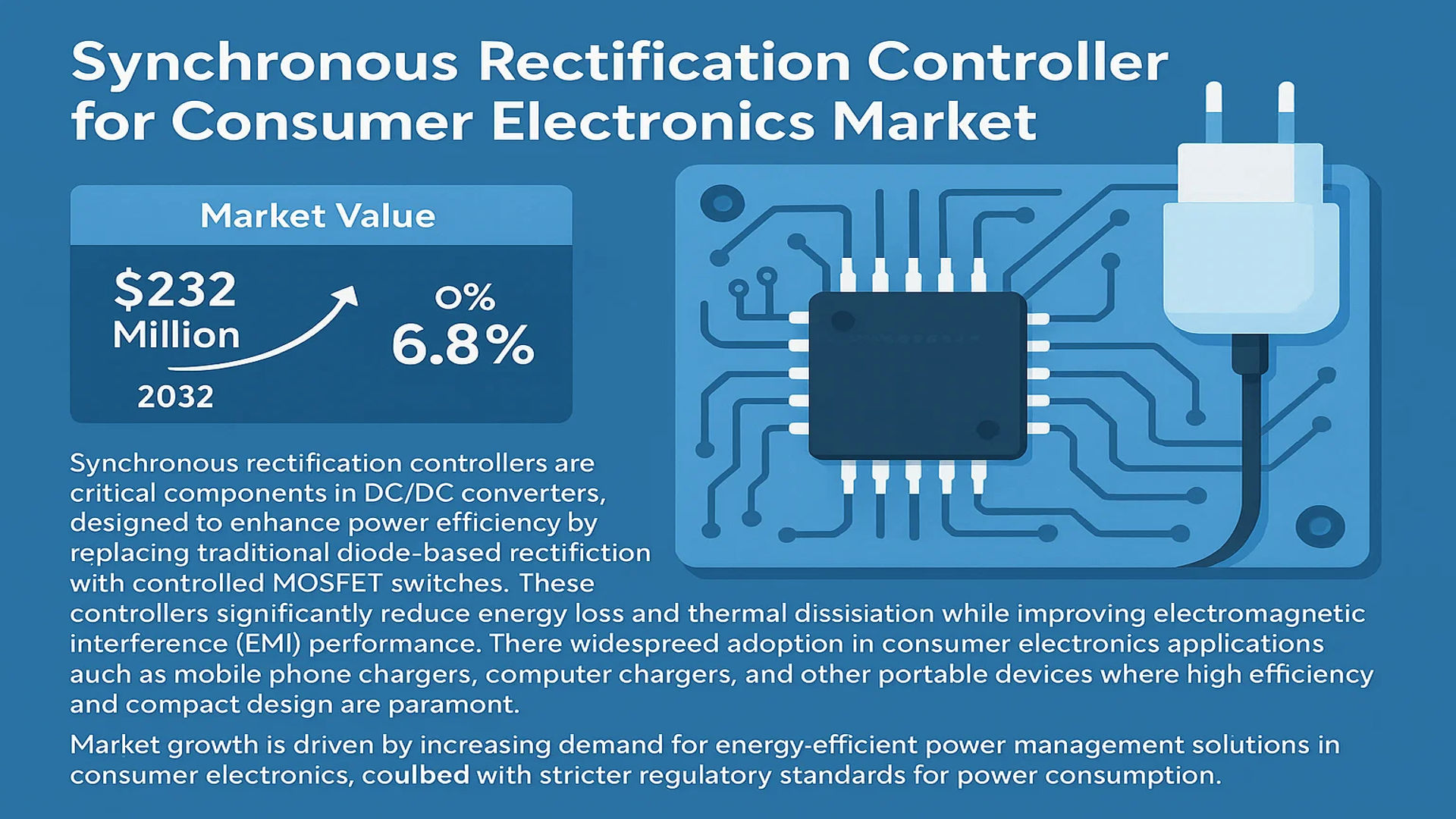
The global Synchronous Rectification Controller for Consumer Electronics Market was valued at 232 million in 2024 and is projected to reach US$ 368 million by 2032, at a CAGR of 6.8% during the forecast period.
Synchronous rectification controllers are critical components in DC/DC converters, designed to enhance power efficiency by replacing traditional diode-based rectification with controlled MOSFET switches. These controllers significantly reduce energy loss and thermal dissipation while improving electromagnetic interference (EMI) performance. They are widely adopted in consumer electronics applications such as mobile phone chargers, computer chargers, and other portable devices where high efficiency and compact design are paramount.
The market growth is driven by increasing demand for energy-efficient power management solutions in consumer electronics, coupled with stricter regulatory standards for power consumption. Key players like Texas Instruments, STMicroelectronics, and Infineon are actively developing advanced controller ICs with higher switching frequencies and lower standby power consumption. The Asia-Pacific region, particularly China, dominates production and consumption due to its concentrated electronics manufacturing ecosystem.
MARKET DYNAMICS
MARKET DRIVERS
Growing Demand for Energy-Efficient Power Solutions in Consumer Electronics
The global push for energy efficiency in consumer electronics is significantly driving the adoption of synchronous rectification controllers. With consumer electronics accounting for approximately 15-20% of household electricity consumption globally, manufacturers are under increasing pressure to develop more efficient power management solutions. These controllers improve power conversion efficiency by 5-10% compared to traditional diode-based rectifiers, directly translating to longer battery life and reduced energy waste. The proliferation of fast-charging technologies in smartphones and laptops, which require highly efficient power delivery, has made synchronous rectification controllers indispensable in modern charging adapters and power banks.
Expansion of 5G Infrastructure and Smart Home Devices
The rapid deployment of 5G networks and smart home ecosystems is creating substantial demand for advanced power management ICs. Synchronous rectification controllers are critical components in power supplies for 5G small cell equipment, which require high-efficiency DC/DC conversion to minimize heat dissipation in compact enclosures. Similarly, the global smart home market, projected to grow at 12% CAGR through 2030, relies on these controllers for efficient power delivery in always-on IoT devices. This dual demand from telecommunications infrastructure and consumer IoT applications is accelerating market growth for synchronous rectification solutions.
Regulatory Pressure for Improved Power Conversion Standards
Stringent energy efficiency regulations worldwide are compelling consumer electronics manufacturers to adopt advanced power management technologies. Standards such as the EU’s Ecodesign Directive and the U.S. Department of Energy’s efficiency requirements for external power supplies now mandate significantly higher conversion efficiencies, particularly in no-load and light-load conditions. Synchronous rectification controllers excel in these scenarios, offering efficiency improvements of up to 3-5% at light loads compared to conventional solutions. This regulatory landscape is forcing widespread industry adoption, with non-compliant products facing potential market restrictions and penalty fees.
MARKET RESTRAINTS
Design Complexity and Integration Challenges in Compact Devices
While offering superior efficiency, synchronous rectification controllers introduce significant design complexities that hinder adoption in space-constrained consumer electronics. The need for precise MOSFET gate driving circuitry and tight loop control adds component count and PCB area requirements, often conflicting with the industry’s relentless pursuit of miniaturization. Many smartphone charger designs struggle to accommodate the additional circuitry within the tight thermal and spatial constraints of ultra-compact power adapters. This challenge is particularly acute in the Below 10V segment, where component density reaches its maximum for given power levels.
Supply Chain Disruptions Affecting Semiconductor Availability
The synchronous rectification controller market faces persistent challenges from the semiconductor supply chain’s fragility. While the worst of the global chip shortage has eased, lead times for power management ICs remain extended by 18-24 weeks across the industry. Automotive and industrial applications continue to receive allocation priority, leaving consumer electronics manufacturers struggling to secure sufficient quantities of advanced synchronous rectification controllers. This supply-demand imbalance creates pricing volatility and forces some manufacturers to postpone efficiency upgrades or use less optimal technical solutions.
MARKET CHALLENGES
Thermal Management in High-Density Power Conversion
Thermal performance remains a critical challenge for synchronous rectification controllers in consumer electronics applications. The push for higher power density in chargers and adapters creates thermal bottlenecks, as the MOSFETs in synchronous rectifiers generate significant heat during switching transitions. Without careful thermal design, the efficiency benefits of synchronous rectification can be negated by thermal derating or reliability issues. This challenge intensifies with the adoption of gallium nitride (GaN) power devices, which operate at higher frequencies and demand even more sophisticated thermal management solutions from the controller ICs.
Other Challenges
EMI/EMC Compliance Issues
The high-frequency switching inherent in synchronous rectification systems generates electromagnetic interference that must be carefully managed to meet global regulatory standards. Design teams often struggle to balance efficiency optimization with EMI suppression, particularly in cost-sensitive consumer products where extensive filtering components are economically impractical.
Software Control Complexity
Advanced digital control algorithms offer performance benefits but require specialized engineering expertise that many consumer electronics manufacturers lack. The learning curve for implementing and debugging these sophisticated control schemes represents a significant barrier to adoption in mid-tier electronics firms.
MARKET OPPORTUNITIES
Emerging Demand for USB Power Delivery 3.1 and GaN-Based Systems
The adoption of USB PD 3.1 specification, which supports up to 240W power delivery, creates substantial opportunities for advanced synchronous rectification controllers. These high-power applications require exceptionally efficient power conversion architectures to manage thermal loads, positioning synchronous rectification as an essential enabling technology. Similarly, the growing penetration of GaN power devices in consumer chargers demands controller ICs specifically optimized for wide-bandgap semiconductor characteristics. Controller manufacturers developing GaN-specific solutions are capturing premium market segments with higher margins.
Integration of AI for Adaptive Power Management
Emerging opportunities exist in the integration of machine learning algorithms into synchronous rectification controllers to enable real-time optimization of power conversion parameters. These intelligent systems can dynamically adjust switching frequencies, dead times, and control loop parameters based on load conditions, input voltage fluctuations, and thermal status. Such adaptive control can push conversion efficiencies above 95% across the entire load range while automatically compensating for component aging and manufacturing variations. Early implementations in premium computing and mobile devices demonstrate the technology’s potential for broader market adoption.
SYNCHRONOUS RECTIFICATION CONTROLLER FOR CONSUMER ELECTRONICS MARKET TRENDS
Rising Demand for Energy-Efficient Power Conversion Solutions Drives Market Growth
The global synchronous rectification controller market for consumer electronics is experiencing robust growth, driven primarily by increasing demand for energy-efficient power conversion solutions. These controllers play a critical role in minimizing power losses, improving thermal performance, and enhancing overall system efficiency in applications such as smartphone chargers, laptop adapters, and other portable electronic devices. The market’s expansion is further supported by stringent energy efficiency regulations and growing consumer awareness about sustainable power consumption. With the global market projected to reach US$ 368 million by 2032 at a CAGR of 6.8%, manufacturers are focusing on developing advanced control ICs with higher integration and smarter power management capabilities.
Other Trends
Miniaturization and High-Power Density Requirements
The relentless push for smaller and more powerful consumer electronics is accelerating demand for synchronous rectification controllers that support high-power density designs. With modern smartphones requiring fast-charging capabilities up to 120W and beyond, power converter designs must deliver more power in significantly smaller form factors. This trend is prompting innovation in controller packaging technologies, with many manufacturers adopting advanced Wafer-Level Chip Scale Packaging (WLCSP) to reduce footprint while improving thermal dissipation. The segment of controllers supporting below 10V applications is showing particularly strong growth potential due to its widespread use in mobile device power adapters.
Asia-Pacific Emerges as Manufacturing and Consumption Hub
The Asia-Pacific region, led by China, has become both the primary manufacturing center and fastest-growing consumption market for synchronous rectification controllers in consumer electronics. China’s market alone is projected to reach a significant valuation by 2032, supported by its dominant position in smartphone and portable electronics production. Major OEMs and ODMs in the region are increasingly adopting these controllers to meet global efficiency standards while maintaining cost competitiveness. The region’s strong semiconductor ecosystem, combined with government incentives for energy-efficient technology adoption, is creating favorable conditions for market expansion, with localization of controller production becoming a key strategy for global players.
COMPETITIVE LANDSCAPE
Key Industry Players
Semiconductor Giants and Emerging Players Vie for Market Dominance
The global synchronous rectification controller market for consumer electronics features a diverse competitive landscape, with established semiconductor leaders competing alongside specialized regional players. Texas Instruments and Infineon Technologies currently dominate the market, accounting for a combined 28% revenue share in 2024. Their leadership stems from decades of power management expertise and broad product portfolios spanning multiple voltage ranges.
While these large players maintain strong positions, Asian manufacturers like Richtek and Hangzhou Silan Microelectronics are gaining traction through cost-competitive solutions tailored for mass-market consumer applications. Their growth reflects the increasing demand for affordable power management ICs in smartphone and wearable device chargers across emerging markets.
The market also features specialized players like ABLIC, which focuses on ultra-low-power solutions for compact consumer electronics, and ROHM Semiconductor, known for its high-efficiency designs. These companies differentiate through technological specialization and application-specific optimizations rather than competing on price alone.
Strategic partnerships between controller manufacturers and MOSFET suppliers have become a key competitive strategy, as synchronous rectification performance depends heavily on switch characteristics. Recent alliances like the collaboration between STMicroelectronics and Onsemi have yielded integrated solutions that simplify charger designs while improving efficiency.
List of Key Synchronous Rectification Controller Manufacturers
- Texas Instruments (U.S.)
- Infineon Technologies (Germany)
- STMicroelectronics (Switzerland)
- Renesas Electronics (Japan)
- NXP Semiconductors (Netherlands)
- Diodes Incorporated (U.S.)
- Onsemi (U.S.)
- ROHM Semiconductor (Japan)
- ABLIC (Japan)
- Richtek (Taiwan)
- Hangzhou Silan Microelectronics (China)
- Nisshinbo Micro Devices (Japan)
Segment Analysis:
By Type
Minimum Voltage: Below 10 V Segment Dominates Due to High Demand in Low-Power Devices
The market is segmented based on type into:
- Minimum Voltage: Below 10 V
- Minimum Voltage: Above or Equal to 10 V
By Application
Mobile Phone Charger Segment Leads Owing to Rising Smartphone Adoption
The market is segmented based on application into:
- Mobile Phone Charger
- Computer Charger
- Other
Regional Analysis: Synchronous Rectification Controller for Consumer Electronics Market
Asia-Pacific
The Asia-Pacific region dominates the global synchronous rectification controller market, driven by China’s massive consumer electronics manufacturing sector and increasing adoption of energy-efficient power solutions. Major OEMs and ODMs in countries like China, Japan, and South Korea are integrating these controllers into chargers and power adapters to meet stricter energy efficiency standards. The Chinese government’s push for greener technologies and Japan’s advanced semiconductor ecosystem have positioned this region as both the largest producer and consumer of synchronous rectification ICs. While cost competition remains intense, local manufacturers are rapidly catching up technologically with global players.
North America
North America represents a high-value market where premium efficiency and compact form factors drive synchronous rectification adoption, particularly in computer chargers and smart device accessories. The U.S. Department of Energy’s efficiency regulations and California’s stringent energy standards have accelerated the replacement of traditional diode-rectification solutions. The presence of major semiconductor companies like Texas Instruments and Onsemi fosters innovation, though higher component costs somewhat limit penetration in price-sensitive consumer segments. The market shows strong growth in USB-PD compliant solutions catering to next-generation mobile devices.
Europe
European manufacturers prioritize synchronous rectification controllers that comply with the EU’s Ecodesign Directive and Energy-related Products (ErP) regulations. German and French automotive-electronics suppliers are increasingly adopting these ICs for in-vehicle charging systems, creating crossover demand from the consumer segment. While the market grows steadily, relatively lower consumer electronics production within Europe creates greater dependence on imports of finished power adapters containing these controllers. Sustainability-focused design approaches are reshaping product development priorities across the region.
South America
The South American market remains in growth phase, with Brazil constituting the largest regional consumer of synchronous rectification controllers for smartphone and laptop chargers. However, economic instability and preference for low-cost alternatives continue to limit market expansion. Local assembly of consumer electronics using imported components is gradually increasing, with multinational brands driving quality improvements. The lack of regional semiconductor fabrication necessitates complete reliance on foreign-sourced controller ICs, creating supply chain vulnerabilities during global component shortages.
Middle East & Africa
This emerging market shows promising growth potential as smartphone penetration increases across the region’s developing economies. The UAE and Saudi Arabia serve as distribution hubs for consumer electronics incorporating synchronous rectification technology, while local manufacturing remains minimal. Price sensitivity limits adoption of advanced power management solutions, with many consumers prioritizing basic functionality over energy efficiency. Infrastructure challenges, including inconsistent power quality, create unique design requirements for power conversion components used in this region.
Report Scope
This market research report provides a comprehensive analysis of the Global Synchronous Rectification Controller for Consumer Electronics Market, covering the forecast period 2024–2032. It offers detailed insights into market dynamics, technological advancements, competitive landscape, and key trends shaping the industry.
Key focus areas of the report include:
- Market Size & Forecast: Historical data and future projections for revenue, unit shipments, and market value across major regions and segments. The market was valued at USD 232 million in 2024 and is projected to reach USD 368 million by 2032, growing at a CAGR of 6.8%.
- Segmentation Analysis: Detailed breakdown by product type (Minimum Voltage: Below 10 V and Above or Equal to 10 V), application (Mobile Phone Charger, Computer Charger, Others), and end-user industry to identify high-growth segments and investment opportunities.
- Regional Outlook: Insights into market performance across North America, Europe, Asia-Pacific, Latin America, and the Middle East & Africa, including country-level analysis. The U.S. and China are key markets driving growth.
- Competitive Landscape: Profiles of leading market participants, including their product offerings, R&D focus, manufacturing capacity, pricing strategies, and recent developments such as mergers, acquisitions, and partnerships.
- Technology Trends & Innovation: Assessment of emerging technologies, integration of AI/IoT, semiconductor design trends, fabrication techniques, and evolving industry standards.
- Market Drivers & Restraints: Evaluation of factors driving market growth, such as increasing demand for energy-efficient solutions, along with challenges like supply chain constraints and regulatory issues.
- Stakeholder Analysis: Insights for component suppliers, OEMs, system integrators, investors, and policymakers regarding the evolving ecosystem and strategic opportunities.
Primary and secondary research methods are employed, including interviews with industry experts, data from verified sources, and real-time market intelligence to ensure the accuracy and reliability of the insights presented.
FREQUENTLY ASKED QUESTIONS:
What is the current market size of Global Synchronous Rectification Controller for Consumer Electronics Market?
->Synchronous Rectification Controller for Consumer Electronics Market was valued at 232 million in 2024 and is projected to reach US$ 368 million by 2032, at a CAGR of 6.8% during the forecast period.
Which key companies operate in Global Synchronous Rectification Controller for Consumer Electronics Market?
-> Key players include STMicroelectronics, Renesas, Diodes, Infineon, Onsemi, Texas Instruments, NXP, Nexperia, ABLIC, and ROHM, among others.
What are the key growth drivers?
-> Key growth drivers include rising demand for energy-efficient power solutions, increasing adoption of consumer electronics, and advancements in semiconductor technology.
Which region dominates the market?
-> Asia-Pacific is the fastest-growing region, driven by China and Japan, while North America remains a key market due to technological advancements.
What are the emerging trends?
-> Emerging trends include miniaturization of components, integration with IoT devices, and development of ultra-low-power solutions.

Get Sample Report PDF for Exclusive Insights
Report Sample Includes
- Table of Contents
- List of Tables & Figures
- Charts, Research Methodology, and more...