Switched Capacitor Converter Market Insights
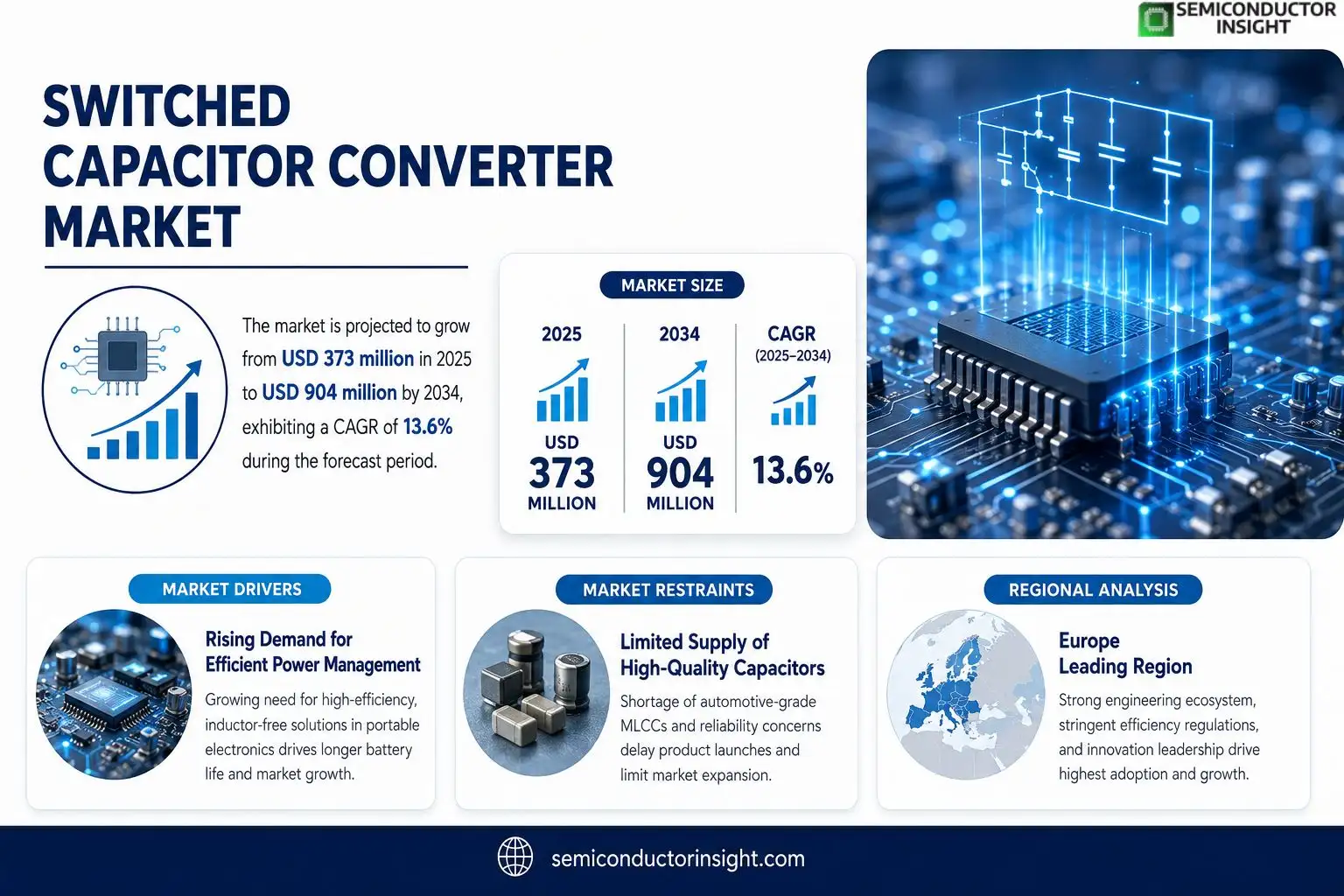
Switched Capacitor Converter market size was valued at USD 373 million in 2025. The market is projected to grow from USD 373 million in 2025 to USD 904 million by 2034, exhibiting a CAGR of 13.6% during the forecast period.
Switched capacitor converters are integrated power‑management devices that achieve voltage conversion through periodic charging and discharging of capacitors and reconfiguration of switch arrays. Their core feature is the ability to perform boost, buck, or voltage‑multiplication functions without relying on inductors. They provide advantages such as small size, low EMI, and easy integration into SoCs and PMICs, making them suitable for low‑to‑medium power, high‑integration, and space‑constrained applications.The market is expanding because thinner consumer electronics demand inductor‑free solutions while platform‑level PMIC integration raises usage per unit. Recent industry activity shows manufacturers developing hybrid modules that combine switched‑capacitor topologies with Buck or LDO regulators for smartphones, wearables, TWS earphones, IoT modules, medical electronics and emerging automotive low‑voltage systems.
MARKET DRIVERS
Rising Demand for Efficient Power Management
Switched Capacitor Converter Market is buoyed by manufacturers seeking to cut losses in low‑voltage domains. As silicon‑based regulators approach their efficiency ceiling, designers are turning to charge‑transfer architectures that can deliver conversion efficiencies above 95 % in compact footprints. This shift enables longer battery life for portable electronics, which directly feeds revenue expansion.
Integration with Emerging IoT Devices
IoT nodes proliferate in smart‑city deployments, and each node typically operates on a few volts. The ability of switched‑capacitor converters to operate without magnetic components simplifies board layouts and reduces bill‑of‑materials costs. Consequently, OEMs are allocating up to 12 % of new product development budgets to these topologies.
➤ “Designers value the reduction in EMI and the scalability of charge‑pump modules, which translates into faster time‑to‑market for edge devices.”
Beyond immediate efficiency gains, the modular nature of charge‑pump cells supports tiered voltage scaling, allowing manufacturers to future‑proof designs against evolving performance specifications.
MARKET CHALLENGES
Thermal Management in High‑Current Applications
When converters are pushed beyond 2 A, the internal capacitive switches generate heat that can degrade dielectric life. Companies lacking robust thermal‑analysis tools often experience early field failures, eroding customer confidence.
Other Challenges
Manufacturing Yield Variability
The precision required for matching capacitor arrays leads to yield gaps that inflate unit costs, especially for low‑volume specialty devices.
MARKET RESTRAINTS
Limited Supply of High‑Quality Capacitors
The shortage of automotive‑grade MLCCs constrains the ability of converters to meet strict reliability standards. OEMs are forced to qualify secondary suppliers, a process that can add six to eight weeks to product launch timelines.
Regulatory Hurdles in Power‑Sensitive Sectors
Medical‑device regulators demand exhaustive validation of charge‑pump behavior under fault conditions. The extensive documentation requirement raises certification costs, discouraging small firms from entering the niche.
MARKET OPPORTUNITIES
Adoption in Renewable‑Energy Interfaces
Solar‑panel micro‑inverters benefit from the low‑loss, transformer‑free conversion that switched‑capacitor topologies provide. Early pilots indicate a potential 8 % increase in overall system efficiency, making the technology attractive for utility‑scale deployments.
Customizable IP Blocks for ASIC Integration
Foundries are now offering IP cores that embed charge‑pump functionality directly into silicon. This reduces board‑level component count and positions Switched Capacitor Converter Market for a surge in ASIC‑centric applications such as wearables and autonomous sensors.Investors monitoring the sector should note that strategic partnerships between capacitor manufacturers and silicon designers are likely to lower entry barriers, unlocking growth in both consumer and industrial segments.
Switched Capacitor Converter Market Trends
Integration Elevates Switched Capacitor Converter Market
The surge in ultra‑thin handhelds and wearable platforms is forcing system designers to abandon conventional inductive stages. Because a switched‑capacitor architecture eliminates the bulky magnetic component, manufacturers can meet the aggressive size and weight targets that dominate the smartphone, TWS earphone, and edge‑IoT segments. In 2025, 480 million units were shipped at an average selling price of $0.85, and the sector sustained a gross margin close to 45 percent, underscoring the commercial viability of the approach. The transition from a niche supplement to a core power‑management block is reinforced by the ability to embed the converter directly into SoCs or PMICs, streamlining board layout and reducing EMI concerns. As platform‑level integration deepens, design teams increasingly view the switched‑capacitor solution as the default choice for low‑to‑medium power paths, rather than a contingency option.
Other Trends
Supply‑Chain Realignment
Upstream, silicon wafers and advanced packaging dominate material consumption, reflecting the need for high‑density switch arrays and reliable dielectric stacks. The dominance of these inputs shapes cost structures and creates a barrier to entry for newcomers lacking dedicated process lines. Downstream, demand is anchored in consumer electronics, but IoT modules, medical wearables, and select automotive low‑voltage systems are expanding the addressable base. The current capacity of roughly 620 million units exceeds shipment volumes, providing manufacturers with headroom to accommodate spikes in demand triggered by new product cycles or regional rollout of 5G‑enabled wearables.
Hybrid Architectures Boost Efficiency
Recent advances in multi‑phase, multi‑rate adaptive switching, combined with the integration of buck regulators and low‑dropout (LDO) stages, are narrowing the efficiency gap that once limited switched‑capacitor use at higher power levels. By dynamically selecting the optimal charge‑transfer pattern, these hybrid modules achieve efficiency curves comparable to traditional inductive converters while preserving the size advantage. This technical evolution opens pathways into automotive‑grade power domains and industrial‑grade edge computing devices, where reliability and thermal performance are paramount. Companies that master the co‑design of control algorithms and process technology can secure a differentiated portfolio, translating technical superiority into higher market share across both established consumer segments and emerging high‑reliability applications.
COMPETITIVE LANDSCAPEKey Industry Players
Competitive Overview of Switched Capacitor Converter Market
Texas Instruments remains the anchor of the switched‑capacitor converter arena, leveraging its extensive analog portfolio and deep silicon‑process expertise to deliver highly integrated power‑management modules that embed boost, buck and voltage‑multiplication functions. By coupling proprietary control algorithms with advanced MOS‑switch arrays, the company commands a sizable share of the $373 million market recorded in 2025 and shapes the supply chain for smartphones, wearables and emerging IoT devices. The market structure reflects a dual tier: a handful of vertically integrated giants that dominate wafer‑fab and packaging capacity, and a broader set of specialists that concentrate on niche topologies or customized solutions for automotive‑grade and medical‑grade segments. This bifurcation creates high entry barriers for newcomers while offering opportunities for established firms to expand into hybrid Buck‑LDO modules that address the growing demand for ultra‑thin power blocks.Beyond the dominant players, a constellation of focused firms enriches the competitive fabric. Murata Manufacturing and Microchip Technology exploit their strong presence in consumer‑electronics OEMs, delivering low‑EMI converter blocks that dovetail with compact PCBs. Infineon and Analog Devices emphasize robustness for automotive low‑voltage systems, employing multi‑phase adaptive switching to improve efficiency across the 2 W‑20 W band. SG Micro, NXP Semiconductors and Monolithic Power Systems target high‑volume wearable and TWS earphone markets, where size‑to‑performance ratios are decisive. Emerging contributors such as CRC New Energy, ELJINTEK, STMicroelectronics, Renesas Electronics, ON Semiconductor, Vishay Intertechnology and ROHM Semiconductor pursue differentiated value propositions—ranging from bespoke capacitive topologies to region‑specific supply‑chain integration—thereby widening the design space for OEMs seeking cost‑effective, indutor‑free power solutions.
List of Key Switched Capacitor Converter Companies Profiled
- Texas Instruments
- Murata Manufacturing
- Microchip Technology
- Infineon Technologies
- SG Micro
- Analog Devices
- NXP Semiconductors
- Monolithic Power Systems
- CRC New Energy
- ELJINTEK
- STMicroelectronics
- Renesas Electronics
- ON Semiconductor
- Vishay Intertechnology
- ROHM Semiconductor
Segment Analysis:
| Segment Category | Sub-Segments | Key Insights |
| By Type |
|
Switched‑Capacitor Converter is the dominant type because it delivers:
|
| By Application |
|
Consumer Electronics lead the application space because:
|
| By End User |
|
Smartphones dominate the end‑user landscape as they:
|
| By Power Range |
|
Below 2 W is the primary power bucket because:
|
| By Integration Mode |
|
Hybrid Buck + Switched‑Capacitor + LDO is emerging as a strategic integration because:
|
Regional Analysis: Switched Capacitor Converter Market
Europe
EU directives on power‑efficiency impose minimum conversion thresholds that favor switched‑capacitor topologies. National standards in Germany and the Netherlands mandate low standby loss, prompting designers to replace linear regulators with the more efficient converters. Compliance incentives have also nudged OEMs toward early adoption, reinforcing Europe’s regulatory edge.
Collaborations between university labs and semiconductor firms have yielded multi‑phase capacitor arrays that deliver higher power density. European design houses are exploiting advanced layout tools to minimize parasitic effects, resulting in converters that meet the stringent size constraints of medical implants. This design momentum fuels a pipeline of differentiated products.
The continent’s dense network of capacitor manufacturers and ASIC foundries reduces lead times compared with offshore alternatives. Recent diversification of raw‑material sources, especially for high‑K dielectrics, mitigates disruption risk, allowing European assemblers to maintain steady output despite shortages.
Precision instrumentation, wearable healthcare, and electric‑mobility sectors account for the bulk of demand. Engineers in these fields value the converter’s ability to achieve sub‑1% loss at low voltage, translating into longer battery life and tighter thermal budgets. Targeted marketing by component distributors has sharpened focus on these high‑value niches.
North America
North America exhibits a pragmatic stance toward switched capacitor converters, emphasizing cost‑effectiveness over pure performance. Silicon Valley start‑ups harness the technology to extend battery life in edge‑computing devices, where energy budget constraints are paramount. However, the region’s broader market remains fragmented; large automotive OEMs are cautious, favoring proven silicon‑based regulators for mass production. The presence of several venture‑capital firms accelerates prototype development, yet scaling hurdles persist due to limited domestic capacitor capacity. Consequently, North America functions as an innovation incubator, supplying concepts that gradually migrate to European or Asian manufacturing pipelines.
Asia-Pacific
The Asia‑Pacific landscape is characterized by rapid product cycles and aggressive pricing pressure. Chinese manufacturers, in particular, are integrating switched capacitor converters into cost‑sensitive consumer gadgets, leveraging their extensive capacitor production capabilities. While the technology garners interest for wearable health monitors, adoption is tempered by lingering concerns over reliability under harsh environmental conditions. Japan’s electronics giants are conducting rigorous qualification programs, aiming to standardize the converters for industrial automation. The region’s vast contract‑manufacturing ecosystem enables swift volume scaling once design confidence is established, positioning Asia‑Pacific as a potential high‑volume source pending maturity of reliability benchmarks.
South America
South America’s market trajectory hinges on renewable‑energy micro‑grid projects where efficient power conversion can improve system economics. Brazilian utility firms are piloting switched capacitor converters within off‑grid solar inverters to minimize conversion losses. Nevertheless, limited local R&D infrastructure curtails indigenous design activity, prompting reliance on imported modules. Regional distributors are beginning to bundle conversion solutions with renewable‑energy kits, creating modest demand that could expand as policy incentives for clean energy strengthen. The market remains niche but offers a foothold for suppliers willing to tailor support services to the continent’s emerging energy initiatives.
Middle East & Africa
In the Middle East & Africa, Switched Capacitor Converter Market finds relevance in military‑grade communications and desert‑rated IoT deployments. United Arab Emirates defense contractors value the converter’s high‑efficiency profile for battery‑powered radios operating under extreme temperatures. African telecom operators are experimenting with low‑power base‑station backhaul to reduce diesel generator consumption, where switched capacitor solutions can contribute to fuel savings. The region’s limited manufacturing base means most components are imported, making after‑sales support a critical differentiator. Companies that combine robust field service with localized training are gaining traction, establishing a modest yet strategically important presence.
Report Scope
This market research report provides a comprehensive analysis of the Switched Capacitor Converter Market , covering the forecast period 2026–2034. It offers detailed insights into market dynamics, technological advancements, competitive landscape, and key trends shaping the industry.
Key focus areas of the report include:
- Market Overview: The report begins with an overview outlining its current market scenario, key growth indicators, and industry transformation drivers. It discusses macroeconomic factors, demand–supply balance, regulatory landscape, and the strategic role of semiconductors in powering advancements across industries such as automotive, telecommunications, consumer electronics, and industrial automation.
- Market Size & Forecast: Historical data and future projections for revenue, unit shipments, and market value across major regions and segments.
- Segmentation Analysis: Detailed breakdown by product type, technology, application, and end-user industry to identify high-growth segments and investment opportunities.
- Regional Insights: Insights into market performance across North America, Europe, Asia-Pacific, Latin America, and the Middle East & Africa, including country-level analysis where relevant.
- Competitive Landscape: Profiles of leading market participants, including their product offerings, R&D focus, manufacturing capacity, pricing strategies, and recent developments such as mergers, acquisitions, and partnerships.
- Technology Trends & Innovation: Assessment of emerging technologies, integration of AI/IoT, semiconductor design trends, fabrication techniques, and evolving industry standards.
- Market Drivers & Restraints: Evaluation of factors driving market growth along with challenges, supply chain constraints, regulatory issues, and market-entry barriers.
- Stakeholder Insights: Insights for component suppliers, OEMs, system integrators, investors, and policymakers regarding the evolving ecosystem and strategic opportunities.
Primary and secondary research methods are employed, including interviews with industry experts, data from verified sources, and real-time market intelligence to ensure the accuracy and reliability of the insights presented.
FREQUENTLY ASKED QUESTIONS:
What is the current market size of Switched Capacitor Converter Market?
-> Switched Capacitor Converter Market was valued at USD 373 million in 2025 and is expected to reach USD 904 million by 2034.
Which key companies operate in Switched Capacitor Converter Market?
-> Key players include TI, Murata Manufacturing Co., Ltd., Microchip Technology, Infineon, SG Micro, Analog Devices, NXP, Monolithic Power Systems, Inc., CRC New Energy, ELJINTEK.
What are the key growth drivers?
-> Key growth drivers include the push for thinner and lighter terminals, elimination of inductors, high integration of platform‑level PMICs, rising consumer‑electronics volume, and demand from smartphones, wearables, IoT modules, medical and automotive low‑voltage systems.
Which region dominates the market?
-> Asia-Pacific leads the market, driven by high manufacturing density of consumer electronics and rapid adoption of integrated power modules.
What are the emerging trends?
-> Emerging trends include deep hybrid integration with Buck and LDO converters, automotive‑grade and industrial‑grade reliability enhancements, multi‑phase adaptive switching, and expansion into edge‑computing and medical electronics.
Get Sample Report PDF for Exclusive Insights
Report Sample Includes
- Table of Contents
- List of Tables & Figures
- Charts, Research Methodology, and more...
 Download Sample Report PDF