MARKET INSIGHTS
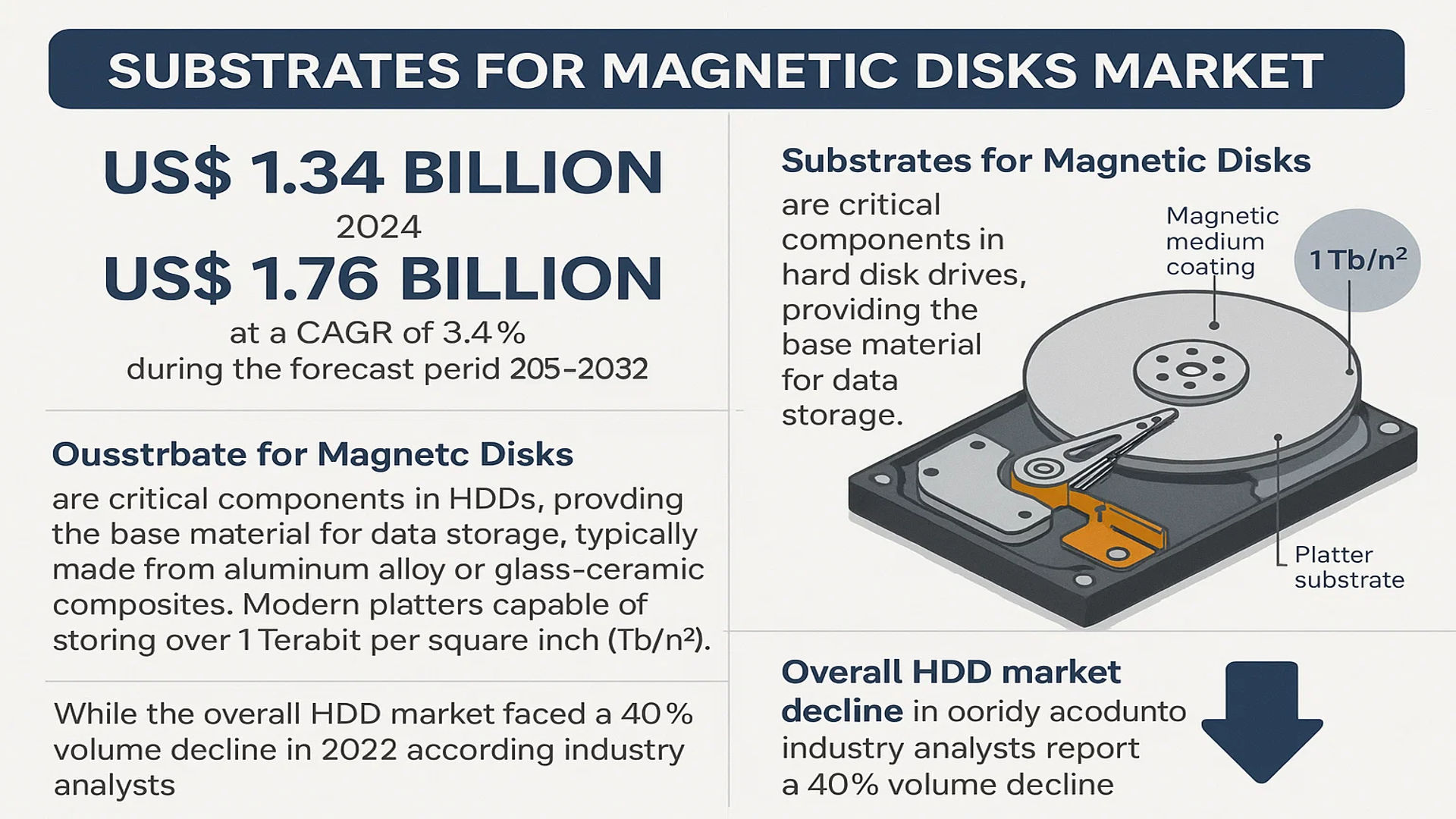
The global Substrates for Magnetic Disks Market size was valued at US$ 1.34 billion in 2024 and is projected to reach US$ 1.76 billion by 2032, at a CAGR of 3.4% during the forecast period 2025-2032.
Substrates for magnetic disks are critical components in hard disk drives (HDDs), providing the base material for data storage. These substrates must be non-magnetic and precisely engineered for smoothness and durability, typically made from aluminum alloy or glass-ceramic composites. The magnetic medium coating on these substrates enables high-density data storage, with modern platters capable of storing over 1 terabit per square inch (Tb/in²).
While the overall HDD market faced a 40% volume decline in 2022 according to industry analysts, the substrate segment is undergoing transformation. The growing adoption of glass substrates – offering superior stability for higher areal densities – is reshaping material preferences. Market leaders like Showa Denko and HOYA are investing in advanced substrate technologies to meet evolving storage demands, particularly in enterprise and cloud storage applications where HDDs maintain cost advantages over SSDs.
MARKET DYNAMICS
MARKET DRIVERS
Rising Demand for High-Capacity Data Storage to Boost Substrate Market Growth
The exponential growth in data generation across industries is driving demand for higher capacity magnetic disk storage solutions. With organizations increasingly relying on big data analytics and cloud computing, the need for high-density storage substrates has surged substantially. Enterprises are rapidly adopting advanced hard disk drives (HDDs) with greater aerial density, requiring sophisticated substrate materials that can support capacities exceeding 20TB per platter. Manufacturers are responding by developing substrates capable of supporting storage densities beyond 2 terabits per square inch, a key factor propelling market expansion.
Advancements in Glass Substrate Technology Accelerating Market Adoption
Technological breakthroughs in glass substrate manufacturing are revolutionizing the magnetic disk market. Glass substrates offer superior flatness, thermal stability, and shock resistance compared to traditional aluminum alloys – critical factors enabling higher storage densities. As manufacturers address previous challenges with glass’s brittleness through advanced coating technologies, adoption has grown significantly. The market share of glass substrates has increased by approximately 35% over the past five years, with projections indicating it may capture over 60% of the high-capacity HDD segment by 2027. This transition is driving substantial R&D investment and capacity expansion among substrate manufacturers.
Emerging Applications in Data Centers Creating New Growth Avenues
The unprecedented expansion of hyperscale data centers presents lucrative opportunities for magnetic disk substrates. While solid-state drives dominate performance tiers, cost-effective HDDs remain essential for high-capacity cold storage solutions. Cloud service providers are deploying increasingly sophisticated storage architectures that leverage both technologies, with HDDs maintaining a strong position for large-scale archival applications. This balanced storage ecosystem ensures sustained demand for advanced magnetic disk substrates, particularly as data center storage capacity requirements continue growing at a compound annual rate exceeding 20%.
MARKET RESTRAINTS
Declining HDD Shipments Impacting Substrate Demand Dynamics
The magnetic disk substrate market faces headwinds from decreasing global HDD shipments, which declined by over 40% between 2020-2023. This contraction reflects broader industry shifts toward solid-state storage solutions for consumer devices and performance-intensive applications. While enterprise and data center demand remains resilient, the overall reduction in total addressable market presents manufacturing scalability challenges for substrate suppliers. This trend is particularly pronounced in consumer electronics, where HDDs are being rapidly displaced by SSDs in laptops and gaming consoles.
Stringent Manufacturing Requirements Elevating Production Costs
The precision engineering required for modern magnetic disk substrates creates significant barriers to cost-effective production. Substrates must maintain nanometer-scale surface smoothness while withstanding the mechanical stresses of high-speed rotation and the thermal variations of data center environments. These demanding specifications require specialized manufacturing equipment and strict quality control processes, resulting in capital expenditures that can exceed $500 million for new production lines. Such high barriers to entry limit market competition while putting pressure on established suppliers to continuously improve yields and operational efficiencies.
Supply Chain Vulnerabilities in Specialty Materials
The substrate manufacturing process relies on several specialized raw materials with constrained global supply chains. Certain glass compositions and high-purity aluminum alloys face periodic shortages due to limited production capacity and geopolitical factors. These supply chain vulnerabilities create production bottlenecks and cost volatility, challenging manufacturers’ ability to maintain stable pricing and delivery schedules. Recent disruptions have highlighted the industry’s dependence on a small number of suppliers for critical input materials, prompting reevaluation of sourcing strategies and inventory management practices.
MARKET OPPORTUNITIES
Innovations in Substrate Coatings Opening New Possibilities
Breakthroughs in thin-film deposition technologies present exciting opportunities for substrate manufacturers. Advanced coating techniques enable novel material combinations that enhance storage density while improving durability. Emerging nanocrystalline and amorphous coatings show particular promise, with some laboratory demonstrations achieving aerial density improvements exceeding 50% compared to conventional solutions. These innovations could significantly extend the competitive position of HDD technology in the storage hierarchy while creating new revenue streams for substrate developers.
Strategic Partnerships with Drive Manufacturers Driving Innovation
Collaborative development programs between substrate suppliers and HDD manufacturers are accelerating the commercialization of next-generation technologies. These partnerships facilitate co-engineering of complete storage solutions optimized for specific application requirements, from enterprise data centers to specialized industrial applications. Recent alliances have successfully reduced development cycles for new substrate technologies by 30-40%, enabling faster time-to-market for high-capacity drives. Such collaborations provide substrate manufacturers with valuable market intelligence while ensuring their products remain aligned with evolving industry needs.
MARKET CHALLENGES
Competition from Alternative Storage Technologies
The rapid advancement of solid-state storage technologies poses significant competitive challenges. While HDDs maintain cost advantages for high-capacity applications, the price gap with SSDs continues narrowing. Forecasts suggest enterprise SSDs could achieve price parity with HDDs for certain capacity points within the next five years, potentially accelerating the transition away from magnetic storage. This dynamic requires substrate manufacturers to continuously demonstrate the value proposition of their technologies while optimizing cost structures to remain competitive.
Manufacturing Yield and Quality Control Complexities
The extreme precision required in substrate production creates persistent challenges in maintaining high manufacturing yields. Even minor deviations in surface characteristics can render substrates unsuitable for high-density storage applications. Yield rates for advanced glass substrates typically range between 65-75%, significantly impacting production economics. Maintaining consistent quality becomes increasingly difficult as manufacturers push the boundaries of storage density, requiring continuous refinement of process controls and inspection methodologies.
Capital Intensive Nature of Capacity Expansion
The advanced cleanroom facilities and specialized equipment required for substrate manufacturing create substantial barriers to capacity expansion. New fabrication lines require investments often exceeding $300-500 million, with lead times of 18-24 months before commercial production begins. This capital intensity complicates demand forecasting and capacity planning, particularly given the cyclical nature of the storage industry. Manufacturers must carefully balance expansion initiatives with market conditions to avoid overcapacity while remaining positioned to meet future demand growth.
SUBSTRATES FOR MAGNETIC DISKS MARKET TRENDS
Shift Toward High-Performance Glass Substrates Gaining Momentum
The magnetic disk substrates market is witnessing a notable transition from traditional aluminum alloy substrates to glass-based alternatives, driven by the demand for higher data storage density and durability. Glass substrates offer superior rigidity, thermal stability, and smooth surface finish compared to aluminum, enabling higher areal densities for modern hard disk drives (HDDs). While aluminum alloy substrates currently dominate with approximately 70-75% market share in 2024, glass substrates are projected to grow at a CAGR of 8-10% through 2032 due to adoption in enterprise and data center storage solutions. Moreover, advancements in glass composition and coating technologies have significantly reduced manufacturing defects, making them commercially viable for high-capacity HDDs exceeding 20TB per platter.
Other Trends
Declining HDD Volumes Impacting Substrate Demand
While substrate technology advances continue, the overall HDD market has faced contraction, with shipments declining by 40-40.5% in 2022 to approximately 35.2-36.4 million units. This downturn directly affects substrate manufacturers, prompting strategic shifts toward specialized high-capacity applications. Enterprise storage and cloud data centers now account for over 65% of substrate demand as consumer HDD usage diminishes. However, the increasing areal density of modern platters partially offsets volume declines, with leading manufacturers now achieving 2+TB per disk compared to 1TB just five years prior.
Material Innovation and Surface Engineering Advances
The substrate industry is responding to evolving storage needs through material science breakthroughs in both glass and aluminum formulations. New aluminum-magnesium alloys with improved thermal properties are enabling thinner, lighter substrates for mobile applications while maintaining structural integrity. Concurrently, glass substrate manufacturers are developing chemically-strengthened compositions with enhanced shock resistance and reduced waviness for ultra-high-density recording. Surface engineering innovations, particularly in nano-texturing and lubrication layer application, have reduced flying height between heads and disks to under 5nm, directly contributing to storage capacity improvements without requiring radical changes in magnetic media technology.
Additionally, the industry is seeing increased adoption of hybrid substrate solutions where glass cores are paired with specialized metallic coatings to combine the benefits of both material types. This approach is particularly prevalent in applications requiring extreme environmental durability, such as automotive data storage systems. The substrate market’s evolution reflects the broader storage industry’s balancing act between maintaining HDD relevance in the SSD era and pushing the boundaries of areal density to meet exponentially growing data demands.
COMPETITIVE LANDSCAPE
Key Industry Players
Technological Advancements and Capacity Expansion Drive Market Competition
The global substrates for magnetic disks market is characterized by a mix of established manufacturers and emerging players, with significant competition driven by material innovation and production capacity. Showa Denko K.K. (SDK) currently leads the market with approximately 30% revenue share in 2024, maintaining dominance through its specialized aluminum substrate technology and vertically integrated production facilities across Japan, China, and Southeast Asia. Their patented surface polishing techniques enable higher data density storage, which remains crucial for enterprise HDD applications.
Toyo Kohan Co., Ltd. follows closely with 25% market share, leveraging its glass substrate expertise to cater to high-performance data center demands. The company’s 2023 investment in a $120 million production line in Malaysia significantly expanded its capacity for glass substrates – a segment projected to grow at 8% CAGR through 2032 as storage densities increase.
Consolidation has marked recent years, with HOYA Corporation acquiring Fuji Electric’s substrate division in 2022 to strengthen its position in the glass substrate segment. Meanwhile, Western Digital and Seagate Technology maintain captive substrate production capabilities, accounting for 40% of global demand through vertical integration strategies that ensure supply chain stability.
List of Key Substrates for Magnetic Disks Companies Profiled
- Showa Denko K.K. (Japan)
- Toyo Kohan Co., Ltd. (Japan)
- HOYA Corporation (Japan)
- Western Digital Corporation (U.S.)
- Seagate Technology LLC (U.S.)
- Fuji Electric Co., Ltd. (Japan)
- UACJ Corporation (Japan)
Segment Analysis:
By Type
Glass Substrates Gain Traction Due to Superior Performance in High-Density Storage Applications
The market is segmented based on type into:
- Aluminium Alloy
- Glass
- Others
By Application
Notebook Computer Segment Leads Demand Due to Increasing Mobile Computing Needs
The market is segmented based on application into:
- Desktop Computer
- Notebook Computer
- External Hard Disk
- Recreational Machines
By End User
Enterprise Storage Segment Drives Growth to Meet Expanding Data Center Requirements
The market is segmented based on end user into:
- Data Centers
- Consumer Electronics
- Industrial Applications
- Cloud Service Providers
By Capacity
High-Capacity Substrates (Above 2TB) Lead Adoption for Enterprise Solutions
The market is segmented based on capacity into:
- Below 1TB
- 1-2TB
- Above 2TB
Regional Analysis: Substrates for Magnetic Disks Market
Asia-Pacific
The Asia-Pacific region dominates the global substrates for magnetic disks market, accounting for the largest revenue and volume share. This leadership position is fueled by the concentration of major hard disk drive manufacturers in countries like China, Japan, and South Korea. The region benefits from strong electronics manufacturing ecosystems, with companies like Seagate and Western Digital operating significant production facilities. While traditional aluminum alloy substrates remain prevalent, there’s growing adoption of glass substrates in high-capacity enterprise drives – particularly in Japan where technological advancements are concentrated. However, the overall market faces pressure from declining HDD demand, with Trendfocus reporting a 40% year-on-year volume decrease in 2022. The region’s cost competitiveness continues to attract manufacturing investments despite these challenges.
North America
North America maintains significant market presence through technological innovation and enterprise storage demand. The U.S. hosts key R&D centers for substrate materials, with companies exploring advanced glass-ceramic composites to increase areal density. The region shows slower decline rates in enterprise HDD adoption compared to consumer markets, sustained by data center expansions. However, stringent environmental regulations impact material sourcing and manufacturing processes, pushing companies toward more sustainable substrate solutions. The market is transitioning toward specialized high-capacity substrates for cloud infrastructure rather than traditional computer applications.
Europe
Europe’s substrate market focuses on specialized applications and high-performance solutions. While hard disk production has significantly declined, the region maintains demand for premium substrates in industrial and enterprise applications. EU environmental directives influence material choices, with manufacturers gradually shifting toward recyclable aluminum alloys and exploring bio-based alternatives. Germany remains the largest market within Europe, supported by its strong industrial base. The region shows particular interest in hybrid solutions combining substrate innovations with emerging storage technologies.
South America
The South American market represents a smaller segment of the global substrates industry, primarily serving local computer manufacturing and data storage needs. Brazil accounts for the majority of regional demand, though economic fluctuations impact consistent growth. The market predominantly utilizes cost-effective aluminum substrates, with limited adoption of advanced glass variants due to price sensitivity. While some multinational manufacturers maintain distribution networks in the region, local production capabilities remain underdeveloped compared to global hubs.
Middle East & Africa
This emerging market shows gradual growth in substrate demand, driven by expanding data center infrastructure in countries like UAE and Saudi Arabia. However, the region relies heavily on imports with minimal local manufacturing. The adoption of advanced substrate materials lags behind global trends, with aluminum alloys dominating the market. While cloud service expansions present future opportunities, current market size remains limited by the broader global shift toward solid-state storage solutions.
Report Scope
This market research report provides a comprehensive analysis of the global and regional Substrates for Magnetic Disks markets, covering the forecast period 2025–2032. It offers detailed insights into market dynamics, technological advancements, competitive landscape, and key trends shaping the industry.
Key focus areas of the report include:
- Market Size & Forecast: Historical data and future projections for revenue, unit shipments, and market value across major regions and segments.
- Segmentation Analysis: Detailed breakdown by product type, technology, application, and end-user industry to identify high-growth segments and investment opportunities.
- Regional Outlook: Insights into market performance across North America, Europe, Asia-Pacific, Latin America, and the Middle East & Africa, including country-level analysis where relevant.
- Competitive Landscape: Profiles of leading market participants, including their product offerings, R&D focus, manufacturing capacity, pricing strategies, and recent developments such as mergers, acquisitions, and partnerships.
- Technology Trends & Innovation: Assessment of emerging technologies, material advancements, fabrication techniques, and evolving industry standards.
- Market Drivers & Restraints: Evaluation of factors driving market growth along with challenges, supply chain constraints, regulatory issues, and market-entry barriers.
- Stakeholder Analysis: Insights for component suppliers, OEMs, system integrators, investors, and policymakers regarding the evolving ecosystem and strategic opportunities.
Primary and secondary research methods are employed, including interviews with industry experts, data from verified sources, and real-time market intelligence to ensure the accuracy and reliability of the insights presented.
FREQUENTLY ASKED QUESTIONS:
What is the current market size of Global Substrates for Magnetic Disks Market?
->Substrates for Magnetic Disks Market size was valued at US$ 1.34 billion in 2024 and is projected to reach US$ 1.76 billion by 2032, at a CAGR of 3.4% during the forecast period 2025-2032.
Which key companies operate in Global Substrates for Magnetic Disks Market?
-> Key players include Toyo Kohan Co, SHOWA DENKO, Western Digital, Seagate, HOYA, Fuji Electric, and UACJ Corporation.
What are the key growth drivers?
-> Key growth drivers include rising demand for high-capacity storage solutions, advancements in glass substrate technology, and increasing adoption in enterprise storage applications.
Which region dominates the market?
-> Asia-Pacific is the dominant market, accounting for over 65% of global production, while North America leads in technological innovation.
What are the emerging trends?
-> Emerging trends include transition to glass substrates, development of higher areal density solutions, and integration of advanced thin-film technologies.

Get Sample Report PDF for Exclusive Insights
Report Sample Includes
- Table of Contents
- List of Tables & Figures
- Charts, Research Methodology, and more...
 Download Sample Report PDF