STT-RAM (Spin-Transfer-Torque RAM) Market Insights
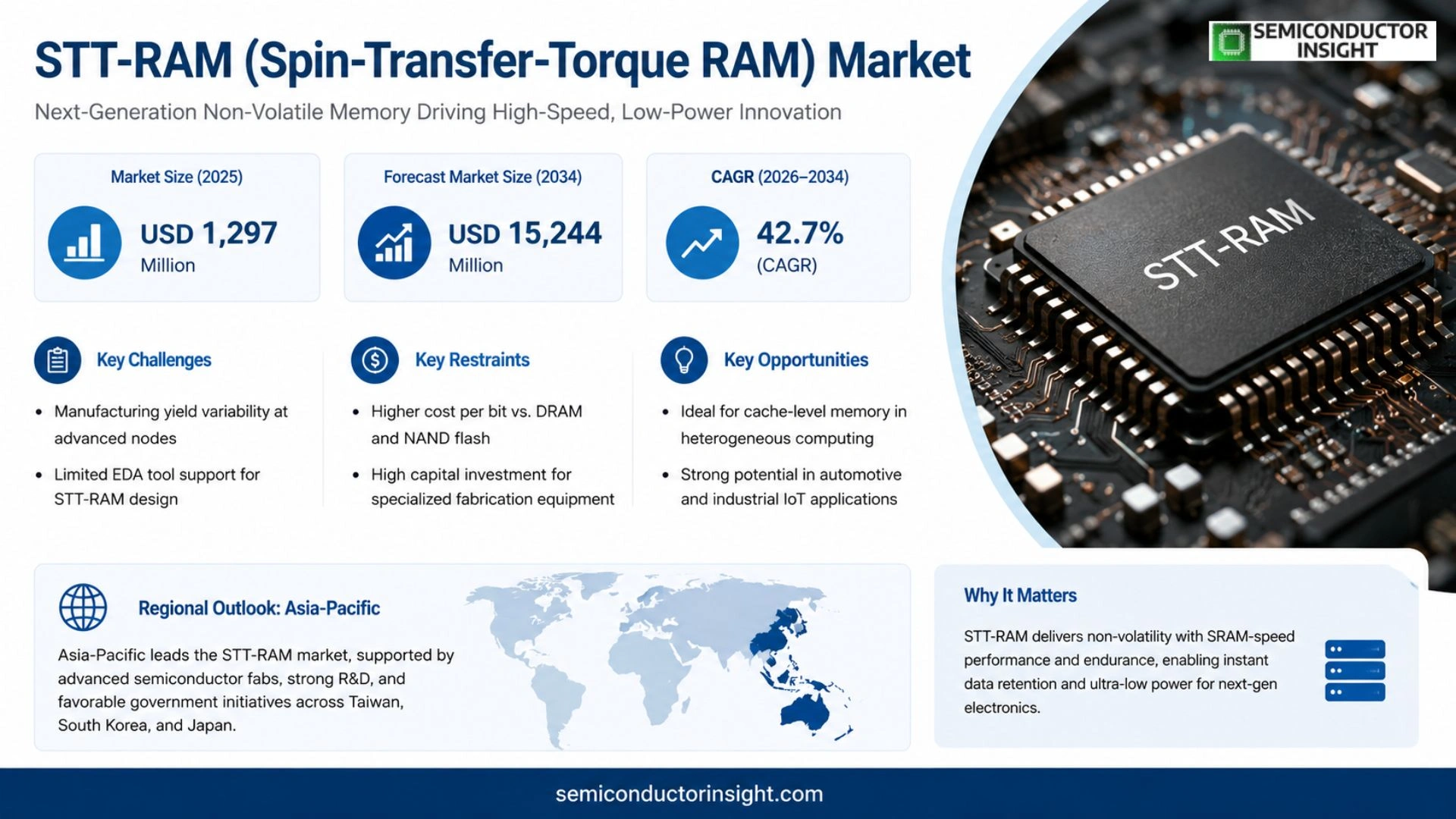
Global STT-RAM (Spin-Transfer-Torque RAM) market market will increase from USD 1,297 million in 2025 to USD 15,244 million by 2034, reflecting a CAGR of 42.7% over the forecast period.
STT‑RAM,often identified as STT‑MRAM or embedded eMRAM,is a magnetoresistive random‑access memory that writes data through spin‑transfer torque. Its value stems from combining near‑working‑memory read/write speed, non‑volatility, high write endurance and low standby power within advanced logic nodes. This blend makes it especially suitable for industrial controllers, automotive electronics and edge‑AI systems where reliability under power loss and high temperature is critical.
The market is gaining momentum because standalone chips from Everspin Technologies, Renesas Electronics and Avalanche Technology address code storage and high‑reliability caching needs, while foundry partners such as Samsung Foundry, GlobalFoundries and TSMC embed eMRAM directly into MCUs and SoCs for automotive and IoT applications. As flash scaling becomes more constrained below 28 nm, manufacturers are turning to STT‑RAM’s endurance and temperature tolerance as a practical alternative.
MARKET DRIVERS
Energy‑Efficient Architecture
STT-RAM (Spin-Transfer-Torque RAM) Market benefits from a shift toward low‑power designs in mobile and edge devices. Unlike conventional SRAM, STT‑RAM retains data without a continuous supply, cutting standby power by up to 80 %. This efficiency translates into longer battery life, a metric that OEMs now prioritize when qualifying components for next‑generation smartphones.
Latency‑Critical Applications
Latency‑sensitive workloads,such as autonomous‑vehicle sensor fusion and real‑time AI inference,require memory that delivers sub‑nanosecond read speeds while maintaining non‑volatility. STT‑RAM meets both criteria, positioning it as a viable alternative to DRAM in platforms where deterministic response times are non‑negotiable.
➤ “The combination of speed, endurance, and zero‑standby power is reshaping how system architects allocate memory tiers.”
From a cost perspective, the technology’s reliance on standard CMOS processes reduces wafer‑level expenditures compared with emerging MRAM variants that need exotic materials. As fab lines incorporate STT‑RAM cells into existing production streams, economies of scale begin to materialize, encouraging broader adoption across automotive, data‑center, and consumer‑electronics segments.
MARKET CHALLENGES
Manufacturing Yield Variability
Achieving consistent write‑error rates across 30‑nm and smaller nodes remains problematic. Minor fluctuations in tunnel‑barrier thickness can cause write failures, prompting manufacturers to implement redundant error‑correction logic that erodes the inherent density advantage of STT‑RAM.
Other Challenges
Design‑Tool Integration
Current EDA suites offer limited native support for STT‑RAM timing models. Engineers often resort to custom scripts, extending development cycles and increasing validation costs, which discourages early‑stage adoption in legacy product lines.
MARKET RESTRAINTS
Cost Competitiveness with Mature Memories
Although STT‑RAM enjoys a superior power profile, its per‑bit price still exceeds that of mass‑produced DRAM and NAND flash. This price differential hampers entry into volume‑driven markets such as smartphones, where bill‑of‑materials constraints dominate component selection.
Furthermore, the capital outlay required to retrofit fabs with dedicated magnetic‑layer deposition equipment adds a financial hurdle that smaller foundries are reluctant to overcome without clear, long‑term demand commitments.
MARKET OPPORTUNITIES
Integration into Heterogeneous Computing Platforms
System‑on‑Chip architects are actively exploring STT‑RAM as a unified cache‑level memory that bridges the gap between volatile SRAM and slower non‑volatile storage. By placing STT‑RAM directly behind the CPU core, designers can achieve instantaneous context restoration after power‑loss events, a capability highly valued in industrial IoT gateways.
Another promising avenue lies in the automotive sector, where safety‑critical ECUs must retain calibration data without relying on backup batteries. The robustness of STT‑RAM against radiation and temperature extremes aligns with automotive qualification standards, opening a pathway for large‑volume contracts as electric‑vehicle platforms mature.
STT-RAM (Spin-Transfer-Torque RAM) Market Trends
Shift Toward Embedded eMRAM Platforms
The most visible development in recent years is the migration of STT‑RAM technology from stand‑alone chips to embedded memory blocks inside advanced logic processes. Foundries such as Samsung, GlobalFoundries, TSMC and UMC have begun shipping eMRAM alongside MCU and SoC cores, targeting automotive-grade reliability, high‑temperature operation and the write‑speed constraints of modern firmware updates. This relocation changes the value proposition: instead of competing on per‑chip price, vendors now sell access to a memory capability that becomes a permanent feature of a customer’s silicon roadmap. The consequence for system designers is a reduction in bill‑of‑materials complexity and a tighter integration of non‑volatile storage with compute, which in turn shortens time‑to‑market for OTA‑enabled vehicles and edge‑AI devices.
Other Trends
Discrete High‑Reliability STT‑MRAM Products
Parallel to the embedded wave, a niche of discrete STT‑MRAM devices continues to thrive among OEMs that require guaranteed data retention under extreme conditions. Companies like Everspin, Renesas, Avalanche and NETSOL supply chips using SPI, xSPI or parallel interfaces for applications such as code storage, backup memory and persistent caching in industrial controllers. These parts are prized for their endurance,often measured in billions of write cycles,and the ability to survive power‑loss events without data corruption. Because the form factor remains separate from the processor, customers retain flexibility to retrofit legacy systems that cannot be re‑designed around a new silicon process. The market implication is a bifurcated supply chain where discrete vendors focus on ruggedness and certification, while foundry partners concentrate on volume integration.
Geographic Division of Labor and Competitive Landscape
Geographically, the ecosystem reflects a clear division of labor. The United States hosts most of the discrete‑device innovators and the IP ecosystems that enable platform partnerships. Japan’s strengths lie in MCU‑centric designs where reliability specifications are paramount. South Korea, driven by Samsung’s foundry capabilities, leads the push for sub‑28 nm eMRAM roadmaps, whereas Taiwan’s TSMC and UMC provide the manufacturing depth required for automotive‑grade production. Europe is beginning to nurture validation facilities through initiatives like the Chips Act, which may lower entry barriers for niche players. For investors and strategic planners, the key takeaway is that success will depend less on a single technology breakthrough and more on the ability to lock in early design‑win relationships within these regional supply chains.
COMPETITIVE LANDSCAPE
Key Industry Players
STT‑RAM Competitive Overview 2024‑2034
Among the discrete‑device segment, Everspin Technologies dominates the high‑reliability niche with a portfolio that spans xSPI, SPI and parallel‑interface STT‑MRAM chips. Its focus on aerospace, automotive safety and industrial logging has cemented a reputation for long‑term data retention under harsh conditions. Renesas Electronics augments this space through its collaboration with Avalanche Technology, delivering embedded solutions that combine fast write cycles with endurance levels comparable to legacy FeRAM. NETSOL, a less visible but technically adept supplier, supplies custom‑format chips for data‑center backup and mission‑critical servers. Together these firms form a tiered ecosystem where product differentiation hinges on interface variety, temperature tolerance and guaranteed write‑cycle counts, shaping procurement decisions for OEMs that cannot tolerate flash‑related wear‑out. The embedded platform side is anchored by Samsung Electronics, whose 28 nm FD‑SOI eMRAM line is already in volume production for automotive MCUs, and by GlobalFoundries, which is positioning Auto‑Grade 1 eMRAM as a standard component for industrial controllers. TSMC and UMC add further depth by integrating eMRAM macro blocks into 16 nm and 14 nm logic cores, effectively turning non‑volatile memory into a native block of the silicon‑on‑silicon stack. This dual‑track structure pushes the market’s value from isolated chip pricing toward broader platform licensing and long‑term design‑win opportunities.
The broader landscape features a mix of foundry partners, semiconductor IP houses and specialist memory vendors that together broaden the addressable base. Intel’s recent acquisition of a small‑scale STT‑RAM IP portfolio signals entry into edge‑AI processors where instant power‑up is critical. NXP Semiconductors, leveraging its automotive MCU lineage, embeds eMRAM into its S32 platform to meet ISO‑26262 safety requirements. Cypress (now part of Infineon) offers low‑power eMRAM options for wearables, while Micron has entered a joint‑development program with European research consortia to explore sub‑10 nm MTJ scaling. IBM’s research arm continues to publish on perpendicular MTJ designs, potentially feeding future process nodes. European players such as STMicroelectronics and IMEC are nurturing pilot lines under the Chips Act, aiming to supply niche industrial modules. These participants, while not commanding the same shipment volumes as the leaders, provide critical diversification of technology risk and regional supply‑chain resilience, factors that influence strategic sourcing for multinational manufacturers.
List of Key STT‑RAM Companies Profiled
- Everspin Technologies
- Samsung Electronics
- Renesas Electronics Corporation
- GlobalFoundries
- Avalanche Technology
- NETSOL
- TSMC
- UMC
- Intel Corporation
- NXP Semiconductors
- Infineon Technologies
- Micron Technology
- STMicroelectronics
- IMEC
- IBM Research
Segment Analysis:
| Segment Category | Sub-Segments | Key Insights |
| By Type |
|
Discrete STT‑MRAM Chip continues to dominate the premium‑performance niche.
|
| By Application |
|
Automotive Electronics is the leading application segment, driven by stringent reliability and temperature requirements.
|
| By End User |
|
Automotive OEMs and Tier‑1 Suppliers leverage STT‑RAM to meet next‑generation vehicle architectures.
|
| By Integration Level |
|
On‑chip Embedded Macro is gaining traction as a strategic differentiator for foundries.
|
| By Value Proposition |
|
Low Power Consumption underpins the strategic appeal of STT‑RAM across all segments.
|
Regional Analysis: STT-RAM (Spin-Transfer-Torque RAM) Market
Chip designers in the region are embedding STT‑RAM into heterogeneous integration platforms, valuing its fast write latency and endurance over conventional flash. Early adopters cite reduced board space and lower static power as decisive factors, especially for edge‑computing modules where thermal budgets are tight.
The concentration of fabs close to material suppliers mitigates lead‑time volatility. Vertical integration strategies, where foundries co‑invest in rare‑earth sourcing, have lessened exposure to geopolitical shocks, ensuring stable availability for volume customers.
A robust IP ecosystem, supported by regional EDA vendors, accelerates the verification of STT‑RAM blocks. Collaborative design‑for‑manufacturing programs lower risk, allowing system houses to certify chips without extensive physical prototyping.
Local standards bodies are harmonizing magnetic‑memory safety specifications, facilitating cross‑border component certification. This regulatory cohesion speeds product launches and reduces compliance costs for multinational manufacturers.
North America
North America remains a critical market for high‑performance computing and data‑center deployments. While its manufacturing footprint is smaller than Asia‑Pacific, the region’s strength lies in R&D intensity and the presence of leading system integrators. Universities and research labs are pioneering new spin‑orbit torque variants that could complement STT‑RAM, promising lower switching energy. Enterprise customers value the memory’s ability to retain data during power outages, a feature that aligns with stringent uptime requirements of cloud service providers. Consequently, demand is skewed toward niche applications such as AI accelerators and mission‑critical storage, where the cost premium is justified by reliability gains.
Europe
European manufacturers focus on integrating STT‑RAM into automotive electronics, reflecting the bloc’s aggressive electrification agenda. The region’s regulatory emphasis on functional safety drives suppliers to adopt non‑volatile memory that can survive harsh temperature cycles. Simultaneously, Europe’s vibrant semiconductor consortiums are funding joint‑development projects to refine fabrication processes, aiming to reduce unit cost and improve yield. This collaborative approach fosters a supply chain that, while less monolithic than Asia‑Pacific, offers differentiated expertise in safety‑critical system design.
South America
Growth in South America is anchored to expanding mobile device markets and incremental adoption of IoT sensors. Local OEMs see STT‑RAM as a pathway to extend battery life in remote monitoring equipment, where frequent battery replacement is impractical. Although import dependence remains high, regional distributors are establishing partnerships with Asian fabs to secure a steady flow of memory modules, positioning the market for modest yet steady uptake over the coming years.
Middle East & Africa
The Middle East & Africa region exhibits nascent demand, primarily driven by defense and satellite communications projects that prioritize rugged, low‑power memory solutions. Governments are investing in sovereign technology initiatives, encouraging local assembly of STT‑RAM‑based subsystems. While the overall volume is limited, the strategic importance of reliable non‑volatile memory in security‑sensitive applications creates a niche that can attract specialized suppliers seeking footholds beyond traditional markets.
Report Scope
This market research report provides a comprehensive analysis of the STT-RAM (Spin-Transfer-Torque RAM) Market , covering the forecast period 2026–2034. It offers detailed insights into market dynamics, technological advancements, competitive landscape, and key trends shaping the industry.
Key focus areas of the report include:
- Market Overview: The report begins with an overview outlining its current market scenario, key growth indicators, and industry transformation drivers. It discusses macroeconomic factors, demand–supply balance, regulatory landscape, and the strategic role of semiconductors in powering advancements across industries such as automotive, telecommunications, consumer electronics, and industrial automation.
- Market Size & Forecast: Historical data and future projections for revenue, unit shipments, and market value across major regions and segments.
- Segmentation Analysis: Detailed breakdown by product type, technology, application, and end-user industry to identify high-growth segments and investment opportunities.
- Regional Insights: Insights into market performance across North America, Europe, Asia-Pacific, Latin America, and the Middle East & Africa, including country-level analysis where relevant.
- Competitive Landscape: Profiles of leading market participants, including their product offerings, R&D focus, manufacturing capacity, pricing strategies, and recent developments such as mergers, acquisitions, and partnerships.
- Technology Trends & Innovation: Assessment of emerging technologies, integration of AI/IoT, semiconductor design trends, fabrication techniques, and evolving industry standards.
- Market Drivers & Restraints: Evaluation of factors driving market growth along with challenges, supply chain constraints, regulatory issues, and market-entry barriers.
- Stakeholder Insights: Insights for component suppliers, OEMs, system integrators, investors, and policymakers regarding the evolving ecosystem and strategic opportunities.
Primary and secondary research methods are employed, including interviews with industry experts, data from verified sources, and real-time market intelligence to ensure the accuracy and reliability of the insights presented.
FREQUENTLY ASKED QUESTIONS:
What is the current market size of STT-RAM (Spin-Transfer-Torque RAM) Market?
-> STT-RAM (Spin-Transfer-Torque RAM) market market will increase from USD 15,244 million by 2034, reflecting a CAGR of 42.7% over the forecast period.
Which key companies operate in STT-RAM (Spin-Transfer-Torque RAM) Market?
-> Key players include Everspin Technologies, Renesas Electronics, NETSOL, Avalanche Technology, Samsung Electronics, GlobalFoundries, TSMC, and United Microelectronics Corporation.
What are the key growth drivers?
-> Key growth drivers include the demand for high‑reliability memory in automotive and industrial electronics, scaling limits of embedded flash, need for low‑standby power, high write endurance, and the push for advanced‑node eMRAM integration.
Which region dominates the market?
-> Asia‑Pacific leads the market due to the strong presence of foundries (Samsung, TSMC, UMC) and rapid adoption of eMRAM in automotive and industrial applications, while North America remains a key hub for discrete high‑reliability products.
What are the emerging trends?
-> Emerging trends include integration of eMRAM into 14nm/8nm advanced logic processes, automotive‑grade eMRAM platforms, edge‑AI controller memory solutions, and the transition from standalone chips to platform‑level IP reuse.
Get Sample Report PDF for Exclusive Insights
Report Sample Includes
- Table of Contents
- List of Tables & Figures
- Charts, Research Methodology, and more...
 Download Sample Report PDF