STT-MRAM Chips Market Insights
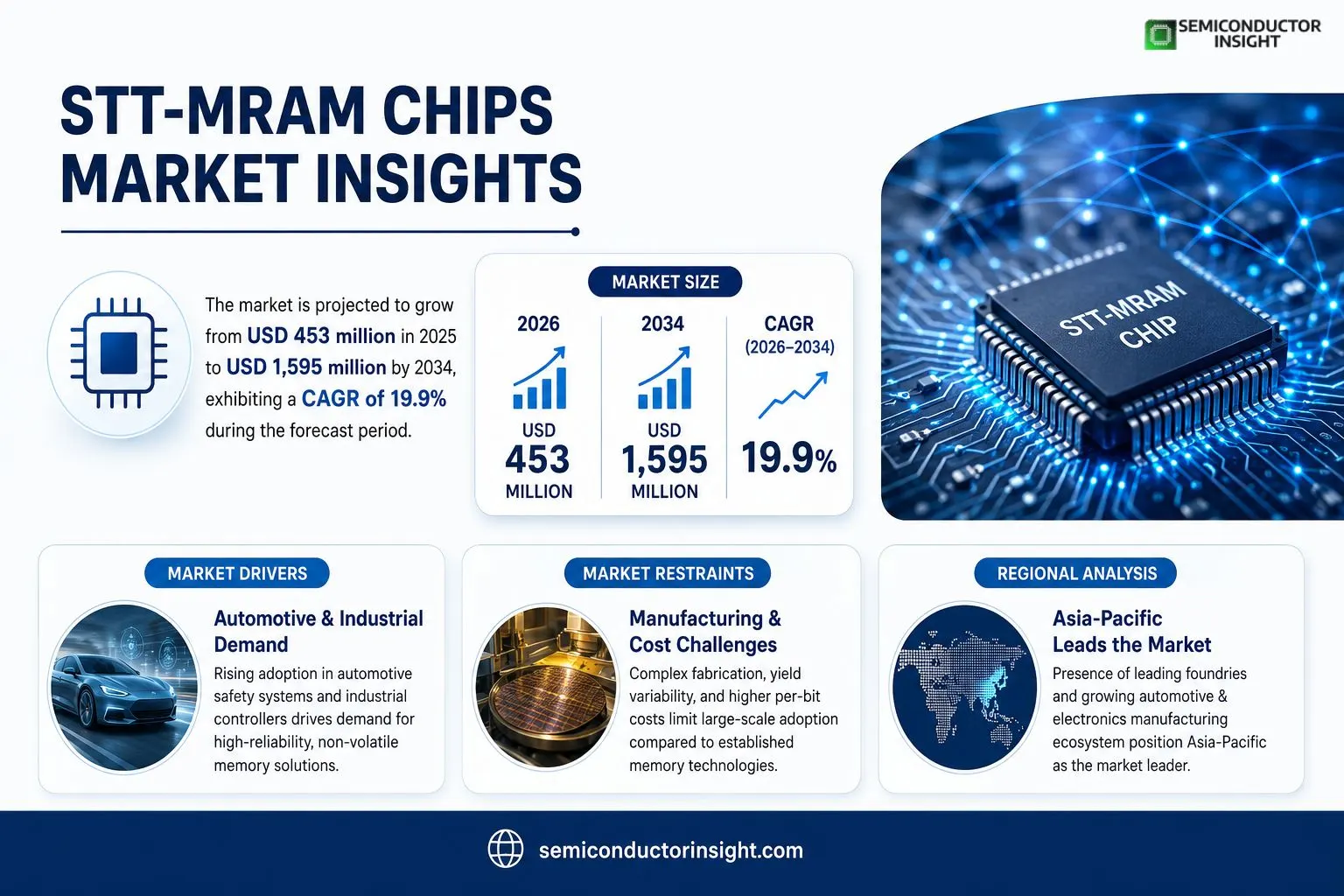
STT-MRAM Chips market size was valued at USD 453 million in 2025. The market is projected to grow from USD 453 million in 2025 to USD 1,595 million by 2034, exhibiting a CAGR of 19.9% during the forecast period.
STT‑MRAM chips are non‑volatile memory devices that employ magnetic tunnel junctions as the storage element and rely on spin‑transfer torque for write operations. Their value lies in simultaneously meeting critical requirements such as power‑loss data retention, low latency, high endurance, high‑temperature reliability, and fast random read/write performance. Consequently, they can serve either as discrete memory chips replacing parts of NOR Flash, EEPROM, FeRAM and nvSRAM, or as embedded eMRAM platforms integrated into MCUs, SoCs and automotive‑grade devices.The market is experiencing strong expansion because automotive electronics demand embedded non‑volatile memory with higher reliability,aerospace sectors require radiation‑tolerant fast‑write solutions,and semiconductor policy increasingly emphasizes domestic process platforms.Suppliers such as Everspin, Renesas, AvalancheandHIKSTOR provide discrete SPI/QSPI/xSPI products,while foundries like Samsung Foundry, GF®, TSMC and UMC deliver embedded MRAM process services for IoT and edge AI applications.These developments together fuel adoption across automotive Tier‑1 suppliers,industrial equipment makersand smart‑metering vendors.
MARKET DRIVERS
Technology Scaling and Low‑Power Demand
The STT-MRAM Chips Market benefits from the relentless push toward smaller device footprints, where traditional volatile memories struggle to maintain energy efficiency. Emerging system‑on‑chip designs now rely on non‑volatile alternatives that can retain data without power, prompting designers to adopt spin‑transfer torque solutions.
Automotive Electronics and Safety‑Critical Applications
Automakers are integrating increasingly sophisticated driver‑assist functions that require memory capable of withstanding harsh temperature cycles. The endurance of STT‑MRAM, typically exceeding 1015 write cycles, aligns with the reliability thresholds demanded by safety‑critical modules, creating a clear incentive for suppliers.
➤ “Non‑volatile memories that combine SRAM‑like speed with flash‑like retention are reshaping design hierarchies across multiple sectors.”
Beyond power‑sensitive products, edge‑computing platforms are adopting STT‑MRAM to reduce latency in real‑time analytics. The convergence of speed, durability, and energy savings translates into cost advantages that manufacturers are eager to capture.
MARKET CHALLENGES
Manufacturing Yield and Process Integration
Scaling STT‑MRAM cells to sub‑20 nm nodes introduces variability in tunnel‑barrier formation, which can erode yield rates. Foundries must fine‑tune deposition techniques and integrate magnetic layers without disrupting existing CMOS flows, a non‑trivial engineering hurdle.
Other Challenges
Cost Competitiveness
While performance metrics are compelling, the per‑bit cost of STT‑MRAM remains higher than established DRAM or NAND solutions. Market participants must achieve economies of scale or develop innovative packaging to narrow the price gap.
MARKET RESTRAINTS
Supply‑Chain Constraints for Rare‑Earth Materials
The magnetic layers at the heart of STT‑MRAM rely on rare‑earth elements whose supply is subject to geopolitical fluctuations. Limited availability can throttle production capacity, especially as automotive OEMs place larger orders for safety‑grade modules.
MARKET OPPORTUNITIES
Emerging 5G Infrastructure and Edge Nodes
5G roll‑out accelerates the deployment of dense edge nodes that process massive data streams locally. STT‑MRAM’s rapid access time and zero‑standby power make it an ideal candidate for buffering and caching in these latency‑critical environments, opening a sizable revenue channel for memory vendors.
STT-MRAM Chips Market Trends
Convergence of Discrete and Embedded Platforms
STT-MRAM Chips Market is increasingly defined by a dual‑track supply model. Traditional discrete suppliers such as Everspin and Avalanche continue to push high‑reliability SPI and QSPI families for boot‑code storage and power‑loss protection, while foundry‑backed services from Samsung, Foundries and TSMC embed MRAM directly into automotive‑grade MCUs and SoCs. This convergence enables customers to select a memory solution that matches both interface preference and process node, eliminating the classic compromise between legacy compatibility and cutting‑edge integration. Engineers are now able to leverage the non‑volatile nature of STT‑MRAM alongside the speed of SRAM, which reduces part counts in safety‑critical designs and shortens validation cycles. The result is a noticeable shift in design architectures where memory is treated as an active system enabler rather than a passive storage block.
Other Trends
Supply‑Chain Evolution
The ecosystem surrounding STT-MRAM Chips Market has matured beyond a single‑vendor landscape. Discrete chip makers focus on niche interfaces (I²C, parallel) and hardened temperature grades, whereas foundry partners provide macro‑level IP that is pre‑qualified for automotive and aerospace standards. This bifurcation raises the competitive bar: success now depends on platform readiness, qualification depth, and the ability to co‑develop reference designs with MCU and SoC designers. Companies that can bundle process compatibility with long‑term reliability data gain a strategic foothold, making entry for new players cost‑intensive and time‑consuming. Additionally, regional policy incentives that prioritize domestic semiconductor capabilities have encouraged collaboration between local fabs and MRAM IP providers, reinforcing a geographically diverse supply chain.
Application‑Driven Differentiation
From an end‑user perspective, STT-MRAM Chips Market is being shaped by application requirements that exceed simple capacity metrics. In automotive electronics, the need for instant state retention after power interruption drives adoption of embedded MRAM in safety‑critical ECUs. Edge AI devices benefit from the combination of low latency and high endurance, allowing frequent model updates without wear‑out concerns. Industrial control systems prize the wide‑temperature operation and radiation tolerance that MRAM offers, simplifying board layouts by removing separate backup memory. These divergent use cases compel manufacturers to diversify interface options—xSPI for high‑throughput boot images, Dual QSPI for firmware over‑the‑air, and platform macros for tight SoC integration. Companies that align their product roadmaps with these specific functional mandates can capture higher margins, while customers gain a clearer path to system‑level differentiation.
COMPETITIVE LANDSCAPEKey Industry Players
STT‑MRAM Chips: Competitive Overview 2024‑2034
Samsung Electronics dominates the embedded MRAM segment by leveraging its advanced foundry services and extensive automotive‑grade qualification portfolio. Its ability to integrate STT‑MRAM directly into logic processes gives it a decisive edge in high‑volume System‑on‑Chip programs, where die‑size efficiency and temperature resilience are non‑negotiable. Parallel to Samsung, Everspin Technologies remains the most visible supplier of discrete STT‑MRAM parts, offering a breadth of SPI, QSPI and parallel‑interface devices that cater to legacy code‑storage and boot‑configuration markets. The market structure now resembles a two‑track ecosystem: one track driven by fabless and foundry partners delivering process‑level memory, the other by specialty vendors supplying ready‑to‑ship chips for niche reliability‑critical applications.Beyond the headline names, a cluster of specialized firms shapes the competitive fringe. Renesas Electronics and NETSOL provide medium‑scale discrete offerings tailored to industrial controllers, while Avalanche Technology focuses on ultra‑low‑power variants for edge AI. HIKSTOR and Shanghai Siproin Microelectronics have expanded from Chinese domestic supply chains into automotive projects, emphasizing radiation‑hard and high‑temperature qualifications. FOUNDRIES, TSMC and United Microelectronics Corporation (UMC) each market MRAM as a process option, nudging the technology toward mainstream adoption in next‑generation SoCs. Smaller but technically aggressive players such as Fujitsu Semiconductor and NXP Semiconductors are experimenting with hybrid macro IP that could lower entry barriers for OEMs seeking customized memory solutions.
List of Key STT-MRAM Chips Companies Profiled
- Samsung Electronics Co., Ltd.
- Everspin Technologies, Inc.
- Avalanche Technology Inc.
- Renesas Electronics Corporation
- NETSOL Co., Ltd.
- FOUNDRIES Inc.
- Taiwan Semiconductor Manufacturing Company Limited
- United Microelectronics Corporation
- HIKSTOR
- Shanghai Siproin Microelectronics Co., Ltd.
- Fujitsu Semiconductor
- NXP Semiconductors
- Micron Technology, Inc.
Segment Analysis:
| Segment Category | Sub-Segments | Key Insights |
| By Type |
|
Discrete STT-MRAM Chips are prized for their high‑performance interfaces (SPI, QSPI, parallel) and immediate data‑loss protection. – They enable fast boot configuration and cache persistence in safety‑critical systems. – Their non‑volatile nature combined with low latency addresses the core requirements of automotive and industrial controllers. – Vendors emphasize robust temperature tolerance and endurance, positioning them as premium replacements for legacy NOR flash. |
| By Application |
|
Automotive Electronics benefit from the ultra‑reliable non‑volatile nature of STT‑MRAM. – Enables fail‑safe state retention during power‑loss events in advanced driver‑assist systems. – Supports high‑temperature operation required for engine‑bay environments. – Provides deterministic write speed, simplifying software architecture for safety‑critical functions. |
| By End User |
|
MCU & SoC Vendors integrate embedded MRAM as a core building block for next‑generation non‑volatile logic. – Facilitates simplified board design by removing separate boot ROM components. – Enhances system reliability while maintaining low power consumption for edge devices. – Encourages ecosystem development around process‑compatible MRAM IP. |
| By Interface |
|
SPI / QSPI Interfaces dominate the discrete segment due to ease of integration and high transfer rates. – Provide flexible pin‑out configurations for diverse board layouts. – Align with legacy firmware expectations while delivering MRAM’s speed and endurance benefits. – Enable rapid adoption in boot‑code storage and secure key management. |
| By Supply Chain |
|
Foundry Platform Providers shape the embedded MRAM ecosystem through process‑level integration. – Offer standardized MRAM macro IP that accelerates time‑to‑market for SoC designers. – Ensure automotive and aerospace qualification across advanced nodes. – Drive collaborative innovation with device vendors, creating a barrier to entry for new entrants. |
Regional Analysis: STT-MRAM Chips Market
North America
Silicon Valley and Boston host clusters where university research translates rapidly into spin‑transfer torque designs, creating a pipeline of patented cell structures that keep North America ahead of the technology curve.
Proximity to advanced lithography fabs and established silicon‑on‑insulator suppliers shortens lead times, allowing manufacturers to iterate designs faster than peers in other continents.
Early contracts with hyperscale data‑center operators and defense contractors provide reference projects that lower perceived risk for mid‑size enterprises considering STT‑MRAM upgrades.
A relatively predictable IP framework and supportive export‑control policies enable cross‑border collaborations, enhancing the ability to scale production without disruptive legal hurdles.
Europe
European chip designers are leveraging strong public‑funded programmes to embed STT‑MRAM into automotive safety systems, where deterministic behavior under temperature extremes is a regulatory requirement. Collaborative clusters in Germany and France combine automotive OEM expertise with memory specialists to produce modules that meet the stringent functional‑safety standards of ISO 26262. This regulatory pressure converts into a modest but growing domestic demand, while at the same time positioning Europe as a testing ground for automotive‑grade spin‑transfer technologies. The region’s emphasis on sustainability also drives interest in low‑power, non‑volatile memories that can reduce overall system energy consumption.
Asia‑Pacific
Asia‑Pacific benefits from a manufacturing scale that can undercut unit costs, yet the market narrative is shifting from pure volume to differentiated solutions. Taiwan’s foundries have begun offering dedicated process windows for STT‑MRAM, while China’s policy incentives encourage local integration of spin‑based memory into 5G infrastructure. The result is a diversified demand profile: high‑volume consumer electronics demand coexists with niche applications in edge‑computing devices where instant‑on capability offers a competitive edge. Companies that can balance cost efficiency with performance tuning are likely to capture the most compelling growth opportunities.
South America
In South America, the STT‑MRAM Chips Market is still nascent, but a handful of telecom operators are experimenting with non‑volatile memory to improve network resilience in remote installations. Brazil’s emerging semiconductor research parks are attracting multinational joint ventures that aim to establish regional pilot lines. While overall market size remains limited, the region’s growing appetite for energy‑efficient hardware in renewable‑energy control systems provides a foothold for early adopters willing to invest in proof‑of‑concept deployments.
Middle East & Africa
The Middle East & Africa region showcases a mixed landscape where oil‑rich economies are channeling sovereign wealth into high‑tech diversification projects, including data‑center expansion in the UAE and Saudi Arabia. These initiatives prioritize low‑latency, always‑on memory architectures, creating a niche for STT‑MRAM in mission‑critical analytics platforms. Simultaneously, African tech hubs are exploring rugged memory options for off‑grid IoT sensors used in agriculture and mining, where the non‑volatile nature of STT‑MRAM reduces maintenance cycles. The confluence of sovereign investment and grassroots innovation frames a modest but strategically significant market slice.
Report Scope
This market research report provides a comprehensive analysis of the STT-MRAM Chips Market , covering the forecast period 2026–2034. It offers detailed insights into market dynamics, technological advancements, competitive landscape, and key trends shaping the industry.
Key focus areas of the report include:
- Market Overview: The report begins with an overview outlining its current market scenario, key growth indicators, and industry transformation drivers. It discusses macroeconomic factors, demand–supply balance, regulatory landscape, and the strategic role of semiconductors in powering advancements across industries such as automotive, telecommunications, consumer electronics, and industrial automation.
- Market Size & Forecast: Historical data and future projections for revenue, unit shipments, and market value across major regions and segments.
- Segmentation Analysis: Detailed breakdown by product type, technology, application, and end-user industry to identify high-growth segments and investment opportunities.
- Regional Insights: Insights into market performance across North America, Europe, Asia-Pacific, Latin America, and the Middle East & Africa, including country-level analysis where relevant.
- Competitive Landscape: Profiles of leading market participants, including their product offerings, R&D focus, manufacturing capacity, pricing strategies, and recent developments such as mergers, acquisitions, and partnerships.
- Technology Trends & Innovation: Assessment of emerging technologies, integration of AI/IoT, semiconductor design trends, fabrication techniques, and evolving industry standards.
- Market Drivers & Restraints: Evaluation of factors driving market growth along with challenges, supply chain constraints, regulatory issues, and market-entry barriers.
- Stakeholder Insights: Insights for component suppliers, OEMs, system integrators, investors, and policymakers regarding the evolving ecosystem and strategic opportunities.
Primary and secondary research methods are employed, including interviews with industry experts, data from verified sources, and real-time market intelligence to ensure the accuracy and reliability of the insights presented.
FREQUENTLY ASKED QUESTIONS:
What is the current market size of STT-MRAM Chips Market?
-> STT-MRAM Chips Market was valued at USD 453 million in 2025 and is expected to reach USD 1,595 million by 2034, at a CAGR of 19.9%.
Which key companies operate in STT-MRAM Chips Market?
-> Key players include Samsung Electronics Co., Ltd.; Everspin Technologies, Inc.; Avalanche Technology Inc.; Renesas Electronics Corporation; NETSOL Co., Ltd.; FOUNDRIES Inc.; Taiwan Semiconductor Manufacturing Company Limited; United Microelectronics Corporation; HIKSTOR; Shanghai Siproin Microelectronics Co., Ltd..
What are the key growth drivers?
-> Key growth drivers include power‑loss data retention, low latency, high endurance, high‑temperature reliability, fast random read/write performance, expanding automotive and aerospace demand, and supportive semiconductor policy encouraging domestic advanced‑process MRAM development.
Which region dominates the market?
-> While the market is , Asia holds a leading position due to the presence of major foundries such as TSMC, Samsung Foundry, and UMC, which drive significant volume of embedded MRAM platforms.
What are the emerging trends?
-> Emerging trends include the adoption of advanced interface standards like xSPI and Dual QSPI, growth of embedded eMRAM platforms for automotive and edge AI, and increasing focus on radiation‑tolerant, high‑reliability memory solutions for aerospace and defense.
Get Sample Report PDF for Exclusive Insights
Report Sample Includes
- Table of Contents
- List of Tables & Figures
- Charts, Research Methodology, and more...
 Download Sample Report PDF