DDR4 RAM Market Insights
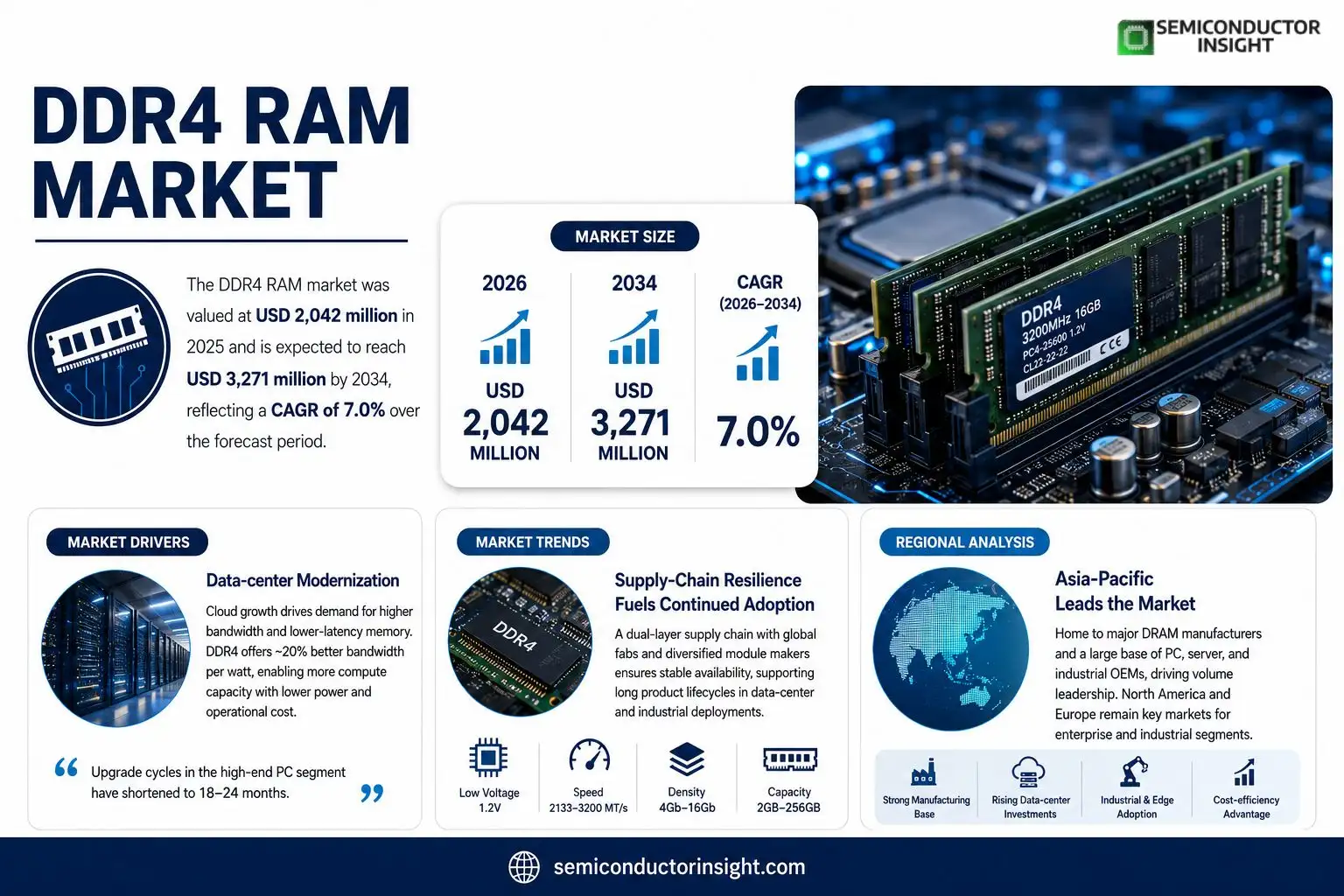
DDR4 RAM market size was valued at USD 2,042 million in 2025 and is expected to reach USD 3,271 million by 2034, reflecting a CAGR of 7.0% over the forecast period.
DDR4 RAM is a mature memory product built on the JEDEC DDR4 standard that delivers system main‑memory capacity and bandwidth through DRAM components and memory modules. It balances low‑voltage operation (≈1.2 V), transfer rates from 2133 MT/s up to 3200 MT/s, chip densities of 4 Gb‑16 Gb and module capacities ranging from 2 GB‑256 GB across form factors such as UDIMM, SODIMM, RDIMM, LRDIMM, VLP and XR‑DIMM.The market retains resilience because PC‑upgrade cycles, server refreshes and industrial automation projects continue to rely on DDR4’s proven reliability and cost efficiency. Major suppliersincluding Samsung Electronics, SK hynix, Micron Technology and Nanya Technologymaintain diversified product lines for consumer computing, data‑center servers and edge devices, while module makers such as Kingston Technology and ADATA package these components for OEMs worldwide.
MARKET DRIVERS
Data‑center Modernization
The surge in cloud‑based services compels hyperscale operators to replace legacy memory modules with higher‑speed, lower‑latency alternatives. DDR4 RAM Market benefits because the newer standard delivers roughly 20% better bandwidth per watt, allowing providers to pack more compute capacity into existing racks while keeping power bills in check.
Consumer Gaming & PC Upgrades
Enthusiast gamers and content creators prioritize frame rates and rendering responsiveness, driving demand for kits with tighter timings. Manufacturers respond by offering performance‑tuned modules that promise measurable latency reductions, a proposition that directly translates into stronger sales for DDR4 RAM Market.
➤ “Upgrade cycles in the high‑end PC segment have shortened to 18‑24 months, double the pace seen a decade ago.”
Beyond raw performance, cost efficiencies achieved through mature fabs have lowered unit prices, making DDR4 the default choice for midsize enterprises that cannot justify the premium of emerging memory generations.
MARKET CHALLENGES
Supply‑Chain Volatility
Geopolitical tensions and unexpected factory shutdowns have intermittently throttled wafer output, creating lead‑time extensions that strain procurement budgets. Companies that rely heavily on just‑in‑time inventory find the unpredictability costly, especially when alternative memory families are not readily interchangeable.
Other Challenges
Pricing Pressure
The commoditization of DDR4 chips intensifies competition among OEMs, eroding profit margins. Even as volume grows, the incremental cost advantage shrinks, forcing manufacturers to seek differentiation through packaging or warranty extensions rather than price cuts alone.
MARKET RESTRAINTS
Emergence of DDR5 Adoption
Early‑stage uptake of DDR5 in premium servers introduces a substitution risk for DDR4 RAM Market. As design cycles converge on the newer standard, some OEMs delay new DDR4 orders to align with anticipated DDR5 roadmaps, creating a temporary dip in demand for the older technology.
MARKET OPPORTUNITIES
Embedded Systems Expansion
Industrial automation, automotive infotainment, and edge AI devices are standardizing on DDR4 for its proven reliability and power profile. Suppliers that tailor low‑profile, temperature‑rated modules for these niches can capture incremental revenue, especially as manufacturers look to extend product lifecycles without the cost of redesigning for DDR5.
Refresh Programs in Legacy Infrastructure
Enterprises managing extensive on‑premise data centers often postpone full migrations to newer platforms. Targeted memory refresh programs that replace aging DDR3 or early DDR4 modules with higher‑density DDR4 parts present a steady stream of aftermarket sales, bolstering DDR4 RAM Market well beyond the initial launch window.
DDR4 RAM Market Trends
Supply‑Chain Resilience Fuels Continued Adoption
DDR4 RAM Market remains anchored by a two‑tiered supply chain that separates silicon fabrication from module integration. Upstream fabs in Korea, the United States, Taiwan and China keep production volumes stable, while downstream brands such as Kingston, ADATA and Innodisk manage diversified form‑factors for desktops, servers and industrial controllers. This structure cushions the segment against abrupt price swings because inventory buffers can be shifted across regions without sacrificing the technical specifications that OEMs demandnamely 1.2 V operation, densities up to 16 Gb per chip and transfer rates spanning 2133 MT/s to 3200 MT/s. Consequently, system integrators favour DDR4 for cost‑sensitive platforms, knowing that supply continuity aligns with long product lifecycles in data‑center and edge deployments.
Other Trends
Industrial and Edge Segments Extend Product Life
Beyond consumer PCs, the industrial automation and edge‑computing arenas place a premium on reliability, temperature tolerance and ECC capability. Vendors like Innodisk and Apacer promote VLP and XR‑DIMM modules that meet stringent certification regimes for transportation, medical imaging and surveillance equipment. Because these applications undergo protracted validation cycles, they rarely migrate to newer memory generations as quickly as consumer devices. The practical outcome is a steady stream of replacement orders that keep DDR4 production lines occupied, reinforcing the segment’s cash‑flow stability even as DDR5 gains traction elsewhere.
Strategic Positioning of Dual‑Layer Supply Network
For market participants, the chief strategic lever lies in mastering the interface between silicon providers and module assemblers. Companies that secure long‑term wafer allocations while offering customized module configurationssuch as registered DIMMs for high‑density servers or wide‑temperature SODIMMs for rugged kioskscapture premium margins that pure commodity sales cannot deliver. Policy initiatives aimed at domestic semiconductor resilience, though not DDR4‑specific, indirectly benefit the segment by preserving fab capacity and encouraging regional module production. Players attentive to these geopolitical currents and capable of aligning inventory with project‑based procurement are poised to retain or modestly grow their share over the next two years.
COMPETITIVE LANDSCAPE
Key Industry Players
DDR4 RAM Market – Competitive Overview
Samsung Electronics, SK hynix and Micron Technology dominate the upstream DRAM segment, supplying the silicon wafers that form the heart of every DDR4 module. Their production lines, concentrated in South Korea, the United States and Taiwan, set pricing floors and dictate technology refresh cycles through chip density upgrades from 4 Gb to 16 Gb. This concentration creates a dual‑layer supply chain: original DRAM makers ship components either directly to server‑grade OEMs or to downstream module assemblers that add form‑factor specific logic, ECC and register features. The resulting market structure is less a pure commodity arena and more a tiered ecosystem where capacity, power‑efficiency and long‑term availability are leveraged as differentiators.Downstream, a broad cohort of module brandsincluding Kingston, ADATA, Innodisk, Apacer, Transcend, and Century Microtranslate raw dies into UDIMM, SODIMM, RDIMM, LRDIMM and VLP variants that suit everything from consumer notebooks to industrial edge devices. Niche players such as Longsys, G.SKILL and Patriot focus on performance‑oriented desktop kits, while companies like CXMT and Winbond maintain a modest but strategic presence in the low‑voltage, high‑density segment. The competitive dynamic is therefore shaped by specialization: server‑grade manufacturers chase reliability, error‑correction and temperature‑range certifications; industrial module makers prioritize long‑life‑cycle support; and retail‑focused brands compete on capacity bundles and price elasticity.
List of Key DDR4 RAM Companies Profiled
- Samsung Electronics
- SK hynix
- Micron Technology
- Nanya Technology Corporation
- Winbond Electronics Corporation
- CXMT Corporation
- Kingston Technology
- ADATA Technology
- Innodisk Corporation
- Apacer Technology
- Transcend Information
- Century Micro
- Longsys Electronics
- G.SKILL International
- Patriot Memory
Segment Analysis:
| Segment Category | Sub-Segments | Key Insights |
| By Type |
|
Memory Modules dominate the demand landscape because they translate raw die capability into form‑factor ready solutions for desktops, notebooks and servers. • System integrators prioritize modules that combine low‑voltage operation with reliable timing across a wide range of capacities. • The availability of multiple module families (UDIMM, SODIMM, RDIMM, LRDIMM) enables precise matching to device architectures, reinforcing the preference for packaged solutions over bare chips. |
| By Application |
|
Server And Data Center remains the leading application segment. • Enterprises value DDR4’s proven stability, ECC support, and wide‑temperature variants for mission‑critical workloads. • The dual‑layer supply chain ensures long‑life‑cycle availability, which aligns with the extended upgrade cycles of data center infrastructure. • Even as DDR5 emerges, many operators retain DDR4 for cost‑sensitive tier‑1 and tier‑2 servers where performance margins are acceptable. |
| By End User |
|
Data Center Operators are the dominant end‑user group. • Their procurement strategies emphasize supply‑chain resilience, long‑term part qualification, and compatibility with existing server platforms. • DDR4’s low‑voltage operation and mature JEDEC standards reduce power‑budget concerns while delivering sufficient bandwidth for many enterprise workloads. • The preference for ECC‑enabled modules reflects a risk‑averse mindset where data integrity outweighs marginal speed gains. |
| By Form Factor |
|
RDIMM emerges as the leading form factor for enterprise and industrial deployments. • Registered DIMMs provide buffered command and address signals, enhancing stability on high‑density memory buses. • Their compatibility with server‑grade motherboards and support for higher capacities make them the preferred choice for scaling workloads. • The continued development of low‑power VLP and rugged XR‑DIMM variants demonstrates that form‑factor differentiation remains a key value driver. |
| By ECC & Reliability |
|
ECC RDIMM is the pivotal reliability segment. • Error‑correcting code mitigates single‑bit failures, a critical requirement for mission‑critical servers and storage arrays. • Manufacturers emphasize extended temperature ranges and long product life cycles, aligning with industrial automation and edge deployments that demand continuous operation. • The persistence of ECC offerings underscores that DDR4’s competitive edge lies in dependable, validated performance rather than raw speed alone. |
Regional Analysis: DDR4 RAM Market
Asia‑Pacific
Integrated wafer‑fab networks and local testing facilities cushion the region against logistics shocks. Manufacturers can reroute capacity within a few weeks, preserving order fulfillment for OEMs that depend on tight launch windows. This agility reduces inventory pressure and sustains competitive pricing across DDR4 RAM Market.
R&D clusters around Shenzhen and Seoul focus on high‑speed signaling and power‑efficiency techniques, delivering incremental performance gains that keep DDR4 relevant despite emerging DDR5 alternatives. The proximity of design houses to fabs accelerates prototype turnover, reinforcing the region’s technical lead.
Mobile handset upgrades, gaming console refreshes, and the expansion of hyperscale cloud infrastructure generate a diverse demand spectrum. Each segment values the balance of capacity and latency that DDR4 RAM supplies, prompting volume growth that outpaces many competing memory formats.
Government incentives for semiconductor self‑sufficiency, coupled with relaxed export controls for mature technologies, encourage domestic investment. These policies underpin a stable operating environment, allowing firms to pursue long‑term capacity expansions without regulatory uncertainty.
North America retains a premium market position, anchored by enterprise‑level cloud providers that prioritize reliability over cost. While local fabrication is limited, the region’s strength lies in sophisticated design services and testing labs that certify DDR4 modules for mission‑critical applications. Strategic partnerships with Asian manufacturers enable North American firms to blend high‑volume supply with bespoke validation, ensuring that data‑center upgrades proceed without interruption. The competitive focus shifts toward value‑added servicessuch as advanced error‑correction and thermal managementrather than pure price competition.
Europe
European demand is shaped by stringent energy‑efficiency standards and a robust automotive electronics sector. Manufacturers in Germany and the Nordics emphasize low‑power DDR4 variants that meet regulatory thresholds while supporting emerging driver‑assist platforms. The continent’s fragmented procurement landscape forces vendors to adopt flexible pricing models and localized support structures. Moreover, EU‑wide sustainability initiatives encourage recycling and responsible sourcing, prompting memory producers to integrate circular‑economy principles into their supply chains.
South America
In South America, growth is linked to expanding broadband infrastructure and a rising middle class acquiring smartphones and laptops. Local distributors act as crucial intermediaries, translating pricing signals into region‑specific terms. Although import tariffs add a cost layer, the market responds by favoring mid‑range DDR4 capacities that balance performance with affordability. Companies targeting this region often bundle memory solutions with service contracts to mitigate after‑sales risk.
Middle East & Africa
The Middle East & Africa region shows a gradual shift from legacy memory stockpiles toward modern DDR4 deployments, driven by sovereign wealth fund investments in data centers and smart‑city projects. Limited local manufacturing means the market is highly import‑dependent, making it sensitive to currency fluctuations. Nevertheless, the appetite for high‑throughput memory in financial services and government IT infrastructures creates opportunities for vendors that can assure consistent delivery timelines and compliance with regional data‑sovereignty regulations.
Report Scope
This market research report provides a comprehensive analysis of the DDR4 RAM Market , covering the forecast period 2026–2034. It offers detailed insights into market dynamics, technological advancements, competitive landscape, and key trends shaping the industry.
Key focus areas of the report include:
- Market Overview: The report begins with an overview outlining its current market scenario, key growth indicators, and industry transformation drivers. It discusses macroeconomic factors, demand–supply balance, regulatory landscape, and the strategic role of semiconductors in powering advancements across industries such as automotive, telecommunications, consumer electronics, and industrial automation.
- Market Size & Forecast: Historical data and future projections for revenue, unit shipments, and market value across major regions and segments.
- Segmentation Analysis: Detailed breakdown by product type, technology, application, and end-user industry to identify high-growth segments and investment opportunities.
- Regional Insights: Insights into market performance across North America, Europe, Asia-Pacific, Latin America, and the Middle East & Africa, including country-level analysis where relevant.
- Competitive Landscape: Profiles of leading market participants, including their product offerings, R&D focus, manufacturing capacity, pricing strategies, and recent developments such as mergers, acquisitions, and partnerships.
- Technology Trends & Innovation: Assessment of emerging technologies, integration of AI/IoT, semiconductor design trends, fabrication techniques, and evolving industry standards.
- Market Drivers & Restraints: Evaluation of factors driving market growth along with challenges, supply chain constraints, regulatory issues, and market-entry barriers.
- Stakeholder Insights: Insights for component suppliers, OEMs, system integrators, investors, and policymakers regarding the evolving ecosystem and strategic opportunities.
Primary and secondary research methods are employed, including interviews with industry experts, data from verified sources, and real-time market intelligence to ensure the accuracy and reliability of the insights presented.
FREQUENTLY ASKED QUESTIONS:
What is the current market size of DDR4 RAM Market?
-> DDR4 RAM Market was valued at USD 2042 million in 2025 and is expected to reach USD 3271 million by 2034 with a CAGR of 7.0% during the forecast period.
Which key companies operate in DDR4 RAM Market?
-> Key players include Samsung Electronics, SK hynix, Micron Technology, Nanya Technology, Winbond Electronics, CXMT, Kingston Technology, ADATA Technology, Innodisk Corporation, Apacer Technology, Transcend Information, and Century Micro, among others.
What are the key growth drivers?
-> Key growth drivers include continued demand for cost‑effective high‑capacity memory in data centers, edge computing, industrial automation, and server deployments, as well as the need for low‑power, high‑reliability modules such as ECC and wide‑temperature parts.
Which region dominates the market?
-> Asia‑Pacific dominates DDR4 RAM Market due to the concentration of upstream DRAM manufacturers and a large base of PC, server, and industrial equipment manufacturers, while Europe remains a significant secondary market.
What are the emerging trends?
-> Emerging trends include increased adoption of ECC and register‑based modules for mission‑critical servers, expansion of low‑voltage VLP and XR‑DIMM formats for industrial and edge applications, and ongoing capacity scaling up to 256 GB per module.
Get Sample Report PDF for Exclusive Insights
Report Sample Includes
- Table of Contents
- List of Tables & Figures
- Charts, Research Methodology, and more...
 Download Sample Report PDF