MARKET INSIGHTS
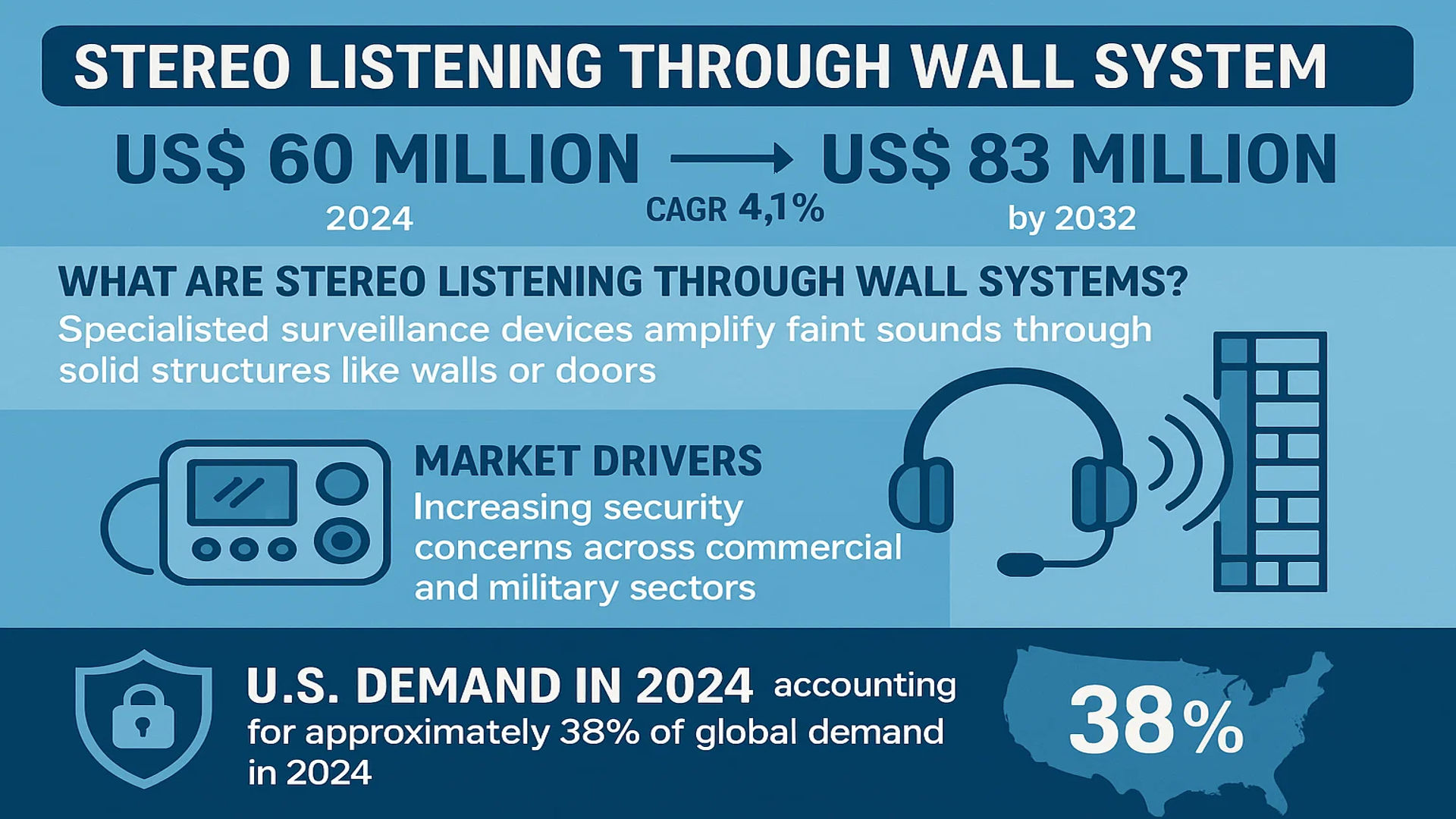
The global Stereo Listening Through Wall System Market size was valued at US$ 60 million in 2024 and is projected to reach US$ 83 million by 2032, at a CAGR of 4.1% during the forecast period 2025-2032.
Stereo listening through wall systems are specialized surveillance devices that amplify faint sounds through solid structures like walls or doors. These systems utilize sensitive microphones and advanced signal processing to detect, amplify, and clarify audio from adjacent spaces while maintaining directional stereo separation for improved sound localization.
The market growth is primarily driven by increasing security concerns across commercial and military sectors, with the U.S. accounting for approximately 38% of global demand in 2024. Technological advancements in noise filtration and signal enhancement have significantly improved device effectiveness, particularly for in-ear systems which are projected to grow at 8.4% CAGR through 2032. Key manufacturers like Beijing Heweiyongtai and Spy Equipment UK continue to innovate, with recent developments focusing on wireless connectivity and extended battery life for field operations.
MARKET DYNAMICS
MARKET DRIVERS
Rising Security Concerns Fueling Demand Across Commercial and Military Sectors
The global stereo listening through wall systems market is experiencing significant growth driven by increasing security threats across various industries. Commercial establishments, law enforcement agencies, and military organizations are adopting these systems as critical surveillance tools to enhance situational awareness and threat detection capabilities. The technology’s ability to capture low-frequency vibrations through solid barriers makes it indispensable in hostage situations, counter-terrorism operations, and corporate espionage prevention. Recent developments in sensor sensitivity and noise filtration algorithms have expanded the effective range of these systems, making them viable for diverse operational environments.
Technological Advancements in Acoustic Monitoring Solutions
Manufacturers are integrating cutting-edge signal processing technologies to improve system performance, creating momentum in market adoption. Modern systems now incorporate AI-powered algorithms that can distinguish between different sound sources, filter ambient noise, and even translate vibrations into intelligible audio with up to 85% accuracy. The transition from analog to digital signal processing has significantly enhanced audio clarity while reducing false positives. These technological improvements are particularly valuable for border security applications, where the ability to detect and interpret faint sounds through fortified barriers can provide critical intelligence.
➤ For instance, recent iterations from leading manufacturers now offer real-time frequency analysis and multi-channel recording capabilities, allowing operators to monitor several locations simultaneously.
Expanding Applications in Private Sector Driving Market Penetration
While military applications continue to dominate market share, commercial adoption is rising at an accelerated pace. Private investigators, hotel security teams, and facility managers are increasingly utilizing these systems for loss prevention and personnel safety. The technology’s covert operation capability makes it particularly attractive for discreet surveillance operations where visible monitoring equipment would be impractical. Furthermore, integration with existing security systems through IoT connectivity allows for centralized monitoring and automated alert systems, creating additional value propositions for enterprise clients.
MARKET RESTRAINTS
Stringent Privacy Regulations Creating Legal and Operational Challenges
Despite technological capabilities, the market faces significant barriers due to evolving data privacy laws. Many jurisdictions have implemented strict regulations regarding electronic surveillance and audio recording without consent, creating legal uncertainties for system deployment. In several countries, evidence obtained through wall listening systems is inadmissible in court unless obtained with proper authorization, limiting their use in law enforcement applications. These regulatory hurdles are particularly pronounced in Europe, where GDPR compliance requires meticulous documentation of surveillance activities.
Technical Limitations in Complex Architectural Environments
While the technology excels in certain scenarios, performance variations across different building materials and structures present operational challenges. Systems demonstrate inconsistent effectiveness when monitoring through multiple layers of insulation or sound-dampening materials commonly found in modern construction. Thick concrete walls or buildings with air gaps can reduce audio capture quality by as much as 40% compared to standard drywall partitions. This variability in performance creates reliability concerns that manufacturers are addressing through advanced material penetration algorithms and multi-sensor arrays.
MARKET OPPORTUNITIES
Emerging Markets Present Untapped Potential for Growth
The increasing urbanization in developing nations offers substantial market expansion opportunities. As cities grow denser and security concerns rise, municipal authorities are investing in advanced surveillance infrastructure. Several governments have initiated smart city projects that incorporate next-generation monitoring technologies, creating lucrative procurement opportunities for stereo listening system manufacturers. Strategic partnerships with local security firms could enable multinational providers to navigate regional regulatory landscapes while establishing distribution networks.
Product Miniaturization Opening New Application Segments
Advances in microelectronics are enabling dramatic reductions in device size without compromising performance. New prototypes demonstrate the feasibility of embedding listening capabilities in standard building materials or security equipment, creating opportunities for preventative security integration. This miniaturization trend aligns with the growing demand for non-intrusive security solutions in sensitive environments such as diplomatic facilities and corporate boardrooms. Furthermore, the development of wireless and battery-operated models is expanding deployment scenarios to temporary installations and mobile operations.
MARKET CHALLENGES
Counter-Technology Development Impacting System Effectiveness
As wall listening technologies become more prevalent, counter-surveillance solutions are emerging to thwart their capabilities. Sound masking systems and vibration-dampening materials specifically designed to interfere with acoustic surveillance present an ongoing technological arms race. Some high-security facilities now implement white noise generators that can reduce system effectiveness by up to 70%, forcing manufacturers to continuously innovate detection algorithms. This cat-and-mouse dynamic increases R&D costs and shortens product lifecycles in the industry.
Skilled Operator Shortage Limiting Market Potential
The effective use of wall listening systems requires specialized training in audio analysis and signal interpretation. The current shortage of trained personnel capable of maximizing system capabilities creates a bottleneck for market growth. Many security organizations lack the in-house expertise to properly calibrate equipment and interpret results, leading to suboptimal deployment. Manufacturers are addressing this challenge through comprehensive training programs and AI-assisted analysis features, but the knowledge gap remains a significant barrier to widespread adoption.
STEREO LISTENING THROUGH WALL SYSTEM MARKET TRENDS
Military and Security Applications Driving Market Expansion
The global Stereo Listening Through Wall System market is witnessing substantial growth, primarily fueled by increasing demand from military and security sectors. These advanced surveillance systems, capable of capturing faint sounds through solid barriers, have become indispensable tools for intelligence gathering and tactical operations. The U.S. continues to dominate this segment, accounting for approximately 45% of global military procurement in wall-listening technologies. Commercial applications are also rising, particularly in private investigations and law enforcement, where discretion and enhanced auditory monitoring are critical.
Other Trends
Technological Advancements in Audio Processing
Recent innovations in signal processing and noise reduction algorithms have significantly enhanced the performance of Stereo Listening Through Wall Systems. Modern devices leverage AI-powered sound isolation to filter ambient noise and amplify target frequencies within specific ranges. The integration of wireless connectivity and cloud-based storage has further expanded functionality, allowing users to remotely monitor and record audio data. These improvements have contributed to a projected 12% annual growth in commercial sector adoption.
Increasing Demand for Discreet Surveillance Solutions
The market is experiencing a shift toward more compact and concealable listening devices, with in-ear models growing at a 15% CAGR. Professionals across various sectors now favor unobtrusive systems that maintain functionality without drawing attention. Manufacturers are responding with micro-sized amplifiers that can be discreetly worn or installed. This trend is particularly evident in corporate security applications, where covert monitoring solutions help prevent industrial espionage and protect sensitive information. However, regulatory challenges regarding privacy laws continue to shape product development and adoption rates in certain regions.
COMPETITIVE LANDSCAPE
Key Industry Players
Innovation and Strategic Expansion Drive Competition in the Stereo Listening Through Wall System Market
The global Stereo Listening Through Wall System market features a fragmented yet rapidly evolving competitive landscape, characterized by both established players and emerging innovators. In 2024, the top five companies accounted for around 40% of global revenue, with demand primarily driven by security, surveillance, and law enforcement applications. While the market remains niche, increasing adoption in commercial and military sectors is creating opportunities for companies to differentiate their offerings.
Beijing Heweiyongtai Sci & Tech Co., Ltd. leads the market with its advanced wall-penetrating audio technology, particularly in Asia-Pacific regions. The company’s competitive edge stems from its proprietary signal processing algorithms, enabling clearer audio capture through dense materials. Meanwhile, Spy Equipment UK has strengthened its position through partnerships with European security agencies, enhancing its credibility in professional applications.
The market has seen growing interest from audio equipment manufacturers like Focal, traditionally known for high-end speakers, which has introduced sophisticated directional listening systems. Their brand recognition in audiophile circles provides a unique advantage in product positioning. Similarly, specialized surveillance providers such as Micronic are expanding their portfolio with integrated wall-listening solutions, combining audio capture with existing monitoring systems.
List of Key Stereo Listening Through Wall System Manufacturers
- Beijing Heweiyongtai Sci & Tech Co., Ltd. (China)
- Focal (France)
- Spy Equipment UK (United Kingdom)
- Micronic (U.S.)
- Lawmate International Corp. (Taiwan)
- Spy Chest (U.S.)
- BrickHouse Security (U.S.)
- Spy Associates (U.S.)
- Spy Tec (U.S.)
Recent strategic developments include the introduction of AI-enhanced noise filtering by leading players to distinguish speech from ambient noise, addressing one of the industry’s persistent challenges. While the competitive intensity is increasing, product certification standards and regulatory constraints in certain regions create barriers to entry, giving established players with compliance expertise an advantage in government procurement processes.
The market is expected to see further consolidation as security technology providers look to integrate listening capabilities into broader surveillance ecosystems. However, privacy concerns and evolving regulations continue to shape competitive dynamics, requiring manufacturers to balance technological advancement with ethical considerations.
Segment Analysis:
By Type
In-Ear Devices Lead the Market Due to Their Portability and Discretion
The market is segmented based on type into:
- In-Ear Devices
- Subtypes: Wired, Wireless, and Hybrid
- Head-Mounted Devices
- Subtypes: Noise-canceling, Standard, and Amplified
- Wall-Mounted Systems
- Portable Handheld Scanners
By Application
Military and Security Applications Dominate Due to Surveillance Needs
The market is segmented based on application into:
- Military & Security
- Law Enforcement
- Commercial Surveillance
- Private Investigation
By Technology
Digital Systems Are Gaining Prominence for Their Enhanced Clarity and Storage Capabilities
The market is segmented based on technology into:
- Analog Systems
- Digital Systems
- Subtypes: AI-Powered, Standard Digital
By End User
Government Agencies Lead Adoption of Advanced Listening Solutions
The market is segmented based on end user into:
- Government Agencies
- Private Security Firms
- Corporate Entities
- Individual Consumers
Regional Analysis: Stereo Listening Through Wall System Market
North America
The North American market for Stereo Listening Through Wall Systems is driven by high adoption in law enforcement and commercial security sectors. The U.S. dominates this market, accounting for the highest revenue share due to stringent security regulations and investments in advanced surveillance technologies. Increasing demand for covert listening devices in corporate investigations and homeland security applications supports market growth. However, privacy laws and ethical concerns regarding unauthorized surveillance pose challenges. Key players in the region are focusing on enhancing device sensitivity and integration with digital recording systems to meet evolving user needs.
Europe
Europe maintains a strong position in the market, where demand is primarily fueled by government agencies and private security firms. Strict data protection laws (e.g., GDPR) influence product compliance standards, pushing manufacturers to develop solutions with encrypted data transmission. Countries like Germany and the U.K. exhibit steady demand due to growing security concerns, while the Nordic region shows increasing interest in high-tech surveillance solutions. However, market expansion is somewhat restricted by regulatory scrutiny, requiring manufacturers to balance innovation with legal compliance.
Asia-Pacific
The fastest-growing market, Asia-Pacific benefits from rising security expenditure in China, India, and Japan. Expanding urban infrastructure and corporate espionage concerns drive adoption in both commercial and government sectors. However, price sensitivity limits the penetration of premium devices in emerging economies. China leads the regional market, with local manufacturers like Beijing Heweiyongtai dominating production. Meanwhile, India and Southeast Asia are increasingly incorporating these systems in military and law enforcement, creating long-term growth opportunities.
South America
South America presents a nascent but evolving market, where demand is primarily led by private investigative agencies and defense applications. Countries like Brazil and Argentina are investing in modern surveillance tools, though economic instability and limited regulation enforcement hinder market development. The lack of local manufacturers results in reliance on imports, which increases costs. Nevertheless, rising security concerns in urban areas suggest gradual market expansion in the coming years.
Middle East & Africa
In this region, the market remains underdeveloped but holds potential, particularly in GCC countries like the UAE and Saudi Arabia, where government and military applications dominate. Demand is fueled by counter-terrorism initiatives and corporate security needs, though limited local production and high import dependency slow market penetration. Africa’s market is fragmented, with South Africa and Egypt emerging as key consumers due to growing security investments. Economic constraints remain a barrier, but infrastructure development projects could drive future demand.
Report Scope
This market research report provides a comprehensive analysis of the global Stereo Listening Through Wall System market, covering the forecast period 2024–2032. It offers detailed insights into market dynamics, technological advancements, competitive landscape, and key trends shaping the industry.
Key focus areas of the report include:
- Market Size & Forecast: Historical data and future projections for revenue, unit shipments, and market value across major regions and segments.
- Segmentation Analysis: Detailed breakdown by product type (In-Ear, Head Mounted), application (Commercial, Military, Others), and end-user industry to identify high-growth segments and investment opportunities.
- Regional Outlook: Insights into market performance across North America, Europe, Asia-Pacific, Latin America, and the Middle East & Africa, including country-level analysis where relevant.
- Competitive Landscape: Profiles of leading market participants, including their product offerings, R&D focus, manufacturing capacity, pricing strategies, and recent developments such as mergers, acquisitions, and partnerships.
- Technology Trends & Innovation: Assessment of emerging technologies in audio amplification, signal processing, and noise filtration for wall-penetrating listening devices.
- Market Drivers & Restraints: Evaluation of factors driving market growth along with challenges, regulatory constraints, and market-entry barriers.
- Stakeholder Analysis: Insights for component suppliers, OEMs, security agencies, law enforcement, and investors regarding the evolving ecosystem and strategic opportunities.
Primary and secondary research methods are employed, including interviews with industry experts, data from verified sources, and real-time market intelligence to ensure the accuracy and reliability of the insights presented.
FREQUENTLY ASKED QUESTIONS:
What is the current market size of Global Stereo Listening Through Wall System Market?
->Stereo Listening Through Wall System Market size was valued at US$ 60 million in 2024 and is projected to reach US$ 83 million by 2032, at a CAGR of 4.1% during the forecast period 2025-2032.
Which key companies operate in Global Stereo Listening Through Wall System Market?
-> Key players include Beijing Heweiyongtai Sci & Tech Co., Ltd., Focal, Spy Equipment UK, and Micronic, among others.
What are the key growth drivers?
-> Key growth drivers include increasing security concerns, law enforcement applications, and technological advancements in audio surveillance.
Which region dominates the market?
-> North America currently leads the market, while Asia-Pacific is expected to show significant growth during the forecast period.
What are the emerging trends?
-> Emerging trends include integration of AI for noise filtering, miniaturization of devices, and development of wireless systems.

Get Sample Report PDF for Exclusive Insights
Report Sample Includes
- Table of Contents
- List of Tables & Figures
- Charts, Research Methodology, and more...
 Download Sample Report PDF