MARKET INSIGHTS
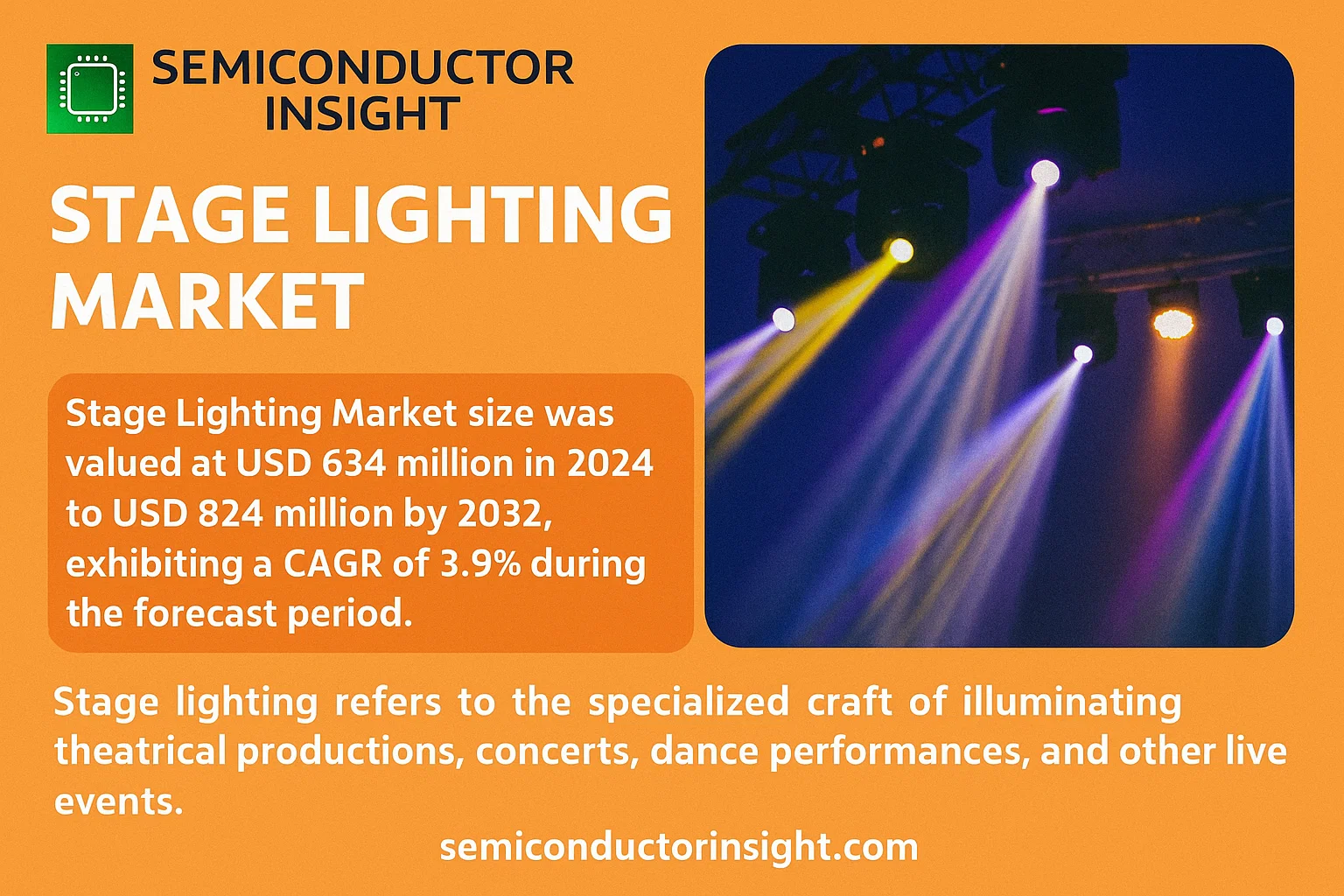
Global Stage Lighting Market size was valued at USD 634 million in 2024 to USD 824 million by 2032, exhibiting a CAGR of 3.9% during the forecast period.
Stage lighting refers to the specialized craft of illuminating theatrical productions, concerts, dance performances, and other live events. These lighting systems enable dynamic control over color temperature, brightness levels, beam angles, and movement patterns that can transform throughout a performance. The industry encompasses various fixture types including moving heads, wash lights, spotlights, beam projectors, and par cans.
The market is experiencing steady growth driven by several key factors: increasing global entertainment industry revenues, rising number of live events and concerts worldwide, and technological advancements in LED lighting systems. Furthermore, the growing adoption of energy-efficient solutions and smart lighting controls is contributing to market expansion. Asia currently dominates as the largest regional market with approximately 43% share due to rapid infrastructure development and expanding entertainment industries across China, Japan, and Southeast Asia. Key players such as ROBE Lighting, Martin Professional, Chauvet & Sons, ADJ Group, Golden Sea, and ACME are actively developing innovative products with enhanced features like wireless DMX control and advanced color mixing capabilities.
MARKET DRIVERS
Expansion of Live Events Industry
Global resurgence of large-scale concerts, theater productions, and international tours post-pandemic is a primary driver for the Stage Lighting Market. Demand for immersive and high-quality visual experiences is pushing venues and production companies to invest in advanced lighting systems. The live events industry is projected to grow by over 8% annually, directly fueling the need for sophisticated stage lighting solutions that enhance audience engagement.
Technological Advancements and LED Adoption
Rapid innovation in lighting technology, particularly the shift from conventional fixtures to energy-efficient LED systems, is driving market growth. LED stage lights offer superior color rendering, longer lifespans, and reduced power consumption, making them highly attractive for both permanent installations and touring setups. The adoption of connected lighting and IoT-enabled systems for centralized control is becoming a standard, improving operational efficiency and creative possibilities.
Furthermore, integration with digital visualization tools and moving head lights allows for dynamic, programmable shows, which are increasingly demanded by event organizers seeking to create unique and memorable experiences.
MARKET CHALLENGES
High Initial Investment and Cost Sensitivity
The significant upfront cost of advanced stage lighting systems, including intelligent fixtures, control consoles, and rigging infrastructure, presents a major barrier for smaller production companies and venues. Many operators face budget constraints, especially in developing regions, which can delay upgrades and limit market penetration for premium products.
Other Challenges
Technical Complexity and Skilled Labor Shortage
The increasing sophistication of stage lighting technology requires specialized knowledge for installation, programming, and maintenance. There is a growing skills gap in the industry, with a shortage of trained lighting designers and technicians capable of operating complex DMX and network-based systems, potentially slowing deployment and innovation.
Supply Chain Disruptions and Component Shortages
Global supply chain issues, affecting the availability of critical components like semiconductors and LEDs, continue to challenge manufacturers. Lead times for professional lighting equipment have extended, impacting project timelines and increasing costs for end-users.
MARKET RESTRAINTS
Economic Volatility and Reduced Discretionary Spending
Economic uncertainties and inflationary pressures can lead to cuts in entertainment budgets, affecting investments in new stage lighting equipment. Corporate events, festivals, and theatrical productions may be scaled back or postponed during economic downturns, directly restraining market growth. The Stage Lighting Market’s performance remains closely tied to the overall health of the entertainment and events sector.
Stringent Safety and Regulatory Standards
Compliance with rigorous international safety standards, such as those governing electrical safety, heat output, and structural rigging, adds complexity and cost to product development and deployment. Manufacturers must continually invest in testing and certification, which can slow down time-to-market for new innovations and increase final product prices.
MARKET OPPORTUNITIES
Growth in Immersive and Hybrid Events
The rise of hybrid events, combining live and virtual audiences, creates new demand for lighting solutions that are optimized for broadcast and streaming. Lighting systems that enhance on-camera appearance and integrate with augmented reality (AR) present significant growth avenues. This trend is expanding the market beyond traditional venues to include television studios and corporate virtual event platforms.
Smart City and Architectural Integration
There is increasing convergence between stage lighting and architectural lighting, particularly in multi-purpose venues and smart city projects. Lighting systems used for concerts and events are being integrated into permanent architectural installations, creating opportunities for manufacturers to supply versatile, dual-purpose products. The market for programmable facade lighting and public space illumination is experiencing steady growth.
Emerging Markets and Infrastructure Development
Rapid urbanization and the construction of new entertainment venues in Asia-Pacific, the Middle East, and Latin America offer substantial opportunities. Governments and private investors are funding large-scale cultural and sports infrastructure projects that require professional-grade stage lighting, driving demand in previously underserved regions.
Stage Lighting Market Trends
Global Market Growth Driven by Technological Advancements
Global Stage Lighting Market is on a steady growth trajectory, with a valuation of USD 634 million in 2024 and projections indicating a rise to USD 824 million by 2032, representing a compound annual growth rate (CAGR) of 3.9%. This sustained growth is largely fueled by the rapid adoption and development of LED technology. As the cost of LED lamps declines and their technological capabilities improve, LED stage lighting is playing an increasingly significant role in the industry, offering superior energy efficiency, longer lifespans, and greater color control compared to traditional discharge and halogen lighting systems.
Other Trends
Geographical Market Concentration
The market demonstrates significant geographical concentration. The Asia-Pacific region is the dominant market, holding approximately 43% of the global market share. This leadership is attributed to a booming entertainment industry and large-scale infrastructure development for performance venues. Europe and North America follow as major markets, accounting for about 29% and 26% of the market share respectively, supported by well-established entertainment sectors and high adoption rates of advanced lighting technologies.
Market Segmentation by Type and Application
Market segmentation reveals key trends in product and application preferences. By type, LED technology is increasingly capturing market share from traditional lighting types such as discharge and halogen lamps. The primary applications driving demand include entertainment venues, performance venues, and tourist performing arts venues, where dynamic and high-quality lighting is essential for creating immersive audience experiences.
Competitive Landscape and Consolidation
The competitive landscape is characterized by the presence of key players such as ROBE, Martin, ACME, and Golden Sea. The market shows a moderate level of concentration, with the top 10 companies collectively occupying approximately 41% of the total market share. This indicates a competitive environment where innovation, product development, and strategic mergers and acquisitions are critical for maintaining and growing market position. The ongoing focus on research and development to enhance lighting effects, connectivity, and smart control systems continues to be a defining trend among leading manufacturers.
COMPETITIVE LANDSCAPE
Key Industry Players
A Market Dominated by Incumbent Leaders and Specialized Innovators
Global Stage Lighting Market is moderately concentrated, with the top ten players accounting for approximately 41% of the market share. The landscape is led by established European manufacturers renowned for their high-quality, professional-grade lighting systems used in major concerts, theatre productions, and live events worldwide. ROBE lighting, Martin Professional, and Chauvet stand out as dominant forces, benefiting from strong brand recognition, extensive product portfolios, and global distribution networks. Their focus on innovation, particularly in high-output LED technology and intelligent lighting control systems, solidifies their leadership positions. The competitive dynamics are characterized by continuous technological advancement, a shift towards energy-efficient LED solutions, and strategic moves such as mergers and acquisitions to expand market reach and technological capabilities.
Beyond the market leaders, a significant portion of the market is served by a broad array of specialized and regional players. Companies like ADJ Group, ETC (Electronic Theatre Controls), and PR Lighting cater to specific segments such as fixed installation in theatres, television studios, and mid-sized entertainment venues. Furthermore, a strong contingent of manufacturers based in Asia, particularly in China, has gained considerable traction by offering cost-effective solutions. Key players from this region include ACME, Golden Sea, Yajiang Photoelectric, and SGM Lighting. These companies compete effectively on price and have significantly improved the quality and technological sophistication of their offerings, capturing substantial market share in the Asia-Pacific region, which is the largest global market for stage lighting.
List of Key Stage Lighting Companies Profiled
- ROBE
- Martin Professional
- Chauvet
- ADJ Group
- JB-Lighting
- Stadio due
- ETC (Electronic Theatre Controls)
- Visage
- SGM Lighting
- Yajiang Photoelectric
- PR Lighting
- Golden Sea
- Fine Art Light
- ACME
- Colorful Light
Segment Analysis:
| Segment Category | Sub-Segments | Key Insights |
| By Type |
|
LED has emerged as the undisputed leader in the Stage Lighting Market, driven by its significant energy efficiency, superior color rendering capabilities, and long operational lifespan which substantially lowers the total cost of ownership. The continuous decline in the cost of LED lamps and ongoing technological advancements are accelerating the replacement of traditional lighting technologies. Furthermore, LEDs offer unparalleled creative flexibility for lighting designers, including dynamic color mixing and digital control, making them the preferred choice for modern productions that demand vibrant and customizable visual experiences. |
| By Application |
|
Entertainment Venues represent the dominant application segment due to the high volume of concerts, nightclubs, and large-scale entertainment events that require sophisticated and powerful lighting systems to create immersive audience experiences. These venues are characterized by a constant demand for the latest lighting technologies to enhance showmanship and visual impact. The segment is driven by the global live events industry’s growth and the rising expectations of audiences for high-production-value spectacles, which fuels continuous investment in advanced stage lighting equipment and control systems. |
| By End User |
|
Rental and Staging Companies are a crucial end-user segment, acting as a primary channel for making high-end stage lighting accessible for a wide range of events without the need for large capital expenditures from individual clients. These companies drive demand for durable, versatile, and technologically advanced lighting fixtures that can withstand frequent transport and varied use cases. Their business model thrives on the cyclical nature of the entertainment industry and the need for event-specific lighting solutions, making them highly influential in adopting and promoting new lighting innovations. |
| By Light Source Technology |
|
Automated/Intelligent Lighting is the leading segment based on technological sophistication, offering dynamic movement, remote controllability, and programmable features that are essential for complex live productions. These systems, including moving head lights and pixel-mappable fixtures, provide lighting designers with an extensive toolkit for creating dynamic and evolving visual narratives. The demand is driven by the pursuit of greater artistic expression and the ability to synchronize lighting with other media, such as video and audio, creating a fully integrated sensory experience for modern audiences. |
| By Control System |
|
Networked/Architectural Control systems are at the forefront, enabling the centralized and sophisticated management of complex lighting rigs across large venues and permanent installations. This segment’s growth is fueled by the need for reliability, scalability, and the ability to pre-program intricate lighting cues for shows and events. The integration of lighting control with broader building management and show control systems is a key trend, allowing for seamless operation and enhancing the overall efficiency and creative potential of lighting designs in both temporary and fixed installations. |
Regional Analysis: Stage Lighting Market
North America is the primary testing ground for next-generation stage lighting technologies, including advanced wireless DMX systems, pixel-mapping software, and laser projection. Major manufacturers often launch flagship products in this market first, and its demanding production companies set the bar for performance, reliability, and creative capabilities that influence global product development and feature sets for the entire industry.
The sheer scale of the North American entertainment industry, from massive music festivals like Coachella to long-running Las Vegas residencies and Broadway, creates unparalleled demand for sophisticated lighting. This ecosystem not only consumes vast quantities of equipment but also inspires new lighting design trends that are replicated worldwide, making it a critical barometer for the health and direction of the global Stage Lighting Market.
Strict safety and energy regulations, particularly from bodies like UL in the U.S., mandate the use of high-quality, safe, and increasingly energy-efficient stage lighting equipment. This regulatory environment discourages the use of low-cost, non-compliant products and fosters a market where reliability, certification, and compliance are key purchasing factors, benefiting established manufacturers with robust quality control.
A well-established and highly competitive network of specialized distributors and large-scale rental houses serves the North American market. These companies provide critical services beyond mere sales, including technical support, system design, and extensive inventory for tours. This mature infrastructure lowers the barrier to entry for high-quality productions and ensures equipment is accessible across the vast region.
Europe
Europe represents a highly sophisticated and diverse market for stage lighting, characterized by a rich cultural heritage and a strong tradition of performing arts. The region boasts world-renowned opera houses, theatre festivals like Edinburgh Fringe, and major music events such as Glastonbury. There is a pronounced emphasis on architectural and heritage lighting for permanent installations in historic venues, requiring specialized, sensitive solutions. The market is also driven by strong public funding for the arts in many countries, supporting regional theatres and cultural events. European manufacturers are known for their engineering excellence and design innovation, particularly in LED technology and control systems. The market is fragmented, with varying preferences and regulations across different countries, but a unified trend towards energy efficiency and sustainability is a major driving force, influencing product development and procurement decisions across the continent.
Asia-Pacific
The Asia-Pacific region is the fastest-growing market for stage lighting, fueled by rapid economic development, urbanization, and a booming entertainment industry. Major growth hotspots include China, Japan, South Korea, and Southeast Asian nations. China, in particular, is a massive manufacturing hub and an increasingly important consumer market, with large-scale government-backed events and a growing domestic entertainment sector. The region shows a strong appetite for large, spectacular displays in theme parks, large-scale ceremonies, and increasingly sophisticated touring productions. While cost sensitivity remains a factor, there is a clear upward trend in the demand for higher-quality, professional-grade equipment. Local manufacturers are becoming increasingly competitive, offering innovative products that challenge established global brands, making the region a dynamic and highly competitive landscape.
South America
The Stage Lighting Market in South America is emerging, with growth primarily concentrated in major economies like Brazil and Argentina. The market is heavily influenced by a vibrant carnival culture, large music festivals, and a growing middle class with increasing disposable income for live entertainment. Demand is often focused on robust and cost-effective solutions suitable for large outdoor events. The market faces challenges such as economic volatility and complex import regulations, which can affect the consistency of supply and investment. However, there is a noticeable trend towards modernization, with venues and production companies gradually upgrading from basic lighting to more advanced LED and moving light systems, indicating significant potential for future growth as economic conditions stabilize.
Middle East & Africa
The Stage Lighting Market in the Middle East & Africa is characterized by extreme contrasts. The Middle East, particularly the Gulf Cooperation Council (GCC) countries, features high-value markets driven by lavish events, luxury hotel installations, and ambitious government projects aiming to establish global tourism and entertainment hubs. This region demands the latest, most advanced lighting technology for spectacular displays. In contrast, the broader African market is nascent and price-sensitive, with growth slowly emerging around major urban centers and a developing live events scene. The continent shows potential, but growth is hampered by infrastructural challenges and limited purchasing power outside of specific sectors and regions, creating a market of significant but uneven opportunity.
Report Scope
This market research report provides a comprehensive analysis of the Global Stage Lighting Market, covering the forecast period 2025–2032. It offers detailed insights into market dynamics, technological advancements, competitive landscape, and key trends shaping the industry.
Key focus areas of the report include:
- Market Overview: The report begins with an overview outlining its current market scenario, key growth indicators, and industry transformation drivers. It discusses macroeconomic factors, demand–supply balance, regulatory landscape, and the strategic role of semiconductors in powering advancements across industries such as automotive, telecommunications, consumer electronics, and industrial automation.
- Market Size & Forecast: Historical data and future projections for revenue, unit shipments, and market value across major regions and segments.
- Segmentation Analysis: Detailed breakdown by product type, technology, application, and end-user industry to identify high-growth segments and investment opportunities.
- Regional Insights: Insights into market performance across North America, Europe, Asia-Pacific, Latin America, and the Middle East & Africa, including country-level analysis where relevant.
- Competitive Landscape: Profiles of leading market participants, including their product offerings, R&D focus, manufacturing capacity, pricing strategies, and recent developments such as mergers, acquisitions, and partnerships.
- Technology Trends & Innovation: Assessment of emerging technologies, integration of AI/IoT, semiconductor design trends, fabrication techniques, and evolving industry standards.
- Market Drivers & Restraints: Evaluation of factors driving market growth along with challenges, supply chain constraints, regulatory issues, and market-entry barriers.
- Stakeholder Insights: Insights for component suppliers, OEMs, system integrators, investors, and policymakers regarding the evolving ecosystem and strategic opportunities.
Primary and secondary research methods are employed, including interviews with industry experts, data from verified sources, and real-time market intelligence to ensure the accuracy and reliability of the insights presented.
FREQUENTLY ASKED QUESTIONS:
What is the current market size of Stage Lighting Market?
-> Stage Lighting Market size was valued at USD 634 million in 2024 to USD 824 million by 2032, exhibiting a CAGR of 3.9% during the forecast period.
Which key companies operate in Stage Lighting Market?
-> Key players include ROBE, Golden Sea, Martin, and ACME, among others. The top 10 companies occupied about 41% market share.
What are the key growth drivers?
-> Key growth drivers include the decline of LED lamp costs, the development of LED technology, and the increasing significance of LED lighting in the stage lighting industry.
Which region dominates the market?
-> Asia is the largest Stage Lighting market with about 43% market share, followed by Europe (29%) and North America (26%).
What are the emerging trends?
-> Emerging trends include the dominant role of LED stage lighting, technological advancements in lighting instruments, and the use of stage lighting across theatre, dance, opera, and other performance arts.

Get Sample Report PDF for Exclusive Insights
Report Sample Includes
- Table of Contents
- List of Tables & Figures
- Charts, Research Methodology, and more...
 Download Sample Report PDF