
MARKET INSIGHTS
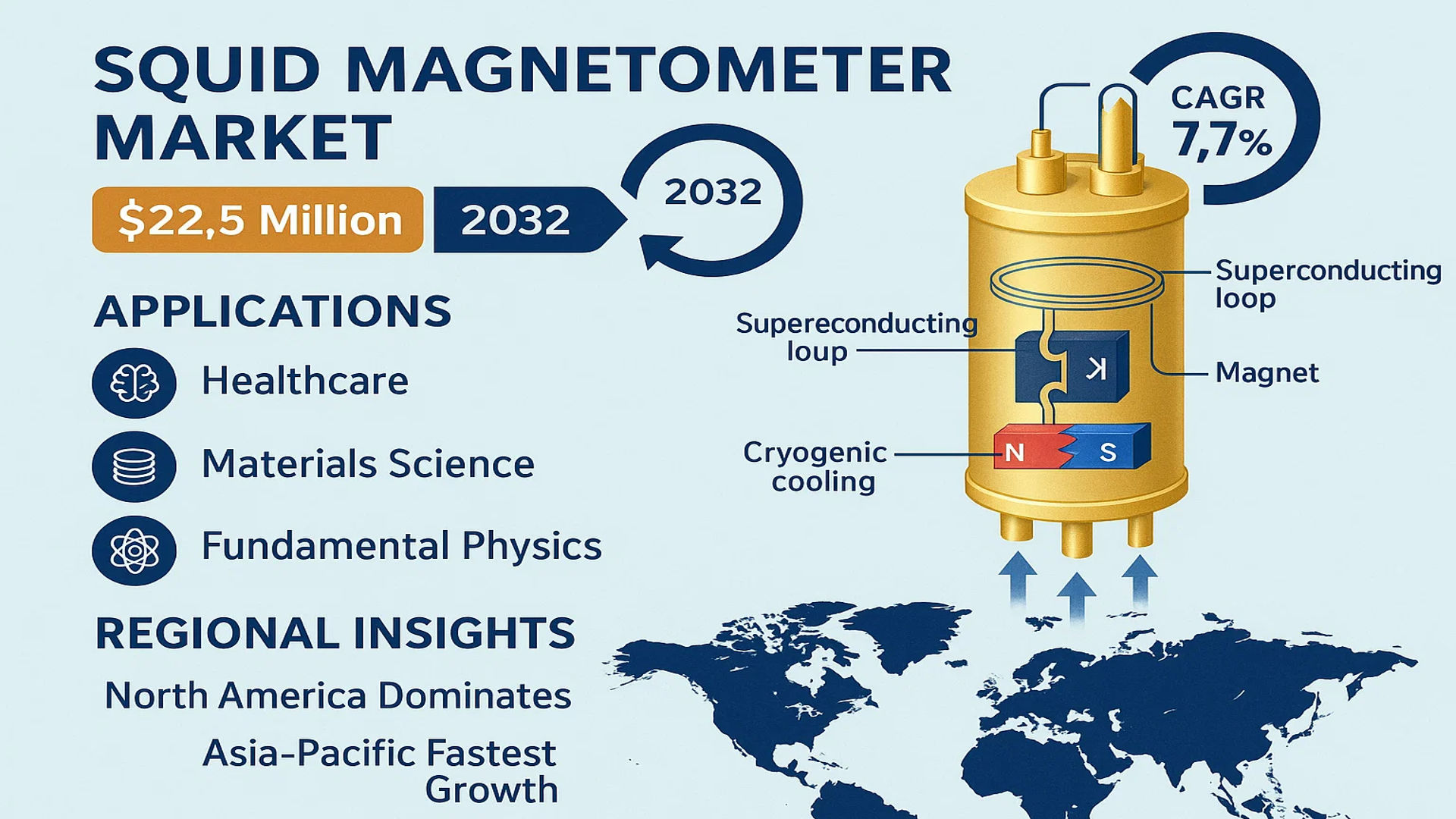
The global SQUID Magnetometer Market was valued at 22.5 million in 2024 and is projected to reach US$ 44.4 million by 2032, at a CAGR of 7.7% during the forecast period. While North America currently dominates the market share due to advanced research infrastructure, Asia-Pacific is anticipated to witness the fastest growth owing to increasing investments in quantum technology and medical imaging applications.
A SQUID (Superconducting Quantum Interference Device) Magnetometer represents the gold standard for ultra-sensitive magnetic field detection, capable of measuring fields as weak as femtotesla (10-15 T). These quantum-based instruments leverage superconducting loops with Josephson junctions to detect minute magnetic flux changes, requiring cryogenic cooling (typically 4K using liquid helium) to maintain superconducting conditions. SQUID magnetometers find critical applications across healthcare (particularly in Magnetoencephalography for brain activity mapping), materials science (for characterizing superconductors), and fundamental physics research (including dark matter detection).
Market growth is primarily driven by expanding applications in biomedical diagnostics, where non-invasive techniques like MEG gain traction for epilepsy and Alzheimer’s research. However, high operational costs associated with cryogenic systems pose adoption challenges. Recent technological advancements focus on developing liquid-nitrogen cooled SQUIDs (operating at 77K) to reduce operational expenses. Key players like Quantum Design and Tristan Technologies are innovating compact systems for industrial NDT applications, while European manufacturers lead in biomedical implementations, reflecting the market’s diverse application-driven segmentation.
MARKET DYNAMICS
MARKET DRIVERS
Advancements in Medical Imaging & Neuroscience Research Fueling SQUID Magnetometer Demand
The global SQUID magnetometer market is being propelled by increasing adoption in medical imaging applications, particularly Magnetoencephalography (MEG) systems used for mapping brain activity. With rising neurological disorder prevalence, healthcare providers are investing heavily in advanced diagnostic tools – the global MEG systems market is expected to reach $326 million by 2026, directly driving SQUID sensor adoption. These ultra-sensitive devices can detect neuronal activity with millisecond temporal resolution, making them indispensable for pre-surgical planning and epilepsy research. In 2023 alone, over 150 new MEG systems were installed globally, each requiring multiple SQUID sensors for optimal functionality.
Growing Materials Science Research Creating New Application Frontiers
Materials science represents one of the fastest-growing application segments for SQUID magnetometers, with research institutions and electronics manufacturers increasingly utilizing these devices to study superconducting materials and quantum phenomena. The push toward room-temperature superconductors and spintronic devices has created robust demand for precise magnetic characterization tools. In semiconductor manufacturing, SQUIDs are becoming critical for defect detection in wafer production lines, as they can identify microscopic impurities affecting chip performance. Government funding for quantum computing research exceeded $2.8 billion globally in recent years, directly benefiting SQUID technology development for qubit measurement and control applications.
Defense and Security Applications Driving Innovation
Military organizations worldwide are increasingly deploying SQUID-based systems for submarine detection, unexploded ordnance location, and anti-stealth technologies. These applications leverage the devices’ unparalleled sensitivity to detect minute magnetic anomalies. Recent naval modernization programs have allocated significant budgets for magnetic anomaly detection (MAD) systems, with the Asia-Pacific region showing particularly strong adoption. Commercial security applications are also emerging, including SQUID-based screening systems capable of detecting concealed weapons without physical contact – a technology currently being piloted at major transportation hubs.
MARKET RESTRAINTS
High Operational Costs and Complex Maintenance Requirements
The sophisticated cryogenic systems required for SQUID operation present a significant barrier to wider adoption, with complete systems often costing between $200,000-$500,000. Liquid helium consumption remains a persistent cost challenge, requiring specialized infrastructure and trained personnel for handling. Maintenance costs can exceed 15% of the initial purchase price annually, making long-term ownership prohibitive for many research institutions and smaller enterprises. While cryocoolers have reduced reliance on liquid helium, their adoption adds substantial upfront costs and introduces vibrational noise that can compromise measurement accuracy in sensitive applications.
Other Key Restraints
Technical Complexity Limits End-User Base
The quantum mechanical principles underlying SQUID operation require specialized knowledge for proper utilization, creating a steep learning curve that limits the technology’s accessibility. Many potential users in industrial settings lack personnel with the necessary expertise, opting instead for less sensitive but more user-friendly alternatives like fluxgate magnetometers. This knowledge gap is particularly evident in emerging markets where access to cryogenic expertise remains limited.
Competition From Alternative Technologies
While SQUIDs remain unmatched in absolute sensitivity, emerging technologies like optically pumped magnetometers (OPMs) are gaining traction in medical and industrial applications. OPMs offer room-temperature operation and comparable sensitivity for certain applications, with commercial systems now achieving sub-picotesla resolution. This competition is particularly acute in neurology, where wearable OPM-MEG systems threaten to disrupt traditional SQUID-based installations.
MARKET OPPORTUNITIES
Next-Generation Cryogen-Free Systems Opening New Commercial Applications
Recent breakthroughs in cryogen-free SQUID technology present significant growth opportunities, particularly in industrial settings where liquid helium infrastructure is impractical. Advanced pulse tube cryocoolers now enable continuous operation below 4K without cryogen replenishment, reducing operating costs by up to 60%. Several manufacturers have introduced turnkey systems targeting materials characterization and semiconductor inspection markets. The development of compact, cryogen-free MEG systems could dramatically expand neurological diagnostics accessibility, potentially enabling deployment in community hospitals and outpatient clinics.
Quantum Computing Ecosystem Creating Adjacent Markets
The rapid development of quantum computing infrastructure creates complementary demand for SQUID-based readout and control systems. Leading quantum hardware developers are increasingly adopting SQUID amplifiers for qubit state measurement, with single-chip integration showing promising results in recent prototypes. This emerging application segment could account for over 15% of the SQUID market by 2028. Concurrently, quantum sensing applications are gaining traction in geology and fundamental physics research, where SQUIDs enable detection of weakly interacting massive particles (WIMPs) and other exotic phenomena.
MARKET CHALLENGES
Environmental Noise and Electromagnetic Interference Limits Urban Deployments
The extreme sensitivity that makes SQUIDs valuable also renders them vulnerable to environmental noise, particularly in urban and industrial settings. Stray electromagnetic fields from power lines, transportation systems, and electronic devices can overwhelm target signals, requiring complex shielding solutions that increase system costs and complexity. While advanced noise cancellation algorithms have improved performance, site selection remains a critical factor that limits deployment options for many applications. This challenge is particularly acute for biomagnetic measurements, where urban hospital locations often necessitate expensive shielded rooms costing $1-2 million per installation.
Other Key Challenges
Supply Chain Vulnerabilities for Critical Components
The specialized materials required for SQUID fabrication, including high-quality superconducting films and Josephson junctions, face supply chain constraints. Geopolitical tensions have disrupted access to certain rare earth materials essential for cryogenic systems, while semiconductor shortages impact electronic component availability. These factors have led to extended lead times (often exceeding 6 months) for complete systems, frustrating end-users and constraining market growth.
Regulatory Barriers in Medical Applications
Medical device approval processes present significant hurdles for new SQUID-based diagnostic systems, with clinical validation requiring large-scale trials and extensive documentation. The FDA’s evolving requirements for biomagnetic imaging devices have delayed several product launches in recent years, creating uncertainty for manufacturers. Similar regulatory challenges exist in other regions, where harmonization of standards remains incomplete for advanced magnetic sensing technologies.
SQUID MAGNETOMETER MARKET TRENDS
Increasing Demand for Ultra-Sensitive Magnetic Field Detection in Healthcare
The healthcare sector is experiencing significant advancements, particularly in diagnostic technologies, driving demand for SQUID magnetometers. These devices, with their attotesla-level sensitivity, are critical for applications such as Magnetoencephalography (MEG), a non-invasive technique for mapping brain activity. Their ability to detect extremely weak biomagnetic fields—such as those generated by neural activity—positions them as indispensable tools in neurology and cardiology diagnostics. Moreover, research in neurodegenerative diseases like Parkinson’s and Alzheimer’s is increasingly relying on high-precision magnetic field measurements, further accelerating adoption in clinical settings. With an aging global population and rising neurological disorder cases, diagnostic applications are expected to fuel market expansion.
Other Trends
Material Science and Quantum Research Expansion
The investigation of novel superconducting materials and quantum computing components has intensified the need for SQUID-based measurements. Researchers utilize these magnetometers to study superconductivity, magnetic nanoparticles, and quantum phenomena, which are pivotal in developing next-generation electronics. The quantum industry, in particular, is leveraging SQUID magnetometers to test coherence times and magnetic flux manipulation in qubit systems. While quantum computing remains in its nascent stages, substantial investments from governments and private entities worldwide are accelerating the incorporation of SQUIDs into R&D pipelines, further extending their market potential.
Challenges in Operational Complexity and Cryogenic Requirements
Despite their unmatched sensitivity, SQUID magnetometers face barriers due to operational complexities, including the necessity for cryogenic cooling with liquid helium—a costly and resource-intensive process. This requirement limits scalability across industries, particularly in regions with inadequate helium supply chains. However, recent materials research focusing on high-temperature superconductors offers a potential workaround to reduce dependency on extreme cooling. Additionally, advancements in cryocooler technologies are lowering operational costs, enabling broader adoption in geological and industrial applications. Innovations in compact SQUID designs could further mitigate these challenges in the coming years, opening new opportunities.
Growth in Geophysical and Mineral Exploration Applications
Geophysical surveys for mineral exploration increasingly incorporate SQUID magnetometers to detect subtle magnetic anomalies in underground formations. Their precision in identifying mineral deposits—such as rare earth elements critical for renewable energy technologies—positions them as superior alternatives to conventional magnetometers. In countries with substantial mining sectors, like Canada and Australia, adoption is further boosted by government-funded exploration initiatives. The rising demand for electric vehicle components, supported by global decarbonization policies, is also propelling market growth in this segment, with projections indicating sustained expansion over the next decade.
COMPETITIVE LANDSCAPE
Key Industry Players
Market Leaders Focus on High-Sensitivity Solutions to Maintain Competitive Edge
The global SQUID Magnetometer market features a mix of established players and specialized manufacturers, creating a semi-concentrated competitive environment. Quantum Design and Magnicon GmbH currently dominate the high-end segment, leveraging their patented superconducting technologies and extensive research collaborations. Quantum Design’s MPMS3 and DynaCool systems have become industry standards for materials research labs, capturing over 25% of the academic and industrial research segments.
In the medical imaging applications, ez SQUID and MagQu Co. Ltd. are emerging as strong contenders through innovative biomagnetic detection systems. Their ultra-sensitive MEG solutions are gaining traction in neurological research hospitals, particularly in North America and Europe where Magnetoencephalography adoption is growing at 9.2% annually. This growth is fueled by increasing research into neurodegenerative diseases and brain mapping projects.
Several manufacturers are expanding their geographical footprint through strategic partnerships. STAR Cryoelectronics recently partnered with Japanese research institutes to develop next-generation DC SQUID arrays, while Tristan Technologies acquired a cryogenics firm to vertically integrate its supply chain. Such moves are expected to reshape market dynamics by reducing production costs and lead times.
The competitive intensity is further heightened by technological differentiation. While some players like SUSTEC focus on ruggedized designs for field geology applications, others such as Physike Technology specialize in miniaturized systems for aerospace applications. This segmentation allows multiple players to coexist while catering to specific niche requirements across industries.
List of Key SQUID Magnetometer Manufacturers
- Quantum Design (U.S.)
- Magnicon GmbH (Germany)
- STAR Cryoelectronics (U.S.)
- Tristan Technologies (U.S.)
- SUSTEC (China)
- ez SQUID (Israel)
- MagQu Co. Ltd. (Taiwan)
- Supracon (Germany)
- Physike Technology (Japan)
Segment Analysis:
By Type
DC SQUID Segment Leads Due to Superior Sensitivity in Detecting Ultra-Weak Magnetic Fields
The market is segmented based on type into:
- DC SQUID
- RF SQUID
By Application
Healthcare Segment Dominates with High Demand for Neurological Imaging Applications
The market is segmented based on application into:
- Healthcare
- Subtypes: Magnetoencephalography (MEG), Cardiac imaging, and others
- Industrial Manufacturing
- Aerospace
- Geological Survey
- Others
By End User
Research Institutions Dominate Due to Extensive Use in Quantum and Material Sciences
The market is segmented based on end user into:
- Research Institutions
- Subtypes: Universities, Government labs, and private research centers
- Hospitals and Diagnostic Centers
- Industrial Enterprises
- Government Agencies
Regional Analysis: SQUID Magnetometer Market
North America
North America leads the global SQUID magnetometer market, driven by significant investments in research infrastructure and advanced clinical diagnostics. The U.S. accounts for over 65% of regional demand, propelled by biomedical applications such as Magnetoencephalography (MEG) in prestigious institutions like Massachusetts General Hospital and UCLA. With strong R&D expenditure (nearly $600 billion annually across sectors), technological superiority in quantum sensing, and the presence of key manufacturers like Quantum Design and Tristan Technologies, the region maintains its technological leadership. Major defense contracts for SQUID-based submarine detection systems further reinforce market growth. However, high operational costs due to liquid helium cooling requirements present a persistent challenge.
Europe
Europe’s market growth is underpinned by collaborative research initiatives under Horizon Europe and national quantum technology programs. Germany and the UK collectively represent 58% of regional sales, with notable adoption in material science research at institutions like Max Planck Society and the National Physical Laboratory. Stringent EU regulations on medical device accuracy are accelerating the transition from conventional sensors to SQUID-based systems in neurological diagnostics. However, market expansion faces headwinds from declining helium reserves and ongoing efforts to develop alternative cooling technologies. Recent developments include the 2024 integration of SQUID arrays in CERN’s dark matter detection experiments.
Asia-Pacific
The APAC region exhibits the fastest growth (projected 9.2% CAGR through 2032), dominated by China’s aggressive quantum technology investments under its 14th Five-Year Plan. Japan follows closely with applications in earthquake prediction systems and superconducting material research. While India shows emerging potential through institutes like TIFR Mumbai, cost sensitivity currently limits adoption to high-budget research facilities. South Korea’s semiconductor industry has begun adopting SQUID solutions for wafer defect detection, signaling diversification beyond traditional research applications. The absence of domestic SQUID manufacturers creates strong import dependency on U.S. and European providers.
South America
Market growth in South America remains constrained by limited research funding and infrastructure, though Brazil demonstrates gradual adoption in oil exploration through Petrobras’ deep-earth magnetic surveys. Argentina’s nuclear research facilities represent niche demand pockets. The region’s lack of cryogenic supply chains and technical expertise creates substantial barriers, with most systems imported through partnerships with European suppliers. Recent mineral prospecting initiatives in Chile show promise for geological applications, but economic volatility continues to suppress larger-scale adoption.
Middle East & Africa
The MEA market remains in nascent stages, with Israel accounting for 72% of regional demand through defense and cybersecurity quantum research applications. GCC countries are making preliminary investments in medical applications, evidenced by 2023 installations at King Faisal Specialist Hospital. Africa’s market is virtually untapped except for mining surveys in South Africa. While the region’s extreme temperatures pose operational challenges, growing technology transfer agreements with Chinese and European firms indicate long-term potential, particularly for petroleum reservoir mapping and neurological research centers in urbanizing economies.
Report Scope
This market research report provides a comprehensive analysis of the Global SQUID Magnetometer Market, covering the forecast period 2024–2032. It offers detailed insights into market dynamics, technological advancements, competitive landscape, and key trends shaping the industry.
Key focus areas of the report include:
- Market Size & Forecast: Historical data and future projections for revenue, unit shipments, and market value across major regions and segments. The Global SQUID Magnetometer market was valued at USD 22.5 million in 2024 and is projected to reach USD 44.4 million by 2032, growing at a CAGR of 7.7% during the forecast period.
- Segmentation Analysis: Detailed breakdown by product type (DC SQUID and RF SQUID), application (Healthcare, Industrial Manufacturing, Aerospace, Geological Survey, and Others), and end-user industry to identify high-growth segments and investment opportunities.
- Regional Outlook: Insights into market performance across North America, Europe, Asia-Pacific, Latin America, and the Middle East & Africa, including country-level analysis where relevant. The U.S. and China are key markets driving demand.
- Competitive Landscape: Profiles of leading market participants, including their product offerings, R&D focus, manufacturing capacity, pricing strategies, and recent developments such as mergers, acquisitions, and partnerships. Key players include STAR Cryoelectronics, Tristan Technologies, Quantum Design, and Magnicon GmbH.
- Technology Trends & Innovation: Assessment of emerging technologies, including advancements in cryogenic cooling, integration of AI for signal processing, and miniaturization of SQUID devices for portable applications.
- Market Drivers & Restraints: Evaluation of factors driving market growth, such as increasing demand for biomedical imaging and materials science research, along with challenges like high operational costs and the need for cryogenic cooling.
- Stakeholder Analysis: Insights for component suppliers, OEMs, system integrators, investors, and policymakers regarding the evolving ecosystem and strategic opportunities in the SQUID Magnetometer market.
Primary and secondary research methods are employed, including interviews with industry experts, data from verified sources, and real-time market intelligence to ensure the accuracy and reliability of the insights presented.
FREQUENTLY ASKED QUESTIONS:
What is the current market size of the Global SQUID Magnetometer Market?
-> SQUID Magnetometer Market was valued at 22.5 million in 2024 and is projected to reach US$ 44.4 million by 2032, at a CAGR of 7.7% during the forecast period..
Which key companies operate in the Global SQUID Magnetometer Market?
-> Key players include STAR Cryoelectronics, Tristan Technologies, Quantum Design, Supracon, Magnicon GmbH, and ez SQUID, among others.
What are the key growth drivers?
-> Key growth drivers include increasing demand for biomedical imaging (MEG), advancements in materials science research, and the need for ultra-sensitive magnetic field detection in quantum computing and geophysical surveys.
Which region dominates the market?
-> North America is the largest market due to significant investments in healthcare and research, while Asia-Pacific is the fastest-growing region driven by expanding industrial and scientific applications.
What are the emerging trends?
-> Emerging trends include the development of portable SQUID systems, integration with AI for real-time data analysis, and advancements in cryogen-free cooling technologies.

Get Sample Report PDF for Exclusive Insights
Report Sample Includes
- Table of Contents
- List of Tables & Figures
- Charts, Research Methodology, and more...
 Download Sample Report PDF


