MARKET INSIGHTS
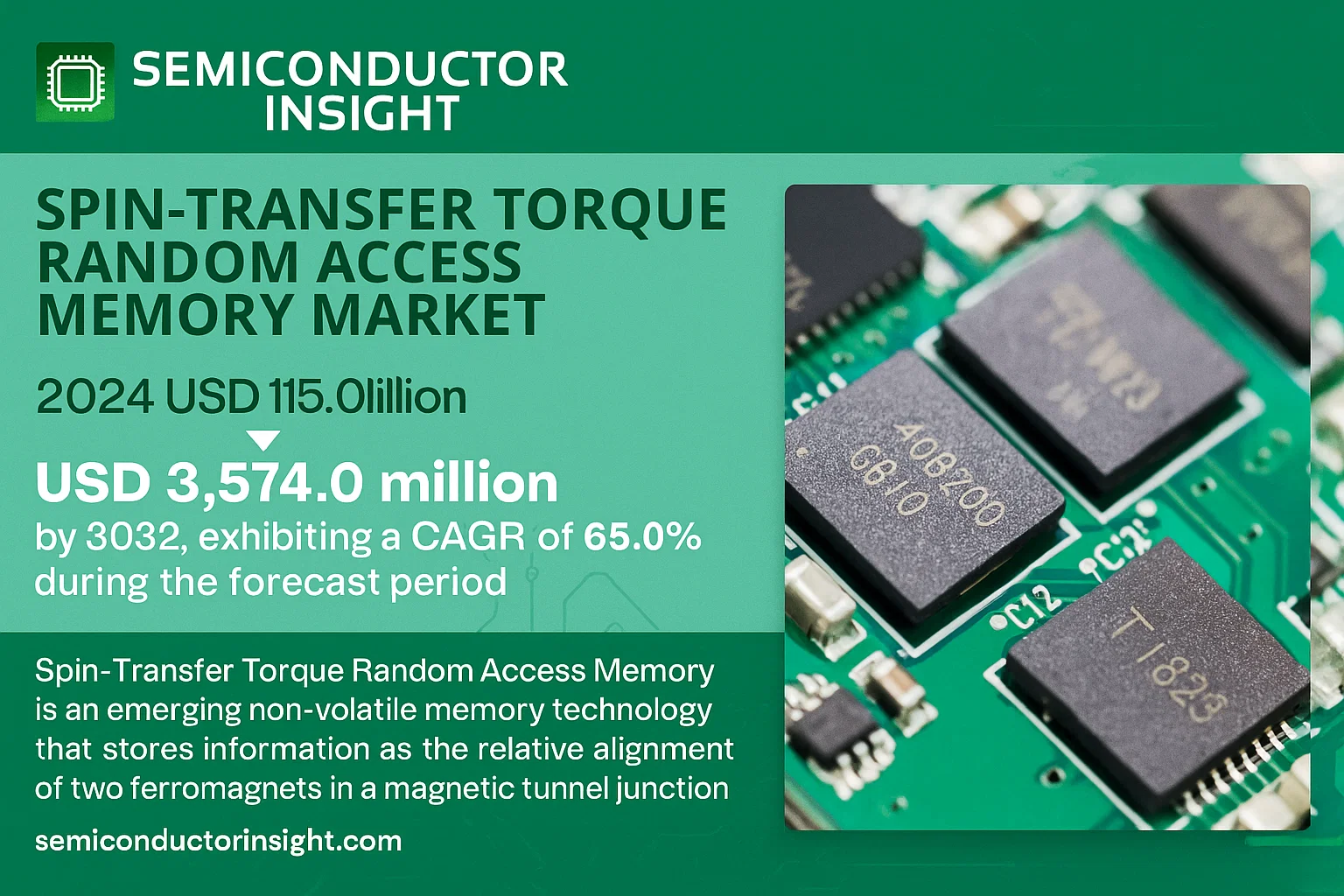
Global Spin-Transfer Torque Random Access Memory Market was valued at USD 115.0 million in 2024 and is projected to reach USD 3,574.0 million by 2032, exhibiting a CAGR of 65.0% during the forecast period.
Spin-Transfer Torque Random Access Memory is an emerging non-volatile memory technology that stores information as the relative alignment of two ferromagnets in a magnetic tunnel junction stack. Due to its high scalability, speed, and endurance, STT-RAM is being considered as a promising candidate for future universal memory. Volume production of STT-RAM began in 2017.
The market is experiencing rapid growth due to several factors, including the rising demand for energy-efficient and high-performance memory solutions across various industries, the increasing adoption of artificial intelligence and machine learning applications that require fast and efficient memory access, and the growing demand for Internet of Things (IoT) devices and edge computing applications that require non-volatile memory with high endurance. Additionally, advancements in semiconductor manufacturing technologies and the increasing demand for data centers and cloud computing services are contributing to market expansion. Key market players such as Everspin Technologies, Avalanche Technology, and Renesas Electronics are focusing on product development and strategic partnerships to strengthen their market position.
MARKET DRIVERS
Growing Demand for High-Performance, Low-Power Memory
The insatiable demand for faster, more energy-efficient computing across data centers, artificial intelligence (AI), and edge computing applications is a primary driver for STT-MRAM. Compared to conventional volatile memories like SRAM and DRAM, STT-MRAM offers a compelling combination of non-volatility, high endurance, and near-infinite read/write cycles. This makes it ideal for applications requiring persistent memory that does not need constant power to retain data, significantly reducing energy consumption in large-scale server farms and battery-powered IoT devices. The performance gap it bridges between high-speed volatile memory and slower non-volatile storage is particularly attractive.
Expansion of AI, Machine Learning, and Big Data Analytics
The computational intensity of AI training and inference, coupled with the vast data sets processed in big data analytics, necessitates memory technologies that can keep pace. STT-MRAM’s speed and non-volatile nature make it suitable for use as embedded memory in AI accelerators and as last-level cache, enabling faster data access and instant-on capabilities for systems. This reduces latency and improves overall processing efficiency, which is critical for real-time analytics and complex neural network operations. The market is seeing increased investment in developing STT-MRAM specifically tailored for these high-performance computing workloads.
➤ The relentless scaling of semiconductor technology pushes traditional memory closer to its physical limits, creating a significant opportunity for next-generation solutions like STT-MRAM to gain market share.
Furthermore, the automotive industry’s shift towards autonomous driving and advanced driver-assistance systems (ADAS) requires memory that is not only fast and reliable but also resilient in harsh operating conditions. STT-MRAM’s robustness against radiation and temperature fluctuations positions it as a strong candidate for automotive-grade chips, further propelling its adoption.
MARKET CHALLENGES
Manufacturing Complexity and High Production Costs
The fabrication of STT-MRAM involves complex processes, such as depositing delicate magnetic tunnel junction (MTJ) stacks, which are more intricate than those for standard CMOS-based memories. This complexity leads to higher initial capital expenditure for manufacturing equipment and lower production yields compared to mature technologies like DRAM and NAND flash. As a result, the cost-per-bit of STT-MRAM remains significantly higher, hindering its widespread adoption in cost-sensitive consumer applications. Achieving economies of scale is a critical hurdle that manufacturers must overcome to compete effectively.
Other Challenges
Competition from Emerging and Incumbent Memory Technologies
STT-MRAM faces intense competition not only from established memories but also from other emerging non-volatile memories like Resistive RAM (ReRAM) and Ferroelectric RAM (FeRAM). Each technology has its own advantages, and the landscape is highly competitive. Incumbent technologies continue to improve, extending their scalability and performance, which makes the value proposition and differentiation of STT-MRAM a constant challenge that requires continuous innovation and clear application-specific advantages.
Integration and Design Challenges
Integrating STT-MRAM cells with standard logic CMOS processes can present technical hurdles related to thermal budget, material compatibility, and ensuring reliable operation at advanced technology nodes. Designing circuits that can efficiently read from and write to the magnetic cells without compromising speed or power efficiency requires specialized expertise, which can slow down design cycles and increase development costs for system-on-chip (SoC) designers.
MARKET RESTRAINTS
High Initial Investment and Slower-than-Expected Commercialization
The significant research, development, and capital investment required to bring STT-MRAM to high-volume manufacturing acts as a major restraint. While the technology has been in development for over a decade, its commercial deployment in mainstream applications has been slower than initially projected. This slow ramp-up delays the achievement of cost parity with established memories and can make potential adopters cautious, preferring to stick with proven, lower-cost alternatives until the technology and its supply chain are more mature and reliable.
Performance and Scalability Limitations
Although STT-MRAM offers excellent endurance and non-volatility, its write speed and write energy, while improving, can still be higher than those of SRAM for certain applications. Scaling the MTJ cells to smaller technology nodes while maintaining stable magnetic properties and high tunneling magnetoresistance (TMR) ratio is a significant technical challenge. These performance trade-offs and scalability concerns can limit its application scope, restraining its market growth in areas where absolute maximum speed or minimal feature size is paramount.
MARKET OPPORTUNITIES
Embedded Applications in MCUs and IoT Devices
A significant growth opportunity for STT-MRAM lies in the embedded memory market, particularly for microcontrollers (MCUs) used in Internet of Things (IoT) devices, industrial automation, and automotive systems. As a embedded non-volatile memory (eNVM), it can replace older technologies like Flash and EEPROM, offering faster write speeds, higher endurance, and lower power consumption. This enables features like instantaneous boot-up, frequent data logging, and robust operation in extreme environments, which are highly valued in these sectors.
Potential as a Universal Memory and in Storage-Class Memory
STT-MRAM has the long-term potential to function as a “universal memory,” bridging the gap between DRAM and storage. Its use in storage-class memory (SCM) applications, positioned between fast DRAM and high-density NAND flash in the memory hierarchy, is a major opportunity. This could lead to revolutionary server architectures that significantly reduce data access latencies and improve the performance of databases and data-intensive applications, creating a substantial new market segment beyond traditional memory roles.
Spin-Transfer Torque Random Access Memory Market Trends
Exponential Market Growth and Projection
The global Spin-Transfer Torque Random Access Memory (STT-MRAM) market is experiencing a period of remarkable growth, driven by its distinct advantages as a non-volatile memory technology. The market, valued at $115 million in 2024, is projected to surge to approximately $3,574 million by 2032, reflecting an astounding compound annual growth rate (CAGR) of 65.0% during the forecast period. This aggressive growth trajectory is primarily fueled by the increasing demand for high-performance, energy-efficient memory solutions in industrial automation, enterprise storage, and data-intensive applications that require persistent memory with high endurance and speed.
Other Trends
Regional Market Dominance and Segmentation
The Asia-Pacific region is the dominant force in the global STT-MRAM market, accounting for the largest share of approximately 62%. This is closely followed by North America and Europe, which collectively hold over 37% of the market. The market is further segmented by product type, with the 16 Mb STT-MRAM segment leading the pack with a share exceeding 27%, indicating a strong demand for this specific capacity in current applications. In terms of application, the Industrial sector is the largest consumer of STT-MRAM technology, with Enterprise Storage representing another significant downstream market.
Competitive Landscape and Technological Advancement
The competitive landscape of the STT-MRAM market is moderately concentrated, with the top three manufacturers, including Everspin and Avalanche Technology, holding a combined market share of about 50%. Since its initial volume production in 2017, STT-MRAM has been increasingly recognized for its high scalability, speed, and endurance, positioning it as a strong candidate for future universal memory. These inherent technological benefits continue to drive research, development, and adoption, with manufacturers focusing on increasing density and reducing costs to capture a larger share of the rapidly expanding market.
COMPETITIVE LANDSCAPE
Key Industry Players
Market Dominated by Pioneers with Strong Presence of Integrated Device Manufacturers
The global STT-MRAM market exhibits a concentrated competitive structure, with the top three manufacturers collectively holding approximately 50% of the market share. Everspin Technologies stands as the undisputed pioneer and current market leader, having commenced volume production as early as 2017. The company has established a strong position with its portfolio of discrete memory products, ranging from 4Mb to 1Gb densities, catering primarily to the industrial and enterprise storage sectors. Following closely, Avalanche Technology is another significant pure-play MRAM specialist, known for its perpendicular magnetic tunnel junction (p-MTJ) technology. The competitive landscape is further shaped by the strategic involvement of major integrated device manufacturers (IDMs), with Japan’s Renesas Electronics being a key player that leverages STT-MRAM for embedded applications in microcontrollers and system-on-chips (SoCs), aiming to capitalize on the technology’s non-volatility and endurance.
Beyond the market leaders, several other significant players contribute to a diverse and specialized competitive field. These include global semiconductor giants like Taiwan Semiconductor Manufacturing Company (TSMC) and Samsung Electronics, which are crucial for their advanced foundry services enabling the high-volume manufacturing of MRAM chips. SK Hynix and Micron Technology represent major memory manufacturers with active R&D programs exploring next-generation memory technologies, including STT-MRAM. Companies such as Intel, Toshiba, and Western Digital (through its partnership with Everspin) are also influential through their research and strategic investments. Furthermore, specialized firms like Spin Memory, Inc. (formerly Spin Transfer Technologies) and Crocus Technology are focused on developing innovative MRAM solutions. Research institutions and collaborations, such as those involving IBM and GlobalFoundries, along with foundry partners like United Microelectronics Corporation (UMC), also play a vital role in advancing the underlying technology and expanding production capabilities. This ecosystem of established players, memory giants, and specialized innovators is driving the rapid commercialization and adoption of STT-MRAM across various applications.
List of Key Spin-Transfer Torque Random Access Memory Companies Profiled
- Everspin Technologies, Inc.
- Avalanche Technology
- Renesas Electronics Corporation
- Taiwan Semiconductor Manufacturing Company (TSMC)
- Samsung Electronics Co., Ltd.
- SK Hynix Inc.
- Micron Technology, Inc.
- Intel Corporation
- Toshiba Corporation
- Western Digital Corp.
- Spin Memory, Inc.
- Crocus Technology
- IBM Research
- GlobalFoundries Inc.
- United Microelectronics Corporation (UMC)
Segment Analysis:
| Segment Category | Sub-Segments | Key Insights |
| By Type |
|
16 Mb STT-MRAM represents the leading capacity segment within the current market landscape due to its optimal balance between density and cost-effectiveness for a broad range of applications. This capacity is widely adopted as it meets the performance requirements for many industrial and enterprise storage systems without the premium cost associated with higher-density alternatives. The segment’s position is reinforced by its maturity in manufacturing processes and strong support from leading suppliers, making it a versatile and reliable choice for initial implementations of STT-MRAM technology, thereby driving its widespread commercial adoption. |
| By Application |
|
Industrial applications are the dominant force in the STT-MRAM market, leveraging the technology’s key advantages of non-volatility, high endurance, and speed in harsh operating environments. The resilience of STT-MRAM to extreme temperatures, radiation, and frequent power cycles makes it exceptionally well-suited for industrial automation, robotics, and automotive systems where data integrity is paramount. This leadership is further solidified by the critical need for persistent memory in programmable logic controllers and IoT edge devices, establishing a strong, foundational demand that continues to expand as industrial digitization accelerates globally. |
| By End User |
|
Large Enterprises are the foremost end-user segment, as they possess the capital resources and strategic imperative to invest in and deploy cutting-edge memory technologies like STT-MRAM to gain a competitive edge. These organizations are actively integrating STT-MRAM into their high-performance computing infrastructures, data centers, and mission-critical systems to achieve significant improvements in speed, power efficiency, and reliability over traditional memory solutions. Their leadership is driven by the long-term operational benefits and the strategic necessity to future-proof their technological infrastructure against evolving data-intensive demands. |
| By Technology Maturity |
|
Volume Production constitutes the leading segment in terms of technology maturity, marking the critical transition of STT-MRAM from a promising R&D project to a commercially viable product. This stage, which began in earnest around 2017, is characterized by established manufacturing processes, consistent quality control, and the availability of components from key suppliers for real-world applications. The focus is on scaling production to meet growing demand while driving down costs, which is essential for broader market penetration and for establishing STT-MRAM as a reliable mainstream memory technology. |
| By Product Integration |
|
Stand-Alone Memory Chips currently lead the product integration segment, serving as the primary form factor for initial market entry and widespread adoption. These discrete components offer design flexibility, allowing system engineers to incorporate STT-MRAM into existing board designs without the complexity and cost of custom semiconductor development. This approach facilitates easier testing, validation, and replacement, lowering the barrier to entry for many potential users and enabling rapid deployment across diverse applications, from cache memory to persistent storage modules, thereby forming the backbone of the current STT-MRAM supply chain. |
Regional Analysis: Spin-Transfer Torque Random Access Memory Market
Japan possesses a deeply entrenched expertise in materials science and magnetic materials, a critical enabler for STT-MRAM development. Leading research institutions and corporations collaborate closely to innovate on magnetic tunnel junction (MTJ) stacks, focusing on improving thermal stability and data retention. This foundational strength in material innovation provides a significant competitive edge, allowing Japanese players to push the performance boundaries of STT-MRAM technology for demanding applications like automotive microcontrollers and industrial IoT.
South Korea’s dominance in the global memory market, spearheaded by industry giants, translates directly to leadership in STT-MRAM manufacturing scaling. The country’s unparalleled expertise in high-volume semiconductor fabrication and process miniaturization is crucial for bringing down the cost per bit of STT-MRAM. This manufacturing might ensures that the region can meet the anticipated high-volume demand, particularly from the smartphone and high-performance computing sectors, securing its long-term market position.
Taiwan’s world-leading semiconductor foundries play a pivotal role, offering advanced process nodes for embedding STT-MRAM into System-on-Chips (SoCs). The close integration between foundries, design houses, and electronics manufacturers creates a highly efficient innovation pipeline. This ecosystem accelerates the adoption of STT-MRAM as embedded cache memory, enabling faster time-to-market for end products and fostering a collaborative environment for refining the integration of this emerging memory technology.
China’s massive and growing domestic electronics market represents a significant demand driver. While still developing its advanced manufacturing capabilities, substantial government-led investments aim to achieve self-sufficiency in semiconductors, including next-generation memories like STT-MRAM. This focus on reducing foreign dependency, combined with a vast base of consumer electronics and industrial automation companies, positions China as a critical future growth engine and a key battlefield for market share within the Asia-Pacific region.
North America
North America remains a critical hub for STT-MRAM innovation, primarily driven by pioneering research from universities and prominent technology firms. The region is a leader in developing advanced architectures and design intellectual property (IP) for STT-MRAM, focusing on high-performance computing, aerospace, and enterprise storage applications. Strong venture capital funding fuels numerous startups specializing in memory technology, fostering a dynamic and competitive landscape. Collaboration between major technology corporations and defense agencies accelerates the qualification of STT-MRAM for mission-critical systems, ensuring its reliability and endurance. While manufacturing scale may be smaller than in Asia-Pacific, North America’s strength lies in high-value, specialized applications and fundamental IP creation that guides the global development roadmap for the technology.
Europe
The European STT-MRAM market is characterized by a strong research and development focus, supported by multi-national collaborative projects and public funding initiatives like those from the European Union. Key players, including major research institutes and semiconductor equipment suppliers, concentrate on niche applications such as automotive electronics, industrial automation, and secure embedded systems. The region’s stringent quality and reliability standards make it an ideal testing ground for STT-MRAM in safety-critical applications within the automotive and aerospace sectors. While the manufacturing footprint is more specialized, Europe’s contribution is vital in pushing the boundaries of material reliability, energy efficiency, and designing for specific, high-margin industrial use cases that demand extreme data integrity.
South America
The STT-MRAM market in South America is currently in a nascent stage, with adoption largely limited to specific industrial and academic research applications. The region’s primary dynamic is as a consumer of technology developed elsewhere, with modest local R&D activities focused on adapting these memories for local industrial needs. Growth is anticipated to be slow but steady, following global trends as the technology matures and becomes more cost-effective. The market potential is linked to the broader expansion of the regional electronics and data center industries. Key opportunities may emerge in applying STT-MRAM for energy-efficient computing solutions, aligning with regional interests in sustainability, but significant local market influence remains a longer-term prospect.
Middle East & Africa
The Middle East & Africa region represents an emerging market for STT-MRAM, with activity concentrated in Gulf Cooperation Council (GCC) countries investing in technological diversification, particularly for smart city and data center infrastructure projects. The primary market dynamic is the import and integration of advanced technology into large-scale digital transformation initiatives. Local R&D is minimal, with the region acting predominantly as an adopter. Future growth will be tied to the success of these national visions for a knowledge-based economy, creating demand for high-performance, energy-efficient memory solutions like STT-MRAM in new data hubs and telecommunications networks being developed across the region.
Report Scope
This market research report provides a comprehensive analysis of the Spin-Transfer Torque Random Access Memory Market , covering the forecast period 2025–2032. It offers detailed insights into market dynamics, technological advancements, competitive landscape, and key trends shaping the industry.
Key focus areas of the report include:
- Market Overview: The report begins with an overview outlining its current market scenario, key growth indicators, and industry transformation drivers. It discusses macroeconomic factors, demand–supply balance, regulatory landscape, and the strategic role of semiconductors in powering advancements across industries such as automotive, telecommunications, consumer electronics, and industrial automation.
- Market Size & Forecast: Historical data and future projections for revenue, unit shipments, and market value across major regions and segments.
- Segmentation Analysis: Detailed breakdown by product type, technology, application, and end-user industry to identify high-growth segments and investment opportunities.
- Regional Insights: Insights into market performance across North America, Europe, Asia-Pacific, Latin America, and the Middle East & Africa, including country-level analysis where relevant.
- Competitive Landscape: Profiles of leading market participants, including their product offerings, R&D focus, manufacturing capacity, pricing strategies, and recent developments such as mergers, acquisitions, and partnerships.
- Technology Trends & Innovation: Assessment of emerging technologies, integration of AI/IoT, semiconductor design trends, fabrication techniques, and evolving industry standards.
- Market Drivers & Restraints: Evaluation of factors driving market growth along with challenges, supply chain constraints, regulatory issues, and market-entry barriers.
- Stakeholder Insights: Insights for component suppliers, OEMs, system integrators, investors, and policymakers regarding the evolving ecosystem and strategic opportunities.
Primary and secondary research methods are employed, including interviews with industry experts, data from verified sources, and real-time market intelligence to ensure the accuracy and reliability of the insights presented.
FREQUENTLY ASKED QUESTIONS:
What is the current market size of Spin-Transfer Torque Random Access Memory Market?
-> Global Spin-Transfer Torque Random Access Memory Market was valued at USD 115 million in 2024 and is projected to reach USD 3574 million by 2032, exhibiting a CAGR of 65.0% during the forecast period.
Which key companies operate in Spin-Transfer Torque Random Access Memory Market?
-> Key players include Everspin, Avalanche Technology, and Renesas Electronics, among others. The global top three manufacturers hold a share of about 50%.
What are the key growth drivers?
-> Key growth drivers include the high scalability, speed, and endurance of STT-RAM, making it a promising candidate for future universal memory, alongside increasing demand from key applications.
Which region dominates the market?
-> Asia-Pacific is the largest market, with a share of about 62%, followed by North America and Europe.
What are the emerging trends?
-> Emerging trends include the technology’s evolution as a non-volatile memory solution, its integration into industrial and enterprise storage applications, and ongoing advancements in fabrication techniques following its start of volume production in 2017.

Get Sample Report PDF for Exclusive Insights
Report Sample Includes
- Table of Contents
- List of Tables & Figures
- Charts, Research Methodology, and more...
 Download Sample Report PDF