MARKET INSIGHTS
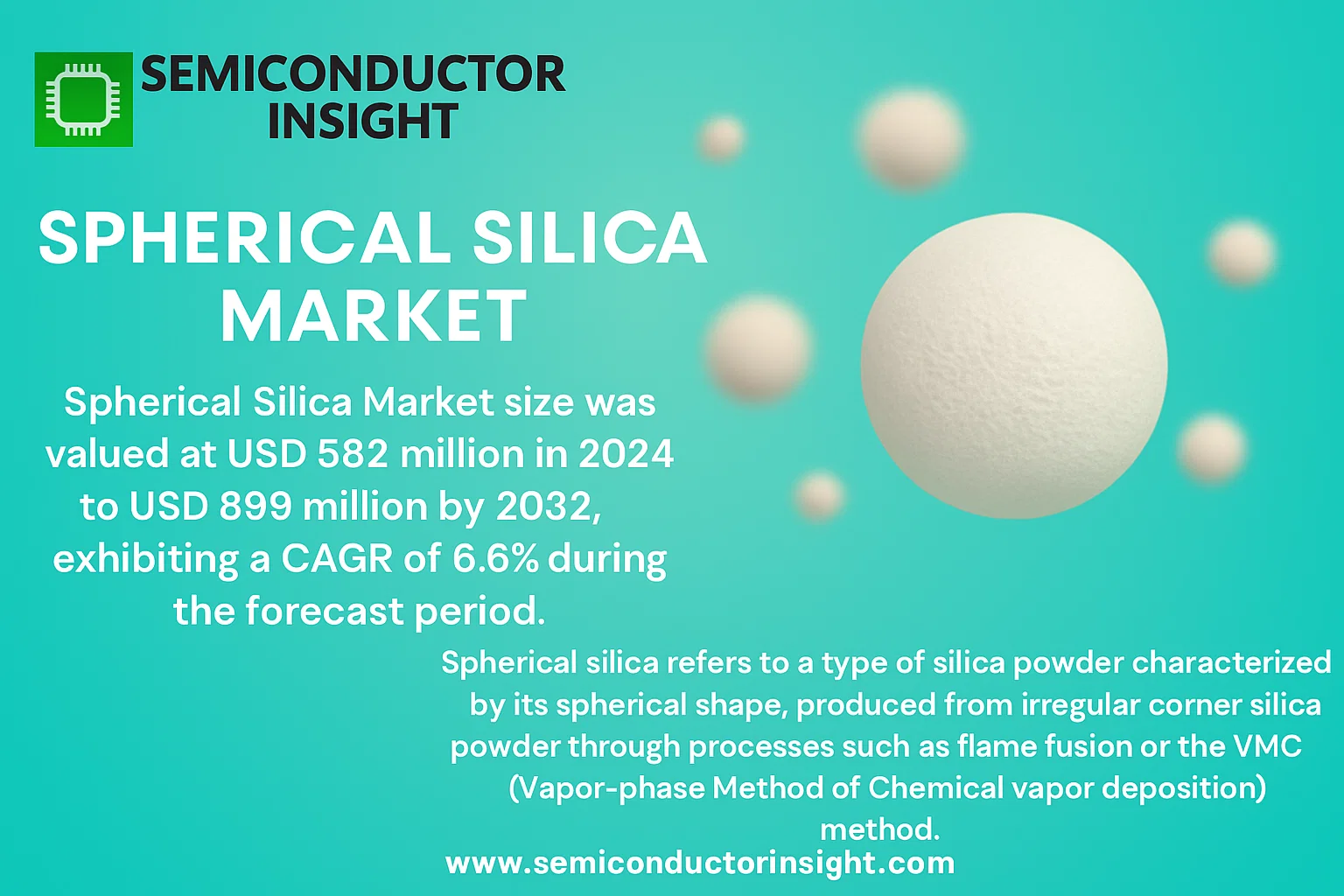
Global Spherical Silica Market size was valued at USD 582 million in 2024 to USD 899 million by 2032, exhibiting a CAGR of 6.6% during the forecast period.
Spherical silica refers to a type of silica powder characterized by its spherical shape, produced from irregular corner silica powder through processes such as flame fusion or the VMC (Vapor-phase Method of Chemical vapor deposition) method. This material is noted for its small surface area, excellent fluidity, and low stress, making it particularly suitable as a filler in semiconductor encapsulation materials. Spherical silica is categorized into several segments based on particle size, including 0.01μm-10μm, 10μm-20μm, and above 20μm.
The market is experiencing steady growth due to several factors, including increased demand from the electronics industry and advancements in semiconductor packaging technologies. Additionally, the growing need for high-performance materials in applications such as epoxy molding compounds (EMC) and copper clad laminates (CCL) is contributing to market expansion. Initiatives by key players are also expected to fuel market growth; Japan dominates production with over 53% of global output. Denka, Admatechs, and Micron are some of the key players that operate in the market with a wide range of portfolios.
MARKET DRIVERS
Growing Demand from the Electronics Industry
The Spherical Silica Market is experiencing robust growth, primarily driven by its critical role in the electronics sector. It is an essential filler material in epoxy molding compounds (EMCs) used for encapsulating semiconductor devices. The surge in demand for consumer electronics, electric vehicles, and advanced telecommunications infrastructure, which all rely on high-performance semiconductors, is a major driver. The miniaturization of electronic components necessitates materials with excellent flowability, low thermal expansion, and high purity, all of which are key attributes of spherical silica.
Advancements in Composite Materials
Beyond electronics, spherical silica is increasingly adopted as a reinforcing filler in advanced composite materials. Its spherical shape provides superior properties compared to irregularly shaped fillers, including improved dispersion, reduced viscosity, and enhanced mechanical strength. This makes it highly valuable in industries such as aerospace, automotive, and construction for producing lightweight, high-strength parts. The push for fuel efficiency and material performance is accelerating its integration into polymer composites.
Furthermore, stringent environmental regulations are promoting the use of spherical silica in lead-free soldering pastes and other “green” electronic applications. As regulations tighten globally, the demand for high-purity, environmentally compliant materials is creating a sustained driver for market expansion.
MARKET CHALLENGES
High Production Costs and Technical Complexity
A significant challenge facing the Spherical Silica Market is the high cost and energy-intensive nature of its production. The process of creating highly spherical, monodispersed particles with a narrow size distribution often involves sophisticated techniques like flame fusion or plasma melting. These processes require significant capital investment and operational expertise, creating a high barrier to entry for new players and putting pressure on profit margins.
Other Challenges
Supply Chain Vulnerabilities
The production of high-purity spherical silica is dependent on a consistent supply of high-quality quartz or silicon metal feedstock. Geopolitical issues, trade restrictions, or supply disruptions for these raw materials can lead to price volatility and potential shortages, challenging the stability of the market.
Competition from Alternative Fillers
In some cost-sensitive applications, spherical silica faces competition from less expensive fillers like crushed silica, calcium carbonate, or talc. While these alternatives may not offer the same performance benefits, their lower cost can be a decisive factor, particularly in standard-grade composites and plastics, posing a challenge to market penetration.
MARKET RESTRAINTS
Economic Sensitivity of End-Use Industries
The Spherical Silica Market’s growth is intrinsically linked to the health of its primary end-use industries, particularly electronics and automotive. Economic downturns or recessions can lead to reduced capital expenditure and consumer spending, causing a decline in the production of smartphones, automobiles, and other durable goods. This cyclicality acts as a significant restraint, as demand for spherical silica is highly correlated with global industrial and economic activity.
Stringent Environmental and Health Regulations
While regulations can be a driver for lead-free applications, they also act as a restraint concerning the material itself. Handling fine silica powders poses potential health risks, such as silicosis, leading to strict workplace safety regulations (e.g., OSHA standards). Compliance with these regulations adds to operational costs for manufacturers and end-users, and any tightening of exposure limits could further complicate production and handling processes.
MARKET OPPORTUNITIES
Expansion in Electric Vehicle (EV) Batteries
A significant emerging opportunity for spherical silica lies in the lithium-ion battery market, which is expanding rapidly due to the global shift toward electric vehicles. Spherical silica is being explored and adopted for use in battery separators and as an additive in anode materials. Its properties can help improve thermal stability, ionic conductivity, and the overall safety and lifespan of batteries, positioning it as a critical material in the next generation of energy storage solutions.
Development of High-Performance Coatings
There is growing interest in utilizing spherical silica in advanced coatings and paints. Its uniform particle size contributes to better light diffusion, scratch resistance, and anti-reflective properties. This creates opportunities in markets for high-end automotive coatings, optical lenses, and display panels. The demand for improved durability and aesthetic quality in these applications presents a lucrative growth avenue for specialized spherical silica products.
Innovation in Pharmaceutical and Cosmetics Applications
The high purity and controlled morphology of spherical silica make it suitable for demanding applications in the pharmaceutical and cosmetics industries. It is used as a carrier for active ingredients, a flow agent in powders, and a texture enhancer. As these industries continue to prioritize product performance and patient/consumer safety, the demand for high-grade, consistent functional additives like spherical silica is expected to rise.
Spherical Silica Market Trends
Sustained Growth Driven by Semiconductor Industry Demand
Global Spherical Silica market is on a robust growth trajectory, with its valuation projected to increase from USD 582 million in 2024 to approximately USD 899 million by 2032, representing a compound annual growth rate (CAGR) of 6.6%. This expansion is primarily fueled by the material’s critical role as a high-performance filler in semiconductor encapsulation materials (EMC), where its spherical shape, small surface area, and excellent fluidity minimize stress and enhance device reliability. The relentless advancement of semiconductor technology and the proliferation of high-tech electronics are the fundamental drivers behind this sustained demand.
Other Trends
Geographical Market Concentration
The market is overwhelmingly concentrated in the Asia-Pacific region, which commands approximately 88% of the global market share. This dominance is underpinned by Japan’s position as the world’s leading producer, accounting for over 53% of global production, followed by China, which holds a significant share of nearly 28%. North America and Europe represent smaller, yet important, markets with shares of about 6% and 4% respectively, linked to their established electronics manufacturing bases.
Innovation in Particle Size and Material Properties
A key trend shaping the market is the focus on developing spherical silica with enhanced properties to meet increasingly stringent industry requirements. Manufacturers are innovating production techniques, such as flame fusion and vapor-phase methods, to achieve finer and more uniform particle sizes across key segments (0.01µm-10µm, 10µm-20µm, and above 20µm). This drive for higher purity and performance is essential for applications in advanced semiconductors, where material characteristics directly impact the miniaturization and efficiency of electronic components. The competitive landscape is consolidated, with the top three manufacturers Denka, Admatechs, and Micron collectively holding over 60% of the market share, indicating a focus on technological leadership and production scale.
COMPETITIVE LANDSCAPE
Key Industry Players
A Market Dominated by Japanese and Global Leaders with Strong Regional Influence
Global Spherical Silica market is characterized by a high level of concentration, with the top three manufacturers Denka, Admatechs, and Micron collectively holding a dominant share exceeding 60% of the market. This leadership is anchored in advanced production technologies and significant capacity, particularly in Japan, which is the world’s leading producer accounting for over 53% of global output. The market’s structure is driven by the critical requirement for high-purity materials in semiconductor encapsulation, where spherical silica’s properties of excellent fluidity and low stress are paramount. The competitive dynamics are heavily influenced by technological expertise, production scale, and strong relationships with major electronics manufacturers in the Asia-Pacific region, which consumes approximately 88% of the global supply.
Beyond the dominant leaders, several other significant players maintain strong positions by focusing on niche applications and specific regional markets. Companies such as Tatsumori and Shin-Etsu Chemical from Japan, along with global minerals specialists like Imerys and Sibelco, provide substantial competition. In China, manufacturers like Jiangsu Yoke Technology and NOVORAY are rapidly expanding their presence, capitalizing on the country’s nearly 28% share of global production. The competitive landscape also includes specialized suppliers catering to segments like refractories, ceramics, and coatings. These players compete on factors including particle size distribution, purity levels, and cost-effectiveness, contributing to a diverse and dynamic market environment.
List of Key Spherical Silica Companies Profiled
- Denka Company Limited
- Admatechs Company Limited
- Micron Co., Ltd.
- Tatsumori Ltd.
- Shin-Etsu Chemical Co., Ltd.
- Imerys S.A.
- Sibelco
- Jiangsu Yoke Technology Co., Ltd.
- NOVORAY (Shanghai) Co., Ltd.
- Momentive Performance Materials Inc.
- Nippon Steel Chemical & Material Co., Ltd.
- Fuji Silysia Chemical Ltd.
- Imerys Fused Minerals
- Dongkuk R&S Co., Ltd.
- Tokuyama Corporation
Segment Analysis:
| Segment Category | Sub-Segments | Key Insights |
| By Type |
|
1μm-10μm represents the leading segment primarily due to its ideal balance between surface area, fluidity, and packing density, which is essential for high-performance semiconductor encapsulation. This particle size range offers superior handling characteristics during manufacturing processes while providing the necessary mechanical and thermal properties required in advanced electronics. Manufacturers are heavily focused on producing uniform particles within this range to meet the stringent demands of the semiconductor industry for miniaturization and enhanced device performance. |
| By Application |
|
Electronics Manufacturing (EMC) is the dominant application segment, driven by the critical role of spherical silica as a filler material in semiconductor packaging. Its excellent fluidity and low stress properties make it indispensable for encapsulating delicate semiconductor components, ensuring reliability and longevity. The relentless advancement in semiconductor technology, including the push towards smaller and more powerful devices, fuels continuous demand from this segment. Innovations in electronic applications are expected to further solidify its leading position. |
| By End User |
|
Semiconductor Industry is the foremost end-user segment, commanding significant demand due to the material’s essential function in device encapsulation. The high purity and performance specifications required by semiconductor manufacturers create a substantial and stable market. This sector’s growth is closely linked to global trends in technology adoption, 5G deployment, and the Internet of Things, which continually require more sophisticated semiconductor components. The segment’s leadership is reinforced by ongoing investments in semiconductor fabrication facilities worldwide. |
| By Production Technology |
|
Flame Fusion is the leading production technology, widely adopted for its ability to produce high-purity spherical silica with excellent sphericity and consistent particle size distribution. This method is favored by major manufacturers for its scalability and cost-effectiveness in meeting large-volume demands from the electronics sector. Continuous process improvements aim to enhance yield and reduce energy consumption, ensuring its dominance remains unchallenged for producing the quality of material required by high-tech industries. |
| By Material Purity |
|
High Purity Grade is the leading segment, as the semiconductor and advanced electronics industries demand materials with minimal impurities to ensure device integrity and performance. This grade offers superior electrical insulation and thermal stability, which are non-negotiable in semiconductor encapsulation applications. The stringent quality control and advanced processing required for high-purity spherical silica create a significant market barrier, solidifying the position of established producers who can consistently deliver these premium specifications. |
Regional Analysis: Spherical Silica Market
Asia-Pacific
The concentration of leading global electronics manufacturers, especially semiconductor fabricators, in countries like Taiwan, South Korea, and China creates an unparalleled demand base. This hub ensures a steady consumption of spherical silica for encapsulants and underfill materials essential for device reliability and miniaturization, driving continuous market growth.
A highly integrated and efficient supply chain for raw materials and advanced chemicals is a key advantage. Proximity to quartz sand sources and sophisticated processing facilities allows for cost-effective production of high-purity spherical silica, giving regional players a significant competitive edge in both quality and pricing.
Beyond electronics, vigorous growth in the automotive, construction, and coatings industries fuels demand. Spherical silica is increasingly used in high-performance paints, adhesives, and composite materials, with infrastructure development projects across the region providing a substantial and diverse application landscape for market expansion.
Strong governmental and private investment in research and development, particularly in nanotechnology and new material science, fosters innovation in spherical silica applications. This focus leads to the development of advanced grades tailored for next-generation technologies, securing the region’s long-term leadership in the market.
North America
The North American Spherical Silica Market is characterized by high technological adoption and stringent quality standards, primarily driven by the advanced electronics and aerospace sectors. The United States hosts major semiconductor companies and defense contractors that demand high-performance materials for critical applications, ensuring a stable, high-value market. There is a strong focus on research into specialized spherical silica for emerging technologies like 5G infrastructure and electric vehicle batteries. The region’s well-established chemical industry and focus on product innovation support the development of custom-grade spherical silica to meet specific customer requirements, although overall market growth is more moderate compared to Asia-Pacific due to mature end-user industries.
Europe
Europe maintains a significant presence in the Spherical Silica Market, supported by its strong automotive, construction, and specialty chemicals industries. Germany, in particular, is a key consumer due to its automotive manufacturing prowess, where spherical silica is used in coatings and lightweight composites. The region emphasizes sustainable production processes and high-quality standards, driving demand for premium products. Research initiatives funded by the European Union often focus on advanced material applications, providing a pipeline for new uses in electronics and energy storage. However, the market faces challenges from slower economic growth in some member states and intense competition from Asian producers, keeping growth rates steady but conservative.
South America
The Spherical Silica Market in South America is emerging, with growth potential linked primarily to the region’s developing industrial and construction sectors. Brazil is the largest market, where demand is driven by paints and coatings applications in a growing construction industry. The mining sector also presents opportunities for spherical silica use in specialty composites and industrial materials. However, the market is constrained by economic volatility, limited local manufacturing capacity for high-purity grades, and a less developed electronics sector compared to other regions. Market growth is therefore gradual, reliant on broader economic stability and increased foreign investment in local industries.
Middle East & Africa
The Spherical Silica Market in the Middle East & Africa is nascent but shows potential, particularly in the Gulf Cooperation Council (GCC) countries. Growth is fueled by investments in construction, infrastructure projects, and a budding electronics assembly sector. The region’s proximity to raw materials is an advantage. However, the market remains small-scale, with demand focused primarily on basic industrial applications rather than high-tech electronics. Limited local production forces reliance on imports, and market development is closely tied to economic diversification plans away from hydrocarbon dependence. Growth is expected to be slow but steady as industrial bases expand.
Report Scope
This market research report provides a comprehensive analysis of the Spherical Silica Market , covering the forecast period 2025–2032. It offers detailed insights into market dynamics, technological advancements, competitive landscape, and key trends shaping the industry.
Key focus areas of the report include:
- Market Overview: The report begins with an overview outlining its current market scenario, key growth indicators, and industry transformation drivers. It discusses macroeconomic factors, demand–supply balance, regulatory landscape, and the strategic role of semiconductors in powering advancements across industries such as automotive, telecommunications, consumer electronics, and industrial automation.
- Market Size & Forecast: Historical data and future projections for revenue, unit shipments, and market value across major regions and segments.
- Segmentation Analysis: Detailed breakdown by product type, technology, application, and end-user industry to identify high-growth segments and investment opportunities.
- Regional Insights: Insights into market performance across North America, Europe, Asia-Pacific, Latin America, and the Middle East & Africa, including country-level analysis where relevant.
- Competitive Landscape: Profiles of leading market participants, including their product offerings, R&D focus, manufacturing capacity, pricing strategies, and recent developments such as mergers, acquisitions, and partnerships.
- Technology Trends & Innovation: Assessment of emerging technologies, integration of AI/IoT, semiconductor design trends, fabrication techniques, and evolving industry standards.
- Market Drivers & Restraints: Evaluation of factors driving market growth along with challenges, supply chain constraints, regulatory issues, and market-entry barriers.
- Stakeholder Insights: Insights for component suppliers, OEMs, system integrators, investors, and policymakers regarding the evolving ecosystem and strategic opportunities.
Primary and secondary research methods are employed, including interviews with industry experts, data from verified sources, and real-time market intelligence to ensure the accuracy and reliability of the insights presented.
FREQUENTLY ASKED QUESTIONS:
What is the current market size of Spherical Silica Market?
-> Spherical Silica Market size was valued at USD 582 million in 2024 to USD 899 million by 2032, exhibiting a CAGR of 6.6% during the forecast period.
Which key companies operate in Spherical Silica Market?
-> Key players include Micron, Denka, Admatechs, Tatsumori, Shin-Etsu Chemical, Imerys, Sibelco, Jiangsu Yoke Technology, and NOVORAY, among others. The top three manufacturers collectively hold over 60% of the market share.
What are the key growth drivers?
-> Key growth drivers include growing demand in the semiconductor industry, increasing use in advanced electronics and high-tech applications, and innovations in production techniques.
Which region dominates the market?
-> Asia-Pacific is the largest market for spherical silica, with a dominant share of about 88%, driven by Japan and China as the leading producers.
What are the emerging trends?
-> Emerging trends include enhanced material properties, development of finer and more uniform particles, and advancements driven by the requirements for high-purity materials in semiconductor applications.

Get Sample Report PDF for Exclusive Insights
Report Sample Includes
- Table of Contents
- List of Tables & Figures
- Charts, Research Methodology, and more...
 Download Sample Report PDF