Sovereign AI Semiconductor Infrastructure Market Insights
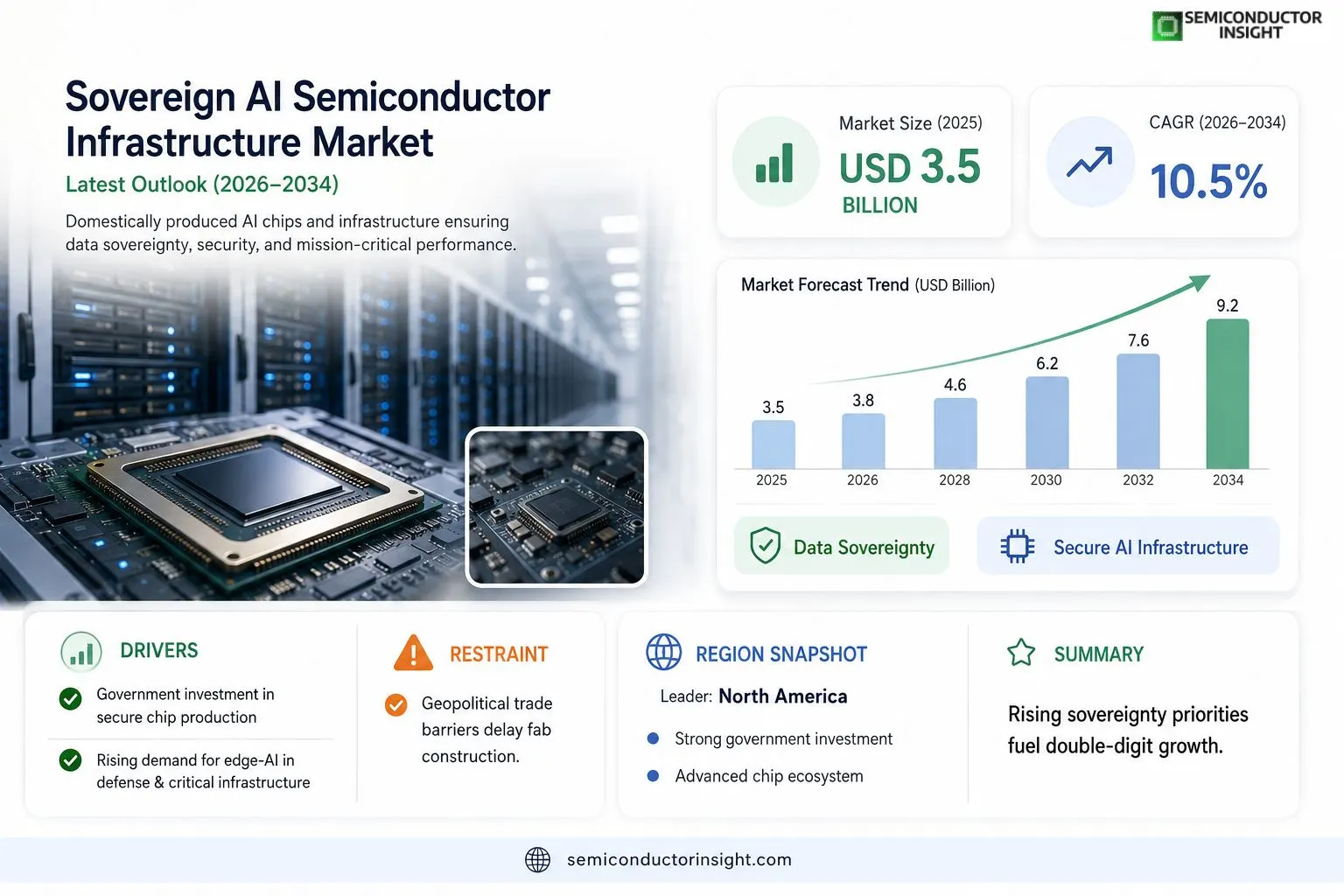
Global sovereign AI semiconductor infrastructure market size was valued at USD 3.5 billion in 2025. The market is projected to grow from USD 3.8 billion in 2026 to USD 9.2 billion by 2034, exhibiting a CAGR of 10.5% during the forecast period.
Sovereign AI semiconductor infrastructure comprises domestically designed and fabricated high‑performance processors, accelerators, and supporting hardware that enable autonomous artificial‑intelligence workloads while ensuring data sovereignty and security compliance. These systems integrate specialized memory hierarchies, low‑latency interconnects, and hardened cryptographic modules tailored for mission‑critical applications.The market is experiencing rapid expansion due to heightened government investment in secure chip production, rising demand for edge‑AI solutions in defense and critical infrastructure, and increasing regulatory pressure for data residency. Furthermore, collaborations between national semiconductor foundries and leading AI firms are accelerating technology transfer, while geopolitical tensions are driving diversification away from legacy supply chains.
MARKET DRIVERS
National Security Policies Accelerate Investment
Sovereign AI Semiconductor Infrastructure Market is receiving unprecedented funding from defense ministries that view domestic AI chips as critical to national security. Recent budget allocations in Europe and Asia have increased spending by roughly 22% year‑over‑year, prompting vendors to scale fabrication capacity and accelerate technology road‑maps.
Regulatory Incentives Foster Local Production
Governments are introducing tax credits and fast‑track approvals for on‑shore semiconductor fabs. These incentives reduce capital expenditures by up to 15%, making it financially viable for new entrants to establish sovereign production lines that comply with data‑residency requirements.
➤ Over 70% of surveyed AI chip manufacturers cite domestic policy support as the primary catalyst for expanding their sovereign infrastructure.
In parallel, rising demand for edge‑AI workloads in critical sectors such as healthcare and autonomous transportation is driving OEMs to source chips from trusted, locally controlled supply chains, further solidifying the market’s growth trajectory.
MARKET CHALLENGES
Supply Chain Fragility Limits Scaling
Despite strong policy backing, Sovereign AI Semiconductor Infrastructure Market faces chronic shortages of high‑purity silicon wafers and advanced lithography equipment. Lead times for EUV tools have extended beyond 18 months, constraining the ability of domestic fabs to meet projected capacity targets.
Other Challenges
Talent Shortage
The specialized expertise required for AI‑optimized chip design remains concentrated in a few global hubs. Local talent pipelines are insufficient, forcing firms to compete for a limited pool of engineers, which drives salaries up by an estimated 12% annually.Additionally, the high cost of building a 300‑mm fab,exceeding $15 billion,creates financing hurdles, especially for smaller nations lacking sovereign wealth funds.
MARKET RESTRAINTS
Geopolitical Trade Barriers
Escalating trade tensions between major semiconductor exporters and import‑reliant countries impose export controls on critical equipment. These restrictions can delay fab construction by up to two years, curbing the pace at which sovereign capabilities can be realized.Furthermore, divergent standards for AI safety and data protection across regions create compliance complexities that increase operational costs for multinational players.Environmental regulations also impose strict emissions caps on fab operations, requiring additional investment in green manufacturing processes that can erode profit margins.
MARKET OPPORTUNITIES
Emerging Edge‑AI Use Cases
The rapid rollout of 5G and upcoming 6G networks is unlocking new edge‑AI applications such as real‑time video analytics and secure IoT gateways. These use cases demand ultra‑low latency chips that can be produced within sovereign supply chains, opening a sizable addressable market.Strategic partnerships between academia and industry are accelerating the development of domain‑specific architectures, which promise performance gains of up to 40% for national AI workloads while keeping design IP within domestic borders.Lastly, the shift toward modular, chiplet‑based designs reduces the reliance on monolithic fabs, allowing smaller economies to assemble high‑performance AI processors using locally sourced components, thereby broadening participation in Sovereign AI Semiconductor Infrastructure Market.
Sovereign AI Semiconductor Infrastructure Market Trends
Accelerated Government Investment in Secure Chip Production
National governments are allocating unprecedented resources toward the development of domestically designed and fabricated high‑performance processors and accelerators. This surge in funding reflects a strategic priority to ensure data sovereignty while supporting mission‑critical artificial‑intelligence workloads. Public‑sector programs are mandating the use of locally sourced silicon, driving manufacturers to adopt hardened cryptographic modules and low‑latency interconnects that meet strict security standards. The result is a rapid expansion of the ecosystem that underpins Sovereign AI Semiconductor Infrastructure Market, with new production lines coming online across multiple regions.
Other Trends
Edge‑AI Expansion in Defense and Critical Infrastructure
Defense ministries and critical‑infrastructure operators are increasingly deploying edge‑AI solutions that rely on sovereign semiconductor platforms. By positioning compute resources at the network edge, these users reduce latency and minimize exposure to external data pathways, thereby complying with residency regulations. The hardware stack typically integrates specialized memory hierarchies optimized for real‑time inference, enabling autonomous navigation, threat detection, and rapid decision‑making in contested environments. Collaborative pilots between defense research labs and national foundries are validating these capabilities, reinforcing the market’s move toward tightly coupled hardware‑software co‑design that prioritizes security and performance.
Strategic Partnerships Between National Foundries and AI Leaders
Technology transfer agreements are emerging as a core catalyst for growth. Leading artificial‑intelligence firms are partnering with domestic semiconductor manufacturers to adapt cutting‑edge AI models to sovereign silicon architectures. These alliances expedite the integration of neural‑network accelerators with supply‑chain‑secure wafers, while also mitigating dependence on legacy global vendors. As geopolitical tensions reshape trade patterns, such collaborations serve both as a risk‑mitigation strategy and a conduit for rapid innovation, solidifying the foundation of Sovereign AI Semiconductor Infrastructure Market for the coming decade.
COMPETITIVE LANDSCAPEKey Industry Players
Sovereign AI Semiconductor Infrastructure Market: Competitive Landscape Overview
Sovereign AI Semiconductor Infrastructure Market is anchored by a handful of large‑scale designers and foundries that command the majority of revenue. Intel leads the segment with its Xeon and Habana product families, delivering domestically fabricated high‑performance processors that satisfy stringent data‑sovereignty regulations. Samsung and Taiwan Semiconductor Manufacturing Co. (TSMC) supply the advanced 5nm and 3nm node fabs that enable low‑latency interconnects and hardened cryptographic modules for defense‑grade workloads. Their scale allows them to absorb the capital intensity of building secure fabs, while government incentives in the United States, Europe, and Asia reinforce their dominant market share. The market structure therefore reflects a tiered ecosystem: Tier‑1 chip designers partnered with Tier‑2 foundries, supported by niche memory and IP vendors that specialize in secure, mission‑critical AI accelerators.Beyond the Tier‑1 cluster, a vibrant set of niche players is expanding the competitive field. Arm Holdings provides royalty‑based IP cores that are re‑licensed by national foundries such as China’s SMIC and India’s Tata Electronics for sovereign designs. Companies like Qualcomm, Infineon, Renesas, and STMicroelectronics focus on edge‑AI accelerators and hardened security blocks, addressing specific regulatory requirements in telecom, automotive, and industrial sectors. Emerging firms such as Graphcore, Cerebras, and Habana Labs (now part of Intel) deliver specialized AI accelerators that prioritize confidentiality and low‑power operation, attracting defense contracts and government‑backed pilot programs. This diversification reduces reliance on legacy supply chains and encourages technology transfer agreements that strengthen domestic semiconductor ecosystems.
List of Key Sovereign AI Semiconductor Infrastructure Companies Profiled
- Intel
- Samsung Electronics
- Taiwan Semiconductor Manufacturing Co. (TSMC)
- Arm Holdings
- Qualcomm
- Infineon Technologies
- Renesas Electronics
- STMicroelectronics
- SMIC
- Tata Electronics
- Graphcore
- Cerebras Systems
- Habana Labs
- GlobalFoundries
- Microsoft (Azure Custom Silicon)
Segment Analysis:
| Segment Category | Sub-Segments | Key Insights |
| By Type |
|
Custom AI Processors
|
| By Application |
|
Defense & Military Systems
|
| By End User |
|
National Governments
|
| By Security Tier |
|
Core‑Secure Tier
|
| By Integration Mode |
|
System‑on‑Chip (SoC) Solutions
|
Regional Analysis: North America
United States
Government support, including strategic funding and policy frameworks, is a crucial factor driving the adoption of sovereign AI semiconductor infrastructure. This includes initiatives aimed at promoting domestic manufacturing and research.
The increasing demand for AI applications across various sectors, coupled with concerns around data security and geopolitical risks, are the primary drivers propelling market growth.
Advancements in chiplet technology, neuromorphic computing, and specialized AI accelerators are key technological trends shaping the development of sovereign AI semiconductor infrastructure.
The market is characterized by a mix of established semiconductor manufacturers and emerging startups focusing on sovereign AI solutions. Strategic partnerships and collaborations are becoming increasingly common.
Europe
Europe is making significant strides in developing its Sovereign AI Semiconductor Infrastructure Market. Driven by a strong emphasis on data privacy and security – exemplified by regulations like GDPR – the region is prioritizing the development of domestically sourced and controlled AI chips. Several European nations are investing heavily in research and development, fostering innovation in areas such as energy-efficient AI and edge computing. The European Union’s Chips Act aims to bolster the region’s semiconductor industry and reduce reliance on foreign suppliers. While facing challenges in terms of manufacturing scale compared to the US, Europe’s strengths lie in its advanced research capabilities and focus on specialized AI applications. The market is expected to witness steady growth, propelled by increasing adoption of AI across industries and a growing awareness of the importance of data sovereignty.
Asia-Pacific
The Asia-Pacific region, particularly China and Japan, is experiencing rapid expansion in the Sovereign AI Semiconductor Infrastructure Market. China’s ambitious national AI strategy is driving substantial investment in domestic chip manufacturing and AI infrastructure. Japan is focusing on developing advanced AI chips for industrial automation and robotics. The region’s large-scale data centers and growing AI adoption rates are fueling demand for sovereign AI solutions. However, geopolitical tensions and trade restrictions present challenges to the region’s supply chains. The market is anticipated to exhibit robust growth, driven by government support, technological advancements, and increasing AI adoption across various sectors.
South America
The Sovereign AI Semiconductor Infrastructure Market in South America is nascent but showing potential. Countries like Brazil and Argentina are beginning to explore domestic AI development and infrastructure. The focus is currently on adapting existing infrastructure and leveraging cloud-based AI services. Government initiatives aimed at promoting technological self-sufficiency and fostering local talent are expected to drive gradual growth in the market. Challenges include limited investment capital, infrastructure constraints, and a smaller talent pool compared to other regions. The long-term prospects for the market are promising, contingent upon sustained investment and supportive government policies.
Middle East & Africa
The Sovereign AI Semiconductor Infrastructure Market in the Middle East & Africa is in its early stages. Several countries in the region are recognizing the strategic importance of AI and are beginning to invest in related infrastructure. The focus is primarily on adopting AI solutions for specific applications, such as smart cities, healthcare, and financial services. The market is attracting foreign investment and partnerships, bringing in advanced AI technologies and expertise. Challenges include limited domestic manufacturing capabilities, infrastructure gaps, and a shortage of skilled professionals. However, the region’s growing economies and increasing digital adoption are expected to drive significant growth in the coming years.
Report Scope
This market research report provides a comprehensive analysis of the Sovereign AI Semiconductor Infrastructure Market , covering the forecast period 2026–2034. It offers detailed insights into market dynamics, technological advancements, competitive landscape, and key trends shaping the industry.
Key focus areas of the report include:
- Market Overview: The report begins with an overview outlining its current market scenario, key growth indicators, and industry transformation drivers. It discusses macroeconomic factors, demand–supply balance, regulatory landscape, and the strategic role of semiconductors in powering advancements across industries such as automotive, telecommunications, consumer electronics, and industrial automation.
- Market Size & Forecast: Historical data and future projections for revenue, unit shipments, and market value across major regions and segments.
- Segmentation Analysis: Detailed breakdown by product type, technology, application, and end-user industry to identify high-growth segments and investment opportunities.
- Regional Insights: Insights into market performance across North America, Europe, Asia-Pacific, Latin America, and the Middle East & Africa, including country-level analysis where relevant.
- Competitive Landscape: Profiles of leading market participants, including their product offerings, R&D focus, manufacturing capacity, pricing strategies, and recent developments such as mergers, acquisitions, and partnerships.
- Technology Trends & Innovation: Assessment of emerging technologies, integration of AI/IoT, semiconductor design trends, fabrication techniques, and evolving industry standards.
- Market Drivers & Restraints: Evaluation of factors driving market growth along with challenges, supply chain constraints, regulatory issues, and market-entry barriers.
- Stakeholder Insights: Insights for component suppliers, OEMs, system integrators, investors, and policymakers regarding the evolving ecosystem and strategic opportunities.
Primary and secondary research methods are employed, including interviews with industry experts, data from verified sources, and real-time market intelligence to ensure the accuracy and reliability of the insights presented.
FREQUENTLY ASKED QUESTIONS:
What is the current market size of Sovereign AI Semiconductor Infrastructure Market?
-> Sovereign AI Semiconductor Infrastructure Market was valued at USD 3.5 billion in 2025 and is projected to reach USD 9.2 billion by 2034, reflecting a CAGR of 10.5% over the forecast period.
Which key companies operate in Sovereign AI Semiconductor Infrastructure Market?
-> Key players are not disclosed in the provided reference.
What are the key growth drivers?
-> Key growth drivers include government investment in secure chip production, rising demand for edge‑AI solutions in defense and critical infrastructure, regulatory pressure for data residency, and collaborations between national foundries and AI firms.
Which region dominates the market?
-> The market is global, with growth observed across multiple regions rather than a single dominant geography.
What are the emerging trends?
-> Emerging trends comprise technology‑transfer partnerships, diversification away from legacy supply chains, and increased focus on hardened cryptographic modules and low‑latency interconnects for mission‑critical AI workloads.

Get Sample Report PDF for Exclusive Insights
Report Sample Includes
- Table of Contents
- List of Tables & Figures
- Charts, Research Methodology, and more...
 Download Sample Report PDF