SoC/Logic IC Probe Card Market Insights
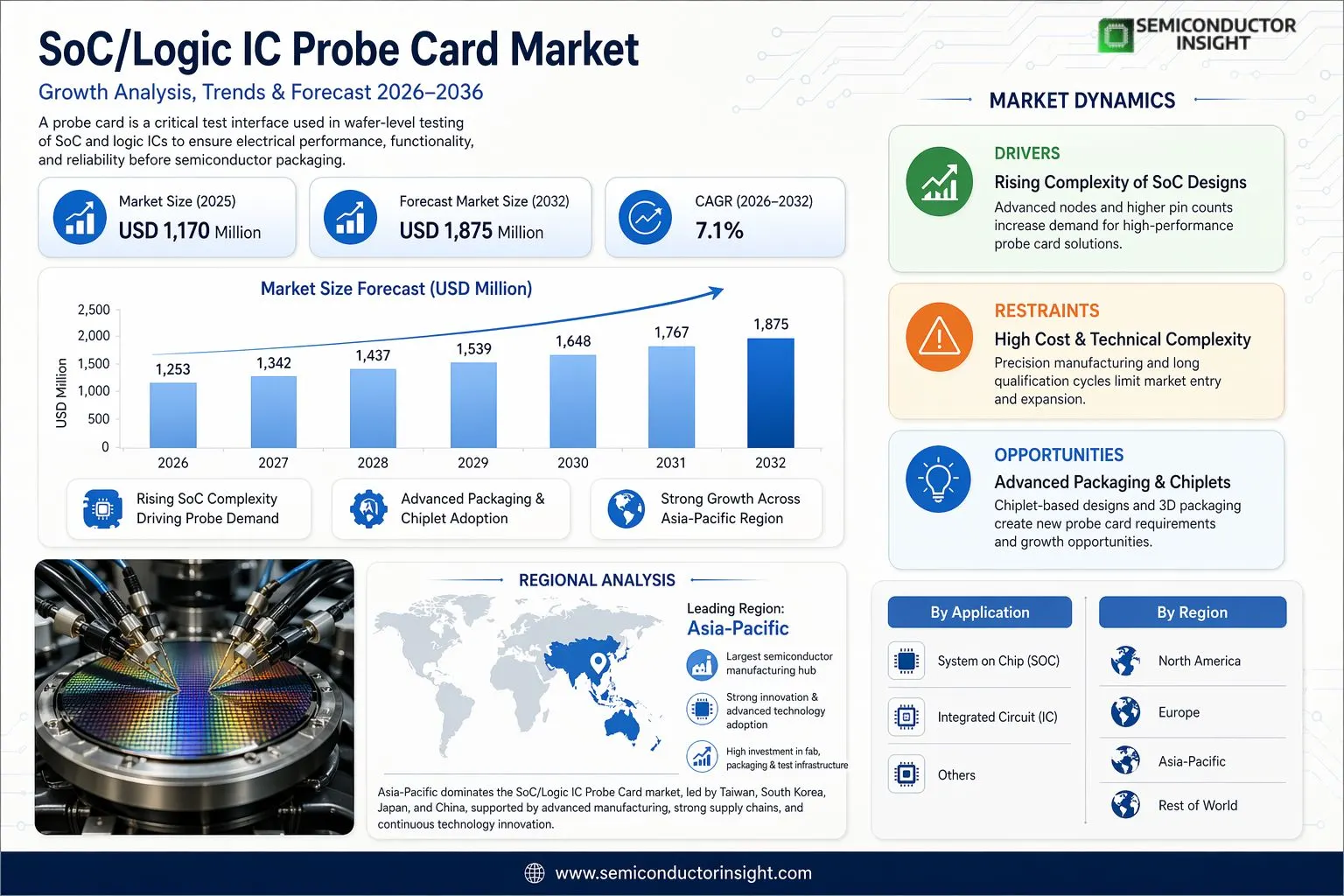
Global SoC/Logic IC Probe Card market size was valued at USD 1,170 million in 2025. The market is projected to grow from USD 1,253 million in 2026 to USD 2,048 million by 2036, exhibiting a CAGR of approximately 6.3% during the forecast period.
A SoC/Logic IC Probe Card is a specialized test tool used to perform electrical testing and validation of System-on-Chip (SoC) and logic integrated circuits (ICs) during the semiconductor manufacturing process. Probe cards are essential for ensuring the functionality, performance, and reliability of semiconductor devices by enabling engineers to make precise physical electrical connections to the test pads or pins of the chip. The product category encompasses Cantilever Probe Cards, Vertical Probe Cards, and other advanced probe card configurations, each designed to address specific testing requirements across varying chip architectures and node geometries.
The market is witnessing sustained growth driven by increasing semiconductor production volumes, rapid proliferation of SoC-based consumer electronics, and the accelerating complexity of logic IC designs. Furthermore, the expansion of advanced packaging technologies and the rising adoption of wafer-level testing in high-volume manufacturing environments are reinforcing demand for high-performance probe card solutions. Key global manufacturers operating in this market include FormFactor, Technoprobe S.p.A., Micronics Japan (MJC), Japan Electronic Materials (JEM), Will Technology, Spirox Corporation, Shenzhen DGT, Sinowin, Grand Junction Semiconductor, Wuxi JUNR Technology, and MemsFlex, among others.
MARKET DRIVERS
Rising Complexity of SoC Designs Fueling Demand for Advanced Probe Card Solutions
The increasing architectural complexity of system-on-chip devices is one of the most significant forces shaping SoC/Logic IC Probe Card Market. As semiconductor manufacturers push toward smaller process nodes — including 5nm, 3nm, and emerging 2nm geometries — the requirements for wafer-level testing infrastructure have grown substantially. Probe cards engineered specifically for high-density logic and SoC configurations must accommodate finer pitch arrays, higher pin counts, and more stringent signal integrity standards, driving consistent investment across both fabless chip designers and integrated device manufacturers.
Accelerated Adoption of AI, HPC, and Data Center Chips Expanding the Addressable Market
Sustained growth in artificial intelligence accelerators, high-performance computing processors, and cloud data center silicon is translating directly into heightened demand within SoC/Logic IC Probe Card Market. These application segments require logic ICs with elevated transistor densities and multi-die configurations, including chiplet-based architectures, which necessitate rigorous wafer-sort testing protocols. Probe card suppliers are responding by developing vertically integrated MEMS-based and advanced cantilever probe technologies capable of supporting the parallel testing regimes demanded by high-volume AI chip production lines.
➤ Global proliferation of edge AI devices, 5G baseband processors, and automotive-grade SoCs is broadening the end-market base for logic IC probe card manufacturers, reinforcing multi-year demand visibility across the semiconductor test supply chain.
Automotive electrification represents another structural driver for SoC/Logic IC Probe Card Market. The transition toward advanced driver-assistance systems, electric vehicle power management ICs, and in-vehicle infotainment SoCs has elevated quality and reliability benchmarks for automotive-grade semiconductors. This dynamic is compelling chipmakers to increase test coverage at the wafer level, consequently generating incremental demand for probe cards engineered to meet automotive qualification standards such as AEC-Q100, reinforcing the market’s long-term growth trajectory.
MARKET CHALLENGES
Technical Complexity and High Manufacturing Cost Constraining Broader Market Penetration
One of the most persistent challenges confronting participants in SoC/Logic IC Probe Card Market is the escalating cost and manufacturing complexity associated with next-generation probe card development. As logic IC designs incorporate finer contact pitches and greater I/O densities, the precision engineering requirements for probe tip fabrication, planarity control, and substrate materials have intensified considerably. These technical demands translate into elevated capital expenditure for probe card manufacturers and longer qualification cycles for end users, creating friction particularly for smaller fabless companies and emerging market entrants with constrained test budgets.
Probe Card Lifetime and Reliability Under High-Parallelism Test Conditions
Probe card longevity remains a critical operational challenge in SoC/Logic IC Probe Card Market, especially as semiconductor manufacturers increase wafer-sort parallelism to maximize throughput on automated test equipment platforms. Elevated contact cycling, thermal stress from power-intensive logic devices, and mechanical wear on probe tips collectively reduce effective card lifetimes, driving up the total cost of ownership for wafer-level test operations. Achieving consistent electrical performance across hundreds of thousands of touchdowns without degradation in contact resistance or planarity is a formidable engineering challenge that continues to demand significant R&D investment from probe card suppliers.
Other Challenges
Supply Chain Constraints for Specialty Materials
SoC/Logic IC Probe Card Market is exposed to supply chain vulnerabilities associated with specialty substrates, tungsten alloy probe wires, and advanced ceramic materials used in high-performance probe card assemblies. Geopolitical uncertainties, export controls on semiconductor manufacturing materials, and concentration of key material suppliers in specific geographies introduce procurement risks that can affect lead times and pricing stability for probe card manufacturers operating on tight production schedules.
Rapid Technology Obsolescence
The accelerating pace of semiconductor process node transitions poses an obsolescence risk for probe card platforms, as designs optimized for one technology generation may require significant re-engineering to remain compatible with subsequent node shrinks or new packaging architectures such as wafer-on-wafer and hybrid bonding. This shortens the commercial lifecycle of individual probe card designs and places ongoing pressure on suppliers to sustain elevated R&D expenditures to remain competitive within SoC/Logic IC Probe Card Market.
MARKET RESTRAINTS
Capital Intensity and Extended Qualification Timelines Limiting Market Entry and Expansion
SoC/Logic IC Probe Card Market is characterized by high barriers to entry driven by the substantial capital investment required to establish advanced probe card manufacturing capabilities. Precision MEMS fabrication facilities, cleanroom infrastructure, and specialized metrology equipment represent significant upfront expenditures that limit the pool of credible suppliers capable of serving leading-edge logic IC customers. Furthermore, the qualification process for probe cards used in advanced SoC testing is rigorous and time-consuming, often spanning several months, which restricts the ability of new entrants to rapidly capture market share even when technically differentiated solutions are available.
Cyclicality of the Semiconductor Industry Creating Demand Volatility
Demand patterns within SoC/Logic IC Probe Card Market are inherently linked to the broader semiconductor capital expenditure cycle, which is subject to periodic downturns driven by inventory corrections, macroeconomic pressures, and shifts in end-market consumption. During periods of semiconductor industry contraction, wafer start reductions at major foundries and IDMs directly suppress probe card procurement activity, creating revenue volatility for market participants. This cyclical exposure constrains the ability of probe card manufacturers to plan long-term production investments with confidence and can lead to underutilization of specialized manufacturing assets during demand troughs.
Concentration of Demand Among a Limited Number of Tier-1 Semiconductor Customers
A structural restraint within SoC/Logic IC Probe Card Market is the concentration of advanced logic IC production among a relatively small number of leading foundries and integrated device manufacturers. This customer concentration dynamic gives large semiconductor manufacturers considerable negotiating leverage over probe card pricing and supply terms, compressing margins for probe card suppliers and creating dependency risk. Diversification of the customer base is strategically important for market participants, but the high technical specificity of advanced SoC probe card designs limits the speed at which suppliers can develop commercially viable relationships with new customers outside of the established tier-1 semiconductor ecosystem.
MARKET OPPORTUNITIES
Expansion of Advanced Packaging and Chiplet Architectures Creating New Probe Card Design Requirements
The industry-wide transition toward chiplet-based designs, 2.5D/3D IC packaging, and heterogeneous integration presents a substantial growth opportunity for SoC/Logic IC Probe Card Market. These advanced packaging architectures require wafer-level testing of individual dies prior to assembly to minimize known-good-die failures and reduce overall packaging yield loss. This pre-bond test requirement is generating incremental demand for probe cards capable of operating at ultra-fine pitches compatible with micro-bump and hybrid bonding interconnect standards, opening a differentiated product category for technically advanced probe card suppliers.
Geographic Diversification of Semiconductor Manufacturing Driving Regional Probe Card Demand
Government-led semiconductor localization initiatives in the United States, Europe, Japan, and India are catalyzing the construction of new wafer fabrication facilities that will require comprehensive test infrastructure, including probe cards tailored for advanced SoC and logic IC production. This geographic diversification of semiconductor manufacturing capacity represents a meaningful medium-to-long-term demand expansion opportunity for SoC/Logic IC Probe Card Market, as newly established fabs will need to qualify and procure wafer-level test solutions across their planned product portfolios, providing addressable market growth independent of existing foundry capacity utilization trends.
Integration of Intelligent Diagnostics and Digital Twins Enhancing Probe Card Value Proposition
The incorporation of embedded sensor technology, real-time contact monitoring, and digital twin simulation capabilities into probe card platforms represents an emerging opportunity for value-added differentiation within SoC/Logic IC Probe Card Market. By enabling predictive maintenance, automated planarity correction, and data-driven probe tip lifecycle management, intelligent probe card solutions can deliver measurable reductions in test downtime and cost of ownership for semiconductor manufacturers. Suppliers that successfully commercialize these capabilities are positioned to command premium pricing and establish deeper, service-oriented relationships with customers, improving both revenue quality and customer retention within an increasingly competitive market landscape.
Trends
Rising Demand for Advanced Semiconductor Testing Drives SoC/Logic IC Probe Card Market
SoC/Logic IC Probe Card Market is experiencing significant momentum as Global semiconductor industry accelerates its push toward more complex and highly integrated chip designs. SoC/Logic IC probe cards serve as critical test interfaces during wafer-level testing, enabling manufacturers to validate the electrical performance and functional integrity of System-on-Chip and logic integrated circuits before packaging. As chip complexity grows in tandem with evolving consumer electronics, automotive electronics, and data center applications, the demand for reliable and high-precision probe card solutions continues to intensify across major semiconductor manufacturing hubs in Asia, North America, and Europe.
Other Trends
Shift Toward Vertical Probe Card Adoption
Among the key product segments within SoC/Logic IC Probe Card Market, vertical probe cards are gaining increasing traction alongside the traditional cantilever probe card segment. Vertical probe cards offer superior pitch capability and higher pin density, making them well-suited for advanced node testing requirements associated with leading-edge SoC designs. As semiconductor manufacturers transition to smaller process nodes, the precision and contact reliability offered by vertical probe card architectures position them as a preferred choice for high-density logic IC testing workflows.
Asia-Pacific Cementing its Position as the Dominant Regional Market
Asia-Pacific, led by Japan, South Korea, China, and Southeast Asia, continues to represent the largest and most dynamic regional segment of SoC/Logic IC Probe Card Market. Japan remains a critical hub for probe card innovation, with established players such as Micronics Japan (MJC) and Japan Electronic Materials (JEM) maintaining strong technological leadership. China is also emerging as a rapidly growing market, driven by domestic semiconductor capacity expansion and government-backed initiatives to develop self-sufficient chip testing ecosystems. This regional concentration of semiconductor fabrication activity directly reinforces probe card demand across both IC and SOC application segments.
Competitive Landscape and Innovation Among Key Market Players
SoC/Logic IC Probe Card Market features a moderately consolidated competitive landscape, with global leaders such as FormFactor, Technoprobe S.p.A., Micronics Japan (MJC), Japan Electronic Materials (JEM), Will Technology, and Spirox Corporation holding substantial market influence. These established players are continuously investing in research and development to address the evolving pin-count, signal integrity, and thermal management requirements of next-generation logic ICs. Emerging companies including Shenzhen DGT, Sinowin, Wuxi JUNR Technology, MemsFlex, and Grand Junction Semiconductor are also actively contributing to market competition by offering cost-competitive and application-specific probe card solutions, further diversifying the technology options available to semiconductor test engineers worldwide.
COMPETITIVE LANDSCAPE
Key Industry Players
SoC/Logic IC Probe Card Market: Dominated by Specialized Test Equipment Leaders Amid Rising Semiconductor Demand
Global SoC/Logic IC Probe Card market, valued at approximately USD 1,170 million in 2025 and projected to reach USD 1,875 million by 2032 at a CAGR of 7.1%, is characterized by a concentrated competitive landscape where a handful of technologically advanced players command significant revenue share. FormFactor, headquartered in the United States, stands as the undisputed market leader, leveraging its broad portfolio of advanced probe card solutions — including cantilever, vertical, and MEMS-based technologies — to serve leading semiconductor foundries and IDMs across North America, Asia, and Europe. The company’s sustained investment in R&D and its strategic acquisitions have reinforced its dominant position. Italy-based Technoprobe S.p.A. ranks as another Tier-1 competitor, offering high-density probe card solutions tailored for SoC and logic IC wafer-level testing, with a strong foothold in European and Asian markets. The top five global players collectively accounted for a substantial share of total market revenue in 2025, underscoring the oligopolistic nature of this specialized segment.
Beyond the market leaders, several niche and regionally significant players are actively shaping the competitive dynamics of the SoC/Logic IC Probe Card industry. Japan-based manufacturers including Micronics Japan (MJC) and Japan Electronic Materials (JEM) maintain strong positions in the Asia-Pacific region, benefiting from their proximity to major semiconductor fabrication hubs in Japan and South Korea. Will Technology and Spirox Corporation cater to mid-tier and emerging foundry clients seeking cost-competitive yet reliable probe card solutions. Chinese players such as Shenzhen DGT, Sinowin, and Wuxi JUNR Technology are gaining traction domestically as China accelerates its semiconductor self-sufficiency initiatives, intensifying competitive pressure on established international vendors. MemsFlex and Grand Junction Semiconductor represent emerging innovators bringing MEMS-based and advanced cantilever technologies into an increasingly performance-driven market. Collectively, these players are expanding the competitive frontier through product diversification, regional capacity investments, and strategic partnerships with major wafer test equipment integrators.
List of Key SoC/Logic IC Probe Card Companies Profiled
- FormFactor
- Technoprobe S.p.A.
- Micronics Japan (MJC)
- Japan Electronic Materials (JEM)
- Will Technology
- Spirox Corporation
- Shenzhen DGT
- Sinowin
- Micronics Japan Co., Ltd.
- Grand Junction Semiconductor
- Wuxi JUNR Technology
- MemsFlex
Segment Analysis:
| Segment Category | Sub-Segments | Key Insights |
| By Type |
|
Vertical Probe Card has emerged as the leading segment in SoC/Logic IC Probe Card Market, driven by growing demand for high-density and fine-pitch testing capabilities in advanced semiconductor nodes.
|
| By Application |
|
System on Chip (SOC) represents the dominant application segment, fueled by rapid advancements in consumer electronics, automotive intelligence systems, and data center infrastructure.
|
| By End User |
|
Fabless Semiconductor Companies constitute the leading end-user segment, reflecting the continued shift in Global semiconductor industry toward design-led business models that rely entirely on third-party foundry and test services.
|
| By Technology Node |
|
Advanced Nodes (Below 10nm) represent the fastest-growing and most technologically demanding segment, as semiconductor manufacturers push the boundaries of miniaturization to achieve higher transistor densities and improved power efficiency.
|
| By Industry Vertical |
|
Consumer Electronics leads the industry vertical segment, underpinned by the relentless demand for advanced SoC integration in smartphones, tablets, smart TVs, gaming consoles, and wearable devices.
|
Regional Analysis: SoC/Logic IC Probe Card Market
Asia-Pacific
Taiwan and South Korea collectively anchor Asia-Pacific’s leadership in SoC/Logic IC Probe Card Market. Taiwan’s advanced foundry ecosystem drives persistent demand for probe cards capable of testing increasingly complex SoC architectures, while South Korea’s leading-edge logic and memory fabs require rigorous wafer-level test coverage. Both markets emphasize performance reliability and precision contact technologies as chip complexity escalates across successive technology generations.
China’s SoC/Logic IC Probe Card Market is experiencing accelerated expansion fueled by substantial state-sponsored investment in domestic semiconductor manufacturing capacity. As local foundries scale operations and mature nodes gain commercial traction, demand for wafer testing consumables including probe cards is intensifying. Localization imperatives are also encouraging domestic probe card manufacturers to enhance their technological capabilities, gradually narrowing the gap with established global players.
Japan occupies a specialized and strategically important position in the Asia-Pacific SoC/Logic IC Probe Card Market, contributing through advanced materials science, precision engineering expertise, and a strong legacy in probe card manufacturing. Japanese suppliers are recognized for developing high-performance probe needle materials and substrate technologies that enhance contact repeatability and durability. Ongoing investment in next-generation semiconductor test equipment ensures Japan remains a critical contributor to the regional supply chain.
Southeast Asian economies including Malaysia, Vietnam, and Singapore are witnessing growing semiconductor packaging and testing investments, creating nascent but expanding demand for SoC/Logic IC probe card solutions. As multinational chipmakers diversify their manufacturing footprints for supply chain resilience, testing infrastructure investments are following, positioning Southeast Asia as a complementary growth pocket within the broader Asia-Pacific SoC/Logic IC Probe Card Market over the forecast horizon.
North America
North America represents a highly sophisticated and innovation-driven segment of Global SoC/Logic IC Probe Card Market. The United States, as the region’s dominant contributor, hosts a rich ecosystem of fabless semiconductor companies, integrated device manufacturers, and advanced research institutions that collectively generate substantial demand for high-precision probe card testing solutions. While mass-volume fabrication is less concentrated in the region compared to Asia-Pacific, the emphasis on cutting-edge chip design for artificial intelligence, high-performance computing, automotive electronics, and defense applications creates specialized requirements for probe card technologies capable of validating complex SoC designs at advanced nodes. Leading probe card manufacturers maintain significant research and development operations in North America, continuously innovating to address the escalating test complexity associated with heterogeneous integration and chiplet-based architectures. Canada also contributes through its growing semiconductor research ecosystem, while government initiatives aimed at reinvigorating domestic semiconductor manufacturing are expected to progressively expand regional probe card consumption over the coming years.
Europe
Europe occupies a strategically relevant position in SoC/Logic IC Probe Card Market, distinguished by strong industrial semiconductor demand, particularly from automotive electronics, industrial automation, and power management segments. Germany, the Netherlands, and France are the region’s primary contributors, each supporting a mature ecosystem of semiconductor manufacturers, equipment suppliers, and research institutions. The automotive sector’s accelerating transition toward electrification and advanced driver-assistance systems is driving sustained demand for highly reliable Logic IC and SoC testing processes, directly influencing probe card procurement patterns. European semiconductor equipment companies are also active participants in probe card technology development, supporting both domestic and global supply chains. Collaborative research frameworks and European Union-backed semiconductor investment programs are gradually strengthening the region’s fabrication and testing infrastructure, creating a foundation for steady, long-term growth in SoC/Logic IC Probe Card Market across the forecast period.
South America
South America remains a developing market within Global SoC/Logic IC Probe Card Market, characterized by limited but gradually evolving semiconductor manufacturing activity. Brazil is the region’s most prominent market, supported by a growing electronics manufacturing base and increasing technology adoption across telecommunications, consumer electronics, and industrial sectors. While the region currently relies predominantly on imported semiconductor components and testing services, targeted government programs in Brazil and other South American economies are beginning to stimulate local electronics production capabilities. As semiconductor content in end-use products continues to rise across the region, indirect demand for probe card solutions through regional test and assembly service providers is expected to see incremental growth. Long-term investment in digital infrastructure and education in advanced manufacturing technologies may gradually elevate South America’s relevance in the broader SoC/Logic IC Probe Card Market supply chain.
Middle East & Africa
The Middle East and Africa region currently represents the nascent frontier of Global SoC/Logic IC Probe Card Market, with semiconductor manufacturing infrastructure at an early developmental stage. However, strategic diversification ambitions across Gulf Cooperation Council economies, particularly in Saudi Arabia and the United Arab Emirates, are translating into significant investments in technology parks, electronics manufacturing zones, and semiconductor research initiatives. Israel stands as a notable exception within the broader region, hosting a mature and globally respected semiconductor design and fabrication ecosystem that generates qualified demand for advanced probe card technologies. Africa’s emerging electronics markets, while still at an early stage of semiconductor consumption sophistication, are expected to contribute gradually as digital transformation initiatives expand across key economies. The region’s long-term trajectory in SoC/Logic IC Probe Card Market will be shaped by the pace of technology investment and the development of supporting industrial ecosystems over the coming decade.
Report Scope
This market research report provides a comprehensive analysis of SoC/Logic IC Probe Card Market, covering the forecast period 2026–2036. It offers detailed insights into market dynamics, technological advancements, competitive landscape, and key trends shaping the industry.
Key focus areas of the report include:
- Market Overview: The report begins with an overview outlining its current market scenario, key growth indicators, and industry transformation drivers. It discusses macroeconomic factors, demand–supply balance, regulatory landscape, and the strategic role of semiconductors in powering advancements across industries such as automotive, telecommunications, consumer electronics, and industrial automation.
- Market Size & Forecast: Historical data and future projections for revenue, unit shipments, and market value across major regions and segments.
- Segmentation Analysis: Detailed breakdown by product type, technology, application, and end-user industry to identify high-growth segments and investment opportunities.
- Regional Insights: Insights into market performance across North America, Europe, Asia-Pacific, Latin America, and the Middle East & Africa, including country-level analysis where relevant.
- Competitive Landscape: Profiles of leading market participants, including their product offerings, R&D focus, manufacturing capacity, pricing strategies, and recent developments such as mergers, acquisitions, and partnerships.
- Technology Trends & Innovation: Assessment of emerging technologies, integration of AI/IoT, semiconductor design trends, fabrication techniques, and evolving industry standards.
- Market Drivers & Restraints: Evaluation of factors driving market growth along with challenges, supply chain constraints, regulatory issues, and market-entry barriers.
- Stakeholder Insights: Insights for component suppliers, OEMs, system integrators, investors, and policymakers regarding the evolving ecosystem and strategic opportunities.
Primary and secondary research methods are employed, including interviews with industry experts, data from verified sources, and real-time market intelligence to ensure the accuracy and reliability of the insights presented.
FREQUENTLY ASKED QUESTIONS:
What is the current market size of SoC/Logic IC Probe Card Market?
-> Global SoC/Logic IC Probe Card Market was valued at USD 1,170 million in 2025 and is projected to reach USD 1,875 million by 2032, growing at a CAGR of 7.1% during the forecast period.
Which key companies operate in SoC/Logic IC Probe Card Market?
-> Key players include FormFactor, Technoprobe S.p.A., Micronics Japan (MJC), Japan Electronic Materials (JEM), Will Technology, Spirox Corporation, Shenzhen DGT, Sinowin, Grand Junction Semiconductor, Wuxi JUNR Technology, and MemsFlex, among others.
What are the key growth drivers?
-> Key growth drivers include rising demand for semiconductor testing solutions, increasing complexity of SoC and logic IC designs, growth in consumer electronics and automotive semiconductor applications, and expanding semiconductor manufacturing capacity globally.
Which region dominates the market?
-> Asia is a dominant and fast-growing region in SoC/Logic IC Probe Card Market, driven by major semiconductor manufacturing hubs in China, Japan, South Korea, and Southeast Asia, while North America also holds a significant market position.
What are the emerging trends?
-> Emerging trends include advancements in vertical probe card technology, miniaturization of semiconductor devices, integration of AI-driven test automation, increasing adoption of advanced packaging technologies, and growing demand for high-density probe cards to support next-generation SoC designs.

Get Sample Report PDF for Exclusive Insights
Report Sample Includes
- Table of Contents
- List of Tables & Figures
- Charts, Research Methodology, and more...
 Download Sample Report PDF