MARKET INSIGHTS
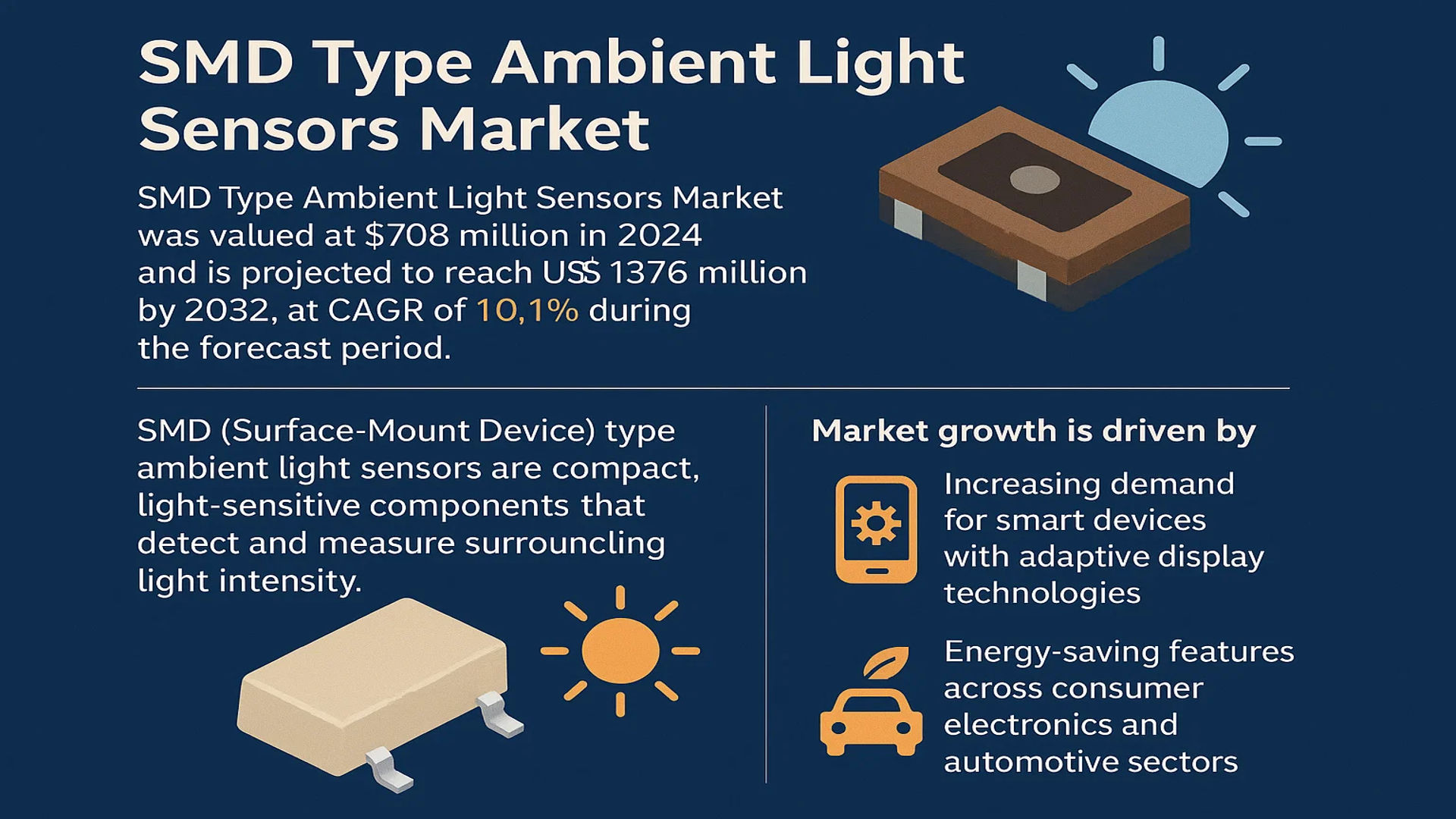
The global SMD Type Ambient Light Sensors Market was valued at 708 million in 2024 and is projected to reach US$ 1376 million by 2032, at a CAGR of 10.1% during the forecast period.
SMD (Surface-Mount Device) type ambient light sensors are compact, light-sensitive components that detect and measure surrounding light intensity. These sensors utilize photodiodes or phototransistors to convert light into electrical signals, typically mimicking the spectral response of human vision for accurate brightness measurement. Their SMD packaging enables seamless integration into modern electronic circuits, making them essential for energy-efficient display management in smartphones, tablets, laptops, and automotive displays.
The market growth is driven by increasing demand for smart devices with adaptive display technologies and energy-saving features across consumer electronics and automotive sectors. Key industry players including ams OSRAM AG, Texas Instruments, and ON Semiconductor are continuously innovating to enhance sensor precision and power efficiency. The consumer electronics segment currently dominates applications, accounting for over 60% of market share, while automotive applications are growing at the fastest rate due to rising adoption in infotainment systems and dashboard displays.
MARKET DYNAMICS
MARKET DRIVERS
Growing Demand in Consumer Electronics to Propel Market Expansion
The global SMD ambient light sensor market is experiencing robust growth primarily due to their widespread adoption in consumer electronics such as smartphones, tablets, laptops, and smart TVs. These sensors enable automatic brightness adjustment, enhancing user comfort while improving energy efficiency. With over 1.5 billion smartphones shipped globally in 2023 and the increasing trend of high-resolution displays requiring precise light management, the demand for these sensors continues to surge. The integration of ambient light sensors has become a standard feature in premium devices, with mid-range models increasingly incorporating this technology to improve user experience and battery performance.
Automotive Sector Adoption Accelerating Market Growth
The automotive industry represents another significant growth driver, where SMD ambient light sensors are being increasingly deployed for interior lighting systems, instrument clusters, and infotainment displays. With the global automotive display market projected to exceed $30 billion by 2030, manufacturers are prioritizing intelligent lighting solutions that automatically adjust to external conditions. These sensors not only improve driver comfort but also enhance safety by preventing display glare in varying light conditions. Furthermore, the transition towards electric vehicles, which prioritizes energy efficiency, has created additional demand for light-sensitive technologies that can optimize power consumption.
Smart Building Integration Creates New Growth Avenues
The smart building sector is emerging as a key adopter of SMD ambient light sensors, utilizing them for automated lighting control systems that optimize energy use. Commercial buildings incorporating these sensors can achieve energy savings of 20-30% in lighting costs, making them attractive for both new constructions and retrofits. The global smart building market’s rapid expansion, coupled with stringent energy efficiency regulations worldwide, is driving significant demand for these sensors. Their ability to provide precise ambient light measurements enables sophisticated lighting management systems that adjust in real-time to changing environmental conditions.
MARKET RESTRAINTS
Technical Limitations in Extreme Light Conditions Challenge Performance
Despite their growing adoption, SMD ambient light sensors face performance challenges in extreme lighting conditions. These sensors may struggle to maintain accuracy in very low-light environments or when exposed to direct sunlight, leading to potentially inconsistent performance. The dynamic range limitations become particularly apparent in automotive applications where lighting conditions can change rapidly. Manufacturers are investing in R&D to develop sensors with wider dynamic ranges and better adaptability, but these technical constraints currently limit application in certain environments.
Other Restraints
Price Sensitivity in Consumer Markets
In price-sensitive market segments, particularly entry-level consumer electronics, the additional cost of ambient light sensors can deter adoption. With profit margins shrinking in competitive markets, some manufacturers may opt to exclude these features to maintain price competitiveness.
Integration Challenges
The miniaturization trend in electronics creates challenges for sensor placement and performance optimization. As devices become thinner and bezels shrink, finding optimal locations for light sensors that provide accurate ambient readings becomes increasingly difficult.
MARKET CHALLENGES
Intense Competition and Price Pressure Impacting Profit Margins
The SMD ambient light sensor market faces intense competition with over 15 major global players vying for market share. This competitive landscape has led to significant price erosion, particularly in consumer electronics applications where cost sensitivity is high. Many manufacturers find themselves caught between the need to invest in advanced R&D while maintaining competitive pricing structures. This pressure is particularly acute in Asia-Pacific markets, where local manufacturers can often produce components at lower costs.
Other Challenges
Supply Chain Vulnerabilities
The semiconductor supply chain disruptions that emerged during the global chip shortage highlighted vulnerabilities in component availability. These sensors rely on semiconductor fabrication processes that remain susceptible to geopolitical and economic factors affecting global supply chains.
Standardization Issues
Lack of universal performance standards for ambient light sensors creates challenges for OEMs in comparing and selecting components. This inconsistency can lead to performance variations across different device manufacturers and applications.
MARKET OPPORTUNITIES
Emerging Applications in Healthcare and IoT Present New Growth Potential
The healthcare sector is emerging as a promising opportunity for SMD ambient light sensors, particularly in medical devices and patient monitoring systems. These sensors are being integrated into sleep monitoring devices and therapeutic equipment where lighting conditions impact treatment effectiveness. Additionally, the proliferation of IoT devices is creating new applications, with smart home systems utilizing these sensors for adaptive lighting solutions that adjust based on occupancy and natural light availability. The global smart home market’s projected growth above 15% CAGR through 2030 indicates substantial potential for sensor integration.
Advanced Automotive Applications Drive Innovation Opportunities
Next-generation automotive applications present significant opportunities for advanced SMD ambient light sensors. The integration of these sensors with ADAS (Advanced Driver Assistance Systems) is gaining traction, where they contribute to glare-free high beam systems and augmented reality head-up displays. Additionally, the development of human-centric lighting in vehicle interiors that adjusts based on time of day and passenger needs is creating demand for more sophisticated sensor solutions with multi-spectral capabilities.
Miniaturization and Integration Trends Open New Possibilities
The ongoing trend towards smaller form factors and sensor integration is driving innovation in SMD ambient light sensor technology. Manufacturers are developing combo sensors that integrate ambient light detection with proximity sensing, color detection, and other environmental monitoring functions. These integrated solutions offer space and cost savings for device manufacturers while enabling more sophisticated contextual awareness in smart devices. The development of ultra-thin, flexible sensors also creates opportunities for novel applications in wearable technology and curved display applications.
SMD TYPE AMBIENT LIGHT SENSORS MARKET TRENDS
Integration of Advanced Sensing Technologies to Emerge as a Key Market Trend
The SMD Type Ambient Light Sensors market is witnessing rapid evolution, driven by the increasing integration of advanced sensing technologies in consumer electronics and automotive applications. With the global market projected to grow from $708 million in 2024 to $1,376 million by 2032, industry players are focusing on developing sensors with higher sensitivity, lower power consumption, and improved compactness. Innovations such as ultra-thin SMD packaging and enhanced spectral response closer to human vision are enhancing adoption in premium smartphones, tablets, and IoT devices. Notably, the demand for sensor accuracy in varied lighting conditions—from 0.01 lux to 100,000 lux—has led to breakthroughs in dynamic range and low-light performance.
Other Trends
Automotive Sector Adoption
The automotive industry is accelerating the deployment of SMD ambient light sensors, particularly for adaptive interior lighting systems and dashboard displays. With modern vehicles incorporating 10-15 ambient light sensors per car for mood lighting and safety features, this segment is expected to grow at a CAGR of 12% over the forecast period. The rise of autonomous vehicles further amplifies the need for real-time ambient light adjustments to optimize camera-based ADAS (Advanced Driver Assistance Systems). Luxury car manufacturers, in particular, are prioritizing these sensors to enhance user experience and energy efficiency.
Smart Home and IoT Expansion
The proliferation of smart home devices is creating robust demand for SMD ambient light sensors in applications like automated lighting control and display dimming. Smart thermostats, security cameras, and voice assistants increasingly rely on these sensors to optimize power usage and improve usability. The Asia-Pacific region dominates this trend, accounting for over 40% of global shipments, driven by rapid urbanization and smart city initiatives. With IoT connectivity becoming ubiquitous, sensor manufacturers are prioritizing wireless integration capabilities and multi-functional sensor hubs to capture this high-growth segment.
Miniaturization and Energy Efficiency
As electronic devices shrink in size while requiring longer battery life, the push for miniaturized SMD sensors with ultra-low power consumption has intensified. Latest-generation sensors now consume as little as 0.65µA in active mode, enabling always-on functionality in wearables and mobile devices without compromising battery performance. This trend aligns with global energy efficiency regulations, particularly in Europe and North America, where standards like Energy Star are mandating smarter power management in consumer electronics. The digital output segment, offering easier integration with microcontrollers, is gaining preference over analog variants for these applications.
COMPETITIVE LANDSCAPE
Key Industry Players
Semiconductor Giants and Sensor Specialists Dominate the SMD Ambient Light Sensor Market
The global SMD type ambient light sensor market demonstrates a fragmented yet competitive landscape, with established semiconductor companies and specialized sensor manufacturers vying for market share. ams OSRAM AG emerges as a dominant player, leveraging its advanced optoelectronic solutions and strong partnerships with consumer electronics brands. The company maintains a technological edge through continuous R&D investments, particularly in high-accuracy digital light sensors for automotive and industrial applications.
Texas Instruments and ROHM Semiconductor have secured significant market positions by offering integrated sensor solutions that combine ambient light detection with proximity sensing and gesture recognition capabilities. Their ability to provide complete sensor ecosystem solutions gives them competitive advantage in the smartphone and tablet markets, which accounted for nearly 45% of global SMD ambient light sensor demand in 2024.
The market also sees intense competition from ON Semiconductor and STMicroelectronics, who are expanding their footprints through strategic acquisitions and technological innovations. Both companies recently introduced ultra-low-power digital light sensors that extend battery life in IoT devices, addressing growing demand from the wearable technology sector.
While the top five players accounted for approximately 35% of global revenue in 2024, the market continues to attract new entrants. Emerging players are focusing on niche applications such as horticultural lighting control and medical device monitoring, where specialized spectral response characteristics are required. This dynamic competition is driving rapid technological advancements across the industry.
List of Key SMD Ambient Light Sensor Manufacturers
- ams OSRAM AG (Austria)
- Analog Devices, Inc. (U.S.)
- Bourns, Inc. (U.S.)
- Broadcom Inc. (U.S.)
- Honeywell International Inc. (U.S.)
- Infineon Technologies AG (Germany)
- NXP Semiconductors N.V. (Netherlands)
- ON Semiconductor Corporation (U.S.)
- ROHM Semiconductor (Japan)
- Sharp Corporation (Japan)
- STMicroelectronics (Switzerland)
- Texas Instruments Incorporated (U.S.)
- Toshiba Electronic Devices & Storage Corporation (Japan)
- Vishay Intertechnology, Inc. (U.S.)
Segment Analysis:
By Type
Digital Output Type Sensors Gain Traction Due to Integration with Smart Devices
The market is segmented based on type into:
- Analog Output Type
- Digital Output Type
By Application
Consumer Electronics Leads the Market with Rising Demand for Smart Displays
The market is segmented based on application into:
- Consumer Electronics
- Automotive
- Healthcare
- Aerospace and Defense
- Retail
- Others
By End User
Smartphone Manufacturers Drive Adoption Through Ambient Light Adaptation Features
The market is segmented based on end user into:
- Electronics OEMs
- Automotive Suppliers
- Medical Device Manufacturers
- Industrial Equipment Producers
Regional Analysis: SMD Type Ambient Light Sensors Market
Asia-Pacific
The Asia-Pacific region dominates the SMD Type Ambient Light Sensors market, driven by massive consumer electronics production and adoption. China leads with over 40% of global sensor demand, fueled by smartphone manufacturers like Xiaomi, Oppo, and Vivo. Japan and South Korea follow closely, with companies like Sharp and Samsung integrating advanced light sensors across their product portfolios. The region’s thriving automotive sector is increasingly adopting these sensors for smart dashboards and adaptive lighting systems. While cost-competitiveness remains crucial, there’s growing emphasis on precision and energy efficiency in sensor designs across all applications.
North America
North America represents a technology-driven market with strong R&D investments in SMD ambient light sensors. The U.S. accounts for nearly 30% of regional demand, with applications expanding beyond consumer electronics into healthcare devices and smart building systems. Major semiconductor firms like Texas Instruments and Broadcom are pioneering low-power digital sensor solutions. The region shows particular growth in automotive applications, where 78% of new vehicles now incorporate ambient light sensing for cabin controls. Stringent energy regulations are pushing manufacturers toward more efficient sensor designs with broader dynamic ranges.
Europe
European demand focuses on high-performance SMD ambient light sensors with environmental certifications. Germany and France lead adoption in automotive and industrial applications, where sensor accuracy and reliability are paramount. EU directives on energy efficiency drive innovation in smart lighting systems, creating secondary demand for ambient light detection. While consumer electronics growth has slowed compared to Asia, there’s increased integration in premium appliances and professional display equipment. The region remains a critical innovation hub, with companies like Ams OSRAM developing spectral sensors that go beyond basic ambient light detection.
South America
The South American market is emerging, with Brazil showing the strongest growth in SMD ambient light sensor adoption. Current applications remain concentrated in consumer electronics, particularly smartphones and tablets. Automotive integration is in early stages, with premium vehicle models first to adopt light-sensing features. Economic volatility impacts widespread adoption of advanced sensor technologies, though local manufacturers are beginning to incorporate basic ambient light functionality in mid-range devices. The region presents long-term potential as mobile device penetration increases and smart city initiatives gain traction in major urban centers.
Middle East & Africa
This region shows nascent but growing demand for SMD ambient light sensors, primarily in consumer electronics and building automation. Gulf countries lead in smart building projects that incorporate light-responsive systems, while African markets see increasing smartphone adoption driving basic sensor demand. The lack of local semiconductor manufacturing means nearly all sensors are imported, predominantly from Asian suppliers. While the market currently represents a small portion of global demand, projected urbanization rates and digitalization efforts suggest steady long-term growth potential for light-sensing technologies across multiple applications.
Report Scope
This market research report provides a comprehensive analysis of the global and regional SMD Type Ambient Light Sensors market, covering the forecast period 2024–2032. It offers detailed insights into market dynamics, technological advancements, competitive landscape, and key trends shaping the industry.
Key focus areas of the report include:
- Market Size & Forecast: Historical data and future projections for revenue, unit shipments, and market value across major regions and segments. The Global SMD Type Ambient Light Sensors market was valued at USD 708 million in 2024 and is projected to reach USD 1376 million by 2032, growing at a CAGR of 10.1%.
- Segmentation Analysis: Detailed breakdown by product type (Analog Output Type, Digital Output Type), application (Consumer Electronics, Automotive, Healthcare, Aerospace & Defense, Retail), and end-user industry to identify high-growth segments.
- Regional Outlook: Insights into market performance across North America, Europe, Asia-Pacific, Latin America, and Middle East & Africa. The U.S. market size is estimated at significant value in 2024, while China is expected to show strong growth.
- Competitive Landscape: Profiles of 15+ leading market participants including ams OSRAM AG, Analog Devices, Broadcom, Texas Instruments, and STMicroelectronics, covering their market share, product portfolios, and recent developments.
- Technology Trends: Assessment of emerging sensor technologies, integration with IoT devices, and innovations in light sensing accuracy and power efficiency.
- Market Drivers & Challenges: Evaluation of factors like increasing demand for smart devices, automotive applications, and challenges like supply chain constraints and price sensitivity.
- Stakeholder Analysis: Strategic insights for sensor manufacturers, OEMs, distributors, and investors regarding market opportunities and competitive strategies.
The research employs both primary and secondary methodologies, including interviews with industry leaders, analysis of financial reports, and validation through multiple data sources to ensure accuracy.
FREQUENTLY ASKED QUESTIONS:
What is the current market size of Global SMD Type Ambient Light Sensors Market?
-> SMD Type Ambient Light Sensors Market was valued at 708 million in 2024 and is projected to reach US$ 1376 million by 2032, at a CAGR of 10.1% during the forecast period.
Which key companies operate in Global SMD Type Ambient Light Sensors Market?
-> Major players include ams OSRAM AG, Analog Devices, Broadcom, Texas Instruments, STMicroelectronics, ON Semiconductor, ROHM Semiconductor, and Vishay Intertechnology.
What are the key growth drivers?
-> Growth is driven by increasing adoption in smartphones/tablets, automotive display systems, IoT devices, and energy-efficient lighting controls.
Which region dominates the market?
-> Asia-Pacific leads in both production and consumption, while North America shows strong growth in automotive and industrial applications.
What are the emerging trends?
-> Key trends include miniaturization of sensors, improved spectral response, lower power consumption, and integration with AI-based adaptive systems.

Get Sample Report PDF for Exclusive Insights
Report Sample Includes
- Table of Contents
- List of Tables & Figures
- Charts, Research Methodology, and more...
 Download Sample Report PDF