Smart Textile Electronics Market Insights
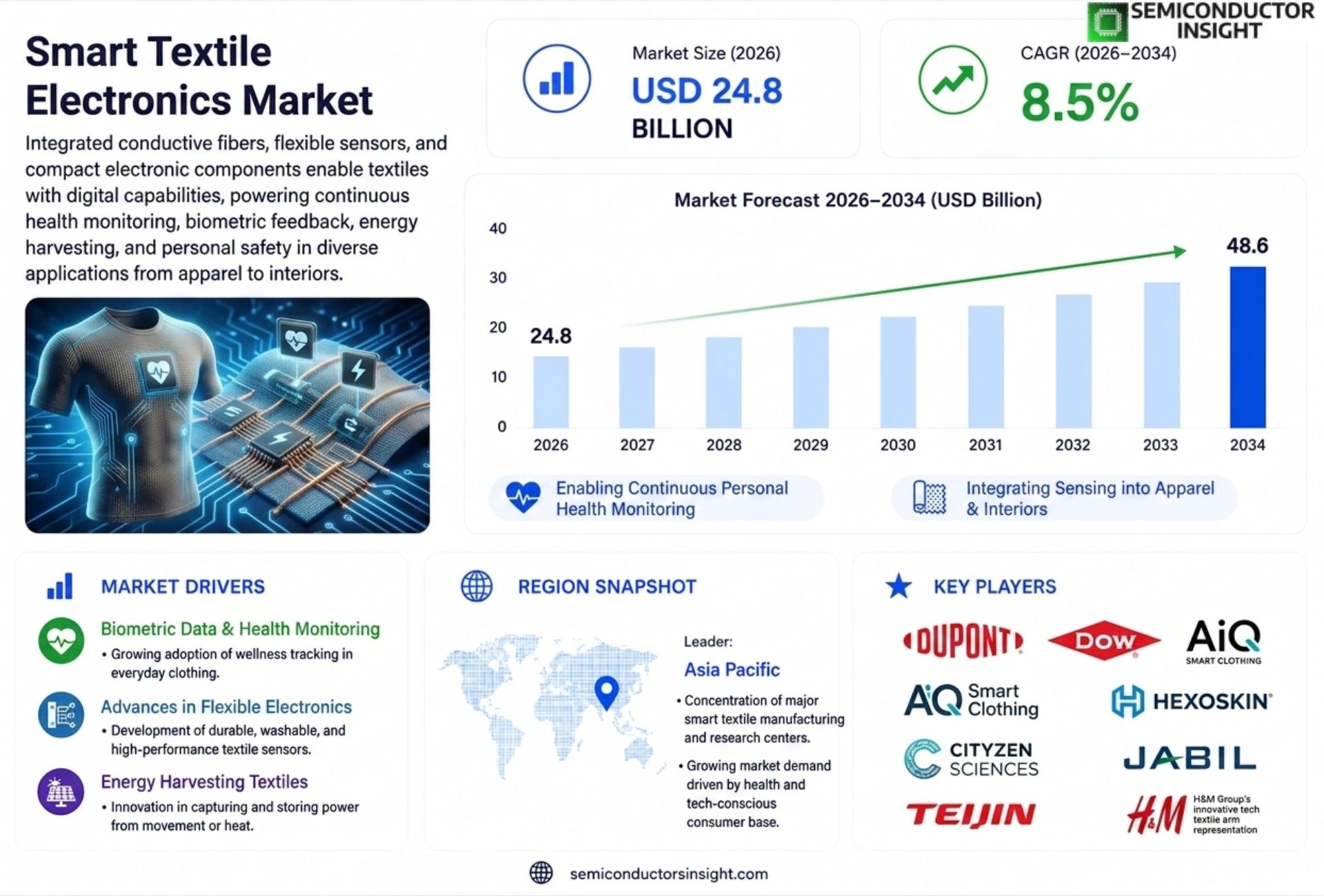
Global Smart Textile Electronics market size was valued at USD 23.4 billion in 2025. The market is projected to grow from USD 24.8 billion in 2026 to USD 48.6 billion by 2034, exhibiting a CAGR of 8.5% during the forecast period.
Smart Textile Electronics refer to fabrics engineered with embedded electronic components,such as conductive yarns, sensors, actuators, power sources, and communication modules,that enable real‑time data capture, adaptive functionality, and interactive user experiences while retaining the comfort and flexibility of traditional textiles.
The market is accelerating because of rising investment in wearable health monitoring, expanding applications in sports performance analytics, and growing demand for connected apparel in defense and automotive sectors. Furthermore, advancements in low‑power flexible circuits and scalable manufacturing processes are lowering entry barriers. Key players,including Hexoskin, Google’s Project Jacquard, Under Armour, Sensoria, and Textronics,are forging strategic partnerships and launching innovative product lines that further fuel expansion.
MARKET DRIVERS
Rising Demand for Wearable Health Monitoring
The increasing prevalence of chronic diseases has accelerated adoption of smart garments that continuously track vital signs. In 2023, wearable health solutions captured approximately 18% of the overall Smart Textile Electronics Market, driven by consumer awareness and preventive care initiatives. Real‑time data collection enables early intervention, making these textiles indispensable for hospitals and home‑care settings.
Integration with IoT Platforms
Seamless connectivity between textile sensors and cloud‑based analytics platforms is fueling rapid market expansion. Enterprises are deploying edge‑computing modules that reduce latency, allowing instant feedback for athletes and industrial workers. The convergence of IoT and smart fabrics is projected to raise the market’s CAGR to roughly 15% through 2030.
➤ Industry surveys indicate that over 70% of apparel manufacturers plan to embed electronic functionalities within the next three years, signaling a strong pipeline of innovative products.
These drivers collectively create a robust ecosystem where design, data, and delivery align, positioning Smart Textile Electronics market for sustained growth across healthcare, sports, and defense sectors.
MARKET CHALLENGES
Technical Complexity and Standardization
Developing durable, washable electronic components that retain performance after repeated laundering remains a core challenge. Lack of unified standards across regions hampers interoperability, leading to fragmented supply chains and higher integration costs for OEMs.
Other Challenges
Manufacturing Scalability
Scaling production from prototype to volume manufacturing requires significant capital investment in specialized equipment. Small‑batch processes inflate unit costs, limiting price competitiveness against conventional textiles.
MARKET RESTRAINTS
High Material Costs
Advanced conductive fibers and flexible printed circuits command premium prices, often exceeding 30% of the total garment cost. This cost premium restricts mass‑market adoption, especially in price‑sensitive segments such as fast‑fashion.
Furthermore, the reliance on rare earth metals for sensor functionality introduces supply‑chain volatility, potentially leading to price spikes that deter long‑term investment.
Regulatory compliance adds another layer of restraint; textiles used for medical monitoring must meet stringent safety certifications, extending time‑to‑market and elevating development expenses.
MARKET OPPORTUNITIES
Expansion into Sports and Defense
High‑performance athletes are increasingly adopting smart apparel that tracks biomechanics, temperature, and hydration. Projected contracts with elite sports teams are expected to generate a $2.8 billion revenue stream by 2027, unlocking a sizable niche within the overall market.
Defense agencies are exploring embedded communication fabrics for soldier wearables, offering stealth data relay and health monitoring in austere environments. These initiatives could add an estimated $1.5 billion to market size over the next five years.
Additionally, collaborations between textile manufacturers and semiconductor firms are fostering modular designs that simplify integration, lowering barriers for new entrants and creating fresh growth avenues.
Smart Textile Electronics Market Trends
Integration of Health Monitoring Sensors
Smart Textile Electronics market is being reshaped by the rapid adoption of health‑monitoring sensors embedded directly into garments. These fabrics capture physiological signals,heart rate, respiration, and temperature,in real time, enabling continuous wellness tracking without the need for separate devices. Investment from medical‑technology firms and public‑health initiatives has accelerated product pipelines, leading to pilot programs in hospitals and remote‑care clinics. The convergence of low‑power flexible circuits with breathable conductive yarns ensures that the added electronics do not compromise wearer comfort, a critical factor for long‑term compliance. As a result, apparel manufacturers are collaborating with health‑tech startups to launch smart shirts and socks that provide actionable data to both patients and clinicians.
Other Trends
Performance Analytics in Sports
In the sports arena, Smart Textile Electronics market supports advanced performance analytics by integrating motion sensors and biomechanical detectors into training apparel. Athletes benefit from instantaneous feedback on stride symmetry, muscle activation, and fatigue levels, which coaches can translate into optimized training regimens. Major sports brands have introduced smart compression wear that streams data to cloud‑based platforms, where machine‑learning algorithms identify patterns linked to injury risk. The scalability of automated weaving processes has lowered production costs, making these high‑tech solutions accessible to amateur teams and fitness enthusiasts alike. This diffusion reinforces the perception of smart textiles as a standard component of competitive edge strategies.
Expansion into Defense and Automotive Sectors
Beyond consumer and medical applications, Smart Textile Electronics market is witnessing growing interest from defense and automotive sectors. Military uniforms now incorporate embedded communication modules, environmental sensors, and low‑visibility heating elements, enhancing soldier safety and situational awareness in hostile environments. Simultaneously, automotive manufacturers are experimenting with smart upholstery that monitors driver vitals and adjusts seat ergonomics automatically. Partnerships between textile specialists and electronics firms accelerate the integration of robust, vibration‑resistant components that meet stringent industry standards. These cross‑sector collaborations are expanding the functional scope of smart fabrics, positioning them as essential enablers of next‑generation protective and interactive systems.
COMPETITIVE LANDSCAPE
Key Industry Players
Strategic Rivalries and Innovation Dynamics Shaping Smart Textile Electronics market
Smart Textile Electronics market is characterized by a moderately consolidated competitive structure, with a blend of established technology conglomerates, specialized wearable technology firms, and emerging start-ups actively vying for market share. Leading the competitive front, Google’s Project Jacquard has set a benchmark through its pioneering work in weaving touch and gesture interactivity directly into fabric, enabling collaborations with major apparel brands. Similarly, Hexoskin has carved out a dominant niche in biometric monitoring apparel, offering clinically validated garments that track cardiac, respiratory, and activity data in real time. Under Armour continues to leverage its athletic apparel stronghold by integrating advanced sensor technologies into performance wear, targeting both professional athletes and fitness-conscious consumers. The competitive intensity is further amplified by sustained R&D investments, strategic licensing agreements, and cross-industry partnerships between textile manufacturers and semiconductor companies, collectively driving product differentiation and accelerating time-to-market across the value chain.
Beyond the frontrunners, several niche yet highly significant players are reshaping specific segments of Smart Textile Electronics market. Sensoria has established a strong foothold in smart footwear and fitness garments, deploying textile pressure sensors to deliver actionable biomechanical insights for injury prevention and athletic optimization. DuPont, through its advanced materials division, supplies critical conductive fiber and ink technologies that underpin many commercial smart textile products globally. Stretchable Electronics specialist Clothing+ and performance-focused firm Textronics contribute proprietary integration methodologies for embedding flexible circuitry into washable garments. Meanwhile, companies such as Adidas, Outlast Technologies, and Myant are expanding their smart textile portfolios targeting healthcare monitoring, thermal regulation, and personalized connected wellness applications. The increasing convergence of IoT ecosystems, AI-driven analytics, and advanced manufacturing techniques is expected to intensify competitive pressures while simultaneously opening new avenues for differentiation across sportswear, medical, defense, and automotive verticals.
List of Key Smart Textile Electronics Companies Profiled
- Hexoskin
- Google (Project Jacquard)
- Under Armour
- Sensoria
- Textronics
- DuPont
- Outlast Technologies
- Myant
- Clothing+
- Adidas
- Smartex
- Ohmatex
- Peratech
- Noble Biomaterials
- Koninklijke Philips N.V.
Segment Analysis:
| Segment Category | Sub-Segments | Key Insights |
| By Type |
|
Integrated Sensors are emerging as the most compelling type because they enable real‑time physiological monitoring without compromising garment comfort.
|
| By Application |
|
Health Monitoring dominates because it directly addresses growing consumer desire for proactive wellness.
|
| By End User |
|
Healthcare Providers are a leading end‑user due to the strategic emphasis on remote diagnostics and continuous monitoring.
|
| By Functionality |
|
Data Acquisition stands out as the primary functional driver, underpinning all downstream applications.
|
| By Market Trend |
|
Sustainable Materials are gaining traction as manufacturers seek to align with eco‑conscious consumer expectations.
|
Regional Analysis: North America
The integration of smart textile electronics into wearable devices is gaining traction, with applications spanning fitness trackers, smartwatches, and health monitoring garments. This segment is expanding rapidly as consumers prioritize proactive health management and seek seamless integration of technology into their daily lives.
The healthcare sector presents a lucrative opportunity for smart textile electronics, with applications in patient monitoring, drug delivery systems, and therapeutic fabrics. The ability to continuously monitor vital signs and deliver medication through smart textiles is revolutionizing patient care and improving treatment outcomes.
In the realm of sports and fitness, smart textile electronics are being utilized to enhance athletic performance through sensors that track movement, heart rate, and other physiological data. These textiles provide valuable insights to athletes and trainers, enabling personalized training regimens and injury prevention strategies.
The intersection of fashion and technology is giving rise to stylish and functional garments embedded with smart textile electronics. This trend is driven by a desire for personalized and connected clothing that seamlessly blends aesthetics with technological capabilities.
United States
The United States represents the largest market within North America for smart textile electronics, exhibiting robust growth fueled by a mature technological infrastructure and a high level of disposable income. The demand for technologically advanced apparel, coupled with a strong focus on healthcare innovation, is driving market expansion. Businesses are increasingly investing in research and development to create innovative solutions for various applications, including medical textiles and performance wear.
The US market is characterized by a competitive landscape with numerous startups and established players vying for market share. Key trends include the development of flexible electronics, the integration of Internet of Things (IoT) capabilities, and the growing adoption of sustainable materials in smart textile production. The focus on personalized health monitoring and athletic performance is further fueling the demand for sophisticated smart textile electronics solutions.
Canada
Canada’s smart textile electronics market is experiencing steady growth, supported by government initiatives promoting innovation and technological development. The country’s strong manufacturing base and a growing interest in wearable technology are contributing to market expansion. The healthcare sector in Canada is a key driver, with increasing adoption of smart textiles for patient monitoring and remote healthcare applications. Business strategies in Canada focus on collaboration between industry, academia, and government to foster innovation and commercialization of smart textile electronics solutions.
Mexico
Mexico’s smart textile electronics market is emerging as a promising growth area, driven by increasing investment in manufacturing and a growing consumer base. The country’s proximity to the US market and lower labor costs are attracting foreign investment in the textile and electronics industries. The demand for smart textile electronics in apparel, automotive, and healthcare applications is expected to increase in the coming years. Businesses are focusing on cost-effective manufacturing and developing solutions tailored to the needs of the local market.
Report Scope
This market research report provides a comprehensive analysis of the Smart Textile Electronics Market , covering the forecast period 2026–2034. It offers detailed insights into market dynamics, technological advancements, competitive landscape, and key trends shaping the industry.
Key focus areas of the report include:
- Market Overview: The report begins with an overview outlining its current market scenario, key growth indicators, and industry transformation drivers. It discusses macroeconomic factors, demand–supply balance, regulatory landscape, and the strategic role of semiconductors in powering advancements across industries such as automotive, telecommunications, consumer electronics, and industrial automation.
- Market Size & Forecast: Historical data and future projections for revenue, unit shipments, and market value across major regions and segments.
- Segmentation Analysis: Detailed breakdown by product type, technology, application, and end-user industry to identify high-growth segments and investment opportunities.
- Regional Insights: Insights into market performance across North America, Europe, Asia-Pacific, Latin America, and the Middle East & Africa, including country-level analysis where relevant.
- Competitive Landscape: Profiles of leading market participants, including their product offerings, R&D focus, manufacturing capacity, pricing strategies, and recent developments such as mergers, acquisitions, and partnerships.
- Technology Trends & Innovation: Assessment of emerging technologies, integration of AI/IoT, semiconductor design trends, fabrication techniques, and evolving industry standards.
- Market Drivers & Restraints: Evaluation of factors driving market growth along with challenges, supply chain constraints, regulatory issues, and market-entry barriers.
- Stakeholder Insights: Insights for component suppliers, OEMs, system integrators, investors, and policymakers regarding the evolving ecosystem and strategic opportunities.
Primary and secondary research methods are employed, including interviews with industry experts, data from verified sources, and real-time market intelligence to ensure the accuracy and reliability of the insights presented.
FREQUENTLY ASKED QUESTIONS:
What is the current market size of Smart Textile Electronics Market?
-> Smart Textile Electronics market was valued at USD 23.4 billion in 2025 and is expected to reach USD 48.6 billion by 2034.
Which key companies operate Smart Textile Electronics market?
-> Key players include Hexoskin, Google’s Project Jacquard, Under Armour, Sensoria, and Textronics.
What are the key growth drivers?
-> Key growth drivers include rising investment in wearable health monitoring, expanding applications in sports performance analytics, and growing demand for connected apparel in defense and automotive sectors.
Which region dominates the market?
-> The market shows strong adoption globally across North America, Europe, and Asia‑Pacific; no single region dominates.
What are the emerging trends?
-> Emerging trends include advancements in low‑power flexible circuits and scalable manufacturing processes.

Get Sample Report PDF for Exclusive Insights
Report Sample Includes
- Table of Contents
- List of Tables & Figures
- Charts, Research Methodology, and more...
 Download Sample Report PDF