MARKET INSIGHTS
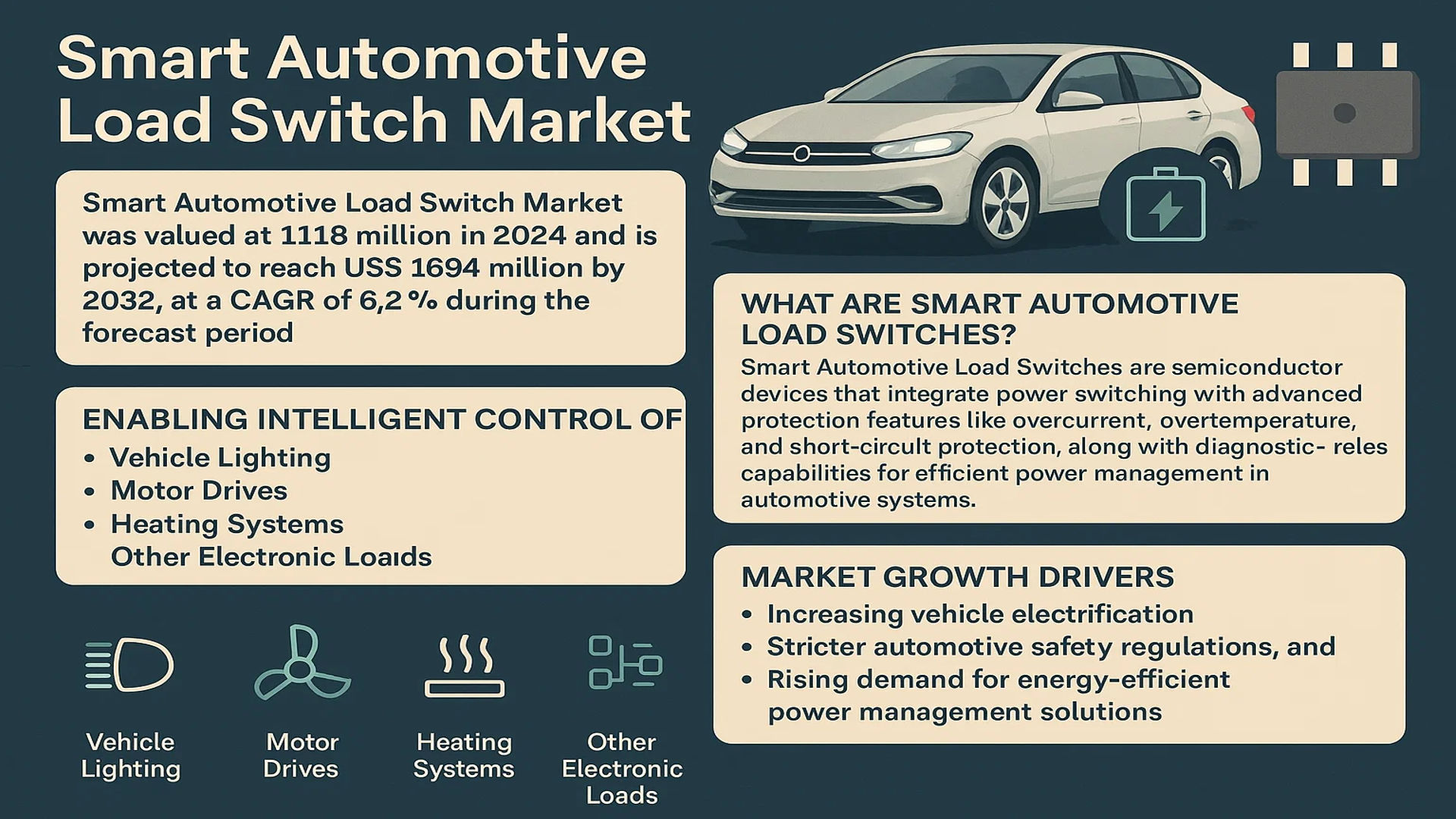
The global Smart Automotive Load Switch Market was valued at 1118 million in 2024 and is projected to reach US$ 1694 million by 2032, at a CAGR of 6.2% during the forecast period.
Smart Automotive Load Switches are semiconductor devices that integrate power switching with advanced protection features like overcurrent, overtemperature, and short-circuit protection, along with diagnostic capabilities for efficient power management in automotive systems. These switches outperform traditional mechanical relays by offering faster response times, reduced power consumption, and enhanced reliability while enabling intelligent control of vehicle lighting, motor drives, heating systems, and other electronic loads.
The market growth is primarily driven by increasing vehicle electrification, stricter automotive safety regulations, and rising demand for energy-efficient power management solutions. While the automotive segment dominates application, industrial and home appliance sectors also contribute significantly. Key players like STMicroelectronics, Infineon, and Texas Instruments are expanding their portfolios through innovations in high-side and low-side switch technologies, with Asia-Pacific emerging as the fastest-growing regional market due to expanding automotive production.
MARKET DYNAMICS
MARKET DRIVERS
Rising Demand for Vehicle Electrification to Accelerate Market Expansion
The global automotive industry is undergoing a seismic shift toward electrification, with electric vehicle sales projected to account for over 30% of total vehicle sales by 2030. Smart load switches play a critical role in this transition by enabling efficient power distribution and system protection in electric and hybrid vehicles. The technology’s ability to handle high currents while providing precise diagnostic feedback makes it indispensable for battery management systems, onboard charging modules, and power conversion units. Major automakers are increasingly adopting these solutions to improve energy efficiency and comply with stringent emissions regulations.
Advancements in Automotive Electronics Fueling Adoption of Smart Load Switches
Modern vehicles now incorporate over 150 electronic control units on average, creating complex power distribution networks that demand intelligent load management. Smart load switches offer significant advantages over traditional fusebox solutions by combining multiple protection features into single-chip solutions while enabling real-time system monitoring. The proliferation of advanced driver assistance systems (ADAS), infotainment platforms, and telematics units is driving manufacturers to adopt these integrated solutions that can reduce wiring complexity by up to 40% while improving reliability.
➤ The integration of smart load switches in automotive lighting systems has demonstrated a 15-20% improvement in energy efficiency compared to conventional relay-based solutions.
Furthermore, the growing emphasis on vehicle safety standards is prompting automakers to replace passive protection devices with intelligent switches that can preemptively detect and mitigate electrical faults before they escalate into critical failures. This trend is particularly prominent in premium vehicle segments where manufacturers are willing to invest in advanced power management technologies.
MARKET RESTRAINTS
Supply Chain Disruptions and Semiconductor Shortages Constraining Market Growth
The automotive semiconductor industry continues to face significant supply chain challenges that impact production timelines and component availability. Smart load switches, being complex mixed-signal ICs, require specialized foundry processes that have been affected by capacity constraints. Lead times for automotive-grade semiconductors have extended to 40-50 weeks in some cases, forcing automakers to seek alternative solutions or delay vehicle launches. This uncertainty in supply is particularly challenging for smaller automotive suppliers that lack long-term agreements with semiconductor manufacturers.
Other Restraints
Design Complexity Limitations
Implementing smart load switches requires extensive system redesigns that many traditional automakers find challenging. The transition from discrete fuse boxes to distributed smart switching architectures demands significant engineering resources and testing validation, which can add 12-18 months to vehicle development cycles.
Cost Sensitivity in Mass Market Segments
While premium vehicle manufacturers readily adopt these technologies, cost-conscious segments remain hesitant due to the 30-40% higher component costs compared to conventional solutions. This price sensitivity is particularly acute in emerging markets where vehicle electrification is still in early stages.
MARKET CHALLENGES
Thermal Management and Reliability Concerns in Harsh Operating Conditions
Smart load switches must maintain operational integrity across extreme temperature ranges from -40°C to +125°C while managing significant current loads. These thermal challenges become more pronounced in electric vehicles where power requirements continue to increase. Premature failures in these components can lead to complete system shutdowns, creating safety hazards and warranty claims. Automotive OEMs require extensive reliability testing that can extend qualification periods by 6-9 months, delaying time-to-market for new solutions.
Additional Challenges
Cybersecurity Vulnerabilities
As power distribution systems become more connected, they present potential attack vectors for malicious actors. The industry is grappling with developing robust security protocols for smart load switches that communicate with vehicle networks while maintaining functional safety requirements.
Standardization Gaps
The lack of uniform industry standards for smart load switch implementation creates integration challenges across different vehicle platforms and suppliers. This fragmentation increases development costs and limits component interoperability across automotive ecosystems.
MARKET OPPORTUNITIES
Emergence of Vehicle-to-Everything (V2X) Technologies Creating New Application Areas
The development of V2X infrastructure presents significant growth potential for smart load switch providers. These systems require intelligent power management solutions that can dynamically adjust to varying load conditions while ensuring uninterrupted operation. Bidirectional charging applications in particular are driving demand for advanced load switches capable of handling power flows in both directions. The global V2X market is projected to grow at a compound annual rate of over 45% through 2030, creating substantial opportunities for innovation in power distribution components.
Expansion of Autonomous Vehicle Development Opening New Frontiers
Autonomous vehicle platforms demand unprecedented levels of power system reliability and redundancy, with many designs incorporating multiple independent power domains. Smart load switches are increasingly being designed into these architectures to provide fault isolation and graceful degradation capabilities. The unique requirements of autonomous systems, including fail-operational capabilities and continuous health monitoring, are driving development of next-generation load switches with enhanced diagnostic features and ultra-high reliability specifications. This segment represents one of the most promising growth avenues for technology providers.
Furthermore, the integration of artificial intelligence in power management systems is creating opportunities for smart load switches that can predict and prevent failures through machine learning algorithms analyzing historical performance data and real-time operating conditions. This predictive maintenance capability could transform vehicle service models while significantly improving system uptime.
SMART AUTOMOTIVE LOAD SWITCH MARKET TRENDS
Electrification and ADAS Integration Fuel Market Growth
The global push toward vehicle electrification and the increasing adoption of Advanced Driver Assistance Systems (ADAS) are significantly driving the demand for smart automotive load switches. These devices play a crucial role in efficient power management, ensuring reliability and safety in electric and hybrid vehicles. With automotive manufacturers prioritizing energy efficiency, smart load switches are replacing traditional mechanical relays due to their faster response times, lower power consumption, and diagnostic capabilities. The automotive segment is projected to account for nearly 40% of the market’s revenue by 2032, reflecting strong industry adoption.
Other Trends
Miniaturization and High Integration
The trend toward miniaturization and higher integration in vehicle electronics has accelerated the development of compact smart load switches with advanced functionalities. Manufacturers are increasingly focusing on integrating multiple protections—such as overcurrent, overvoltage, and thermal shutdown—into single-chip solutions to reduce PCB footprint. This is particularly critical for next-generation vehicles, where space optimization is paramount. High-side switches, which dominate the market with a share of over 55%, are witnessing rapid innovation to support tighter integration in modern automotive architectures.
Increasing Focus on Functional Safety Compliance
The stringent regulatory landscape for automotive safety standards, including ISO 26262, is compelling manufacturers to adopt smart load switches that comply with functional safety requirements. These devices enable real-time fault detection and diagnostics, essential for mission-critical applications like braking systems and power steering. Furthermore, the rise of autonomous vehicles has amplified the need for fail-safe power distribution solutions, with smart load switches emerging as a key enabler. The market is responding with ASIL-rated products, which are expected to grow at a CAGR of 8.3% from 2024 to 2032, outpacing the broader industry growth rate.
COMPETITIVE LANDSCAPE
Key Industry Players
Market Leaders Drive Innovation in Automotive Power Management Solutions
The global smart automotive load switch market features a dynamic competitive landscape dominated by semiconductor giants and specialized electronics manufacturers. Leading players such as STMicroelectronics and Infineon Technologies collectively command a significant share of the market, benefiting from their extensive automotive-grade product portfolios and strong relationships with major automakers. While these companies continue to dominate, smaller players are carving out niches in specific applications such as electric vehicles and advanced driver assistance systems (ADAS).
Market consolidation has been accelerating, with Texas Instruments and ROHM Semiconductor making strategic acquisitions to expand their power management offerings. Meanwhile, Asian manufacturers like Toshiba Electronic Devices & Storage Corporation are gaining traction by offering cost-competitive solutions without compromising on the reliability demanded by automotive applications.
The competitive intensity is further heightened by the transition towards vehicle electrification, pushing companies to develop more sophisticated load switches with higher current ratings and enhanced diagnostic capabilities. As automotive architectures become more complex with the rise of zonal controllers and centralized computing, manufacturers who can deliver integrated solutions will likely gain an edge in this evolving market.
List of Key Smart Automotive Load Switch Manufacturers
- STMicroelectronics (Switzerland)
- Infineon Technologies (Germany)
- Diodes Incorporated (U.S.)
- ROHM Semiconductor (Japan)
- Renesas Electronics (Japan)
- Fuji Electric (Japan)
- Texas Instruments (U.S.)
- Microchip Technology (U.S.)
- onsemi (U.S.)
- Toshiba Electronic Devices (Japan)
Segment Analysis:
By Type
High-Side Switches Lead Due to Enhanced Efficiency in Power Distribution Management
The market is segmented based on type into:
- High-Side Switches
- Subtypes: Single-channel, multi-channel, and others
- Low-Side Switches
By Application
Automotive Segment Dominates Owing to Increasing Demand for Advanced Electronics
The market is segmented based on application into:
- Industrial
- Home Appliances
- Automotive
- Others
By Protection Features
Integrated Protection Systems Drive Market Growth in Automotive Electronics
The market is segmented based on protection features into:
- Overcurrent Protection
- Overtemperature Protection
- Short-Circuit Protection
- Diagnostic Functions
Regional Analysis: Smart Automotive Load Switch Market
Asia-Pacific
The Asia-Pacific region dominates the Smart Automotive Load Switch market, driven by rapid automotive production growth and increasing adoption of advanced electronic systems in vehicles. China leads the regional demand, accounting for over 40% of APAC’s market share, as its automotive manufacturers integrate smart load switches into both internal combustion engine and electric vehicles. Japan and South Korea follow closely, where technological sophistication and high vehicle electrification rates create strong demand. India is emerging as a high-growth market, with its automotive sector expanding at 7-9% annually. Local manufacturers like ROHM and Renesas compete effectively with global players, while government initiatives like India’s ‘Make in India’ program encourage domestic semiconductor production.
North America
North America represents the second-largest market for smart automotive load switches, characterized by stringent vehicle safety standards and rapid electrification. The U.S. accounts for approximately 60% of regional demand, with major automotive OEMs increasingly specifying smart load switches for their enhanced protection features. Canada’s market, though smaller, shows strong growth potential with its focus on autonomous vehicle technologies. Regional players like Texas Instruments and Microchip Technology continue to innovate, developing switches with higher current ratings and diagnostic capabilities to meet automotive OEM requirements.
Europe
Europe’s automotive sector maintains strong demand for smart load switches, particularly in Germany and France where premium vehicle manufacturers integrate these components extensively. The EU’s strict electromagnetic compatibility (EMC) standards and vehicle safety regulations drive adoption, while the transition to electric vehicles creates additional growth opportunities. European semiconductor companies like Infineon and STMicroelectronics lead in developing smart switches that meet the region’s stringent automotive quality standards, often incorporating advanced features like load current monitoring and thermal protection.
South America
The South American market shows moderate but steady growth for smart automotive load switches, with Brazil being the primary consumer. While adoption lags behind other regions due to cost sensitivity in the automotive sector, local manufacturers are gradually recognizing the reliability benefits of smart switches over traditional solutions. The region’s challenging electrical environments, including voltage fluctuations, particularly favor smart switches with robust protection features. However, economic instability and currency fluctuations continue to impact market growth potential.
Middle East & Africa
This region represents the smallest but fastest-growing market for smart automotive load switches, with Turkey and South Africa showing the most promising development. Demand primarily comes from international automotive brands with local manufacturing operations, as they implement global component standards across all production locations. While price sensitivity remains a challenge, increasing vehicle electrification and government initiatives to modernize automotive manufacturing are creating opportunities for market expansion, particularly in Gulf Cooperation Council countries.
Report Scope
This market research report provides a comprehensive analysis of the Global Smart Automotive Load Switch market, covering the forecast period 2024–2032. It offers detailed insights into market dynamics, technological advancements, competitive landscape, and key trends shaping the industry.
Key focus areas of the report include:
- Market Size & Forecast: Historical data and future projections for revenue, unit shipments, and market value across major regions and segments. The Global Smart Automotive Load Switch market was valued at USD 1,118 million in 2024 and is projected to reach USD 1,694 million by 2032, growing at a CAGR of 6.2%.
- Segmentation Analysis: Detailed breakdown by product type (High-Side Switches, Low-Side Switches), application (Industrial, Home Appliances, Automotive, Others), and end-user industry to identify high-growth segments and investment opportunities.
- Regional Outlook: Insights into market performance across North America, Europe, Asia-Pacific, Latin America, and the Middle East & Africa, including country-level analysis where relevant. The U.S. and China are key markets with significant growth potential.
- Competitive Landscape: Profiles of leading market participants, including their product offerings, R&D focus, manufacturing capacity, pricing strategies, and recent developments such as mergers, acquisitions, and partnerships. Key players include STMicroelectronics, Infineon, Diodes Incorporated, ROHM, Renesas, Fuji Electric, Texas Instruments, Microchip, onsemi, and Toshiba.
- Technology Trends & Innovation: Assessment of emerging technologies, integration of smart power management solutions, semiconductor design trends, and evolving automotive electronics standards.
- Market Drivers & Restraints: Evaluation of factors driving market growth such as increasing vehicle electrification and demand for energy-efficient solutions, along with challenges like supply chain constraints and regulatory compliance.
- Stakeholder Analysis: Insights for component suppliers, automotive OEMs, system integrators, investors, and policymakers regarding the evolving ecosystem and strategic opportunities in smart power distribution.
Primary and secondary research methods are employed, including interviews with industry experts, data from verified sources, and real-time market intelligence to ensure the accuracy and reliability of the insights presented.
FREQUENTLY ASKED QUESTIONS:
What is the current market size of Global Smart Automotive Load Switch Market?
-> Smart Automotive Load Switch Market was valued at 1118 million in 2024 and is projected to reach US$ 1694 million by 2032, at a CAGR of 6.2% during the forecast period.
Which key companies operate in Global Smart Automotive Load Switch Market?
-> Key players include STMicroelectronics, Infineon, Diodes Incorporated, ROHM, Renesas, Fuji Electric, Texas Instruments, Microchip, onsemi, and Toshiba, among others.
What are the key growth drivers?
-> Key growth drivers include increasing vehicle electrification, demand for energy-efficient power management solutions, and the transition towards smart automotive electronics.
Which region dominates the market?
-> Asia-Pacific is the fastest-growing region due to expanding automotive production, while North America and Europe remain significant markets for advanced automotive electronics.
What are the emerging trends?
-> Emerging trends include integration of AI-powered diagnostics, advanced power management ICs, and the development of ultra-low power consumption switches for next-generation vehicles.

Get Sample Report PDF for Exclusive Insights
Report Sample Includes
- Table of Contents
- List of Tables & Figures
- Charts, Research Methodology, and more...
 Download Sample Report PDF