SIP Devices Market Insights
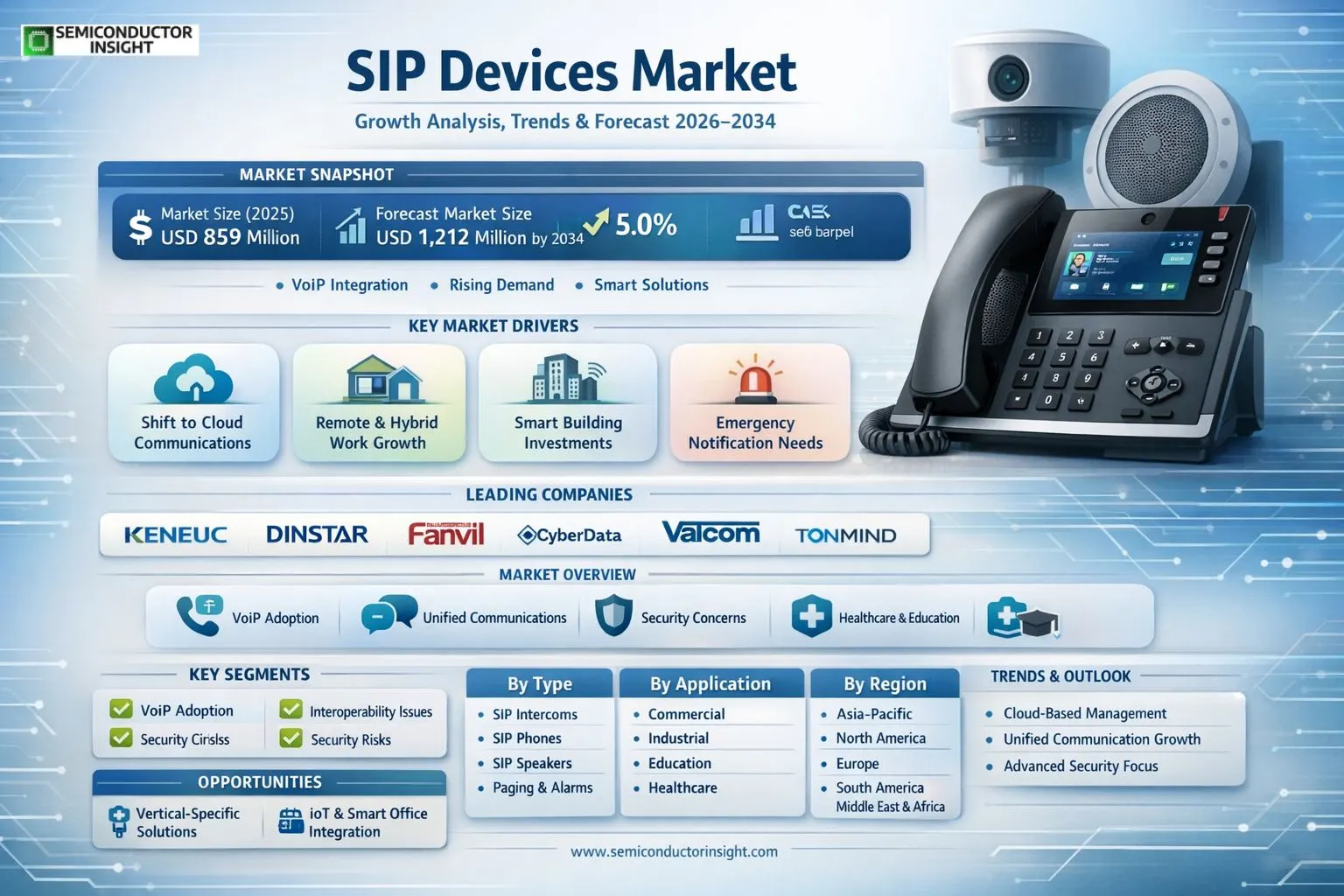
Global SIP devices market size was valued at USD 859 million in 2025. The market is projected to grow from USD 902 million in 2026 to USD 1,212 million by 2034, exhibiting a CAGR of 5.0% during the forecast period.
SIP (Session Initiation Protocol) devices are hardware endpoints that facilitate voice, video, and messaging communication over IP networks. These devices are essential components of modern unified communications systems, leveraging the SIP standard to establish, manage, and terminate multimedia sessions. The product landscape includes SIP phones, intercoms, speakers, paging amplifiers, and SIP-enabled strobe lights and alarms. Their integration with VoIP (Voice over IP) platforms offers enhanced features like zone-based paging, emergency alerts, and centralized control.
The market is experiencing steady growth driven by Global shift towards cloud-based communications and the retirement of legacy analog systems. Key growth factors include the rising adoption of remote and hybrid work models, which necessitate flexible and scalable communication solutions. Furthermore, significant investments in smart building infrastructure and the need for reliable mass notification systems in sectors like healthcare and education are propelling demand. For instance, recent industry developments highlight partnerships aimed at enhancing SIP interoperability and security. Leading players such as Grandstream Networks, Inc., Panasonic, Snom, and Fanvil Technology operate in this market with extensive portfolios of SIP endpoints designed for commercial and industrial applications.
MARKET DRIVERS
Enterprise Transition to Unified Communications
Global SIP Devices Market is propelled by the widespread enterprise migration from legacy telephony to cloud-based and hybrid Unified Communications (UC) platforms. This shift, driven by the need for cost reduction, scalability, and enhanced collaboration, necessitates compatible endpoint hardware. SIP phones, video phones, and conference units are fundamental elements that integrate voice, video, messaging, and presence into a single application stack. The proven cost savings of up to 60% on call and maintenance charges compared to traditional PBX systems continue to serve as a primary adoption driver for SIP devices.
Proliferation of Remote and Hybrid Work Models
The normalization of distributed workforces has permanently altered enterprise communication infrastructure requirements. Organizations now require flexible, secure, and professional-grade communication tools that can be deployed at office desks, in home offices, or on the go. This trend directly fuels demand for a variety of SIP devices, including DECT phones for campus mobility, executive desktop models, and softphone-capable conference speakers. The market is seeing robust growth in devices designed specifically for the quality-of-experience and simplicity needed in home office environments.
➤ The relentless expansion of VoIP and UCaaS subscriptions, projected to grow at over 10% CAGR, creates a continuous and expanding installed base requiring compatible SIP endpoint hardware.
Furthermore, the integration of advanced features like AI-powered noise suppression, touchscreen interfaces, and Bluetooth connectivity into SIP devices is raising their value proposition, encouraging upgrades and stimulating replacement cycles within the market.
MARKET CHALLENGES
Intense Competition and Price Erosion
The SIP Devices Market faces significant margin pressure due to high competition among established vendors and low-cost manufacturers. The relative maturity of core SIP phone technology has led to product commoditization in the entry-level and mid-range segments. This environment forces vendors to compete aggressively on price, which can stifle innovation and investment in R&D for hardware differentiation. Maintaining profitability while meeting the market’s expectation for feature-rich, low-cost devices presents a persistent operational challenge.
Other Challenges
Fragmentation and Interoperability Issues
Despite SIP being a standard protocol, subtle implementation differences between UC platform providers (e.g., Cisco, Microsoft Teams, Zoom, RingCentral) can lead to interoperability challenges. Vendors must invest heavily in certification programs across multiple platforms, increasing time-to-market and development costs. This fragmentation can also create confusion for end-users and IT departments when selecting compatible devices.
Security Vulnerabilities
As network endpoints, SIP devices are potential targets for cyber threats, including toll fraud, eavesdropping, and denial-of-service attacks. Ensuring robust, built-in security features,such as encrypted signaling and media, secure boot, and regular firmware update mechanisms,adds to manufacturing costs. The market must continuously address evolving security threats to maintain enterprise trust.
MARKET RESTRAINTS
Increasing Dominance of Mobile and Softphone Applications
A key factor restraining hardware growth in the SIP Devices Market is the ubiquitous adoption of software-based clients on smartphones, tablets, and laptops. Many UCaaS providers bundle robust softphones with their service subscriptions, offering a “good enough” solution for a significant portion of users, particularly those in highly mobile or cost-sensitive roles. This trend caps the total addressable market for dedicated desktop hardware, as enterprises may opt to provision physical SIP phones only for roles requiring superior audio quality, dedicated functionality, or a professional desk presence.
Extended Hardware Lifecycles and Slower Replacement Rates
SIP phones are inherently durable goods with lifespans often exceeding five years. Unlike software, which can be updated or licensed annually, the replacement cycle for hardware is driven by physical failure, significant feature gaps, or major office relocations. This elongated refresh rate inherently limits the growth velocity of the overall SIP Devices Market when compared to the software and services segments of the UC ecosystem. Economic uncertainty further encourages enterprises to extend the usable life of existing device fleets.
MARKET OPPORTUNITIES
Demand for Advanced, Vertical-Specific Solutions
Beyond commodity deskset phones, a significant opportunity lies in developing specialized SIP devices for vertical markets. This includes hardened, hygienic, or noise-canceling phones for healthcare; multi-line, high-volume phones for contact centers and trading floors; and intuitive, integration-ready devices for hospitality. By focusing on unique workflow requirements, vendors can create higher-value products with better margins that are less susceptible to pure price competition, thus expanding the SIP Devices Market into specialized segments.
Integration with IoT and Smart Office Ecosystems
The convergence of communication and operational technology presents a transformative opportunity. Future SIP devices can evolve into smart office hubs, integrating sensors, touch controls, and APIs to manage room booking, environmental controls, and security systems. A SIP conference phone, for example, could automatically adjust lights and start a meeting when a user taps their badge. This evolution from a pure communication endpoint to a central intelligent node creates a new premium tier within the market and drives replacement of legacy units.
SIP Devices Market Trends
Convergence with Unified Communications
A primary trend steering the SIP Devices market is the deepening integration with Unified Communications (UC) platforms. SIP phones, intercoms, and paging devices are no longer standalone endpoints but key components in a holistic communications ecosystem. This convergence enables seamless functionality between voice, video, messaging, and collaboration tools, directly from SIP hardware. Enterprises increasingly favor these integrated, vendor-agnostic systems for their operational efficiency and cost-effectiveness over closed, proprietary systems, driving consistent adoption across commercial and institutional sectors. This move towards open-architecture communications is fundamental to current market expansion in the SIP Devices arena.
Other Trends
Expansion of Vertical-Specific Solutions
Leading companies are tailoring SIP devices to meet the stringent demands of specific verticals. In healthcare, for instance, SIP-enabled strobe lights and alarms are designed for HIPAA-compliant emergency notification. For educational institutions, robust SIP paging amplifiers and speakers facilitate campus-wide announcements and emergency lockdown procedures. Industrial applications leverage ruggedized SIP intercoms for harsh environments. This focus on specialized application development creates growth pockets within the broader market, moving beyond generic hardware to value-added, purpose-built solutions.
Shift Towards Cloud-Managed Deployments
The management of large-scale SIP device fleets is increasingly shifting to cloud-based platforms. This trend reduces the need for on-premise provisioning servers, lowers IT overhead, and enables centralized control of geographically dispersed endpoints from a single dashboard. Providers of SIP Devices are enhancing their offerings with simplified cloud registration, bulk firmware updates, and remote diagnostics, catering to the needs of distributed enterprises and managed service providers. This evolution enhances the inherent scalability of SIP technology.
Rising Emphasis on Interoperability and Security
As networks become more complex, ensuring robust interoperability between SIP devices from different manufacturers and stringent security protocols has become critical. The market shows a clear trend towards devices that not only meet basic SIP standards but also support advanced telephony features and encryption for voice and signaling. This is paramount for adoption in sectors like finance and government. Consequently, manufacturers are prioritizing comprehensive certification programs and built-in security features, such as TLS and SRTP, to build user trust and meet enterprise-grade requirements, solidifying their position in the competitive SIP Devices market landscape.
COMPETITIVE LANDSCAPE
Key Industry Players
A Consolidated Market Led by Established IP Communications Vendors
Global SIP devices market is characterized by a mix of specialized IP communication hardware vendors and established network technology providers. In 2025, Global top five players held a significant collective revenue share, indicating a moderately concentrated market structure. Leaders such as Grandstream Networks, Inc. and Panasonic leverage their extensive brand recognition and broad product portfolios, which include SIP intercoms, phones, and paging devices, to serve diverse verticals including commercial, industrial, and healthcare. Companies like CyberData Corporation and Valcom have established strong niches, particularly in specialized SIP paging amplifiers, speakers, and alarm systems for industrial and educational environments. The competitive dynamics are driven by continuous investment in product development for enhanced integration with unified communications platforms and the expansion of feature sets like advanced zoning and emergency alerting.
Beyond the dominant players, numerous other companies contribute to market segmentation and innovation. A group of agile and technology-focused firms, primarily from Asia-Pacific, competes effectively on price-performance and customization. Notable among these are DINSTAR, Fanvil Technology, and Akuvox, which offer comprehensive SIP device lines. Furthermore, companies like Snom (a wholly-owned GN Audio company) and Nextiva focus on high-quality SIP endpoints for business telephony, while others such as Barix and the Telos Alliance provide critical audio-over-IP and broadcast-focused SIP solutions. The presence of players like Zenitel and Clear-Com in security and professional intercom segments highlights the market’s application-specific diversification. This competitive environment fosters rapid adoption of new standards and cost-effective solutions across global regions.
List of Key SIP Devices Companies Profiled
- KENEUC
- Grandstream Networks, Inc.
- CyberData Corporation
- Valcom
- DINSTAR
- Fanvil Technology
- Guangzhou Unisoft Information Technology
- SHENZHEN NICEUC
- TONMIND
- Akuvox
- Snom
- Panasonic
- Nextiva
- Barix
- Telos Alliance
Segment Analysis:
| Segment Category | Sub-Segments | Key Insights |
| By Type |
|
SIP Intercoms and SIP Phones constitute the foundational hardware driving market adoption, characterized by their dual role as entry points for SIP networks and primary user interfaces. The demand surge is propelled by their critical function in enabling secure, two-way communication across diverse verticals while integrating seamlessly with broader Unified Communications platforms. Additionally, the ‘Others’ category showcases significant innovation momentum, incorporating emerging device forms that extend SIP functionality into niche and specialized operational environments. |
| By Application |
|
Commercial and Healthcare applications are pivotal growth arenas, leveraging SIP devices for enhanced operational communication and critical alerting systems. In commercial settings, the focus is on scalability and cost-effective management of internal communications and customer-facing interactions. The healthcare segment demonstrates particularly strong traction due to the non-negotiable need for reliable, instant broadcasting of emergency codes, patient alerts, and staff coordination across sprawling hospital campuses, directly linking to patient safety and operational efficiency protocols. |
| By End User |
|
Large Enterprises and Healthcare Providers are the most influential end-user cohorts, driving sophisticated demand. Large enterprises value the centralized management, network integration, and scalability SIP systems offer for multi-site operations. Concurrently, healthcare providers represent a high-stakes segment where device reliability, clear audio quality, and integration with nurse call and building management systems are paramount, often leading to customized deployments and fostering long-term vendor relationships based on performance and support. |
| By Integration Level |
|
Devices Integrated with UCaaS and Building Automation Systems signify the market’s evolution beyond basic voice communication. The integration with Unified Communications as a Service platforms is a major trend, offering users a consolidated suite of voice, video, and messaging. Furthermore, embedding SIP functionality into broader IoT and smart building ecosystems unlocks advanced capabilities like triggered audio alerts based on sensor data and centralized control of environmental and security systems, representing a high-value, sticky segment for vendors. |
| By Deployment Model |
|
Cloud-Based and Hybrid Deployment models are accelerating market accessibility and flexibility. The cloud-based model significantly lowers the barrier to entry for SMEs by reducing upfront capital expenditure and simplifying remote management and updates. The hybrid model is gaining particular favor among large, established organizations with legacy infrastructure, as it allows for a phased, strategic migration to SIP, securing existing investments while gradually leveraging the scalability and advanced features of cloud solutions for new capabilities. |
Regional Analysis: SIP Devices Market
North America
The region hosts the world’s leading developers of cloud communication platforms and SIP endpoints, driving product innovation. This concentration of R&D fosters a mature SIP devices market characterized by advanced features, robust security protocols, and seamless integration with other business applications.
Strict regulations governing emergency services (E911) and data privacy (like sector-specific rules in healthcare and finance) mandate the use of compliant SIP devices, creating a consistent demand for certified hardware from enterprises, a dynamic less prominent in other global markets.
A strong trend of digital transformation compels businesses across the US and Canada to replace legacy phone systems with UCaaS platforms. This transition necessitates significant investment in new SIP device fleets, from executive desk phones to common area phones for lobbies and conference rooms.
The sustained prevalence of hybrid and remote work models demands reliable, professional-grade communication tools for home offices. This drives the SIP devices market for personal endpoints that offer features comparable to office equipment, ensuring connectivity and productivity.
Europe
Europe represents a sophisticated and diverse market for SIP devices, characterized by varying rates of adoption across its member states. Western and Northern Europe, including the UK, Germany, and the Nordics, exhibit heightened demand driven by strong data protection regulations like GDPR, which influence enterprise communication infrastructure choices. The region’s focus on interoperability and open standards aligns well with the SIP protocol. The phased PSTN switch-off in several major countries, most notably the UK, acts as a critical catalyst, forcing millions of businesses and consumers to migrate to IP-based solutions, directly fueling demand for SIP devices. However, adoption in Southern and Eastern Europe is progressing at a comparatively measured pace, often linked to broader digital infrastructure upgrades. Pan-European enterprises are standardizing their communications on SIP-enabled platforms to ensure consistency across branches, supporting the market for scalable SIP device deployments.
Asia-Pacific
The Asia-Pacific region is identified as the most dynamic and high-growth market for SIP devices globally, powered by rapid digitalization, massive economic expansion, and the proliferation of small-to-medium enterprises (SMEs). Countries like China, India, Japan, and Australia are key revenue contributors. The market growth is substantially driven by the aggressive adoption of cost-effective, cloud-hosted telephony by SMEs seeking to modernize operations without heavy capital investment in traditional hardware. Government-led digital city and smart nation initiatives across Southeast Asia further create a fertile environment for IP communication infrastructure. The region also benefits from a strong manufacturing base for SIP devices, which helps in managing costs and enabling competitive pricing. However, the SIP devices market landscape is highly fragmented, with varying levels of telecom regulation and broadband quality influencing adoption rates from country to country.
South America
The SIP devices market in South America is in a significant growth phase, propelled by economic stabilization and increasing investment in digital infrastructure, particularly in Brazil, Argentina, and Chile. The primary growth driver is the replacement of aging and costly legacy telephony systems with modern VoIP solutions as businesses seek to enhance operational efficiency and reduce communication expenses. The expanding footprint of global and regional UCaaS providers in the area is making SIP-based telephony more accessible. While economic volatility in certain countries can pose challenges for capital expenditure, the operational expenditure model of cloud communications paired with SIP devices is particularly appealing. Market education and growing awareness of the benefits of SIP trunking and endpoints among SMBs are key factors sustaining momentum, though adoption lags behind more mature regions.
Middle East & Africa
The SIP devices market across the Middle East & Africa region presents a landscape of contrast and opportunity. The Gulf Cooperation Council (GCC) nations, with their focus on economic diversification and smart city megaprojects, demonstrate advanced adoption. High investment in IT infrastructure and a concentration of multinational corporations create strong demand for enterprise-grade SIP devices as part of unified communication suites. In contrast, much of Africa is experiencing growth from a lower base, driven by mobile and fiber network expansion that enables VoIP services. The adoption of SIP devices here is often led by sectors like BPO, finance, and hospitality. Overall, the market’s evolution is closely tied to broader improvements in internet reliability and bandwidth availability, with significant long-term potential as digital transformation agendas advance.
Report Scope
This market research report provides a comprehensive analysis of the SIP Devices Market , covering the forecast period 2026–2034. It offers detailed insights into market dynamics, technological advancements, competitive landscape, and key trends shaping the industry.
Key focus areas of the report include:
- Market Overview: The report begins with an overview outlining its current market scenario, key growth indicators, and industry transformation drivers. It discusses macroeconomic factors, demand–supply balance, regulatory landscape, and the strategic role of semiconductors in powering advancements across industries such as automotive, telecommunications, consumer electronics, and industrial automation.
- Market Size & Forecast: Historical data and future projections for revenue, unit shipments, and market value across major regions and segments.
- Segmentation Analysis: Detailed breakdown by product type, technology, application, and end-user industry to identify high-growth segments and investment opportunities.
- Regional Insights: Insights into market performance across North America, Europe, Asia-Pacific, Latin America, and the Middle East & Africa, including country-level analysis where relevant.
- Competitive Landscape: Profiles of leading market participants, including their product offerings, R&D focus, manufacturing capacity, pricing strategies, and recent developments such as mergers, acquisitions, and partnerships.
- Technology Trends & Innovation: Assessment of emerging technologies, integration of AI/IoT, semiconductor design trends, fabrication techniques, and evolving industry standards.
- Market Drivers & Restraints: Evaluation of factors driving market growth along with challenges, supply chain constraints, regulatory issues, and market-entry barriers.
- Stakeholder Insights: Insights for component suppliers, OEMs, system integrators, investors, and policymakers regarding the evolving ecosystem and strategic opportunities.
Primary and secondary research methods are employed, including interviews with industry experts, data from verified sources, and real-time market intelligence to ensure the accuracy and reliability of the insights presented.
FREQUENTLY ASKED QUESTIONS:
What is the current market size and growth rate of the SIP Devices Market?
-> Global SIP Devices market was valued at USD 859 million in 2025 and is projected to reach USD 1212 million by 2034, growing at a CAGR of 5.0% during the forecast period.
Which key companies operate in the SIP Devices Market?
-> Key players include KENEUC, RUKOTA, DINSTAR, Fanvil Technology, Guangzhou Unisoft Information Technology, SHENZHEN NICEUC, Grandstream Networks, Inc., CyberData Corporation, Valcom, and TONMIND, among others.
What are the key growth drivers for the SIP Devices Market?
-> Key growth drivers include the flexibility, scalability, and cost-effectiveness of SIP-based systems compared to traditional analogs, increasing integration with VoIP systems, and demand from sectors like commercial, industrial, educational, and healthcare for features like zone-based paging and emergency alerts.
What are the major segments in the SIP Devices Market?
-> The market is segmented by type into SIP Intercoms, SIP Phones, SIP Speakers, SIP Paging Amplifiers, SIP-enabled Strobe Lights and Alarms, and Others. By application, it is segmented into Commercial Use, Industrial Use, Educational Institutions (Schools, Universities), Healthcare (Hospitals, Clinics), and Other Applications.
Which regions are covered in the market analysis?
-> The report provides regional analysis for North America, Europe, Asia, South America, and Middle East & Africa, including key countries such as the U.S., China, Germany, Japan, and others.

Get Sample Report PDF for Exclusive Insights
Report Sample Includes
- Table of Contents
- List of Tables & Figures
- Charts, Research Methodology, and more...