MARKET INSIGHTS
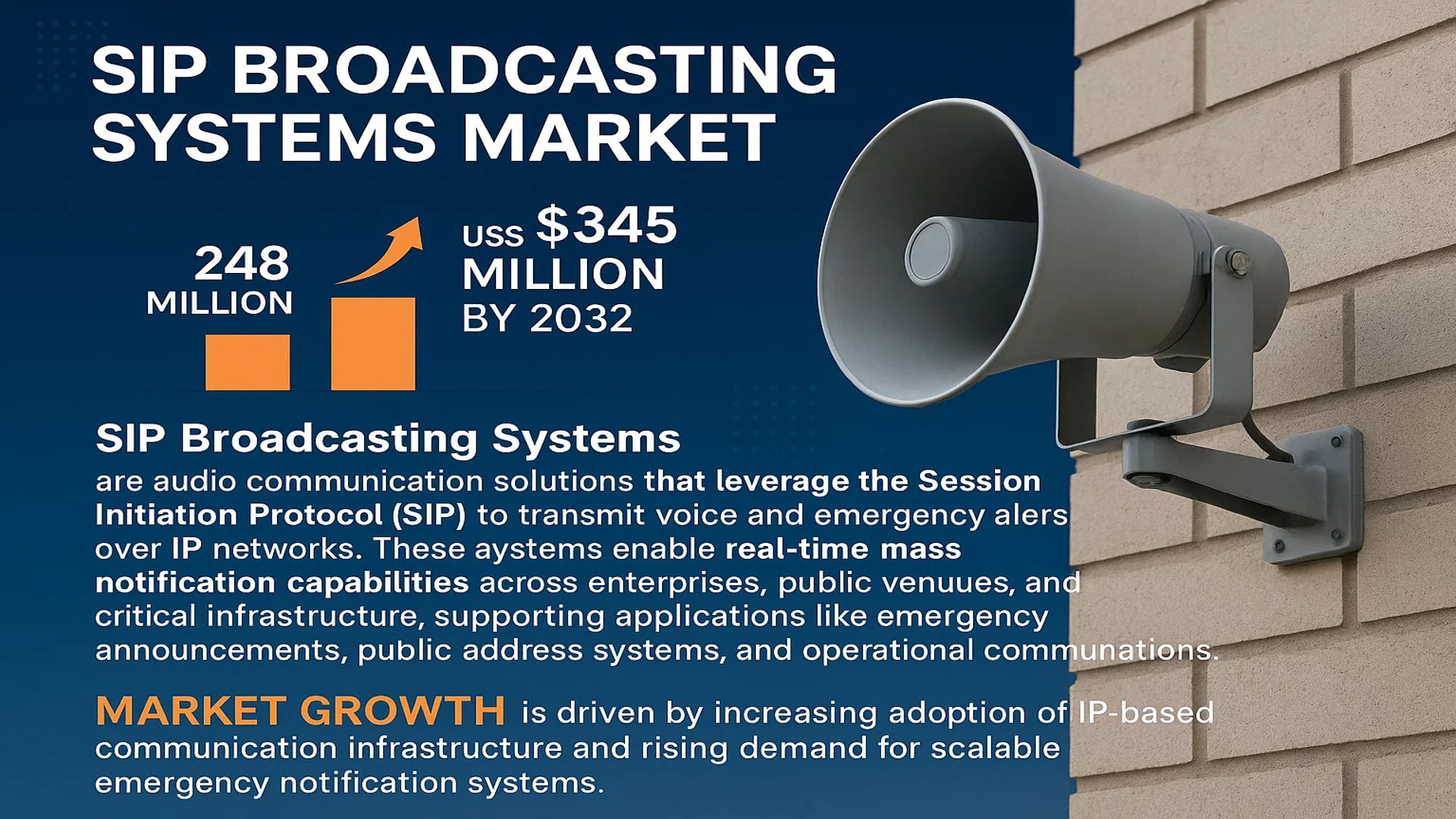
The global SIP Broadcasting Systems Market was valued at 248 million in 2024 and is projected to reach US$ 345 million by 2032, at a CAGR of 4.9% during the forecast period.
SIP Broadcasting Systems are audio communication solutions that leverage the Session Initiation Protocol (SIP) to transmit voice and emergency alerts over IP networks. These systems enable real-time mass notification capabilities across enterprises, public venues, and critical infrastructure, supporting applications like emergency announcements, public address systems, and operational communications.
The market growth is driven by increasing adoption of IP-based communication infrastructure and rising demand for scalable emergency notification systems. While North America currently dominates with over 35% market share due to stringent safety regulations, Asia-Pacific is witnessing accelerated adoption with an estimated 6.2% CAGR through 2032, fueled by smart city initiatives. Key players including KENEUC, Telos Alliance, and CyberData Corporation are expanding their product portfolios with AI-enhanced solutions, reflecting the industry’s shift toward intelligent broadcasting platforms.
MARKET DYNAMICS
MARKET DRIVERS
Growing Adoption of IP-Based Communication to Fuel SIP Broadcasting Demand
The shift from legacy public address systems to IP-based solutions is accelerating the adoption of SIP broadcasting systems globally. Organizations are increasingly recognizing the benefits of converged networks that unify voice, data, and emergency communications. This transition is particularly evident in sectors like education, healthcare, and transportation where real-time, reliable broadcasting is critical. As digital transformation initiatives gain momentum across industries, the demand for scalable, cost-effective SIP broadcasting solutions continues to rise. The global IP telephony market, which SIP broadcasting systems leverage, has demonstrated consistent growth, further validating this trend.
Rising Safety Regulations and Emergency Preparedness Standards to Drive Market Growth
Stringent government regulations regarding public safety communications are compelling organizations to upgrade their emergency notification systems. SIP broadcasting solutions meet these evolving requirements by providing instantaneous mass notification capabilities during critical situations. The increasing frequency of security threats and natural disasters has prompted both public and private sectors to invest in reliable broadcasting infrastructure. Educational institutions and corporate campuses are particularly active in implementing these systems to comply with emergency response protocols. Recent enhancements in SIP broadcasting technology, including location-based alerting and multi-channel messaging, are making these systems indispensable for modern organizations.
Expansion of Smart Building Infrastructure Creates New Opportunities
The rapid development of smart building ecosystems is creating favorable conditions for SIP broadcasting system deployment. These systems integrate seamlessly with building automation platforms, enabling centralized control of safety announcements, background music, and general notifications. As the smart building market continues its upward trajectory, SIP broadcasting solutions are becoming an integral component of intelligent infrastructure. Their ability to interface with other building systems like access control and surveillance enhances overall safety and operational efficiency. The convergence of SIP broadcasting with IoT platforms represents a significant growth avenue for market players.
MARKET RESTRAINTS
Network Security Concerns Restrain Widespread Adoption
While SIP broadcasting systems offer numerous advantages, their reliance on IP networks introduces significant security vulnerabilities. Potential threats include eavesdropping, service disruption, and unauthorized access to critical notification systems. Organizations handling sensitive information often hesitate to implement SIP broadcasting due to these security concerns. The increasing sophistication of cyber threats requires continuous investment in security measures, which can inflate the total cost of ownership. These challenges are particularly acute in sectors like government and finance where communication security is paramount.
Integration Complexities with Legacy Infrastructure Pose Challenges
The transition to SIP broadcasting often encounters technical hurdles when integrating with existing analog and hybrid communication systems. Many organizations face compatibility issues that require substantial infrastructure upgrades or customized solutions. The lack of standardized interfaces between different manufacturers’ equipment further complicates integration efforts. These technical challenges can significantly extend deployment timelines and increase implementation costs, particularly for large-scale installations across distributed locations.
MARKET OPPORTUNITIES
AI-Powered Analytics Creates New Value Proposition
The integration of artificial intelligence with SIP broadcasting systems presents significant growth opportunities. AI-powered analysis of broadcast patterns and usage data can help organizations optimize their communication strategies. Features like automated event detection and predictive alerting can dramatically enhance system effectiveness in emergency scenarios. As AI adoption continues to grow across industries, SIP broadcasting solutions with intelligent capabilities will command premium pricing and increased market share.
5G Deployment Accelerates Mobile Broadcasting Capabilities
The global rollout of 5G networks enables new applications for SIP broadcasting, particularly for mobile workforce communications. The higher bandwidth and lower latency of 5G facilitate real-time video broadcasting alongside traditional audio alerts. This development is particularly relevant for transportation networks and large industrial facilities where mobile workers need instant access to critical information. As 5G coverage expands, SIP broadcasting systems stand to benefit from enhanced capabilities in mobile environments.
Hybrid Work Models Drive Demand for Flexible Solutions
The post-pandemic shift toward hybrid work arrangements creates demand for SIP broadcasting systems that can reach both on-site and remote employees. Organizations are seeking solutions that integrate with unified communication platforms while maintaining robust emergency notification capabilities. This trend presents opportunities for vendors to develop cloud-based broadcasting solutions with seamless mobile integration. The ability to deliver consistent communication across physical and virtual workspaces will become a key differentiator in the market.
MARKET CHALLENGES
Regulatory Fragmentation Complicates Global Expansion
The lack of uniform regulations governing emergency communication systems creates challenges for vendors operating in multiple regions. Each market has distinct requirements regarding alerting protocols, system certification, and compliance documentation. Navigating this regulatory patchwork requires significant legal and technical resources, potentially slowing market expansion. Manufacturers must maintain multiple product variants to meet regional specifications, increasing development and support costs.
Budget Constraints in Public Sector Limit Adoption
While public sector organizations represent a significant market segment for SIP broadcasting systems, their procurement processes and budget cycles can hinder adoption. Many government agencies and educational institutions operate with legacy systems due to funding limitations for technology upgrades. The ongoing operational costs associated with SIP systems, including network maintenance and software updates, present additional financial hurdles for cost-conscious public entities.
Competition from Alternative Communication Platforms
SIP broadcasting systems face increasing competition from mobile apps and social media platforms that offer mass notification capabilities. While these alternatives lack the reliability and integration capabilities of dedicated SIP solutions, their low cost and ease of deployment make them attractive options for certain applications. Market players must clearly articulate the superior performance and security advantages of SIP-based systems to maintain growth in the face of these alternatives.
SIP BROADCASTING SYSTEMS MARKET TRENDS
Enterprise Digital Transformation Drives SIP Broadcasting Adoption
The rapid digital transformation across enterprises has significantly accelerated the adoption of SIP-based broadcasting solutions. Organizations are increasingly replacing traditional PA systems with IP-based broadcasting to enhance real-time communication efficiency. The global SIP Broadcasting Systems market, valued at $248 million in 2024, is projected to grow at a CAGR of 4.9% through 2032, reaching $345 million. This growth is fueled by the need for scalable, low-latency communication in sectors like healthcare, education, and logistics. Cloud-based SIP broadcasting solutions are gaining traction due to their flexibility in multi-site deployments and cost-effective maintenance.
Other Trends
Smart City Infrastructure Integration
Municipalities worldwide are integrating SIP broadcasting systems into smart city frameworks for public safety and emergency notifications. These systems enable simultaneous mass alerts across transportation hubs, educational institutions, and government facilities during crises. In 2024, hardware components accounted for approximately 65% of system implementations, reflecting the ongoing infrastructure upgrades in urban centers. The technology’s compatibility with IoT devices allows for automated triggering of emergency broadcasts based on sensor data, significantly improving response times.
Hybrid Work Models Fuel Demand for Unified Communication Solutions
The persistence of hybrid work arrangements has created substantial demand for SIP broadcasting systems that seamlessly integrate with existing UC platforms. Businesses are investing in solutions that can deliver consistent broadcast quality across in-office speakers, desktop clients, and mobile devices. North America currently leads market adoption with 38% revenue share, while the Asia-Pacific region shows the fastest growth due to expanding corporate campuses and manufacturing facilities. Vendors are focusing on developing AI-enhanced voice clarity features to overcome acoustic challenges in diverse work environments.
COMPETITIVE LANDSCAPE
Key Industry Players
Market Leaders Leverage IP-Based Solutions to Strengthen Presence
The competitive landscape of the SIP Broadcasting Systems market is moderately fragmented, featuring a mix of established multinational corporations and agile regional players. KENEUC and Telos Alliance have emerged as dominant forces, collectively accounting for approximately 35% of the global market share in 2024. These companies have solidified their positions through continuous innovation in IP-based audio broadcasting solutions and strategic partnerships with telecommunication providers.
While North American and European firms currently lead in technological advancements, Chinese manufacturers like Guangzhou Unisoft Information Technology and Akuvox are rapidly gaining traction by offering cost-competitive solutions tailored for emerging markets. Their growth is further accelerated by government initiatives promoting smart city infrastructure.
The market has witnessed increased R&D investments, particularly in AI integration and cloud-based broadcasting solutions. CyberData Corporation recently launched a next-generation SIP paging adapter with enhanced security features, reflecting the industry’s shift toward cybersecurity in real-time communication systems.
Smaller players such as ZYCOO and Flyingvoice are carving niche positions by specializing in vertical-specific solutions, particularly for the education and healthcare sectors where emergency notification requirements are stringent.
List of Key SIP Broadcasting System Providers
- KENEUC (China)
- Telos Alliance (U.S.)
- Guangzhou Unisoft Information Technology (China)
- CyberData Corporation (U.S.)
- Valcom (U.S.)
- TONMIND (South Korea)
- Akuvox (China)
- Flyingvoice (China)
- ZYCOO (China)
- RUKOTA (Germany)
Segment Analysis:
By Type
Hardware Segment Dominates the Market Due to High Adoption in Enterprise and Emergency Applications
The market is segmented based on type into:
- Hardware
- Subtypes: SIP Speakers, SIP Paging Adapters, and SIP Amplifiers
- Software
- Subtypes: SIP Broadcasting Platforms and SIP Paging Servers
By Application
Commercial Use Segment Leads Owing to Rising Demand in Retail, Hospitality, and Education Sectors
The market is segmented based on application into:
- Commercial Use
- Subtypes: Retail Outlets, Hotels, and Educational Institutions
- Industrial Use
- Subtypes: Manufacturing Plants and Warehouses
- Emergency Response
- Subtypes: Public Safety and Healthcare Facilities
- Others
By End User
Enterprise Segment Holds Major Share Due to Widespread Implementation for Internal Communications
The market is segmented based on end user into:
- Enterprises
- Government and Public Sector
- Healthcare Facilities
- Transportation Hubs
- Others
Regional Analysis: SIP Broadcasting Systems Market
North America
The SIP Broadcasting Systems market in North America is driven by high adoption rates of IP-based communication technologies and strict safety regulations, particularly in the U.S. and Canada. The region accounts for a significant share of global market revenue due to its advanced enterprise communication infrastructure and the presence of leading vendors such as Telos Alliance and Cyber Data Corporation. The demand for emergency notification systems across corporate campuses, educational institutions, and public spaces is fueling market growth. Additionally, government mandates for real-time emergency alert systems, especially in high-risk sectors, have accelerated SIP broadcasting adoption.
Europe
Europe’s SIP Broadcasting Systems market is characterized by stringent compliance requirements and a strong push for unified communications across industries. Countries like Germany, France, and the UK are seeing increased deployment of these systems in smart buildings and industrial facilities. The EU’s emphasis on workplace safety standards and the need for efficient mass communication in emergencies contribute to steady market expansion. Local players, including RUKOTA, are actively innovating to meet evolving regulatory demands, while partnerships between telecom providers and security firms further boost integration of SIP broadcasting in public safety networks.
Asia-Pacific
As the fastest-growing region, Asia-Pacific is propelled by rapid urbanization and digital transformation across China, India, and Japan. China, in particular, is a key contributor due to its extensive infrastructure projects and increasing investments in smart city initiatives. The shift from traditional PA systems to IP-based SIP broadcasting solutions in commercial complexes and transportation hubs presents significant opportunities. Yet, cost sensitivity in emerging economies restricts premium product adoption, favoring budget-friendly solutions from suppliers such as Akuvox and Guangzhou Unisoft Information Technology.
South America
South America has a developing SIP Broadcasting Systems market, primarily driven by Brazil and Argentina. The region’s growth is hampered by economic instability, but sectors like oil & gas, mining, and manufacturing increasingly deploy these systems for operational efficiency and safety compliance. Government-led modernization of public infrastructure provides some momentum, though limited IT spending and inconsistent regulatory enforcement slow large-scale adoption of advanced IP broadcasting solutions.
Middle East & Africa
The MEA market is nascent but showing promise with rising smart city projects in the UAE and Saudi Arabia. Oil-rich Gulf nations are integrating SIP broadcasting in industrial zones and large enterprises for operational alerts. However, market penetration remains low in Africa due to inadequate network infrastructure and budget constraints. Long-term growth potential exists as telecom expansions and digitization initiatives gradually improve the adoption landscape.
Report Scope
This market research report provides a comprehensive analysis of the Global SIP Broadcasting Systems Market, covering the forecast period 2024–2032. It offers detailed insights into market dynamics, technological advancements, competitive landscape, and key trends shaping the industry.
Key focus areas of the report include:
- Market Size & Forecast: Historical data and future projections for revenue, unit shipments, and market value across major regions and segments. The Global SIP Broadcasting Systems Market was valued at USD 248 million in 2024 and is projected to reach USD 345 million by 2032, growing at a CAGR of 4.9%.
- Segmentation Analysis: Detailed breakdown by product type (Hardware, Software), application (Commercial, Industrial, Others), and end-user industry to identify high-growth segments.
- Regional Outlook: Insights into market performance across North America, Europe, Asia-Pacific, Latin America, and the Middle East & Africa, including country-level analysis. The U.S. and China are key markets driving growth.
- Competitive Landscape: Profiles of leading market participants, including their product offerings, market share, and recent developments. Key players include KENEUC, RUKOTA, Telos Alliance, Guangzhou Unisoft Information Technology, and CyberData Corporation.
- Technology Trends & Innovation: Assessment of emerging technologies, integration with IP networks, and evolving industry standards for real-time broadcasting solutions.
- Market Drivers & Restraints: Evaluation of factors such as increasing demand for emergency communication systems, enterprise digitization, and challenges like regulatory compliance.
- Stakeholder Analysis: Insights for system integrators, OEMs, investors, and policymakers regarding strategic opportunities in the SIP broadcasting ecosystem.
Primary and secondary research methods are employed, including interviews with industry experts, data from verified sources, and real-time market intelligence to ensure the accuracy and reliability of the insights presented.
FREQUENTLY ASKED QUESTIONS:
What is the current market size of Global SIP Broadcasting Systems Market?
-> SIP Broadcasting Systems Market was valued at 248 million in 2024 and is projected to reach US$ 345 million by 2032, at a CAGR of 4.9% during the forecast period.
Which key companies operate in Global SIP Broadcasting Systems Market?
-> Key players include KENEUC, RUKOTA, Telos Alliance, Guangzhou Unisoft Information Technology, CyberData Corporation, Valcom, TONMIND, Akuvox, Flyingvoice, and ZYCOO.
What are the key growth drivers?
-> Key growth drivers include rising demand for IP-based communication systems, emergency response requirements, and enterprise digital transformation.
Which region dominates the market?
-> North America leads in market share, while Asia-Pacific is projected as the fastest-growing region due to rapid industrialization.
What are the emerging trends?
-> Emerging trends include AI-powered broadcasting, cloud-based solutions, and integration with unified communication platforms.

Get Sample Report PDF for Exclusive Insights
Report Sample Includes
- Table of Contents
- List of Tables & Figures
- Charts, Research Methodology, and more...
 Download Sample Report PDF