
MARKET INSIGHTS
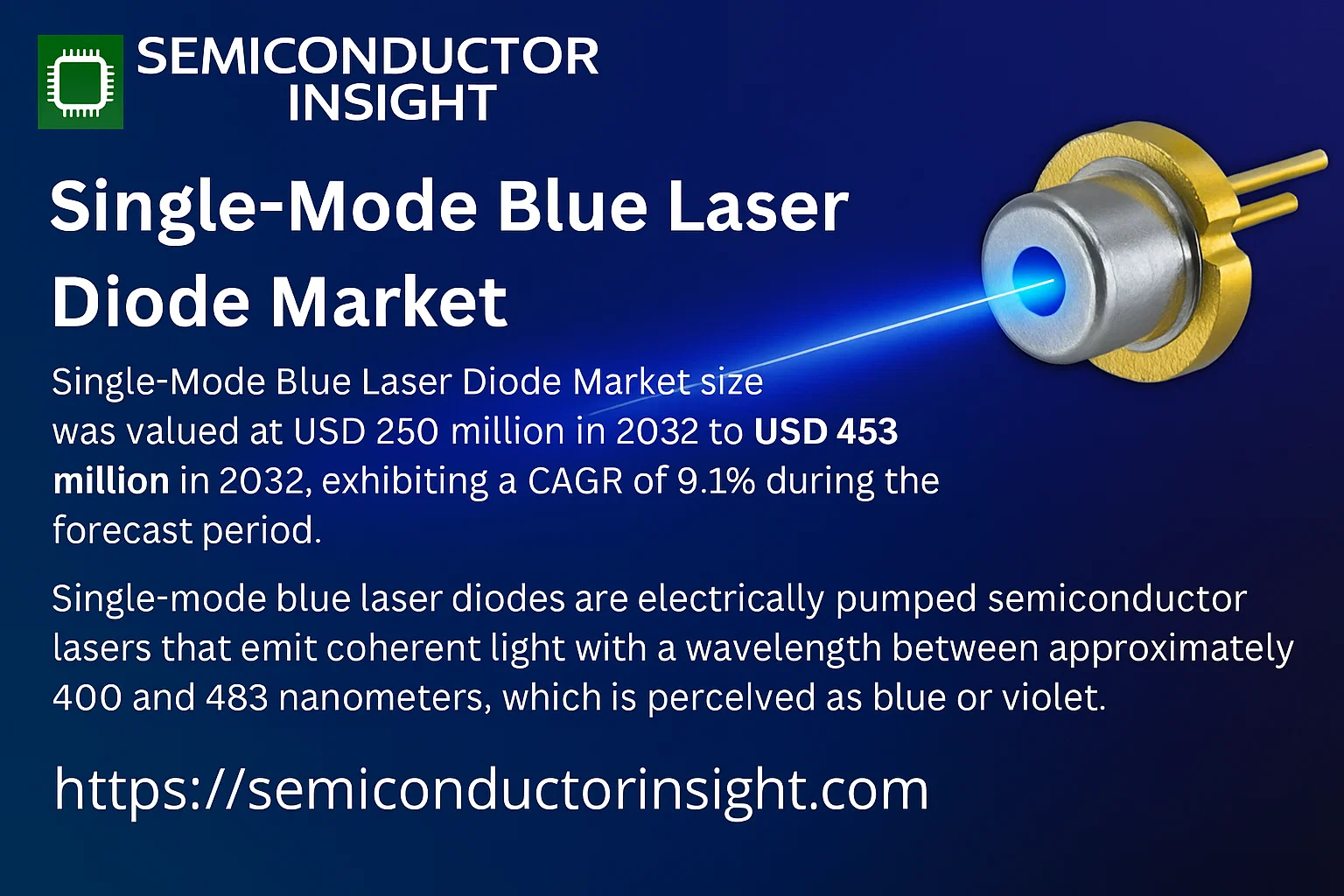
Global Single-Mode Blue Laser Diode Market size was valued at USD 250 million in 2024 to USD 453 million by 2032, exhibiting a CAGR of 9.1% during the forecast period.
Single-mode blue laser diodes are electrically pumped semiconductor lasers that emit coherent light with a wavelength between approximately 400 and 483 nanometers, which is perceived as blue or violet. These devices operate with only one spatial mode of light propagation, resulting in a high-quality beam ideal for precision applications. This report specifically covers discrete single-mode blue laser diodes within the defined wavelength range and excludes integrated modules or complete laser systems.
The market is experiencing significant growth driven by rising demand across several key industries. The expansion is primarily fueled by increasing adoption in bio/medical applications such as flow cytometry and DNA sequencing, as well as growing use in consumer electronics like Blu-Ray devices. Furthermore, advancements in industrial sectors utilizing laser projectors and scanners are contributing to market expansion. The industry is highly concentrated, with key players including Nichia, Sony, Sharp, Osram Opto Semiconductors, TOPTICA Photonics Inc., Egismos Technology Corporation, and Ondax collectively holding a dominant market share exceeding 90% by revenue.
MARKET DRIVERS
Rising Demand for High-Brightness Projectors and Displays
The single-mode blue laser diode market is primarily driven by the growing need for high-brightness, energy-efficient light sources in consumer electronics. These lasers are critical components in compact laser projectors, cinema projectors, and augmented reality glasses, where their superior beam quality and efficiency enable vivid, high-resolution images. The shift from traditional lamp-based projectors to solid-state laser illumination is a key trend, with the market for laser projection expected to grow significantly over the next five years. This transition is fueled by the longer lifespan and lower total cost of ownership offered by laser-based systems.
Expansion in Biomedical and Scientific Instrumentation
Applications in biomedical imaging and scientific research represent a major growth area. Single-mode blue lasers are essential for advanced microscopy techniques like confocal microscopy and flow cytometry, where their precise wavelength and stable output are required for fluorescence excitation. The global life sciences tools market is experiencing steady growth, directly increasing the demand for reliable, high-performance laser sources. The push for more compact and affordable diagnostic equipment also favors the adoption of these diodes.
➤ The market for laser-based material processing is expanding, with single-mode blue lasers gaining traction for their ability to precisely process materials like copper and gold, which have high reflectivity in the infrared spectrum.
Furthermore, advancements in fabrication technologies have led to higher output powers and improved reliability, making single-mode blue laser diodes more attractive for industrial applications such as precision machining and lithography. This technological progression lowers the barrier for adoption across new verticals.
MARKET CHALLENGES
High Manufacturing Costs and Complex Fabrication
The production of high-quality single-mode blue laser diodes involves complex epitaxial growth processes, such as metal-organic chemical vapor deposition (MOCVD), and stringent defect control. These factors contribute to a higher manufacturing cost compared to multi-mode lasers or other light sources. Achieving high yield and consistent performance remains a significant technical challenge for manufacturers, which can constrain supply and keep end-product prices elevated, potentially limiting market penetration in cost-sensitive applications.
Other Challenges
Thermal Management and Reliability
Managing heat dissipation is a critical challenge for single-mode blue laser diodes, especially as power levels increase to meet application demands. Excessive heat can degrade performance, shift the wavelength, and shorten the device’s operational lifetime. Developing efficient and compact thermal management solutions adds complexity and cost to the final system design.
Intense Competition from Alternative Technologies
The market faces competition from emerging solid-state lighting technologies, such as blue LEDs and frequency-doubled lasers, which can sometimes offer a cheaper alternative for certain applications. Additionally, continuous innovation in multi-mode diode technology challenges the value proposition of single-mode diodes in scenarios where extreme beam quality is not absolutely necessary.
MARKET RESTRAINTS
Stringent Regulatory and Safety Standards
The deployment of blue laser diodes is subject to strict international safety regulations, particularly those classifying lasers based on their output power and potential to cause eye damage. Compliance with standards from bodies like the IEC (International Electrotechnical Commission) requires incorporating safety features into products, which can increase design complexity and cost. This regulatory burden can slow down product development cycles and market entry for new applications, especially in consumer-facing devices.
Supply Chain Vulnerabilities for Raw Materials
The market’s growth is partly restrained by dependencies on specific raw materials, such as gallium and nitride substrates, which are essential for manufacturing Gallium Nitride (GaN)-based blue laser diodes. Geopolitical tensions and trade policies can create volatility in the supply and pricing of these materials, posing a risk to stable manufacturing output and potentially leading to price increases for end-users.
MARKET OPPORTUNITIES
Next-Generation Optical Data Storage
The development of next-generation optical data storage technologies, such as holographic data storage, presents a significant opportunity. Single-mode blue lasers, with their short wavelength, enable higher data density compared to red lasers. As the global demand for data storage capacity continues to explode, research into these advanced storage solutions is accelerating, potentially creating a substantial new market for high-specification blue laser diodes.
Growth in Consumer Electronics and Automotive LiDAR
The integration of sensing and imaging capabilities into smartphones, tablets, and automotive systems is a major growth vector. Single-mode blue lasers are being explored for use in compact time-of-flight (ToF) sensors and LiDAR systems for consumer electronics and autonomous vehicles. Their visibility in ambient light can offer advantages for certain sensing applications, opening up large-volume markets if technical and cost targets are met.
Advancements in Quantum Technologies
Quantum technology research, including quantum computing and quantum communication, relies on precisely controlled light-matter interactions. Single-mode blue laser diodes are suitable for cooling and manipulating certain ions and atoms used in these systems. As governments and private enterprises increase investment in quantum research, the demand for specialized, high-stability laser sources is expected to rise, representing a high-value niche opportunity.
Single-Mode Blue Laser Diode Market Trends
Strong Growth Fueled by Expanding Applications
Global Single-Mode Blue Laser Diode Market is on a significant growth trajectory, with its valuation projected to increase from USD 250 million in 2024 to USD 453 million by 2032, representing a compound annual growth rate (CAGR) of 9.1%. A single-mode blue laser diode emits light within the 405 to 483 nanometre wavelength range and is characterized by a single propagation mode, which provides superior beam quality and stability compared to multi-mode alternatives. This specific performance attribute is critical for high-precision applications, making these diodes indispensable in advanced technological fields.
Other Trends
Market Consolidation and Regional Dominance
The industry is highly concentrated, with a few key players dominating the landscape. Companies including Sony, Nichia, Sharp, Osram Opto Semiconductors, TOPTICA Photonics Inc, Egismos Technology Corporation, and Ondax collectively command more than 90% of the market share by revenue. Geographically, Japan is the largest consumption region, accounting for approximately 56% of the market, which is largely attributable to the strong presence of leading manufacturers and a robust electronics sector. Europe follows as the second-largest market, holding a 17% share of global consumption.
Segmentation by Power and Application
The market is segmented by output power into categories such as Below 30mW, 30mW-60mW, 60mW-90mW, 90mW-200mW, and More than 200mW. Different power classes cater to specific application needs. In terms of application, the market is primarily driven by the Bio/Medical sector, Laser Projectors and Scanners, and Blu-Ray Devices, with other applications comprising a smaller segment. The demand from the medical field, particularly for diagnostic and therapeutic equipment, and from high-definition projection systems, are key growth drivers.
Technological Advancements and Future Outlook
Continuous technological improvements in semiconductor materials and fabrication processes are leading to diodes with higher efficiency, longer lifespans, and more stable output. The ongoing miniaturization of electronic devices and the increasing demand for high-resolution displays and precision medical instruments are expected to sustain market growth. The analysis of market dynamics, including driving factors, challenges, and potential risks, is crucial for stakeholders to navigate the competitive landscape and capitalize on emerging opportunities in different global regions and market segments.
COMPETITIVE LANDSCAPE
Key Industry Players
An Industry Concentrated Among Optical Technology Giants
The market for Single-Mode Blue Laser Diodes is characterized by a high degree of concentration, with a select group of established players dominating the global supply. The industry’s key brands, including Sony, Nichia, and Sharp, have solidified their positions through technological expertise, extensive manufacturing capabilities, and strong intellectual property portfolios. Japan stands as the epicenter of both production and consumption, accounting for approximately 56% of the global market. This dominance is largely attributed to the presence of these leading Japanese electronics and optoelectronics firms. The competitive landscape is marked by significant barriers to entry, such as the complex semiconductor fabrication processes and stringent quality requirements for single-mode operation. A remarkably small group of manufacturers, estimated to be fewer than ten, collectively command over 90% of the global market share by revenue, underscoring the mature and concentrated nature of this high-technology sector.
Beyond the dominant players, a niche segment of specialized manufacturers and technology companies caters to specific application areas and custom requirements. Companies like TOPTICA Photonics and Ondax are recognized for their focus on high-precision and scientific-grade laser systems, often integrating their own diodes into advanced instruments for research and metrology. Other significant participants, such as Osram Opto Semiconductors and Egismos Technology Corporation, contribute to the market’s diversity, offering components that serve applications ranging from bio-medical devices to industrial projectors. These companies often compete by focusing on specific power output segments, wavelength stability, or reliability characteristics demanded by particular end-markets. The market’s growth is further supported by a network of specialized suppliers and distributors who facilitate the global reach of these key manufacturers.
List of Key Single-Mode Blue Laser Diode Companies Profiled
- Sony
- Nichia
- Sharp
- Osram Opto Semiconductors
- TOPTICA Photonics Inc.
- Egismos Technology Corporation
- Ondax
- Panasonic
- Rohm Semiconductor
- Ushio Inc.
- Hamamatsu Photonics
- QSI
- Frankfurt Laser Company
Segment Analysis:
| Segment Category | Sub-Segments | Key Insights |
| By Type |
|
Medium Power (30mW-60mW) represents a highly versatile and leading segment, primarily due to its balance between performance intensity and operational stability. This power range is particularly well-suited for core applications such as high-precision biomedical instrumentation and consumer electronics like advanced laser projectors, where reliable output without excessive thermal management is crucial. The segment benefits from mature manufacturing processes and widespread adoption across various industries, making it a cornerstone of the market’s supply chain. Its dominance is further reinforced by the continuous demand for energy-efficient components in portable and compact devices, ensuring its sustained leadership position. |
| By Application |
|
Bio/Medical is the leading application segment, driven by the critical need for high-precision, single-mode light sources in sophisticated diagnostic and therapeutic equipment. The superior beam quality and stability of single-mode blue laser diodes make them indispensable for applications such as flow cytometry, DNA sequencing, and confocal microscopy, where accuracy is paramount. Furthermore, ongoing advancements in medical technology, including minimally invasive surgical tools and photodynamic therapy, continue to expand the demand for these reliable components. The stringent regulatory requirements and the high value of medical applications also contribute to this segment’s leadership, as manufacturers prioritize quality and performance consistency. |
| By End User |
|
Electronics Manufacturers constitute the dominant end-user segment, leveraging single-mode blue laser diodes for a wide array of consumer and professional products. This leadership is fueled by the integration of these diodes into high-volume applications such as Blu-ray disc drives, laser projectors for home entertainment and business, and various scanning and sensing systems. The segment’s scale, combined with continuous innovation in consumer electronics that demand smaller, more efficient, and higher-resolution components, solidifies its position. Electronics manufacturers drive significant production volumes and technological refinements, influencing supply chain dynamics and cost structures across the entire market. |
| By Wavelength Range |
|
405nm-435nm is the leading wavelength segment due to its foundational role in established optical storage technologies like Blu-ray devices, where this specific wavelength is critical for achieving high data density. This range also finds strong utility in fluorescence microscopy and other bio-imaging techniques, as it effectively excites a wide range of commonly used fluorophores. The maturity of manufacturing processes for diodes in this spectral band ensures high yield and reliability, making it a preferred and cost-effective choice for both high-volume consumer applications and specialized scientific instruments, thus cementing its leading market position. |
| By Technology Maturity |
|
Mature/Established technology represents the leading segment, characterized by standardized manufacturing, high-volume production, and widespread integration into mainstream applications like optical storage and consumer projection systems. The dominance of this segment is underpinned by the strong market positions of key manufacturers who have optimized production for reliability and cost-efficiency over many years. This maturity leads to a stable supply chain, predictable performance characteristics, and broad acceptance across multiple industries, making it the backbone of the current market. While emerging technologies offer future potential, the established segment continues to drive the majority of commercial revenue and application development. |
Regional Analysis: Single-Mode Blue Laser Diode Market
Asia-Pacific’s mature and highly efficient electronics manufacturing ecosystem provides a significant cost and speed advantage. The concentration of fabrication plants and specialized component suppliers creates a robust supply chain that is highly responsive to global demand, enabling rapid prototyping and mass production of single-mode blue laser diodes for diverse applications.
The region is a global hub for photonics research, with substantial investments from both public and private entities. Leading universities and corporate R&D centers are continuously pushing the boundaries of semiconductor laser technology, focusing on improving wavelength stability, beam quality, and longevity, which are critical for high-end applications in scientific and industrial settings.
A massive and technologically demanding consumer base drives the need for high-performance components. Single-mode blue laser diodes are essential in consumer products requiring precise light sources, from pocket projectors and high-definition optical drives to emerging augmented reality devices, ensuring a steady and high-volume market within the region.
Supportive government policies, including subsidies for high-tech industries and national programs focused on advancing photonics and semiconductor technologies, create a favorable environment for growth. These initiatives encourage local production, reduce dependency on imports, and foster international collaborations, strengthening the region’s overall market leadership.
North America
North America holds a strong position in the Single-Mode Blue Laser Diode market, characterized by high-value, specialized applications. The region’s strength lies in its advanced research institutions and a strong focus on defense, aerospace, and medical technology. Demand is driven by requirements for high-reliability and precision in applications such as scientific instrumentation, biomedical imaging systems, and advanced manufacturing processes like precision machining and lithography. The presence of major technology firms and a culture of innovation supports the development of cutting-edge products, though the market volume is often surpassed by the mass-production capabilities of Asia-Pacific. Regulations and stringent quality standards also shape the market, favoring suppliers who can meet high-performance criteria.
Europe
The European market for Single-Mode Blue Laser Diodes is mature and driven by a strong industrial and scientific base. Key demand originates from the automotive sector for LiDAR in autonomous driving systems, from the industrial sector for materials processing and quality control, and from a well-established research community for spectroscopy and analytical instruments. European manufacturers are often leaders in niche, high-performance segments, competing on quality and technical sophistication rather than price. Collaborative multinational research projects within the EU foster innovation, but the market growth is sometimes tempered by a more fragmented industrial landscape compared to the integrated supply chains seen in Asia.
South America
The Single-Mode Blue Laser Diode market in South America is in a developing stage, with growth primarily linked to industrial modernization and increasing adoption in academic and medical research. Brazil and Argentina are the most significant markets, where applications are emerging in medical diagnostics, such as flow cytometry, and in telecommunications infrastructure projects. The market faces challenges related to economic volatility and a reliance on imported technology, which can slow adoption rates. However, gradual investment in technology sectors and a growing awareness of the benefits of laser-based solutions indicate potential for future, albeit slower, market expansion.
Middle East & Africa
This region represents an emerging market with growth potential driven by infrastructure development and investments in healthcare and oil & gas industries. Applications for single-mode blue laser diodes are found in specialized medical equipment in private hospitals and in sensing and measurement tools for the energy sector. The market is relatively small and fragmented, with adoption hindered by a lack of local manufacturing and a primary reliance on imports. Strategic investments, particularly in Gulf Cooperation Council countries, in diversifying economies towards technology and knowledge-based industries are creating nascent opportunities for market penetration and growth.
Report Scope
This market research report provides a comprehensive analysis of the Single-Mode Blue Laser Diode Market, covering the forecast period 2025–2032. It offers detailed insights into market dynamics, technological advancements, competitive landscape, and key trends shaping the industry.
Key focus areas of the report include:
-
Market Overview: The report begins with an overview outlining its current market scenario, key growth indicators, and industry transformation drivers. It discusses macroeconomic factors, demand–supply balance, regulatory landscape, and the strategic role of semiconductors in powering advancements across industries such as Bio/Medical, Laser Projectors and Scanners, Blu-Ray Devices, and other applications.
- Market Size & Forecast: Historical data and future projections for revenue, unit shipments, and market value across major regions and segments.
- Segmentation Analysis: Detailed breakdown by product type (e.g., Below 30mW, 30mW-60mW, 60mW-90mW, 90mW-200mW, More than 200mW), application, and end-user industry to identify high-growth segments and investment opportunities.
- Regional Insights: Insights into market performance across North America, Europe, Asia, South America, and the Middle East & Africa, including country-level analysis where relevant.
- Competitive Landscape: Profiles of leading market participants, including their product offerings, R&D focus, manufacturing capacity, pricing strategies, and recent developments such as mergers, acquisitions, and partnerships.
- Technology Trends & Innovation: Assessment of emerging technologies, integration of laser diodes in various applications, fabrication techniques, and evolving industry standards.
- Market Drivers & Restraints: Evaluation of factors driving market growth along with challenges, supply chain constraints, regulatory issues, and market-entry barriers.
- Stakeholder Insights: Insights for component suppliers, OEMs, system integrators, investors, and policymakers regarding the evolving ecosystem and strategic opportunities.
Primary and secondary research methods are employed, including interviews with industry experts, data from verified sources, and real-time market intelligence to ensure the accuracy and reliability of the insights presented.
FREQUENTLY ASKED QUESTIONS:
What is the current market size of Single-Mode Blue Laser Diode Market?
-> Single-Mode Blue Laser Diode Market size was valued at USD 250 million in 2024 to USD 453 million by 2032, exhibiting a CAGR of 9.1% during the forecast period.
Which key companies operate in Single-Mode Blue Laser Diode Market?
-> Key players include Sony, Nichia, Sharp, Osram Opto Semiconductors, TOPTICA Photonics Inc, Egismos Technology Corporation, and Ondax. These companies occupy more than 90% of the market share by revenue.
What are the key growth drivers?
-> Key growth drivers include advancements in laser technology, increasing demand from the Bio/Medical sector, and widespread use in Laser Projectors, Scanners, and Blu-Ray Devices.
Which region dominates the market?
-> Japan is the largest consumption region, with a market share of nearly 56%, followed by Europe as the second largest with a share of 17%.
What are the emerging trends?
-> Emerging trends include technological advancements in semiconductor lasers, increasing precision in medical applications, and the growing integration of blue laser diodes in consumer electronics and industrial automation.

Get Sample Report PDF for Exclusive Insights
Report Sample Includes
- Table of Contents
- List of Tables & Figures
- Charts, Research Methodology, and more...
 Download Sample Report PDF


