Single Door Access Controller Market Insights
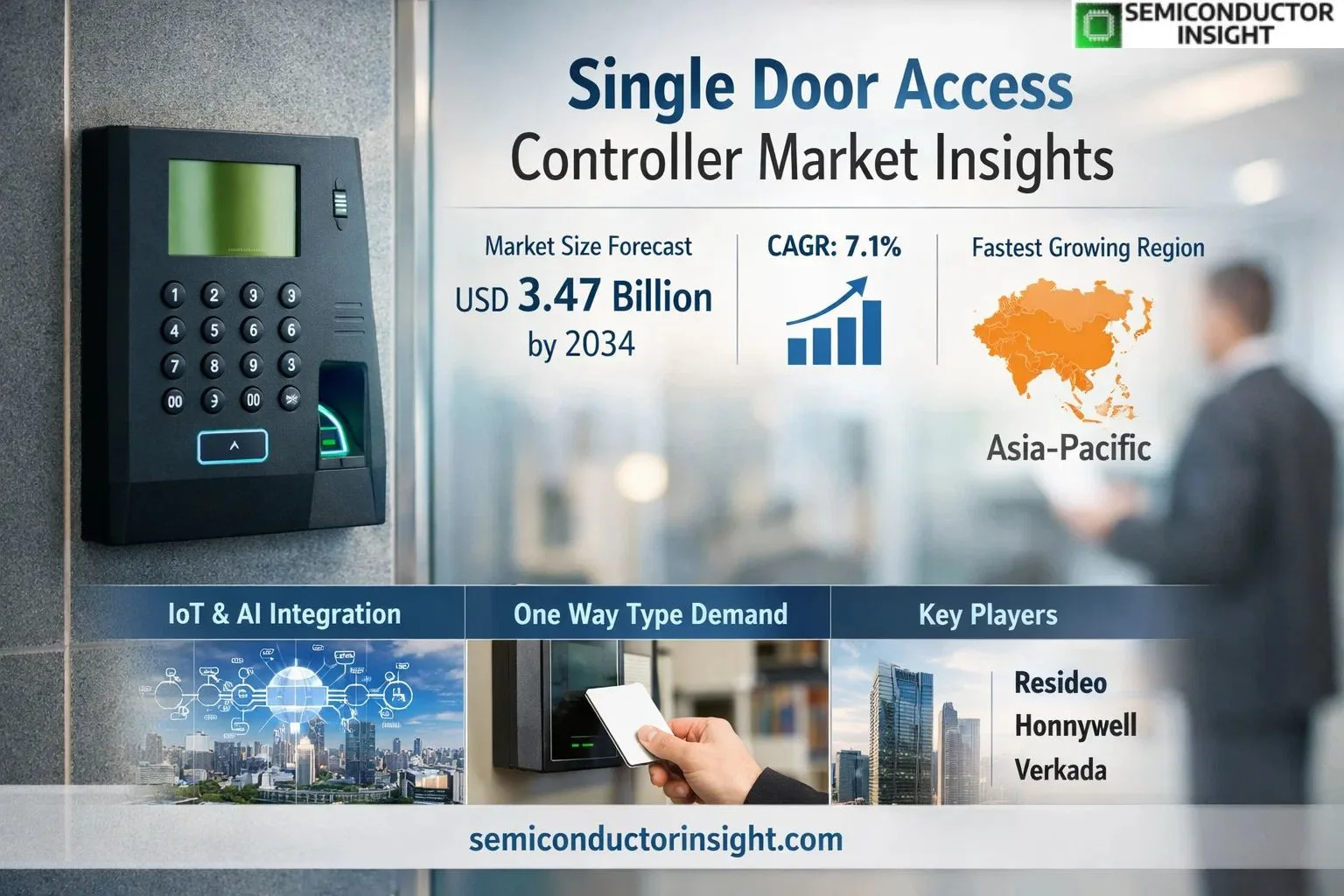
Global single door access controller market size was valued at USD 1.85 billion in 2025. The market is projected to grow from USD 2.02 billion in 2026 to USD 3.47 billion by 2034, exhibiting a CAGR of 7.1% during the forecast period.
Single door access controllers are electronic security devices designed to manage entry through a single entry point, typically using authentication methods such as keycards, biometrics, or PIN codes. These systems integrate with broader security infrastructure, offering features like real-time monitoring, audit trails, and remote access control. The market includes both one-way and two-way variants, catering to diverse applications across residential, commercial, and institutional sectors.
The market growth is driven by increasing security concerns, regulatory compliance requirements, and the adoption of IoT-enabled smart building solutions. While demand is rising across regions, North America and Asia-Pacific lead in deployment due to rapid urbanization and technological advancements. Key players such as Honeywell, Resideo, and Avigilon are expanding their portfolios with AI-powered analytics and cloud-based management platforms to address evolving customer needs.
MARKET DRIVERS
Rising Demand for Physical Security Solutions
Global single door access controller market is experiencing growth due to increasing security concerns across commercial, industrial, and residential sectors. Organizations are prioritizing secure access control systems to prevent unauthorized entry, driving adoption of single door solutions.
Cost-Effective Security for Small Businesses
Small and medium enterprises favor single door access controllers as they provide affordable yet robust security without the complexity of multi-door systems. The lower installation and maintenance costs make these solutions accessible to businesses with limited security budgets.
“The single door access controller market is projected to grow at 7.2% annually, with SMEs accounting for 42% of total deployments.”
Advancements in authentication technologies like biometrics and mobile credentials are further enhancing the value proposition of single door access control systems.
MARKET CHALLENGES
Competition from Integrated Security Systems
Single door access controllers face competition from comprehensive security solutions that bundle multiple functions. Some end-users prefer unified systems that combine access control with surveillance and alarm systems.
Other Challenges
Technology Compatibility Issues
Integration challenges with legacy systems and varying protocols can hinder adoption of new single door access controllers, particularly in facilities with mixed security infrastructures.
Limited Features Compared to Multi-Door Systems
The simplified functionality of single door controllers may deter large enterprises that require advanced features like centralized management of multiple entry points.
MARKET RESTRAINTS
Slow Adoption in Price-Sensitive Markets
In developing regions, high upfront costs relative to traditional lock-and-key systems continue to limit market penetration of single door access controllers, despite their long-term security benefits.
MARKET OPPORTUNITIES
Emerging IoT-Enabled Solutions
The integration of IoT capabilities in single door access controllers presents significant growth potential, enabling remote management and real-time monitoring through cloud platforms. Smart building trends are expected to drive demand for these connected solutions.
Retrofit Installations in Existing Buildings
There is substantial opportunity in the retrofit market, as many older facilities upgrade from mechanical locks to electronic single door access control systems without requiring extensive infrastructure changes.
Single Door Access Controller Market Trends
Growing Demand for Smart Security Solutions
The Single Door Access Controller market is experiencing steady growth due to increasing adoption of smart security systems across residential and commercial sectors. Organizations are prioritizing secure access management, driving demand for reliable single door solutions that integrate with modern building automation systems.
Other Trends
Wireless Connectivity Advancements
Manufacturers are focusing on developing single door access controllers with improved wireless capabilities, including Bluetooth and Wi-Fi connectivity. These advancements enable remote monitoring and control, addressing the need for flexible security management in distributed facilities.
Cloud-Based Access Control Adoption
The industry is witnessing accelerated adoption of cloud-based single door access control systems, particularly among small and medium enterprises. These solutions reduce infrastructure costs while providing centralized administration and real-time access logging capabilities.
Integration with Biometric Technologies
Leading vendors are incorporating fingerprint and facial recognition technologies into single door controllers, enhancing security while maintaining user convenience. This trend is particularly prominent in high-security applications such as data centers and healthcare facilities.
Growth in Multi-Technology Reader Solutions
The market is shifting toward single door controllers supporting multiple credential technologies (proximity cards, mobile credentials, and biometrics) to accommodate diverse user requirements. This flexibility helps organizations future-proof their access control investments.
Energy-Efficient Designs
Recent product developments emphasize power efficiency in single door access controllers, with manufacturers incorporating low-power components and intelligent power management features to reduce operational costs and environmental impact.
COMPETITIVE LANDSCAPE
Key Industry Players
Market Dominated by Security Technology Leaders with Increasing Regional Competition
Global Single Door Access Controller market is led by established players like Resideo and Honeywell, which hold significant market shares through comprehensive product portfolios and strong distribution networks. These companies benefit from brand recognition in commercial security systems and continuous R&D investments in IoT-enabled access control solutions. The market exhibits moderate concentration with the top five players accounting for approximately 40% revenue share in 2025, while regional specialists are gaining traction through cost-competitive offerings.
Niche players like ButterflyMX and Verkada are disrupting the market with cloud-based solutions tailored for modern smart buildings. Emerging Asian manufacturers such as Tiandy TECHNOLOGIES and Fcard Electronics are expanding globally through competitive pricing and government infrastructure projects. The competitive intensity is increasing as companies integrate advanced features like facial recognition and mobile credentials to differentiate their offerings in both residential and commercial segments.
List of Key Single Door Access Controller Companies Profiled
- Resideo
- Avigilon
- ButterflyMX
- Paxton
- Verkada
- Honeywell
- Elsema
- Tiandy TECHNOLOGIES
- Fcard Electronics
- ASSA ABLOY
- Johnson Controls
- Bosch Security Systems
- dormakaba
- Allegion
- Nedap
Segment Analysis:
| Segment Category | Sub-Segments | Key Insights |
| By Type |
|
One Way Type
|
| By Application |
|
Office Building
|
| By End User |
|
Enterprise
|
| By Technology |
|
Web-based
|
| By Authentication Method |
|
Mobile Credentials
|
Regional Analysis: Single Door Access Controller Market
North America
North American firms lead in developing biometric and mobile-enabled single door controllers. Major vendors invest heavily in touchless solutions and cybersecurity hardening for networked access systems, setting global standards for the Single Door Access Controller Market.
Strict building codes and data protection laws shape product development. UL 294 access control standards and SOC 2 compliance requirements drive innovation while creating barriers for international competitors in the Single Door Access Controller Market segment.
Healthcare and financial institutions represent nearly half of regional demand. The education sector shows fastest growth, installing single door controllers for classroom security amid rising safety concerns across North American school districts.
The market features concentrated competition among established security firms and specialized access control providers. Strategic partnerships between hardware manufacturers and software platforms define the evolving Single Door Access Controller Market ecosystem.
Europe
Europe’s Single Door Access Controller Market benefits from GDPR-compliant solutions and growing smart building investments. Germany leads in industrial applications, while UK facilities prioritize integration with existing security infrastructure. Scandinavian countries demonstrate high adoption of energy-efficient controllers. The region shows increasing preference for wireless single door solutions in heritage buildings where cabling challenges exist. European manufacturers emphasize eco-friendly materials and low-power designs to meet sustainability directives. Cross-border standardization efforts facilitate multi-country deployments.
Asia-Pacific
APAC emerges as the fastest-growing Single Door Access Controller Market, fueled by smart city initiatives and commercial construction booms. China dominates regional production while Singapore sets benchmarks for high-security installations. India shows surging demand in IT parks and metro developments. Japanese manufacturers lead in compact design innovations for space-constrained urban environments. The region exhibits price sensitivity driving localized manufacturing, though premium security installations in financial hubs demand advanced features.
Middle East & Africa
The MEA Single Door Access Controller Market grows through infrastructure modernization and high-security projects. Gulf nations implement controllers in smart buildings and critical infrastructure. Africa shows nascent adoption concentrated in banking and mining sectors. The region presents unique challenges with extreme climate durability requirements and power reliability considerations driving innovation in ruggedized controllers with backup capabilities.
South America
Brazil anchors South America’s Single Door Access Controller Market with concentrated demand in São Paulo and Rio de Janeiro commercial districts. The region shows growing interest in cost-effective solutions compatible with legacy systems. Economic volatility influences procurement cycles, though increasing security awareness supports steady market growth. Local manufacturers compete through simplified installation and Portuguese/Spanish language support.
Report Scope
This market research report provides a comprehensive analysis of the Single Door Access Controller Market, covering the forecast period 2026–2034. It offers detailed insights into market dynamics, technological advancements, competitive landscape, and key trends shaping the industry.
Key focus areas of the report include:
- Market Overview: The report begins with an overview outlining its current market scenario, key growth indicators, and industry transformation drivers. It discusses macroeconomic factors, demand–supply balance, regulatory landscape, and the strategic role of semiconductors in powering advancements across industries such as automotive, telecommunications, consumer electronics, and industrial automation.
- Market Size & Forecast: Historical data and future projections for revenue, unit shipments, and market value across major regions and segments.
- Segmentation Analysis: Detailed breakdown by product type, technology, application, and end-user industry to identify high-growth segments and investment opportunities.
- Regional Insights: Insights into market performance across North America, Europe, Asia-Pacific, Latin America, and the Middle East & Africa, including country-level analysis where relevant.
- Competitive Landscape: Profiles of leading market participants, including their product offerings, R&D focus, manufacturing capacity, pricing strategies, and recent developments such as mergers, acquisitions, and partnerships.
- Technology Trends & Innovation: Assessment of emerging technologies, integration of AI/IoT, semiconductor design trends, fabrication techniques, and evolving industry standards.
- Market Drivers & Restraints: Evaluation of factors driving market growth along with challenges, supply chain constraints, regulatory issues, and market-entry barriers.
- Stakeholder Insights: Insights for component suppliers, OEMs, system integrators, investors, and policymakers regarding the evolving ecosystem and strategic opportunities.
Primary and secondary research methods are employed, including interviews with industry experts, data from verified sources, and real-time market intelligence to ensure the accuracy and reliability of the insights presented.
FREQUENTLY ASKED QUESTIONS:
What is the current market size of Single Door Access Controller Market?
-> The Single Door Access Controller Market was valued at USD 1.85 billionin 2025 and is expected to reach USD 3.47 billion by 2034.
Which key companies operate in Single Door Access Controller Market?
-> Key players include Resideo, Avigilon, ButterflyMX, Paxton, Verkada, Honeywell, Elsema, Tiandy TECHNOLOGIES, and Fcard Electronics, among others.
What are the key growth drivers?
-> Key growth drivers include increasing demand for security solutions, technological advancements in access control, and rising adoption in residential and commercial sectors.
Which region dominates the market?
-> Asia is the fastest-growing region, with China expected to reach USD million by 2034.
What are the emerging trends?
-> Emerging trends include integration of AI/IoT in access control systems and the growth of One Way Type segment.
Get Sample Report PDF for Exclusive Insights
Report Sample Includes
- Table of Contents
- List of Tables & Figures
- Charts, Research Methodology, and more...
 Download Sample Report PDF