MARKET INSIGHTS
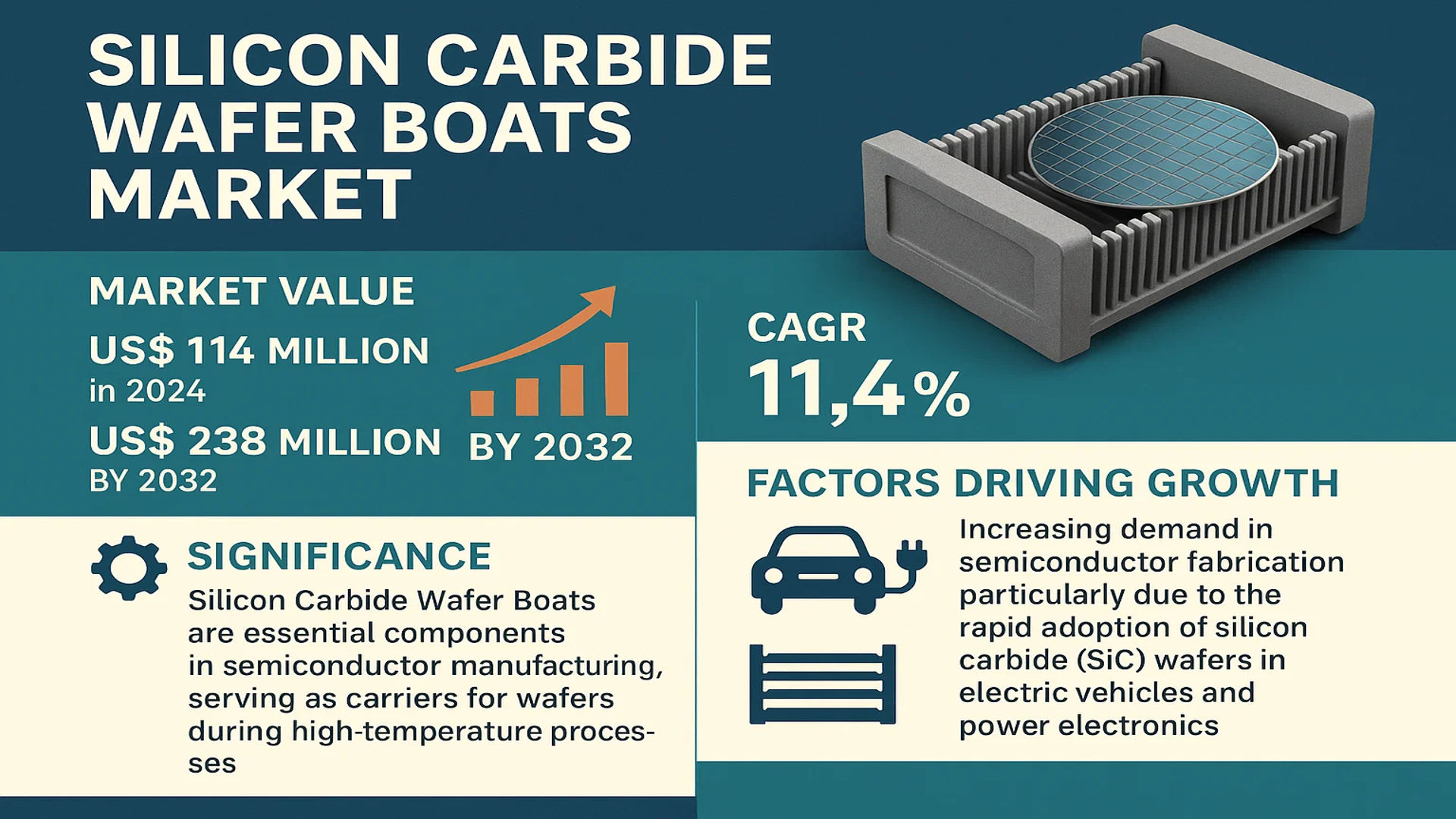
The global Silicon Carbide Wafer Boats Market was valued at 114 million in 2024 and is projected to reach US$ 238 million by 2032, at a CAGR of 11.4% during the forecast period.
Silicon Carbide Wafer Boats are essential components used in semiconductor manufacturing and related industries, serving as carriers for wafers during high-temperature processes such as diffusion, oxidation, annealing, and deposition. These boats are made from high-purity silicon carbide, which offers exceptional thermal stability, chemical resistance, and mechanical durability. The two primary types of wafer boats include horizontal and vertical configurations, each suited for specific industrial applications.
The market growth is driven by increasing demand in semiconductor fabrication, particularly due to the rapid adoption of silicon carbide (SiC) wafers in electric vehicles (EVs) and power electronics. According to industry reports, the global SiC wafer market reached USD 750 million in 2022, with 6-inch wafers dominating production. However, an ongoing shift toward 8-inch wafers is anticipated to further accelerate demand. While the U.S., Europe, and Japan remain key players, China is emerging as a significant contributor, with multiple domestic companies expanding their SiC manufacturing capabilities. Leading manufacturers such as CoorsTek, Ferrotec, and Kallex continue to innovate, ensuring market competitiveness through product advancements and strategic collaborations.
MARKET DYNAMICS
MARKET DRIVERS
Rising Demand for Silicon Carbide Wafers in Electric Vehicles to Accelerate Market Growth
The global shift toward electric vehicles is creating unprecedented demand for silicon carbide wafer boats, as SiC wafers become essential components in EV power electronics. Silicon carbide’s superior thermal conductivity and high-voltage capabilities make it ideal for automotive applications, particularly in inverters and onboard chargers. With EV production projected to grow at 25% annually through 2030, semiconductor manufacturers are rapidly expanding SiC wafer production capacity. This expansion directly fuels demand for high-quality wafer boats capable of withstanding extreme processing temperatures while minimizing particulate contamination during semiconductor fabrication.
Transition to Larger Wafer Sizes Driving Equipment Upgrades
The industry-wide transition from 6-inch to 8-inch silicon carbide wafers is creating significant growth opportunities for wafer boat manufacturers. Larger wafers deliver substantial cost reductions through improved yields and higher throughput, with leading semiconductor foundries actively qualifying 8-inch SiC processes. This transition necessitates entirely new wafer handling solutions, as legacy 6-inch boats cannot accommodate the larger formats. Manufacturers capable of producing ultra-pure, large-format silicon carbide wafer boats with tight dimensional tolerances stand to capture substantial market share as this transition accelerates through 2027.
Growth in Renewable Energy Applications Expanding Market Potential
Silicon carbide’s adoption in solar power conversion systems and wind turbine power electronics is creating additional demand streams for wafer boats. The global renewable energy sector requires robust power electronics that can operate efficiently at high voltages and temperatures – precisely the operating conditions where SiC excels. As solar installations grow approximately 8% annually worldwide, manufacturers of wafer boats are seeing increased orders from companies producing power modules for photovoltaic systems. The superior thermal shock resistance of silicon carbide wafer boats makes them particularly suitable for high-temperature processing of power semiconductor devices used in these green energy applications.
MARKET RESTRAINTS
High Production Costs and Complex Manufacturing Process Limit Market Penetration
Silicon carbide wafer boat manufacturing requires specialized equipment and rigorous process controls that significantly increase production costs compared to conventional quartz or ceramic alternatives. The sintering process alone demands temperatures exceeding 2000°C in controlled atmospheres, while precise machining of the complex geometries adds further expense. These elevated costs make adoption challenging for smaller semiconductor manufacturers, particularly in price-sensitive markets. While the performance benefits justify the premium for advanced semiconductor applications, the high price point remains a barrier to broader market penetration across all semiconductor manufacturing segments.
Other Restraints
Supply Chain Vulnerabilities
The concentrated nature of silicon carbide raw material suppliers creates supply chain risks that could impact wafer boat availability. Nearly 60% of high-purity silicon carbide powder originates from a limited number of producers, making the market susceptible to disruptions from geopolitical factors or production issues at key facilities.
Technical Complexity in Large-Format Production
Scaling wafer boat dimensions to accommodate 8-inch wafers introduces significant manufacturing challenges, including maintaining structural integrity during high-temperature processes while preventing warpage or cracking. These technical hurdles have slowed the commercialization of large-format solutions, temporarily restraining market growth.
MARKET CHALLENGES
Stringent Purity Requirements Create Formidable Production Barriers
Semiconductor-grade silicon carbide wafer boats must meet exceptionally stringent purity standards, with metallic contamination levels below 1 part per billion. Achieving and maintaining this level of purity through the entire manufacturing process presents significant technical challenges. Contamination can originate from raw materials, processing equipment, or even handling procedures, requiring costly cleanroom environments and specialized production protocols. These purity requirements particularly challenge manufacturers expanding into emerging markets where clean manufacturing infrastructure may be less developed.
Other Challenges
Limited Qualified Suppliers
The specialized expertise required for silicon carbide processing has resulted in a limited pool of qualified wafer boat suppliers. Many semiconductor manufacturers maintain strict qualification processes that can take 12-18 months, making it difficult for new entrants to disrupt established supplier relationships. This supply concentration creates potential single-source risks for semiconductor producers.
Thermal Stress Management
Repeated thermal cycling during semiconductor processing subjects wafer boats to extreme stresses that can lead to microcracking over time. Developing formulations with both high thermal conductivity and superior thermal shock resistance remains an ongoing challenge for materials engineers in this space.
MARKET OPPORTUNITIES
Emerging Asian Semiconductor Hubs Present Untapped Growth Potential
Rapid semiconductor industry expansion across China, South Korea, and Southeast Asia creates substantial opportunities for silicon carbide wafer boat suppliers. These regions are investing heavily in domestic semiconductor capabilities, with new fabrication facilities specifically designed for power electronics production. As these facilities come online, demand for specialized process equipment like silicon carbide wafer boats will grow proportionally. Suppliers establishing local manufacturing or technical support presence in these emerging hubs stand to capture first-mover advantages in these high-growth markets.
Advancements in Coating Technologies Enable New Application Segments
Innovations in protective coating technologies are opening new application possibilities for silicon carbide wafer boats. Proprietary surface treatments that further reduce particle generation or enhance chemical resistance allow penetration into demanding memory and logic semiconductor processes previously considered unsuitable for ceramic boats. These coating advancements, combined with silicon carbide’s inherent material advantages, position wafer boat suppliers to compete in broader semiconductor market segments beyond traditional power device applications.
Material Science Breakthroughs to Drive Next-Generation Solutions
Ongoing research into silicon carbide composites and nanoparticle-reinforced ceramics promises to enhance wafer boat performance characteristics significantly. These material innovations could yield solutions with improved thermal stability, longer service life, and reduced maintenance requirements compared to current offerings. Companies investing in advanced materials R&D will be well-positioned to deliver the next generation of wafer boats capable of meeting the increasingly demanding requirements of advanced semiconductor processes.
SILICON CARBIDE WAFER BOATS MARKET TRENDS
Expanding Semiconductor Industry Driving Growth in Silicon Carbide Wafer Boat Demand
The global silicon carbide (SiC) wafer boats market is experiencing substantial growth, primarily fueled by the expanding semiconductor industry, which accounted for over 60% of the total demand in 2024. As semiconductor devices continue to evolve toward higher power efficiency and thermal stability, SiC wafer boats have become indispensable in wafer fabrication processes such as diffusion, oxidation, and deposition. The market is further bolstered by the rapid adoption of electric vehicles (EVs) and renewable energy systems, both of which rely heavily on SiC-based power electronics. With a projected CAGR of 11.4%, the market is set to nearly double in value, from $114 million in 2024 to $238 million by 2032.
Other Trends
Transition to Larger Wafer Sizes
The semiconductor industry’s shift toward larger wafer sizes, particularly 8-inch SiC wafers, is reshaping the silicon carbide wafer boat market. While 6-inch wafers currently dominate, leading manufacturers are increasingly investing in production facilities capable of handling larger formats. This transition presents both challenges and opportunities—while it requires significant R&D investment in material science and boat design, the larger wafer capacity enables higher throughput and cost efficiencies in semiconductor fabrication. Chinese players are aggressively entering this space, positioning themselves as key contributors to the global supply chain for SiC wafer handling solutions.
Technological Innovations in Wafer Boat Manufacturing
Manufacturers are focusing on enhancing the durability and thermal stability of silicon carbide wafer boats through advanced ceramic engineering techniques. New coating technologies and refined sintering processes are extending product lifespans while maintaining ultra-high purity standards essential for semiconductor applications. The development of hybrid designs combining silicon carbide with other advanced ceramics is gaining traction, offering improved resistance to thermal shock—a critical requirement for high-temperature semiconductor processes that often exceed 1,200°C. These innovations are enabling more efficient energy utilization in semiconductor fabs while meeting increasingly stringent quality requirements from chip manufacturers.
COMPETITIVE LANDSCAPE
Key Industry Players
Manufacturers Accelerate Capacity Expansion Amid Rising Semiconductor Demand
The global silicon carbide wafer boats market features a mix of established ceramic engineering firms and specialized semiconductor materials suppliers competing across major regional markets. CoorsTek leads the industry with vertically integrated manufacturing capabilities and patented SiC sintering technologies that ensure high-temperature stability for advanced semiconductor processes. Their 2024 acquisition of a Japanese ceramics producer strengthened their foothold in Asia’s thriving chip fabrication sector.
China’s Xi’an Zhongwei New Materials has emerged as the second-largest player, capitalizing on domestic semiconductor equipment investments that grew 28% year-over-year in 2023. Their cost-efficient production methods and government-supported R&D initiatives position them favorably as more fabs adopt 8-inch SiC wafer processing.
Meanwhile, Ferrotec Taiwan Co and FCT(Tangshan) are rapidly scaling output through strategic joint ventures, responding to the 62% surge in global SiC power device sales since 2021. These Taiwan-based suppliers are particularly focused on developing low-particle generation boat designs required for next-generation EV power modules.
List of Key Silicon Carbide Wafer Boat Manufacturers
- CoorsTek Inc. (U.S.) – Market leader with 22% global revenue share
- Xi’an Zhongwei New Materials (China) – Fastest growing Asian supplier
- Ferrotec Taiwan Co (Taiwan) – Specializes in high-purity components
- FCT(Tangshan) (China) – Major supplier to Chinese foundries
- Kallex (Japan) – Precision ceramics specialist since 1978
- 3X Ceramic Parts (Japan) – Leading provider of 8-inch wafer boats
- Zhejiang Dongxin New Material (China) – Expanding European distribution
- Shandong Huamei New Material (China) – Low-cost production leader
The competitive environment continues evolving as manufacturers invest in proprietary coating technologies for particle reduction and extended product lifespans. Recent industry benchmarking studies show CoorsTek maintaining the lowest defect rates (15 particles/cm² vs industry average of 42), while Chinese competitors are closing the gap through accelerated quality improvement programs. With the transition to larger wafer sizes gaining momentum, partnerships between materials suppliers and semiconductor OEMs are becoming increasingly critical for sustaining technological leadership.
Segment Analysis:
By Type
Horizontal Silicon Carbide Wafer Boats Hold Majority Share Due to High Compatibility with Semiconductor Fabrication
The market is segmented based on type into:
- Horizontal
- Subtypes: Standard, Custom, and others
- Vertical
By Application
Semiconductor Segment Leads Due to Increasing Adoption in Power Electronics and EV Components
The market is segmented based on application into:
- Semiconductor
- LED
- PV
By Manufacturing Process
Diffusion Process Dominates as it Forms Core of Semiconductor Device Fabrication
The market is segmented based on manufacturing process into:
- Diffusion
- Dry oxidation
- Wet oxidation
- Annealing
By Wafer Size
6-Inch Wafers Currently Lead Market Share While 8-Inch Segment Shows Higher Growth Potential
The market is segmented based on wafer size into:
- 4-inch
- 6-inch
- 8-inch
Regional Analysis: Silicon Carbide Wafer Boats Market
Asia-Pacific
The Asia-Pacific region dominates the global Silicon Carbide Wafer Boats market, accounting for over 60% of the total consumption in 2024. This leadership position stems from the concentration of semiconductor manufacturing in countries like China, Japan, and South Korea, supported by substantial government investments. China’s aggressive push into electric vehicle production and 5G infrastructure has significantly boosted demand for SiC wafers, with local manufacturers rapidly expanding their 6-inch and 8-inch wafer production capacities. Japan remains a technology leader in high-purity SiC wafer boats, while Taiwan’s foundries drive consistent demand. However, intense price competition and quality variations among Chinese suppliers present challenges for market standardization.
North America
North America holds the second-largest market share, propelled by cutting-edge semiconductor R&D and the presence of major chip manufacturers. The U.S. CHIPS Act’s $52 billion investment in domestic semiconductor production is accelerating adoption of SiC wafer boats, particularly for power electronics in defense, automotive, and renewable energy applications. Leading equipment manufacturers are collaborating with material science companies to develop next-generation wafer boats with enhanced thermal stability. Vertical integration strategies by U.S.-based SiC substrate producers are reshaping supply chains, though reliance on imported raw materials remains a vulnerability.
Europe
Europe maintains a strong position in the high-end segment of the market, with Germany and France at the forefront. The European Chips Act is fostering regional self-sufficiency in semiconductor manufacturing, driving demand for specialized wafer boats. European manufacturers focus on ultra-clean chamber components for SiC epitaxy processes, catering to the region’s strength in automotive-grade power devices. Strict environmental regulations regarding ceramic processing influence production methods, with water-based binder systems gaining traction. While European companies lead in technical innovation, higher production costs compared to Asian counterparts limit market expansion.
South America
The South American market shows nascent but promising growth, primarily serving local semiconductor packaging and LED manufacturing needs. Brazil accounts for nearly 80% of regional demand, though the overall market remains small at under 5% global share. Limited domestic production capabilities mean most wafer boats are imported from Asia and North America. Investments in renewable energy infrastructure are expected to spur demand for SiC-based power modules, potentially boosting the wafer boats market. However, economic instability and underdeveloped supply chains continue to constrain market development.
Middle East & Africa
This region represents the smallest but fastest-growing market, albeit from a very low base. Strategic investments in technology hubs in Israel and the UAE are creating localized demand for semiconductor processing equipment. Israel’s thriving fabless chip design ecosystem drives specialty wafer boat requirements, while Saudi Arabia’s Vision 2030 includes semiconductor manufacturing goals. The lack of indigenous production facilities means the market remains entirely import-dependent. While current volumes are negligible, the region’s focus on technological diversification suggests long-term potential for wafer boat suppliers.
Report Scope
This market research report provides a comprehensive analysis of the global Silicon Carbide Wafer Boats market, covering the forecast period 2025–2032. It offers detailed insights into market dynamics, technological advancements, competitive landscape, and key trends shaping the industry.
Key focus areas of the report include:
- Market Size & Forecast: Historical data and future projections for revenue, unit shipments, and market value across major regions and segments. The global Silicon Carbide Wafer Boats market was valued at USD 114 million in 2024 and is projected to reach USD 238 million by 2032, growing at a CAGR of 11.4%.
- Segmentation Analysis: Detailed breakdown by product type (horizontal, vertical), application (semiconductor, LED, PV), and end-user industry to identify high-growth segments and investment opportunities.
- Regional Outlook: Insights into market performance across North America, Europe, Asia-Pacific, Latin America, and the Middle East & Africa, including country-level analysis. Asia-Pacific dominates with China as a key growth region.
- Competitive Landscape: Profiles of leading market participants, including their product offerings, R&D focus, manufacturing capacity, pricing strategies, and recent developments such as mergers, acquisitions, and partnerships.
- Technology Trends & Innovation: Assessment of emerging semiconductor fabrication technologies, transition from 6-inch to 8-inch SiC wafers, and evolving industry standards.
- Market Drivers & Restraints: Evaluation of factors driving market growth (EV industry demand, semiconductor expansion) along with challenges (supply chain constraints, high production costs).
- Stakeholder Analysis: Insights for component suppliers, OEMs, system integrators, investors, and policymakers regarding the evolving ecosystem and strategic opportunities.
Primary and secondary research methods are employed, including interviews with industry experts, data from verified sources, and real-time market intelligence to ensure the accuracy and reliability of the insights presented.
FREQUENTLY ASKED QUESTIONS:
What is the current market size of Global Silicon Carbide Wafer Boats Market?
-> Silicon Carbide Wafer Boats Market was valued at 114 million in 2024 and is projected to reach US$ 238 million by 2032, at a CAGR of 11.4% during the forecast period.
Which key companies operate in Global Silicon Carbide Wafer Boats Market?
-> Key players include Kallex, 3X Ceramic Parts, CoorsTek, Ferrotec Taiwan Co, FCT(Tangshan), Xi’an Zhongwei New Materials, Zhejiang Dongxin New Material, and Shandong Huamei New Material.
What are the key growth drivers?
-> Key growth drivers include rising demand from electric vehicle industry, expansion of semiconductor manufacturing, and increasing adoption of SiC wafers in power electronics.
Which region dominates the market?
-> Asia-Pacific is the dominant market, with China emerging as a key production hub for Silicon Carbide Wafer Boats.
What are the emerging trends?
-> Emerging trends include transition to 8-inch SiC wafers, increasing R&D investments in advanced semiconductor materials, and growing adoption in renewable energy applications.

Get Sample Report PDF for Exclusive Insights
Report Sample Includes
- Table of Contents
- List of Tables & Figures
- Charts, Research Methodology, and more...
 Download Sample Report PDF