SEMICONDUCTOR INSIGHT
MARKET RESEARCH REPORT

SiC Wafer Boats Market

2026 to 2034
MARKET INTELLIGENCE
ACROSS KEY REGIONS
2026 EDITION
DIELECTRIC MATERIALS Semiconductor Market Research

SiC Wafer Boats Market

◷
UPDATED 27 October 2026
▤
REPORT LENGTH Detailed Report
▣
REPORT CODE 086659fa96a9
▯
FORMATS PDF

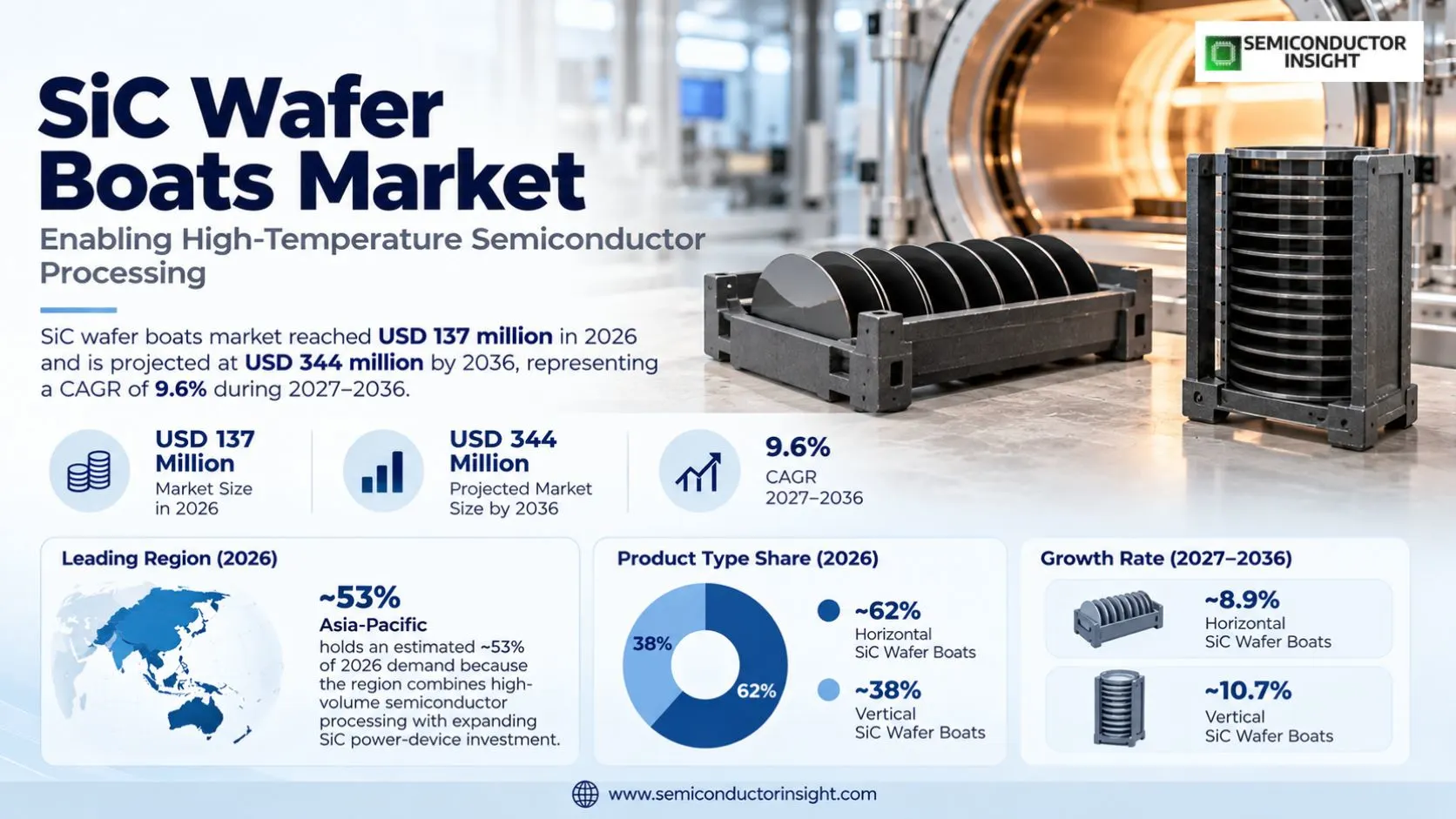
SiC wafer boats market reached USD 137 million in 2026 and is projected at USD 344 million by 2036, representing a CAGR of 9.6% during 2027–2036. Asia-Pacific holds an estimated ~53% of 2026 demand because the region combines high-volume semiconductor processing with expanding SiC power-device investment. Purchases are tied to qualified horizontal and vertical furnace-carrier designs, not to semiconductor wafer sales.

Get the sample PDF with study scope, segmentation and methodology details.

Key Statistics

2026 Market Size
USD 137 million
2036 Projected Size
USD 344 million
CAGR (2027–2036)
9.6%
Largest Market in 2026
Asia-Pacific (~53%)

Key Takeaways

  • Revenue outlook: The SiC wafer boats market is valued at USD 137 million in 2026 and is forecast to reach USD 344 million in 2036, implying a 9.6% CAGR during 2027–2036 as semiconductor furnaces increasingly require stable, clean wafer-handling fixtures.
  • Horizontal configurations: Horizontal boats represent an estimated ~62% of 2026 sales, reflecting the established diffusion and LPCVD installed base; vertical carriers account for ~38% and are modeled to grow faster at ~10.7% annually as space-efficient vertical batch processing expands.
  • Semiconductor demand: Semiconductor manufacturing supplies an estimated ~73% of 2026 revenue, while LED and photovoltaic processing contribute ~16% and ~11%; diffusion is the leading process category at ~35%, and 6-inch boats remain the largest size class at ~61%.
  • Regional position: Asia-Pacific accounts for an estimated ~53% of base-year consumption, supported by established wafer processing in China, Japan, South Korea and Taiwan, plus Malaysia-based SiC capacity investments; North America follows at ~20% and Europe at ~18%.
  • Principal constraint: High-purity ceramic manufacturing, costly rejection after thermal cycling, and qualification against quartz or polysilicon furnaceware can lengthen replacement decisions despite demand from power electronics and 200mm wafer transitions.

SiC Wafer Boats Market Overview

SiC wafer boats market reached USD 137 million in 2026 and is projected at USD 344 million by 2036, representing a CAGR of 9.6% during 2027–2036. Asia-Pacific holds an estimated ~53% of 2026 demand because the region combines high-volume semiconductor processing with expanding SiC power-device investment. Purchases are tied to qualified horizontal and vertical furnace-carrier designs, not to semiconductor wafer sales.

Base year: 2026 · Estimated year: 2027 · Forecast: 2036 · Historical period: 2021–2025 · Unit: USD million

Wafer boats made from silicon carbide are precision furnace fixtures that position multiple substrates during thermal steps, including diffusion, dry and wet oxidation, annealing and selected deposition operations. Horizontal boats slide into tube furnaces, while vertical designs arrange wafers in upright stacks with controlled spacing. Their economic value lies in reducing particle generation and dimensional drift during repeated hot processing, which helps protect device yield and extend maintenance intervals for semiconductor production lines.

The revenue boundary covers finished SiC wafer boats and dedicated SiC carrier assemblies used in semiconductor, LED and photovoltaic manufacturing, across the horizontal and vertical designs and the wafer sizes explicitly covered by the segmentation. It includes replacement carriers and qualified new-tool hardware. It excludes bare SiC wafers, epitaxial films, diffusion furnaces, semiconductor devices, generic quartz boats, polysilicon fixtures and graphite susceptors sold as separate products. Furnaceware materials may compete, but their unrelated sales do not enter this market.

Material and geometry requirements differ across applications. High-purity chemical-vapor-deposited silicon carbide can resist aggressive temperatures and reduce contamination risk, while reaction-bonded and coated structures balance cost with mechanical stability. CoorsTek documents horizontal and vertical SiC furnace components, and Ferrotec describes CVD-SiC high-temperature annealing boats. Toolmakers must coordinate groove tolerances, thermal expansion, wafer contact points and robot-handling interfaces to achieve reproducible process results over many furnace cycles.

Power-semiconductor capacity additions are an important demand channel rather than a direct measure of boat revenue. Infineon opened the first phase of its 200mm SiC facility in Kulim, Malaysia, in August 2024, and STMicroelectronics announced a vertically integrated 200mm SiC campus in Catania, Italy, in May 2024. Each fab expansion creates qualification opportunities for carriers compatible with its thermal processes, although some manufacturing steps use alternative fixtures and cannot be converted into a one-for-one boat purchase count.

The shift from 150mm to 200mm substrates changes carrier economics. Larger wafers raise the consequences of sag, contact damage and nonuniform temperature exposure, so equipment owners evaluate both boat material and the total furnace loading arrangement. Wolfspeed commercially launched 200mm SiC materials in September 2025, and Infineon signed a further 200mm substrate agreement with Wolfspeed in October 2026. These milestones support demand for redesigned process consumables, but customer qualifications and furnace installation schedules govern the timing of orders.

Segment Analysis: By Type

Horizontal and vertical SiC wafer boats address different furnace architectures rather than interchangeable packaging choices. Horizontal equipment remains the larger 2026 category with an estimated ~62% of value, while vertical designs hold ~38% and show a modeled ~10.7% growth rate, compared with ~8.9% for horizontal carriers. Selection depends on wafer orientation, loading mechanics, contamination control and furnace chamber geometry.

Type Function Market position
Horizontal Horizontal SiC boats support tube-furnace processing by holding batches of 4-inch, 6-inch or 8-inch substrates in fixed relative positions during heating and cooling. Engineers prioritize stable horizontal slot pitch and low particle shedding, and may specify coated, dense or CVD-derived SiC grades to fit their recipes. The horizontal carrier must fit its particular furnace load system while remaining compatible with the selected process gases. Horizontal designs hold an estimated ~62% of 2026 sales and are modeled to grow at ~8.9% CAGR through 2036. Commercial exposure is strongest in established diffusion and LPCVD production; equipment compatibility limits immediate substitution from one design to the other. Customers typically approve horizontal carriers against a specific wafer size, boat pitch and thermal recipe before placing repeat production orders.
Vertical Vertical SiC boats support upright batch furnaces by holding batches of 4-inch, 6-inch or 8-inch substrates in fixed relative positions during heating and cooling. Engineers prioritize stacked wafer clearance and controlled thermal uniformity, and may specify coated, dense or CVD-derived SiC grades to fit their recipes. The vertical carrier must fit its particular furnace load system while remaining compatible with the selected process gases. Vertical designs hold an estimated ~38% of 2026 sales and are modeled to grow at ~10.7% CAGR through 2036. Commercial exposure is strongest in capacity additions in vertical annealing and oxidation; equipment compatibility limits immediate substitution from one design to the other. Customers typically approve vertical carriers against a specific wafer size, boat pitch and thermal recipe before placing repeat production orders.

Secondary segmentation: process type and wafer size

Process-specific and diameter-specific purchasing provide two further views of the same finished carrier revenue. Diffusion, dry oxidation, wet oxidation, annealing and deposition are distinct thermal operations; 4-inch, 6-inch, 8-inch and other sizes describe the substrate geometry carried by the boat. The largest modeled categories are diffusion at ~35% and 6-inch at ~61% in 2026, while the 8-inch format is modeled to grow at ~13.0% annually.

Axis Members Commercial role
Process Type Diffusion process · Dry oxidation process · Wet oxidation process · Annealing process · Deposition process Diffusion process leads at ~35% in 2026. For the process type lens, buyer decisions connect 4-inch, 6-inch and 8-inch wafer formats with diffusion, oxidation, annealing or deposition temperatures. For the process-type axis, buyers compare each carrier with the furnace recipe and chamber temperature before selecting between material alternatives. The fastest-changing purchase specifications involve mechanical fit, material purity and repeatability as power-device manufacturers move to larger substrates.
Wafer Size 4-inch · 6-inch · 8-inch · Others 6-inch leads at ~61% in 2026. For the wafer size lens, buyer decisions connect 4-inch, 6-inch and 8-inch wafer formats with diffusion, oxidation, annealing or deposition temperatures. For the wafer-size axis, buyers compare carrier geometry with the 4-inch, 6-inch and 8-inch tool fleet before approving a supplier. The fastest-changing purchase specifications involve mechanical fit, material purity and repeatability as power-device manufacturers move to larger substrates.

Segment Analysis: By Application

Semiconductor device manufacturing accounts for an estimated ~73% of SiC wafer boat revenue in 2026 because wafer carriers are used repeatedly in contamination-sensitive diffusion, oxidation and annealing. LED producers represent ~16%, and photovoltaic operations ~11%, with different cost ceilings and replacement rhythms. Growth is strongest in semiconductor processing at a modeled ~10.1% CAGR, whereas the LED segment expands more slowly at ~7.4%.

Application Demand characteristics
Semiconductor Semiconductor buyers use SiC furnace carriers for power device and mainstream wafer thermal processing. This application represents an estimated ~73% of 2026 demand and is modeled to expand at ~10.1% annually through 2036. Purchasing depends on Infineon Kulim and ST Catania 200mm programs, together with temperature cycling, particle control and wafer loading efficiency. For semiconductor customers, orders follow process qualification and tool utilization rather than mirroring sales of finished devices or energy products.
LED LED buyers use SiC furnace carriers for compound-semiconductor and LED wafer fabrication. This application represents an estimated ~16% of 2026 demand and is modeled to expand at ~7.4% annually through 2036. Purchasing depends on process uniformity and contamination-sensitive lighting devices, together with temperature cycling, particle control and wafer loading efficiency. For led customers, orders follow process qualification and tool utilization rather than mirroring sales of finished devices or energy products.
PV PV buyers use SiC furnace carriers for photovoltaic cell furnace processing. This application represents an estimated ~11% of 2026 demand and is modeled to expand at ~9.2% annually through 2036. Purchasing depends on batch economics and durability in solar cell production, together with temperature cycling, particle control and wafer loading efficiency. For pv customers, orders follow process qualification and tool utilization rather than mirroring sales of finished devices or energy products.

The sales channel combines direct supply to integrated device manufacturers, equipment-maker qualification and specialist ceramic distributors. A wafer boat can be selected during original furnace integration or after a process change, but an apparently identical replacement must still meet mechanical tolerances and purity requirements. This makes technical service and traceable manufacturing history important commercial differentiators. Buyers may request 2 or more sample iterations before approving a design for regular replenishment.
Regional Analysis

Asia-Pacific is the largest 2026 regional market at an estimated ~53%, followed by North America at ~20% and Europe at ~18%; Middle East & Africa and South America account for ~5% and ~4%. Modeled regional growth rates range from ~7.5% to ~10.6% across the 2027–2036 outlook. The geographic split reflects the location of wafer-processing furnaces and ceramic procurement rather than the final destination of electric vehicles or power devices.

Where does demand for SiC furnace boats originate?

Manufacturing geography matters because a wafer boat is qualified at the furnace and purchased by the operator of the thermal process. The strongest clusters combine wafer fabs, ceramic processing know-how and equipment maintenance teams. Asia-Pacific leads through the breadth of installed processing capacity, while North America and Europe offer high-value specialty opportunities tied to 200mm development and power-device manufacturing. Import-dependent regions show smaller volumes and more variable order timing.

Region Position Growth outlook Demand profile What decides supplier selection
Asia-Pacific Largest (~53%) ~10.6% CAGR Volume manufacturing and 200mm migration Local qualification support, wafer-size tooling and documented cleanliness. In Asia-Pacific, suppliers must show that a SiC carrier meets the intended furnace loading geometry, particle limits and thermal-cycle requirements. The Asia-Pacific opportunity during 2026–2036 depends on installed processing equipment, customer approvals and replacement intervals. A lower-cost Asia-Pacific supply offer can be rejected if process trials show wafer-contact damage or dimensional drift.
North America Rank 2 (~20%) ~8.7% CAGR Advanced-materials qualification and specialty production Materials traceability, intellectual property and field engineering. In North America, suppliers must show that a SiC carrier meets the intended furnace loading geometry, particle limits and thermal-cycle requirements. The North America opportunity during 2026–2036 depends on installed processing equipment, customer approvals and replacement intervals. A lower-cost North America supply offer can be rejected if process trials show wafer-contact damage or dimensional drift.
Europe Rank 3 (~18%) ~8.8% CAGR Automotive-grade qualification and integrated sic fabrication Long qualification cycles and automotive-quality documentation. In Europe, suppliers must show that a SiC carrier meets the intended furnace loading geometry, particle limits and thermal-cycle requirements. The Europe opportunity during 2026–2036 depends on installed processing equipment, customer approvals and replacement intervals. A lower-cost Europe supply offer can be rejected if process trials show wafer-contact damage or dimensional drift.
Middle East & Africa Rank 4 (~5%) ~7.7% CAGR Selective semiconductor initiatives and imported technical ceramics Import logistics, small-lot technical service and local application support. In Middle East & Africa, suppliers must show that a SiC carrier meets the intended furnace loading geometry, particle limits and thermal-cycle requirements. The Middle East & Africa opportunity during 2026–2036 depends on installed processing equipment, customer approvals and replacement intervals. A lower-cost Middle East & Africa supply offer can be rejected if process trials show wafer-contact damage or dimensional drift.
South America Rank 5 (~4%) ~7.5% CAGR Import-dependent specialized wafer processing Small-volume import capability, service continuity and cost transparency. In South America, suppliers must show that a SiC carrier meets the intended furnace loading geometry, particle limits and thermal-cycle requirements. The South America opportunity during 2026–2036 depends on installed processing equipment, customer approvals and replacement intervals. A lower-cost South America supply offer can be rejected if process trials show wafer-contact damage or dimensional drift.

Asia-Pacific LARGEST · ~53% SHARE · ~10.6% CAGR

What determines SiC wafer-boat adoption in Asia-Pacific?

Asia-Pacific represents an estimated ~53% of the 2026 SiC wafer boats market and is modeled at ~10.6% CAGR through 2036. The region is characterized by volume manufacturing and 200mm migration: China and Taiwan supply dense semiconductor manufacturing clusters, while Japan and South Korea contribute established precision-processing capabilities and Malaysia is adding power-device capacity. Within Asia-Pacific, process engineers compare furnace geometry, ceramic purity and replacement economics against the region’s installed tool configurations. The most consequential supplier access requirement is local qualification support, wafer-size tooling and documented cleanliness.

Market positionEstimated ~53% of 2026 demand
Growth outlook~10.6% CAGR in 2027–2036
Demand profileVolume manufacturing and 200mm migration
Market access gateLocal qualification support, wafer-size tooling and documented cleanliness
Country Position in region What drives demand
China Largest manufacturing ecosystem China participates in the Asia-Pacific opportunity through largest manufacturing ecosystem. Domestic foundry and power-device production creates demand for diffusion and annealing carriers. Local ceramic vendors compete with imports on delivery time and tool-specific geometry. In China, orders over 2026–2036 depend on verified operation of 4-inch, 6-inch or 8-inch thermal-processing equipment and the availability of carriers accepted for those tools. The China opportunity therefore reflects specific ceramic hardware purchasing rather than general electronics or energy expenditure.
Japan Precision materials and equipment Japan participates in the Asia-Pacific opportunity through precision materials and equipment. Japanese furnace and substrate manufacturing emphasizes repeatable high-temperature behavior and long-life process hardware. Purchasers often prioritize materials characterization and stable dimensions over lowest initial cost. In Japan, orders over 2026–2036 depend on verified operation of 4-inch, 6-inch or 8-inch thermal-processing equipment and the availability of carriers accepted for those tools. The Japan opportunity therefore reflects specific ceramic hardware purchasing rather than general electronics or energy expenditure.
South Korea Memory and power-device processing South Korea participates in the Asia-Pacific opportunity through memory and power-device processing. Advanced fabrication facilities require tight contamination controls and careful replacement planning. SiC boats can serve selected thermal steps while quartz and other engineered materials remain relevant alternatives. In South Korea, orders over 2026–2036 depend on verified operation of 4-inch, 6-inch or 8-inch thermal-processing equipment and the availability of carriers accepted for those tools. The South Korea opportunity therefore reflects specific ceramic hardware purchasing rather than general electronics or energy expenditure.
Malaysia Growing power-semiconductor hub Malaysia participates in the Asia-Pacific opportunity through growing power-semiconductor hub. Infineon opened the first phase of its Kulim SiC fab in August 2024, adding an identifiable power-device manufacturing base and associated qualification demand for process hardware. In Malaysia, orders over 2026–2036 depend on verified operation of 4-inch, 6-inch or 8-inch thermal-processing equipment and the availability of carriers accepted for those tools. The Malaysia opportunity therefore reflects specific ceramic hardware purchasing rather than general electronics or energy expenditure.

Market instances

  • Kulim facility opening, August 2024 Infineon opened its first 200mm SiC fab phase in Malaysia, demonstrating industrial investment in larger substrates. This creates potential carrier-design work where furnace processes use SiC fixtures, although no disclosed investment figure should be interpreted as a direct wafer-boat purchase. The kulim facility opening, august 2024 case demonstrates a distinct purchasing channel within Asia-Pacific across 2026–2036. This kulim facility opening, august 2024 context cannot be converted directly from capital spending into ceramic consumable revenue. Orders arising from kulim facility opening, august 2024 depend on qualification and compatibility with 6-inch or 8-inch wafer-processing tools.
  • 200mm materials commercialization, September 2025 Wolfspeed made 200mm SiC materials commercially available, creating a clearer pathway for high-throughput wafer processing. Larger substrates can require altered boat slot pitch, support geometry and handling interfaces, encouraging suppliers to refine 8-inch product families. The 200mm materials commercialization, september 2025 case demonstrates a distinct purchasing channel within Asia-Pacific across 2026–2036. This 200mm materials commercialization, september 2025 context cannot be converted directly from capital spending into ceramic consumable revenue. Orders arising from 200mm materials commercialization, september 2025 depend on qualification and compatibility with 6-inch or 8-inch wafer-processing tools.
  • China-led installed furnace base The region has the deepest concentration of semiconductor and photovoltaic production lines that use batch thermal processing. Established horizontal equipment sustains replacement demand, while vertical designs are considered for selected high-density or contamination-sensitive operations. The china-led installed furnace base case demonstrates a distinct purchasing channel within Asia-Pacific across 2026–2036. This china-led installed furnace base context cannot be converted directly from capital spending into ceramic consumable revenue. Orders arising from china-led installed furnace base depend on qualification and compatibility with 6-inch or 8-inch wafer-processing tools.
In the full report: Country-level purchasing patterns, qualified suppliers, 2026–2036 segment demand and furnace-technology constraints for Asia-Pacific.

North America REGIONAL MARKET · ~20% SHARE · ~8.7% CAGR

What determines SiC wafer-boat adoption in North America?

North America represents an estimated ~20% of the 2026 SiC wafer boats market and is modeled at ~8.7% CAGR through 2036. The region is characterized by advanced-materials qualification and specialty production: the United States houses SiC materials developers and equipment engineers, with selective wafer fabrication and automotive-power supply chains providing downstream demand. Within North America, process engineers compare furnace geometry, ceramic purity and replacement economics against the region’s installed tool configurations. The most consequential supplier access requirement is materials traceability, intellectual property and field engineering.

Market positionEstimated ~20% of 2026 demand
Growth outlook~8.7% CAGR in 2027–2036
Demand profileAdvanced-materials qualification and specialty production
Market access gateMaterials traceability, intellectual property and field engineering
Country Position in region What drives demand
United States Materials and process engineering United States participates in the North America opportunity through materials and process engineering. Wolfspeed launched its 200mm SiC materials portfolio in September 2025, reinforcing substrate development and device-manufacturing investment. Furnace consumables are specified by equipment and process engineers rather than purchased in proportion to wafer sales. In United States, orders over 2026–2036 depend on verified operation of 4-inch, 6-inch or 8-inch thermal-processing equipment and the availability of carriers accepted for those tools. The United States opportunity therefore reflects specific ceramic hardware purchasing rather than general electronics or energy expenditure.
Canada Specialty technology users Canada participates in the North America opportunity through specialty technology users. Canadian electronics and advanced-materials organizations are potential buyers for limited-volume thermal-processing hardware. Qualification tends to be project-based, and supplier relationships may depend on specialized machining and export logistics. In Canada, orders over 2026–2036 depend on verified operation of 4-inch, 6-inch or 8-inch thermal-processing equipment and the availability of carriers accepted for those tools. The Canada opportunity therefore reflects specific ceramic hardware purchasing rather than general electronics or energy expenditure.
Mexico Automotive supply-chain adjacency Mexico participates in the North America opportunity through automotive supply-chain adjacency. Vehicle electronics and assembly activities provide an indirect demand channel for power semiconductors. Local purchase of wafer boats remains limited because wafer fabrication, not vehicle assembly, is the direct furnaceware customer. In Mexico, orders over 2026–2036 depend on verified operation of 4-inch, 6-inch or 8-inch thermal-processing equipment and the availability of carriers accepted for those tools. The Mexico opportunity therefore reflects specific ceramic hardware purchasing rather than general electronics or energy expenditure.

Market instances

  • Wolfspeed 200mm product launch The September 2025 commercial release of 200mm bare SiC wafers and epitaxy qualification materials expanded options for downstream device manufacturers. For wafer-boat suppliers, the significance is process migration and potential demand for new fixtures rather than a published order for ceramic carriers. The wolfspeed 200mm product launch case demonstrates a distinct purchasing channel within North America across 2026–2036. This wolfspeed 200mm product launch context cannot be converted directly from capital spending into ceramic consumable revenue. Orders arising from wolfspeed 200mm product launch depend on qualification and compatibility with 6-inch or 8-inch wafer-processing tools.
  • North American SiC materials engineering High-purity furnaceware competes on contamination performance, thermal cycling and tool compatibility. CoorsTek publishes silicon-carbide boat and pedestal product families, while manufacturers must demonstrate consistent material properties over multiple process cycles. The north american sic materials engineering case demonstrates a distinct purchasing channel within North America across 2026–2036. This north american sic materials engineering context cannot be converted directly from capital spending into ceramic consumable revenue. Orders arising from north american sic materials engineering depend on qualification and compatibility with 6-inch or 8-inch wafer-processing tools.
  • Automotive electrification linkage The IEA documented sustained global electric-vehicle adoption in its 2025 outlook. This supports the end-market case for SiC power electronics, but a 2026 vehicle sale does not imply a fixed number of replacement furnace boats. The automotive electrification linkage case demonstrates a distinct purchasing channel within North America across 2026–2036. This automotive electrification linkage context cannot be converted directly from capital spending into ceramic consumable revenue. Orders arising from automotive electrification linkage depend on qualification and compatibility with 6-inch or 8-inch wafer-processing tools.
In the full report: Country-level purchasing patterns, qualified suppliers, 2026–2036 segment demand and furnace-technology constraints for North America.

Europe REGIONAL MARKET · ~18% SHARE · ~8.8% CAGR

What determines SiC wafer-boat adoption in Europe?

Europe represents an estimated ~18% of the 2026 SiC wafer boats market and is modeled at ~8.8% CAGR through 2036. The region is characterized by automotive-grade qualification and integrated SiC fabrication: Italy and Austria anchor major SiC manufacturing programs, while German equipment and ceramic specialists support process integration and high-temperature engineering. Within Europe, process engineers compare furnace geometry, ceramic purity and replacement economics against the region’s installed tool configurations. The most consequential supplier access requirement is long qualification cycles and automotive-quality documentation.

Market positionEstimated ~18% of 2026 demand
Growth outlook~8.8% CAGR in 2027–2036
Demand profileAutomotive-grade qualification and integrated sic fabrication
Market access gateLong qualification cycles and automotive-quality documentation
Country Position in region What drives demand
Italy Integrated SiC campus investment Italy participates in the Europe opportunity through integrated sic campus investment. STMicroelectronics announced its Catania campus in May 2024, combining substrates, epitaxy, device fabrication and packaging. Process hardware qualification is relevant to the planned 200mm lines, subject to actual furnace configurations. In Italy, orders over 2026–2036 depend on verified operation of 4-inch, 6-inch or 8-inch thermal-processing equipment and the availability of carriers accepted for those tools. The Italy opportunity therefore reflects specific ceramic hardware purchasing rather than general electronics or energy expenditure.
Austria 200mm power-device manufacturing Austria participates in the Europe opportunity through 200mm power-device manufacturing. Infineon announced customer product rollout from its Villach 200mm SiC manufacturing process in February 2025. Thermal process suppliers serving such fabs must align carrier geometry with qualified tool recipes. In Austria, orders over 2026–2036 depend on verified operation of 4-inch, 6-inch or 8-inch thermal-processing equipment and the availability of carriers accepted for those tools. The Austria opportunity therefore reflects specific ceramic hardware purchasing rather than general electronics or energy expenditure.
Germany Equipment and engineering hub Germany participates in the Europe opportunity through equipment and engineering hub. European furnace and ceramic equipment engineering emphasizes high-temperature uniformity and mechanical precision. centrotherm describes SiC thermal processing capabilities, providing an adjacent indication of specialized hardware requirements. In Germany, orders over 2026–2036 depend on verified operation of 4-inch, 6-inch or 8-inch thermal-processing equipment and the availability of carriers accepted for those tools. The Germany opportunity therefore reflects specific ceramic hardware purchasing rather than general electronics or energy expenditure.
France Industrial power-device demand France participates in the Europe opportunity through industrial power-device demand. Automotive and industrial electronics manufacturers create downstream demand for efficient power conversion. Direct wafer-boat orders depend on where fabrication occurs and on whether relevant processes use SiC carriers rather than competing materials. In France, orders over 2026–2036 depend on verified operation of 4-inch, 6-inch or 8-inch thermal-processing equipment and the availability of carriers accepted for those tools. The France opportunity therefore reflects specific ceramic hardware purchasing rather than general electronics or energy expenditure.

Market instances

  • ST Catania announcement, May 2024 ST outlined a multi-year 200mm SiC campus investment in Italy, with integrated fabrication and substrate capabilities. A broad campus project can stimulate procurement of many process components, but only SiC boats used in qualifying thermal steps fall within this market. The st catania announcement, may 2024 case demonstrates a distinct purchasing channel within Europe across 2026–2036. This st catania announcement, may 2024 context cannot be converted directly from capital spending into ceramic consumable revenue. Orders arising from st catania announcement, may 2024 depend on qualification and compatibility with 6-inch or 8-inch wafer-processing tools.
  • Infineon Villach product release, February 2025 Infineon began releasing products fabricated using 200mm SiC technology from Villach. This indicates progress from process development toward customer supply and raises the importance of repeatable carrier designs, process traceability and high-temperature handling stability. The infineon villach product release, february 2025 case demonstrates a distinct purchasing channel within Europe across 2026–2036. This infineon villach product release, february 2025 context cannot be converted directly from capital spending into ceramic consumable revenue. Orders arising from infineon villach product release, february 2025 depend on qualification and compatibility with 6-inch or 8-inch wafer-processing tools.
  • European furnace integration centrotherm lists a SiC activator platform with processing temperatures up to 2000 degrees Celsius. Such conditions illustrate the materials-engineering challenge for fixtures, while the choice of carrier composition varies with chamber chemistry and customer recipe. The european furnace integration case demonstrates a distinct purchasing channel within Europe across 2026–2036. This european furnace integration context cannot be converted directly from capital spending into ceramic consumable revenue. Orders arising from european furnace integration depend on qualification and compatibility with 6-inch or 8-inch wafer-processing tools.
In the full report: Country-level purchasing patterns, qualified suppliers, 2026–2036 segment demand and furnace-technology constraints for Europe.

Middle East & Africa REGIONAL MARKET · ~5% SHARE · ~7.7% CAGR

What determines SiC wafer-boat adoption in Middle East & Africa?

Middle East & Africa represents an estimated ~5% of the 2026 SiC wafer boats market and is modeled at ~7.7% CAGR through 2036. The region is characterized by selective semiconductor initiatives and imported technical ceramics: the regional manufacturing footprint is less extensive than the three leading markets, leaving most furnaceware opportunities concentrated in specialized electronics, research and emerging fabrication investments. Within Middle East & Africa, process engineers compare furnace geometry, ceramic purity and replacement economics against the region’s installed tool configurations. The most consequential supplier access requirement is import logistics, small-lot technical service and local application support.

Market positionEstimated ~5% of 2026 demand
Growth outlook~7.7% CAGR in 2027–2036
Demand profileSelective semiconductor initiatives and imported technical ceramics
Market access gateImport logistics, small-lot technical service and local application support
Country Position in region What drives demand
Israel Advanced research and device design Israel participates in the Middle East & Africa opportunity through advanced research and device design. The country has electronics and semiconductor engineering expertise, but local SiC wafer-boat demand is more closely linked to specific manufacturing and laboratory processes than to chip-design activity. In Israel, orders over 2026–2036 depend on verified operation of 4-inch, 6-inch or 8-inch thermal-processing equipment and the availability of carriers accepted for those tools. The Israel opportunity therefore reflects specific ceramic hardware purchasing rather than general electronics or energy expenditure.
United Arab Emirates Industrial technology initiatives United Arab Emirates participates in the Middle East & Africa opportunity through industrial technology initiatives. Electronics and energy diversification programs may create specialized equipment opportunities. However, broad investment announcements should not be interpreted as established high-volume SiC furnace consumable purchases. In United Arab Emirates, orders over 2026–2036 depend on verified operation of 4-inch, 6-inch or 8-inch thermal-processing equipment and the availability of carriers accepted for those tools. The United Arab Emirates opportunity therefore reflects specific ceramic hardware purchasing rather than general electronics or energy expenditure.
Saudi Arabia Emerging industrial projects Saudi Arabia participates in the Middle East & Africa opportunity through emerging industrial projects. Power electronics and renewable-energy development provide potential downstream relevance. Direct ceramic-carrier demand depends on actual wafer-processing assets and verified tool installations, not the scale of power-generation projects. In Saudi Arabia, orders over 2026–2036 depend on verified operation of 4-inch, 6-inch or 8-inch thermal-processing equipment and the availability of carriers accepted for those tools. The Saudi Arabia opportunity therefore reflects specific ceramic hardware purchasing rather than general electronics or energy expenditure.

Market instances

  • Research-scale qualification A small number of specialty furnace installations can generate occasional carrier orders when high-temperature process recipes require SiC. Procurement may involve one-off engineering drawings, sample inspection and import lead times rather than a standardized volume contract. The research-scale qualification case demonstrates a distinct purchasing channel within Middle East & Africa across 2026–2036. This research-scale qualification context cannot be converted directly from capital spending into ceramic consumable revenue. Orders arising from research-scale qualification depend on qualification and compatibility with 6-inch or 8-inch wafer-processing tools.
  • Energy-system demand proxy Renewable generation and industrial electrification can support adoption of SiC power devices in converters. Regional wafer-boat purchases remain a separate upstream issue because those devices may be manufactured elsewhere and imported as finished components. The energy-system demand proxy case demonstrates a distinct purchasing channel within Middle East & Africa across 2026–2036. This energy-system demand proxy context cannot be converted directly from capital spending into ceramic consumable revenue. Orders arising from energy-system demand proxy depend on qualification and compatibility with 6-inch or 8-inch wafer-processing tools.
  • Distributor-led procurement Limited local wafer-fabrication scale favors sourcing through overseas technical-ceramics manufacturers. Buyers evaluate export documentation, transport damage risk and replacement turnaround alongside purity and dimensional tolerances. The distributor-led procurement case demonstrates a distinct purchasing channel within Middle East & Africa across 2026–2036. This distributor-led procurement context cannot be converted directly from capital spending into ceramic consumable revenue. Orders arising from distributor-led procurement depend on qualification and compatibility with 6-inch or 8-inch wafer-processing tools.
In the full report: Country-level purchasing patterns, qualified suppliers, 2026–2036 segment demand and furnace-technology constraints for Middle East & Africa.

South America REGIONAL MARKET · ~4% SHARE · ~7.5% CAGR

What determines SiC wafer-boat adoption in South America?

South America represents an estimated ~4% of the 2026 SiC wafer boats market and is modeled at ~7.5% CAGR through 2036. The region is characterized by import-dependent specialized wafer processing: electronics manufacturing is concentrated in selected national clusters while dedicated SiC wafer fabrication remains relatively limited. Within South America, process engineers compare furnace geometry, ceramic purity and replacement economics against the region’s installed tool configurations. The most consequential supplier access requirement is small-volume import capability, service continuity and cost transparency.

Market positionEstimated ~4% of 2026 demand
Growth outlook~7.5% CAGR in 2027–2036
Demand profileImport-dependent specialized wafer processing
Market access gateSmall-volume import capability, service continuity and cost transparency
Country Position in region What drives demand
Brazil Electronics and renewable-energy demand Brazil participates in the South America opportunity through electronics and renewable-energy demand. Brazil has industrial and electronics end-markets relevant to power semiconductors, but many chips are imported. Wafer-boat revenue depends on the much narrower set of local thermal-processing users. In Brazil, orders over 2026–2036 depend on verified operation of 4-inch, 6-inch or 8-inch thermal-processing equipment and the availability of carriers accepted for those tools. The Brazil opportunity therefore reflects specific ceramic hardware purchasing rather than general electronics or energy expenditure.
Argentina Research and limited manufacturing Argentina participates in the South America opportunity through research and limited manufacturing. Research laboratories and selected materials users can purchase high-temperature ceramic fixtures in small batches. Carrier designs may be customized to laboratory furnaces rather than standardized production tools. In Argentina, orders over 2026–2036 depend on verified operation of 4-inch, 6-inch or 8-inch thermal-processing equipment and the availability of carriers accepted for those tools. The Argentina opportunity therefore reflects specific ceramic hardware purchasing rather than general electronics or energy expenditure.
Chile Downstream clean-energy applications Chile participates in the South America opportunity through downstream clean-energy applications. Renewable-energy and industrial electrification increase the relevance of SiC power devices. They do not establish a domestic SiC furnace consumables market unless wafer-processing capacity is separately installed. In Chile, orders over 2026–2036 depend on verified operation of 4-inch, 6-inch or 8-inch thermal-processing equipment and the availability of carriers accepted for those tools. The Chile opportunity therefore reflects specific ceramic hardware purchasing rather than general electronics or energy expenditure.

Market instances

  • Specialized imports for furnace users Technical ceramic components for a small semiconductor process line can be sourced internationally when local machining capability is insufficient. Purchase decisions depend on minimum order quantities, replacement lead time and compatibility with existing tools. The specialized imports for furnace users case demonstrates a distinct purchasing channel within South America across 2026–2036. This specialized imports for furnace users context cannot be converted directly from capital spending into ceramic consumable revenue. Orders arising from specialized imports for furnace users depend on qualification and compatibility with 6-inch or 8-inch wafer-processing tools.
  • Power-conversion downstream market Solar inverters and industrial drives provide potential applications for SiC chips. Because finished power devices can be imported, these end markets should not be treated as evidence of corresponding domestic wafer-boat production. The power-conversion downstream market case demonstrates a distinct purchasing channel within South America across 2026–2036. This power-conversion downstream market context cannot be converted directly from capital spending into ceramic consumable revenue. Orders arising from power-conversion downstream market depend on qualification and compatibility with 6-inch or 8-inch wafer-processing tools.
  • Service and qualification barriers A low installed base of compatible furnaces reduces the number of recurring replacement contracts. Suppliers may compete through technical support and logistics rather than local manufacturing scale, making project timing especially important. The service and qualification barriers case demonstrates a distinct purchasing channel within South America across 2026–2036. This service and qualification barriers context cannot be converted directly from capital spending into ceramic consumable revenue. Orders arising from service and qualification barriers depend on qualification and compatibility with 6-inch or 8-inch wafer-processing tools.
In the full report: Country-level purchasing patterns, qualified suppliers, 2026–2036 segment demand and furnace-technology constraints for South America.

Competitive Landscape

Competition is shaped by high-purity ceramic capability, wafer-boat geometry and a supplier’s ability to support qualification at a specific furnace customer. CoorsTek and Ferrotec publish relevant SiC furnaceware product information; several additional Asian ceramic firms are included among the profiled companies. Market positioning is more closely associated with process reliability and repeat orders than with generic silicon-carbide output, which includes many unrelated products.

CoorsTek markets semiconductor furnace components, including silicon-carbide boats and pedestals used in horizontal and vertical processing. Its product literature emphasizes material grades, thermal durability and fabrication of complex furnace parts. These attributes are commercially important because a defective fixture can compromise many wafers in one high-temperature batch, raising the cost of qualification failure beyond the ceramic purchase price.

Ferrotec describes CVD-SiC ceramic components for semiconductor manufacturing, including high-temperature annealing and cassette-boat applications. The company also markets alternative furnaceware materials, illustrating how suppliers compete across both material chemistry and design. Customers can compare CVD-SiC with polysilicon or quartz solutions for particular recipes; the right choice depends on contamination thresholds, chamber conditions and cost per useful process cycle.

Regional ceramic producers compete on custom machining, responsiveness to process changes and domestic delivery. The profiled list includes Kallex, 3X Ceramic Parts, FCT (Tangshan), Xi’an Zhongwei New Materials, Zhejiang Dongxin New Material and Shandong Huamei New Material. Inclusion identifies participants named in the market landscape, not proof that every company currently supplies the same semiconductor-grade boat design or meets each customer’s qualification standard.

Supplier differentiation becomes sharper during 200mm conversion. A redesign for 8-inch wafers may require larger support spans, more demanding slot tolerances and validation against new load mechanisms. A vendor with repeatable machining and metrology can secure multi-year replenishment work after initial acceptance. Conversely, an unqualified low-price offer may be unattractive when equipment downtime or wafer breakage costs outweigh purchase savings.

Tier structure

Tier Companies Basis of competition
Tier 1 CoorsTek; Ferrotec Taiwan Co. Direct product evidence covers semiconductor SiC furnaceware, high-temperature carriers and relevant material technologies. These suppliers can support engineered boat specifications, contamination control and repeat orders for process tools. Tier placement describes technical product presence, not a verified ranking by global wafer-boat revenue, because comparable market-specific financial disclosures are limited. In the tier 1 purchasing cycle, engineers compare material cleanliness, load geometry, thermal-cycle durability and delivery consistency rather than buying only on quoted piece price. Within the tier 1 supplier group, customer acceptance requires recipe-specific inspection of slot geometry, surface finish and load interfaces before recurring production supply.
Tier 2 Qualified regional ceramic specialists Specialist vendors can compete through custom groove machining, local customer service and short-run replacement programs. Buyers typically require documentation of material purity, thermal cycling and dimensional consistency before approving recurring production supply. Named firms should only be assigned to this tier after product-specific qualification evidence, rather than from general ceramic manufacturing capabilities. In the tier 2 purchasing cycle, engineers compare material cleanliness, load geometry, thermal-cycle durability and delivery consistency rather than buying only on quoted piece price. Within the tier 2 supplier group, customer acceptance requires recipe-specific inspection of slot geometry, surface finish and load interfaces before recurring production supply.
Tier 3 Kallex; 3X Ceramic Parts; FCT (Tangshan); Xi’an Zhongwei New Materials; Zhejiang Dongxin New Material; Shandong Huamei New Material The remaining profiled participants form a broader competitive reference group. Their presence in the market landscape is not a claim that all are independently confirmed current semiconductor-grade SiC boat suppliers. Commercial relevance depends on evidence of specific carrier designs, installed customer approvals, material composition and ongoing production capacity. In the tier 3 purchasing cycle, engineers compare material cleanliness, load geometry, thermal-cycle durability and delivery consistency rather than buying only on quoted piece price. Within the tier 3 supplier group, customer acceptance requires recipe-specific inspection of slot geometry, surface finish and load interfaces before recurring production supply.

Key companies profiled

  • CoorsTek
  • Ferrotec Taiwan Co.
  • Kallex
  • 3X Ceramic Parts
  • FCT (Tangshan)
  • Xi’an Zhongwei New Materials
  • Zhejiang Dongxin New Material
  • Shandong Huamei New Material

Production Capacity Analysis

Production capacity for SiC wafer boats depends on specialized ceramic fabrication and finishing operations, not on silicon-carbide wafer crystal-growth capacity. Manufacturing routes may include chemical-vapor deposition, machining of dense ceramics, coatings and final cleanliness treatment. A furnaceware supplier’s practical output is constrained by qualified geometry, inspection yield and customer-specific material specifications, so raw material tonnage is a poor indicator of shippable carriers.

The supply base is concentrated where advanced ceramics and semiconductor equipment manufacturing coexist. Asia-Pacific offers cost-competitive machining and proximity to wafer fabs, while North American and European specialists focus on difficult geometries and high-purity applications. CoorsTek and Ferrotec describe different SiC material technologies that can be applied to furnace hardware, demonstrating that process know-how is as important as installed machining capacity.

Customers seeking second-source resilience may qualify carriers from more than one geography, but dual sourcing is not instantaneous. An alternative supplier must reproduce slot positions, surface quality, chemical compatibility and packaging cleanliness. The 2026–2036 transition toward 200mm SiC devices increases demand for larger carrier designs, while existing 150mm tools continue to require replacement components; both generations can remain commercially active at once.

The limiting steps often occur after forming the ceramic body. Fine finishing, inspection, particle removal and thermal-cycle qualification determine whether a boat can enter a contamination-sensitive production furnace. A defect that escapes inspection may damage a full batch of wafers, so customers reward repeatability rather than maximum quoted output. Manufacturers that shorten inspection and qualification loops can improve usable capacity without necessarily building a new factory.

Market Dynamics

Demand drivers are concentrated in semiconductor wafer processing, the transition toward 200mm SiC production and recurring replacement of high-temperature furnace hardware. Restraints arise from ceramic manufacturing expense, supplier qualification and competition from other fixture materials. The 2027–2036 impact table expresses modeled percentage-point contributions to the market growth outlook and distinguishes near-term investment effects from longer-term process migration.

MARKET DRIVERS

Drivers Impact Analysis*

Market Drivers Impact Rank CAGR Contribution (%) 2027–2029 2030–2032 2033–2036
Expansion of SiC power-device wafer processing High +4.20% High High High
Migration from 150mm to 200mm substrates High +3.20% Medium High High
Semiconductor furnace replacement demand Medium-High +2.60% High High Medium
High-temperature material performance needs Medium +1.80% Medium High High
PV and LED thermal processing demand Low-Medium +0.90% Medium Medium Medium
Others (equipment retrofits, local sourcing, process yield upgrades) Low +0.70% Low Medium High

SiC device investment

Fab investments in power devices increase the number and complexity of thermal-processing steps that may use specialized carriers. Infineon opened its Kulim 200mm SiC facility phase in August 2024, and ST announced an integrated Catania campus in May 2024. These projects are upstream indicators for ceramic equipment demand, while individual wafer-boat purchase timing depends on furnace selection and process qualification.

200mm process migration

Moving from 150mm to 200mm SiC wafers changes the dimensions and mechanical loads experienced by wafer supports. Wolfspeed launched commercial 200mm materials in September 2025, and Infineon announced a multi-year 200mm substrate agreement in October 2026. Larger-diameter processing can trigger redesigns of vertical and horizontal boats, increasing engineering content even when the installed number of furnaces grows slowly.

Replacement cycles and uptime

Furnace fixtures face repeated high-temperature exposure and cleaning, which can degrade surfaces and dimensions over time. The replacement market therefore follows wafer throughput and recipe severity, not just greenfield equipment orders. Semiconductor customers usually maintain approved spares to reduce unexpected downtime, making repeat business an important stabilizer for suppliers with established quality performance and predictable lead times.

Purity and process yield

CoorsTek and Ferrotec describe SiC materials designed for demanding semiconductor furnace environments. Buyers value low contamination, reliable wafer spacing and thermal stability because even small particle or contact problems can impair device yield. These technical requirements create a premium segment for dense, precisely machined carriers, although the premium must be justified through demonstrated performance over many production batches.

MARKET RESTRAINTS

Restraints Impact Analysis*

Market Restraints Impact Rank CAGR Contribution (%) 2027–2029 2030–2032 2033–2036
High-purity ceramic fabrication cost High -1.80% High High Medium
Long qualification and revalidation cycles Medium-High -1.00% High Medium Medium
Competition from quartz and polysilicon fixtures Medium -0.60% High Medium Medium
Others (yield losses, tool downtime, logistics delays) Low -0.40% Medium Medium Low
*CAGR contribution shows the percentage points each factor adds to or removes from the forecast CAGR for 2027–2036; driver contributions less restraint contributions equal the market CAGR. For SiC wafer boats, the period columns distinguish how strongly each factor influences different forecast intervals.

Manufacturing and finishing expense

SiC ceramics require demanding forming, machining and inspection, particularly for intricate slot patterns or large-diameter carriers. Tool wear, material losses and rejected parts can raise the cost of qualified units. Some furnace operators continue using lower-cost quartz or other fixtures where process temperatures and contamination requirements permit, preventing automatic substitution to silicon carbide across every thermal process.

Lengthy customer approvals

Semiconductor manufacturers normally qualify a carrier together with its furnace recipe, wafer handling system and cleanliness requirements. Changing supplier or moving from 6-inch to 8-inch wafers can require engineering trials, particle testing and dimensional inspection. This creates a lag between a supplier announcing a product and earning recurring production orders, and it can favor established vendors even when new entrants offer lower prices.

Material alternatives

Quartz, polysilicon and engineered graphite fixtures remain viable in selected furnace conditions. Ferrotec markets polysilicon furnaceware alongside SiC solutions, demonstrating that purchasing is a process-specific material decision. Where SiC offers no measurable yield or durability advantage, a fab may continue with its existing fixture type, limiting the obtainable share of the broader furnaceware spending pool.

Concentrated technical supply

A limited number of suppliers with documented semiconductor-grade ceramic capability can constrain flexibility during rapid demand shifts. Geographic concentration may create longer transport routes or exposure to export and customs delays. Buyers may hold extra spares or invest in second-source qualification, which can temporarily raise inventories but also slows conversion to new boat designs and material grades.

MARKET OPPORTUNITIES

Qualified 8-inch boat families

As 200mm wafer production broadens, carriers must meet larger support spans and more demanding wafer-contact requirements. A supplier able to demonstrate low particles and stable slot geometry can sell both initial tool sets and replacements. The opportunity is strongest where a furnace conversion requires a genuinely new boat design rather than a simple change in the number of wafers loaded per batch.

Specialized annealing processes

High-temperature power-device annealing can require materials that withstand aggressive thermal conditions. centrotherm describes SiC activation equipment reaching 2000 degrees Celsius, highlighting the engineering demands of certain process environments. Boat suppliers can collaborate with furnace integrators to define compatible carrier materials and handling designs, while recognizing that not every high-temperature tool uses a SiC wafer boat.

Lifecycle service and refurbishment

Qualified vendors can improve customer retention by offering dimensional inspection, cleaning guidance, repair assessment and planned replacement programs. This service component does not transform unrelated maintenance revenue into wafer-boat sales, but it can influence which supplier receives recurring hardware orders. Traceability across production lots becomes more valuable when a fab operates multiple 150mm and 200mm process lines.

Regional supply resilience

Manufacturers seeking to reduce dependence on a single ceramic source may consider regional alternatives. A new supplier that meets the same purity and mechanical criteria can compete on delivery time and engineering response. However, qualifying an alternative remains a significant undertaking; the best commercial opportunity lies in supporting a customer’s planned process change rather than forcing a mid-cycle replacement.

Supply Chain Analysis

The SiC wafer-boat supply chain begins with engineered ceramic materials and proceeds through forming, coating or deposition, precision machining, cleaning, inspection and qualification. Finished carriers are supplied either through furnace-equipment relationships or directly to wafer-fabrication operators. Material alternatives such as quartz and polysilicon create competitive pressure, while customer-specific drawings and long service lives make order timing less predictable than semiconductor device shipments.

Upstream materialsHigh-purity SiC feedstocks, deposited coatings and engineered ceramic blanks are selected for process chemistry and thermal stability.
Component manufacturingCarrier forming, groove machining, finishing and dimensional inspection create tool-compatible horizontal and vertical boat assemblies.
Qualification channelEquipment makers, integrated device manufacturers and ceramic suppliers test material cleanliness, wafer fit and repeated thermal cycling.
Downstream processingSemiconductor, LED and photovoltaic fabs consume approved carriers in diffusion, oxidation, annealing and deposition furnaces.

Upstream. The material grade sets limits for impurity content, thermal conductivity and structural stability. CoorsTek documents high-purity silicon-carbide options and Ferrotec offers CVD-SiC components. A producer may choose different ceramic routes for a 6-inch diffusion boat and an 8-inch annealing carrier, so input availability must be assessed against the exact qualified specification rather than generic SiC supply.

Manufacturing. Precision forming and machining determine wafer-contact geometry and slot uniformity. A vertical boat can require different load paths from a horizontal tube-furnace carrier, making design verification central to commercial acceptance. Yield losses during finishing reduce shippable capacity, while consistent inspection records help customers compare replacement lots across 2026–2036 process requirements. In the supply manufacturing purchasing cycle, engineers compare material cleanliness, load geometry, thermal-cycle durability and delivery consistency rather than buying only on quoted piece price. For supply paras, acceptance depends on the particular furnace recipe, with slot geometry, surface finish and loading interfaces evaluated before regular production adoption.

Channel. A new carrier may be selected by the furnace maker during equipment integration or directly by a fab maintenance and process team. Once qualified, the supplier often receives replacement orders against a controlled drawing and material specification. This favors vendors able to provide traceable batches, local technical support and predictable lead times rather than those offering a generic catalog item without process evidence.

Downstream. Semiconductor fabs are the largest buyers, with modeled 2026 application demand of ~73%, followed by LED at ~16% and PV at ~11%. These applications impose different economics: advanced power-device processing prioritizes contamination and uptime, while cost-sensitive solar operations emphasize throughput and useful carrier life. The downstream buyer’s furnace utilization and cleaning cycle are stronger order predictors than sales of finished end products.

Recent Developments

  • 15 Oct 2026 Announced
    Infineon and Wolfspeed signed a multi-year agreement for 200mm SiC wafers, extending their previous 150mm supply relationship. The transition reinforces demand for qualified processing of larger substrates. Wafer-boat manufacturers may see redesign and qualification opportunities where these devices pass through compatible batch furnaces; the agreement itself does not disclose any purchase of ceramic carriers. In the development 0 purchasing cycle, engineers compare material cleanliness, load geometry, thermal-cycle durability and delivery consistency rather than buying only on quoted piece price. For devs 0, acceptance depends on the particular furnace recipe, with slot geometry, surface finish and loading interfaces evaluated before regular production adoption. Source
  • 4 May 2026 Reported
    The Semiconductor Industry Association reported USD 298.5 billion of global semiconductor sales in the first quarter of 2026, up 25% from the preceding quarter. This broad industry indicator supports fab-utilization context but is not a direct estimate of furnaceware demand. Carrier orders are tied to wafer starts, equipment configuration and replacement schedules, which may move differently from total chip revenue. Source
  • 6 Feb 2026 Published
    The Semiconductor Industry Association reported global semiconductor sales of USD 791.7 billion in 2025, a 25.6% increase from 2024. Rising chip activity can sustain thermal processing, but memory and logic growth do not translate uniformly into SiC wafer-boat purchases. The market opportunity remains concentrated in the subset of furnaces using compatible high-purity carriers and relevant replacement cycles. Source
  • 10 Sep 2025 Announced
    Wolfspeed commercially launched its 200mm silicon-carbide materials portfolio, including bare wafers and epitaxy products available for customer qualification. Larger substrate formats can change mechanical support requirements inside semiconductor thermal tools. For carrier suppliers, the significance lies in 8-inch product engineering and qualification rather than a reported wafer-boat order or a direct revenue contribution. In the development 3 purchasing cycle, engineers compare material cleanliness, load geometry, thermal-cycle durability and delivery consistency rather than buying only on quoted piece price. For devs 3, acceptance depends on the particular furnace recipe, with slot geometry, surface finish and loading interfaces evaluated before regular production adoption. Source
  • 13 Feb 2025 Announced
    Infineon stated that products made using its 200mm SiC technology at Villach would begin reaching customers in the first quarter of 2025. The announcement also described the transition of Kulim manufacturing toward larger wafers. The commercial implication for furnaceware is that qualified tooling must support both developing and established production recipes as equipment generations coexist. Source
  • 8 Aug 2024 Announced
    Infineon opened the first phase of its Kulim SiC power-semiconductor facility in Malaysia, establishing an important new manufacturing location for 200mm production. Additional wafer-processing capacity creates potential demand for carriers and consumables that satisfy specific furnace recipes. The facility announcement does not establish the number, price or composition of wafer boats procured for the site. Source
  • 31 May 2024 Announced
    STMicroelectronics announced plans for a vertically integrated 200mm silicon-carbide campus in Catania, Italy, spanning substrates, fabrication and downstream manufacturing. Its proposed expansion illustrates the capital intensity and process integration of SiC power-device production. High-temperature fixtures can be required in certain manufacturing steps, but carrier material and purchasing volume depend on the selected equipment and qualified process flow. Source

REPORT SCOPE & SEGMENTATION

Attribute Details
Study Period 2021–2036
Base Year 2026
Base-Year Market Size USD 137 million
Estimated Year 2027
Estimated Market Size USD 150 million
Forecast Year 2036
Forecast Market Size USD 344 million
Forecast CAGR 9.6%
Market Definition Finished silicon-carbide wafer boats and dedicated carrier assemblies for qualified batch semiconductor, LED and photovoltaic thermal processing; excludes standalone wafers, equipment and unrelated furnaceware.
Revenue Unit USD million; global supplier revenue from qualified SiC carrier products
By Type Horizontal · Vertical
By Application Semiconductor · LED · PV
By Process Type Diffusion process · Dry oxidation process · Wet oxidation process · Annealing process · Deposition process
By Wafer Size 4-inch · 6-inch · 8-inch · Others
By Region Estimated 2026 regional shares and modeled growth are presented in the regional analysis.
Asia-PacificChina · Japan · South Korea · Malaysia
North AmericaUnited States · Canada · Mexico
EuropeItaly · Austria · Germany · France
Middle East & AfricaIsrael · United Arab Emirates · Saudi Arabia
South AmericaBrazil · Argentina · Chile
Key Companies Profiled CoorsTek · Ferrotec Taiwan Co. · Kallex · 3X Ceramic Parts · FCT (Tangshan) · Xi’an Zhongwei New Materials · Zhejiang Dongxin New Material · Shandong Huamei New Material
Customization Scope Country-level 2026–2036 projections, wafer-diameter and process segmentation, ceramic-material requirements, equipment compatibility and company-specific supply-chain assessment.

Frequently Asked Questions

What is the size and forecast of the SiC wafer boats market?

The global SiC wafer boats market stands at USD 137 million in 2026 and is projected to reach USD 344 million by 2036, representing a CAGR of 9.6% during 2027–2036. Demand is tied to high-temperature wafer-processing capacity and recurring replacement of qualified ceramic carriers, particularly in semiconductor diffusion, oxidation and annealing. The forecast covers finished SiC boats rather than the value of wafers or furnaces.

Which type of SiC wafer boat leads sales?

Horizontal SiC wafer boats hold an estimated ~62% of 2026 market revenue, compared with ~38% for vertical designs. Horizontal carriers benefit from a broad installed base of tube furnaces and familiar loading systems. Vertical boats are modeled to grow faster, at ~10.7% annually through 2036, as some manufacturers adopt space-efficient batch equipment requiring specialized wafer spacing and thermal control.

What applications purchase the most SiC wafer boats?

Semiconductor processing is the largest application with an estimated ~73% share in 2026. LED manufacturing accounts for ~16% and photovoltaic production ~11%, reflecting different equipment bases and purity requirements. Semiconductor demand is linked to process yield and tool uptime, while solar and LED buyers may place greater weight on consumable lifetime and total operating cost.

Which region is the largest market?

Asia-Pacific leads at an estimated ~53% of 2026 revenue, followed by North America at ~20% and Europe at ~18%. Its position reflects dense semiconductor manufacturing, local ceramic supply and new SiC device investment in markets including China, Taiwan, Japan, South Korea and Malaysia. The region is modeled to expand at ~10.6% annually through 2036, ahead of the other four geographic groups.

What wafer diameter dominates current purchases?

The 6-inch segment accounts for an estimated ~61% of 2026 SiC wafer-boat revenue, while 8-inch carriers represent ~24%, 4-inch products ~12% and other sizes ~3%. Existing 150mm process tools sustain replacement orders, but 200mm migration can require new carrier geometries. The 8-inch category is modeled to grow fastest at ~13.0% annually, conditional on furnace qualification.

How are SiC wafer boats used in thermal processing?

A SiC boat supports multiple wafers at controlled spacing inside a furnace during diffusion, oxidation, annealing or selected deposition processes. The carrier must tolerate repeated heating, cleaning and mechanical loading without excessive particles or distortion. Horizontal and vertical designs serve different loading systems, so compatibility with chamber geometry and handling equipment matters as much as the ceramic grade itself.

What is the largest process-type segment?

Diffusion processes are modeled to represent ~35% of 2026 market value, followed by dry oxidation and annealing at ~20% each, wet oxidation at ~13% and deposition at ~12%. These are estimated allocations within the same finished-carrier revenue pool, not separate totals to be added to the type or application segmentation. Process chemistry and temperature determine material selection and replacement intervals.

Who supplies semiconductor SiC wafer boats?

CoorsTek and Ferrotec publish direct technical product information on SiC semiconductor furnaceware and high-temperature carriers. The broader profiled landscape includes Kallex, 3X Ceramic Parts, FCT (Tangshan), Xi’an Zhongwei New Materials, Zhejiang Dongxin New Material and Shandong Huamei New Material. Actual qualification and current supply status depend on specific product grades, drawings, process requirements and customer approvals.

What limits growth in this market?

High-purity SiC production, complex groove machining, thermal-cycle reliability and extended qualification can increase delivered cost. Quartz and polysilicon carriers remain viable alternatives for selected process conditions, so SiC does not replace every furnace fixture. A supplier must show measurable cleanliness or durability benefits, and a buyer may delay adoption until the next scheduled tool upgrade or process change.

What revenue is included in the market boundary?

The market covers finished silicon-carbide wafer boats and dedicated SiC carrier assemblies used for thermal processing in semiconductor, LED and photovoltaic fabs. It includes both original equipment qualification and replacement hardware for horizontal and vertical furnaces. It excludes SiC substrate wafers, epitaxial films, complete process equipment, unrelated graphite parts and alternative-material furnaceware sold as separate products.

Research Sources & Evidence Base

View research sources used for this overview
  1. Semiconductor Industry Association. First-Quarter 2026 Semiconductor Sales, adjacent evidence; sIA reported first-quarter 2026 semiconductor sales USD 298.5 billion May 2026.
  2. CoorsTek. Furnace Components for Diffusion and LPCVD, direct evidence; coorsTek offers silicon carbide wafer boats and pedestals for horizontal and vertical batch diffusion and LPCVD processes.
  3. CoorsTek. Silicon Carbide Furnace Components Brochure, direct evidence; coorsTek brochure describes high-purity vertical column and horizontal contiguous wafer boats for semiconductor and solar manufacturing.
  4. CoorsTek. Silicon Carbide Materials, direct evidence; coorsTek silicon carbide grades include 99.9995 percent PureSiC CVD ceramics and wafer boat furnace components.
  5. CoorsTek. Semiconductor Epitaxy Components, adjacent evidence; coorsTek SiC-coated graphite susceptors require thermal uniformity and clean wafer handling.
  6. Ferrotec. CVD-SiC Ceramics, direct evidence; ferrotec CVD SiC products include high-temperature annealing boats and narrow-pitch cassette boats.
  7. Ferrotec. CVD-SiC Material Properties, direct evidence; ferrotec CVD SiC materials describe purity, heat resistance and wafer carrier applications.
  8. Ferrotec. SiFusion Furnaceware, adjacent evidence; ferrotec SiFusion polysilicon furnaceware is a competing alternative to quartz and SiC for 200mm and 300mm furnace use.
  9. Infineon Technologies. Kulim SiC Fab Opening, adjacent evidence; infineon opened 200mm SiC fab in Kulim Malaysia August 2024, supporting advanced wafer carrier demand.
  10. Infineon Technologies. 200mm Wafer Supply Agreement, adjacent evidence; infineon and Wolfspeed signed multi-year 200mm SiC wafer supply agreement 15 October 2026.
  11. Infineon Technologies. 200mm SiC Product Rollout, adjacent evidence; infineon began releasing SiC products made on 200mm wafers from Villach February 2025.
  12. International Energy Agency. Global EV Outlook 2025, adjacent evidence; iEA Global EV Outlook 2025 documents automotive power electronics end-demand driver.
  13. STMicroelectronics. Catania SiC Campus Announcement, adjacent evidence; sT announced Catania 200mm SiC manufacturing campus May 2024, a future demand source for process consumables.
  14. Semiconductor Industry Association. 2025 Global Semiconductor Sales, adjacent evidence; semiconductor Industry Association reported 2025 global semiconductor sales USD 791.7 billion.
  15. Wolfspeed. Commercial 200mm SiC Materials Launch, adjacent evidence; wolfspeed launched 200mm SiC materials in September 2025, supporting migration to larger wafer handling components.
  16. centrotherm. c.aktivator SiC Processing Platform, direct evidence; centrotherm 200mm SiC annealing furnace has increased boat capacity and high-temperature processing up to 2000 C.
SiC Wafer Boats Market

Get Sample Report PDF for Exclusive Insights

Report Sample Includes

  • Table of Contents
  • List of Tables & Figures
  • Charts, Research Methodology, and more...

PDF Icon Download Sample Report PDF

Download Sample Report

Table of Content

1 Introduction to Research & Analysis Reports
1.1 SiC Wafer Boats Market Definition
1.2 Market Segments
1.2.1 Segment by Type
1.2.2 Segment by Application
1.3 Global SiC Wafer Boats Market Overview
1.4 Features & Benefits of This Report
1.5 Methodology & Sources of Information
1.5.1 Research Methodology
1.5.2 Research Process
1.5.3 Base Year
1.5.4 Report Assumptions & Caveats
2 Global SiC Wafer Boats Overall Market Size
2.1 Global SiC Wafer Boats Market Size: 2024 VS 2032
2.2 Global SiC Wafer Boats Market Size, Prospects & Forecasts: 2026-2034
2.3 Global SiC Wafer Boats Sales: 2026-2034
3 Company Landscape
3.1 Top SiC Wafer Boats Players in Global Market
3.2 Top Global SiC Wafer Boats Companies Ranked by Revenue
3.3 Global SiC Wafer Boats Revenue by Companies
3.4 Global SiC Wafer Boats Sales by Companies
3.5 Global SiC Wafer Boats Price by Manufacturer (2020-2025)
3.6 Top 3 and Top 5 SiC Wafer Boats Companies in Global Market, by Revenue in 2024
3.7 Global Manufacturers SiC Wafer Boats Product Type
3.8 Tier 1, Tier 2, and Tier 3 SiC Wafer Boats Players in Global Market
3.8.1 List of Global Tier 1 SiC Wafer Boats Companies
3.8.2 List of Global Tier 2 and Tier 3 SiC Wafer Boats Companies
4 Sights by Product
4.1 Overview
4.1.1 Segment by Type – Global SiC Wafer Boats Market Size Markets, 2024 & 2032
4.1.2 Horizontal
4.1.3 Vertical
4.2 Segment by Type – Global SiC Wafer Boats Revenue & Forecasts
4.2.1 Segment by Type – Global SiC Wafer Boats Revenue, 2020-2025
4.2.2 Segment by Type – Global SiC Wafer Boats Revenue, 2026-2032
4.2.3 Segment by Type – Global SiC Wafer Boats Revenue Market Share, 2026-2034
4.3 Segment by Type – Global SiC Wafer Boats Sales & Forecasts
4.3.1 Segment by Type – Global SiC Wafer Boats Sales, 2020-2025
4.3.2 Segment by Type – Global SiC Wafer Boats Sales, 2026-2032
4.3.3 Segment by Type – Global SiC Wafer Boats Sales Market Share, 2026-2034
4.4 Segment by Type – Global SiC Wafer Boats Price (Manufacturers Selling Prices), 2026-2034
5 Sights by Application
5.1 Overview
5.1.1 Segment by Application – Global SiC Wafer Boats Market Size, 2024 & 2032
5.1.2 Semiconductor
5.1.3 LED
5.1.4 PV
5.2 Segment by Application – Global SiC Wafer Boats Revenue & Forecasts
5.2.1 Segment by Application – Global SiC Wafer Boats Revenue, 2020-2025
5.2.2 Segment by Application – Global SiC Wafer Boats Revenue, 2026-2032
5.2.3 Segment by Application – Global SiC Wafer Boats Revenue Market Share, 2026-2034
5.3 Segment by Application – Global SiC Wafer Boats Sales & Forecasts
5.3.1 Segment by Application – Global SiC Wafer Boats Sales, 2020-2025
5.3.2 Segment by Application – Global SiC Wafer Boats Sales, 2026-2032
5.3.3 Segment by Application – Global SiC Wafer Boats Sales Market Share, 2026-2034
5.4 Segment by Application – Global SiC Wafer Boats Price (Manufacturers Selling Prices), 2026-2034
6 Sights by Region
6.1 By Region – Global SiC Wafer Boats Market Size, 2024 & 2032
6.2 By Region – Global SiC Wafer Boats Revenue & Forecasts
6.2.1 By Region – Global SiC Wafer Boats Revenue, 2020-2025
6.2.2 By Region – Global SiC Wafer Boats Revenue, 2026-2032
6.2.3 By Region – Global SiC Wafer Boats Revenue Market Share, 2026-2034
6.3 By Region – Global SiC Wafer Boats Sales & Forecasts
6.3.1 By Region – Global SiC Wafer Boats Sales, 2020-2025
6.3.2 By Region – Global SiC Wafer Boats Sales, 2026-2032
6.3.3 By Region – Global SiC Wafer Boats Sales Market Share, 2026-2034
6.4 North America
6.4.1 By Country – North America SiC Wafer Boats Revenue, 2026-2034
6.4.2 By Country – North America SiC Wafer Boats Sales, 2026-2034
6.4.3 United States SiC Wafer Boats Market Size, 2026-2034
6.4.4 Canada SiC Wafer Boats Market Size, 2026-2034
6.4.5 Mexico SiC Wafer Boats Market Size, 2026-2034
6.5 Europe
6.5.1 By Country – Europe SiC Wafer Boats Revenue, 2026-2034
6.5.2 By Country – Europe SiC Wafer Boats Sales, 2026-2034
6.5.3 Germany SiC Wafer Boats Market Size, 2026-2034
6.5.4 France SiC Wafer Boats Market Size, 2026-2034
6.5.5 U.K. SiC Wafer Boats Market Size, 2026-2034
6.5.6 Italy SiC Wafer Boats Market Size, 2026-2034
6.5.7 Russia SiC Wafer Boats Market Size, 2026-2034
6.5.8 Nordic Countries SiC Wafer Boats Market Size, 2026-2034
6.5.9 Benelux SiC Wafer Boats Market Size, 2026-2034
6.6 Asia
6.6.1 By Region – Asia SiC Wafer Boats Revenue, 2026-2034
6.6.2 By Region – Asia SiC Wafer Boats Sales, 2026-2034
6.6.3 China SiC Wafer Boats Market Size, 2026-2034
6.6.4 Japan SiC Wafer Boats Market Size, 2026-2034
6.6.5 South Korea SiC Wafer Boats Market Size, 2026-2034
6.6.6 Southeast Asia SiC Wafer Boats Market Size, 2026-2034
6.6.7 India SiC Wafer Boats Market Size, 2026-2034
6.7 South America
6.7.1 By Country – South America SiC Wafer Boats Revenue, 2026-2034
6.7.2 By Country – South America SiC Wafer Boats Sales, 2026-2034
6.7.3 Brazil SiC Wafer Boats Market Size, 2026-2034
6.7.4 Argentina SiC Wafer Boats Market Size, 2026-2034
6.8 Middle East & Africa
6.8.1 By Country – Middle East & Africa SiC Wafer Boats Revenue, 2026-2034
6.8.2 By Country – Middle East & Africa SiC Wafer Boats Sales, 2026-2034
6.8.3 Turkey SiC Wafer Boats Market Size, 2026-2034
6.8.4 Israel SiC Wafer Boats Market Size, 2026-2034
6.8.5 Saudi Arabia SiC Wafer Boats Market Size, 2026-2034
6.8.6 UAE SiC Wafer Boats Market Size, 2026-2034
7 Manufacturers & Brands Profiles
7.1 Kallex
7.1.1 Kallex Company Summary
7.1.2 Kallex Business Overview
7.1.3 Kallex SiC Wafer Boats Major Product Offerings
7.1.4 Kallex SiC Wafer Boats Sales and Revenue in Global (2020-2025)
7.1.5 Kallex Key News & Latest Developments
7.2 3X Ceramic Parts
7.2.1 3X Ceramic Parts Company Summary
7.2.2 3X Ceramic Parts Business Overview
7.2.3 3X Ceramic Parts SiC Wafer Boats Major Product Offerings
7.2.4 3X Ceramic Parts SiC Wafer Boats Sales and Revenue in Global (2020-2025)
7.2.5 3X Ceramic Parts Key News & Latest Developments
7.3 CoorsTek
7.3.1 CoorsTek Company Summary
7.3.2 CoorsTek Business Overview
7.3.3 CoorsTek SiC Wafer Boats Major Product Offerings
7.3.4 CoorsTek SiC Wafer Boats Sales and Revenue in Global (2020-2025)
7.3.5 CoorsTek Key News & Latest Developments
7.4 Ferrotec Taiwan Co
7.4.1 Ferrotec Taiwan Co Company Summary
7.4.2 Ferrotec Taiwan Co Business Overview
7.4.3 Ferrotec Taiwan Co SiC Wafer Boats Major Product Offerings
7.4.4 Ferrotec Taiwan Co SiC Wafer Boats Sales and Revenue in Global (2020-2025)
7.4.5 Ferrotec Taiwan Co Key News & Latest Developments
7.5 FCT(Tangshan)
7.5.1 FCT(Tangshan) Company Summary
7.5.2 FCT(Tangshan) Business Overview
7.5.3 FCT(Tangshan) SiC Wafer Boats Major Product Offerings
7.5.4 FCT(Tangshan) SiC Wafer Boats Sales and Revenue in Global (2020-2025)
7.5.5 FCT(Tangshan) Key News & Latest Developments
7.6 Xi’an Zhongwei New Materials
7.6.1 Xi’an Zhongwei New Materials Company Summary
7.6.2 Xi’an Zhongwei New Materials Business Overview
7.6.3 Xi’an Zhongwei New Materials SiC Wafer Boats Major Product Offerings
7.6.4 Xi’an Zhongwei New Materials SiC Wafer Boats Sales and Revenue in Global (2020-2025)
7.6.5 Xi’an Zhongwei New Materials Key News & Latest Developments
7.7 Zhejiang Dongxin New Material
7.7.1 Zhejiang Dongxin New Material Company Summary
7.7.2 Zhejiang Dongxin New Material Business Overview
7.7.3 Zhejiang Dongxin New Material SiC Wafer Boats Major Product Offerings
7.7.4 Zhejiang Dongxin New Material SiC Wafer Boats Sales and Revenue in Global (2020-2025)
7.7.5 Zhejiang Dongxin New Material Key News & Latest Developments
7.8 Shandong Huamei New Material
7.8.1 Shandong Huamei New Material Company Summary
7.8.2 Shandong Huamei New Material Business Overview
7.8.3 Shandong Huamei New Material SiC Wafer Boats Major Product Offerings
7.8.4 Shandong Huamei New Material SiC Wafer Boats Sales and Revenue in Global (2020-2025)
7.8.5 Shandong Huamei New Material Key News & Latest Developments
8 Global SiC Wafer Boats Production Capacity, Analysis
8.1 Global SiC Wafer Boats Production Capacity, 2026-2034
8.2 SiC Wafer Boats Production Capacity of Key Manufacturers in Global Market
8.3 Global SiC Wafer Boats Production by Region
9 Key Market Trends, Opportunity, Drivers and Restraints
9.1 Market Opportunities & Trends
9.2 Market Drivers
9.3 Market Restraints
10 SiC Wafer Boats Supply Chain Analysis
10.1 SiC Wafer Boats Industry Value Chain
10.2 SiC Wafer Boats Upstream Market
10.3 SiC Wafer Boats Downstream and Clients
10.4 Marketing Channels Analysis
10.4.1 Marketing Channels
10.4.2 SiC Wafer Boats Distributors and Sales Agents in Global
11 Conclusion
12 Appendix
12.1 Note
12.2 Examples of Clients
12.3 DisclaimerList of Tables
Table 1. Key Players of SiC Wafer Boats in Global Market
Table 2. Top SiC Wafer Boats Players in Global Market, Ranking by Revenue (2024)
Table 3. Global SiC Wafer Boats Revenue by Companies, (US$, Mn), 2020-2025
Table 4. Global SiC Wafer Boats Revenue Share by Companies, 2020-2025
Table 5. Global SiC Wafer Boats Sales by Companies, (Units), 2020-2025
Table 6. Global SiC Wafer Boats Sales Share by Companies, 2020-2025
Table 7. Key Manufacturers SiC Wafer Boats Price (2020-2025) & (US$/Unit)
Table 8. Global Manufacturers SiC Wafer Boats Product Type
Table 9. List of Global Tier 1 SiC Wafer Boats Companies, Revenue (US$, Mn) in 2024 and Market Share
Table 10. List of Global Tier 2 and Tier 3 SiC Wafer Boats Companies, Revenue (US$, Mn) in 2024 and Market Share
Table 11. Segment by Type – Global SiC Wafer Boats Revenue, (US$, Mn), 2024 & 2032
Table 12. Segment by Type – Global SiC Wafer Boats Revenue (US$, Mn), 2020-2025
Table 13. Segment by Type – Global SiC Wafer Boats Revenue (US$, Mn), 2026-2032
Table 14. Segment by Type – Global SiC Wafer Boats Sales (Units), 2020-2025
Table 15. Segment by Type – Global SiC Wafer Boats Sales (Units), 2026-2032
Table 16. Segment by Application – Global SiC Wafer Boats Revenue, (US$, Mn), 2024 & 2032
Table 17. Segment by Application – Global SiC Wafer Boats Revenue, (US$, Mn), 2020-2025
Table 18. Segment by Application – Global SiC Wafer Boats Revenue, (US$, Mn), 2026-2032
Table 19. Segment by Application – Global SiC Wafer Boats Sales, (Units), 2020-2025
Table 20. Segment by Application – Global SiC Wafer Boats Sales, (Units), 2026-2032
Table 21. By Region – Global SiC Wafer Boats Revenue, (US$, Mn), 2025-2032
Table 22. By Region – Global SiC Wafer Boats Revenue, (US$, Mn), 2020-2025
Table 23. By Region – Global SiC Wafer Boats Revenue, (US$, Mn), 2026-2032
Table 24. By Region – Global SiC Wafer Boats Sales, (Units), 2020-2025
Table 25. By Region – Global SiC Wafer Boats Sales, (Units), 2026-2032
Table 26. By Country – North America SiC Wafer Boats Revenue, (US$, Mn), 2020-2025
Table 27. By Country – North America SiC Wafer Boats Revenue, (US$, Mn), 2026-2032
Table 28. By Country – North America SiC Wafer Boats Sales, (Units), 2020-2025
Table 29. By Country – North America SiC Wafer Boats Sales, (Units), 2026-2032
Table 30. By Country – Europe SiC Wafer Boats Revenue, (US$, Mn), 2020-2025
Table 31. By Country – Europe SiC Wafer Boats Revenue, (US$, Mn), 2026-2032
Table 32. By Country – Europe SiC Wafer Boats Sales, (Units), 2020-2025
Table 33. By Country – Europe SiC Wafer Boats Sales, (Units), 2026-2032
Table 34. By Region – Asia SiC Wafer Boats Revenue, (US$, Mn), 2020-2025
Table 35. By Region – Asia SiC Wafer Boats Revenue, (US$, Mn), 2026-2032
Table 36. By Region – Asia SiC Wafer Boats Sales, (Units), 2020-2025
Table 37. By Region – Asia SiC Wafer Boats Sales, (Units), 2026-2032
Table 38. By Country – South America SiC Wafer Boats Revenue, (US$, Mn), 2020-2025
Table 39. By Country – South America SiC Wafer Boats Revenue, (US$, Mn), 2026-2032
Table 40. By Country – South America SiC Wafer Boats Sales, (Units), 2020-2025
Table 41. By Country – South America SiC Wafer Boats Sales, (Units), 2026-2032
Table 42. By Country – Middle East & Africa SiC Wafer Boats Revenue, (US$, Mn), 2020-2025
Table 43. By Country – Middle East & Africa SiC Wafer Boats Revenue, (US$, Mn), 2026-2032
Table 44. By Country – Middle East & Africa SiC Wafer Boats Sales, (Units), 2020-2025
Table 45. By Country – Middle East & Africa SiC Wafer Boats Sales, (Units), 2026-2032
Table 46. Kallex Company Summary
Table 47. Kallex SiC Wafer Boats Product Offerings
Table 48. Kallex SiC Wafer Boats Sales (Units), Revenue (US$, Mn) and Average Price (US$/Unit) & (2020-2025)
Table 49. Kallex Key News & Latest Developments
Table 50. 3X Ceramic Parts Company Summary
Table 51. 3X Ceramic Parts SiC Wafer Boats Product Offerings
Table 52. 3X Ceramic Parts SiC Wafer Boats Sales (Units), Revenue (US$, Mn) and Average Price (US$/Unit) & (2020-2025)
Table 53. 3X Ceramic Parts Key News & Latest Developments
Table 54. CoorsTek Company Summary
Table 55. CoorsTek SiC Wafer Boats Product Offerings
Table 56. CoorsTek SiC Wafer Boats Sales (Units), Revenue (US$, Mn) and Average Price (US$/Unit) & (2020-2025)
Table 57. CoorsTek Key News & Latest Developments
Table 58. Ferrotec Taiwan Co Company Summary
Table 59. Ferrotec Taiwan Co SiC Wafer Boats Product Offerings
Table 60. Ferrotec Taiwan Co SiC Wafer Boats Sales (Units), Revenue (US$, Mn) and Average Price (US$/Unit) & (2020-2025)
Table 61. Ferrotec Taiwan Co Key News & Latest Developments
Table 62. FCT(Tangshan) Company Summary
Table 63. FCT(Tangshan) SiC Wafer Boats Product Offerings
Table 64. FCT(Tangshan) SiC Wafer Boats Sales (Units), Revenue (US$, Mn) and Average Price (US$/Unit) & (2020-2025)
Table 65. FCT(Tangshan) Key News & Latest Developments
Table 66. Xi’an Zhongwei New Materials Company Summary
Table 67. Xi’an Zhongwei New Materials SiC Wafer Boats Product Offerings
Table 68. Xi’an Zhongwei New Materials SiC Wafer Boats Sales (Units), Revenue (US$, Mn) and Average Price (US$/Unit) & (2020-2025)
Table 69. Xi’an Zhongwei New Materials Key News & Latest Developments
Table 70. Zhejiang Dongxin New Material Company Summary
Table 71. Zhejiang Dongxin New Material SiC Wafer Boats Product Offerings
Table 72. Zhejiang Dongxin New Material SiC Wafer Boats Sales (Units), Revenue (US$, Mn) and Average Price (US$/Unit) & (2020-2025)
Table 73. Zhejiang Dongxin New Material Key News & Latest Developments
Table 74. Shandong Huamei New Material Company Summary
Table 75. Shandong Huamei New Material SiC Wafer Boats Product Offerings
Table 76. Shandong Huamei New Material SiC Wafer Boats Sales (Units), Revenue (US$, Mn) and Average Price (US$/Unit) & (2020-2025)
Table 77. Shandong Huamei New Material Key News & Latest Developments
Table 78. SiC Wafer Boats Capacity of Key Manufacturers in Global Market, 2023-2025 (Units)
Table 79. Global SiC Wafer Boats Capacity Market Share of Key Manufacturers, 2023-2025
Table 80. Global SiC Wafer Boats Production by Region, 2020-2025 (Units)
Table 81. Global SiC Wafer Boats Production by Region, 2026-2032 (Units)
Table 82. SiC Wafer Boats Market Opportunities & Trends in Global Market
Table 83. SiC Wafer Boats Market Drivers in Global Market
Table 84. SiC Wafer Boats Market Restraints in Global Market
Table 85. SiC Wafer Boats Raw Materials
Table 86. SiC Wafer Boats Raw Materials Suppliers in Global Market
Table 87. Typical SiC Wafer Boats Downstream
Table 88. SiC Wafer Boats Downstream Clients in Global Market
Table 89. SiC Wafer Boats Distributors and Sales Agents in Global Market

List of Figures
Figure 1. SiC Wafer Boats Product Picture
Figure 2. SiC Wafer Boats Segment by Type in 2024
Figure 3. SiC Wafer Boats Segment by Application in 2024
Figure 4. Global SiC Wafer Boats Market Overview: 2024
Figure 5. Key Caveats
Figure 6. Global SiC Wafer Boats Market Size: 2024 VS 2032 (US$, Mn)
Figure 7. Global SiC Wafer Boats Revenue: 2026-2034 (US$, Mn)
Figure 8. SiC Wafer Boats Sales in Global Market: 2026-2034 (Units)
Figure 9. The Top 3 and 5 Players Market Share by SiC Wafer Boats Revenue in 2024
Figure 10. Segment by Type – Global SiC Wafer Boats Revenue, (US$, Mn), 2024 & 2032
Figure 11. Segment by Type – Global SiC Wafer Boats Revenue Market Share, 2026-2034
Figure 12. Segment by Type – Global SiC Wafer Boats Sales Market Share, 2026-2034
Figure 13. Segment by Type – Global SiC Wafer Boats Price (US$/Unit), 2026-2034
Figure 14. Segment by Application – Global SiC Wafer Boats Revenue, (US$, Mn), 2024 & 2032
Figure 15. Segment by Application – Global SiC Wafer Boats Revenue Market Share, 2026-2034
Figure 16. Segment by Application – Global SiC Wafer Boats Sales Market Share, 2026-2034
Figure 17. Segment by Application -Global SiC Wafer Boats Price (US$/Unit), 2026-2034
Figure 18. By Region – Global SiC Wafer Boats Revenue, (US$, Mn), 2025 & 2032
Figure 19. By Region – Global SiC Wafer Boats Revenue Market Share, 2020 VS 2024 VS 2032
Figure 20. By Region – Global SiC Wafer Boats Revenue Market Share, 2026-2034
Figure 21. By Region – Global SiC Wafer Boats Sales Market Share, 2026-2034
Figure 22. By Country – North America SiC Wafer Boats Revenue Market Share, 2026-2034
Figure 23. By Country – North America SiC Wafer Boats Sales Market Share, 2026-2034
Figure 24. United States SiC Wafer Boats Revenue, (US$, Mn), 2026-2034
Figure 25. Canada SiC Wafer Boats Revenue, (US$, Mn), 2026-2034
Figure 26. Mexico SiC Wafer Boats Revenue, (US$, Mn), 2026-2034
Figure 27. By Country – Europe SiC Wafer Boats Revenue Market Share, 2026-2034
Figure 28. By Country – Europe SiC Wafer Boats Sales Market Share, 2026-2034
Figure 29. Germany SiC Wafer Boats Revenue, (US$, Mn), 2026-2034
Figure 30. France SiC Wafer Boats Revenue, (US$, Mn), 2026-2034
Figure 31. U.K. SiC Wafer Boats Revenue, (US$, Mn), 2026-2034
Figure 32. Italy SiC Wafer Boats Revenue, (US$, Mn), 2026-2034
Figure 33. Russia SiC Wafer Boats Revenue, (US$, Mn), 2026-2034
Figure 34. Nordic Countries SiC Wafer Boats Revenue, (US$, Mn), 2026-2034
Figure 35. Benelux SiC Wafer Boats Revenue, (US$, Mn), 2026-2034
Figure 36. By Region – Asia SiC Wafer Boats Revenue Market Share, 2026-2034
Figure 37. By Region – Asia SiC Wafer Boats Sales Market Share, 2026-2034
Figure 38. China SiC Wafer Boats Revenue, (US$, Mn), 2026-2034
Figure 39. Japan SiC Wafer Boats Revenue, (US$, Mn), 2026-2034
Figure 40. South Korea SiC Wafer Boats Revenue, (US$, Mn), 2026-2034
Figure 41. Southeast Asia SiC Wafer Boats Revenue, (US$, Mn), 2026-2034
Figure 42. India SiC Wafer Boats Revenue, (US$, Mn), 2026-2034
Figure 43. By Country – South America SiC Wafer Boats Revenue Market Share, 2026-2034
Figure 44. By Country – South America SiC Wafer Boats Sales, Market Share, 2026-2034
Figure 45. Brazil SiC Wafer Boats Revenue, (US$, Mn), 2026-2034
Figure 46. Argentina SiC Wafer Boats Revenue, (US$, Mn), 2026-2034
Figure 47. By Country – Middle East & Africa SiC Wafer Boats Revenue, Market Share, 2026-2034
Figure 48. By Country – Middle East & Africa SiC Wafer Boats Sales, Market Share, 2026-2034
Figure 49. Turkey SiC Wafer Boats Revenue, (US$, Mn), 2026-2034
Figure 50. Israel SiC Wafer Boats Revenue, (US$, Mn), 2026-2034
Figure 51. Saudi Arabia SiC Wafer Boats Revenue, (US$, Mn), 2026-2034
Figure 52. UAE SiC Wafer Boats Revenue, (US$, Mn), 2026-2034
Figure 53. Global SiC Wafer Boats Production Capacity (Units), 2026-2034
Figure 54. The Percentage of Production SiC Wafer Boats by Region, 2024 VS 2032
Figure 55. SiC Wafer Boats Industry Value Chain
Figure 56. Marketing Channels