SEMICONDUCTOR INSIGHT
MARKET RESEARCH REPORT

SiC Power Modules Market

2026 to 2034
MARKET INTELLIGENCE
ACROSS KEY REGIONS
2026 EDITION
POWER ELECTRONICS Semiconductor Market Research

SiC Power Modules Market

◷
UPDATED 27 October 2026
▤
REPORT LENGTH Detailed Report
▣
REPORT CODE 68d344682995
▯
FORMATS PDF

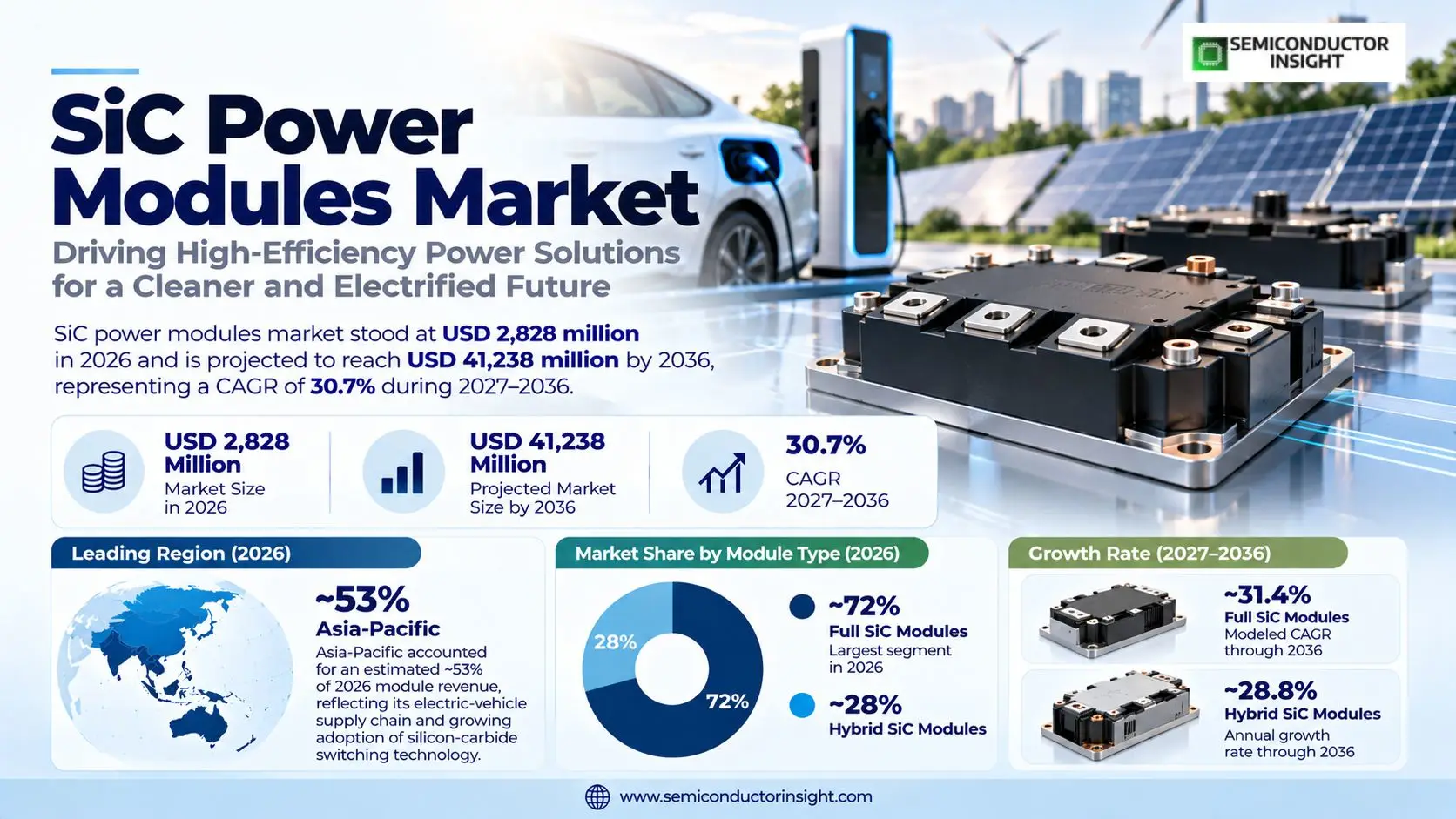
SiC power modules market stood at USD 2,828 million in 2026 and is projected to reach USD 41,238 million by 2036, representing a CAGR of 30.7% during 2027–2036. Asia-Pacific accounted for an estimated ~53% of 2026 module revenue, reflecting its electric-vehicle supply chain and growing adoption of silicon-carbide switching technology.

Get the sample PDF with study scope, segmentation and methodology details.

Key Statistics

2026 Market Size
USD 2,828 million
2036 Projected Size
USD 41,238 million
CAGR (2027–2036)
30.7%
Largest Market in 2026
Asia-Pacific (~53%)

Key Takeaways

  • Revenue outlook: The SiC power modules market reached USD 2,828 million in 2026 and is forecast to attain USD 41,238 million by 2036, growing at a 30.7% CAGR over 2027–2036. Growth is associated with high-voltage conversion in electric vehicles, charging infrastructure, industrial equipment and renewable energy.
  • Technology mix: Full SiC modules lead with an estimated ~72% of 2026 sales, against ~28% for hybrid SiC modules. Full SiC solutions are modeled to grow at ~31.4% annually as traction inverters and industrial converters pursue lower switching losses.
  • Application demand: Automotive & EV/HEV is the largest use case at an estimated ~48% of 2026 revenue; EV charging follows at ~13%, industrial drives at ~12%, and PV, energy storage and wind at ~15%. These are shares of module sales, not of the entire converter.
  • Regional demand: Asia-Pacific leads at an estimated ~53% of the 2026 market, supported by Chinese electric-vehicle manufacturing and regional module assembly. Europe contributes ~23% and North America ~17%; emerging regions account for the remaining ~7%.
  • Qualification barrier: The strongest constraints are high-quality SiC die supply, expensive ceramic substrates and packaging, power-cycling durability and automotive qualification. Module makers must coordinate switching behavior with gate drivers, cooling plates and the converter busbar architecture.

SiC Power Modules Market Overview

SiC power modules market stood at USD 2,828 million in 2026 and is projected to reach USD 41,238 million by 2036, representing a CAGR of 30.7% during 2027–2036. Asia-Pacific accounted for an estimated ~53% of 2026 module revenue, reflecting its electric-vehicle supply chain and growing adoption of silicon-carbide switching technology.

Historical period: 2021–2025 · Base year: 2026 · Estimate: 2027 · Forecast: 2036 · Revenue unit: USD million

Silicon-carbide power modules package multiple power semiconductor chips into an electrically isolated assembly capable of controlling substantial current and voltage. The module may integrate SiC MOSFETs, Schottky diodes, or a combination of SiC devices with silicon switches in hybrid architectures. It provides power terminals, electrical isolation, thermal paths and mechanical mounting, allowing converter designers to deploy faster switching and lower conduction losses than conventional silicon-only configurations in appropriate operating regimes.

The market boundary includes finished full-SiC and hybrid-SiC power modules sold for automotive traction and auxiliary converters, off-board charging, industrial motor drives, photovoltaic and storage inverters, data-center power systems and rail applications. It excludes bare SiC substrates, separately sold discrete MOSFETs and diodes, gate-driver boards, complete inverter cabinets, vehicle drivetrains and turnkey charging stations. The scope follows the product and application mix in the published segmentation; module packaging revenue is not confused with the value of the larger equipment into which it is integrated.

In a traction inverter, the module must switch battery power into controlled three-phase motor current while handling frequent acceleration, regeneration and temperature cycling. In a photovoltaic or wind converter, different load profiles reward low conduction loss and stable operation at elevated DC-link voltages. Infineon introduced 2300 V CoolSiC XHP 2 modules in May 2026 for renewable energy converters, illustrating how voltage ratings and package design are expanding beyond passenger-vehicle use cases. The technology choice is constrained by insulation, creepage distance, cooling design and the availability of matching drivers.

The International Energy Agency reported more than 20 million electric cars sold in 2025 and projected 23 million for 2026. That expansion supports the potential installed base for SiC traction systems, but not every electric car uses a SiC main inverter and the module content varies by vehicle platform. Procurement therefore depends on the proportion of new models adopting 400 V or 800 V architectures, the module count per powertrain and the pricing of qualified assemblies rather than on global vehicle deliveries alone.

The application mix is broadening toward higher-power infrastructure. Microchip announced production availability of 3.3 kV mSiC modules in May 2026 for solid-state transformers serving data centers, and Semikron Danfoss and Mitsubishi Electric announced a common three-level package concept in June 2026. Such developments show that buyers increasingly evaluate a module as part of a complete switching cell, including thermal interfaces, stray inductance and serviceability. Packaging interoperability can accelerate adoption but does not eliminate product-specific qualification requirements.

Segment Analysis: By Type

Full SiC modules account for an estimated ~72% of 2026 market revenue and are modeled at ~31.4% CAGR through 2036. Hybrid SiC modules represent ~28% and expand at ~28.8% annually. A full SiC configuration employs silicon-carbide switching elements throughout the main power path; hybrid designs retain selected silicon devices to balance performance and component cost. Both require suitable substrates, encapsulation and electrical terminals.

Type Function Market position
Full SiC Modules Full SiC modules integrate SiC MOSFET switching devices, often with SiC Schottky diodes or optimized body-diode operation, to achieve high switching frequencies and strong efficiency at demanding voltages. They are used in traction inverters, chargers, grid converters and selected data-center power systems where electrical and thermal design can exploit wide-bandgap characteristics. For Full SiC Modules functionality, engineering reviews compare device layout, switching losses and parasitic inductance against the power-converter duty cycle and lifetime target. A purchase normally follows prototype measurements of efficiency, electromagnetic interference and junction-temperature margin; the winning design is not necessarily the lowest-priced semiconductor. That process creates a commercial difference between a catalog listing and a module approved for repeat manufacture. Full SiC Modules represent an estimated ~72% of 2026 sales and are projected to grow ~31.4% per year through 2036. Buyers assess package footprint, available current ratings, switching frequency and the cost of the complete converter. The share estimate is consistent with supplier catalogues that now offer multiple full-SiC module families for high-power applications. For Full SiC Modules market, engineering reviews compare lifetime cost, isolation performance and cooling-system integration against the power-converter duty cycle and lifetime target. A purchase normally follows prototype measurements of efficiency, electromagnetic interference and junction-temperature margin; the winning design is not necessarily the lowest-priced semiconductor. That process creates a commercial difference between a catalog listing and a module approved for repeat manufacture.
Hybrid SiC Modules Hybrid designs combine SiC devices with conventional silicon IGBTs or diodes in one power-stage assembly. This architecture can reduce switching losses without the full material cost of an all-SiC module, making it attractive for converters with mixed duty cycles or where legacy equipment platforms must be upgraded incrementally. For Hybrid SiC Modules functionality, engineering reviews compare device layout, switching losses and parasitic inductance against the power-converter duty cycle and lifetime target. A purchase normally follows prototype measurements of efficiency, electromagnetic interference and junction-temperature margin; the winning design is not necessarily the lowest-priced semiconductor. That process creates a commercial difference between a catalog listing and a module approved for repeat manufacture. Hybrid SiC Modules represent an estimated ~28% of 2026 sales and are projected to grow ~28.8% per year through 2036. Buyers assess package footprint, available current ratings, switching frequency and the cost of the complete converter. The share estimate is consistent with supplier catalogues that now offer multiple full-SiC module families for high-power applications. For Hybrid SiC Modules market, engineering reviews compare lifetime cost, isolation performance and cooling-system integration against the power-converter duty cycle and lifetime target. A purchase normally follows prototype measurements of efficiency, electromagnetic interference and junction-temperature margin; the winning design is not necessarily the lowest-priced semiconductor. That process creates a commercial difference between a catalog listing and a module approved for repeat manufacture.

Segment Analysis: By Application

The 2026 application model places Automotive & EV/HEV at ~48% of SiC power-module revenue, EV Charging at ~13%, Industrial Motor/Drive at ~12%, PV, Energy Storage, Wind Power at ~15%, UPS, Data Center & Server at ~6%, Rail Transport at ~4% and Others at ~2%. Application-specific operating voltages, duty cycles and certification regimes influence module size and unit pricing.

Application Demand characteristics
Automotive & EV/HEV Automotive & EV/HEV demand centers on traction inverters and selected onboard converters, with an estimated ~48% of 2026 revenue and ~31.5% modeled annual growth through 2036. Purchasing specifications prioritize automotive power-cycling tests, reliability over vehicle lifetime and tight thermal envelopes. Integrators compare full-SiC and hybrid approaches against converter efficiency, cooling volume, electromagnetic compatibility and overall lifecycle cost. The semiconductor module is only one part of the power system and its value is counted separately from the complete assembly.
EV Charging EV Charging demand centers on high-power dc chargers and charging-station conversion stages, with an estimated ~13% of 2026 revenue and ~32.0% modeled annual growth through 2036. Purchasing specifications prioritize fast switching, low switching loss and reliable operation under variable station utilization. Integrators compare full-SiC and hybrid approaches against converter efficiency, cooling volume, electromagnetic compatibility and overall lifecycle cost. The semiconductor module is only one part of the power system and its value is counted separately from the complete assembly.
Industrial Motor/Drive Industrial Motor/Drive demand centers on variable-frequency drives, automation motors and high-voltage power controls, with an estimated ~12% of 2026 revenue and ~28.5% modeled annual growth through 2036. Purchasing specifications prioritize downtime avoidance, motor-control harmonics and rugged installation environments. Integrators compare full-SiC and hybrid approaches against converter efficiency, cooling volume, electromagnetic compatibility and overall lifecycle cost. The semiconductor module is only one part of the power system and its value is counted separately from the complete assembly.
PV, Energy Storage, Wind Power PV, Energy Storage, Wind Power demand centers on solar inverters, battery storage power-conversion systems and wind turbines, with an estimated ~15% of 2026 revenue and ~30.4% modeled annual growth through 2036. Purchasing specifications prioritize high DC-link voltage, inverter efficiency and long service intervals. Integrators compare full-SiC and hybrid approaches against converter efficiency, cooling volume, electromagnetic compatibility and overall lifecycle cost. The semiconductor module is only one part of the power system and its value is counted separately from the complete assembly.
UPS, Data Center & Server UPS, Data Center & Server demand centers on uninterruptible power systems and high-voltage distribution, with an estimated ~6% of 2026 revenue and ~28.9% modeled annual growth through 2036. Purchasing specifications prioritize solid-state transformer efficiency, isolation and power-density constraints. Integrators compare full-SiC and hybrid approaches against converter efficiency, cooling volume, electromagnetic compatibility and overall lifecycle cost. The semiconductor module is only one part of the power system and its value is counted separately from the complete assembly.
Rail Transport Rail Transport demand centers on rail traction and auxiliary converters, with an estimated ~4% of 2026 revenue and ~28.1% modeled annual growth through 2036. Purchasing specifications prioritize long duty cycles, shock resistance and high-voltage insulation. Integrators compare full-SiC and hybrid approaches against converter efficiency, cooling volume, electromagnetic compatibility and overall lifecycle cost. The semiconductor module is only one part of the power system and its value is counted separately from the complete assembly.
Others Others demand centers on specialty marine, aerospace and laboratory power electronics, with an estimated ~2% of 2026 revenue and ~27.9% modeled annual growth through 2036. Purchasing specifications prioritize small production runs and application-specific qualification. Integrators compare full-SiC and hybrid approaches against converter efficiency, cooling volume, electromagnetic compatibility and overall lifecycle cost. The semiconductor module is only one part of the power system and its value is counted separately from the complete assembly.

Module procurement is increasingly tied to co-design with inverter manufacturers. An automotive Tier 1 supplier may approve a specific power-module package across multiple vehicle platforms, while an industrial equipment maker can select a catalog module for a lower-volume converter. These differences affect sales channels, production forecasts and the time between initial engineering samples and recurring shipments. Suppliers that provide gate-drive guidance and thermal models can reduce qualification effort without changing the revenue boundary.
Regional Analysis

Asia-Pacific accounts for an estimated ~53% of 2026 SiC power-module revenue, Europe ~23%, North America ~17%, Middle East & Africa ~4% and South America ~3%. Regional growth is modeled at ~31.4%, ~30.4%, ~30.0%, ~29.5% and ~28.0% respectively through 2036. The split reflects module demand and supplier ecosystems, not the location where a final vehicle or renewable-power system is sold.

Where are SiC power modules designed, integrated and purchased?

The manufacturing and demand maps differ because SiC die can be produced in one country, assembled into modules elsewhere and integrated into an inverter at a third location. Asia-Pacific benefits from dense automotive and electronics manufacturing, Europe from vehicle and industrial converter engineering, and North America from grid and data-center development. For emerging regions, imported modules may be more significant than domestic semiconductor production.

Region Position Growth outlook Demand profile What decides supplier selection
Asia-Pacific ~53% of 2026 revenue ~31.4% CAGR High-volume EV supply chains and regional electronics assembly In Asia-Pacific, supplier selection depends on automotive or industrial design wins, distribution coverage and support for inverter engineering. The regional share is estimated at ~53% for 2026 with modeled growth of ~31.4% through 2036. Package thermal resistance, voltage rating, insulation performance and reliable delivery all affect procurement outcomes. For Asia-Pacific market access, engineering reviews compare Asia-Pacific component sourcing and engineering support against the power-converter duty cycle and lifetime target. A purchase normally follows prototype measurements of efficiency, electromagnetic interference and junction-temperature margin; the winning design is not necessarily the lowest-priced semiconductor. That process creates a commercial difference between a catalog listing and a module approved for repeat manufacture.
Europe ~23% of 2026 revenue ~30.4% CAGR Automotive electrification and high-power industrial conversion In Europe, supplier selection depends on automotive or industrial design wins, distribution coverage and support for inverter engineering. The regional share is estimated at ~23% for 2026 with modeled growth of ~30.4% through 2036. Package thermal resistance, voltage rating, insulation performance and reliable delivery all affect procurement outcomes. For Europe market access, engineering reviews compare Europe component sourcing and engineering support against the power-converter duty cycle and lifetime target. A purchase normally follows prototype measurements of efficiency, electromagnetic interference and junction-temperature margin; the winning design is not necessarily the lowest-priced semiconductor. That process creates a commercial difference between a catalog listing and a module approved for repeat manufacture.
North America ~17% of 2026 revenue ~30.0% CAGR Automotive platforms, grid modernization and data-center power In North America, supplier selection depends on automotive or industrial design wins, distribution coverage and support for inverter engineering. The regional share is estimated at ~17% for 2026 with modeled growth of ~30.0% through 2036. Package thermal resistance, voltage rating, insulation performance and reliable delivery all affect procurement outcomes. For North America market access, engineering reviews compare North America component sourcing and engineering support against the power-converter duty cycle and lifetime target. A purchase normally follows prototype measurements of efficiency, electromagnetic interference and junction-temperature margin; the winning design is not necessarily the lowest-priced semiconductor. That process creates a commercial difference between a catalog listing and a module approved for repeat manufacture.
Middle East & Africa ~4% of 2026 revenue ~29.5% CAGR Grid conversion, solar projects and emerging electric mobility In Middle East & Africa, supplier selection depends on automotive or industrial design wins, distribution coverage and support for inverter engineering. The regional share is estimated at ~4% for 2026 with modeled growth of ~29.5% through 2036. Package thermal resistance, voltage rating, insulation performance and reliable delivery all affect procurement outcomes. For Middle East & Africa market access, engineering reviews compare Middle East & Africa component sourcing and engineering support against the power-converter duty cycle and lifetime target. A purchase normally follows prototype measurements of efficiency, electromagnetic interference and junction-temperature margin; the winning design is not necessarily the lowest-priced semiconductor. That process creates a commercial difference between a catalog listing and a module approved for repeat manufacture.
South America ~3% of 2026 revenue ~28.0% CAGR Renewable energy installations and developing EV infrastructure In South America, supplier selection depends on automotive or industrial design wins, distribution coverage and support for inverter engineering. The regional share is estimated at ~3% for 2026 with modeled growth of ~28.0% through 2036. Package thermal resistance, voltage rating, insulation performance and reliable delivery all affect procurement outcomes. For South America market access, engineering reviews compare South America component sourcing and engineering support against the power-converter duty cycle and lifetime target. A purchase normally follows prototype measurements of efficiency, electromagnetic interference and junction-temperature margin; the winning design is not necessarily the lowest-priced semiconductor. That process creates a commercial difference between a catalog listing and a module approved for repeat manufacture.

Asia-Pacific LARGEST · ~53% SHARE · ~31.4% CAGR

What supports the SiC module outlook in Asia-Pacific?

Asia-Pacific is modeled to represent ~53% of 2026 SiC power-module sales, with ~31.4% annual growth through 2036. Its principal demand profile is high-volume ev supply chains and regional electronics assembly. Supplier competitiveness is shaped by qualified product families, technical support and the capacity to satisfy automotive, industrial or energy-infrastructure procurement cycles. The modeled growth path does not presume that all downstream equipment adopts SiC switching.

Market position~53% modeled 2026 share
Growth outlook~31.4% CAGR, 2027–2036
Demand profileHigh-volume EV supply chains and regional electronics assembly
Market access gateQualification, distribution and design support
Country Position in region What drives demand
China EV integration China combines large electric-car production with local module suppliers such as BYD Semiconductor and CRRC Times Electric. Its 2025 EV market accounted for a majority of new-car sales, supporting demand for traction-inverter power stages. In the 2026 market model, Asia-Pacific represents ~53% of world module demand; this national opportunity sits inside that regional estimate rather than being an additional market. Converter engineers typically request thermal-resistance data, 650 V to 2300 V operating-class options and evidence of stable switching under field conditions.
Japan Industrial systems Japan has established automotive and power-device engineering companies, including ROHM, Mitsubishi Electric and Fuji Electric, that develop high-voltage module designs. In the 2026 market model, Asia-Pacific represents ~53% of world module demand; this national opportunity sits inside that regional estimate rather than being an additional market. Converter engineers typically request thermal-resistance data, 650 V to 2300 V operating-class options and evidence of stable switching under field conditions.
South Korea Renewables South Korea has automotive electrification programs and industrial electronics customers requiring thermal and switching qualification. In the 2026 market model, Asia-Pacific represents ~53% of world module demand; this national opportunity sits inside that regional estimate rather than being an additional market. Converter engineers typically request thermal-resistance data, 650 V to 2300 V operating-class options and evidence of stable switching under field conditions.
India Power electronics India is expanding EV production and charging infrastructure, although many module components are imported or sourced through international supplier networks. In the 2026 market model, Asia-Pacific represents ~53% of world module demand; this national opportunity sits inside that regional estimate rather than being an additional market. Converter engineers typically request thermal-resistance data, 650 V to 2300 V operating-class options and evidence of stable switching under field conditions.

Market instances

  • Customer deployment Chinese EV manufacturing provides the largest regional demand channel for 750 V and 1200 V power modules; module selection depends on vehicle platforms and converter topology rather than car sales alone. For the Asia-Pacific forecast, the estimated ~53% share and ~31.4% CAGR represent a modeled regional allocation, while the specific project or supplier event is evidence of a potential demand mechanism. Buyers still need a qualified module that matches inverter voltage, cooling and expected operating life.
  • Supplier technology Japanese supplier engineering links substrate, SiC die and module packaging expertise; ROHM reference designs for three-phase inverters illustrate the support offered to equipment makers. For the Asia-Pacific forecast, the estimated ~53% share and ~31.4% CAGR represent a modeled regional allocation, while the specific project or supplier event is evidence of a potential demand mechanism. Buyers still need a qualified module that matches inverter voltage, cooling and expected operating life.
  • Procurement implication Indian charging and industrial demand creates opportunities for distributors of full-SiC and hybrid modules, subject to localization and service requirements. For the Asia-Pacific forecast, the estimated ~53% share and ~31.4% CAGR represent a modeled regional allocation, while the specific project or supplier event is evidence of a potential demand mechanism. Buyers still need a qualified module that matches inverter voltage, cooling and expected operating life.
In the full report: Asia-Pacific country-level demand, application shares, inverter voltage classes, supplier access and qualification schedules for 2026–2036.

Europe REGIONAL · ~23% SHARE · ~30.4% CAGR

What supports the SiC module outlook in Europe?

Europe is modeled to represent ~23% of 2026 SiC power-module sales, with ~30.4% annual growth through 2036. Its principal demand profile is automotive electrification and high-power industrial conversion. Supplier competitiveness is shaped by qualified product families, technical support and the capacity to satisfy automotive, industrial or energy-infrastructure procurement cycles. The modeled growth path does not presume that all downstream equipment adopts SiC switching.

Market position~23% modeled 2026 share
Growth outlook~30.4% CAGR, 2027–2036
Demand profileAutomotive electrification and high-power industrial conversion
Market access gateQualification, distribution and design support
Country Position in region What drives demand
Germany EV integration Germany anchors European automotive traction development and hosts major power electronics engineering operations, including Infineon and industrial inverter integrators. In the 2026 market model, Europe represents ~23% of world module demand; this national opportunity sits inside that regional estimate rather than being an additional market. Converter engineers typically request thermal-resistance data, 650 V to 2300 V operating-class options and evidence of stable switching under field conditions.
France Industrial systems France has vehicle electrification programs, rail applications and industrial automation customers that evaluate SiC module thermal reliability. In the 2026 market model, Europe represents ~23% of world module demand; this national opportunity sits inside that regional estimate rather than being an additional market. Converter engineers typically request thermal-resistance data, 650 V to 2300 V operating-class options and evidence of stable switching under field conditions.
Italy Renewables Italy supports industrial drives and renewable-energy conversion, with STMicroelectronics supplying semiconductor technologies to European power-electronics manufacturers. In the 2026 market model, Europe represents ~23% of world module demand; this national opportunity sits inside that regional estimate rather than being an additional market. Converter engineers typically request thermal-resistance data, 650 V to 2300 V operating-class options and evidence of stable switching under field conditions.
United Kingdom Power electronics The United Kingdom contributes industrial electronics and energy-storage demand, where modular power conversion is evaluated against grid and installation requirements. In the 2026 market model, Europe represents ~23% of world module demand; this national opportunity sits inside that regional estimate rather than being an additional market. Converter engineers typically request thermal-resistance data, 650 V to 2300 V operating-class options and evidence of stable switching under field conditions.

Market instances

  • Customer deployment European vehicle makers are increasing adoption of efficient traction inverters; system integrators specify current ratings and cooling interfaces during vehicle-platform design. For the Europe forecast, the estimated ~23% share and ~30.4% CAGR represent a modeled regional allocation, while the specific project or supplier event is evidence of a potential demand mechanism. Buyers still need a qualified module that matches inverter voltage, cooling and expected operating life.
  • Supplier technology Infineon’s May 2026 2300 V XHP 2 announcement demonstrates high-voltage module options for wind, photovoltaic and battery-storage converters. For the Europe forecast, the estimated ~23% share and ~30.4% CAGR represent a modeled regional allocation, while the specific project or supplier event is evidence of a potential demand mechanism. Buyers still need a qualified module that matches inverter voltage, cooling and expected operating life.
  • Procurement implication Semikron Danfoss and Mitsubishi Electric announced a common three-level module package in June 2026, highlighting the importance of interchangeability and supply resilience. For the Europe forecast, the estimated ~23% share and ~30.4% CAGR represent a modeled regional allocation, while the specific project or supplier event is evidence of a potential demand mechanism. Buyers still need a qualified module that matches inverter voltage, cooling and expected operating life.
In the full report: Europe country-level demand, application shares, inverter voltage classes, supplier access and qualification schedules for 2026–2036.

North America REGIONAL · ~17% SHARE · ~30.0% CAGR

What supports the SiC module outlook in North America?

North America is modeled to represent ~17% of 2026 SiC power-module sales, with ~30.0% annual growth through 2036. Its principal demand profile is automotive platforms, grid modernization and data-center power. Supplier competitiveness is shaped by qualified product families, technical support and the capacity to satisfy automotive, industrial or energy-infrastructure procurement cycles. The modeled growth path does not presume that all downstream equipment adopts SiC switching.

Market position~17% modeled 2026 share
Growth outlook~30.0% CAGR, 2027–2036
Demand profileAutomotive platforms, grid modernization and data-center power
Market access gateQualification, distribution and design support
Country Position in region What drives demand
United States EV integration The United States includes Microchip, onsemi and Wolfspeed engineering activity and significant data-center investment; buyers evaluate high-voltage modules for solid-state transformers. In the 2026 market model, North America represents ~17% of world module demand; this national opportunity sits inside that regional estimate rather than being an additional market. Converter engineers typically request thermal-resistance data, 650 V to 2300 V operating-class options and evidence of stable switching under field conditions.
Canada Industrial systems Canada provides industrial electrification and renewable-power customers, although local module production is smaller than the United States. In the 2026 market model, North America represents ~17% of world module demand; this national opportunity sits inside that regional estimate rather than being an additional market. Converter engineers typically request thermal-resistance data, 650 V to 2300 V operating-class options and evidence of stable switching under field conditions.
Mexico Renewables Mexico hosts vehicle assembly and automotive electronics suppliers that may specify qualified traction inverters for regional and export platforms. In the 2026 market model, North America represents ~17% of world module demand; this national opportunity sits inside that regional estimate rather than being an additional market. Converter engineers typically request thermal-resistance data, 650 V to 2300 V operating-class options and evidence of stable switching under field conditions.

Market instances

  • Customer deployment Microchip announced 3.3 kV HV-D3 mSiC power modules in May 2026, targeting solid-state transformers and other medium-voltage systems. For the North America forecast, the estimated ~17% share and ~30.0% CAGR represent a modeled regional allocation, while the specific project or supplier event is evidence of a potential demand mechanism. Buyers still need a qualified module that matches inverter voltage, cooling and expected operating life.
  • Supplier technology Wolfspeed introduced a 10 kV discrete SiC MOSFET in March 2026; this is adjacent device evidence rather than a packaged module release. For the North America forecast, the estimated ~17% share and ~30.0% CAGR represent a modeled regional allocation, while the specific project or supplier event is evidence of a potential demand mechanism. Buyers still need a qualified module that matches inverter voltage, cooling and expected operating life.
  • Procurement implication The North American EV and industrial customer base can support qualified module programs, but supplier revenue depends on OEM awards and manufacturing location. For the North America forecast, the estimated ~17% share and ~30.0% CAGR represent a modeled regional allocation, while the specific project or supplier event is evidence of a potential demand mechanism. Buyers still need a qualified module that matches inverter voltage, cooling and expected operating life.
In the full report: North America country-level demand, application shares, inverter voltage classes, supplier access and qualification schedules for 2026–2036.

Middle East & Africa REGIONAL · ~4% SHARE · ~29.5% CAGR

What supports the SiC module outlook in Middle East & Africa?

Middle East & Africa is modeled to represent ~4% of 2026 SiC power-module sales, with ~29.5% annual growth through 2036. Its principal demand profile is grid conversion, solar projects and emerging electric mobility. Supplier competitiveness is shaped by qualified product families, technical support and the capacity to satisfy automotive, industrial or energy-infrastructure procurement cycles. The modeled growth path does not presume that all downstream equipment adopts SiC switching.

Market position~4% modeled 2026 share
Growth outlook~29.5% CAGR, 2027–2036
Demand profileGrid conversion, solar projects and emerging electric mobility
Market access gateQualification, distribution and design support
Country Position in region What drives demand
Saudi Arabia EV integration Saudi Arabia is investing in industrial electrification and renewable power, creating potential demand for efficient inverter power stages. In the 2026 market model, Middle East & Africa represents ~4% of world module demand; this national opportunity sits inside that regional estimate rather than being an additional market. Converter engineers typically request thermal-resistance data, 650 V to 2300 V operating-class options and evidence of stable switching under field conditions.
United Arab Emirates Industrial systems The United Arab Emirates has utility-scale solar and data-center projects that may use high-efficiency power conversion hardware. In the 2026 market model, Middle East & Africa represents ~4% of world module demand; this national opportunity sits inside that regional estimate rather than being an additional market. Converter engineers typically request thermal-resistance data, 650 V to 2300 V operating-class options and evidence of stable switching under field conditions.
South Africa Renewables South Africa combines renewable-power installations with mining and industrial drive applications, where converter efficiency and maintainability matter. In the 2026 market model, Middle East & Africa represents ~4% of world module demand; this national opportunity sits inside that regional estimate rather than being an additional market. Converter engineers typically request thermal-resistance data, 650 V to 2300 V operating-class options and evidence of stable switching under field conditions.

Market instances

  • Customer deployment Utility-scale solar projects create demand for power converters, but not every project uses SiC modules; qualification depends on system voltage and economics. For the Middle East & Africa forecast, the estimated ~4% share and ~29.5% CAGR represent a modeled regional allocation, while the specific project or supplier event is evidence of a potential demand mechanism. Buyers still need a qualified module that matches inverter voltage, cooling and expected operating life.
  • Supplier technology High-voltage DC conversion and storage can create future applications for 1700 V and 2300 V classes, subject to supplier approval. For the Middle East & Africa forecast, the estimated ~4% share and ~29.5% CAGR represent a modeled regional allocation, while the specific project or supplier event is evidence of a potential demand mechanism. Buyers still need a qualified module that matches inverter voltage, cooling and expected operating life.
  • Procurement implication Regional procurement is often served by imported modules and local converter integrators, making service support and inventory lead times relevant. For the Middle East & Africa forecast, the estimated ~4% share and ~29.5% CAGR represent a modeled regional allocation, while the specific project or supplier event is evidence of a potential demand mechanism. Buyers still need a qualified module that matches inverter voltage, cooling and expected operating life.
In the full report: Middle East & Africa country-level demand, application shares, inverter voltage classes, supplier access and qualification schedules for 2026–2036.

South America REGIONAL · ~3% SHARE · ~28.0% CAGR

What supports the SiC module outlook in South America?

South America is modeled to represent ~3% of 2026 SiC power-module sales, with ~28.0% annual growth through 2036. Its principal demand profile is renewable energy installations and developing ev infrastructure. Supplier competitiveness is shaped by qualified product families, technical support and the capacity to satisfy automotive, industrial or energy-infrastructure procurement cycles. The modeled growth path does not presume that all downstream equipment adopts SiC switching.

Market position~3% modeled 2026 share
Growth outlook~28.0% CAGR, 2027–2036
Demand profileRenewable energy installations and developing EV infrastructure
Market access gateQualification, distribution and design support
Country Position in region What drives demand
Brazil EV integration Brazil has electric mobility growth and an established industrial motor-drive market that can use advanced power-conversion modules. In the 2026 market model, South America represents ~3% of world module demand; this national opportunity sits inside that regional estimate rather than being an additional market. Converter engineers typically request thermal-resistance data, 650 V to 2300 V operating-class options and evidence of stable switching under field conditions.
Chile Industrial systems Chile has solar generation and energy-storage deployment opportunities where inverter efficiency influences lifecycle economics. In the 2026 market model, South America represents ~3% of world module demand; this national opportunity sits inside that regional estimate rather than being an additional market. Converter engineers typically request thermal-resistance data, 650 V to 2300 V operating-class options and evidence of stable switching under field conditions.
Argentina Renewables Argentina includes industrial automation and specialty power electronics customers, although module volumes depend on imported equipment availability. In the 2026 market model, South America represents ~3% of world module demand; this national opportunity sits inside that regional estimate rather than being an additional market. Converter engineers typically request thermal-resistance data, 650 V to 2300 V operating-class options and evidence of stable switching under field conditions.

Market instances

  • Customer deployment Brazilian EV and charging projects are an indirect demand driver for SiC modules; vehicle inverter design choices determine the direct purchase opportunity. For the South America forecast, the estimated ~3% share and ~28.0% CAGR represent a modeled regional allocation, while the specific project or supplier event is evidence of a potential demand mechanism. Buyers still need a qualified module that matches inverter voltage, cooling and expected operating life.
  • Supplier technology Chilean solar and storage plants can employ high-voltage conversion, but module choice is driven by engineering qualification and project procurement. For the South America forecast, the estimated ~3% share and ~28.0% CAGR represent a modeled regional allocation, while the specific project or supplier event is evidence of a potential demand mechanism. Buyers still need a qualified module that matches inverter voltage, cooling and expected operating life.
  • Procurement implication South American distribution partners help equipment makers access qualified semiconductor modules and application support without requiring local wafer fabrication. For the South America forecast, the estimated ~3% share and ~28.0% CAGR represent a modeled regional allocation, while the specific project or supplier event is evidence of a potential demand mechanism. Buyers still need a qualified module that matches inverter voltage, cooling and expected operating life.
In the full report: South America country-level demand, application shares, inverter voltage classes, supplier access and qualification schedules for 2026–2036.

Competitive Landscape

Competition in SiC power modules is determined by semiconductor die performance, module packaging, customer qualifications and the ability to supply the same electrical design over a long production cycle. Infineon, STMicroelectronics, ROHM, onsemi, Microchip and Semikron Danfoss offer relevant power-module or SiC product families, while the broader publisher roster spans device, packaging and power-electronics participants. Market-specific revenue rankings are not inferred from total corporate sales.

Automotive awards are particularly important because a traction inverter can remain in production across multiple model years. Module makers work with vehicle and Tier 1 engineers on power density, short-circuit withstand time, thermal cycling and reliability screening. A package selected for one vehicle platform may generate recurring shipments, but a different busbar layout or coolant system can require redesign and a new approval process.

Industrial customers compare package standardization and availability of multiple voltage classes. Semikron Danfoss describes both full-SiC and hybrid modules, and its 2026 work with Mitsubishi Electric on a three-level package highlights the role of compatible terminal layouts. Design support, thermal modeling and distributor inventory can matter as much as die efficiency when equipment makers need to reduce engineering time.

Microchip introduced a 3.3 kV module for solid-state transformer designs in May 2026, showing how high-voltage specialists can serve data-center power infrastructure. ROHM provides SiC module reference designs for three-phase inverters. Such supplier documentation offers direct evidence of product capability, but it does not establish comparable worldwide module revenue for every profiled company. For specialized module competition, engineering reviews compare thermal management, gate-drive selection and production qualification against the power-converter duty cycle and lifetime target. A purchase normally follows prototype measurements of efficiency, electromagnetic interference and junction-temperature margin; the winning design is not necessarily the lowest-priced semiconductor. That process creates a commercial difference between a catalog listing and a module approved for repeat manufacture.

Access to high-quality SiC wafers, MOSFET die, ceramic substrates and qualified encapsulation capacity influences delivery. Suppliers may source chips internally or externally and then package them into different module families. Yield at both the device and assembly stages affects cost, while customer expectations for traceability and longevity create barriers for firms offering only unqualified prototype hardware.

Tier structure

Tier Companies Basis of competition
Tier 1 Infineon; STMicroelectronics; ROHM; Semikron Danfoss These firms publish identifiable SiC module families or complete power-module platforms and provide applications engineering for automotive and industrial converters. They compete through qualified packages, thermal performance, switching efficiency and production continuity. The tier reflects documented product breadth rather than a claimed numerical ranking by global SiC module revenue. For tier 1 module vendors, engineering reviews compare thermal management, gate-drive selection and production qualification against the power-converter duty cycle and lifetime target. A purchase normally follows prototype measurements of efficiency, electromagnetic interference and junction-temperature margin; the winning design is not necessarily the lowest-priced semiconductor. That process creates a commercial difference between a catalog listing and a module approved for repeat manufacture.
Tier 2 Microchip; onsemi; Mitsubishi Electric; Fuji Electric; StarPower These suppliers participate in power electronics through specialized modules, automotive switching technologies or industrial packages. Their competitive position depends on the specific voltage class and assembly offered to each customer. Some named technologies are adjacent devices or common package designs, so product-level evidence should be checked before assuming identical module portfolios. For tier 2 module vendors, engineering reviews compare thermal management, gate-drive selection and production qualification against the power-converter duty cycle and lifetime target. A purchase normally follows prototype measurements of efficiency, electromagnetic interference and junction-temperature margin; the winning design is not necessarily the lowest-priced semiconductor. That process creates a commercial difference between a catalog listing and a module approved for repeat manufacture.
Tier 3 Other profiled device, substrate and power-electronics participants The remaining names include firms active in SiC devices, semiconductor materials or converter electronics. Inclusion in the publisher roster does not by itself establish that every company currently sells a production-qualified full-SiC power module. Analysts and procurement teams should distinguish direct module suppliers from discrete-device manufacturers and downstream system integrators. For broader company roster, engineering reviews compare thermal management, gate-drive selection and production qualification against the power-converter duty cycle and lifetime target. A purchase normally follows prototype measurements of efficiency, electromagnetic interference and junction-temperature margin; the winning design is not necessarily the lowest-priced semiconductor. That process creates a commercial difference between a catalog listing and a module approved for repeat manufacture.

Key companies profiled

  • STMicroelectronics
  • Infineon
  • Wolfspeed
  • Rohm
  • onsemi
  • BYD Semiconductor
  • Microchip (Microsemi)
  • Mitsubishi Electric (Vincotech)
  • Semikron Danfoss
  • Fuji Electric
  • Toshiba
  • Littelfuse (IXYS)
  • SemiQ
  • Bosch
  • GE Aerospace
  • KEC Corporation
  • SanRex
  • Cissoid
  • BASiC Semiconductor
  • CETC 55
  • Zhuzhou CRRC Times Electric
  • StarPower
  • Guangdong AccoPower Semiconductor

Production Capacity Analysis

SiC power-module capacity combines availability of suitable MOSFET and diode die with ceramic substrates, copper metallization, die attachment, bonding, encapsulation and final electrical testing. A supplier with ample wafer output may still face module bottlenecks in assembly yield or qualified packaging lines. Manufacturing capacity is therefore evaluated in finished module units and voltage-class capability rather than only in the number of SiC substrate wafers produced.

Asia-Pacific offers extensive electronics assembly infrastructure and automotive inverter manufacturing, while Europe, Japan and North America retain specialized power-semiconductor design and module production. Capacity can be geographically distributed: substrate material may be produced in one facility, die fabricated in another and final modules assembled close to vehicle or industrial customers. This division increases the importance of process traceability and supply-chain coordination.

As customers move to higher DC-link voltages, insulation spacing, ceramic substrate quality and thermal-interface stability become more demanding. Infineon’s 2300 V XHP 2 range and Microchip’s 3.3 kV HV-D3 family illustrate that capacity cannot be described by a single generic module type. Equipment and test investment may be required for each new voltage and current envelope.

Automotive and grid equipment makers generally approve production lines, materials and change-control processes. A package revision can improve performance yet still require customer requalification. Production expansion therefore becomes commercially useful only after reliability testing and delivery commitments align with customer ramps. Assembly yield and power-cycling reliability are key indicators of usable capacity. For qualified capacity, engineering reviews compare thermal management, gate-drive selection and production qualification against the power-converter duty cycle and lifetime target. A purchase normally follows prototype measurements of efficiency, electromagnetic interference and junction-temperature margin; the winning design is not necessarily the lowest-priced semiconductor. That process creates a commercial difference between a catalog listing and a module approved for repeat manufacture.

Market Dynamics

The forecast is driven by the value of efficient switching in electrified transport and energy infrastructure. The impact model attributes +38.70 percentage points to positive factors and −8.00 points to restraints, producing the headline CAGR over 2027–2036. These contributions are analytical estimates of growth influence, not independently measured changes in semiconductor shipments. Near-term strength is concentrated in EV conversion; later periods place greater weight on charging, storage and high-voltage systems.

MARKET DRIVERS

Drivers Impact Analysis*

Market Drivers Impact Rank CAGR Contribution (%) 2027–2029 2030–2032 2033–2036
EV traction inverter adoption High +12.00% High High High
Renewable-energy converter electrification High +9.00% High High High
Fast charging and high-voltage distribution Medium-High +7.00% Medium High High
Industrial drives and power-density requirements Medium +5.00% Medium High High
Data-center and solid-state transformer programs Low-Medium +3.50% Low Medium High
Others (rail traction, storage upgrades, efficiency rules) Low +2.20% Low Medium Medium

Traction inverter adoption

The IEA reported global electric-car sales exceeding 20 million in 2025 and projected 23 million in 2026. Vehicle programs using SiC modules can benefit from lower switching losses and compact cooling systems, especially in high-voltage architectures. The revenue effect depends on platform adoption, semiconductor content per vehicle and qualified module pricing rather than on car unit growth alone.

Renewable energy power conversion

Utility solar, wind and battery storage systems require efficient conversion over long operating lives. Infineon’s May 2026 2300 V CoolSiC XHP 2 launch directly targets renewable converters and demonstrates demand for high-voltage module packaging. The engineering benefit is strongest where higher switching frequency reduces magnetics or where reduced semiconductor losses lower operating costs across large installations.

Fast charging and grid interfaces

High-power charging stations and solid-state transformers impose demanding current and isolation requirements. Microchip’s May 2026 3.3 kV HV-D3 release addresses medium-voltage power delivery and data-center transformers, with possible use in heavy-duty vehicle charging. Such applications expand the module addressable market beyond passenger cars, although they require extensive system validation before high-volume deployment. For driver 2 Fast charging and grid interfaces, engineering reviews compare thermal management, gate-drive selection and production qualification against the power-converter duty cycle and lifetime target. A purchase normally follows prototype measurements of efficiency, electromagnetic interference and junction-temperature margin; the winning design is not necessarily the lowest-priced semiconductor. That process creates a commercial difference between a catalog listing and a module approved for repeat manufacture.

Industrial and data-center efficiency

Variable-speed drives, UPS systems and server power distribution are increasingly evaluated for electrical losses and equipment footprint. Semikron Danfoss and Mitsubishi Electric described a shared three-level package concept in June 2026, reflecting demand for standardized industrial converter building blocks. Designers must verify that switching advantages outweigh the higher device and package cost in each power range.

MARKET RESTRAINTS

Restraints Impact Analysis*

Market Restraints Impact Rank CAGR Contribution (%) 2027–2029 2030–2032 2033–2036
SiC die and module production cost High -3.50% High Medium Medium
Qualification and reliability testing Medium-High -2.00% High Medium Medium
Competing silicon IGBT designs Medium -1.50% High Medium Low
Others (supply concentration, thermal design, project delays) Low -1.00% Medium Medium Low
*CAGR contribution shows the percentage points each factor adds to or removes from the forecast CAGR for 2027–2036; driver contributions less restraint contributions equal the market CAGR. Period columns rate the strength of each factor in that window.

Material and assembly economics

Silicon-carbide MOSFET die, ceramic substrates, silver sintering and high-reliability interconnects can make a module substantially more expensive than conventional silicon alternatives. Cost reductions depend on wafer yield, assembly automation and scale. Customers compare the price premium with reduced cooling, magnetics and lifetime energy losses, so attractive electrical performance does not guarantee adoption in every inverter class.

Automotive and industrial qualification

Module packages undergo thermal cycling, power cycling, humidity, vibration and electrical overstress evaluations before they are accepted in vehicles or industrial assets. A design win may precede production revenue by several quarters or years. Changes to bonding materials or substrate suppliers can trigger further testing, reducing the speed at which a manufacturer converts prototype interest into sustained shipments.

Incumbent silicon technology

Modern silicon IGBT modules remain cost-effective in many established drive and power-conversion architectures. Hybrid SiC packages provide an intermediate option, but the economics vary with switching frequency, voltage and duty cycle. Where a converter already meets efficiency targets with silicon, equipment makers may defer a costly redesign until a scheduled platform refresh. For restraint 2 Incumbent silicon technology, engineering reviews compare thermal management, gate-drive selection and production qualification against the power-converter duty cycle and lifetime target. A purchase normally follows prototype measurements of efficiency, electromagnetic interference and junction-temperature margin; the winning design is not necessarily the lowest-priced semiconductor. That process creates a commercial difference between a catalog listing and a module approved for repeat manufacture.

Supply-chain and integration risk

A power module must match gate-drive voltage, switching transients, insulation clearances, thermal interfaces and cooling-system constraints. Poorly controlled parasitic inductance or thermal cycling can erode the expected efficiency advantage. Semiconductor and packaging capacity concentration can also expose OEMs to lead-time volatility, encouraging dual sourcing and additional qualification costs. For restraint 3 Supply-chain and integration risk, engineering reviews compare thermal management, gate-drive selection and production qualification against the power-converter duty cycle and lifetime target. A purchase normally follows prototype measurements of efficiency, electromagnetic interference and junction-temperature margin; the winning design is not necessarily the lowest-priced semiconductor. That process creates a commercial difference between a catalog listing and a module approved for repeat manufacture.

MARKET OPPORTUNITIES

Higher-voltage energy systems

Infineon’s 2300 V product announcement illustrates opportunities in wind, photovoltaic and storage inverters operating at elevated DC-link voltages. Higher module ratings can simplify converter topologies and reduce series-connected device counts, provided isolation and thermal performance meet equipment standards. The value proposition is strongest in applications where reduced system complexity offsets the higher semiconductor cost. For opportunity 0 Higher-voltage energy systems, engineering reviews compare thermal management, gate-drive selection and production qualification against the power-converter duty cycle and lifetime target. A purchase normally follows prototype measurements of efficiency, electromagnetic interference and junction-temperature margin; the winning design is not necessarily the lowest-priced semiconductor. That process creates a commercial difference between a catalog listing and a module approved for repeat manufacture.

Data-center medium-voltage conversion

Microchip’s 3.3 kV HV-D3 module launch targets solid-state transformers that could connect medium-voltage distribution to data-center power systems. As AI computing increases electricity demand, converter efficiency and power density become important design variables. Module suppliers may earn revenue through new high-voltage power stages, but deployment schedules remain dependent on customer architecture decisions and grid-connection approvals.

Common package standards

Semikron Danfoss and Mitsubishi Electric announced a shared three-level module package concept in June 2026 for industrial drives and renewable-energy systems. Interoperable footprints can reduce redesign effort and support alternate sourcing. Suppliers that combine common mechanical interfaces with differentiated SiC die and thermal performance may expand their reachable customer base without requiring completely proprietary inverter platforms.

Emerging-market charging and storage

Growth in electric mobility and distributed energy across Southeast Asia, Latin America and parts of the Middle East creates opportunities for qualified converter modules. Many local system integrators depend on imported semiconductor assemblies and distributor engineering support. Successful suppliers will need stable inventory, application notes and service networks as much as favorable device-level efficiency. For opportunity 3 Emerging-market charging and storage, engineering reviews compare thermal management, gate-drive selection and production qualification against the power-converter duty cycle and lifetime target. A purchase normally follows prototype measurements of efficiency, electromagnetic interference and junction-temperature margin; the winning design is not necessarily the lowest-priced semiconductor. That process creates a commercial difference between a catalog listing and a module approved for repeat manufacture.

Supply Chain Analysis

A finished SiC power module requires high-quality substrates, epitaxial layers, processed MOSFET or diode die, ceramic isolation, copper metallization, thermal interfaces and electrical packaging. The value chain links material growers, semiconductor foundries, module assemblers, application engineers and converter OEMs. Yield losses at either the wafer or assembly stage can influence module price and delivery even when downstream demand is strong.

Upstream materialsSiC wafers, epitaxy, copper, ceramic substrates, die-attach and encapsulation materials define the available voltage and thermal envelope.
Device and module assemblyMOSFET die fabrication, testing, module interconnects, insulation and power-cycling qualification create shippable full-SiC or hybrid products.
Sales and design channelAutomotive Tier 1 suppliers, industrial distributors and application engineers qualify modules for inverter designs and manage production changes.
Downstream systemsTraction inverters, chargers, industrial drives, renewable converters, UPS equipment and rail traction consume finished module assemblies.

Materials. Substrate and epitaxy yield determine the supply of reliable SiC die, while ceramic isolation and copper metallization determine thermal and electrical capability after packaging. Module designers balance the conductivity of the thermal path with creepage distance and insulation requirements. A high-voltage product can require different materials from a compact automotive half-bridge, so supplier qualification is specific to the final module class.

Manufacturing. Wafer fabrication and die testing precede assembly operations such as sintering, bonding, encapsulation and final power-cycling verification. Module yield can be reduced by voids, bond defects or insufficient electrical isolation. Manufacturers therefore invest in process control and inspection to convert wafer output into reliably packaged products; bare-die volume is not an adequate measure of finished-module capacity.

Channels. Large automotive programs typically involve direct technical engagement with OEMs and Tier 1 inverter suppliers, while industrial customers may purchase through authorized distributors. Evaluation boards, thermal models and reference designs help customers compare voltage classes. Long product lifetimes and controlled engineering changes are especially important when a module is designed into industrial or transportation equipment.

Applications. End users pay for improved converter efficiency, smaller cooling systems or increased switching frequency, not for SiC material in isolation. In an EV, the module forms part of the traction inverter; in storage and solar, it sits inside the bidirectional or grid-tied converter. Counting only the packaged semiconductor assembly avoids conflating this market with complete system revenue.

Recent Developments

  • 08 Jun 2026 Announced
    Semikron Danfoss and Mitsubishi Electric introduced a common three-level power-module package concept based on SEMITRANS 20 and LV100-type interfaces. The package is intended for industrial drives and renewable energy converters and can accommodate SiC or IGBT technologies up to 3.3 kV. Its significance is potential interoperability and reduced inverter redesign, not a claim that every proposed configuration is already shipping. Source
  • 02 Jun 2026 Announced
    Infineon expanded its 750 V CoolSiC offering with an integrated half-bridge package intended to simplify power-stage design. The announcement adds technical evidence for compact silicon-carbide switching options, but a package containing integrated devices is not automatically equivalent to every high-power module category in this market. Engineers evaluate current capability, isolation and cooling before choosing between integrated packages and larger modules. Source
  • 26 May 2026 Announced
    Microchip released 3.3 kV HV-D3 mSiC power modules in a 62 mm package for solid-state transformers and other high-voltage systems. The company described 100–300 A applications, 6 kV isolation and production availability. This is direct evidence of module commercialization for data-center power architecture, while actual adoption depends on grid interface design, customer qualification and the pace of transformer deployment. Source
  • 11 May 2026 Announced
    Infineon introduced 2300 V CoolSiC XHP 2 high-power modules for renewable energy and storage converters, with product variants offering different on-resistance and isolation ratings. The company emphasized reduced switching losses and higher power density. This release broadens the range of commercially available high-voltage module designs, although the value of wind and solar installations should not be treated as equivalent to module revenue. Source
  • 28 Apr 2026 Announced
    onsemi and Geely expanded collaboration around EliteSiC technology for advanced vehicle electrical architectures. The event is relevant to SiC device adoption in automotive conversion, but the release does not independently quantify global packaged power-module sales. For market demand, the important transmission mechanism is qualification of semiconductor switching components in actual vehicle platforms and sustained production after design approval. Source
  • 17 Mar 2026 Published
    ROHM introduced reference designs for three-phase inverters incorporating its SiC power modules. Reference designs can shorten system engineering by clarifying power-stage topology, gate-drive conditions and device selection. The commercial effect is potential acceleration of qualified module adoption; reference design availability alone is not proof of production shipment volume or a specific revenue contribution to the market. Source
  • 05 Mar 2026 Announced
    Wolfspeed introduced a commercially available 10 kV SiC MOSFET die aimed at grid, industrial and data-center applications. This is a discrete-device announcement rather than a completed module launch, and it is included as adjacent evidence of the higher-voltage design direction. Packaged module products require separate interconnect, insulation, thermal and qualification work before they can enter the market revenue boundary. Source

REPORT SCOPE & SEGMENTATION

Attribute Details
Study Period 2021–2036
Base Year 2026
Base-Year Market Size USD 2,828 million
Estimated Year 2027
Estimated Market Size USD 3,698 million
Forecast Year 2036
Forecast Market Size USD 41,238 million
Forecast CAGR 30.7%
Market Definition Finished full SiC and hybrid SiC power-module assemblies for automotive, charging, industrial, renewable, UPS, data-center and rail power conversion; excludes discrete devices and complete converter systems.
Revenue Unit USD million, finished power-module supplier revenue
By Type Hybrid SiC Modules · Full SiC Modules
By Application Automotive & EV/HEV · EV Charging · Industrial Motor/Drive · PV, Energy Storage, Wind Power · UPS, Data Center & Server · Rail Transport · Others
By Region 2026 regional shares and 2027–2036 growth are modeled estimates.
Asia-PacificChina · Japan · South Korea · India
EuropeGermany · France · Italy · United Kingdom
North AmericaUnited States · Canada · Mexico
Middle East & AfricaSaudi Arabia · United Arab Emirates · South Africa
South AmericaBrazil · Chile · Argentina
Key Companies Profiled STMicroelectronics · Infineon · Wolfspeed · Rohm · onsemi · BYD Semiconductor · Microchip (Microsemi) · Mitsubishi Electric (Vincotech) · Semikron Danfoss · Fuji Electric · Toshiba · Littelfuse (IXYS) · SemiQ · Bosch · GE Aerospace · KEC Corporation · SanRex · Cissoid · BASiC Semiconductor · CETC 55 · Zhuzhou CRRC Times Electric · StarPower · Guangdong AccoPower Semiconductor
Customization Scope Company-level module portfolio comparison, voltage-class splits, vehicle inverter qualification, regional module demand and 2027–2036 application forecasts.

Frequently Asked Questions

What is the size of the SiC power modules market?

The global SiC power modules market is valued at USD 2,828 million in 2026 and is forecast to reach USD 41,238 million by 2036, equivalent to a 30.7% CAGR over 2027–2036. The market measures finished semiconductor power modules rather than complete traction inverters, charging stations or solar conversion systems. Automotive, industrial and renewable-energy designs are the principal demand channels.

Which SiC power module type has the largest share?

Full SiC modules account for an estimated ~72% of 2026 revenue, compared with ~28% for hybrid SiC modules. The full-SiC category is modeled to grow at ~31.4% annually, while hybrid products expand at ~28.8%. Product choice depends on efficiency targets, module cost, converter architecture and reliability requirements; neither design is automatically superior for every operating duty cycle.

Which application generates the most demand?

Automotive & EV/HEV is the leading application at an estimated ~48% of 2026 module revenue. EV charging represents ~13%, industrial motor drives ~12%, renewable and storage conversion ~15%, UPS and data centers ~6%, rail transport ~4% and other uses ~2%. These shares describe packaged SiC modules, not the sales value of the complete end-use systems.

Which geographic market is largest?

Asia-Pacific is the largest modeled region with ~53% of 2026 sales and ~31.4% forecast annual growth through 2036. Europe follows at ~23%, North America at ~17%, Middle East & Africa at ~4% and South America at ~3%. The regional allocation reflects module purchasing and manufacturing ecosystems rather than only the destination of finished electric vehicles.

What is the difference between full SiC and hybrid SiC modules?

A full SiC module uses silicon-carbide switching devices in the principal power path, whereas a hybrid module combines SiC components with conventional silicon semiconductors. Full SiC can support higher switching frequency and lower losses, but the system benefit depends on gate-drive control and cooling. Hybrid designs can preserve established IGBT architectures while improving selected switching characteristics at lower component cost.

Why are SiC modules attractive in electric vehicles?

SiC modules can reduce losses in a traction inverter and help engineers design smaller cooling systems or higher switching-frequency power stages. Their benefits are particularly relevant to demanding high-voltage architectures, but vehicle manufacturers still test short-circuit behavior, power cycling, vibration and long-term reliability. Global electric-car sales are a demand indicator, not a direct count of modules installed in every vehicle.

What is the role of SiC modules in renewable energy?

Solar, wind and battery storage converters use semiconductor power stages to regulate and exchange electricity with the grid. High-voltage SiC modules can lower conversion losses and support compact inverter topologies when matched to the operating regime. Infineon announced 2300 V XHP 2 modules in May 2026 for such applications, illustrating the commercial relevance of advanced package voltage classes.

Can SiC modules support data-center power infrastructure?

Yes. High-voltage SiC modules can be designed into solid-state transformers, UPS systems and other power-distribution equipment. Microchip announced 3.3 kV HV-D3 mSiC modules in May 2026 for solid-state transformer architectures. Adoption depends on electrical isolation, thermal management, utility interfaces and customer validation, so announcements should not be confused with confirmed installation volumes. For FAQ 7, engineering reviews compare thermal management, gate-drive selection and production qualification against the power-converter duty cycle and lifetime target. A purchase normally follows prototype measurements of efficiency, electromagnetic interference and junction-temperature margin; the winning design is not necessarily the lowest-priced semiconductor. That process creates a commercial difference between a catalog listing and a module approved for repeat manufacture.

Which companies participate in SiC power modules?

The profiled landscape includes Infineon, STMicroelectronics, ROHM, onsemi, Microchip, Semikron Danfoss, Mitsubishi Electric, Fuji Electric, BYD Semiconductor and other device and module firms. Some listed participants focus on SiC die, substrates or adjacent power-electronics products rather than qualified finished modules. Procurement requires product-level confirmation of voltage rating, packaging, manufacturing continuity and technical support. For FAQ 8, engineering reviews compare thermal management, gate-drive selection and production qualification against the power-converter duty cycle and lifetime target. A purchase normally follows prototype measurements of efficiency, electromagnetic interference and junction-temperature margin; the winning design is not necessarily the lowest-priced semiconductor. That process creates a commercial difference between a catalog listing and a module approved for repeat manufacture.

What is excluded from the market forecast?

The revenue boundary excludes bare SiC wafers, discrete MOSFETs and diodes sold separately, gate-driver ICs, full inverter assemblies, EV drivetrains, charging-station equipment and turnkey renewable-energy installations. Only the finished full-SiC and hybrid-SiC module value is counted. This prevents double counting when a module is integrated into a much larger electrical system. For FAQ 9, engineering reviews compare thermal management, gate-drive selection and production qualification against the power-converter duty cycle and lifetime target. A purchase normally follows prototype measurements of efficiency, electromagnetic interference and junction-temperature margin; the winning design is not necessarily the lowest-priced semiconductor. That process creates a commercial difference between a catalog listing and a module approved for repeat manufacture.

Research Sources & Evidence Base

View research sources used for this overview
  1. Microchip Technology. Microchip announced 3.3 kV SiC HV-D3 power modules on 26 May 2026 for data center transformers, direct evidence covering module specifications, power conversion or semiconductor demand; microchip announced 3.3 kV SiC HV-D3 power modules on 26 May 2026 for data center transformers.
  2. Infineon Technologies. Infineon introduced 2300 V CoolSiC XHP 2 high power modules on 11 May 2026 for renewable energy converters, direct evidence covering module specifications, power conversion or semiconductor demand; infineon introduced 2300 V CoolSiC XHP 2 high power modules on 11 May 2026 for renewable energy converters.
  3. Infineon Technologies. Infineon CoolSiC module product portfolio for power conversion applications, direct evidence covering module specifications, power conversion or semiconductor demand; infineon CoolSiC module product portfolio for power conversion applications.
  4. Infineon Technologies. Infineon introduced 750V integrated half-bridge SiC package on 2 June 2026, adjacent evidence covering module specifications, power conversion or semiconductor demand; infineon introduced 750V integrated half-bridge SiC package on 2 June 2026.
  5. Infineon Technologies. Infineon expanded CoolSiC JFET portfolio on 2 June 2026, adjacent device technology, adjacent evidence covering module specifications, power conversion or semiconductor demand; infineon expanded CoolSiC JFET portfolio on 2 June 2026, adjacent device technology.
  6. International Energy Agency. IEA Global EV Outlook 2026 reports 2025 electric car sales exceeding 20 million, adjacent evidence covering module specifications, power conversion or semiconductor demand; iEA Global EV Outlook 2026 reports 2025 electric car sales exceeding 20 million.
  7. International Energy Agency. IEA reported 2026 global EV sales forecast of 23 million on 20 May 2026, adjacent evidence covering module specifications, power conversion or semiconductor demand; iEA reported 2026 global EV sales forecast of 23 million on 20 May 2026.
  8. International Energy Agency. IEA EV deployment scenarios to 2035 support power converter demand context, adjacent evidence covering module specifications, power conversion or semiconductor demand; iEA EV deployment scenarios to 2035 support power converter demand context.
  9. ROHM. ROHM announced three-phase inverter reference designs using available SiC modules on 17 March 2026, direct evidence covering module specifications, power conversion or semiconductor demand; rOHM announced three-phase inverter reference designs using available SiC modules on 17 March 2026.
  10. ROHM. ROHM documents 750V DOT-247 half-bridge SiC power module product specifications, direct evidence covering module specifications, power conversion or semiconductor demand; rOHM documents 750V DOT-247 half-bridge SiC power module product specifications.
  11. SEMI. SEMI forecast 2026 semiconductor equipment market on 14 July 2026, adjacent evidence covering module specifications, power conversion or semiconductor demand; sEMI forecast 2026 semiconductor equipment market on 14 July 2026.
  12. STMicroelectronics. STMicroelectronics ACEPACK DMT-32 module uses SiC MOSFETs for EV and industrial power conversion, direct evidence covering module specifications, power conversion or semiconductor demand; sTMicroelectronics ACEPACK DMT-32 module uses SiC MOSFETs for EV and industrial power conversion.
  13. STMicroelectronics. ST ACEPACK 2 power module uses SiC MOSFETs in 3-level topology, direct evidence covering module specifications, power conversion or semiconductor demand; sT ACEPACK 2 power module uses SiC MOSFETs in 3-level topology.
  14. Semiconductor Industry Association. SIA reported 2025 global semiconductor sales on 6 February 2026, adjacent evidence covering module specifications, power conversion or semiconductor demand; sIA reported 2025 global semiconductor sales on 6 February 2026.
  15. Semikron Danfoss. Semikron Danfoss documents hybrid and full SiC power modules up to 1700V, direct evidence covering module specifications, power conversion or semiconductor demand; semikron Danfoss documents hybrid and full SiC power modules up to 1700V.
  16. Semikron Danfoss. Semikron Danfoss describes 1200V full SiC MOSFET half bridge module, direct evidence covering module specifications, power conversion or semiconductor demand; semikron Danfoss describes 1200V full SiC MOSFET half bridge module.
  17. Semikron Danfoss. Semikron Danfoss and Mitsubishi announced shared 3-level package standard on 8 June 2026, adjacent evidence covering module specifications, power conversion or semiconductor demand; semikron Danfoss and Mitsubishi announced shared 3-level package standard on 8 June 2026.
  18. Wolfspeed. Wolfspeed announced a 10kV SiC MOSFET on 5 March 2026, adjacent evidence covering module specifications, power conversion or semiconductor demand; wolfspeed announced a 10kV SiC MOSFET on 5 March 2026; device evidence adjacent to module packaging.
  19. onsemi. onsemi announced Geely collaboration 28 April 2026 using EliteSiC technology for 900V vehicle architectures, adjacent evidence covering module specifications, power conversion or semiconductor demand; onsemi announced Geely collaboration 28 April 2026 using EliteSiC technology for 900V vehicle architectures.
SiC Power Modules Market

Get Sample Report PDF for Exclusive Insights

Report Sample Includes

  • Table of Contents
  • List of Tables & Figures
  • Charts, Research Methodology, and more...

PDF Icon Download Sample Report PDF

Download Sample Report

Table of Content

1 Introduction to Research & Analysis Reports
1.1 SiC Power Modules Market Definition
1.2 Market Segments
1.2.1 Segment by Type
1.2.2 Segment by Application
1.3 Global SiC Power Modules Market Overview
1.4 Features & Benefits of This Report
1.5 Methodology & Sources of Information
1.5.1 Research Methodology
1.5.2 Research Process
1.5.3 Base Year
1.5.4 Report Assumptions & Caveats
2 Global SiC Power Modules Overall Market Size
2.1 Global SiC Power Modules Market Size: 2024 VS 2031
2.2 Global SiC Power Modules Market Size, Prospects & Forecasts: 2026-2034
2.3 Global SiC Power Modules Sales: 2026-2034
3 Company Landscape
3.1 Top SiC Power Modules Players in Global Market
3.2 Top Global SiC Power Modules Companies Ranked by Revenue
3.3 Global SiC Power Modules Revenue by Companies
3.4 Global SiC Power Modules Sales by Companies
3.5 Global SiC Power Modules Price by Manufacturer (2020-2025)
3.6 Top 3 and Top 5 SiC Power Modules Companies in Global Market, by Revenue in 2024
3.7 Global Manufacturers SiC Power Modules Product Type
3.8 Tier 1, Tier 2, and Tier 3 SiC Power Modules Players in Global Market
3.8.1 List of Global Tier 1 SiC Power Modules Companies
3.8.2 List of Global Tier 2 and Tier 3 SiC Power Modules Companies
4 Sights by Product
4.1 Overview
4.1.1 Segment by Type – Global SiC Power Modules Market Size Markets, 2024 & 2031
4.1.2 Hybrid SiC Modules
4.1.3 Full SiC Modules
4.2 Segment by Type – Global SiC Power Modules Revenue & Forecasts
4.2.1 Segment by Type – Global SiC Power Modules Revenue, 2020-2025
4.2.2 Segment by Type – Global SiC Power Modules Revenue, 2026-2031
4.2.3 Segment by Type – Global SiC Power Modules Revenue Market Share, 2026-2034
4.3 Segment by Type – Global SiC Power Modules Sales & Forecasts
4.3.1 Segment by Type – Global SiC Power Modules Sales, 2020-2025
4.3.2 Segment by Type – Global SiC Power Modules Sales, 2026-2031
4.3.3 Segment by Type – Global SiC Power Modules Sales Market Share, 2026-2034
4.4 Segment by Type – Global SiC Power Modules Price (Manufacturers Selling Prices), 2026-2034
5 Sights by Application
5.1 Overview
5.1.1 Segment by Application – Global SiC Power Modules Market Size, 2024 & 2031
5.1.2 Automotive & EV/HEV
5.1.3 EV Charging
5.1.4 Industrial Motor/Drive
5.1.5 PV, Energy Storage, Wind Power
5.1.6 UPS, Data Center & Server
5.1.7 Rail Transport
5.1.8 Others
5.2 Segment by Application – Global SiC Power Modules Revenue & Forecasts
5.2.1 Segment by Application – Global SiC Power Modules Revenue, 2020-2025
5.2.2 Segment by Application – Global SiC Power Modules Revenue, 2026-2031
5.2.3 Segment by Application – Global SiC Power Modules Revenue Market Share, 2026-2034
5.3 Segment by Application – Global SiC Power Modules Sales & Forecasts
5.3.1 Segment by Application – Global SiC Power Modules Sales, 2020-2025
5.3.2 Segment by Application – Global SiC Power Modules Sales, 2026-2031
5.3.3 Segment by Application – Global SiC Power Modules Sales Market Share, 2026-2034
5.4 Segment by Application – Global SiC Power Modules Price (Manufacturers Selling Prices), 2026-2034
6 Sights by Region
6.1 By Region – Global SiC Power Modules Market Size, 2024 & 2031
6.2 By Region – Global SiC Power Modules Revenue & Forecasts
6.2.1 By Region – Global SiC Power Modules Revenue, 2020-2025
6.2.2 By Region – Global SiC Power Modules Revenue, 2026-2031
6.2.3 By Region – Global SiC Power Modules Revenue Market Share, 2026-2034
6.3 By Region – Global SiC Power Modules Sales & Forecasts
6.3.1 By Region – Global SiC Power Modules Sales, 2020-2025
6.3.2 By Region – Global SiC Power Modules Sales, 2026-2031
6.3.3 By Region – Global SiC Power Modules Sales Market Share, 2026-2034
6.4 North America
6.4.1 By Country – North America SiC Power Modules Revenue, 2026-2034
6.4.2 By Country – North America SiC Power Modules Sales, 2026-2034
6.4.3 United States SiC Power Modules Market Size, 2026-2034
6.4.4 Canada SiC Power Modules Market Size, 2026-2034
6.4.5 Mexico SiC Power Modules Market Size, 2026-2034
6.5 Europe
6.5.1 By Country – Europe SiC Power Modules Revenue, 2026-2034
6.5.2 By Country – Europe SiC Power Modules Sales, 2026-2034
6.5.3 Germany SiC Power Modules Market Size, 2026-2034
6.5.4 France SiC Power Modules Market Size, 2026-2034
6.5.5 U.K. SiC Power Modules Market Size, 2026-2034
6.5.6 Italy SiC Power Modules Market Size, 2026-2034
6.5.7 Russia SiC Power Modules Market Size, 2026-2034
6.5.8 Nordic Countries SiC Power Modules Market Size, 2026-2034
6.5.9 Benelux SiC Power Modules Market Size, 2026-2034
6.6 Asia
6.6.1 By Region – Asia SiC Power Modules Revenue, 2026-2034
6.6.2 By Region – Asia SiC Power Modules Sales, 2026-2034
6.6.3 China SiC Power Modules Market Size, 2026-2034
6.6.4 Japan SiC Power Modules Market Size, 2026-2034
6.6.5 South Korea SiC Power Modules Market Size, 2026-2034
6.6.6 Southeast Asia SiC Power Modules Market Size, 2026-2034
6.6.7 India SiC Power Modules Market Size, 2026-2034
6.7 South America
6.7.1 By Country – South America SiC Power Modules Revenue, 2026-2034
6.7.2 By Country – South America SiC Power Modules Sales, 2026-2034
6.7.3 Brazil SiC Power Modules Market Size, 2026-2034
6.7.4 Argentina SiC Power Modules Market Size, 2026-2034
6.8 Middle East & Africa
6.8.1 By Country – Middle East & Africa SiC Power Modules Revenue, 2026-2034
6.8.2 By Country – Middle East & Africa SiC Power Modules Sales, 2026-2034
6.8.3 Turkey SiC Power Modules Market Size, 2026-2034
6.8.4 Israel SiC Power Modules Market Size, 2026-2034
6.8.5 Saudi Arabia SiC Power Modules Market Size, 2026-2034
6.8.6 UAE SiC Power Modules Market Size, 2026-2034
7 Manufacturers & Brands Profiles
7.1 STMicroelectronics
7.1.1 STMicroelectronics Company Summary
7.1.2 STMicroelectronics Business Overview
7.1.3 STMicroelectronics SiC Power Modules Major Product Offerings
7.1.4 STMicroelectronics SiC Power Modules Sales and Revenue in Global (2020-2025)
7.1.5 STMicroelectronics Key News & Latest Developments
7.2 Infineon
7.2.1 Infineon Company Summary
7.2.2 Infineon Business Overview
7.2.3 Infineon SiC Power Modules Major Product Offerings
7.2.4 Infineon SiC Power Modules Sales and Revenue in Global (2020-2025)
7.2.5 Infineon Key News & Latest Developments
7.3 Wolfspeed
7.3.1 Wolfspeed Company Summary
7.3.2 Wolfspeed Business Overview
7.3.3 Wolfspeed SiC Power Modules Major Product Offerings
7.3.4 Wolfspeed SiC Power Modules Sales and Revenue in Global (2020-2025)
7.3.5 Wolfspeed Key News & Latest Developments
7.4 Rohm
7.4.1 Rohm Company Summary
7.4.2 Rohm Business Overview
7.4.3 Rohm SiC Power Modules Major Product Offerings
7.4.4 Rohm SiC Power Modules Sales and Revenue in Global (2020-2025)
7.4.5 Rohm Key News & Latest Developments
7.5 onsemi
7.5.1 onsemi Company Summary
7.5.2 onsemi Business Overview
7.5.3 onsemi SiC Power Modules Major Product Offerings
7.5.4 onsemi SiC Power Modules Sales and Revenue in Global (2020-2025)
7.5.5 onsemi Key News & Latest Developments
7.6 BYD Semiconductor
7.6.1 BYD Semiconductor Company Summary
7.6.2 BYD Semiconductor Business Overview
7.6.3 BYD Semiconductor SiC Power Modules Major Product Offerings
7.6.4 BYD Semiconductor SiC Power Modules Sales and Revenue in Global (2020-2025)
7.6.5 BYD Semiconductor Key News & Latest Developments
7.7 Microchip (Microsemi)
7.7.1 Microchip (Microsemi) Company Summary
7.7.2 Microchip (Microsemi) Business Overview
7.7.3 Microchip (Microsemi) SiC Power Modules Major Product Offerings
7.7.4 Microchip (Microsemi) SiC Power Modules Sales and Revenue in Global (2020-2025)
7.7.5 Microchip (Microsemi) Key News & Latest Developments
7.8 Mitsubishi Electric (Vincotech)
7.8.1 Mitsubishi Electric (Vincotech) Company Summary
7.8.2 Mitsubishi Electric (Vincotech) Business Overview
7.8.3 Mitsubishi Electric (Vincotech) SiC Power Modules Major Product Offerings
7.8.4 Mitsubishi Electric (Vincotech) SiC Power Modules Sales and Revenue in Global (2020-2025)
7.8.5 Mitsubishi Electric (Vincotech) Key News & Latest Developments
7.9 Semikron Danfoss
7.9.1 Semikron Danfoss Company Summary
7.9.2 Semikron Danfoss Business Overview
7.9.3 Semikron Danfoss SiC Power Modules Major Product Offerings
7.9.4 Semikron Danfoss SiC Power Modules Sales and Revenue in Global (2020-2025)
7.9.5 Semikron Danfoss Key News & Latest Developments
7.10 Fuji Electric
7.10.1 Fuji Electric Company Summary
7.10.2 Fuji Electric Business Overview
7.10.3 Fuji Electric SiC Power Modules Major Product Offerings
7.10.4 Fuji Electric SiC Power Modules Sales and Revenue in Global (2020-2025)
7.10.5 Fuji Electric Key News & Latest Developments
7.11 Toshiba
7.11.1 Toshiba Company Summary
7.11.2 Toshiba Business Overview
7.11.3 Toshiba SiC Power Modules Major Product Offerings
7.11.4 Toshiba SiC Power Modules Sales and Revenue in Global (2020-2025)
7.11.5 Toshiba Key News & Latest Developments
7.12 Littelfuse (IXYS)
7.12.1 Littelfuse (IXYS) Company Summary
7.12.2 Littelfuse (IXYS) Business Overview
7.12.3 Littelfuse (IXYS) SiC Power Modules Major Product Offerings
7.12.4 Littelfuse (IXYS) SiC Power Modules Sales and Revenue in Global (2020-2025)
7.12.5 Littelfuse (IXYS) Key News & Latest Developments
7.13 SemiQ
7.13.1 SemiQ Company Summary
7.13.2 SemiQ Business Overview
7.13.3 SemiQ SiC Power Modules Major Product Offerings
7.13.4 SemiQ SiC Power Modules Sales and Revenue in Global (2020-2025)
7.13.5 SemiQ Key News & Latest Developments
7.14 Bosch
7.14.1 Bosch Company Summary
7.14.2 Bosch Business Overview
7.14.3 Bosch SiC Power Modules Major Product Offerings
7.14.4 Bosch SiC Power Modules Sales and Revenue in Global (2020-2025)
7.14.5 Bosch Key News & Latest Developments
7.15 GE Aerospace
7.15.1 GE Aerospace Company Summary
7.15.2 GE Aerospace Business Overview
7.15.3 GE Aerospace SiC Power Modules Major Product Offerings
7.15.4 GE Aerospace SiC Power Modules Sales and Revenue in Global (2020-2025)
7.15.5 GE Aerospace Key News & Latest Developments
7.16 KEC Corporation
7.16.1 KEC Corporation Company Summary
7.16.2 KEC Corporation Business Overview
7.16.3 KEC Corporation SiC Power Modules Major Product Offerings
7.16.4 KEC Corporation SiC Power Modules Sales and Revenue in Global (2020-2025)
7.16.5 KEC Corporation Key News & Latest Developments
7.17 SanRex
7.17.1 SanRex Company Summary
7.17.2 SanRex Business Overview
7.17.3 SanRex SiC Power Modules Major Product Offerings
7.17.4 SanRex SiC Power Modules Sales and Revenue in Global (2020-2025)
7.17.5 SanRex Key News & Latest Developments
7.18 Cissoid
7.18.1 Cissoid Company Summary
7.18.2 Cissoid Business Overview
7.18.3 Cissoid SiC Power Modules Major Product Offerings
7.18.4 Cissoid SiC Power Modules Sales and Revenue in Global (2020-2025)
7.18.5 Cissoid Key News & Latest Developments
7.19 BASiC Semiconductor
7.19.1 BASiC Semiconductor Company Summary
7.19.2 BASiC Semiconductor Business Overview
7.19.3 BASiC Semiconductor SiC Power Modules Major Product Offerings
7.19.4 BASiC Semiconductor SiC Power Modules Sales and Revenue in Global (2020-2025)
7.19.5 BASiC Semiconductor Key News & Latest Developments
7.20 CETC 55
7.20.1 CETC 55 Company Summary
7.20.2 CETC 55 Business Overview
7.20.3 CETC 55 SiC Power Modules Major Product Offerings
7.20.4 CETC 55 SiC Power Modules Sales and Revenue in Global (2020-2025)
7.20.5 CETC 55 Key News & Latest Developments
7.21 Zhuzhou CRRC Times Electric
7.21.1 Zhuzhou CRRC Times Electric Company Summary
7.21.2 Zhuzhou CRRC Times Electric Business Overview
7.21.3 Zhuzhou CRRC Times Electric SiC Power Modules Major Product Offerings
7.21.4 Zhuzhou CRRC Times Electric SiC Power Modules Sales and Revenue in Global (2020-2025)
7.21.5 Zhuzhou CRRC Times Electric Key News & Latest Developments
7.22 StarPower
7.22.1 StarPower Company Summary
7.22.2 StarPower Business Overview
7.22.3 StarPower SiC Power Modules Major Product Offerings
7.22.4 StarPower SiC Power Modules Sales and Revenue in Global (2020-2025)
7.22.5 StarPower Key News & Latest Developments
7.23 Guangdong AccoPower Semiconductor
7.23.1 Guangdong AccoPower Semiconductor Company Summary
7.23.2 Guangdong AccoPower Semiconductor Business Overview
7.23.3 Guangdong AccoPower Semiconductor SiC Power Modules Major Product Offerings
7.23.4 Guangdong AccoPower Semiconductor SiC Power Modules Sales and Revenue in Global (2020-2025)
7.23.5 Guangdong AccoPower Semiconductor Key News & Latest Developments
8 Global SiC Power Modules Production Capacity, Analysis
8.1 Global SiC Power Modules Production Capacity, 2026-2034
8.2 SiC Power Modules Production Capacity of Key Manufacturers in Global Market
8.3 Global SiC Power Modules Production by Region
9 Key Market Trends, Opportunity, Drivers and Restraints
9.1 Market Opportunities & Trends
9.2 Market Drivers
9.3 Market Restraints
10 SiC Power Modules Supply Chain Analysis
10.1 SiC Power Modules Industry Value Chain
10.2 SiC Power Modules Upstream Market
10.3 SiC Power Modules Downstream and Clients
10.4 Marketing Channels Analysis
10.4.1 Marketing Channels
10.4.2 SiC Power Modules Distributors and Sales Agents in Global
11 Conclusion
12 Appendix
12.1 Note
12.2 Examples of Clients
12.3 DisclaimerList of Tables
Table 1. Key Players of SiC Power Modules in Global Market
Table 2. Top SiC Power Modules Players in Global Market, Ranking by Revenue (2024)
Table 3. Global SiC Power Modules Revenue by Companies, (US$, Mn), 2020-2025
Table 4. Global SiC Power Modules Revenue Share by Companies, 2020-2025
Table 5. Global SiC Power Modules Sales by Companies, (K Units), 2020-2025
Table 6. Global SiC Power Modules Sales Share by Companies, 2020-2025
Table 7. Key Manufacturers SiC Power Modules Price (2020-2025) & (US$/Unit)
Table 8. Global Manufacturers SiC Power Modules Product Type
Table 9. List of Global Tier 1 SiC Power Modules Companies, Revenue (US$, Mn) in 2024 and Market Share
Table 10. List of Global Tier 2 and Tier 3 SiC Power Modules Companies, Revenue (US$, Mn) in 2024 and Market Share
Table 11. Segment by Type – Global SiC Power Modules Revenue, (US$, Mn), 2024 & 2031
Table 12. Segment by Type – Global SiC Power Modules Revenue (US$, Mn), 2020-2025
Table 13. Segment by Type – Global SiC Power Modules Revenue (US$, Mn), 2026-2031
Table 14. Segment by Type – Global SiC Power Modules Sales (K Units), 2020-2025
Table 15. Segment by Type – Global SiC Power Modules Sales (K Units), 2026-2031
Table 16. Segment by Application – Global SiC Power Modules Revenue, (US$, Mn), 2024 & 2031
Table 17. Segment by Application – Global SiC Power Modules Revenue, (US$, Mn), 2020-2025
Table 18. Segment by Application – Global SiC Power Modules Revenue, (US$, Mn), 2026-2031
Table 19. Segment by Application – Global SiC Power Modules Sales, (K Units), 2020-2025
Table 20. Segment by Application – Global SiC Power Modules Sales, (K Units), 2026-2031
Table 21. By Region – Global SiC Power Modules Revenue, (US$, Mn), 2025-2031
Table 22. By Region – Global SiC Power Modules Revenue, (US$, Mn), 2020-2025
Table 23. By Region – Global SiC Power Modules Revenue, (US$, Mn), 2026-2031
Table 24. By Region – Global SiC Power Modules Sales, (K Units), 2020-2025
Table 25. By Region – Global SiC Power Modules Sales, (K Units), 2026-2031
Table 26. By Country – North America SiC Power Modules Revenue, (US$, Mn), 2020-2025
Table 27. By Country – North America SiC Power Modules Revenue, (US$, Mn), 2026-2031
Table 28. By Country – North America SiC Power Modules Sales, (K Units), 2020-2025
Table 29. By Country – North America SiC Power Modules Sales, (K Units), 2026-2031
Table 30. By Country – Europe SiC Power Modules Revenue, (US$, Mn), 2020-2025
Table 31. By Country – Europe SiC Power Modules Revenue, (US$, Mn), 2026-2031
Table 32. By Country – Europe SiC Power Modules Sales, (K Units), 2020-2025
Table 33. By Country – Europe SiC Power Modules Sales, (K Units), 2026-2031
Table 34. By Region – Asia SiC Power Modules Revenue, (US$, Mn), 2020-2025
Table 35. By Region – Asia SiC Power Modules Revenue, (US$, Mn), 2026-2031
Table 36. By Region – Asia SiC Power Modules Sales, (K Units), 2020-2025
Table 37. By Region – Asia SiC Power Modules Sales, (K Units), 2026-2031
Table 38. By Country – South America SiC Power Modules Revenue, (US$, Mn), 2020-2025
Table 39. By Country – South America SiC Power Modules Revenue, (US$, Mn), 2026-2031
Table 40. By Country – South America SiC Power Modules Sales, (K Units), 2020-2025
Table 41. By Country – South America SiC Power Modules Sales, (K Units), 2026-2031
Table 42. By Country – Middle East & Africa SiC Power Modules Revenue, (US$, Mn), 2020-2025
Table 43. By Country – Middle East & Africa SiC Power Modules Revenue, (US$, Mn), 2026-2031
Table 44. By Country – Middle East & Africa SiC Power Modules Sales, (K Units), 2020-2025
Table 45. By Country – Middle East & Africa SiC Power Modules Sales, (K Units), 2026-2031
Table 46. STMicroelectronics Company Summary
Table 47. STMicroelectronics SiC Power Modules Product Offerings
Table 48. STMicroelectronics SiC Power Modules Sales (K Units), Revenue (US$, Mn) and Average Price (US$/Unit) & (2020-2025)
Table 49. STMicroelectronics Key News & Latest Developments
Table 50. Infineon Company Summary
Table 51. Infineon SiC Power Modules Product Offerings
Table 52. Infineon SiC Power Modules Sales (K Units), Revenue (US$, Mn) and Average Price (US$/Unit) & (2020-2025)
Table 53. Infineon Key News & Latest Developments
Table 54. Wolfspeed Company Summary
Table 55. Wolfspeed SiC Power Modules Product Offerings
Table 56. Wolfspeed SiC Power Modules Sales (K Units), Revenue (US$, Mn) and Average Price (US$/Unit) & (2020-2025)
Table 57. Wolfspeed Key News & Latest Developments
Table 58. Rohm Company Summary
Table 59. Rohm SiC Power Modules Product Offerings
Table 60. Rohm SiC Power Modules Sales (K Units), Revenue (US$, Mn) and Average Price (US$/Unit) & (2020-2025)
Table 61. Rohm Key News & Latest Developments
Table 62. onsemi Company Summary
Table 63. onsemi SiC Power Modules Product Offerings
Table 64. onsemi SiC Power Modules Sales (K Units), Revenue (US$, Mn) and Average Price (US$/Unit) & (2020-2025)
Table 65. onsemi Key News & Latest Developments
Table 66. BYD Semiconductor Company Summary
Table 67. BYD Semiconductor SiC Power Modules Product Offerings
Table 68. BYD Semiconductor SiC Power Modules Sales (K Units), Revenue (US$, Mn) and Average Price (US$/Unit) & (2020-2025)
Table 69. BYD Semiconductor Key News & Latest Developments
Table 70. Microchip (Microsemi) Company Summary
Table 71. Microchip (Microsemi) SiC Power Modules Product Offerings
Table 72. Microchip (Microsemi) SiC Power Modules Sales (K Units), Revenue (US$, Mn) and Average Price (US$/Unit) & (2020-2025)
Table 73. Microchip (Microsemi) Key News & Latest Developments
Table 74. Mitsubishi Electric (Vincotech) Company Summary
Table 75. Mitsubishi Electric (Vincotech) SiC Power Modules Product Offerings
Table 76. Mitsubishi Electric (Vincotech) SiC Power Modules Sales (K Units), Revenue (US$, Mn) and Average Price (US$/Unit) & (2020-2025)
Table 77. Mitsubishi Electric (Vincotech) Key News & Latest Developments
Table 78. Semikron Danfoss Company Summary
Table 79. Semikron Danfoss SiC Power Modules Product Offerings
Table 80. Semikron Danfoss SiC Power Modules Sales (K Units), Revenue (US$, Mn) and Average Price (US$/Unit) & (2020-2025)
Table 81. Semikron Danfoss Key News & Latest Developments
Table 82. Fuji Electric Company Summary
Table 83. Fuji Electric SiC Power Modules Product Offerings
Table 84. Fuji Electric SiC Power Modules Sales (K Units), Revenue (US$, Mn) and Average Price (US$/Unit) & (2020-2025)
Table 85. Fuji Electric Key News & Latest Developments
Table 86. Toshiba Company Summary
Table 87. Toshiba SiC Power Modules Product Offerings
Table 88. Toshiba SiC Power Modules Sales (K Units), Revenue (US$, Mn) and Average Price (US$/Unit) & (2020-2025)
Table 89. Toshiba Key News & Latest Developments
Table 90. Littelfuse (IXYS) Company Summary
Table 91. Littelfuse (IXYS) SiC Power Modules Product Offerings
Table 92. Littelfuse (IXYS) SiC Power Modules Sales (K Units), Revenue (US$, Mn) and Average Price (US$/Unit) & (2020-2025)
Table 93. Littelfuse (IXYS) Key News & Latest Developments
Table 94. SemiQ Company Summary
Table 95. SemiQ SiC Power Modules Product Offerings
Table 96. SemiQ SiC Power Modules Sales (K Units), Revenue (US$, Mn) and Average Price (US$/Unit) & (2020-2025)
Table 97. SemiQ Key News & Latest Developments
Table 98. Bosch Company Summary
Table 99. Bosch SiC Power Modules Product Offerings
Table 100. Bosch SiC Power Modules Sales (K Units), Revenue (US$, Mn) and Average Price (US$/Unit) & (2020-2025)
Table 101. Bosch Key News & Latest Developments
Table 102. GE Aerospace Company Summary
Table 103. GE Aerospace SiC Power Modules Product Offerings
Table 104. GE Aerospace SiC Power Modules Sales (K Units), Revenue (US$, Mn) and Average Price (US$/Unit) & (2020-2025)
Table 105. GE Aerospace Key News & Latest Developments
Table 106. KEC Corporation Company Summary
Table 107. KEC Corporation SiC Power Modules Product Offerings
Table 108. KEC Corporation SiC Power Modules Sales (K Units), Revenue (US$, Mn) and Average Price (US$/Unit) & (2020-2025)
Table 109. KEC Corporation Key News & Latest Developments
Table 110. SanRex Company Summary
Table 111. SanRex SiC Power Modules Product Offerings
Table 112. SanRex SiC Power Modules Sales (K Units), Revenue (US$, Mn) and Average Price (US$/Unit) & (2020-2025)
Table 113. SanRex Key News & Latest Developments
Table 114. Cissoid Company Summary
Table 115. Cissoid SiC Power Modules Product Offerings
Table 116. Cissoid SiC Power Modules Sales (K Units), Revenue (US$, Mn) and Average Price (US$/Unit) & (2020-2025)
Table 117. Cissoid Key News & Latest Developments
Table 118. BASiC Semiconductor Company Summary
Table 119. BASiC Semiconductor SiC Power Modules Product Offerings
Table 120. BASiC Semiconductor SiC Power Modules Sales (K Units), Revenue (US$, Mn) and Average Price (US$/Unit) & (2020-2025)
Table 121. BASiC Semiconductor Key News & Latest Developments
Table 122. CETC 55 Company Summary
Table 123. CETC 55 SiC Power Modules Product Offerings
Table 124. CETC 55 SiC Power Modules Sales (K Units), Revenue (US$, Mn) and Average Price (US$/Unit) & (2020-2025)
Table 125. CETC 55 Key News & Latest Developments
Table 126. Zhuzhou CRRC Times Electric Company Summary
Table 127. Zhuzhou CRRC Times Electric SiC Power Modules Product Offerings
Table 128. Zhuzhou CRRC Times Electric SiC Power Modules Sales (K Units), Revenue (US$, Mn) and Average Price (US$/Unit) & (2020-2025)
Table 129. Zhuzhou CRRC Times Electric Key News & Latest Developments
Table 130. StarPower Company Summary
Table 131. StarPower SiC Power Modules Product Offerings
Table 132. StarPower SiC Power Modules Sales (K Units), Revenue (US$, Mn) and Average Price (US$/Unit) & (2020-2025)
Table 133. StarPower Key News & Latest Developments
Table 134. Guangdong AccoPower Semiconductor Company Summary
Table 135. Guangdong AccoPower Semiconductor SiC Power Modules Product Offerings
Table 136. Guangdong AccoPower Semiconductor SiC Power Modules Sales (K Units), Revenue (US$, Mn) and Average Price (US$/Unit) & (2020-2025)
Table 137. Guangdong AccoPower Semiconductor Key News & Latest Developments
Table 138. SiC Power Modules Capacity of Key Manufacturers in Global Market, 2023-2025 (K Units)
Table 139. Global SiC Power Modules Capacity Market Share of Key Manufacturers, 2023-2025
Table 140. Global SiC Power Modules Production by Region, 2020-2025 (K Units)
Table 141. Global SiC Power Modules Production by Region, 2026-2031 (K Units)
Table 142. SiC Power Modules Market Opportunities & Trends in Global Market
Table 143. SiC Power Modules Market Drivers in Global Market
Table 144. SiC Power Modules Market Restraints in Global Market
Table 145. SiC Power Modules Raw Materials
Table 146. SiC Power Modules Raw Materials Suppliers in Global Market
Table 147. Typical SiC Power Modules Downstream
Table 148. SiC Power Modules Downstream Clients in Global Market
Table 149. SiC Power Modules Distributors and Sales Agents in Global Market

List of Figures
Figure 1. SiC Power Modules Product Picture
Figure 2. SiC Power Modules Segment by Type in 2024
Figure 3. SiC Power Modules Segment by Application in 2024
Figure 4. Global SiC Power Modules Market Overview: 2024
Figure 5. Key Caveats
Figure 6. Global SiC Power Modules Market Size: 2024 VS 2031 (US$, Mn)
Figure 7. Global SiC Power Modules Revenue: 2026-2034 (US$, Mn)
Figure 8. SiC Power Modules Sales in Global Market: 2026-2034 (K Units)
Figure 9. The Top 3 and 5 Players Market Share by SiC Power Modules Revenue in 2024
Figure 10. Segment by Type – Global SiC Power Modules Revenue, (US$, Mn), 2024 & 2031
Figure 11. Segment by Type – Global SiC Power Modules Revenue Market Share, 2026-2034
Figure 12. Segment by Type – Global SiC Power Modules Sales Market Share, 2026-2034
Figure 13. Segment by Type – Global SiC Power Modules Price (US$/Unit), 2026-2034
Figure 14. Segment by Application – Global SiC Power Modules Revenue, (US$, Mn), 2024 & 2031
Figure 15. Segment by Application – Global SiC Power Modules Revenue Market Share, 2026-2034
Figure 16. Segment by Application – Global SiC Power Modules Sales Market Share, 2026-2034
Figure 17. Segment by Application -Global SiC Power Modules Price (US$/Unit), 2026-2034
Figure 18. By Region – Global SiC Power Modules Revenue, (US$, Mn), 2025 & 2031
Figure 19. By Region – Global SiC Power Modules Revenue Market Share, 2020 VS 2024 VS 2031
Figure 20. By Region – Global SiC Power Modules Revenue Market Share, 2026-2034
Figure 21. By Region – Global SiC Power Modules Sales Market Share, 2026-2034
Figure 22. By Country – North America SiC Power Modules Revenue Market Share, 2026-2034
Figure 23. By Country – North America SiC Power Modules Sales Market Share, 2026-2034
Figure 24. United States SiC Power Modules Revenue, (US$, Mn), 2026-2034
Figure 25. Canada SiC Power Modules Revenue, (US$, Mn), 2026-2034
Figure 26. Mexico SiC Power Modules Revenue, (US$, Mn), 2026-2034
Figure 27. By Country – Europe SiC Power Modules Revenue Market Share, 2026-2034
Figure 28. By Country – Europe SiC Power Modules Sales Market Share, 2026-2034
Figure 29. Germany SiC Power Modules Revenue, (US$, Mn), 2026-2034
Figure 30. France SiC Power Modules Revenue, (US$, Mn), 2026-2034
Figure 31. U.K. SiC Power Modules Revenue, (US$, Mn), 2026-2034
Figure 32. Italy SiC Power Modules Revenue, (US$, Mn), 2026-2034
Figure 33. Russia SiC Power Modules Revenue, (US$, Mn), 2026-2034
Figure 34. Nordic Countries SiC Power Modules Revenue, (US$, Mn), 2026-2034
Figure 35. Benelux SiC Power Modules Revenue, (US$, Mn), 2026-2034
Figure 36. By Region – Asia SiC Power Modules Revenue Market Share, 2026-2034
Figure 37. By Region – Asia SiC Power Modules Sales Market Share, 2026-2034
Figure 38. China SiC Power Modules Revenue, (US$, Mn), 2026-2034
Figure 39. Japan SiC Power Modules Revenue, (US$, Mn), 2026-2034
Figure 40. South Korea SiC Power Modules Revenue, (US$, Mn), 2026-2034
Figure 41. Southeast Asia SiC Power Modules Revenue, (US$, Mn), 2026-2034
Figure 42. India SiC Power Modules Revenue, (US$, Mn), 2026-2034
Figure 43. By Country – South America SiC Power Modules Revenue Market Share, 2026-2034
Figure 44. By Country – South America SiC Power Modules Sales, Market Share, 2026-2034
Figure 45. Brazil SiC Power Modules Revenue, (US$, Mn), 2026-2034
Figure 46. Argentina SiC Power Modules Revenue, (US$, Mn), 2026-2034
Figure 47. By Country – Middle East & Africa SiC Power Modules Revenue, Market Share, 2026-2034
Figure 48. By Country – Middle East & Africa SiC Power Modules Sales, Market Share, 2026-2034
Figure 49. Turkey SiC Power Modules Revenue, (US$, Mn), 2026-2034
Figure 50. Israel SiC Power Modules Revenue, (US$, Mn), 2026-2034
Figure 51. Saudi Arabia SiC Power Modules Revenue, (US$, Mn), 2026-2034
Figure 52. UAE SiC Power Modules Revenue, (US$, Mn), 2026-2034
Figure 53. Global SiC Power Modules Production Capacity (K Units), 2026-2034
Figure 54. The Percentage of Production SiC Power Modules by Region, 2024 VS 2031
Figure 55. SiC Power Modules Industry Value Chain
Figure 56. Marketing Channels