Key Statistics
Key Takeaways
- Market trajectory: The combined SiC and GaN power devices market is valued at USD 2,426 million in 2026 and reaches USD 40,462 million by 2036, representing 32.5% CAGR during 2027–2036 as power conversion shifts from silicon to wide-bandgap switching technologies.
- Technology split: Silicon carbide represents an estimated ~63% of 2026 device revenue and grows at ~30.2% CAGR, while gallium nitride represents ~37% and expands at ~35.8% CAGR as compact converters, automotive auxiliary systems and high-frequency supplies scale.
- End-market mix: Automotive and transportation account for an estimated ~38% of demand; industrial use represents ~28%, consumer electronics ~26%, and other conversion systems ~8%, reflecting different voltage ratings, packaging requirements and qualification cycles.
- Regional leadership: Asia-Pacific has an estimated ~48% of 2026 revenue, ahead of North America at ~26%, Europe at ~20%, Middle East and Africa at ~3%, and South America at ~3%; manufacturing scale and electric-vehicle platforms underpin its lead.
- Commercial constraints: Higher substrate cost, packaging complexity and qualification time restrain adoption, but 750 V and 1200 V SiC MOSFETs and 80 V to 650 V GaN transistors address measurable efficiency and switching-frequency needs in power supplies.
SiC and GaN Power Devices Market Overview
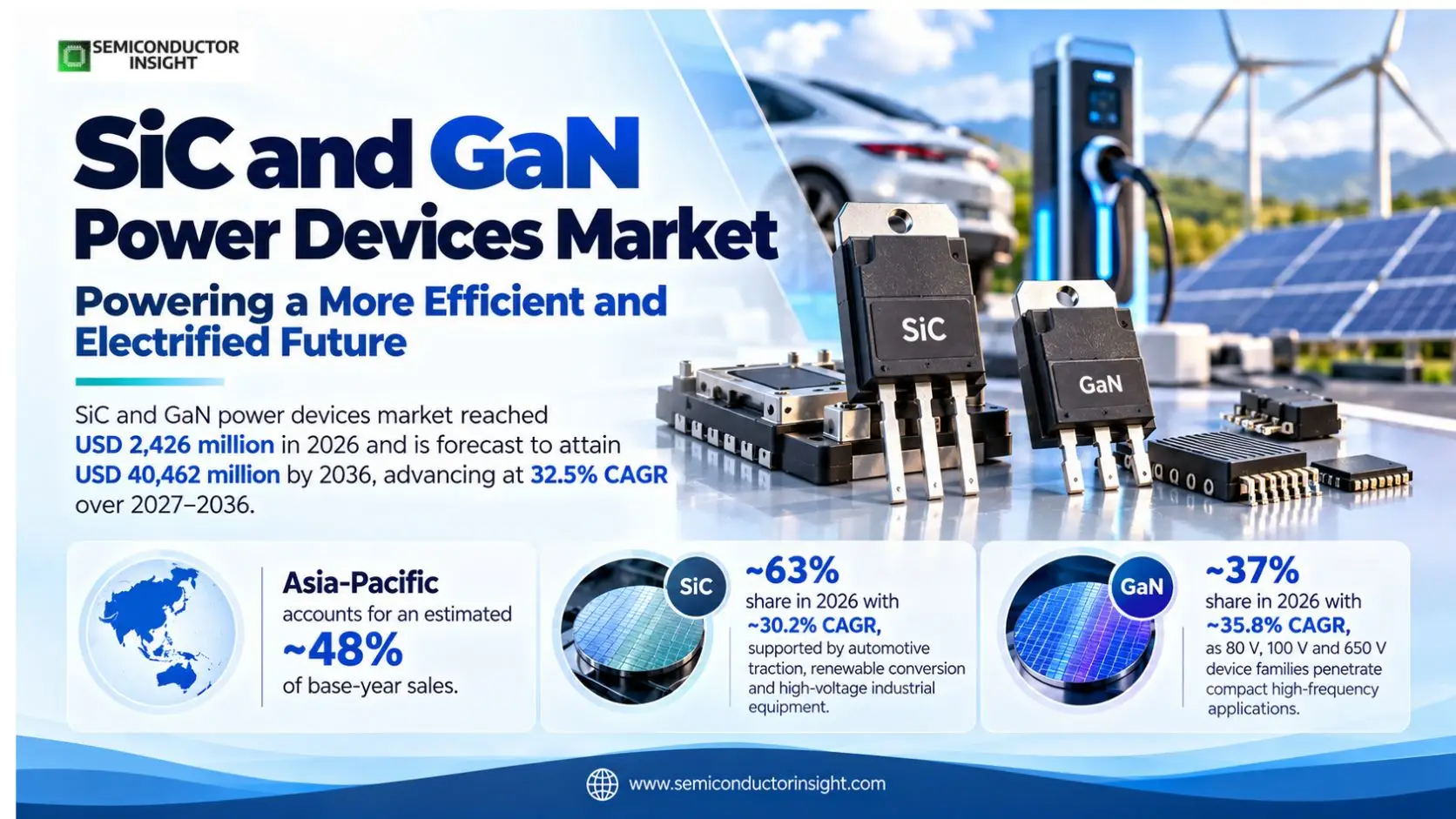
SiC and GaN power devices market reached USD 2,426 million in 2026 and is forecast to attain USD 40,462 million by 2036, advancing at 32.5% CAGR over 2027–2036. Asia-Pacific accounts for an estimated ~48% of base-year sales, reflecting concentrated power-electronics production, automotive electrification and a substantial regional semiconductor manufacturing ecosystem.
Wide-bandgap power devices replace conventional silicon switches when switching loss, thermal headroom or conversion density materially affect system economics. Silicon carbide serves higher-voltage and higher-current designs, including 750 V, 1200 V, 1700 V and 2300 V classes; gallium nitride offers exceptionally fast switching in lower- and medium-voltage circuits, including 80 V automotive DC-DC stages and 650 V consumer or server power supplies. The commercial distinction is the price of a qualified packaged transistor, diode or integrated power IC, rather than the value of the complete vehicle, charger or converter into which it is installed.
For 2026, the estimated technology allocation is ~63% SiC and ~37% GaN. SiC leads revenue because high-power automotive and industrial components carry greater average selling values and often require complex packaging or module qualification. GaN is expanding faster at ~35.8% CAGR as charger makers, power-supply designers and automotive electronics teams migrate from silicon MOSFETs. Automotive and transportation together account for an estimated ~38% of the market, but that share combines traction-related SiC purchases with smaller, rapidly growing GaN opportunities in onboard chargers and auxiliary conversion.
The boundary includes SiC MOSFETs, SiC Schottky devices, GaN HEMTs and integrated GaN power ICs supplied for electrical power conversion, including qualified device modules where their sales are captured within the power-device category. It excludes bare SiC or GaN substrates, separately priced epitaxial services, RF-only amplifiers, finished inverters, complete EV charging stations and downstream vehicles. This separation matters because the same substrate can move through several supply-chain transactions, and counting all of them as finished-device revenue would overstate the semiconductor opportunity.
Product qualification, not just semiconductor performance, determines commercialization. Infineon announced 2300 V CoolSiC modules for high-voltage systems in May 2026; Navitas announced automotive qualification of high-power GaNSafe ICs in April 2025. These examples show the two technology tracks: SiC extends usable bus voltage and power handling, while GaN expands into safety-qualified high-frequency conversion. Buyers compare switching losses, electromagnetic interference, short-circuit behavior, thermal interfaces and multi-year supply commitments before changing established power-stage architectures.
Asia-Pacific leads with an estimated ~48% share because Japan, China, South Korea and Taiwan combine device fabrication, vehicle electronics, industrial drives and consumer adapter production. North America contributes ~26% through semiconductor design, data-center power and automotive programs, while Europe represents ~20% through vehicle electrification and industrial automation. Smaller Middle East and Africa and South America markets are primarily downstream deployment locations rather than equivalent fabrication centers. Regional percentages are modeled market allocations rather than audited manufacturer shipment statistics.
Segment Analysis: By Type
By semiconductor technology, the market separates into SiC and GaN power devices. SiC has the larger modeled 2026 revenue share of ~63% and ~30.2% forecast CAGR, supported by automotive traction, renewable conversion and high-voltage industrial equipment. GaN has ~37% share but grows at ~35.8% CAGR as 80 V, 100 V and 650 V device families penetrate compact high-frequency conversion.
| Type | Technology and use cases | Market position |
|---|---|---|
| SiC | Silicon carbide power MOSFETs, Schottky diodes and qualified modules serve 750 V, 1200 V, 1700 V and emerging 2300 V systems where low conduction loss and thermal endurance are central. Automotive traction inverters, high-voltage charging stages, utility converters and industrial drives use the material to manage higher current and bus voltage without excessively increasing cooling and passive-component requirements. | Largest 2026 type (~63% share, ~30.2% CAGR). SiC benefits from larger power-device values and established automotive qualification routes. Infineon expanded its 2300 V module offering in May 2026, while ST and onsemi continue developing SiC MOSFET and packaging platforms. The commercial challenge is maintaining substrate quality, epitaxial uniformity and packaging yield while reducing cost per converted kilowatt. |
| GaN | Gallium nitride enhancement-mode FETs and integrated power ICs support rapid switching and high power density in 80 V, 100 V, 400 V and 650 V circuits. They are widely evaluated for consumer fast chargers, server supplies, telecom power, automotive 48 V conversion and onboard chargers. Integration of drivers, protection and sensing can reduce board area but increases requirements for layout discipline and system validation. | Fastest-growing type (~37% share, ~35.8% CAGR). GaN adoption is expanding beyond compact adapters toward automotive-qualified power ICs and data-center supplies. Navitas announced AEC-Q100 and AEC-Q101 qualification for its high-power GaNSafe family in April 2025, and EPC markets low-voltage GaN FETs for synchronous DC-DC conversion. Supplier differentiation centers on reliability evidence, gate protection and manufacturable system design. |
Device-class economics and qualification
The semiconductor technology axis should not be confused with the end-product power rating. SiC and GaN both appear in power converters, but SiC normally commands the high-voltage traction and grid-conversion sockets while GaN emphasizes switching speed, integration and compact magnetics. A ~63% SiC revenue allocation does not mean the material accounts for the same percentage of units, because a 1200 V SiC module and a low-voltage GaN transistor have radically different selling values, qualification requirements and thermal packages.
For supplier comparisons, a useful technical distinction is between discrete devices and power ICs or qualified modules. GaN integration can simplify protection and gate-drive design, while SiC packaging may prioritize low inductance, thermal cycling and isolation. Those capabilities influence customer qualification and therefore revenue capture more directly than a nominal wafer-diameter claim. The market remains segmented by SiC and GaN in line with the product categories rather than creating overlapping device-level revenue buckets.
Segment Analysis: By Application
By application, the market comprises Consumer Electronics, Automotive & Transportation, Industrial Use, and Others. Automotive and transportation represent an estimated ~38% of 2026 revenue and ~33.3% CAGR, with industrial use at ~28%, consumer electronics at ~26%, and other systems at ~8%. The segments differ in required operating life, power density and design qualification.
| Application | Demand characteristics |
|---|---|
| Consumer Electronics | Estimated ~26% share, ~33.8% CAGR. Laptop adapters, compact chargers, gaming power supplies and home electronics exploit GaN switching frequency to reduce magnetics and heat. Device selection depends on 65 W, 100 W, 140 W and higher adapter architectures, conducted-emissions testing and component supply continuity. The channel is highly cost sensitive and can shift rapidly between integrated GaN ICs and silicon alternatives. |
| Automotive & Transportation | Largest application (~38% share, ~33.3% CAGR). SiC power devices support 400 V and 800 V traction platforms, onboard charging and high-voltage auxiliary systems; GaN targets compact DC-DC stages and emerging qualified onboard-charger designs. Automakers require AEC qualification, traceable manufacturing, controlled failure modes and years of product availability, making design wins valuable but slow to monetize. |
| Industrial Use | Estimated ~28% share, ~30.1% CAGR. Industrial motor drives, UPS systems, solar inverters, battery storage converters and high-efficiency power distribution adopt SiC and GaN where loss reductions justify engineering cost. 1200 V SiC MOSFETs address high-current industrial stages, while GaN devices suit fast low- and medium-voltage conversion. Customers favor proven thermal cycling, repairability and vendor support. |
| Others | Estimated ~8% share, ~32.1% CAGR. Rail auxiliary converters, aerospace power distribution, laboratory power systems and specialized energy infrastructure contribute smaller but technically demanding orders. A 2300 V SiC device may support high-voltage conversion, while lower-voltage GaN devices appear in compact power electronics. Sales cycles are irregular because each project requires application-specific certification and system-level testing. |
Automotive demand creates the highest device-value opportunities but does not automatically imply the fastest unit growth. Consumer chargers can adopt new 650 V GaN families within relatively short product cycles, whereas automotive traction platforms may require multi-year qualification and reliability evidence. The estimated ~38% automotive share therefore reflects semiconductor content per powertrain and the mix of SiC and GaN, not a claim that automotive vehicles contain the most devices by count. Industrial buyers similarly weigh efficiency gains against maintenance risk and switching-noise mitigation.
Regional Analysis
Asia-Pacific accounts for an estimated ~48% of the 2026 SiC and GaN power devices market, North America ~26%, Europe ~20%, Middle East and Africa ~3%, and South America ~3%. The region ranking reflects a combination of device manufacturing, automotive electronics procurement and downstream conversion demand; Asia-Pacific expands at an estimated ~33.9% CAGR, while smaller developing regions grow from a lower installed base.
Where are SiC and GaN power devices manufactured and adopted most rapidly?
Production geography differs from end-use geography. Japan, China and other Asia-Pacific economies host compound-semiconductor fabrication, power-device packaging and electronics assembly, while US and European manufacturers operate important design, process and automotive qualification programs. The modeled 2026 allocation places ~48% of device revenue in Asia-Pacific, but this is a regional market estimate, not an allocation of every multinational supplier’s legal-entity revenue or a measurement of global wafer-start capacity.
Across regions, SiC demand follows electric-vehicle traction systems, industrial motor controls and renewable-energy conversion, while GaN demand follows compact consumer adapters, telecom power and increasingly automotive auxiliary systems. The technologies therefore respond differently to vehicle production, data-center investment and renewable projects. Forecast CAGRs range from an estimated ~30.2% in Europe to ~34.5% in Middle East and Africa, with faster percentage growth in small markets not necessarily implying larger absolute device purchases.
| Region | Position | Growth outlook | Demand profile | What decides supplier selection |
|---|---|---|---|---|
| Asia-Pacific | Largest (~48%) | ~33.9% CAGR | EV platforms, consumer adapters, electronics assembly | Automotive qualification, local supply, process yield |
| North America | Second (~26%) | ~31.0% CAGR | Data centers, vehicle power, power IC design | Reliability data, vendor continuity, thermal design |
| Europe | Third (~20%) | ~30.2% CAGR | Industrial drives, automotive electrification | AEC qualification, efficiency, long product life |
| Middle East & Africa | Emerging (~3%) | ~34.5% CAGR | Solar conversion, charging infrastructure | Local distribution, project service, heat tolerance |
| South America | Emerging (~3%) | ~33.4% CAGR | Solar inverters, industrial power, EV charging | Landed price, distributor inventory, technical support |
SiC and GaN Power Devices Competitive Landscape
Competition combines integrated power-semiconductor manufacturers, specialized GaN innovators and technology owners acquired by larger groups. Infineon, STMicroelectronics, ROHM, Mitsubishi Electric, Fuji Electric, Toshiba and Microchip participate in SiC, while EPC, VisIC and Navitas provide differentiated GaN or mixed wide-bandgap portfolios. Design wins depend on device reliability, qualification support, cost at volume and the ability to deliver consistent 650 V or 1200 V product generations.
Infineon competes across SiC and GaN, with CoolSiC device and module families spanning automotive, industrial and energy systems. Its October 2023 acquisition of GaN Systems brought that brand into the group rather than leaving it as an independent 2026 supplier. STMicroelectronics emphasizes SiC traction and industrial technology, while ROHM, Mitsubishi Electric, Fuji Electric and Toshiba serve high-reliability power-device markets. Product breadth and long-term customer qualification are advantages, but capital intensity and price pressure still constrain margins.
Specialist suppliers differentiate through architecture rather than manufacturing scale alone. EPC markets enhancement-mode GaN FETs including 80 V, 100 V and 150 V devices for high-frequency conversion; VisIC develops automotive-oriented GaN power technology; Navitas combines GaNFast power ICs with GeneSiC devices. GeneSiC is a Navitas business, while UnitedSiC became part of Qorvo, so legacy brand lists should not be mistaken for separate independent corporations. Buyers evaluate integrated protection, gate behavior and validated reliability against system design costs.
Automotive and data-center customers increasingly compare silicon carbide and gallium nitride at the circuit level rather than selecting materials on principle. A 1200 V SiC MOSFET may offer compelling efficiency in traction stages, while a 650 V GaN IC may reduce size in an onboard charger or server supply. Switching noise, heat removal, availability of qualified packages and multi-source risk determine the final design. Suppliers with reference designs, simulation models and field-failure data can therefore win business without having the lowest catalog device price.
Competitive intensity differs by application and time horizon. Consumer adapters refresh rapidly and expose GaN devices to aggressive annual price negotiations, whereas automotive SiC sockets may remain qualified for several vehicle generations. Industrial equipment values long availability and repairability; data-center power designs prioritize conversion efficiency and compact form factors. A single revenue-share estimate across all uses masks these distinct procurement cycles, making the estimated ~63% SiC and ~37% GaN split more informative when paired with end-market analysis.
Tier structure
| Tier | Companies | Basis of competition |
|---|---|---|
| Integrated suppliers | Infineon, STMicroelectronics, ROHM, Mitsubishi Electric, Fuji Electric, Toshiba | Qualified 650 V, 750 V, 1200 V and higher-voltage device families, automotive engineering support and established industrial channels. |
| Specialist innovators | EPC, VisIC Technologies, Navitas Semiconductor | GaN switching performance, integrated gate protection, 80 V to 650 V architectures and targeted automotive or server applications. |
| Portfolio and legacy brands | Microchip Technology, Qorvo / UnitedSiC, Infineon / GaN Systems, Navitas / GeneSiC | Mixed device portfolios and acquired technology families; historical labels remain useful for product identification but do not imply independent 2026 ownership. |
Key companies profiled
- Infineon Technologies
- ROHM Co., Ltd.
- Mitsubishi Electric
- STMicroelectronics
- Fuji Electric
- Toshiba
- Microchip Technology
- Qorvo (UnitedSiC)
- Navitas Semiconductor (GeneSiC)
- Efficient Power Conversion (EPC)
- VisIC Technologies
- onsemi
SiC and GaN Power Device Manufacturing and Capacity Analysis
Manufacturing capacity is shaped by different process routes: SiC requires crystal substrates, epitaxial growth, device fabrication and high-performance packaging, whereas GaN devices commonly use heteroepitaxial structures and integration with silicon-based manufacturing infrastructure. A 200 mm substrate transition can change SiC cost economics, while GaN capacity expansion depends on wafer processing, defect control and assembly yield. The estimated ~63% SiC revenue share should not be interpreted as a matching fraction of wafer starts.
SiC manufacturing begins with bulk crystal growth and wafer slicing, followed by polishing, epitaxy, device fabrication and packaging. Defect density and usable die area influence yield at 150 mm and 200 mm diameters, while larger wafers can improve economics only when equipment utilization and process control remain strong. Power-device manufacturers therefore invest in substrate sourcing and process qualification alongside transistor design. A new wafer-capacity announcement does not immediately translate into finished device sales, because automotive reliability validation and package qualification may take several product cycles.
GaN production uses different epitaxial stacks and device structures, with high-frequency switching behavior placing strict demands on gate reliability and dynamic on-resistance. Manufacturers seek compatibility with scalable wafer processing while maintaining electrical consistency, thermal management and package robustness. Infineon demonstrated 300 mm GaN wafer technology in September 2024, but that pilot achievement is not equivalent to shipped 300 mm power-device revenue. The commercial objective is lower die cost and stable device characteristics across qualified manufacturing lots.
Final assembly and test are decisive for both materials. SiC modules need low-inductance interconnects, effective thermal paths and resistance to repeated power cycling, while GaN ICs require protection against fast voltage transients and electromagnetic interference. Customers purchase packaged, qualified parts rather than bare theoretical switching performance, so test coverage, traceability and failure-analysis capability can be bottlenecks. The expansion of 750 V, 1200 V and 2300 V offerings increases packaging variety and demands disciplined inventory planning.
Capacity location also influences procurement resilience. Asian fabrication and assembly clusters support high-volume electronics, European suppliers bring industrial and automotive qualifications, and North American firms contribute design and specialty production. A device vendor may fabricate in one region and package in another, complicating geographic attribution. The regional model therefore measures end-market device demand rather than assigning every sale to the location of a substrate furnace or the headquarters of a multinational supplier.
SiC and GaN Power Devices Market Dynamics: Drivers, Restraints and Opportunities
Growth reflects accelerating adoption of wide-bandgap switches in electric vehicles, charging infrastructure, industrial energy conversion, consumer adapters and data-center power systems. SiC captures high-voltage and high-current sockets, while GaN adds compact high-frequency conversion opportunities. The 2027–2036 outlook is constrained by device cost, reliability qualification and supply-chain scaling, so the headline growth rate represents the combined effect of positive and negative contributions rather than uniform adoption in every circuit.
MARKET DRIVERS
Drivers Impact Analysis*
| Market Drivers | Impact Rank | CAGR Contribution (%) | 2027–2029 | 2030–2032 | 2033–2036 |
|---|---|---|---|---|---|
| Electric-vehicle traction and onboard charging adoption | High | +11.00% | High | High | Medium |
| Industrial and renewable-energy conversion efficiency | High | +9.00% | High | High | High |
| GaN consumer adapter and server power migration | Medium-High | +7.00% | High | High | Medium |
| Higher-voltage SiC and integrated GaN device launches | Medium | +5.00% | Medium | High | High |
| Automotive qualification and long-term design wins | Low-Medium | +4.00% | Medium | High | High |
| Others (rail, protection, aerospace and specialized supplies) | Low | +2.50% | Low | Medium | Medium |
Vehicle electrification raises semiconductor value per converter
Automotive traction systems operate at hundreds of volts and high current, making semiconductor losses and cooling requirements economically important. SiC MOSFETs can reduce switching losses in traction inverters and charging stages, while GaN power ICs are being qualified for compact onboard chargers and DC-DC converters. Navitas reported automotive qualification of its high-power GaNSafe ICs in April 2025. Adoption depends on platform engineering and reliability validation, so revenue ramps follow vehicle program schedules rather than an immediate change in catalog availability.
Renewable power and industrial drives reward efficiency
Solar, wind and storage converters run for long periods, so even modest efficiency gains can affect thermal design and lifetime energy losses. Infineon introduced 2300 V CoolSiC modules in May 2026 for high-voltage renewable systems, illustrating how wide-bandgap devices extend beyond passenger vehicles. Industrial drives and UPS systems provide additional sockets at 650 V, 1200 V and 1700 V. Manufacturers must still demonstrate power cycling, electromagnetic compatibility and acceptable cost per converted kilowatt to secure large orders.
Compact adapters and AI power systems accelerate GaN adoption
High-frequency GaN switching allows designers to shrink magnetics and improve power density in 65 W, 100 W, 140 W and higher-output adapters. Data-center power supplies present a second opportunity because small efficiency differences become important across large equipment fleets. EPC offers low-voltage enhancement-mode GaN transistors, and Navitas markets integrated GaN power ICs. These products compete with mature silicon solutions, so design teams must balance device price against reduced cooling, board area and power loss.
Product-generation upgrades widen addressable voltage classes
SiC technology now spans commonly used 750 V and 1200 V classes and specialized 2300 V modules, while GaN families serve 80 V, 100 V, 400 V and 650 V conversion. Infineon announced 750 V CoolSiC G2 products in April 2025 and expanded JFET options in June 2026. These milestones broaden engineering choice, but each device family requires suitable gate drivers, thermal interfaces and system qualification. Revenue growth depends on completed design wins, not on the number of newly announced voltage ratings.
Reliability evidence reduces the adoption barrier
Customers require proof of switching stability, thermal endurance and fault behavior before replacing established silicon transistors. Automotive qualification such as AEC-Q100 and AEC-Q101 creates a pathway for GaN power ICs, while SiC suppliers emphasize power cycling and module packaging. Product qualification can require months or years and therefore spreads the impact of new technology across several forecast windows. Vendors that provide simulation models, failure analysis and production traceability can convert technical interest into repeat semiconductor orders.
MARKET RESTRAINTS
Restraints Impact Analysis*
| Market Restraints | Impact Rank | CAGR Contribution (%) | 2027–2029 | 2030–2032 | 2033–2036 |
|---|---|---|---|---|---|
| SiC substrates and advanced package costs | High | -2.40% | High | Medium | Medium |
| Automotive reliability and long design cycles | Medium-High | -1.80% | High | High | Medium |
| Gate-drive and electromagnetic integration complexity | Medium | -1.20% | Medium | Medium | Low |
| Others (silicon competition and qualification delays) | Low | -0.60% | Medium | Low | Low |
Substrate quality and packaging increase device cost
SiC crystal growth, polishing and epitaxial processing can be expensive, while high-power modules need advanced interconnects and thermal materials. GaN devices also require controlled epitaxy and reliable packaging, even when fabricated using scalable wafer processes. The price premium over silicon remains difficult to justify in low-utilization equipment. Suppliers must improve usable die yield, test throughput and package manufacturing before the cost advantage of higher efficiency can reach a broader customer base.
Automotive qualification slows commercialization
A new power device cannot enter an established vehicle platform solely because it offers lower conduction loss. Customers require detailed thermal cycling, short-circuit, electromagnetic compatibility and traceability evidence, often under AEC or OEM-specific standards. GaN devices face additional scrutiny because high switching speed changes system behavior, while SiC modules must survive high-current transients. This qualification cycle delays revenue and concentrates near-term opportunities among suppliers with proven production histories and engineering support.
Circuit integration can erase device-level efficiency gains
Faster switching increases sensitivity to parasitic inductance, layout, gate-drive behavior and electromagnetic interference. A poorly engineered GaN or SiC converter can lose its theoretical advantage through extra filtering, thermal derating or reliability margins. Designers therefore evaluate the entire power stage, including 80 V and 650 V GaN choices or 1200 V SiC alternatives, rather than selecting by a single datasheet parameter. Limited local engineering support can further slow adoption in emerging markets.
MARKET OPPORTUNITIES
Automotive auxiliary systems expand the GaN opportunity
GaN is moving beyond consumer adapters into automotive onboard charging, 48 V systems and high-voltage-to-low-voltage conversion. Navitas reported AEC-qualified GaNSafe devices in April 2025, signaling a credible qualification pathway. Suppliers that combine integrated protection with proven electromagnetic performance may win compact automotive power stages, particularly where lower passive-component volume matters. Commercial timing remains linked to vehicle platform approvals, which can take longer than consumer charger refresh cycles.
Grid and renewable systems create high-voltage SiC sockets
Infineon’s May 2026 2300 V CoolSiC modules target high-voltage photovoltaic, wind and battery-storage converters, illustrating opportunities beyond traditional 1200 V designs. Grid equipment buyers evaluate thermal losses, insulation requirements and operating lifetime across long deployment periods. Suppliers able to provide robust modules and application engineering can capture higher-value conversion stages. The addressable opportunity should be measured as semiconductor content rather than the capital cost of the complete renewable-energy project.
Data-center power rewards power density and protection
AI computing infrastructure increases attention to power-distribution losses and compact high-current supplies. GaN can support high-frequency conversion, while SiC JFETs and MOSFETs can enable fast protection and higher-voltage stages. Infineon expanded normally-off CoolSiC JFET options in June 2026 for data-center and industrial uses. Suppliers that provide integrated sensing, thermal packaging and system reference designs can shorten qualification time, though equipment makers still require independent efficiency and reliability testing.
Industrial retrofits can improve lifecycle economics
Motor drives, UPS systems and specialized industrial converters often operate for enough hours that reduced semiconductor losses have measurable value. SiC devices can reduce switching and conduction losses at 650 V to 1700 V, while GaN suits selected compact auxiliary stages. Suppliers should focus on applications with documented duty cycles and high electricity utilization rather than promising universal replacement. Retrofit decisions depend on mechanical fit, maintenance intervals, control compatibility and the availability of qualified replacement devices.
SiC and GaN Power Device Supply Chain Analysis
The value chain begins with compound-semiconductor materials and epitaxy, moves through power-device fabrication and assembly, and ends with qualification by converter, vehicle and industrial equipment manufacturers. Silicon carbide and gallium nitride have distinct upstream processes but share the need for reliable packaging, traceable testing and application engineering. Supplier economics are shaped by usable die yield, module reliability and the time required to qualify each voltage class.
Upstream. SiC substrate crystal quality, wafer thickness and epitaxial uniformity influence defect density and usable die yield, while GaN requires stable heterostructure growth and controlled dynamic resistance. Manufacturing improvements can reduce cost, but a bare wafer is an intermediate input rather than the finished device sold to a power-system customer. Semiconductor vendors manage material qualification and supplier concentration carefully because a change in upstream process can require extensive revalidation of 650 V or 1200 V products.
Device fabrication. Power MOSFETs, Schottky diodes and GaN HEMTs require different transistor structures, passivation and high-voltage testing. Fab capacity only creates saleable output when yields and electrical distributions meet device specifications across full production lots. Integrated GaN power ICs add drive and protection circuitry, while SiC manufacturers may optimize die structures for low switching loss and fault robustness. Wafer-level probing, burn-in and statistical process control determine whether production capacity converts into qualified customer deliveries.
Packaging and channels. A high-performance bare die can fail commercially if the package has excessive inductance, poor thermal extraction or inadequate power-cycle life. Discrete devices and modules are therefore tested under operating conditions that resemble customer systems. Distribution channels serve industrial and consumer designers, while automotive buyers frequently purchase through approved Tier 1 relationships. Technical documentation, simulation support and predictable product longevity help suppliers secure repeat orders even when another manufacturer offers a lower nominal device price.
Downstream. The final buyers include automotive inverter makers, charger suppliers, industrial drive manufacturers, renewable-energy converter builders and data-center power-system designers. Their purchase decisions depend on system efficiency, reliability and total conversion cost, not just semiconductor switching speed. An 800 V vehicle platform may favor 1200 V SiC, while a compact adapter may prefer 650 V GaN. The value chain therefore produces differentiated demand signals rather than one uniform substitution cycle across all applications.
Recent Developments in SiC and GaN Power Devices
- 2 June 2026 Launched
Infineon expanded its CoolSiC JFET product family with normally-off variants and additional packaging for solid-state circuit breakers and AI data-center power distribution. The company described 750 V and 1200 V devices entering mass production, broadening the range of high-speed protection components available to system designers. The development matters because it moves SiC beyond conventional inverter switching into fault-management functions, where switching speed, coordination and system reliability can justify specialized device value. Source - 11 May 2026 Launched
Infineon introduced 2300 V CoolSiC MOSFET XHP2 modules intended for high-voltage renewable-energy conversion, including wind, photovoltaic and battery storage. The company stated that the devices support DC-link voltages up to 1500 V, providing a higher-voltage option than many established 1200 V stages. This expansion matters for high-power converter design because semiconductor voltage margin, switching losses and thermal packaging influence system density, although the announcement does not provide global device shipments. Source - 4 December 2025 Launched
Onsemi announced top-cooling packaging technology for high-density power applications, focusing on heat removal from demanding switching stages. Thermal extraction can determine how effectively a power device’s electrical characteristics translate into converter-level efficiency and reliability. The announcement is relevant to SiC and other advanced power devices because package parasitics and thermal interfaces are increasingly part of the customer qualification decision, but it does not establish a separate regional market share. Source - 30 September 2025 Launched
Infineon expanded its 400 V and 440 V CoolSiC MOSFET product options for high-power computing and related conversion applications. Lower-voltage SiC families add choices where high switching efficiency, package compatibility and thermal management are important, broadening a technology often associated with 1200 V automotive stages. System manufacturers still compare the full power-stage economics against GaN and advanced silicon, so this product launch indicates technical scope rather than guaranteed replacement of incumbent devices. Source - 15 April 2025 Qualified
Navitas announced AEC-Q100 and AEC-Q101 qualification for its high-power GaNSafe integrated circuits, targeting automotive onboard chargers and high-to-low-voltage DC-DC conversion. The company emphasized integrated control, sensing and protection features as well as production reliability experience. The qualification matters because automotive customers require more than switching performance before adopting GaN; they need evidence on fault behavior, device consistency and long-term availability, with commercial volumes following vehicle platform approvals. Source - 29 April 2025 Launched
Infineon introduced 750 V CoolSiC G2 MOSFETs for automotive and industrial applications, extending the device choices available for conversion systems between lower-voltage GaN circuits and higher-voltage SiC power stages. This development supports optimization of switching and conduction losses for specific DC-link conditions. Customers still need to qualify gate drives, package thermal performance and electromagnetic compatibility, so the technology update should be read as a design option rather than an immediate shift in the market’s application mix. Source - 24 September 2024 Introduced
STMicroelectronics announced its fourth-generation silicon-carbide MOSFET technology for automotive traction power conversion, emphasizing performance improvements in electric-vehicle inverter systems. The generation change illustrates how suppliers continue to reduce switching losses and improve power density as vehicle platforms evolve. Its significance is strongest in qualification pipelines for high-voltage powertrains, where reliability testing, thermal design and production ramp timing govern eventual revenue rather than a product announcement alone. Source
REPORT SCOPE & SEGMENTATION
| Attribute | Details |
|---|---|
| Study Period | 2021–2036 |
| Base Year | 2026 |
| Estimated Year | 2027 |
| Forecast Period | 2027–2036 |
| Historical Period | 2021–2025 |
| Market Size 2026 | USD 2,426 million |
| Market Size 2027 | USD 3,214 million |
| Market Size 2036 | USD 40,462 million |
| Growth Rate | CAGR of 32.5% from 2027–2036 |
| Unit | Revenue (USD million) |
| Segmentation | By Type, By Application and By Region |
| By Type | GaN · SiC |
| By Application | Consumer Electronics · Automotive & Transportation · Industrial Use · Others |
| By Region | Regional revenue shares are estimated for 2026 and represent device sales within the defined market boundary. North AmericaUnited States, Canada, Mexico EuropeGermany, France, United Kingdom, Italy and rest of Europe Asia-PacificChina, Japan, South Korea, Taiwan, India and Southeast Asia South AmericaBrazil, Chile, Argentina and rest of South America Middle East & AfricaSaudi Arabia, UAE, South Africa, North Africa and other markets |
| Key Companies Profiled | Infineon Technologies, ROHM, Mitsubishi Electric, STMicroelectronics, Fuji Electric, Toshiba, Microchip Technology, Qorvo / UnitedSiC, Navitas / GeneSiC, EPC, VisIC Technologies, onsemi |
| Customization Scope | Custom country, voltage-class and application analysis, including SiC-versus-GaN adoption scenarios and company-specific device portfolios, is available with the complete study. |
Frequently Asked Questions
How large is the global SiC and GaN power devices market?
The combined market is estimated at USD 2,426 million in 2026 and is projected to reach USD 40,462 million by 2036, expanding at 32.5% CAGR during 2027–2036. This valuation covers finished SiC and GaN power semiconductor devices rather than complete vehicles or converter systems. Demand is led by automotive power electronics, industrial conversion and high-efficiency power supplies, with technology choice depending on voltage and switching requirements.
Which material has the largest market share?
Silicon carbide has the larger modeled 2026 revenue share at ~63%, compared with ~37% for gallium nitride. SiC benefits from high-value 750 V, 1200 V and higher-voltage automotive and industrial power stages, while GaN is expanding rapidly in 80 V to 650 V compact conversion. GaN has the faster modeled CAGR of ~35.8%, but device unit counts should not be inferred from revenue shares because average selling values differ substantially.
What is the largest application for these power devices?
Automotive and transportation account for an estimated ~38% of 2026 revenue, ahead of industrial use at ~28%, consumer electronics at ~26%, and other uses at ~8%. Vehicle traction systems create substantial SiC demand, while onboard chargers and DC-DC converters are emerging GaN applications. Customer qualification can take multiple years, so the application share describes modeled semiconductor sales rather than the number of vehicles or chargers produced.
Which region leads SiC and GaN power-device demand?
Asia-Pacific leads with an estimated ~48% share in 2026, followed by North America at ~26% and Europe at ~20%. The region combines power-device manufacturing, automotive electronics, industrial equipment and high-volume consumer adapter assembly. Middle East and Africa and South America each represent ~3% in the model, but both can expand rapidly from smaller bases as energy conversion and charging infrastructure develop.
How do SiC and GaN differ in electrical applications?
SiC is generally selected for higher-voltage, higher-current power conversion where low losses and thermal endurance matter, while GaN offers fast switching and compact magnetics in lower- and medium-voltage circuits. Examples include 1200 V SiC traction MOSFETs and 650 V GaN adapter or server supply devices. The technologies overlap in some onboard-charger applications, making package design, cost, reliability and system electromagnetic behavior decisive.
What are the main growth drivers through 2036?
Electric-vehicle powertrains, charging systems, renewable-energy converters, industrial drives and compact computing supplies support the growth outlook. New 2300 V SiC module options extend high-voltage capability, while automotive-qualified GaN ICs expand the potential design base. The combined modeled CAGR is unusually high for 2027–2036, but individual applications can grow at different rates depending on qualification schedules, energy prices and competing silicon technology.
Why are wide-bandgap devices more expensive than silicon?
SiC crystal substrates and epitaxial processing are complex, while GaN devices need specialized epitaxial structures, reliable gate protection and careful packaging. High-voltage SiC modules add thermal-interface and power-cycling requirements, and automotive programs demand extensive qualification. These costs are partly offset by lower conversion losses, smaller passive components and higher power density. The business case is strongest where equipment operates for many hours or space and cooling are constrained.
Which manufacturers compete in SiC and GaN power devices?
Key manufacturers and developers include Infineon, ROHM, STMicroelectronics, Mitsubishi Electric, Fuji Electric, Toshiba, Microchip, EPC, VisIC, Navitas, Qorvo and onsemi. Ownership matters: GaN Systems joined Infineon in 2023, UnitedSiC belongs to Qorvo, and GeneSiC belongs to Navitas. These legacy product labels remain relevant but should not be counted as independent suppliers in current competitive concentration estimates.
Are GaN devices suitable for automotive use?
GaN devices are increasingly being qualified for automotive power conversion, particularly onboard charging and auxiliary DC-DC stages. Navitas announced AEC-Q100 and AEC-Q101 qualification for high-power GaNSafe ICs in April 2025. This demonstrates a route to automotive adoption, but qualification of the device is only one step; automakers also validate converter-level thermal behavior, electromagnetic compatibility, functional safety and production traceability before approving a design.
What revenue is included in this market definition?
The market includes finished SiC MOSFETs, Schottky devices, GaN HEMTs, integrated power ICs and qualified power-device modules within the publisher’s product category. It excludes standalone substrates, separately billed epitaxy, RF-only GaN amplifiers, finished inverters, complete EV charging stations and vehicles. The base year is 2026, the estimate year 2027 and the forecast period 2027–2036, with modeled type, application and regional allocations.
Research Sources & Evidence Base
Get Sample Report PDF for Exclusive Insights
Report Sample Includes
- Table of Contents
- List of Tables & Figures
- Charts, Research Methodology, and more...
 Download Sample Report PDF