Server Chipsets Market Insights
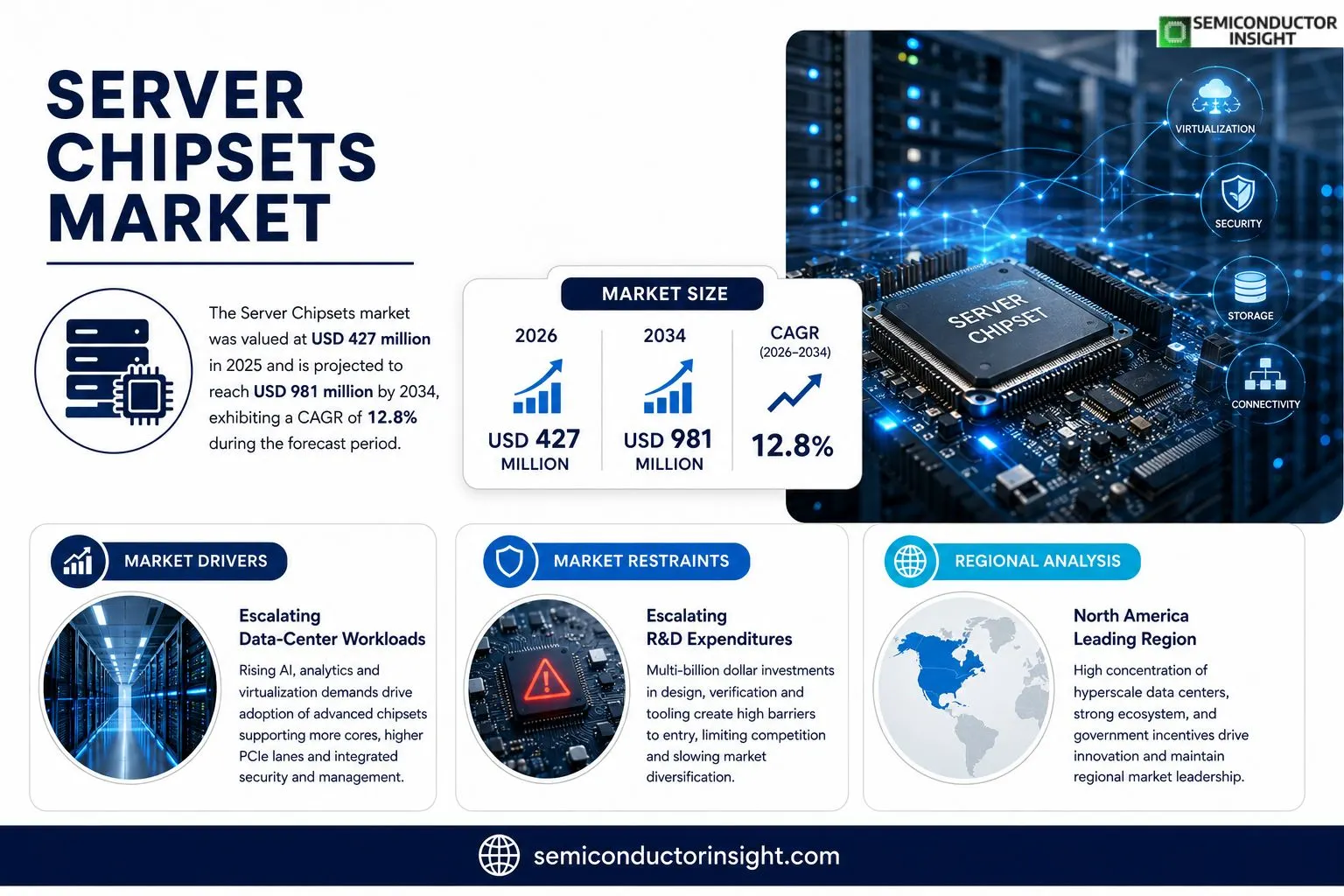
Server Chipsets market was valued at USD 427 million in 2025 and will reach USD 981 million by 2034, reflecting a CAGR of 12.8% over the forecast period.
A server chipset is a control chip paired with a server processor platform, responsible for coordinating connectivity, management, and reliability functions outside the CPU. It integrates storage interfaces, peripheral buses, security modules and platform scheduling into a manufacturable motherboard architecture. Vendors such as Intel (C741), Zhaoxin (ZX100S) and AMD (SR5690) illustrate how chipsets provide PCIe lanes, SATA ports, USB interfaces, IOMMU, ECC memory support and virtualization features tailored to specific ecosystems. Typical deployments span general‑purpose servers, storage servers and industry information systems for government or finance, with OEMs and motherboard makers as primary customers.
MARKET DRIVERS
Escalating Data‑Center Workloads
Enterprises are transitioning from legacy servers to high‑density platforms that demand more cores per socket. This shift forces OEMs to adopt chipsets capable of handling multi‑threaded workloads such as AI inference, real‑time analytics, and large‑scale virtualization. The resulting pressure on chipset designers fuels rapid product cycles and higher integration levels, directly expanding Server Chipsets Market.
Regulatory Incentives for Energy Efficiency
Governments across North America and the EU have tightened power‑usage standards for data‑center equipment. Vendors that embed advanced power‑management IP in their chipsets gain a competitive edge, as operators seek to lower TCO while meeting compliance thresholds. Consequently, manufacturers invest heavily in low‑idle‑power architectures, a clear catalyst for market activity.
➤ “Clients now prioritize silicon that can deliver 30 % more performance per watt compared with the 2019 baseline.”
These dynamics push silicon firms to consolidate networking, storage, and security functions onto a single die, simplifying board layouts and accelerating time‑to‑market. The trend not only raises the overall market size but also reshapes the value chain toward integrated solutions.
MARKET CHALLENGES
Supply‑Chain Volatility
The semiconductor ecosystem continues to feel the aftershocks of recent capacity shortages. Fab utilization rates hover above 90 %, leaving little slack for unexpected order spikes. This environment forces data‑center builders to place larger advance orders, which can strain cash flow and limit flexibility.
Other Challenges
Compatibility Legacy Issues
Older server architectures rely on legacy chipset sockets that lack support for the newest PCIe 5.0 lanes and DDR5 memory. Upgrading these assets often requires a full platform refresh, a cost that many mid‑size operators are reluctant to absorb.
MARKET RESTRAINTS
Escalating R&D Expenditures
Designing next‑generation chipsets demands multi‑billion‑dollar investments in tooling, verification, and talent acquisition. Smaller players struggle to match the spending power of industry giants, leading to a concentration of market share that can deter new entrants and slow diversification.
MARKET OPPORTUNITIES
Edge‑Computing Integration
As edge deployments proliferate to support latency‑sensitive applications, there is a rising need for compact server chipsets that balance performance with low power draw. Companies that can fuse AI accelerators and high‑speed networking onto a single platform stand to capture a growing slice of Server Chipsets Market, especially in telecom and industrial IoT segments.
Server Chipsets Market Trends
Shift Toward Integrated Platform Companion Chipsets
The most visible transformation in Server Chipsets Market is the migration from the classic north‑bridge/south‑bridge split to a tightly coupled companion control block that lives beside a specific processor family. Intel’s C741 illustrates this approach: it delivers 20 PCIe Gen3 lanes, 20 SATA ports, extensive USB connectivity, VT‑d virtualization assistance and TXT security extensions, all while being marketed as a platform‑level enabler rather than a raw performance accelerator. Zhaoxin’s ZX100S mirrors the same philosophy, emphasizing ECC memory, hot‑plug capability and I/O virtualization for storage‑centric deployments. Even legacy AMD offerings such as the SR5690, with HyperTransport, IOMMU and multi‑processor RAS features, reinforce the notion that chipset value is rooted in reliability, manageability and ecosystem compatibility. This evolution signals that vendors are betting on long‑term board‑level stability and feature integration more than on squeezing additional compute cycles from the chipset itself.
Other Trends
Data‑Center Expansion Fuels Chipset Demand
Worldwide construction of hyperscale facilities continues to outpace previous cycles, driven by the surge in AI workloads and the need for high‑throughput storage back‑ends. The United States hosts more than half of the current capacity, while China’s “East Data West Compute” initiative is prompting a wave of retrofits and green‑energy‑focused upgrades. Both regions are issuing policies that reward low‑power, highly manageable platforms, effectively raising the bar for chipset manufacturers. OEMs that can provide low‑latency I/O aggregation, secure boot and remote management within a compact power envelope are seeing stronger order books, especially as legacy data‑center refreshes demand compatible yet more efficient companion chips.
Regional Supply Concentration and Policy Influence
Supply of Server Chipsets remains anchored to a handful of ecosystem owners. Companies embedded in the Intel and AMD processor families dominate the North American and European markets, leveraging mature standards and l OEM relationships. Chinese firms such as Zhaoxin and Loongson are gaining traction by aligning product roadmaps with national security and self‑sufficiency goals, benefitting from subsidies under the CHIPS and Science Act and parallel initiatives in the EU. The policy environment is reshaping competitive dynamics: access to domestic certification, long‑term supply guarantees and compliance with low‑carbon data‑center mandates are becoming decisive factors. For downstream integrators, the strategic implication is clear—selecting chipset partners that can navigate both technical integration and regulatory landscapes will be essential to sustain growth in Server Chipsets Market.
COMPETITIVE LANDSCAPEKey Industry Players
Server Chipsets Market: Competitive Overview
Intel remains the anchor of the server‑chipset ecosystem, leveraging its extensive CPU portfolio to lock in platform compatibility. Its C741 chipset exemplifies the strategy of bundling native security, power‑management, and virtualization features that OEMs regard as essential for high‑availability data‑center deployments. By controlling the reference designs used by the majority of hyperscale builders, Intel can dictate the cadence of feature introductions and maintain a pricing advantage that smaller rivals struggle to match. The company’s deep ties to motherboard vendors also create a barrier to entry for newcomers, as certification costs and long‑term supply commitments favor incumbents with proven track records.Beyond Intel, the competitive field is populated by a mix of legacy silicon veterans and emerging regional champions. AMD’s SR5690 chipset, while rooted in an older northbridge architecture, still offers robust I/O virtualization and RAS capabilities that appeal to niche workloads. Chinese firms such as Zhaoxin, Loongson Technology, and Phytium Technology are rapidly expanding their footprints by aligning chipsets with domestically produced CPUs, a move reinforced by government procurement policies. Meanwhile, diversified fabless players like Samsung Electronics, Marvell Technology Group, Broadcom Inc., and MediaTek are injecting advanced interconnect technologies and power‑efficiency improvements, positioning themselves as attractive alternatives for specialized storage or edge‑server solutions. This mosaic of capabilities creates a landscape where ecosystem alignment, long‑term reliability, and the ability to meet region‑specific regulatory demands dictate market success.
List of Key Server Chipsets Companies Profiled
- Intel Corporation
- Advanced Micro Devices (AMD)
- Zhaoxin Semiconductor Co., Ltd.
- Loongson Technology
- Phytium Technology Co., Ltd.
- Samsung Electronics
- Marvell Technology Group Ltd.
- Broadcom Inc.
- Qualcomm Incorporated
- Renesas Electronics Corporation
- MediaTek Inc.
Segment Analysis:
| Segment Category | Sub-Segments | Key Insights |
| By Type |
|
Discrete Chipset remains the leading type because it delivers clear separation of control logic and flexibility for OEM customization.
|
| By Application |
|
Storage Server is the dominant application segment, driven by the need for high‑reliability I/O and data protection.
|
| By End User |
|
OEMs and Motherboard Vendors lead due to their responsibility for platform compatibility and long‑term support.
|
| By Integration Level |
|
System‑on‑Chip Companion is emerging as the leading integration approach because it embeds management, security and power functions directly alongside the CPU.
|
| By Ecosystem Alignment |
|
Intel Platform Ecosystem remains the dominant driver because of its mature certification processes and extensive OEM adoption.
|
Regional Analysis: Server Chipsets Market
North America
Large‑scale data centers are standardizing on chipset platforms that consolidate compute, storage and networking functions, cutting cabling complexity and boosting energy efficiency. Buyers value the predictability of a single‑vendor road map, which reduces firmware fragmentation and eases lifecycle planning.
Native support for heterogeneous cores, embedded security enclaves and high‑speed interconnects is redefining how server architects allocate silicon real estate, allowing more workloads per rack without sacrificing latency.
Tier‑1 manufacturers are diversifying fab sources and building buffer inventories of critical components, a response to recent semiconductor shortages that preserves order fulfillment for mission‑critical deployments.
Government incentives for domestic silicon production and cybersecurity certifications are nudging customers toward locally sourced chipsets, reinforcing the region’s competitive edge.
Europe
European cloud providers are emphasizing sustainability, prompting a shift toward chipsets that enable power‑aware workload scheduling. Integration of advanced thermal management within the silicon helps meet stringent energy‑use targets set by EU directives. Meanwhile, the region’s strong standards bodies are influencing chipset security roadmaps, ensuring that encryption and attestation features are baked in from silicon level. OEMs that can navigate the fragmented regulatory environment while delivering low‑latency interconnects are gaining preference among enterprises that balance data sovereignty with cost efficiency.
Asia‑Pacific
The Asia‑Pacific market is characterized by rapid scale‑out in emerging economies, where hyperscale operators are experimenting with modular server designs that rely on versatile chipsets. Local manufacturers are leveraging cost‑effective fabrication partnerships to produce variants optimized for regional workloads such as video transcoding and edge AI. A growing pool of engineering talent in countries like India and Vietnam accelerates customization cycles, allowing OEMs to quickly adapt chipset features to meet diverse client specifications across the sub‑region.
South America
In South America, limited data‑center density has encouraged hybrid deployments that mix on‑premise edge nodes with public‑cloud back‑ends. Chipsets offering integrated networking and security accelerators are appealing because they simplify node management in environments with constrained IT staff. Companies are also watching the region’s evolving trade policies, which could affect component import tariffs and thereby influence sourcing decisions for new server platforms.
Middle East & Africa
The Middle East & Africa is witnessing increased investment in sovereign cloud infrastructures, driven by national digital transformation agendas. Chipset vendors that provide robust cryptographic modules and compliance with regional data‑protection standards are securing early contracts. Additionally, the harsh climatic conditions in parts of the region demand silicon that can maintain performance under elevated temperatures, prompting OEMs to prioritize thermal‑tolerant designs for this market.
Report Scope
This market research report provides a comprehensive analysis of the Server Chipsets Market , covering the forecast period 2026–2034. It offers detailed insights into market dynamics, technological advancements, competitive landscape, and key trends shaping the industry.
Key focus areas of the report include:
- Market Overview: The report begins with an overview outlining its current market scenario, key growth indicators, and industry transformation drivers. It discusses macroeconomic factors, demand–supply balance, regulatory landscape, and the strategic role of semiconductors in powering advancements across industries such as automotive, telecommunications, consumer electronics, and industrial automation.
- Market Size & Forecast: Historical data and future projections for revenue, unit shipments, and market value across major regions and segments.
- Segmentation Analysis: Detailed breakdown by product type, technology, application, and end-user industry to identify high-growth segments and investment opportunities.
- Regional Insights: Insights into market performance across North America, Europe, Asia-Pacific, Latin America, and the Middle East & Africa, including country-level analysis where relevant.
- Competitive Landscape: Profiles of leading market participants, including their product offerings, R&D focus, manufacturing capacity, pricing strategies, and recent developments such as mergers, acquisitions, and partnerships.
- Technology Trends & Innovation: Assessment of emerging technologies, integration of AI/IoT, semiconductor design trends, fabrication techniques, and evolving industry standards.
- Market Drivers & Restraints: Evaluation of factors driving market growth along with challenges, supply chain constraints, regulatory issues, and market-entry barriers.
- Stakeholder Insights: Insights for component suppliers, OEMs, system integrators, investors, and policymakers regarding the evolving ecosystem and strategic opportunities.
Primary and secondary research methods are employed, including interviews with industry experts, data from verified sources, and real-time market intelligence to ensure the accuracy and reliability of the insights presented.
FREQUENTLY ASKED QUESTIONS:
What is the current market size of Server Chipsets Market?
-> Server Chipsets Market was valued at USD 427 million in 2025 and is expected to reach USD 981 million by 2034, at a CAGR of 12.8%.
Which key companies operate in Server Chipsets Market?
-> Key players include Intel, AMD, Loongson Technology, Zhaoxin, and Phytium Technology, among others.
What are the key growth drivers?
-> Key growth drivers include rapid data‑center expansion, AI‑driven compute demand, supportive government policies for semiconductor localization, and the need for low‑power, highly manageable platform companion chips.
Which region dominates the market?
-> North America leads the market in revenue, driven by a high concentration of hyperscale data centers and strong ecosystem support from U.S. vendors, while Asia‑Pacific exhibits the fastest growth rate.
What are the emerging trends?
-> Emerging trends include tight integration of companion control logic with CPU platforms, expanded virtualization capabilities, energy‑efficient chipset designs, and growing adoption of server chipsets in edge‑computing and AI‑focused infrastructures.
Get Sample Report PDF for Exclusive Insights
Report Sample Includes
- Table of Contents
- List of Tables & Figures
- Charts, Research Methodology, and more...