MARKET INSIGHTS
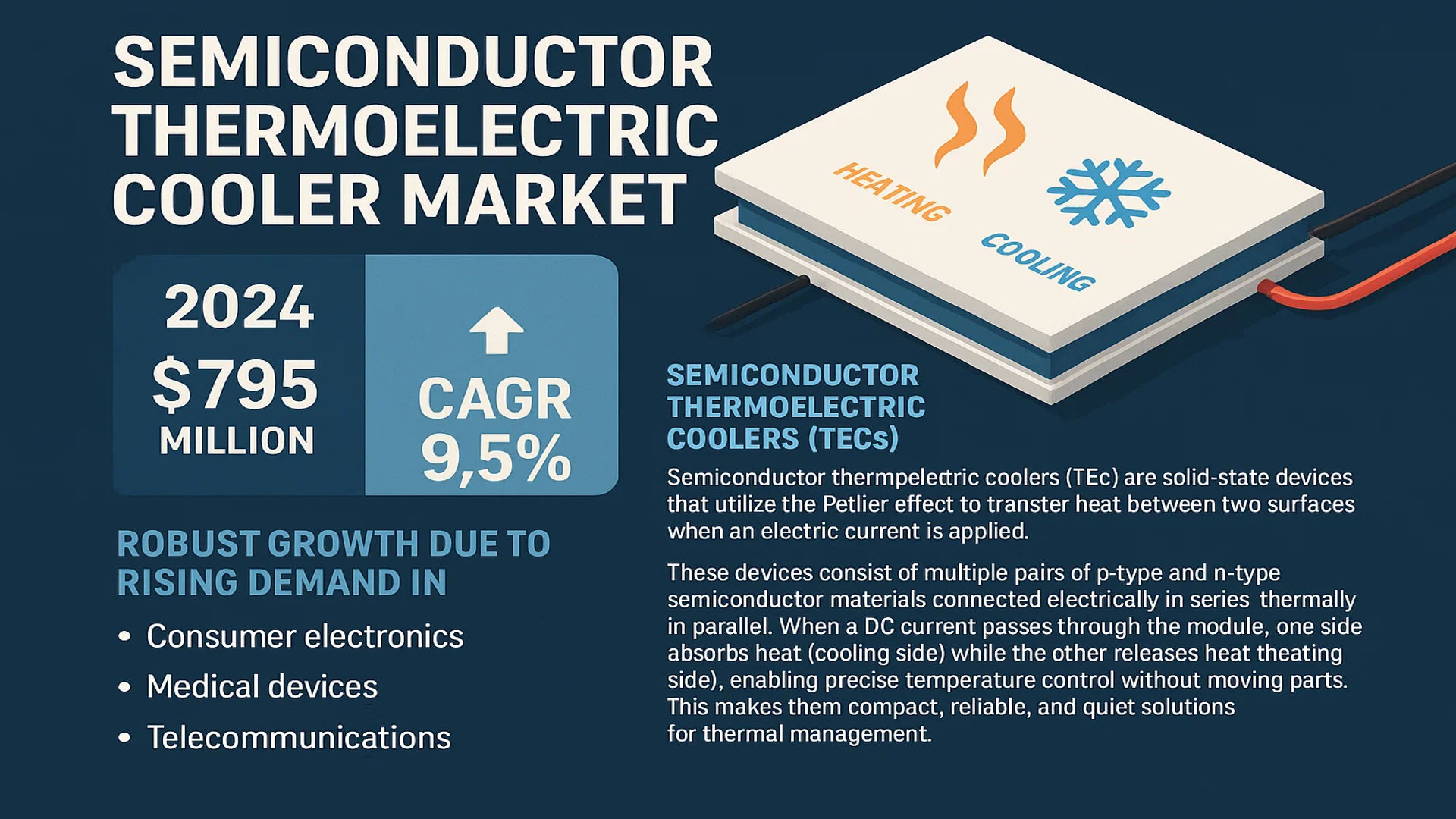
The global Semiconductor Thermoelectric Cooler Market was valued at 795 million in 2024 and is projected to reach US$ 1475 million by 2032, at a CAGR of 9.5% during the forecast period.
Semiconductor thermoelectric coolers (TECs) are solid-state devices that utilize the Peltier effect to transfer heat between two surfaces when an electric current is applied. These devices consist of multiple pairs of p-type and n-type semiconductor materials connected electrically in series and thermally in parallel. When a DC current passes through the module, one side absorbs heat (cooling side) while the other releases heat (heating side), enabling precise temperature control without moving parts. This makes them compact, reliable, and quiet solutions for thermal management.
The market is experiencing robust growth due to rising demand in consumer electronics, medical devices, and telecommunications. The increasing adoption of 5G technology and electric vehicles further drives demand for efficient thermal management solutions. Additionally, advancements in semiconductor materials and manufacturing techniques are enhancing the performance and efficiency of TECs, expanding their application scope. Key players such as Ferrotec, Laird Thermal Systems, and Coherent Corp are investing in R&D to strengthen their market position. For instance, in 2023, Ferrotec expanded its production capacity to meet growing demand from the automotive sector, particularly for electric vehicle battery cooling systems.
MARKET DYNAMICS
MARKET DRIVERS
Increasing Demand for Energy-Efficient Cooling Solutions Drives Market
The global push toward energy efficiency and sustainability is significantly boosting demand for semiconductor thermoelectric coolers (TECs). Unlike conventional cooling systems, TECs offer precise temperature control without refrigerants or moving parts, aligning with stringent environmental regulations. With the electronics industry accounting for nearly 30% of global energy consumption, manufacturers increasingly adopt TECs for applications requiring localized cooling. Their solid-state nature and compact design make them ideal for modern compact electronic devices, where traditional cooling methods are impractical.
Rapid Growth in Electric Vehicles Accelerates TEC Adoption
The electric vehicle (EV) revolution is creating substantial opportunities for TEC manufacturers. Battery thermal management systems in EVs increasingly incorporate thermoelectric coolers to maintain optimal operating temperatures, extending battery life and performance. As EV production is projected to exceed 50 million units annually by 2030, the demand for reliable thermal management solutions continues to grow. TECs provide precise temperature control critical for sensitive EV components, making them indispensable in this rapidly expanding market sector.
MARKET RESTRAINTS
High Production Costs Limit Widespread Adoption
Despite their advantages, semiconductor thermoelectric coolers face challenges in cost competitiveness. The manufacturing process requires expensive semiconductor materials like bismuth telluride and specialized fabrication techniques. Current production costs are approximately 30-40% higher than conventional cooling systems, creating barriers for price-sensitive applications. While technological advancements aim to reduce costs, this remains a significant restraint for market expansion in consumer applications where cost considerations dominate purchasing decisions.
Efficiency Limitations in High-Capacity Applications
TECs demonstrate excellent performance in small-scale cooling applications but face efficiency challenges when scaling up for larger thermal loads. Their coefficient of performance (COP) typically ranges between 0.3-0.7, significantly lower than vapor compression systems. This limitation restricts their use in applications requiring substantial cooling capacity, forcing manufacturers to explore hybrid solutions that combine TECs with traditional cooling methods.
MARKET OPPORTUNITIES
Medical Technology Advancements Create New Application Frontiers
The medical device sector presents significant growth opportunities for TEC technology. Portable medical equipment, laboratory instruments, and precision diagnostic devices increasingly require the exact temperature control that TECs provide. With the global medical equipment market expected to reach $800 billion by 2030, manufacturers are developing specialized TEC solutions for applications ranging from PCR machines to portable insulin coolers, creating new revenue streams in this high-value sector.
5G Infrastructure Expansion Drives Cooling Demand
The global rollout of 5G networks necessitates advanced thermal management solutions for base stations and transmission equipment. TECs are increasingly deployed to cool sensitive components in 5G infrastructure, particularly in small cell deployments where traditional cooling is impractical. With over 7 million 5G base stations projected by 2025, this application represents a high-growth segment for TEC manufacturers developing ruggedized solutions for telecommunications applications.
MARKET CHALLENGES
Material Supply Chain Vulnerabilities Impact Production
The TEC industry faces supply chain challenges for critical raw materials, particularly rare-earth elements and specialized semiconductor compounds. Market volatility for materials like bismuth and tellurium, with prices fluctuating up to 25% annually, creates production planning difficulties. Geopolitical factors further complicate supply chains, as over 60% of critical materials originate from limited geographic regions, exposing manufacturers to potential disruptions.
Technical Limitations in Extreme Temperature Environments
While TECs perform well in moderate conditions, they face operational challenges in extreme environments. Performance degradation occurs at temperatures exceeding 150°C, limiting applications in harsh industrial or aerospace settings. Research into new material combinations aims to address these limitations, but current technological constraints remain a barrier for certain high-temperature applications.
SEMICONDUCTOR THERMOELECTRIC COOLER MARKET TRENDS
Rising Demand for Miniaturized Cooling Solutions in Electronics
The semiconductor thermoelectric cooler (TEC) market is experiencing robust growth, driven by the increasing need for compact and efficient thermal management solutions in modern electronics. As devices become smaller yet more powerful, conventional cooling methods struggle to keep pace with heat dissipation requirements. TECs offer a solid-state alternative that eliminates moving parts while providing precise temperature control—critical for sensitive components in 5G infrastructure, AI processors, and high-performance computing. The global market, valued at $795 million in 2024, reflects this demand surge, with consumer electronics accounting for 25% of total shipments. Notably, manufacturers are now developing ultra-thin TEC modules under 1mm thickness for wearable devices and medical implants, pushing the boundaries of thermal engineering.
Other Trends
Automotive Electrification Spurs Innovation
The transition to electric vehicles (EVs) is creating new opportunities for TEC applications in battery thermal management and onboard electronics cooling. With EV sales projected to grow at 20% CAGR through 2030, automakers are adopting multi-stage TECs to maintain optimal battery temperatures—extending range and lifespan. Furthermore, advanced driver-assistance systems (ADAS) and LiDAR sensors require stable operating temperatures for reliability, prompting TEC integration in over 60% of premium EV models. This automotive shift complements the broader trend of electrification across industries, from industrial sensors to renewable energy storage systems.
Healthcare Applications Drive Precision Cooling Demand
Medical diagnostics and therapeutic equipment are increasingly leveraging TEC technology for their noise-free operation and precise temperature control. PCR machines, DNA sequencers, and portable MRI systems now incorporate custom TEC solutions to maintain sub-millikelvin temperature stability—a requirement for accurate test results. The medical TEC segment is growing at 11% annually, outpacing industrial applications. Recent breakthroughs include implantable TECs for targeted cryotherapy in cancer treatment and wearable cooling patches for neuropathy patients. These advancements align with the healthcare sector’s broader digital transformation, where reliable thermal management ensures both patient comfort and diagnostic precision.
COMPETITIVE LANDSCAPE
Key Industry Players
Innovation and Strategic Expansion Drive Market Leadership in Semiconductor Thermoelectric Cooler Space
The global Semiconductor Thermoelectric Cooler market exhibits a competitive but fragmented landscape with strong regional players and multinational corporations vying for market share. Ferrotec Corporation maintains dominant market leadership, capturing over 20% of global revenue in 2024, owing to its vertically integrated manufacturing and extensive patent portfolio spanning cooling module designs and advanced thermoelectric materials.
Japanese manufacturer KELK Ltd. (a Komatsu subsidiary) and US-based Laird Thermal Systems follow closely, holding approximately 15% and 12% of the market respectively. These firms differentiate through application-specific module designs, particularly for telecommunications and automotive markets where reliability under vibration is critical. KELK’s strength in industrial cooling applications complements Laird’s medical and aerospace expertise, demonstrating the industry’s segmentation by vertical applications.
Meanwhile, Coherent Corp (following its acquisition of II-VI) and KYOCERA are aggressively expanding their thermoelectric solutions portfolio through strategic R&D investments. Coherent recently unveiled a new line of high-efficiency automotive TECs with 18% improved coefficient of performance (COP), while KYOCERA’s ceramic substrate technology enables thinner, more durable modules for consumer electronics.
Chinese manufacturers like Guangdong Fuxin Technology and Zhejiang Wangu Semiconductor are gaining traction in cost-sensitive segments, leveraging domestic rare-earth material supplies to undercut competitors on price. However, they face challenges in penetrating premium markets due to perceived quality gaps and IP restrictions. Industry consolidation is accelerating as larger firms acquire specialist manufacturers – Laird’s 2023 purchase of Kryotherm expanded its European footprint significantly, demonstrating the strategic value of regional capabilities.
Moving forward, competition will intensify around thermal management for AI server racks and EV battery systems, with Phononic and TE Technology emerging as innovators in these high-growth niches. The market’s technical complexity creates barriers to entry, but rewards companies that can balance material science advancements with scalable production capabilities across both single-stage and multi-stage thermoelectric assemblies.
List of Key Semiconductor Thermoelectric Cooler Companies Profiled
- Ferrotec Corporation (Japan)
- KELK Ltd. (Komatsu Group) (Japan)
- Laird Thermal Systems (U.S.)
- Coherent Corp (U.S.)
- KYOCERA Corporation (Japan)
- Phononic (U.S.)
- TE Technology, Inc. (U.S.)
- Guangdong Fuxin Technology (China)
- Thermonamic Electronics (China)
- Z-MAX Co., Ltd. (Japan)
- Kryotherm Industries (Russia)
- Wakefield Thermal (U.S.)
- Zhejiang Wangu Semiconductor (China)
- Merit Technology Group (China)
Segment Analysis:
By Type
Single Stage Segment Dominates Due to Cost-Effectiveness and Compact Design in Consumer Electronics
The market is segmented based on type into:
- Single Stage
- Multistage
By Application
Consumer Electronics Segment Leads Owing to High Adoption in Smartphones and Wearables
The market is segmented based on application into:
- Consumer Electronics
- Communication
- Medical
- Automotive
- Industrial
- Aerospace & Defense
- Others
By Cooling Capacity
Low Capacity Segment Dominates for Small-Scale Thermal Management in Portable Devices
The market is segmented based on cooling capacity into:
- Low Capacity (<100W)
- Medium Capacity (100-500W)
- High Capacity (>500W)
By Material Type
Bismuth Telluride (Bi2Te3) Leads the Market Due to Superior Thermoelectric Properties
The market is segmented based on material type into:
- Bismuth Telluride (Bi2Te3)
- Lead Telluride (PbTe)
- Silicon-Germanium (SiGe)
- Others
Regional Analysis: Semiconductor Thermoelectric Cooler Market
Asia-Pacific
The Asia-Pacific region dominates the global semiconductor thermoelectric cooler (TEC) market, accounting for more than 50% of total revenue in 2024. China leads regional demand due to its massive electronics manufacturing sector and rapid adoption of 5G infrastructure. Japan and South Korea contribute significantly through advanced applications in automotive thermal management and precision medical equipment. The region benefits from strong government support for semiconductor self-sufficiency and electric vehicle adoption, with China’s NEV sales exceeding 8 million units in 2023. While cost sensitivity remains a factor, technology transfer agreements between local firms and global leaders like Ferrotec are narrowing the innovation gap.
North America
North America maintains technology leadership in high-performance TECs, particularly for defense and medical applications. The U.S. accounts for 80% of regional demand, driven by Department of Defense contracts for ruggedized cooling systems and growing adoption in laser diode temperature stabilization. Silicon Valley’s AI hardware boom is creating new opportunities for chip-level thermal management solutions. However, reliance on Asian suppliers for raw materials presents supply chain vulnerabilities. Recent CHIPS Act funding includes provisions for domestic thermoelectric material production, potentially reshaping the competitive landscape by 2026.
Europe
Europe’s market prioritizes energy-efficient TEC solutions aligned with EU Ecodesign regulations. Germany and France lead in industrial automation applications, where thermoelectric modules maintain critical instrument temperatures with minimal power consumption. The automotive sector shows promising growth, particularly for seat climate control systems in premium vehicles. Stricter RoHS compliance requirements have accelerated the phase-out of lead-containing TE materials, creating opportunities for companies like Laird Thermal Systems that specialize in compliant designs. Collaborative R&D initiatives under Horizon Europe are funding next-generation thermoelectric materials with improved ZT values.
South America
The South American TEC market remains nascent but shows potential in medical refrigeration and telecom applications. Brazil represents 60% of regional demand, primarily for consumer electronics cooling. Economic constraints limit adoption of high-end applications, though increasing mobile network upgrades are driving demand for base station cooling modules. Local manufacturing is virtually nonexistent, with 95% of supply imported from China and the U.S. Recent trade agreements may improve access to cost-effective solutions, but currency volatility continues to challenge market stability.
Middle East & Africa
This emerging market concentrates TEC adoption in telecommunications infrastructure and medical cold chain applications. GCC countries lead in deployment for 5G network cooling, while South Africa shows growth in laboratory equipment applications. The lack of local component manufacturing results in complete import dependency, with lead times often exceeding 12 weeks. Emerging opportunities exist in solar-powered TEC systems for off-grid refrigeration, though high upfront costs hinder widespread adoption. Strategic partnerships between Chinese suppliers and African telecom operators are gradually improving market access.
Report Scope
This market research report provides a comprehensive analysis of the global Semiconductor Thermoelectric Cooler market, covering the forecast period 2025–2032. It offers detailed insights into market dynamics, technological advancements, competitive landscape, and key trends shaping the industry.
Key focus areas of the report include:
- Market Size & Forecast: Historical data and future projections for revenue, unit shipments, and market value across major regions and segments. The global market was valued at USD 795 million in 2024 and is projected to reach USD 1,475 million by 2032 at a CAGR of 9.5%.
- Segmentation Analysis: Detailed breakdown by product type (single-stage, multistage), application (consumer electronics, automotive, medical, etc.), and end-user industry to identify high-growth segments.
- Regional Outlook: Insights into market performance across North America, Europe, Asia-Pacific (which held over 50% share in 2024), Latin America, and Middle East & Africa, with country-level analysis.
- Competitive Landscape: Profiles of 25+ leading participants including Ferrotec (20% market share), Laird Thermal Systems, and KYOCERA, covering product portfolios, R&D focus, and M&A activities.
- Technology Trends: Assessment of emerging innovations in thermoelectric materials, integration with 5G/IoT systems, and efficiency improvements in Peltier devices.
- Market Drivers & Restraints: Evaluation of factors like 5G expansion and EV adoption versus challenges such as low energy efficiency and high material costs.
- Stakeholder Analysis: Strategic insights for semiconductor manufacturers, OEMs, system integrators, and investors regarding market opportunities.
The research employs primary interviews with industry experts and analysis of verified market data, ensuring accuracy and reliability. Over 250 million units were shipped globally in 2024, with the Asia-Pacific region accounting for USD 500 million in market value.
FREQUENTLY ASKED QUESTIONS:
What is the current market size of Global Semiconductor Thermoelectric Cooler Market?
-> Semiconductor Thermoelectric Cooler Market was valued at 795 million in 2024 and is projected to reach US$ 1475 million by 2032, at a CAGR of 9.5% during the forecast period.
Which key companies operate in this market?
-> Leading players include Ferrotec, Laird Thermal Systems, Coherent Corp, KELK Ltd., and Guangdong Fuxin Technology, with the top 5 companies holding 55% market share.
What are the key growth drivers?
-> Growth is driven by 5G infrastructure deployment, electric vehicle adoption, and increasing demand for precision cooling in medical devices.
Which region dominates the market?
-> Asia-Pacific dominates with over 50% share (USD 500 million in 2024), led by China’s electronics manufacturing sector.
What are the emerging trends?
-> Emerging trends include nanostructured thermoelectric materials, IoT-integrated cooling systems, and applications in battery thermal management for EVs.

Get Sample Report PDF for Exclusive Insights
Report Sample Includes
- Table of Contents
- List of Tables & Figures
- Charts, Research Methodology, and more...
 Download Sample Report PDF