Semiconductor IP Modules Market Insights
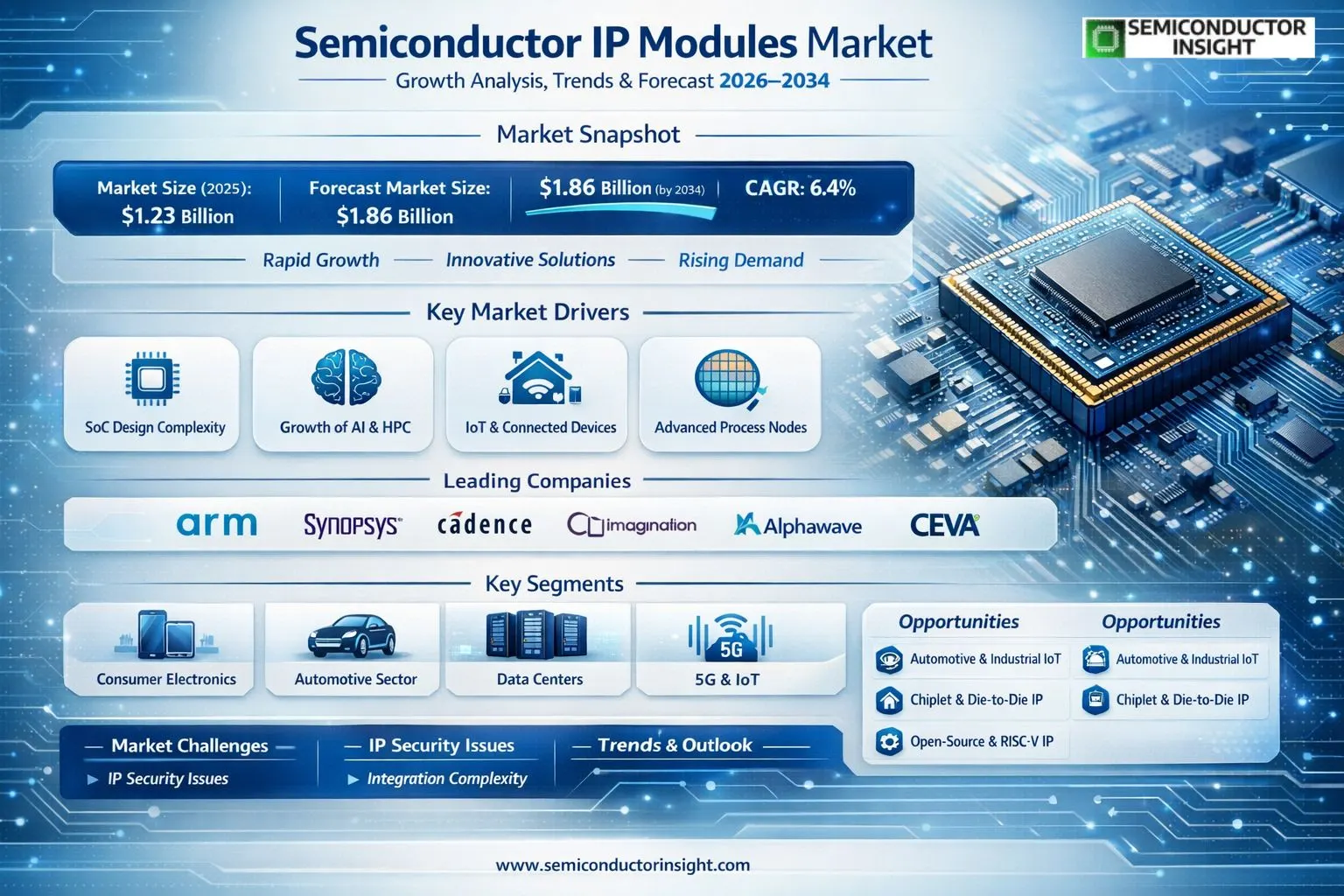
Global Semiconductor IP Modules market size was valued at USD 1.23 billion in 2025. The market is projected to grow from USD 1.31 billion in 2026 to USD 1.86 billion by 2034, exhibiting a CAGR of 6.4% during the forecast period.
Semiconductor IP Modules are pre-designed, reusable functional blocks of intellectual property (IP) that are integrated into semiconductor devices such as System-on-Chip (SoC) designs or other integrated circuits (ICs). These modules provide key functionalities and can range from complex components like processor cores to simpler modules such as I/O interfaces or communication protocols. Semiconductor IP modules are licensed by designers to avoid developing these functionalities from scratch, saving significant time and cost while improving overall design quality and reliability.
The market is experiencing steady growth due to several factors, including the increasing complexity of SoC designs across consumer electronics and automotive applications, alongside the rapid proliferation of connected Internet of Things (IoT) devices. Furthermore, the rising demand for advanced computing in data centers and the transition to newer process nodes are compelling companies to leverage third-party IP to accelerate time-to-market. Initiatives by key players also fuel market expansion; for instance, the strategic acquisition of Arm by Nvidia underscores the critical value of processor IP in future computing paradigms. Other leading players operating in this space with extensive portfolios include Synopsys, Cadence Design Systems, and Imagination Technologies.
MARKET DRIVERS
Demand for System-on-Chip (SoC) Design Efficiency
The relentless push for feature-rich, compact electronic devices is a primary driver for the Semiconductor IP Modules Market. Designing complex SoCs from scratch is increasingly time-consuming and costly. Licensed semiconductor IP modules, providing pre-verified functional blocks like processor cores, memory interfaces, and connectivity protocols, drastically reduce design cycles and non-recurring engineering costs. This enables faster time-to-market for products across consumer electronics, automotive, and data centers, fueling market growth as companies seek competitive advantage through innovation speed.
Proliferation of AI and Specialized Computing
The explosive growth of artificial intelligence, machine learning, and high-performance computing necessitates specialized hardware accelerators. The Semiconductor IP Modules Market is directly propelled by the need for configurable IP blocks like neural processing units (NPUs), tensor cores, and high-bandwidth memory interfaces. These modules allow chip designers to integrate cutting-edge AI capabilities without developing the underlying architecture from the ground up, a critical factor in the development of edge AI devices and data center accelerators.
➤ Global demand for advanced driver-assistance systems (ADAS) and autonomous vehicle platforms is creating a significant, high-reliability segment within the Semiconductor IP Modules Market, focusing on safety-certified IP for automotive SoCs.
Furthermore, the transition to advanced process nodes below 7nm acts as a key technical driver. Designing at these nodes is prohibitively expensive for most firms. Semiconductor IP providers invest heavily in developing and qualifying IP modules for these leading-edge processes, allowing a broader range of companies to access advanced chip manufacturing, thereby expanding the total addressable market for these essential design components.
MARKET CHALLENGES
Intellectual Property Management and Security Risks
A core challenge in the Semiconductor IP Modules Market revolves around the complex management of Intellectual Property. Integrating third-party IP into an SoC design raises significant concerns regarding IP ownership, licensing terms, and integration liability. Furthermore, the threat of IP piracy, reverse engineering, and hardware-based security threats like Trojan horses inserted into IP blocks is a major concern for chip designers, especially in sensitive applications, requiring rigorous trust and verification processes that can slow adoption.
Other Challenges
Integration and Verification Complexity
As SoC designs grow more complex with heterogeneous components, integrating multiple semiconductor IP modules from different vendors becomes a significant challenge. Ensuring interoperability, meeting timing closure, and managing power and thermal performance across disparate IP blocks increases verification time and cost, potentially negating some of the time-to-market benefits.
Fragmented Standards and Interoperability
While interface standards like AMBA are widely used, a lack of complete standardization across all IP types and vendor-specific implementations can lead to integration hurdles. This fragmentation in the Semiconductor IP Modules Market can lock designers into specific vendor ecosystems, reducing flexibility and potentially increasing long-term costs.
MARKET RESTRAINTS
High Cost of Leading-Edge IP and SoC Development
Despite offering cost savings versus full custom design, the cumulative expense of licensing multiple high-performance semiconductor IP modules, especially for advanced process nodes, remains a significant market restraint. The licensing fees, often coupled with royalty payments per chip produced, can create substantial upfront costs. This is compounded by the soaring expense of tape-outs at cutting-edge nodes, creating a high barrier to entry for startups and smaller design houses, potentially consolidating market opportunities with larger players.
Geopolitical and Trade Policy Uncertainties
Global nature of the Semiconductor IP Modules Market makes it highly susceptible to geopolitical tensions and export control regulations. Restrictions on the trade of certain technologies or IP between major economic regions can disrupt supply chains, limit access to critical IP for designers in certain countries, and force costly redesigns or vendor switches. This environment of uncertainty can lead to delayed projects and increased risk aversion among chip developers, restraining market momentum.
MARKET OPPORTUNITIES
Expansion into Automotive and Industrial IoT Segments
The rapid electrification and automation of vehicles, alongside the growth of the Industrial Internet of Things (IIoT), present substantial growth avenues for the Semiconductor IP Modules Market. These sectors demand robust, reliable, and often safety-certified IP for microcontrollers, sensor interfaces, vehicle networking, and real-time control systems. IP providers that develop modules meeting stringent automotive-grade (AEC-Q100) and functional safety (ISO 26262) standards are poised to capture a growing, high-value segment of the market.
Rise of Chiplet-Based Designs and Die-to-Die IP
The emerging chiplet paradigm, where smaller chiplets are integrated into a single package, is creating a new frontier for semiconductor IP. This shift demands specialized IP modules for die-to-die interconnects (e.g., UCIe), advanced packaging interfaces, and chiplet management. The Semiconductor IP Modules Market has a clear opportunity to evolve from providing standalone functional blocks to offering essential connectivity and integration fabrics that enable modular, heterogeneous chiplet architectures, promoting design reuse and yield improvement.
Growth of Open-Source and RISC-V Based IP Ecosystems
The increasing adoption of the open-standard RISC-V instruction set architecture is disrupting the traditional processor IP landscape and creating fresh opportunities. This is fostering a growing ecosystem of both commercial and open-source semiconductor IP modules centered around RISC-V cores and related peripherals. This trend lowers barriers for innovation, particularly in embedded and application-specific markets, and encourages new business models for IP providers, expanding the overall market scope.
Semiconductor IP Modules Market Trends
Accelerated Shift Towards Heterogeneous Integration and Chiplet Architectures
A dominant trend in the Semiconductor IP Modules market is the fundamental shift toward heterogeneous integration and chiplet-based designs. As semiconductor designs push against the physical and economic limits of monolithic scaling, designers are increasingly utilizing specialized Semiconductor IP core modules that can be integrated like building blocks. This trend is a direct response to demands for higher performance and cost efficiency in applications like artificial intelligence accelerators and high-performance computing. The need for optimized solutions is driving strong demand for advanced interface IP modules, such as those for die-to-die connectivity, which are essential for this modular design approach.
Other Trends
Expansion of Edge AI and IoT Ecosystems
The rapid proliferation of edge computing and Artificial Intelligence of Things (AIoT) devices is creating sustained demand for low-power, high-efficiency Semiconductor IP. Specific modules for neural network processing, ultra-low-power microcontrollers, and energy-efficient connectivity are critical for embedding intelligence in endpoint devices. This trend directly supports growth in the processor IP and communication IP segments, as designers seek to balance computational performance with stringent power budgets and form factor constraints in automotive, industrial, and consumer applications.
Increasing Focus on Security and Functional Safety
Modern system-on-chip designs, especially for automotive and data center applications, require robust security and safety as foundational features. This is propelling significant investment in and adoption of specialized security IP modules, including hardware roots of trust, cryptographic accelerators, and tamper-resistant elements. Concurrently, the automotive sector’s reliance on Semiconductor IP for advanced driver-assistance systems (ADAS) necessitates modules certified to functional safety standards like ISO 26262, integrating safety mechanisms directly into the IP. This dual demand for security and safety is becoming a key differentiator and a non-negotiable requirement in IP selection, influencing the strategic roadmap of major vendors in the Semiconductor IP Modules market.
COMPETITIVE LANDSCAPE
Key Industry Players
A Consolidated Market Poised for Strategic Expansion
Global Semiconductor IP Modules market is characterized by a high degree of consolidation, with major players leveraging extensive portfolios and strategic acquisitions to maintain dominance. The market structure features a clear tiering, with powerhouse companies like ARM (now part of Nvidia), Synopsys, and Cadence collectively commanding a significant revenue share. Notably, ARM’s acquisition by Nvidia is a monumental shift, positioning the combined entity to accelerate innovation in AI, data center, and automotive SoC designs. These leading firms provide comprehensive ecosystems spanning processor, interface, and memory IP, which is critical for complex, multi-die system-on-chip (SoC) designs prevalent in data centers, advanced automotive applications, and next-generation consumer electronics. The competitive intensity is high, with differentiation increasingly hinging on performance-per-watt, security IP, and support for emerging protocols like PCIe, CXL, and UCIe.
Beyond the top tier, numerous significant niche and specialized players have established strong positions by focusing on high-growth segments or innovative technologies. Companies such as Rambus, Alphawave IP, and Ceva excel in high-speed interface, security, and DSP/IP for wireless and AI edge applications, respectively. Specialist firms like eMemory Technology dominate the market for embedded non-volatile memory (eNVM) IP, while Arteris and Moortec provide essential NoC interconnect and chip monitoring IP. The competitive landscape is further enriched by a growing cohort of dynamic companies from the Asia-Pacific region, such as VeriSilicon, Faraday Technology, and Nuclei System Technology, which offer tailored solutions and competitive pricing, intensifying the market dynamics particularly in the IoT and consumer electronics sectors.
List of Key Semiconductor IP Modules Companies Profiled
- ARM (Nvidia)
- Synopsys
- Cadence
- Imagination Technologies
- Alphawave IP
- Ceva
- SST (Silicon Storage Technology)
- eMemory Technology
- Rambus
- Arteris
- Silicon Creations
- VeriSilicon
- Faraday Technology
- Innosilicon
- Nuclei System Technology
Segment Analysis:
| Segment Category | Sub-Segments | Key Insights |
| By Type |
|
Processor IP remains the cornerstone of complex semiconductor design due to its critical role in system functionality.
|
| By Application |
|
Consumer Electronics is a dominant and highly innovative application segment, fuelling continuous IP module development.
|
| By End User |
|
Fabless Semiconductor Companies are the primary consumers, heavily reliant on external IP to build competitive systems-on-chip (SoCs).
|
| By Design Complexity |
|
High-Performance Computing & AI is a leading and rapidly evolving segment, pushing the boundaries of IP capabilities.
|
| By Licensing Model |
|
Royalty-Based Licensing is a prevalent and strategically important model, especially for high-volume, mainstream IP.
|
Regional Analysis: Semiconductor IP Modules Market
ASIA-PACIFIC
The dense network of fabless design houses and pure-play foundries creates a unique environment for the Semiconductor IP Modules Market, with IP providers working closely to ensure compatibility and performance on the latest process technologies from regional leaders like TSMC and Samsung.
National policies and substantial state-backed funding in key economies are accelerating domestic chip design, directly boosting demand for both foundational and application-specific IP modules to reduce external dependencies and build sovereign capabilities.
Demand is fueled by multiple high-volume sectors including mobile devices, consumer electronics, and a rapidly growing automotive sector, particularly in China, which requires specialized IP for electric vehicle powertrains, ADAS, and in-cabin infotainment.
The region boasts a large, growing pool of engineering talent and increasing R&D expenditures, fostering local IP development startups and specialized innovation centers for areas like AI accelerators and high-performance computing IP modules.
NORTH AMERICA
North America remains a critical innovation and high-value core for the Semiconductor IP Modules Market, anchored by leading semiconductor firms, pioneering fabless companies, and world-class research institutions in the United States. The region’s strength lies in defining architectural roadmaps and developing the most complex, high-performance IP cores for data-centric applications. Demand is heavily driven by cloud computing, artificial intelligence, and hyperscale data center deployments, requiring IP modules for advanced processor architectures, high-bandwidth memory, and cutting-edge interconnect technologies. The ecosystem’s focus on frontier technologies ensures it leads in segments like AI/ML accelerators, quantum computing interfaces, and next-generation networking IP. While manufacturing is less concentrated than in Asia-Pacific, the region’s influence on global design standards and its concentration of market-leading IP vendors solidify its role as the primary source of architectural innovation and premium IP within the Semiconductor IP Modules Market.
EUROPE
Europe holds a strong, specialized position in Global Semiconductor IP Modules Market, distinguished by deep expertise in automotive, industrial, and security applications. The region is a leader in providing and consuming highly reliable, safety-certified, and secure IP modules. The robust automotive industry, particularly in Germany, drives significant demand for IP related to automotive microcontrollers, sensor interfaces, and functional safety (ISO 26262) compliant processor cores. Furthermore, Europe’s focus on industrial IoT, aerospace, and medical technologies creates a steady market for robust analog/mixed-signal IP, low-power designs, and hardware security modules. Collaborative research initiatives, such as those funded by the European Union, further stimulate innovation in specialized areas like photonics integration and edge AI. This results in a market less focused on raw volume and more on high-reliability, application-specific IP modules with long development cycles and stringent certification requirements.
SOUTH AMERICA
The South American Semiconductor IP Modules Market is in a developmental phase, characterized by nascent but growing local design activity and reliance on imports for complex semiconductor components. Brazil is the most active market, with increasing interest in electronics design for consumer appliances, agricultural technology, and basic industrial automation. The regional market primarily engages with more mature and standardized IP modules for microcontroller and connectivity applications, as the ecosystem for cutting-edge, nanometer-scale design is limited. Growth is incremental, often tied to government-supported technology initiatives and the expansion of local technology parks aimed at fostering hardware startups. While not a primary driver of global IP trends, the region represents an emerging market where demand for foundational IP is gradually increasing as local design capabilities mature and integration into global electronics supply chains continues.
MIDDLE EAST & AFRICA
The Semiconductor IP Modules Market in the Middle East & Africa is emerging, marked by strategic investments aimed at economic diversification and building sovereign technological capabilities. Gulf nations, particularly Saudi Arabia and the UAE, are making significant investments in establishing technology hubs and attracting global semiconductor firms, which is beginning to generate demand for foundational design IP and training. The focus is often on strategic niches like data center infrastructure to support regional digital transformation and secure communications. In parts of Africa, growth is linked to the telecommunications boom and the proliferation of mobile devices, fostering a need for connectivity and basic processor IP for localized electronics assembly and design. The market is in its early stages, with potential growth heavily dependent on sustained policy support, education in microelectronics, and the successful establishment of regional design centers partnering with global leaders in the Semiconductor IP Modules Market.
Report Scope
This market research report provides a comprehensive analysis of the Semiconductor IP Modules Market , covering the forecast period 2026–2034. It offers detailed insights into market dynamics, technological advancements, competitive landscape, and key trends shaping the industry.
Key focus areas of the report include:
- Market Overview: The report begins with an overview outlining its current market scenario, key growth indicators, and industry transformation drivers. It discusses macroeconomic factors, demand–supply balance, regulatory landscape, and the strategic role of semiconductors in powering advancements across industries such as automotive, telecommunications, consumer electronics, and industrial automation.
- Market Size & Forecast: Historical data and future projections for revenue, unit shipments, and market value across major regions and segments.
- Segmentation Analysis: Detailed breakdown by product type, technology, application, and end-user industry to identify high-growth segments and investment opportunities.
- Regional Insights: Insights into market performance across North America, Europe, Asia-Pacific, Latin America, and the Middle East & Africa, including country-level analysis where relevant.
- Competitive Landscape: Profiles of leading market participants, including their product offerings, R&D focus, manufacturing capacity, pricing strategies, and recent developments such as mergers, acquisitions, and partnerships.
- Technology Trends & Innovation: Assessment of emerging technologies, integration of AI/IoT, semiconductor design trends, fabrication techniques, and evolving industry standards.
- Market Drivers & Restraints: Evaluation of factors driving market growth along with challenges, supply chain constraints, regulatory issues, and market-entry barriers.
- Stakeholder Insights: Insights for component suppliers, OEMs, system integrators, investors, and policymakers regarding the evolving ecosystem and strategic opportunities.
Primary and secondary research methods are employed, including interviews with industry experts, data from verified sources, and real-time market intelligence to ensure the accuracy and reliability of the insights presented.
FREQUENTLY ASKED QUESTIONS:
What is the current market size and growth outlook for the Semiconductor IP Modules market?
-> Global Semiconductor IP Modules market was valued at USD 1226 million in 2025 and is projected to reach USD 1857 million by 2034, growing at a CAGR of 6.4% during the forecast period.
What are Semiconductor IP Modules?
-> Semiconductor IP Modules are pre-designed, reusable functional blocks of intellectual property (IP) integrated into semiconductor devices like System-on-Chip (SoC) designs. They range from complex processor cores to simpler I/O interfaces, licensed by designers to save time, reduce costs, and improve design quality.
Which key companies operate in the Semiconductor IP Modules market?
-> Key players include ARM (Nvidia), Synopsys, Cadence, Imagination Technologies, Alphawave, Ceva, SST, eMemory Technology, Rambus, and Alphawave IP, among others. Global top five players held a significant revenue share in 2025.
What are the primary segments of the Semiconductor IP Modules market by type?
-> The market is segmented by type into Processor IP, Memory IP, Peripheral and Interface IP, Analog and Mixed Circuit IP, Communication IP, and Others.
What are the major application areas for Semiconductor IP Modules?
-> Key application areas include Consumer Electronics, Automotive, Internet of Things (IoT), Communications, Data Centers and Cloud Computing, and Others.

Get Sample Report PDF for Exclusive Insights
Report Sample Includes
- Table of Contents
- List of Tables & Figures
- Charts, Research Methodology, and more...
 Download Sample Report PDF