Security Monitoring System SoC Market Insights
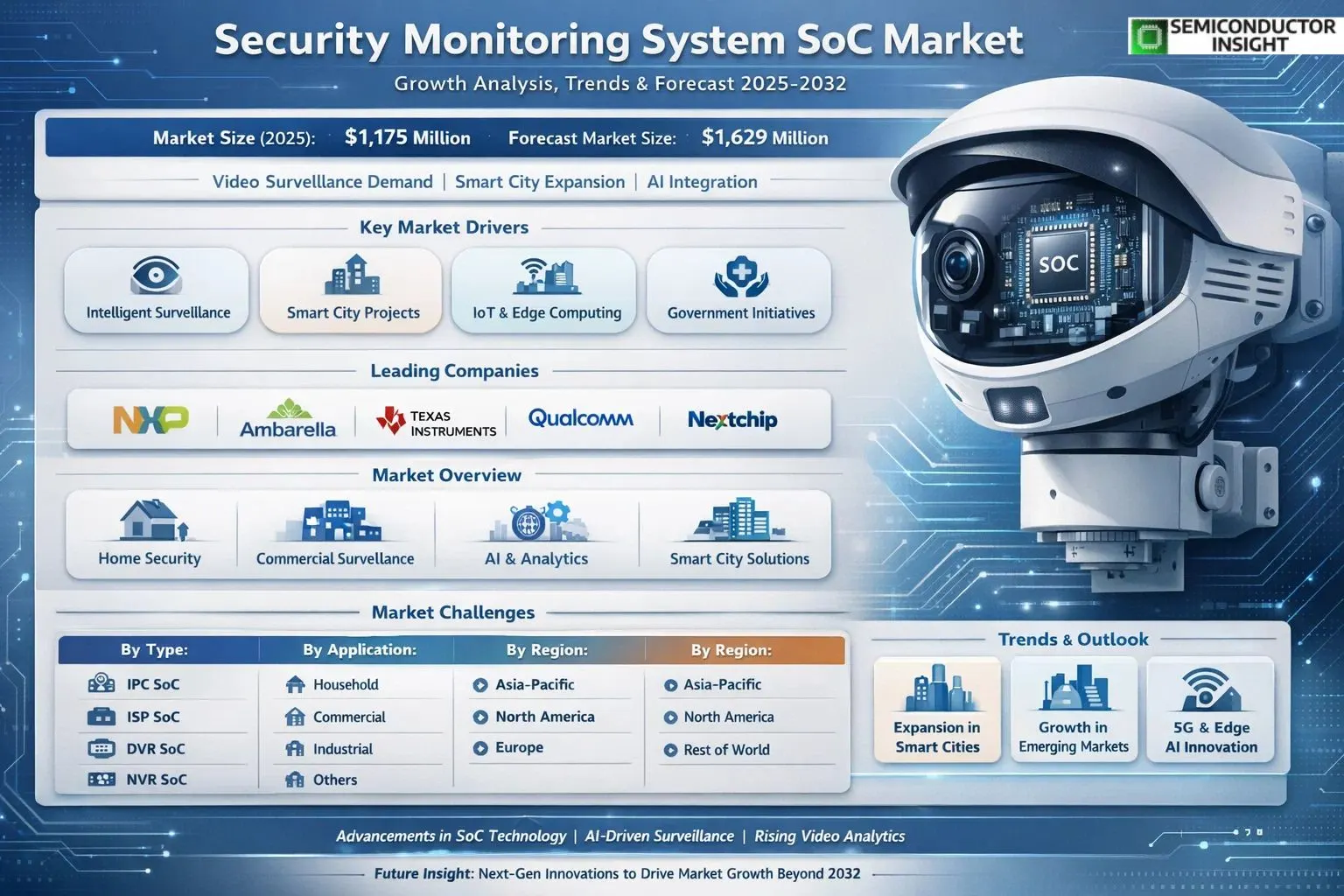
Global Security Monitoring System SoC market size was valued at USD 1,175 million in 2025. The market is projected to reach USD 1,629 million by 2032, exhibiting a CAGR of 4.9% during the forecast period.
Security Monitoring System SoCs are highly integrated chips designed for video surveillance applications, which are widely used in home security, commercial surveillance, and smart cities. This SoC integrates an image sensor, an image signal processor (ISP), a video encoder, a CPU, a GPU, and other processing units necessary to process and analyze video data in real time. Intelligent algorithms such as face recognition, behavioral analysis, and object detection are integrated to enhance the intelligence of the surveillance system.
The market is experiencing steady growth due to several factors, including heightened global security concerns, rapid expansion of smart city projects, and rising demand for AI-enabled edge computing in surveillance. Additionally, advancements in high-resolution imaging and real-time analytics are driving further adoption across household, commercial, and industrial sectors. Initiatives by key players continue to propel innovation. For instance, Ambarella has advanced its CVflow AI vision processor technology for enhanced security camera performance. NXP Semiconductors, Ambarella, Texas Instruments, Qualcomm, Nextchip, Socionext Inc., Huawei HiSilicon, Novatek, Kneron, and SigmaStar are some of the key players operating in the market with diverse portfolios.
MARKET DRIVERS
Rising Demand for Intelligent Surveillance
Security Monitoring System SoC Market is propelled by the surge in demand for advanced video surveillance solutions integrated with AI capabilities. As urban populations grow, cities worldwide are investing heavily in smart city infrastructure, where System on Chip (SoC) solutions enable real-time threat detection and analytics at the edge. This shift reduces reliance on cloud processing, enhancing efficiency and lowering latency in security monitoring systems.
IoT and Edge Computing Integration
Proliferation of IoT devices has accelerated adoption of compact, power-efficient SoCs tailored for security cameras and sensors. These chips support seamless connectivity via Wi-Fi and 5G, allowing for scalable deployments in residential and commercial settings. Market data indicates that edge computing in security monitoring has grown by 12% annually, driving innovation in SoC designs for Security Monitoring System SoC Market.
➤ Government initiatives for public safety, such as the allocation of over $5 billion in funding for surveillance upgrades in major economies, further bolster SoC demand.
Additionally, heightened cybersecurity threats in surveillance networks underscore the need for secure SoC architectures with hardware-based encryption, positioning key players to capture expanding market share.
MARKET CHALLENGES
Technical Integration Complexities
Integrating advanced SoCs into existing security monitoring infrastructures poses significant hurdles due to compatibility issues with legacy systems. Manufacturers face challenges in balancing high-performance features like 4K video processing with low power consumption, often leading to increased development timelines and costs in Security Monitoring System SoC Market.
Other Challenges
Supply Chain Disruptions
Global semiconductor shortages have delayed SoC production, impacting delivery schedules for security system deployments and raising costs by up to 15% for end-users reliant on timely upgrades.Competition from low-cost alternatives also pressures premium SoC providers, forcing continuous R&D investments to differentiate through superior AI acceleration and security features.
MARKET RESTRAINTS
Regulatory and Privacy Hurdles
Stringent data privacy regulations, such as GDPR in Europe and similar laws globally, impose restrictions on video surveillance deployments, limiting the growth trajectory of Security Monitoring System SoC Market. Compliance requires robust onboard data processing in SoCs to anonymize footage, adding layers of complexity and cost to chip design.High initial investment for deploying SoC-based systems remains a barrier, particularly for small and medium enterprises, where budgets constrain adoption rates despite long-term savings potential.Moreover, vulnerability to cyber attacks on connected security devices highlights ongoing concerns over SoC firmware security, prompting cautious procurement decisions among enterprise buyers.
MARKET OPPORTUNITIES
Expansion in Smart City Projects
Security Monitoring System SoC Market stands to benefit from burgeoning smart city initiatives, projected to integrate over 1 billion surveillance nodes by 2028. SoCs optimized for AI-driven analytics offer scalable solutions for traffic management and public safety, opening avenues for partnerships with urban developers.Emerging markets in Asia-Pacific and Latin America present untapped potential, with rising urbanization driving demand for affordable, high-efficiency SoCs in residential security systems.Advancements in 5G and edge AI further enable next-generation features like predictive threat analysis, positioning innovative SoC vendors to capture a larger share of the evolving Security Monitoring System SoC Market.
Security Monitoring System SoC Market Trends
Advancements in Highly Integrated Chips for Video Surveillance
Security Monitoring System SoC solutions represent a pivotal evolution in video surveillance technology, featuring highly integrated chips that combine image sensors, image signal processors, video encoders, CPUs, and GPUs. These components enable real-time processing and analysis of video data, significantly enhancing system efficiency across home security, commercial surveillance, and smart city deployments. The incorporation of intelligent algorithms for face recognition, behavioral analysis, and object detection is driving superior performance, allowing systems to deliver proactive security insights rather than passive recording.
Other Trends
Shifts in Product Segments
Within Security Monitoring System SoC Market, segments such as IPC SoC, ISP SoC, DVR SoC, and NVR SoC are experiencing varied dynamics. IPC SoC stands out due to its adaptability in network cameras, supporting high-resolution imaging and edge computing capabilities. ISP SoC continues to gain traction for optimized image processing, while DVR and NVR SoC variants cater to storage and management needs in diverse setups. This segmentation reflects broader industry moves toward modular, scalable architectures that align with evolving surveillance demands.
Expansion Across Applications and Regions
Applications in household, commercial, and industrial sectors are fueling Security Monitoring System SoC adoption, with household use emphasizing user-friendly smart devices, commercial focusing on perimeter protection, and industrial prioritizing robust environmental resilience. Regionally, North America, including the US and Canada, maintains strong footholds through advanced infrastructure, while Asia—particularly China, Japan, and South Korea—emerges as a growth epicenter due to rapid urbanization and smart city initiatives. Europe, South America, and the Middle East & Africa follow with tailored implementations. Leading manufacturers like NXP Semiconductors, Ambarella, Texas Instruments, Qualcomm, Nextchip, Socionext, Huawei Hisilicon, Novatek, Kneron, and SigmaStar are intensifying competition via innovation in processing power and AI integration, shaping a dynamic competitive landscape. These trends underscore the market’s trajectory toward intelligent, interconnected security ecosystems.
COMPETITIVE LANDSCAPE
Key Industry Players
Top Manufacturers Shaping Security Monitoring System SoC Market
Security Monitoring System SoC Market is characterized by a moderately concentrated structure, where a handful of semiconductor leaders command significant market share. In 2025, the global top five players, including NXP Semiconductors, Ambarella, Texas Instruments, Qualcomm, and Nextchip, collectively held a substantial portion of revenue, driving innovation in integrated chips for video surveillance. These companies dominate due to their advanced integration of image signal processors (ISP), CPUs, GPUs, and AI algorithms for real-time video analytics like face recognition and object detection. NXP and Ambarella stand out with robust portfolios tailored for IP cameras (IPC SoCs) and network video recorders (NVRs), benefiting from strong R&D investments and partnerships in smart city and commercial applications. The market’s growth, projected at a 4.9% CAGR to reach US$1,629 million by 2032, underscores their influence amid rising demand for intelligent surveillance solutions.
Beyond the frontrunners, a vibrant ecosystem of niche players, particularly from Asia, contributes specialized SoCs for household, industrial, and DVR applications. Firms like Socionext Inc., Huawei HiSilicon, and Novatek offer cost-effective, high-performance chips excelling in edge AI processing, while emerging innovators such as Kneron, SigmaStar, and Goke Microelectronics focus on power-efficient designs for battery-powered devices. Companies including Shanghai Fullhan, Ingenic Semiconductor, and Rockchip provide tailored solutions for regional markets like China, intensifying competition through rapid product iterations and vertical integration. This fragmentation fosters innovation but challenges smaller players with pricing pressures and supply chain dependencies, as global leaders leverage scale for broader adoption in North America and Europe.
List of Key Security Monitoring System SoC Companies Profiled
- NXP Semiconductors
- Ambarella
- Texas Instruments
- Qualcomm
- Nextchip
- Socionext Inc
- Huawei HiSilicon
- Novatek
- Kneron
- SigmaStar
- Shanghai Fullhan
- Ingenic Semiconductor
- Goke Microelectronics
- Anyka
- Realtek Semiconductor
Segment Analysis:
| Segment Category | Sub-Segments | Key Insights |
| By Type |
|
IPC SoC leads as it offers comprehensive integration tailored for modern IP cameras, supporting end-to-end video processing from capture to analytics.
|
| By Application |
|
Commercial applications spearhead adoption, driven by needs for scalable and reliable surveillance in retail, offices, and public venues.
|
| By End User |
|
Commercial Enterprises represent the forefront, leveraging SoCs for sophisticated monitoring in high-stakes business environments.
|
| By Deployment Mode |
|
Edge Deployment prevails with its decentralized processing advantages, ideal for responsive security systems.
|
| By Intelligence Level |
|
AI-Enabled Detection stands out for transforming passive surveillance into proactive security solutions.
|
Regional Analysis: Security Monitoring System SoC Market
North America
Key drivers include widespread smart city deployments and stringent cybersecurity mandates that necessitate advanced SoCs for seamless integration in Security Monitoring System SoC Market applications. Heightened awareness of public safety fuels institutional investments, while consumer trends toward home automation boost compact chip solutions.
Leading semiconductor firms innovate proprietary architectures optimized for surveillance workloads, partnering with system integrators to embed Security Monitoring System SoC Market technologies in diverse ecosystems from retail to transportation.
Compliance with data protection standards shapes SoC designs, emphasizing secure boot processes and encrypted data flows essential for Security Monitoring System SoC Market deployments in regulated sectors like healthcare and finance.
Emerging opportunities lie in edge AI enhancements and 5G convergence, expanding Security Monitoring System SoC Market potential in autonomous vehicles and industrial IoT monitoring frameworks.
Europe
Europe’s Security Monitoring System SoC Market thrives on rigorous privacy regulations that compel manufacturers to prioritize GDPR-compliant chips with on-device data anonymization. Focus on sustainable urban security solutions drives demand for low-power SoCs in video surveillance networks across historic cities. Collaborative EU-funded projects accelerate hybrid analog-digital designs for legacy system upgrades. Industrial sectors leverage ruggedized SoCs for perimeter protection in manufacturing hubs. Northern Europe’s harsh climates spur innovations in thermal-efficient processing, while Southern markets emphasize crowd management applications. Cross-border harmonization of standards fosters pan-European supply chains, enhancing interoperability in multinational deployments. The region’s emphasis on ethical AI integration positions it for steady expansion in intelligent monitoring ecosystems.
Asia-Pacific
Asia-Pacific exhibits dynamic growth in Security Monitoring System SoC Market, propelled by explosive urbanization and dense population centers demanding scalable surveillance infrastructures. Manufacturing prowess in key nations enables cost-effective, high-volume SoC production tailored for mass-market cameras. Government-backed smart nation programs integrate advanced chips for predictive analytics in public spaces. Rapid ecommerce rise heightens warehouse security needs, favoring modular SoC platforms. Southeast Asian tourism hotspots deploy weather-resistant solutions for hospitality venues. Intra-regional trade agreements streamline component sourcing, bolstering resilience against global disruptions. Innovation in facial recognition-optimized SoCs aligns with societal security priorities, marking Asia-Pacific as a high-velocity arena.
South America
In South America, Security Monitoring System SoC Market gains momentum from escalating urban crime concerns and infrastructure modernization efforts. Emerging economies invest in affordable, AI-enhanced SoCs for public safety networks in sprawling metropolises. Border regions prioritize long-range detection capabilities amid geopolitical tensions. Agricultural estates adopt remote monitoring SoCs to safeguard vast farmlands. Local fabless design houses collaborate with international foundries for customized low-latency chips. Renewable energy integration powers off-grid deployments in rural areas. Progressive policy frameworks encourage domestic content in security tenders, nurturing a vibrant ecosystem poised for accelerated adoption.
Middle East & Africa
The Middle East & Africa region shapes its Security Monitoring System SoC Market around strategic infrastructure protections and visionary city projects. Oil-rich economies deploy premium SoCs for critical asset safeguarding in energy facilities. African megacities embrace cloud-edge hybrid architectures to combat informal settlement vulnerabilities. Desert climates drive durable, heat-tolerant chip innovations for perimeter defense. Public-private partnerships fund R&D in biometric fusion technologies. Continental integration initiatives promote standardized SoC protocols for cross-border cooperation. Rising middle-class affluence spurs residential smart security uptake, underscoring the region’s transformative potential.
Report Scope
This market research report provides a comprehensive analysis of Security Monitoring System SoC Market, covering the forecast period 2025–2032. It offers detailed insights into market dynamics, technological advancements, competitive landscape, and key trends shaping the industry.
Key focus areas of the report include:
- Market Overview: The report begins with an overview outlining its current market scenario, key growth indicators, and industry transformation drivers. It discusses macroeconomic factors, demand–supply balance, regulatory landscape, and the strategic role of semiconductors in powering advancements across industries such as home security, commercial surveillance, smart cities, and industrial monitoring.
- Market Size & Forecast: Historical data and future projections for revenue, unit shipments, and market value across major regions and segments.
- Segmentation Analysis: Detailed breakdown by product type, technology, application, and end-user industry to identify high-growth segments and investment opportunities.
- Regional Insights: Insights into market performance across North America, Europe, Asia-Pacific, Latin America, and the Middle East & Africa, including country-level analysis where relevant.
- Competitive Landscape: Profiles of leading market participants, including their product offerings, R&D focus, manufacturing capacity, pricing strategies, and recent developments such as mergers, acquisitions, and partnerships.
- Technology Trends & Innovation: Assessment of emerging technologies, integration of AI/IoT, semiconductor design trends, fabrication techniques, and evolving industry standards.
- Market Drivers & Restraints: Evaluation of factors driving market growth along with challenges, supply chain constraints, regulatory issues, and market-entry barriers.
- Stakeholder Insights: Insights for component suppliers, OEMs, system integrators, investors, and policymakers regarding the evolving ecosystem and strategic opportunities.
Primary and secondary research methods are employed, including interviews with industry experts, data from verified sources, and real-time market intelligence to ensure the accuracy and reliability of the insights presented.
FREQUENTLY ASKED QUESTIONS:
What is the current market size of Security Monitoring System SoC Market?
-> Global Security Monitoring System SoC Market was valued at USD 1,175 million in 2025 and is expected to reach USD 1,629 million by 2032, at a CAGR of 4.9% during the forecast period.
Which key companies operate in Security Monitoring System SoC Market?
-> Key players include NXP Semiconductors, Ambarella, Texas Instruments, Qualcomm, Nextchip, Socionext Inc, among others.
What are the key growth drivers?
-> Key growth drivers include demand for video surveillance in home security, commercial applications, smart cities, and integration of AI algorithms such as face recognition and object detection.
Which region dominates the market?
-> Asia dominates the market, driven by key markets like China.
What are the emerging trends?
-> Emerging trends include highly integrated SoCs with image sensors, ISPs, video encoders, CPUs, GPUs, and intelligent algorithms for real-time video analysis.

Get Sample Report PDF for Exclusive Insights
Report Sample Includes
- Table of Contents
- List of Tables & Figures
- Charts, Research Methodology, and more...
 Download Sample Report PDF