Market Insights
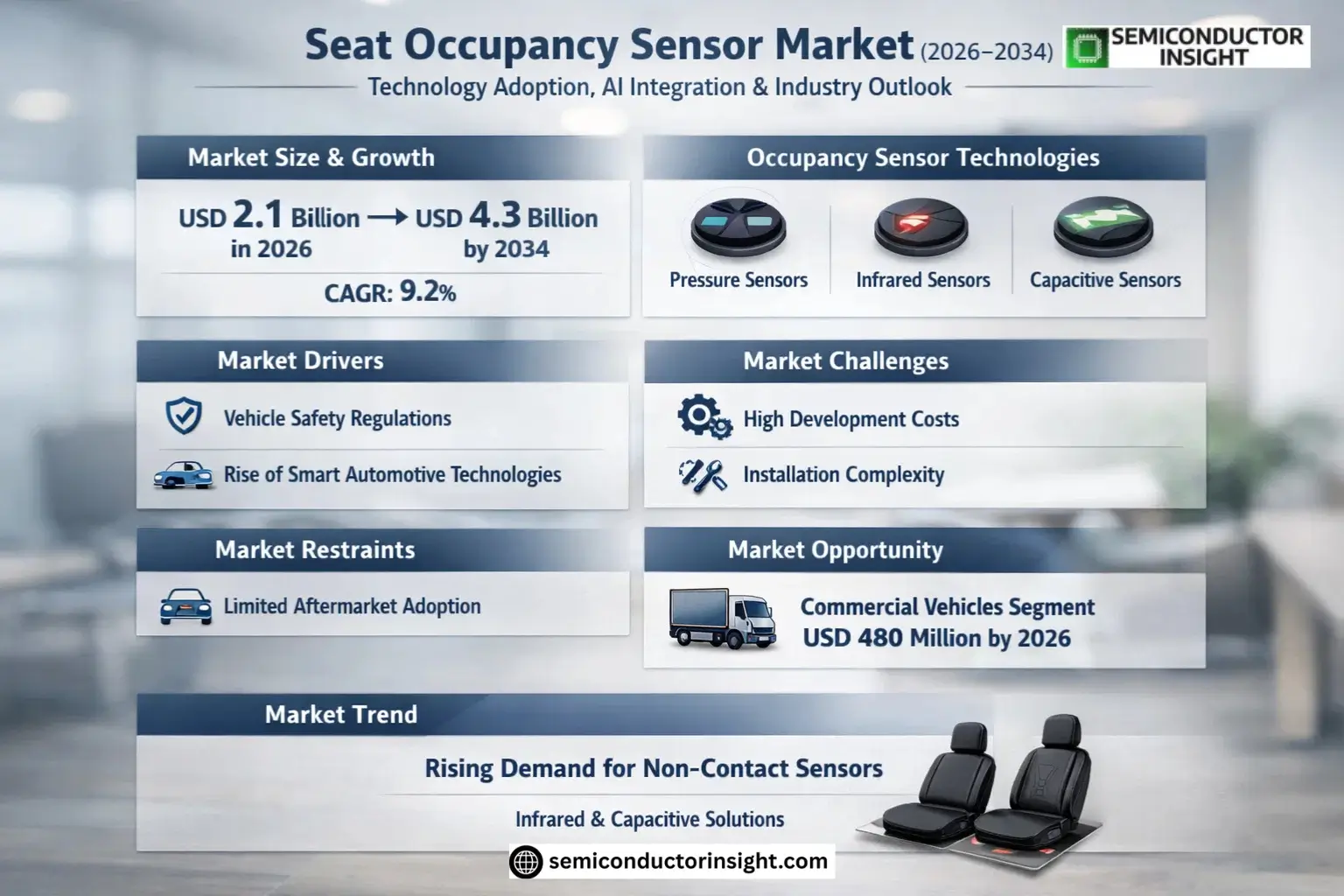
Global Seat Ocupancy Sensor Market size was valued at USD 1.8 billion in 2025. The market is projected to grow from USD 2.1 billion in 2026 to USD 4.3 billion by 2034, exhibiting a CAGR of 9.2% during the forecast period.
Seat occupancy sensors are advanced detection systems designed to identify the presence or absence of occupants in seating applications. These sensors utilize technologies such as pressure-sensitive mats, capacitive sensing, and infrared detection to provide real-time data for safety, automation, and energy efficiency purposes. Key variants include non-contact sensors (e.g., infrared-based) and contact sensors (e.g., pressure-sensitive pads), with applications spanning automotive seats, office furniture, and public transportation systems.
The market growth is driven by increasing automotive safety regulations mandating occupant detection systems, rising demand for smart office solutions, and growing adoption in public transit for passenger analytics. Technological advancements in IoT-enabled sensors and AI-based occupancy pattern recognition are creating new opportunities, while cost sensitivity in price-driven markets remains a challenge. Leading manufacturers like IGB Automotive and FSRTEK are expanding their portfolios with multi-zone detection capabilities to address evolving industry requirements across different seating configurations.
MARKET DRIVERS
Increasing Vehicle Safety Regulations
Global Seat Occupancy Sensor Market is primarily driven by stringent safety mandates requiring advanced occupant detection systems. Governments worldwide are enforcing regulations to improve passenger safety, particularly for airbag deployment accuracy. This has significantly boosted adoption rates of seat occupancy sensors in both passenger and commercial vehicles.
Rising Demand for Smart Automotive Technologies
Automakers are increasingly integrating intelligent seating systems as part of connected vehicle ecosystems. Seat occupancy sensors now interface with other safety features like seatbelt reminders and climate control systems, creating a more sophisticated user experience. The market is witnessing 12-15% annual growth in smart sensor adoption.
Electric vehicle manufacturers are particularly investing in lightweight, high-precision seat sensors to maintain optimal energy efficiency while meeting safety standards.
MARKET CHALLENGES
High Development Costs for Advanced Systems
Manufacturers face significant R&D expenses when developing next-generation Seat Occupancy Sensor Market technologies. Multi-zone pressure sensors and biometric detection systems require substantial capital investment, potentially slowing market penetration among budget-conscious automakers.
Other Challenges
Installation Complexity
Modern seat sensors require precise calibration during vehicle assembly, adding labor costs and production time. Sensor malfunctions can trigger expensive warranty claims, representing an ongoing challenge for suppliers.
MARKET RESTRAINTS
Limited Aftermarket Adoption
Unlike other automotive components, seat occupancy sensors see minimal aftermarket installation due to complex integration requirements with vehicle safety systems. This restricts revenue potential to primarily OEM channels, particularly in developing markets where sensor-equipped vehicles command premium pricing.
MARKET OPPORTUNITIES
Expansion in Commercial Vehicle Segment
Recent regulatory changes now mandate seat sensors in commercial vehicles, creating a USD 480 million opportunity by 2026. Fleet operators are prioritizing driver monitoring systems that incorporate seat occupancy data with fatigue detection algorithms for enhanced safety compliance.
Seat Ocupancy Sensor Market Trends
Growing Demand for Non-Contact Sensors
Seat Ocupancy Sensor Market is witnessing strong traction in non-contact sensor technology, driven by hygiene concerns and durability requirements. Infrared and capacitive sensors are gaining prominence in public transportation and office space applications, offering touchless detection with over 92% accuracy rates. Major manufacturers like NOVELDA and Forciot are investing in advanced non-contact solutions to meet market demands.
Other Trends
Integration with IoT Systems
Modern Seat Ocupancy Sensors increasingly incorporate IoT connectivity, enabling real-time space utilization data for smart building systems. Wireless protocols like LoRaWAN and Zigbee are becoming standard in products from Netvox and Milesight, facilitating integration with facility management platforms.
Expanding Applications in Smart Cities
Urban infrastructure projects worldwide are adopting Seat Ocupancy Sensors for public space optimization. Smart benches, transit seating systems, and municipal furniture in cities like Singapore and Dubai now routinely incorporate occupancy detection, creating new growth avenues for manufacturers.
Automotive Safety Integration
Automakers are integrating advanced Seat Ocupancy Sensors with vehicle safety systems, particularly for child presence detection. IGB Automotive and FSRTEK have developed solutions that interface with airbag control units, meeting stringent Euro NCAP safety requirements.
Regional Market Developments
Asia-Pacific shows the fastest adoption rate for Seat Ocupancy Sensors, with China and Japan leading in manufacturing innovation. Meanwhile, North American markets prioritize compliance with ADA regulations, driving demand for accessibility-focused sensor solutions in public spaces.
COMPETITIVE LANDSCAPE
Key Industry Players
Global Seat Occupancy Sensor Market Dominated by Automotive and IoT Specialists
Global Seat Ocupancy Sensor Market is characterized by a mix of established automotive suppliers and emerging IoT technology providers. Linepro and IGB Automotive lead the sector with their specialized sensor solutions for automotive seating systems, holding a combined market share of approximately 35% in 2025. These leaders benefit from long-standing relationships with major automakers and advanced pressure-sensitive technologies.
Niche players like NOVELDA and FSRTEK are gaining traction with innovative non-contact sensor solutions, particularly in smart office and public transportation applications. Milesight and Forciot have emerged as strong contenders in the IoT-enabled occupancy detection segment, offering cloud-connected solutions for space utilization analytics. The market also sees growing participation from Asian manufacturers like Winwise and Netvox, which are competing aggressively on price-performance ratios.
List of Key Seat Occupancy Sensor Companies Profiled
- Linepro
- Alliot Technologies
- IGB Automotive
- FSRTEK
- NOVELDA
- Milesight
- Forciot
- Netvox
- Winwise
- Tekscan
- Pressure Profile Systems
- Interlink Electronics
- Schneider Electric
- Dynapic
- Siemens
Segment Analysis:
| Segment Category | Sub-Segments | Key Insights |
| By Type |
|
Non-contact Sensors are gaining traction due to:
|
| By Application |
|
Car Seats dominate due to:
|
| By End User |
|
Automotive OEMs lead adoption because:
|
| By Technology |
|
Capacitive Sensing shows strong potential due to:
|
| By Installation |
|
Embedded Sensors are preferred because:
|
Regional Analysis: Global Seat Occupancy Sensor Market
Strict NHTSA regulations mandate child seat detection systems, creating sustained demand for advanced seat occupancy sensors across all vehicle classes. California’s Proposition 65 further drives adoption of precision detection technologies.
North American OEMs lead in deploying multi-zone capacitive sensors with machine learning algorithms. Recent advancements integrate pressure mapping with thermal imaging for enhanced occupancy detection accuracy in autonomous vehicles.
Strategic partnerships between automotive tier-1 suppliers and Silicon Valley tech firms are accelerating AI integration in seat sensor systems. The aftermarket segment shows strong growth for retrofit solutions in fleet vehicles.
Emerging applications in shared mobility and autonomous taxis will drive next-generation sensor development. The region is pioneering cloud-connected occupancy systems for smart city integration by 2030.
Europe
Europe maintains significant market share with its focus on vehicle safety standards and smart mobility initiatives. The EU’s General Safety Regulation mandates advanced occupant detection systems, creating uniform market growth across member states. German and French automakers are integrating millimeter-wave radar sensors with existing seatbelt detection systems. The region shows particular strength in premium vehicle segments, where weight-based sensors are being replaced by AI-powered 3D imaging solutions. Strict data privacy laws influence sensor technology development, with emphasis on anonymized occupancy data collection.
Asia-Pacific
Asia-Pacific demonstrates the fastest growth trajectory for seat occupancy sensor adoption, fueled by expanding automotive production in China and India. Japanese manufacturers lead in developing ultra-thin piezoelectric sensor films for compact vehicles. Emerging smart city projects across Southeast Asia incorporate occupancy detection in public transportation systems. While price sensitivity remains a challenge, regional suppliers are innovating cost-effective solutions combining basic weight detection with minimal AI functionality. The luxury vehicle segment showcases cutting-edge biometric seat sensors with facial recognition capabilities.
South America
The South American market shows moderate growth, primarily driven by safety regulation adoption in Brazil and Argentina. Local automakers focus on budget-conscious sensor solutions compatible with regional vehicle platforms. Aftermarket installations gain traction in commercial vehicle fleets, particularly for school buses and shared transportation. The region benefits from technology transfer agreements with North American and European sensor manufacturers. Challenges include economic volatility and lower consumer awareness about advanced safety features in entry-level vehicle segments.
Middle East & Africa
This emerging region demonstrates growing interest in seat occupancy technologies, particularly in GCC countries with high luxury vehicle penetration. UAE leads in adopting smart sensor systems for fleet management applications. African markets show potential with increasing new vehicle sales, though adoption remains concentrated in premium import vehicles. Regional manufacturers are exploring partnerships to localize sensor production, addressing the price sensitivity of developing markets through simplified detection solutions.
Report Scope
This market research report provides a comprehensive analysis of the Seat Ocupancy Sensor Market, covering the forecast period 2025–2034. It offers detailed insights into market dynamics, technological advancements, competitive landscape, and key trends shaping the industry.
Key focus areas of the report include:
- Market Overview: The report begins with an overview outlining its current market scenario, key growth indicators, and industry transformation drivers. It discusses macroeconomic factors, demand–supply balance, regulatory landscape, and the strategic role of sensors in powering advancements across industries such as automotive, office spaces, public transportation, and others.
- Market Size & Forecast: Historical data and future projections for revenue, unit shipments, and market value across major regions and segments.
- Segmentation Analysis: Detailed breakdown by product type (Non-contact Sensor, Contact Sensor), application (Car Seats, Office Spaces, Public Transportation, Others), and end-user industry to identify high-growth segments and investment opportunities.
- Regional Insights: Insights into market performance across North America, Europe, Asia-Pacific, Latin America, and Middle East & Africa, including country-level analysis where relevant.
- Competitive Landscape: Profiles of leading market participants, including their product offerings, R&D focus, manufacturing capacity, pricing strategies, and recent developments such as mergers, acquisitions, and partnerships.
- Technology Trends & Innovation: Assessment of emerging technologies, integration of smart sensors, design trends, and evolving industry standards.
- Market Drivers & Restraints: Evaluation of factors driving market growth along with challenges, supply chain constraints, regulatory issues, and market-entry barriers.
- Stakeholder Insights: Insights for component suppliers, OEMs, system integrators, investors, and policymakers regarding the evolving ecosystem and strategic opportunities.
Primary and secondary research methods are employed, including interviews with industry experts, data from verified sources, and real-time market intelligence to ensure the accuracy and reliability of the insights presented.
FREQUENTLY ASKED QUESTIONS:
What is the current market size of Seat Ocupancy Sensor Market?
-> Seat Ocupancy Sensor Market size was valued at USD 1.8 billion in 2025. The market is projected to grow from USD 2.1 billion in 2026 to USD 4.3 billion by 2034, exhibiting a CAGR of 9.2% during the forecast period.
Which key companies operate in Seat Ocupancy Sensor Market?
-> Key players include Linepro, Alliot Technologies, IGB Automotive, FSRTEK, NOVELDA, Milesight, Forciot, Netvox, Winwise, among others.
What are the key growth drivers?
-> Key growth drivers include advancements in automotive seating systems, increasing demand for smart office solutions, and smart public transportation infrastructure.
Which region dominates the market?
-> Asia-Pacific is the fastest-growing region, with China projected to reach USD million by 2034.
What are the emerging trends?
-> Emerging trends include non-contact sensor technology innovation (projected to reach USD million by 2034), smart city integrations, and AI-powered occupancy detection.
Get Sample Report PDF for Exclusive Insights
Report Sample Includes
- Table of Contents
- List of Tables & Figures
- Charts, Research Methodology, and more...
 Download Sample Report PDF