Market Insights
Global Seat Belt Alarm System Market size was valued at USD 1.85 billion in 2025. The market is projected to grow from USD 1.98 billion in 2026 to USD 3.12 billion by 2034, exhibiting a CAGR of 5.8% during the forecast period.
Seat belt alarm systems are safety devices designed to alert drivers and passengers when seat belts are not fastened. These systems use sensors to detect whether seat belts are engaged and trigger audible or visual warnings if they remain unfastened during vehicle operation. The technology plays a critical role in enhancing road safety by encouraging compliance with seat belt regulations.
The market growth is driven by increasing government mandates for vehicle safety features, rising awareness about passenger protection, and stricter enforcement of traffic regulations worldwide. Automotive manufacturers are integrating advanced seat belt reminder systems as standard equipment across vehicle segments, further propelling market expansion. Key industry players such as Phoenix Seating, IEE Smart Sensing Solutions, and Freedman Seating continue to innovate with smart detection technologies that improve system reliability and user experience.
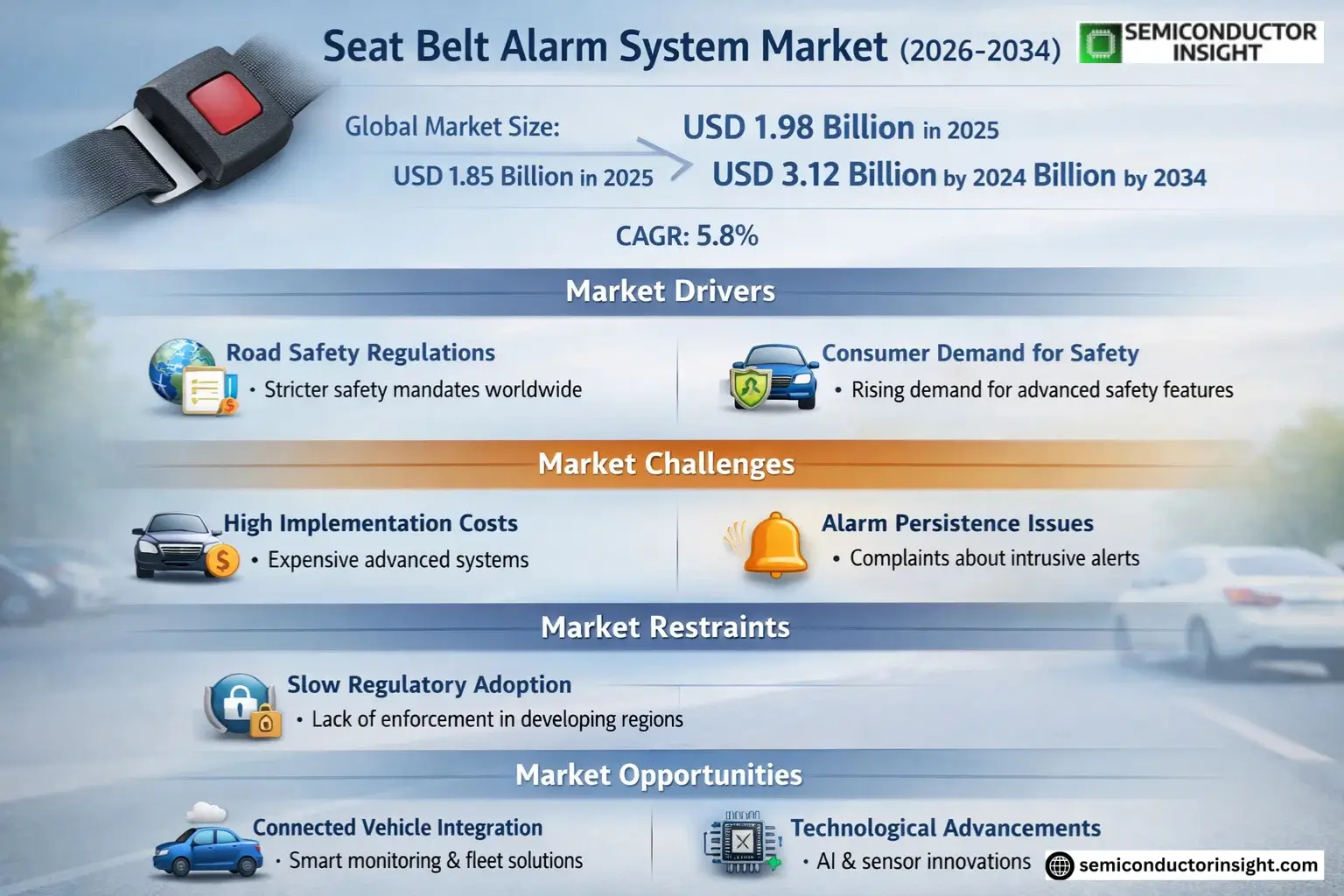
MARKET DRIVERS
Increasing Road Safety Regulations Worldwide
Stringent government mandates for vehicle safety features, particularly in developed regions, are driving the Seat Belt Alarm System Market. Over 80 countries have adopted UN Regulation 16 standards, making seat belt reminders compulsory for front seats. The growing emphasis on reducing road fatalities has accelerated adoption rates in passenger and commercial vehicles alike.
Consumer Demand for Enhanced Safety Features
Vehicle purchasers increasingly prioritize safety ratings when making buying decisions, with seat belt alarm systems becoming a standard expectation. Crash test organizations now award higher ratings to vehicles with advanced seat belt reminder systems, creating competitive pressure among automakers. The market has seen a 12% annual growth in demand for integrated seat belt alert technologies.
Technological advancements in weight sensors and intelligent reminder algorithms are creating sophisticated detection systems that improve compliance without being overly intrusive to drivers.
MARKET CHALLENGES
High Implementation Costs for Advanced Systems
While basic seat belt alarms are inexpensive, intelligent systems with occupant classification and multi-stage alerts significantly increase vehicle production costs. This creates pricing pressures, particularly in price-sensitive emerging markets where regulations may be less stringent.
Other Challenges
Consumer Complaints About Alarm Persistence
Some jurisdictions report increasing driver complaints about overly persistent seat belt alarms, leading to potential regulatory reviews of acceptable alert durations and volumes. Manufacturers must balance safety effectiveness with user experience.
MARKET RESTRAINTS
Slow Regulatory Adoption in Developing Nations
While developed markets have strict seat belt alarm requirements, many developing economies lack comprehensive regulations, limiting market penetration. The absence of enforcement mechanisms in these regions reduces the urgency for OEMs to include advanced seat belt reminder systems in all vehicle models.
MARKET OPPORTUNITIES
Integration With Connected Vehicle Technologies
The emergence of connected car ecosystems presents opportunities to enhance seat belt alarm systems through cloud-based monitoring and reporting. Fleet operators in particular show strong interest in systems that can monitor seat belt usage patterns across their vehicle pools for safety compliance and insurance benefits.
Seat Belt Alarm System Market Trends
Stringent Safety Regulations Driving Market Growth
Seat Belt Alarm System Market is experiencing significant growth due to increasingly stringent vehicle safety regulations worldwide. Governments across North America, Europe, and Asia are mandating advanced seat belt reminder systems in all vehicle classes, with particular focus on commercial fleets and passenger vehicles. The U.S. and China lead in regulatory enforcement, creating substantial market demand for compliant systems.
Other Trends
Expansion of Rear Seat Warning Systems
Automakers are increasingly integrating Seat Belt Alarm Systems for rear passengers, responding to new safety requirements in several key markets. This segment is growing faster than traditional driver-focused systems, with manufacturers developing multi-point detection technologies for comprehensive vehicle coverage.
Integration with Vehicle Telematics
Advanced Seat Belt Alarm Systems are being incorporated into vehicle telematics platforms, enabling fleet operators to monitor seat belt usage patterns. This integration provides valuable data for safety analytics while maintaining real-time compliance monitoring capabilities.
Technological Advancements in Sensor Systems
Manufacturers are developing more sophisticated seat belt detection technologies using advanced pressure sensors and AI-based occupancy detection. These innovations reduce false alarms while improving reliability, particularly in commercial vehicle applications where usage patterns vary significantly.
Market Consolidation Among Key Players
Seat Belt Alarm System Market is seeing consolidation as major automotive suppliers acquire specialized technology providers. Companies like IEE Smart Sensing Solutions and Phoenix Seating are expanding their market share through strategic partnerships and technology integration with vehicle safety platforms.
Regional Growth Variations
While developed markets show steady adoption of advanced systems, emerging economies are experiencing accelerated growth as safety awareness increases. Asia-Pacific demonstrates particularly strong demand, driven by regulatory changes in China and India’s expanding automotive manufacturing sector.
COMPETITIVE LANDSCAPE
Key Industry Players
Seat Belt Alarm System Market Dominated by Safety Technology Specialists
Global Seat Belt Alarm System Market features a mix of automotive safety specialists and seating solution providers. Phoenix Seating and IEE Smart Sensing Solutions have emerged as technology leaders, offering integrated warning systems that comply with stringent global safety regulations. The top five players collectively held significant market share in 2025, with product differentiation being a key competitive strategy. Manufacturers are increasingly focusing on multi-sensor systems that detect both seat occupancy and belt engagement.
Niche players like Cubetech Solution and FSRTEK are gaining traction through customized solutions for commercial vehicle applications. Asia-based manufacturers such as Krishna Enterprise are expanding their presence through cost-competitive offerings, while European firms dominate the premium vehicle segment. Recent industry developments include the integration of haptic feedback systems and connectivity features for fleet management applications.
List of Key Seat Belt Alarm System Companies Profiled
- Phoenix Seating
- SGESCO MAX
- IEE Smart Sensing Solutions
- Krishna Enterprise
- Cubetech Solution Sdn Bhd
- FSRTEK
- AliMed
- Freedman Seating
- Far Europe
- Hale Products
- InterMotive
- Takata Corporation
- Autoliv
- Robert Bosch GmbH
- Continental AG
Segment Analysis:
| Segment Category | Sub-Segments | Key Insights |
| By Type |
|
Driver Seat Belt Warning System dominates the market due to:
|
| By Application |
|
Commercial Vehicles show strongest growth potential because:
|
| By End User |
|
OEM Segment leads the market as:
|
| By Technology |
|
Smart Sensor Systems emerge as future growth drivers due to:
|
| By Alert Type |
|
Voice Alert Systems gain traction because:
|
Regional Analysis: Global Seat Belt Alarm System Market
North American automotive suppliers lead in developing smart seat belt alarms with machine learning capabilities. These systems differentiate between intentional non-use and temporary releases, reducing false alarms while maintaining safety compliance.
Strict NHTSA regulations mandating seat belt reminder systems for all seating positions create steady demand. Recent proposals for enhanced audible-visual alerts are pushing OEMs to upgrade their seat belt alarm systems.
High safety consciousness among North American drivers supports premium pricing for advanced seat belt alarm features. Educational campaigns by automotive safety organizations reinforce the importance of consistent seat belt usage.
The region shows strong demand for seat belt alarm retrofit solutions, particularly in commercial vehicles and older passenger cars where OEM systems are absent or outdated.
Europe
Europe maintains a strong position in the Seat Belt Alarm System Market, with EU safety regulations driving standardization across member states. The region sees growing integration of seat belt monitoring with other vehicle safety systems like airbag control units. German and French automakers are pioneering adaptive alarm systems that adjust warning intensity based on driving conditions. Suppliers are developing multi-stage alert systems that comply with upcoming Euro NCAP testing protocols.
Asia-Pacific
The Asia-Pacific region presents the fastest growth potential for seat belt alarm systems, fueled by increasing vehicle production and safety regulations. Japan and South Korea lead in technological advancements, while emerging markets like India are implementing phased-in regulations. Chinese manufacturers are developing cost-effective seat belt alarm solutions for budget vehicle segments without compromising functionality.
South America
South America shows moderate adoption of seat belt alarm systems, with Brazil and Argentina leading regional implementation. Market growth is constrained by economic volatility but supported by improving safety standards and fleet modernization programs. Local manufacturers focus on rugged systems suited for regional driving conditions.
Middle East & Africa
The Middle East demonstrates uneven adoption of seat belt alarm systems, with high-end vehicles featuring advanced systems while budget segments lag. Africa shows potential for growth as new vehicle safety regulations emerge, though most demand currently comes from commercial fleet operators and luxury vehicle buyers.
Report Scope
This market research report provides a comprehensive analysis of the Seat Belt Alarm System Market, covering the forecast period 2025–2034. It offers detailed insights into market dynamics, technological advancements, competitive landscape, and key trends shaping the industry.
Key focus areas of the report include:
- Market Overview: The report begins with an overview outlining its current market scenario, key growth indicators, and industry transformation drivers. It discusses macroeconomic factors, demand–supply balance, regulatory landscape, and the strategic role of safety systems in vehicle manufacturing.
- Market Size & Forecast: Historical data and future projections for revenue, unit shipments, and market value across major regions and segments.
- Segmentation Analysis: Detailed breakdown by product type, application, and end-user industry to identify high-growth segments and investment opportunities.
- Regional Insights: Insights into market performance across North America, Europe, Asia, Latin America, and Middle East & Africa, including country-level analysis where relevant.
- Competitive Landscape: Profiles of leading market participants, including their product offerings, R&D focus, manufacturing capacity, pricing strategies, and recent developments such as mergers, acquisitions, and partnerships.
- Technology Trends & Innovation: Assessment of emerging technologies and evolving industry standards.
- Market Drivers & Restraints: Evaluation of factors driving market growth along with challenges, supply chain constraints, regulatory issues, and market-entry barriers.
- Stakeholder Insights: Insights for component suppliers, OEMs, system integrators, investors, and policymakers regarding the evolving ecosystem and strategic opportunities.
Primary and secondary research methods are employed, including interviews with industry experts, data from verified sources, and real-time market intelligence to ensure the accuracy and reliability of the insights presented.
FREQUENTLY ASKED QUESTIONS:
What is the current market size of Seat Belt Alarm System Market?
-> Seat Belt Alarm System Market size was valued at USD 1.85 billion in 2025. The market is projected to grow from USD 1.98 billion in 2026 to USD 3.12 billion by 2034, exhibiting a CAGR of 5.8% during the forecast period.
Which key companies operate in Seat Belt Alarm System Market?
-> Key players include Phoenix Seating, SGESCO MAX, IEE Smart Sensing Solutions, Krishna Enterprise, Cubetech Solution Sdn Bhd, FSRTEK, AliMed, Freedman Seating, Far Europe, and Hale Products, among others.
What are the key growth drivers?
-> Key growth drivers include increasing vehicle safety regulations, rising awareness about passenger safety, and technological advancements in automotive safety systems.
Which region dominates the market?
-> Asia is the fastest-growing region, while North America remains a dominant market with USD million estimated market size in 2025.
What are the emerging trends?
-> Emerging trends include integration with vehicle telematics, smart sensor technologies, and development of multi-occupant alert systems.
Get Sample Report PDF for Exclusive Insights
Report Sample Includes
- Table of Contents
- List of Tables & Figures
- Charts, Research Methodology, and more...
 Download Sample Report PDF