Market Insights
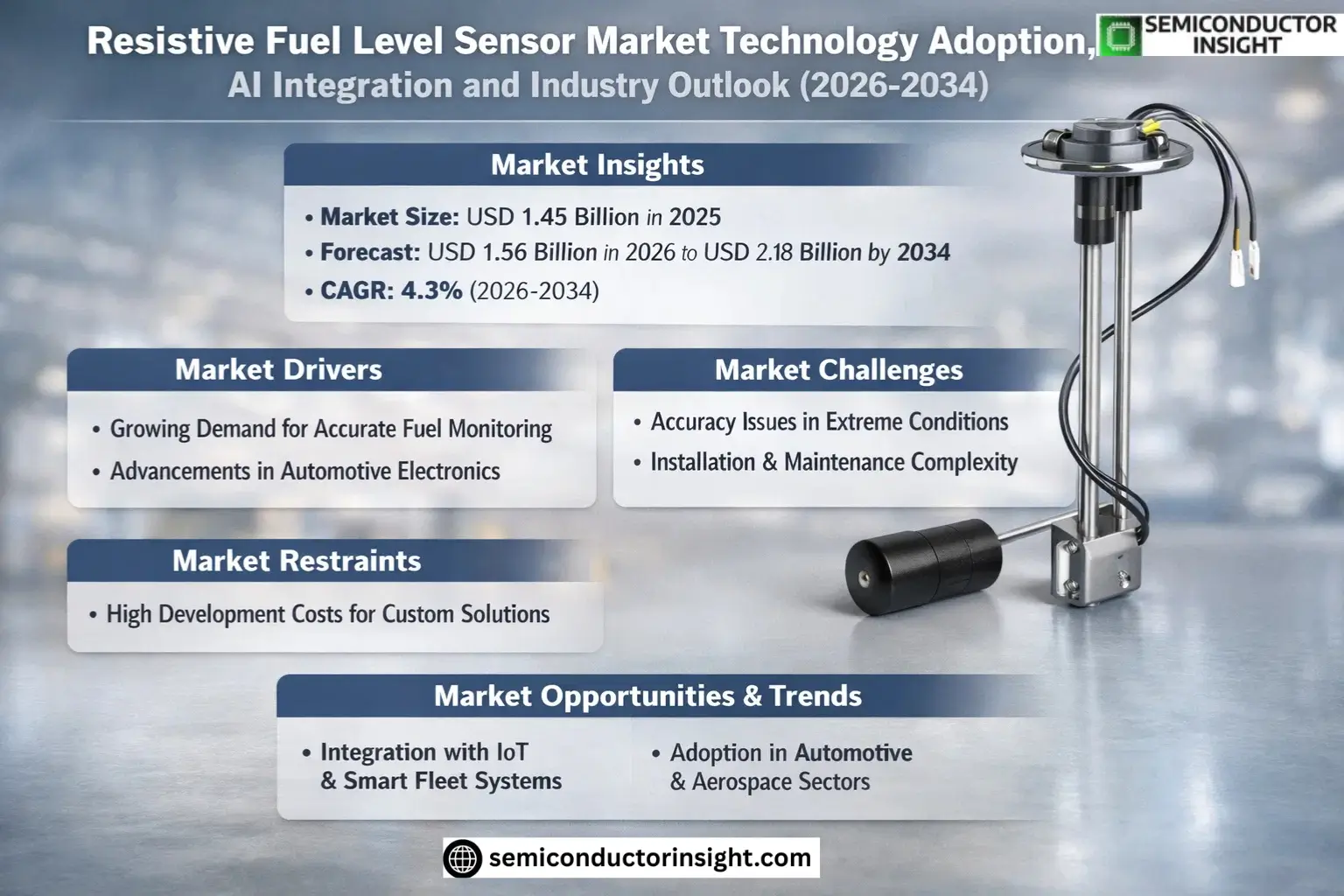
Global Resistive Fuel Level Sensor Market size was valued at USD 1.45 billion in 2025. The market is projected to grow from USD 1.56 billion in 2026 to USD 2.18 billion by 2034, exhibiting a CAGR of 4.3% during the forecast period.
Resistive fuel level sensors are critical components used to measure fuel levels in vehicles, aircraft, and marine applications. These sensors operate by detecting changes in resistance as fuel levels fluctuate, providing accurate readings for efficient fuel management. The technology includes both contact and contactless variants, catering to diverse industry requirements.
The market growth is driven by increasing vehicle production, stringent emission regulations, and advancements in automotive electronics. However, challenges such as sensor durability in harsh environments and competition from alternative technologies like capacitive sensors may restrain expansion. Key players such as Veratron, COBO, and EPT Technology are investing in R&D to enhance sensor precision and reliability.
MARKET DRIVERS
Growing Demand for Accurate Fuel Monitoring
Resistive Fuel Level Sensor Market is experiencing steady growth due to increasing demand for precise fuel monitoring across automotive and industrial applications. These sensors provide reliable measurements even in harsh conditions, making them essential for fleet management and fuel efficiency optimization. Global market is projected to grow at 5.2% CAGR through 2028.
Advancements in Automotive Electronics
Modern vehicles require sophisticated fuel monitoring systems to meet emission regulations and improve performance. Resistive fuel level sensors are increasingly integrated with telematics systems, creating new growth opportunities. The automotive segment accounts for over 65% of total market revenue, with electric vehicles presenting new integration challenges.
Stringent government regulations regarding fuel efficiency and emissions continue to propel market growth across major economies.
MARKET CHALLENGES
Technical Limitations in Extreme Conditions
While resistive fuel level sensors offer reliability, they face accuracy challenges in extreme temperature variations and with alternative fuel compositions. Market research indicates accuracy deviations up to 8% in sub-zero temperatures for standard models.
Other Challenges
Installation and Maintenance Complexity
Proper calibration and regular maintenance are required for optimal performance, increasing total cost of ownership. This presents adoption barriers for small-scale operators.
Competition from Alternative Technologies
Ultrasonic and capacitive sensors are gaining traction in premium applications, though resistive types maintain cost advantages in mass-market segments.
MARKET RESTRAINTS
High Development Costs for Custom Solutions
Developing specialized resistive fuel level sensors for niche applications requires significant R&D investment, limiting market expansion. Custom solutions can cost 3-5 times more than standard models, making them unaffordable for many potential users.
MARKET OPPORTUNITIES
Integration with IoT and Smart Fleet Systems
The rise of connected vehicles and industrial IoT presents significant growth potential for resistive fuel level sensors. Manufacturers are developing smart sensors with wireless connectivity for real-time fuel monitoring, creating new revenue streams. This segment is projected to grow at 7.8% annually through 2030.
Resistive Fuel Level Sensor Market Trends
Growing Adoption in Automotive and Aerospace Sectors
Resistive Fuel Level Sensor Market is witnessing significant growth due to increasing demand from the automotive and aerospace industries. These sensors provide accurate fuel measurement, which is critical for vehicle performance and safety. Major manufacturers are focusing on developing advanced sensors with improved durability and precision to meet stringent industry requirements.
Other Trends
Shift Toward Contactless Sensor Technology
Contactless resistive fuel level sensors are gaining traction as they offer higher reliability and longer lifespan compared to traditional contact sensors. This technology minimizes mechanical wear, making it ideal for demanding applications in marine and heavy-duty vehicles. Market leaders are investing in R&D to enhance the efficiency of contactless solutions.
Regional Market Expansion in Asia-Pacific
The Asia-Pacific region is emerging as a key growth area for the Resistive Fuel Level Sensor Market, driven by rapid industrialization and increasing automotive production. Countries like China, Japan, and South Korea are leading demand, with local manufacturers expanding their production capabilities to cater to both domestic and international markets.
Integration with Smart Monitoring Systems
Sensor manufacturers are increasingly integrating resistive fuel level sensors with IoT-enabled monitoring systems. This allows real-time fuel tracking and predictive maintenance, improving operational efficiency for fleet operators and industrial users. The trend is particularly prominent in commercial transportation and aviation sectors.
Competitive Landscape and Key Players
The market remains competitive with leading players like Veratron, COBO, and EPT Technology dominating revenue shares. Companies are focusing on strategic partnerships and product innovation to strengthen market position, particularly in high-growth segments such as electric vehicle conversion kits and hybrid systems.
COMPETITIVE LANDSCAPE
Key Industry Players
Global Resistive Fuel Level Sensor Market Dominated by Automotive and Aerospace Specialists
Global Resistive Fuel Level Sensor Market features strong consolidation among top-tier manufacturers, with Veratron and COBO leading through advanced automotive sensing technologies. These industry frontrunners collectively held a significant revenue share in 2025, leveraging their expertise in contact-based measurement systems for motor vehicle applications. The market structure shows vertical integration among aircraft sensor specialists like Aero Tec Laboratories, who maintain strategic partnerships with aerospace OEMs.
Niche innovation comes from European engineering firms such as Daviteq and EPT Technology, specializing in marine-grade fuel monitoring solutions. Emerging Asian manufacturers are gaining traction through cost-competitive contactless sensors, though quality benchmarks remain controlled by established Western players. Auxitrol Weston and Misensor continue to dominate the premium segment with military-grade fuel measurement systems featuring enhanced durability specifications.
List of Key Resistive Fuel Level Sensor Companies Profiled
- Veratron
- COBO
- EPT Technology
- Daviteq
- Auxitrol Weston
- Misensor
- Amperflex
- Aero Tec Laboratories
- MEOKON
- TI Automotive
- Sensor Scientific
- Pricol Limited
- Spectrex
- Yazaki Corporation
- Continental AG
Segment Analysis:
| Segment Category | Sub-Segments | Key Insights |
| By Type |
|
Contact Sensors dominate due to their cost-effectiveness and reliability in standard fuel monitoring applications
|
| By Application |
|
Motor Vehicle segment leads with extensive adoption across passenger and commercial vehicles
|
| By End User |
|
OEM Segment maintains strong position with integrated sensor solutions
|
| By Technology |
|
Smart Sensors emerging as game-changers with advanced features
|
| By Material |
|
Metal-based sensors dominate for their durability and conductivity
|
Regional Analysis: Asia-Pacific Resistive Fuel Level Sensor Market
China’s extensive automotive production facilities have created concentrated demand for resistive fuel level sensors, with local manufacturers developing cost-effective solutions tailored for Asian vehicle models and fuel types.
Japan’s mature automotive market shows strong aftermarket potential for resistive sensors, with vehicle owners increasingly replacing outdated mechanical systems with more precise digital resistive alternatives.
India’s massive two-wheeler market presents unique opportunities for compact resistive fuel sensors, with manufacturers developing specialized versions for motorcycles and scooters that dominate urban transportation.
Southeast Asia’s construction boom is driving demand for resistive fuel sensors in heavy machinery, where their durability in tough operating conditions makes them preferable to alternative technologies.
North America
The North American Resistive Fuel Level Sensor Market benefits from strict EPA regulations and advanced automotive technologies. US manufacturers are focusing on integrating smart resistive sensors with telematics systems for fleet management applications. The region shows strong adoption in commercial vehicles, where fuel monitoring is critical for logistics operations. Canadian markets are seeing increased demand in off-road and agricultural equipment sectors.
Europe
European markets prioritize high-precision resistive fuel sensors compatible with sophisticated engine management systems. Germany’s automotive excellence centers are driving innovations in sensor accuracy and longevity. The region’s emphasis on alternative fuels is prompting sensor adaptations for biodiesel and ethanol blends. Eastern Europe is emerging as a manufacturing base for cost-competitive sensor components.
South America
Brazil leads South America’s adoption of resistive fuel level sensors, with growth tied to flex-fuel vehicle production. Local manufacturers are developing hybrid solutions that work with multiple fuel types prevalent in the region. Infrastructure challenges are prompting innovations in ruggedized sensor designs for the commercial vehicle sector.
Middle East & Africa
The Middle East shows steady demand for resistive sensors in oilfield equipment and heavy-duty vehicles. African markets are witnessing gradual adoption driven by urbanization and improving vehicle parc. Temperature-resistant sensor variants are gaining traction in Gulf countries where extreme heat affects fuel measurement accuracy.
Report Scope
This market research report provides a comprehensive analysis of the Resistive Fuel Level Sensor Market, covering the forecast period 2025–2034. It offers detailed insights into market dynamics, technological advancements, competitive landscape, and key trends shaping the industry.
Key focus areas of the report include:
- Market Overview: The report begins with an overview outlining its current market scenario, key growth indicators, and industry transformation drivers. It discusses macroeconomic factors, demand–supply balance, regulatory landscape, and the strategic role of fuel level sensors across industries such as automotive, marine, aerospace, and industrial applications.
- Market Size & Forecast: Historical data and future projections for revenue, unit shipments, and market value across major regions and segments.
- Segmentation Analysis: Detailed breakdown by product type, technology, application, and end-user industry to identify high-growth segments and investment opportunities.
- Regional Insights: Insights into market performance across North America, Europe, Asia-Pacific, Latin America, and the Middle East & Africa, including country-level analysis where relevant.
- Competitive Landscape: Profiles of leading market participants, including their product offerings, R&D focus, manufacturing capacity, pricing strategies, and recent developments such as mergers, acquisitions, and partnerships.
- Technology Trends & Innovation: Assessment of emerging technologies, integration of AI/IoT, sensor design trends, fabrication techniques, and evolving industry standards.
- Market Drivers & Restraints: Evaluation of factors driving market growth along with challenges, supply chain constraints, regulatory issues, and market-entry barriers.
- Stakeholder Insights: Insights for component suppliers, OEMs, system integrators, investors, and policymakers regarding the evolving ecosystem and strategic opportunities.
Primary and secondary research methods are employed, including interviews with industry experts, data from verified sources, and real-time market intelligence to ensure the accuracy and reliability of the insights presented.
FREQUENTLY ASKED QUESTIONS:
What is the current market size of Resistive Fuel Level Sensor Market?
-> Resistive Fuel Level Sensor Market size was valued at USD 1.45 billion in 2025. The market is projected to grow from USD 1.56 billion in 2026 to USD 2.18 billion by 2034, exhibiting a CAGR of 4.3% during the forecast period.
Which key companies operate in Resistive Fuel Level Sensor Market?
-> Key players include Veratron, COBO, EPT Technology, Daviteq, Auxitrol Weston, Misensor, Amperflex, Aero Tec Laboratories, MEOKON, among others.
What are the key growth drivers?
-> Key growth drivers include increasing demand from automotive and aerospace industries, technological advancements in sensor accuracy, and rising adoption of fuel-efficient vehicles.
Which region dominates the market?
-> Asia-Pacific is the fastest-growing region, while North America remains a dominant market.
What are the emerging trends?
-> Emerging trends include development of contactless sensors, integration with IoT platforms, and miniaturization of sensor components.

Get Sample Report PDF for Exclusive Insights
Report Sample Includes
- Table of Contents
- List of Tables & Figures
- Charts, Research Methodology, and more...
 Download Sample Report PDF