Schmitt Trigger Inverters Market Insights
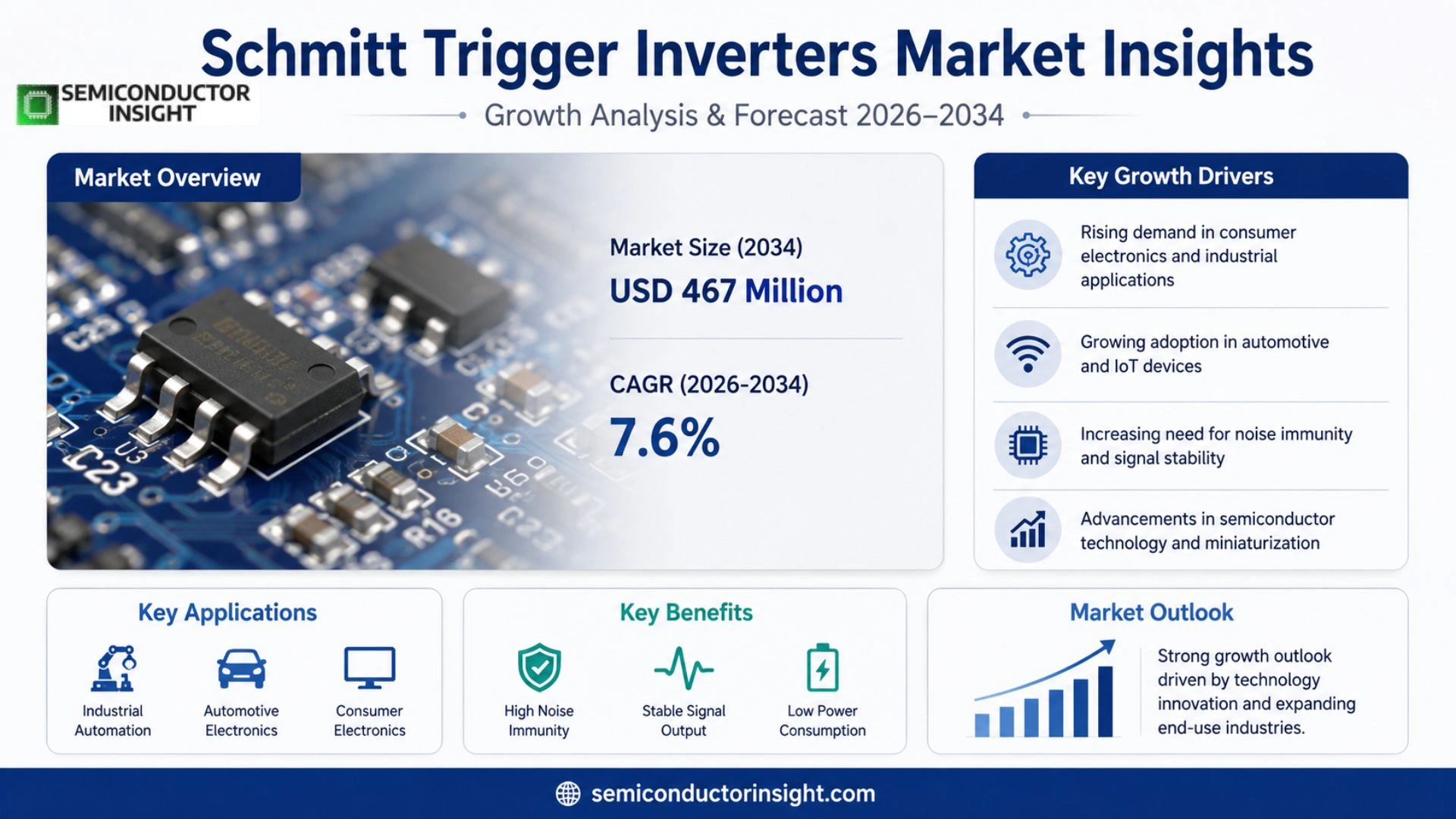
Global Schmitt Trigger Inverters market size was valued at USD 274 million in 2025 and will grow to USD 467 million by 2034, reflecting a CAGR of 7.6% over the forecast horizon.
A Schmitt Trigger Inverter is a digital logic IC that merges the conventional inverter function with a hysteresis‑based input stage, delivering enhanced noise immunity and well‑defined switching thresholds. These devices are produced using CMOS or TTL processes and are available in compact packages such as SOT‑23, SOIC or DIP; typical families include 74LVC1G14, 74LVT14D and SN74AHCT1G14.
The expansion is linked to rising adoption in consumer electronics, automotive control modules and industrial automation where reliable edge‑shaping and debounce capabilities are critical. Key suppliers,including Texas Instruments, Nexperia and ON Semiconductor,are extending their product lines while the proliferation of IoT endpoints sustains volume growth across major regions.
MARKET DRIVERS
Increasing Demand for Low‑Power Electronics
The surge in portable and battery‑operated devices has forced designers to prioritize components that minimize static power loss. Schmitt Trigger Inverters offer a clean transition between logic levels, reducing quiescent current and extending device runtimes. As OEMs embed more intelligent functions into wearables and IoT sensors, the preference for such efficient inversion circuits has become a decisive purchasing factor.
Shift Toward Higher Noise Immunity
Industrial automation and automotive electronics operate in electrically noisy environments. The hysteresis characteristic of Schmitt Trigger Inverters filters out spurious fluctuations, delivering stable outputs where conventional inverters would falter. This reliability translates into lower warranty costs and stronger brand reputation for manufacturers that specify these parts.
➤ “Designers are now specifying Schmitt Trigger Inverters not just for their logic function but for the robustness they add to overall system integrity.”
Manufacturers that integrate these inverters can command premium pricing because the downstream savings on shielding, filtering, and redesign outweigh the modest cost premium of the component itself.
MARKET CHALLENGES
Supply‑Chain Volatility
Recent semiconductor shortages have exposed the fragility of global foundry capacity. While the Schmitt Trigger Inverter is a relatively simple device, it still depends on specific silicon processes that are currently oversubscribed. Procurement teams report lead times stretching beyond six months for critical batches, which stalls production schedules.
Other Challenges
Pricing Pressure from Emerging Competitors
New entrants from low‑cost manufacturing regions are offering stripped‑down inverter families at marginally lower price points. Although these alternatives lack the full hysteresis range of established products, price‑sensitive segments such as low‑end consumer electronics may gravitate toward them, compressing margins for incumbents.
MARKET RESTRAINTS
Stringent Regulatory Requirements
Electromagnetic compatibility (EMC) standards across Europe and North America have tightened, demanding tighter control over switching transients. While Schmitt Trigger Inverters help meet these standards, certification processes add time and expense, especially for new product introductions.
Limited Differentiation in Commodity Segments
In high‑volume, cost‑driven markets, the functional gap between a standard CMOS inverter and a Schmitt‑based version narrows. Without clear value‑added features, customers may default to the cheaper option, constraining market expansion for premium devices.
Design cycles that prioritize component count reduction also discourage the addition of extra inversion stages, curbing the opportunity for Schmitt Trigger Inverters to penetrate ultra‑compact designs.
MARKET OPPORTUNITIES
Growth in Edge‑Computing Platforms
Edge‑compute nodes require reliable signal conditioning under variable power conditions. Incorporating Schmitt Trigger Inverters into power‑management ICs can simplify board layouts while safeguarding against voltage sag and bounce. This integration opens a niche where vendors can differentiate their edge solutions with higher uptime guarantees.
Customization for Automotive Safety Systems
Vehicle‑to‑everything (V2X) communications and advanced driver‑assistance systems (ADAS) rely on deterministic logic. Tailoring hysteresis thresholds to meet automotive safety integrity levels (ASIL) creates a premium product line that aligns with upcoming safety regulations, offering a clear revenue stream for firms that invest in automotive‑grade qualifications.
Integration with Power‑Management ASICs
Silicon vendors are bundling Schmitt Trigger functionality directly into mixed‑signal ASICs aimed at IoT gateways. This trend reduces bill‑of‑materials while delivering a turnkey solution for developers, expanding the addressable market for Schmitt Trigger Inverters segment.
Schmitt Trigger Inverters Market Trends
Rising Demand for Noise‑Robust Logic in Embedded Systems
Schmitt Trigger Inverters market, valued at US$274 million in 2025, is on track to reach roughly US$467 million by 2032. The upward trajectory reflects a broader shift toward electronic designs that must operate reliably in electrically noisy environments, such as automotive control units and IoT edge devices. Designers are increasingly selecting devices with built‑in hysteresis because they simplify board‑level layouts, eliminate the need for external filtering components, and reduce overall power consumption. As manufacturers embed more sensors and connectivity into compact products, the tolerance for spurious transitions shrinks, prompting a clear preference for the stable switching characteristics offered by Schmitt trigger ICs.
Other Trends
Advances in CMOS Process Technology
Modern CMOS nodes enable Schmitt Trigger Inverters to be packaged in ultra‑small footprints like SOT‑23 while maintaining wide supply‑voltage ranges from 1.65 V to 5.5 V. This scalability aligns with the industry’s push for higher component density in mobile and wearable platforms. Moreover, reduced gate leakage in advanced processes translates to lower static power draw, a decisive factor for battery‑powered applications. As a result, leading vendors such as Texas Instruments and Nexperia have expanded their portfolios with low‑power variants that meet stringent energy budgets without sacrificing threshold stability.
Supply‑Chain Consolidation and Regional Shifts
Supply‑chain analysis shows a concentration of fabrication capacity in the Asia‑Pacific region, where most foundries operate at high volume and cost efficiency. Meanwhile, North America and Europe emphasize design innovation and system integration, creating a two‑tier ecosystem: ASIC and FPGA developers in the west rely on Asian‑manufactured Schmitt trigger parts for final product assembly. This geographic split encourages strategic partnerships, ensuring that inventory levels remain resilient despite occasional disruptions. Companies that secure diversified distribution channels are better positioned to capitalize on the expanding application base across automotive, consumer electronics, and industrial automation segments.
COMPETITIVE LANDSCAPE
Key Industry Players
Competitive Overview of the Schmitt Trigger Inverter Market
Texas Instruments continues to dominate the Schmitt‑trigger inverter segment thanks to its extensive CMOS logic portfolio, broad distribution network, and deep engineering support. The company’s ability to integrate hysteresis‑enhanced inverters into mixed‑signal families such as SN74LVC and SN74AHCT gives design‑win leverage across automotive, consumer, and industrial customers. Its scale permits aggressive pricing while preserving margin, a balance that forces smaller rivals to specialize or target niche applications. The market structure therefore resembles a tiered hierarchy: a few global fabs supply the bulk of volume, while a constellation of regional players occupies price‑sensitive or application‑specific corners.
Beyond the clear leader, the landscape is populated by a diverse set of manufacturers that sustain competitive pressure. Nexperia leverages its legacy of robust TTL/CMOS devices to serve cost‑conscious OEMs, whereas STMicroelectronics and ON Semiconductor focus on automotive‑grade reliability and extended temperature ranges. NXP adds value through its extensive IP ecosystem, enabling designers to embed Schmitt‑trigger functions within broader microcontroller families. Rohm and Toshiba supply high‑frequency variants suited to communication gear, while Diodes Incorporated offers compact SOT‑23 packages for IoT boards. Asian contenders such as Hangzhou Silan Microelectronics and Infineon Technologies supply volume‑driven parts to regional fabs, and Analog Devices provides precision comparator‑based implementations for niche signal‑conditioning tasks. This breadth of players creates a resilient supply chain and drives incremental innovation in threshold tuning, power efficiency, and package density.
List of Key Schmitt Trigger Inverter Companies Profiled
- Texas Instruments
- Nexperia
- STMicroelectronics
- ON Semiconductor
- NXP Semiconductors
- Rohm Semiconductor
- Toshiba Electronic Devices & Storage
- Diodes Incorporated
- Hangzhou Silan Microelectronics
- Infineon Technologies
- Analog Devices
- Microchip Technology
Segment Analysis:
| Segment Category | Sub-Segments | Key Insights |
| By Type |
|
Single Schmitt‑Trigger Inverter is the dominant form because it offers the most compact footprint and lowest power consumption, making it ideal for space‑constrained IoT and consumer devices. Key qualitative drivers:
|
| By Application |
|
Automotive emerges as the leading application segment due to stringent requirements for noise immunity and temperature robustness in vehicle control and infotainment systems. Qualitative observations:
|
| By End User |
|
OEMs dominate end‑user demand as they embed Schmitt trigger inverters directly into mass‑produced boards for consumer, automotive, and industrial devices. Important qualitative factors:
|
| By Circuit Implementation |
|
CMOS Integrated Schmitt Inverter is the preferred implementation because it delivers the best combination of speed, power efficiency, and manufacturability. Qualitative drivers include:
|
| By Physical Form |
|
SOT‑23 Package leads the physical form segment as its miniature footprint and low‑cost assembly suit high‑volume consumer and IoT products. Qualitative insights:
|
Regional Analysis: Schmitt Trigger Inverters Market
North America
Companies in the leading region invest heavily in mixed‑signal design tools that allow tighter integration of Schmitt trigger stages with power‑saving algorithms. This results in modules that meet the exacting latency and noise tolerance required by modern robotics and electric‑vehicle powertrains, giving local vendors a distinct edge in high‑value contracts.
Proximity between silicon fabs, component distributors, and system integrators shortens the procurement cycle. The ability to source critical passive components domestically mitigates exposure to overseas disruptions, a factor that many customers now weigh heavily in supplier selection.
Early adopters across aerospace and defense urge manufacturers to embed enhanced over‑voltage protection within inverter stages. Responding to these signals, firms iterate quickly, aligning product roadmaps with the evolving safety criteria demanded by mission‑critical applications.
The region’s standards bodies continuously revise electromagnetic emissions limits, compelling designers to refine trigger thresholds. This regulatory pressure drives a culture of meticulous testing that raises the overall quality benchmark for the market.
Europe
European manufacturers benefit from a collaborative ecosystem that blends long‑standing precision engineering with a strong emphasis on sustainability. Power‑efficient inverter designs are increasingly required to meet the EU’s Green Deal objectives, encouraging firms to embed adaptive threshold mechanisms that reduce idle current draw. Moreover, a dense network of specialized component suppliers across Germany and the Nordic countries shortens development cycles for niche applications such as high‑speed rail and renewable‑energy converters. While the market enjoys robust demand from automotive safety systems, procurement decisions are often tempered by rigorous certification processes, which can lengthen time‑to‑market but ensure durability in demanding environments. The region’s focus on modularity allows OEMs to reuse inverter blocks across diverse platforms, creating economies of scale that offset higher material costs associated with premium silicon.
Asia‑Pacific
The Asia‑Pacific corridor, led by China, Japan, and South Korea, presents a rapidly evolving landscape where cost efficiency intersects with burgeoning consumer electronics demand. Manufacturers in this zone leverage high‑volume production capabilities to deliver competitively priced inverter modules, a factor that drives adoption in mass‑market devices such as smart appliances and portable power tools. Simultaneously, a surge in electric‑vehicle assembly lines is prompting local designers to incorporate more robust Schmitt trigger thresholds to handle the wider voltage swings typical of automotive powertrains. Government incentives aimed at expanding domestic chip fabs have begun to alleviate past concerns over reliance on imported silicon, gradually strengthening the regional supply base. However, divergent standards across national markets sometimes complicate cross‑border component integration, nudging firms toward region‑specific customization.
South America
In South America, market activity is anchored primarily in Brazil and Mexico, where growth in industrial automation and renewable‑energy projects fuels demand for reliable inverter solutions. The emphasis on ruggedized designs reflects the continent’s diverse operating conditions, ranging from humid tropical climates to high‑altitude mining sites. Local assemblers often partner with North American design houses to gain access to advanced Schmitt trigger architectures, thereby bridging technology gaps while maintaining cost competitiveness. Trade agreements that lower tariff barriers have facilitated the influx of premium components, enabling system integrators to meet stricter performance metrics without inflating project budgets. Nevertheless, uneven infrastructure development across the region can hinder consistent product rollout, prompting firms to adopt flexible deployment strategies.
Middle East & Africa
The Middle East & Africa region displays a heterogeneous profile, where oil‑rich economies invest heavily in petrochemical control systems, while emerging markets focus on solar‑farm inverters. In the Gulf Cooperation Council, the need for high‑temperature tolerant inverter designs drives the incorporation of Schmitt triggers with enhanced thermal stability, ensuring uninterrupted operation in extreme heat. African nations, on the other hand, are prioritizing off‑grid power solutions; this trend encourages suppliers to develop compact, low‑maintenance inverter packages that can be quickly deployed in remote villages. Strategic partnerships with European firms are common, as they provide design expertise that complements local manufacturing capabilities. The overall pace of adoption is moderated by varying levels of capital availability, yet the region’s appetite for resilient, energy‑efficient technology remains a catalyst for continued market maturation.
Report Scope
This market research report provides a comprehensive analysis of the Schmitt Trigger Inverters Market , covering the forecast period 2026–2034. It offers detailed insights into market dynamics, technological advancements, competitive landscape, and key trends shaping the industry.
Key focus areas of the report include:
- Market Overview: The report begins with an overview outlining its current market scenario, key growth indicators, and industry transformation drivers. It discusses macroeconomic factors, demand–supply balance, regulatory landscape, and the strategic role of semiconductors in powering advancements across industries such as automotive, telecommunications, consumer electronics, and industrial automation.
- Market Size & Forecast: Historical data and future projections for revenue, unit shipments, and market value across major regions and segments.
- Segmentation Analysis: Detailed breakdown by product type, technology, application, and end-user industry to identify high-growth segments and investment opportunities.
- Regional Insights: Insights into market performance across North America, Europe, Asia-Pacific, Latin America, and the Middle East & Africa, including country-level analysis where relevant.
- Competitive Landscape: Profiles of leading market participants, including their product offerings, R&D focus, manufacturing capacity, pricing strategies, and recent developments such as mergers, acquisitions, and partnerships.
- Technology Trends & Innovation: Assessment of emerging technologies, integration of AI/IoT, semiconductor design trends, fabrication techniques, and evolving industry standards.
- Market Drivers & Restraints: Evaluation of factors driving market growth along with challenges, supply chain constraints, regulatory issues, and market-entry barriers.
- Stakeholder Insights: Insights for component suppliers, OEMs, system integrators, investors, and policymakers regarding the evolving ecosystem and strategic opportunities.
Primary and secondary research methods are employed, including interviews with industry experts, data from verified sources, and real-time market intelligence to ensure the accuracy and reliability of the insights presented.
FREQUENTLY ASKED QUESTIONS:
What is the current market size of Schmitt Trigger Inverters Market?
-> Schmitt Trigger Inverters market will grow to USD 467 million by 2034, reflecting a CAGR of 7.6% over the forecast horizon.
Which key companies operate in Schmitt Trigger Inverters Market?
-> Key players include Texas Instruments, Nexperia, ON Semiconductor, STMicroelectronics, NXP Semiconductors, Diodes Incorporated, Toshiba, Rohm, among others.
What are the key growth drivers?
-> Key growth drivers include demand from consumer electronics, automotive electronics, industrial automation, advances in CMOS technology and low‑power design trends.
Which region dominates the market?
-> Asia‑Pacific is the fastest‑growing region, while Europe remains a dominant market.
What are the emerging trends?
-> Emerging trends include integration of low‑power wide‑voltage designs, IoT‑focused miniaturized packages, and advanced CMOS processes enhancing noise immunity.

Get Sample Report PDF for Exclusive Insights
Report Sample Includes
- Table of Contents
- List of Tables & Figures
- Charts, Research Methodology, and more...
 Download Sample Report PDF