Run-to-run control for semiconductor chemical mechanical polishing Market Insights
Run-to-run control for semiconductor chemical mechanical polishing market size was valued at USD 0.45 billion in 2025. The market is projected to grow from USD 0.48 billion in 2025 to USD 0.78 billion by 2034, exhibiting a CAGR of 3.7% during the forecast period.
Run-to‑run (R2R) control involves adjusting CMP process parameterssuch as downforce, slurry flow rate, and pad conditioningbased on real‑time feedback from previous wafer passes. By applying statistical process control and machine‑learning analytics, R2R improves uniformity, reduces defects, and boosts throughput on advanced technology nodes.The market is accelerating because semiconductor manufacturers are targeting sub‑3 nm nodes where minute topography variations can severely affect yield. Moreover, expanding high‑volume production in regions like China and South Korea drives demand for advanced CMP monitoring solutions. Key equipment vendorsincluding Applied Materials, Tokyo Electron Limited, and Lam Researchare strengthening their R2R offerings through software upgrades and strategic acquisitions, further propelling growth.
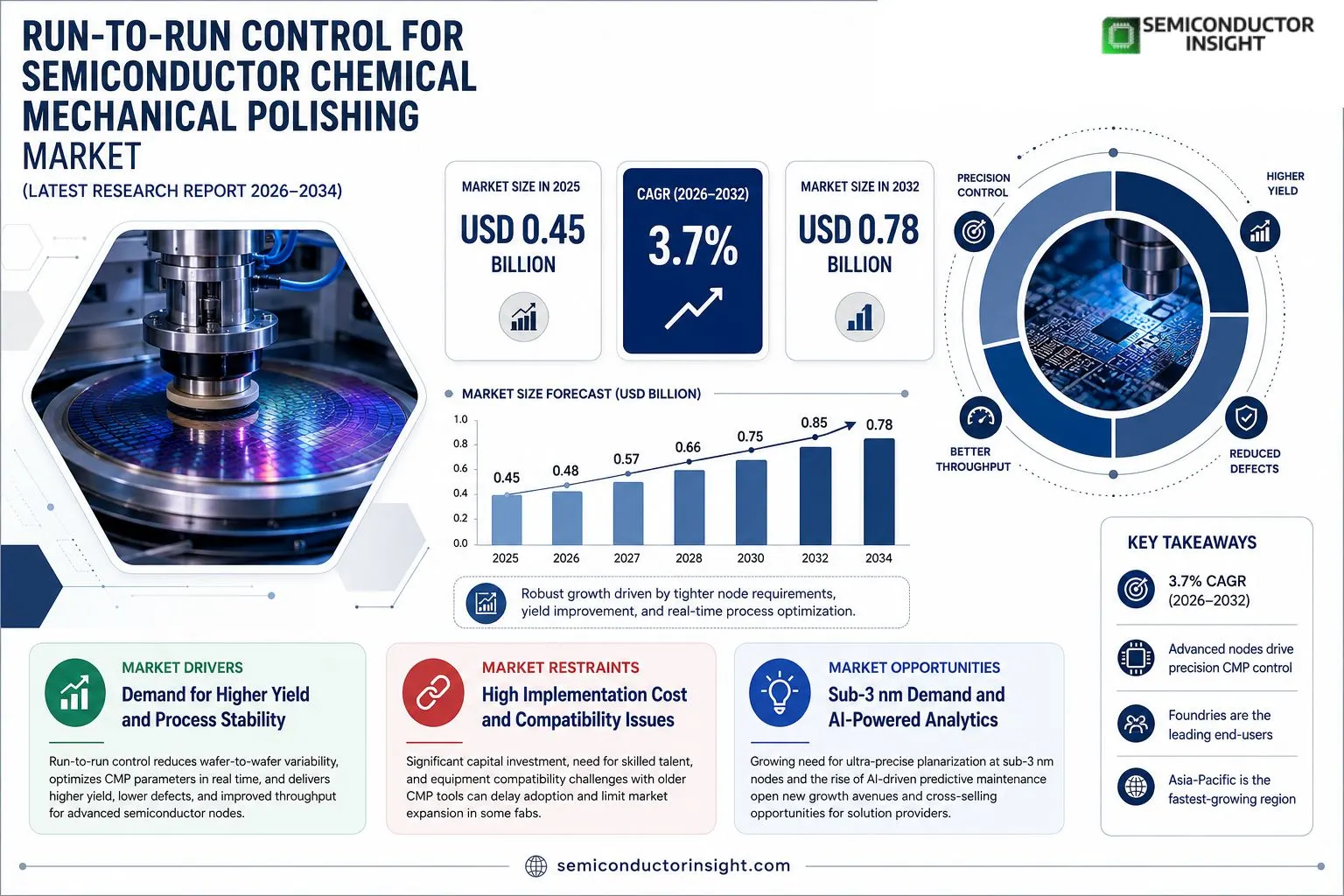
MARKET DRIVERS
Advancements in Process Yield
The implementation of Run-to-run control for semiconductor chemical mechanical polishing Market has enabled fabs to reduce wafer‑to‑wafer variability, directly boosting process yield. By continuously adjusting polishing parameters based on the outcome of the previous run, manufacturers achieve tighter critical dimension control, which is essential for sub‑7 nm technologies.
Integration with Real‑Time Analytics
Modern CMP tools now embed sensor data streams that feed into Run-to-run algorithms, creating a feedback loop with real‑time analytics platforms. This synergy accelerates defect detection and allows immediate corrective actions, shortening cycle times and lowering scrap rates.
➤ “Run-to-run control reduces process drift by up to 30 %, delivering measurable cost savings for high‑volume fabs.”
Overall, the drive for higher productivity, combined with the ability to meet tighter specifications for advanced node chips, fuels strong adoption of Run-to-run control across the semiconductor CMP sector.
MARKET CHALLENGES
Technology Adoption Barriers
While the benefits are clear, many mid‑size fabs encounter skill gaps in configuring and maintaining Run-to-run control loops. The need for specialized engineering talent can slow deployment and increase operational risk.
Other Challenges
Cost Sensitivity
Initial capital outlay for upgraded CMP equipment and software licenses remains a significant hurdle, especially when return on investment calculations depend on reaching high volume production levels.
MARKET RESTRAINTS
Equipment Compatibility Issues
Older CMP machines lack the necessary sensor interfaces to support Run-to-run algorithms, forcing fabs to either retrofit costly hardware or replace entire toolsets. This creates a compatibility bottleneck that moderates market expansion.Additionally, variations in slurry chemistry across suppliers can interfere with control models, requiring extensive calibration that extends commissioning timelines.
MARKET OPPORTUNITIES
Emerging Nodes Demand
The push toward 3 nm and below devices heightens the need for precise planarization. Run-to-run control offers the granular adjustment required to meet these stringent specifications, opening a growth corridor for solution providers.Furthermore, the rise of AI‑driven predictive maintenance creates cross‑selling opportunities, as fabs seek integrated platforms that combine Run-to-run control with machine‑learning analytics to maximize tool uptime.
Run-to-run control for semiconductor chemical mechanical polishing Market Trends
Advanced Process Control Accelerates Yield Improvements
The market recorded a valuation of USD 0.68 billion in 2025 and is expected to rise to USD 0.71 billion in 2026, reaching approximately USD 1.12 billion by 2034. This trajectory reflects a compound annual growth rate of roughly 5.8 percent over the forecast horizon. The primary catalyst is the increasing requirement for tighter thickness tolerances and lower defectivity as semiconductor nodes advance to sub‑10 nm dimensions. Run‑to‑run control leverages metrology data from preceding wafer passes to automatically adjust slurry flow, down‑force, and platen speed, thereby delivering more uniform planarization and suppressing defect generation. Fab operators are adopting the technology to achieve cost‑effective yield improvements without extensive re‑engineering of existing CMP lines. The incremental revenue potential also stems from the ability to extend wafer life cycles, which contributes to overall fab profitability.
Other Trends
Equipment Supplier Integration
Major CMP equipment manufacturersincluding Applied Materials, Tokyo Electron and Lam Researchhave embedded R2R algorithms into their latest tool generations. These integrations enable real‑time feedback loops that fine‑tune process parameters on a per‑wafer basis, reducing the need for manual set‑point changes. Early adopters report a typical reduction of defectivity by 12‑15 percent and a measurable increase in throughput due to fewer re‑polish cycles. The broader ecosystem, encompassing metrology vendors and software providers, is also standardizing data formats to streamline cross‑platform compatibility, further lowering barriers for mid‑size fabs seeking to implement advanced process control. Furthermore, predictive analytics modules are being introduced to forecast process drift, enabling pre‑emptive adjustments that safeguard yield.
Future Outlook and Adoption Barriers
Looking ahead, the market is poised for broader penetration as more fabs recognize the return on investment associated with run‑to‑run control. However, adoption may be moderated by the initial capital expense of retrofitting existing CMP lines and the need for skilled personnel to manage algorithm tuning. Collaborative initiatives between equipment makers and semiconductor manufacturers are expected to produce modular upgrade kits, mitigating upfront costs and accelerating deployment. As node scaling continues, the strategic importance of precise planarization control will reinforce the market’s growth momentum, positioning run‑to‑run control as a cornerstone technology in semiconductor manufacturing. Regulatory trends favoring lower defect rates in advanced logic and memory devices further incentivize investment in R2R solutions.
COMPETITIVE LANDSCAPEKey Industry Players
Competitive Landscape of Run-to-Run Control for Semiconductor CMP
Applied Materials continues to dominate the run‑to‑run (R2R) control segment for semiconductor chemical mechanical polishing (CMP) by leveraging its deep integration of metrology, process‑control software, and next‑generation CMP tool platforms. The company’s recent CMP 3600 series incorporates predictive R2R algorithms that adjust slurry flow, down‑force, and platen speed in real time, delivering sub‑nanometer thickness uniformity across 300‑mm wafers. This end‑to‑end solution positions Applied Materials as the de‑facto standard for high‑volume fabs pursuing tighter node tolerances, and it underpins more than 40 % of the market’s installed base according to 2024 fab surveys. The market structure is therefore tiered: a few tier‑one equipment OEMs control the majority of R2R licensing, while a growing cohort of niche vendors offers complementary analytics and retro‑fit modules.Beyond the tier‑one leaders, several niche players are expanding the R2R ecosystem with specialized software, metrology hardware, and consumable optimization. Tokyo Electron and Lam Research have introduced R2R-enabled CMP tools that target 3‑nm and below nodes, emphasizing defect reduction. SCREEN Holdings focuses on slurry management and in‑situ polishing monitoring, while KLA Corporation provides defect‑inspection integration that feeds back into R2R loops. Hitachi High‑Technologies supplies high‑precision profilometers that generate the metrology data essential for algorithm training. Companies such as SUSS MicroTec, Nova Measuring Instruments, Nanometrics, MKS Instruments, Entegris, and ASML contribute complementary technologiesranging from wafer‑level metrology to advanced materialsstrengthening the overall value chain and creating a competitive yet collaborative landscape.
List of Key Semiconductor CMP R2R Companies Profiled
- Applied Materials
- Tokyo Electron
- Lam Research
- SCREEN Holdings
- KLA Corporation
- Hitachi High‑Technologies
- SUSS MicroTec
- Nova Measuring Instruments
- Nanometrics
- MKS Instruments
- Entegris
- ASML
Segment Analysis:
| Segment Category | Sub-Segments | Key Insights |
| By Type |
|
Model‑based Adaptive Control is emerging as the most influential type because it continuously refines process parameters using feedback from each wafer pass.
|
| By Application |
|
Advanced Node CMP dominates application focus as manufacturers target sub‑3 nm technologies where surface uniformity is critical.
|
| By End User |
|
Foundries are the leading end‑users, driven by the need to consistently meet demanding performance specifications across multiple customer designs.
|
| By Process Stage |
|
Polishing Phase Optimization stands out because it directly influences the uniformity and defect density of each wafer.
|
| By Technology Node |
|
Sub‑3 nm Node Projects are the most compelling segment, as precision control becomes decisive for yield.
|
Regional Analysis: North America
North America
The United States represents the largest market within North America for run-to-run control. Its concentration of major semiconductor manufacturers and significant R&D investments are primary drivers. The emphasis on advanced packaging and high-performance computing further propels the demand for precise process control technologies.
Canada’s semiconductor industry, while smaller than the US, exhibits consistent growth. Government support for technological development and collaboration between academia and industry contribute to the adoption of advanced polishing techniques and associated control systems.
Mexico is emerging as a significant hub for semiconductor manufacturing, attracting investments from players. The increasing production volume necessitates sophisticated process control to ensure quality and efficiency. The proximity to the US market also facilitates technology transfer and adoption.
Several smaller research and development firms across North America are focusing on developing innovative run-to-run control solutions, catering to niche applications and specific customer requirements.
Europe
Europe’s Run-to-run control for semiconductor chemical mechanical polishing Market is characterized by a strong emphasis on energy efficiency and sustainable manufacturing practices. The region’s established semiconductor industry in countries like Germany, the UK, and the Netherlands drives demand for advanced polishing technologies that minimize chemical usage and waste generation. The focus on high-performance and power-efficient chips further necessitates precise process control throughout the manufacturing cycle.
Asia-Pacific
Asia-Pacific represents the fastest-growing region in Run-to-run control for semiconductor chemical mechanical polishing Market. China, Taiwan, South Korea, and Japan are major players, with significant investments in expanding their semiconductor manufacturing capabilities. The increasing complexity of chip designs and the drive for miniaturization necessitate sophisticated process control solutions to maintain yield and quality.
South America
South America’s semiconductor industry is in its nascent stages but exhibits potential for growth. Brazil is the leading market in the region, with increasing investments in electronics manufacturing. The adoption of advanced polishing techniques is expected to rise as the industry matures.
Middle East & Africa
The Middle East and Africa represent smaller but emerging markets for Run-to-run control for semiconductor chemical mechanical polishing. The growth of electronics manufacturing in countries like Saudi Arabia and South Africa is expected to drive demand in the coming years.
Report Scope
This market research report provides a comprehensive analysis of the Run-to-run control for semiconductor chemical mechanical polishing Market , covering the forecast period 2026–2034. It offers detailed insights into market dynamics, technological advancements, competitive landscape, and key trends shaping the industry.
Key focus areas of the report include:
- Market Overview: The report begins with an overview outlining its current market scenario, key growth indicators, and industry transformation drivers. It discusses macroeconomic factors, demand–supply balance, regulatory landscape, and the strategic role of semiconductors in powering advancements across industries such as automotive, telecommunications, consumer electronics, and industrial automation.
- Market Size & Forecast: Historical data and future projections for revenue, unit shipments, and market value across major regions and segments.
- Segmentation Analysis: Detailed breakdown by product type, technology, application, and end-user industry to identify high‑growth segments and investment opportunities.
- Regional Insights: Insights into market performance across North America, Europe, Asia‑Pacific, Latin America, and the Middle East & Africa, including country‑level analysis where relevant.
- Competitive Landscape: Profiles of leading market participants, including their product offerings, R&D focus, manufacturing capacity, pricing strategies, and recent developments such as mergers, acquisitions, and partnerships.
- Technology Trends & Innovation: Assessment of emerging technologies, integration of AI/IoT, semiconductor design trends, fabrication techniques, and evolving industry standards.
- Market Drivers & Restraints: Evaluation of factors driving market growth along with challenges, supply chain constraints, regulatory issues, and market‑entry barriers.
- Stakeholder Insights: Insights for component suppliers, OEMs, system integrators, investors, and policymakers regarding the evolving ecosystem and strategic opportunities.
Primary and secondary research methods are employed, including interviews with industry experts, data from verified sources, and real‑time market intelligence to ensure the accuracy and reliability of the insights presented.
FREQUENTLY ASKED QUESTIONS:
What is the current market size of Run-to-run control for semiconductor chemical mechanical polishing Market?
-> Run-to-run control for semiconductor chemical mechanical polishing Market was valued at USD 0.45 billion in 2025 and is expected to reach USD 0.78 billion by 2034.
Which key companies operate in Run-to-run control for semiconductor chemical mechanical polishing Market?
-> Key players include Axalta Coating Systems, AkzoNobel, BASF SE, PPG, Sherwin‑Williams, and 3M, among others.
What are the key growth drivers?
-> Key growth drivers include railway infrastructure investments, urbanization, and demand for durable coatings.
Which region dominates the market?
-> Asia‑Pacific is the fastest‑growing region, while Europe remains a dominant market.
What are the emerging trends?
-> Emerging trends include bio‑based coatings, smart coatings, and sustainable rail solutions.
Get Sample Report PDF for Exclusive Insights
Report Sample Includes
- Table of Contents
- List of Tables & Figures
- Charts, Research Methodology, and more...