MARKET INSIGHTS
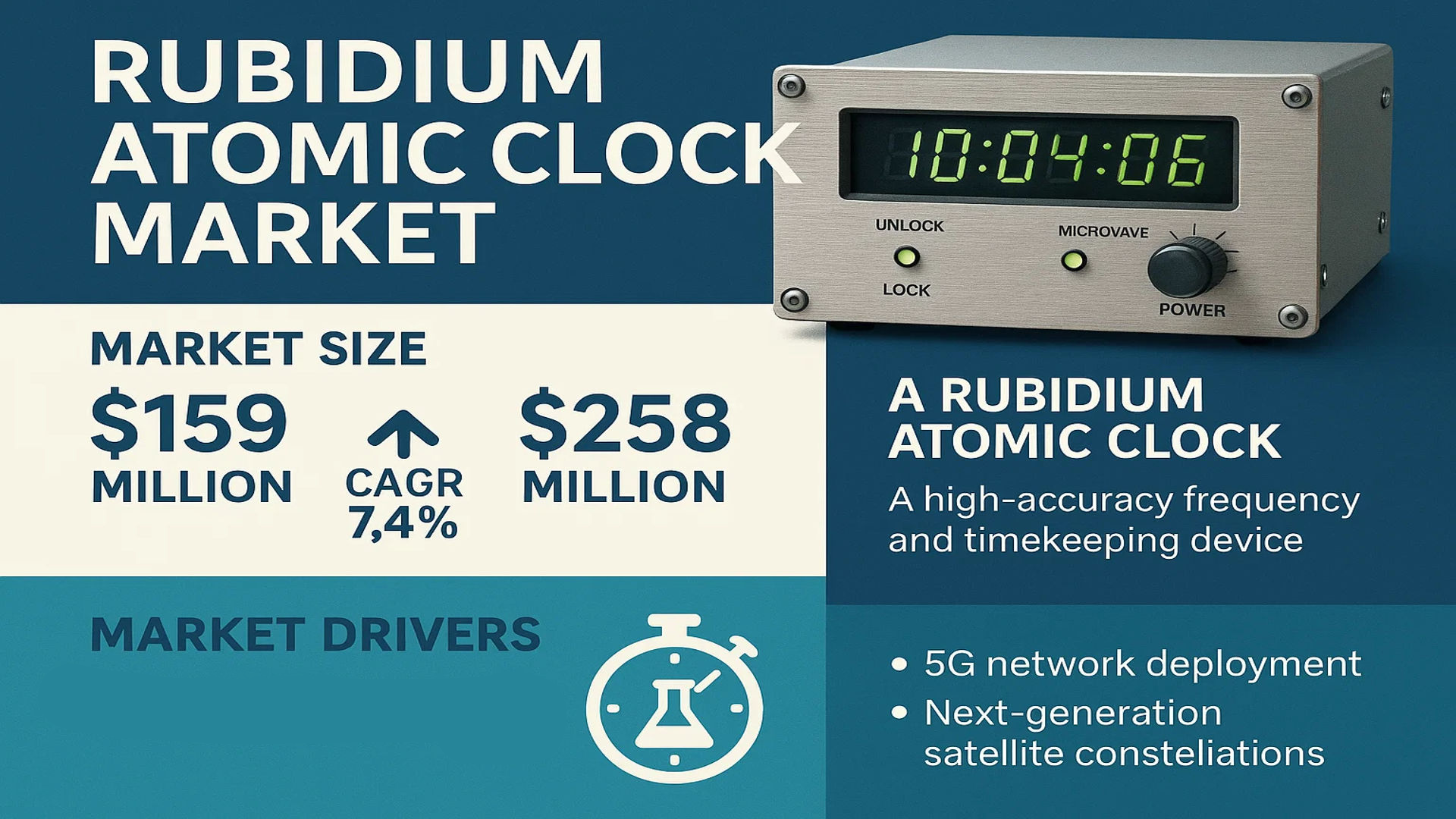
The global Rubidium Atomic Clock Market was valued at 159 million in 2024 and is projected to reach US$ 258 million by 2032, at a CAGR of 7.4% during the forecast period.
A Rubidium Atomic Clock, often termed a rubidium standard, is a high-accuracy frequency and timekeeping device. It operates by utilizing a glass cell containing rubidium gas; the absorption of light by this gas changes at a specific optical frequency when the surrounding microwave frequency is precisely tuned. As the most compact, cost-effective, and widely produced type of atomic clock, it serves as a secondary frequency standard, crucial for synchronizing networks in telecommunications, broadcasting, and global navigation satellite systems (GNSS) like GPS.
Market expansion is primarily driven by escalating demand for precise timing solutions in critical infrastructure, including 5G network deployment and next-generation satellite constellations. Furthermore, advancements in miniaturization and power efficiency are broadening their application in portable and space-constrained military/aerospace systems. The competitive landscape is concentrated, with the top five manufacturers holding approximately 75% of the global market share, underscoring the presence of established technological leaders.
MARKET DYNAMICS
MARKET DRIVERS
Expansion of Global Navigation Satellite Systems to Accelerate Market Growth
The proliferation of global navigation satellite systems (GNSS) is a primary driver for the rubidium atomic clock market. These clocks provide the high-precision timing essential for satellite positioning, navigation, and data synchronization. With over 3,400 operational GNSS satellites currently in orbit and continuous deployment of new constellations, the demand for reliable, compact frequency standards is surging. Rubidium clocks, offering stability within 1 part in 10^11, are integral to ensuring signal accuracy and system resilience. The ongoing modernization of systems like GPS, Galileo, and BeiDou, coupled with increasing satellite launches—projected to exceed 2,500 annually by 2030—fuels consistent demand. Furthermore, the rise of autonomous vehicles and smart infrastructure, which rely on precise timing, reinforces this growth trajectory.
Growing 5G and Telecommunications Infrastructure Deployment
The rollout of 5G networks worldwide significantly drives the adoption of rubidium atomic clocks. These networks require ultra-precise time synchronization to minimize latency and ensure coherent operation across base stations. With over 1.3 billion 5G subscriptions globally and forecasts suggesting coverage for 65% of the world’s population by 2025, the need for secondary frequency standards is escalating. Rubidium clocks provide a cost-effective solution compared to cesium standards, with typical accuracy of 5×10^-11 per month, making them ideal for telecom applications. The expansion of IoT devices, which exceeded 15 billion in 2023 and is growing at 18% annually, further amplifies the need for robust timing solutions. This telecommunications boom, especially in emerging economies, ensures sustained market momentum.
Increased Defense and Aerospace Expenditures
Rising global defense budgets and space exploration initiatives are propelling the rubidium atomic clock market. Military systems, including encrypted communications, radar, and electronic warfare, depend on precise timing for synchronization and jamming resistance. Global defense spending surpassed $2.2 trillion in 2023, with significant allocations to modernizing navigation and communication systems. Additionally, the space sector is experiencing robust growth, with over 180 orbital launches in 2023 alone, many utilizing rubidium clocks for payload timing. The clocks’ resilience to vibration and temperature fluctuations—operating reliably from -40°C to 75°C—makes them suitable for harsh environments. This dual demand from defense and aerospace sectors, supported by government investments, underpins market expansion.
Moreover, advancements in miniaturization and power efficiency, such as devices consuming under 1.5 watts, enhance their applicability in portable and satellite systems.
➤ For instance, recent contracts for military communication satellites often specify rubidium clocks due to their balance of performance, size, and cost.
Furthermore, collaborations between governments and private entities in space missions are expected to drive continued adoption.
MARKET CHALLENGES
Competition from Emerging Timing Technologies to Constrain Growth
While the rubidium atomic clock market is expanding, it faces intensifying competition from alternative technologies like chip-scale atomic clocks (CSACs) and advanced crystal oscillators. CSACs, though less stable initially, are improving rapidly and offer significant advantages in size, power consumption, and cost for certain applications. For example, CSACs now achieve stabilities of 3×10^-10 per day while consuming only 100 milliwatts, making them attractive for portable devices. This technological evolution pressures rubidium clock manufacturers to innovate continuously to maintain market share, especially in consumer and IoT segments where price sensitivity is high.
Other Challenges
Supply Chain Vulnerabilities
The production of rubidium atomic clocks relies on specialized components and raw materials, including rubidium-87 gas, which faces supply constraints. Geopolitical tensions and trade restrictions can disrupt the supply chain, leading to production delays and increased costs. For instance, rubidium is often sourced from limited geographical regions, creating dependency risks.
Technical Limitations in Extreme Environments
Although rubidium clocks perform well in many conditions, they can experience frequency drift under extreme temperature variations or high radiation environments, such as deep space missions. This limits their adoption in certain aerospace applications where cesium or hydrogen maser clocks are preferred despite higher costs.
MARKET RESTRAINTS
High Initial Costs and Maintenance Requirements to Hinder Adoption
The relatively high cost of rubidium atomic clocks compared to quartz-based solutions restrains broader market penetration. While rubidium clocks are cheaper than cesium standards, their price point—ranging from $1,000 to $5,000 per unit—can be prohibitive for budget-sensitive applications. Additionally, these clocks require periodic calibration and have a finite lifespan, typically around 10 years, adding to the total cost of ownership. In price-sensitive markets such as emerging economies or high-volume commercial applications, these factors can deter adoption in favor of less accurate but more economical alternatives.
Moreover, the need for specialized technical expertise for installation and maintenance complicates deployment, particularly in regions with limited support infrastructure.
Furthermore, the emergence of network-based time synchronization protocols, like Precision Time Protocol (PTP), reduces the need for standalone atomic clocks in some networked systems, impacting demand growth.
MARKET OPPORTUNITIES
Rising Demand for Network Synchronization in Financial Services and Data Centers
The exponential growth of high-frequency trading and data center operations presents significant opportunities for rubidium atomic clocks. Financial transactions require timestamp accuracy to microseconds to ensure regulatory compliance and competitive advantage. With global digital transformation accelerating, data center construction is booming, projected to require over 2,000 new facilities annually. Rubidium clocks, offering microsecond-level precision without dependency on external signals, are ideal for ensuring data integrity and synchronization in these critical environments. This trend is further amplified by increasing cybersecurity concerns, where precise timing is vital for encryption and audit trails.
Additionally, the expansion of cloud computing and edge computing infrastructures, which rely on distributed but synchronized nodes, drives demand for reliable onboard timing solutions.
Moreover, advancements in quantum computing and scientific research, which require exquisite timing precision, open new avenues for application beyond traditional sectors.
RUBIDIUM ATOMIC CLOCK MARKET TRENDS
Integration with Next-Generation Satellite Constellations Drives Market Expansion
The global rubidium atomic clock market is experiencing significant growth due to its critical integration within next-generation satellite constellations. With over 5,000 active satellites currently in orbit and projections indicating the launch of an additional 15,000 to 20,000 satellites within the next decade, the demand for precise timing solutions has never been higher. Rubidium clocks provide the essential frequency stability required for satellite navigation, communication payload synchronization, and Earth observation systems. Their compact size, relatively low power consumption of approximately 1-2 watts, and cost-effectiveness compared to cesium standards make them the preferred choice for mass-produced satellite systems. The ongoing deployment of mega-constellations by leading aerospace companies continues to drive substantial orders for rubidium atomic clocks, with the space segment accounting for approximately 40% of the total market demand.
Other Trends
5G Network Infrastructure Deployment
The global rollout of 5G networks represents another major growth driver for rubidium atomic clocks. 5G technology requires extremely precise timing synchronization between base stations to maintain network integrity and enable advanced features like ultra-reliable low-latency communication. The implementation of 5G networks demands timing accuracy within 100 nanoseconds, which traditional quartz oscillators cannot reliably provide. Rubidium atomic clocks offer the necessary stability of 1×10^-11 per month, making them ideal for 5G infrastructure. With over 2.5 million 5G base stations deployed globally and projections indicating this number will triple by 2028, telecommunications represents the second-largest application segment after aerospace, accounting for approximately 30% of the total market revenue.
Miniaturization and Power Efficiency Improvements
Technological advancements focusing on miniaturization and power efficiency are creating new application opportunities for rubidium atomic clocks. Recent developments have reduced the size of commercial rubidium clocks to less than 40 cubic centimeters while maintaining frequency stability better than 5×10^-11 per month. Power consumption has been reduced to under 1 watt in some advanced models, making them suitable for portable military equipment, unmanned systems, and emerging Internet of Things applications requiring precise timing without access to GPS signals. These improvements have expanded the addressable market beyond traditional aerospace and telecommunications sectors into defense applications, scientific research instruments, and critical infrastructure protection systems where size, weight, and power constraints previously limited adoption.
Enhanced Resilience Against GPS Jamming and Spoofing
Growing concerns about GPS vulnerability are driving increased adoption of rubidium atomic clocks as holdover oscillators in critical infrastructure and defense applications. Rubidium clocks provide exceptional short-term stability during GPS outages caused by jamming, spoofing, or environmental factors, with modern units maintaining accuracy within 1 microsecond for up to 24 hours without external reference. This capability has become particularly important for financial trading networks, power grid synchronization, and military communications systems where timing disruptions could have severe consequences. The increasing frequency of GPS interference incidents, which have risen by over 200% in the past five years according to navigation authorities, has accelerated the implementation of rubidium-based timing solutions as essential backup systems across multiple industries.
COMPETITIVE LANDSCAPE
Key Industry Players
Technological Innovation and Strategic Positioning Drive Market Leadership
The global rubidium atomic clock market exhibits a semi-consolidated competitive structure, characterized by a mix of established multinational corporations and specialized technology firms. Microchip Technology (through its acquisition of Microsemi) is a dominant force, commanding a significant portion of the market share. This leadership is largely due to its comprehensive product portfolio, which serves critical applications in Military/Aerospace and Navigation, and its extensive global distribution network, particularly strong in North America which accounts for approximately 50% of the global market.
Spectratime (a part of the Orolia Group) and Casic are also major contributors, holding substantial market positions. Their growth is fueled by continuous investment in research and development, leading to enhancements in clock stability and miniaturization. These innovations are crucial for next-generation global navigation satellite systems (GNSS) and secure communications networks, which are primary growth drivers for the industry.
Furthermore, these leading players are actively pursuing growth through strategic initiatives. This includes geographical expansion into emerging markets in the Asia-Pacific region, which is experiencing rapid growth in telecom infrastructure, and new product launches designed for specific applications like 5G network synchronization. Such moves are anticipated to solidify their market positions throughout the forecast period.
Meanwhile, other key participants like Frequency Electronics and AccuBeat Ltd. are strengthening their foothold by focusing on niche, high-reliability segments. They are making significant investments in advanced manufacturing techniques and forming strategic partnerships with defense contractors and telecom equipment manufacturers. This focus on high-precision applications ensures their products remain integral to complex systems, promoting sustained growth within the competitive arena.
List of Key Rubidium Atomic Clock Companies Profiled
- Microchip Technology (U.S.)
- Spectratime (Switzerland)
- Frequency Electronics, Inc. (U.S.)
- AccuBeat Ltd. (Israel)
- Excelitas Technologies Corp. (U.S.)
- Stanford Research Systems (U.S.)
- IQD Frequency Products Ltd. (UK)
- China Aerospace Science and Industry Corporation (Casic) (China)
- Chengdu Spaceon Electronics Co., Ltd. (China)
- Zurich Instruments AG (Switzerland)
Segment Analysis:
By Output Frequency
Above 10MHz Segment Dominates the Market Due to Critical Synchronization Requirements in Navigation and Telecom
The market is segmented based on output frequency into:
- Production Frequency: Below 5MHz
- Production Frequency: 5-10MHz
- Production Frequency: Above 10MHz
By Application
Military/Aerospace Segment Leads Due to Stringent Precision and Reliability Demands in Defense Systems
The market is segmented based on application into:
- Navigation
- Military/Aerospace
- Telecom/Broadcasting
- Scientific & Metrology Research
- Others
By End User
Government & Defense Sector Represents Largest End-User Segment for High-Stability Timekeeping Solutions
The market is segmented based on end user into:
- Government & Defense
- Telecommunications
- Research Institutions
- Commercial & Industrial
- Others
Regional Analysis: Rubidium Atomic Clock Market
North America
North America is the dominant market for rubidium atomic clocks, holding approximately 50% of the global market share. This leadership is driven by substantial defense and aerospace expenditures, particularly in the United States, where organizations like the Department of Defense and NASA demand the highest precision timing for navigation, satellite systems, and secure communications. The region is a hub for technological innovation, home to leading manufacturers such as Microchip Technology and Stanford Research Systems. The proliferation of 5G network infrastructure and the ongoing modernization of the GPS constellation further fuel demand. However, the market is highly competitive and subject to strict export controls on sensitive technology, which can influence international trade dynamics.
Europe
Europe accounts for roughly 25% of the global market, characterized by a strong focus on scientific research, metrology, and the development of the Galileo satellite navigation system. The presence of key players like Spectratime (part of the Orolia Group) underscores the region’s commitment to high-reliability timing solutions for critical infrastructure. European demand is bolstered by stringent requirements in telecommunications, financial trading networks, and energy grid synchronization. Collaborative projects between the European Space Agency (ESA) and various national research institutions provide a steady stream of advanced applications, though market growth is tempered by rigorous certification processes and competition from North American and Asian suppliers.
Asia-Pacific
The Asia-Pacific region is the fastest-growing market, propelled by massive investments in space programs, telecommunications, and military modernization. China is a particularly significant driver, with entities like Casic and Chengdu Spaceon Electronics developing indigenous capabilities to support its BeiDou Navigation Satellite System and reduce reliance on foreign technology. India and Japan are also major contributors, with their respective space agencies and telecom sectors generating robust demand. While cost sensitivity can be a factor, the sheer scale of infrastructure projects and the strategic importance of secure, precise timing ensure a strong and expanding market. The region presents a complex landscape of both opportunity and intense competition.
South America
The market in South America is nascent but developing, primarily driven by gradual upgrades to telecommunications infrastructure and scientific initiatives. Countries like Brazil and Argentina are making incremental investments in their national timekeeping standards and space capabilities. The adoption of rubidium clocks is often limited to specific, high-value applications within research institutes and major telecom operators, as broader market penetration is hindered by economic volatility and budget constraints. The region largely depends on imports from North American and European manufacturers, with local production capabilities being very limited.
Middle East & Africa
This region represents an emerging market with potential tied to strategic infrastructure development. Nations like Israel, Saudi Arabia, and the UAE are investing in defense systems, satellite communications, and smart city projects that require precise timing. Israel, in particular, has a developed tech sector with companies involved in defense applications. However, overall market growth is constrained by funding limitations and a lack of widespread, advanced technological adoption outside of specific flagship projects. Demand is sporadic and focused on high-end applications, with the market relying almost entirely on imported technology from established global suppliers.
Report Scope
This market research report provides a comprehensive analysis of the global and regional Rubidium Atomic Clock markets, covering the forecast period 2025–2032. It offers detailed insights into market dynamics, technological advancements, competitive landscape, and key trends shaping the industry.
Key focus areas of the report include:
- Market Size & Forecast: Historical data and future projections for revenue, unit shipments, and market value across major regions and segments.
- Segmentation Analysis: Detailed breakdown by product type, technology, application, and end-user industry to identify high-growth segments and investment opportunities.
- Regional Outlook: Insights into market performance across North America, Europe, Asia-Pacific, Latin America, and the Middle East & Africa, including country-level analysis where relevant.
- Competitive Landscape: Profiles of leading market participants, including their product offerings, R&D focus, manufacturing capacity, pricing strategies, and recent developments such as mergers, acquisitions, and partnerships.
- Technology Trends & Innovation: Assessment of emerging technologies, integration of AI/IoT, semiconductor design trends, fabrication techniques, and evolving industry standards.
- Market Drivers & Restraints: Evaluation of factors driving market growth along with challenges, supply chain constraints, regulatory issues, and market-entry barriers.
- Stakeholder Analysis: Insights for component suppliers, OEMs, system integrators, investors, and policymakers regarding the evolving ecosystem and strategic opportunities.
Primary and secondary research methods are employed, including interviews with industry experts, data from verified sources, and real-time market intelligence to ensure the accuracy and reliability of the insights presented.
FREQUENTLY ASKED QUESTIONS:
What is the current market size of Global Rubidium Atomic Clock Market?
-> Rubidium Atomic Clock Market was valued at 159 million in 2024 and is projected to reach US$ 258 million by 2032, at a CAGR of 7.4% during the forecast period.
Which key companies operate in Global Rubidium Atomic Clock Market?
-> Key players include Microchip Technology, Spectratime (Orolia Group), Frequency Electronics, AccuBeat, and Excelitas Technologies, among others. The top five manufacturers hold a combined market share of approximately 75%.
What are the key growth drivers?
-> Key growth drivers include advancements in global navigation satellite systems (GNSS), increasing demand for precise timekeeping in telecommunications and 5G infrastructure, and heightened investments in military and aerospace applications.
Which region dominates the market?
-> North America is the largest market, holding a share of about 50%, driven by significant defense and aerospace expenditures. Europe follows with a share of approximately 25%.
What are the emerging trends?
-> Emerging trends include the development of more stable rubidium fountain clocks, miniaturization of components for portable applications, and integration into next-generation network infrastructure for enhanced synchronization.

Get Sample Report PDF for Exclusive Insights
Report Sample Includes
- Table of Contents
- List of Tables & Figures
- Charts, Research Methodology, and more...
 Download Sample Report PDF