Robotics Motion Control Market Insights
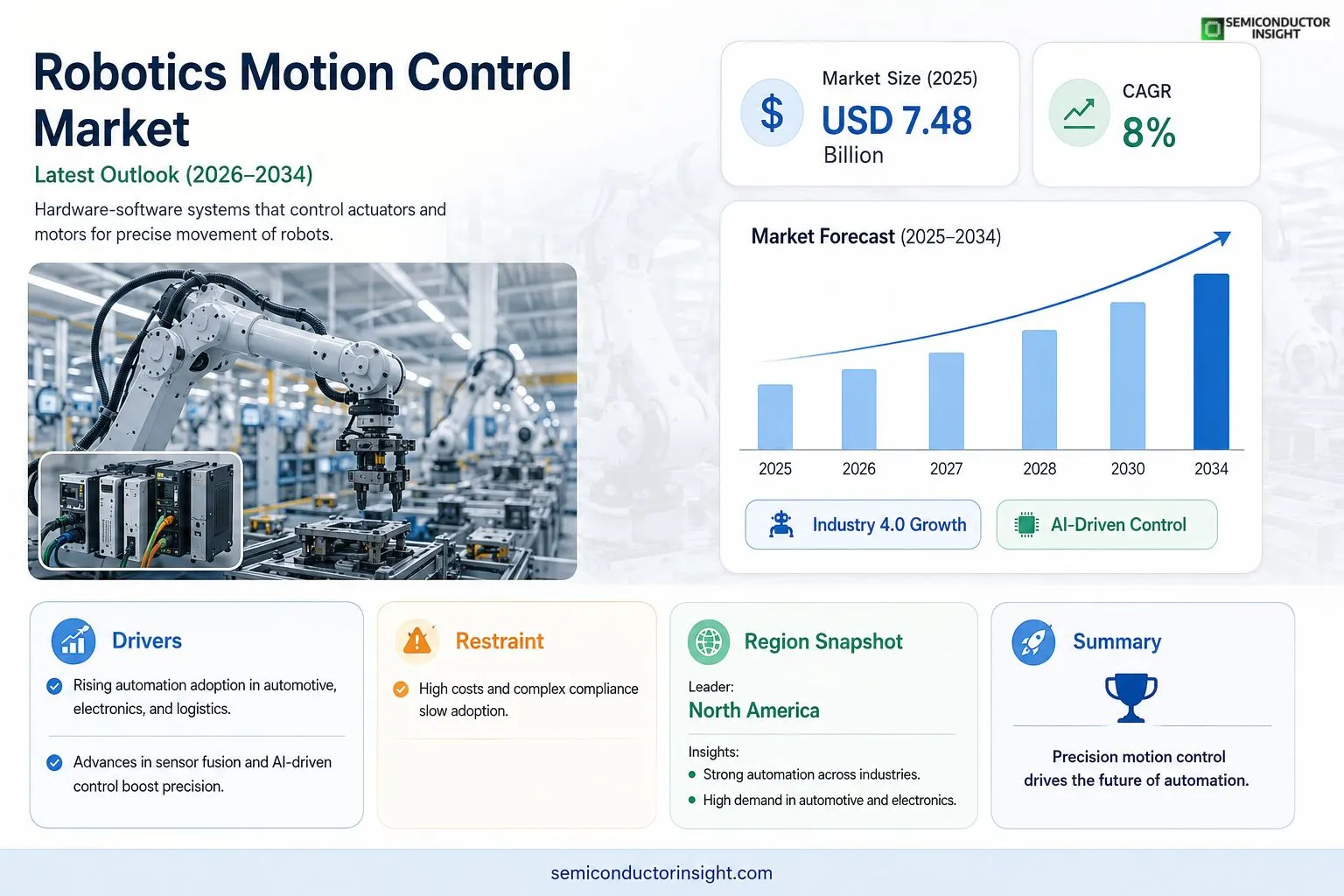
Robotics Motion Control market size was valued at USD 7.48 billion in 2025. The market is projected to grow from USD 7.55 billion in 2026 to USD 14.92 billion by 2034, exhibiting a CAGR of 8% during the forecast period.
Robotics motion control refers to the integrated hardware‑software solutions that command actuators, servomotors and drives to achieve precise positioning, speed regulation and trajectory planning for robotic arms and mobile platforms. These systems combine sensors, controllers, algorithms and communication interfaces to translate digital commands into accurate mechanical movement.The market is accelerating because manufacturers are investing heavily in Industry 4.0 automation, while sectors such as automotive assembly, electronics handling and logistics demand higher throughput and flexibility. Furthermore, advances in AI‑driven path planning and edge computing are expanding application scope. Key players,including Siemens AG, ABB Ltd., Rockwell Automation and Mitsubishi Electric,are continuously launching next‑generation controllers and offering comprehensive service ecosystems.
MARKET DRIVERS
Rising Automation Adoption Across Industries
Robotics Motion Control Market surpassed $7.5 billion in 2023 and is projected to expand at a 12 % CAGR through 2030, propelled by manufacturers in automotive, electronics, and logistics embracing fully automated production lines. Enterprises are investing heavily in precision motion solutions to boost throughput and reduce labor costs, creating a robust demand pipeline.
Breakthroughs in Sensor Fusion and AI‑Driven Control
Advances in sensor fusion, AI‑enabled predictive algorithms, and edge‑computing have enhanced real‑time positioning accuracy to sub‑micron levels. These technological gains enable robots to perform complex tasks such as delicate assembly and high‑speed pick‑and‑place, further widening the addressable market.
➤ “Modular motion controllers are set to become the standard architecture for next‑gen automation platforms,” says a leading industry analyst.
Overall, the convergence of cost‑effective hardware, sophisticated software stacks, and expanding use‑cases fuels sustained growth, positioning Robotics Motion Control Market as a cornerstone of Industry 4.0 transformation.
MARKET CHALLENGES
High Development Costs and Integration Complexity
Engineering high‑performance motion controllers demands significant R&D outlays, specialized talent, and extensive validation cycles. Small‑ and medium‑sized system integrators often struggle to meet these financial thresholds, limiting market participation and slowing time‑to‑market for innovative solutions.
Other Challenges
Supply Chain Vulnerabilities
Component shortages, particularly for rare‑earth magnets and high‑precision encoders, create lead‑time uncertainties. Fluctuating raw‑material prices add cost volatility, pressuring manufacturers to adopt risk‑mitigation strategies such as dual‑sourcing and inventory buffers.
MARKET RESTRAINTS
Regulatory and Safety Compliance Barriers
Stringent safety standards (e.g., ISO 10218, IEC 61508) require rigorous certification processes for robotic systems. Compliance costs, coupled with frequent updates to regulations, can delay product launches and increase overall system pricing, restraining market expansion in highly regulated sectors such as pharmaceuticals and aerospace.
MARKET OPPORTUNITIES
Emerging Applications in Collaborative Robotics
Collaborative robots (cobots) are gaining traction in small‑batch production and flexible manufacturing cells. Their need for lightweight, adaptable motion controllers creates a sizable opportunity for vendors offering plug‑and‑play, safety‑rated solutions that integrate seamlessly with human‑machine interfaces. This trend is expected to drive a notable share of new revenue in the coming decade.
Robotics Motion Control Market Trends
Accelerating Adoption of Industry 4.0 Automation
Robotics Motion Control Market is experiencing rapid growth as manufacturers embed advanced motion controllers into smart factories. Integrated hardware‑software solutions now enable precise positioning, speed regulation, and trajectory planning across robotic arms and mobile platforms. By linking sensors, controllers, and communication interfaces, firms achieve higher throughput while reducing cycle time. Investment in Industry 4.0 equipment is driving demand for controllers that support real‑time data exchange and deterministic performance, positioning the market as a strategic enabler of modern production lines.
Other Trends
AI‑Driven Path Planning
Artificial intelligence is reshaping motion control algorithms, allowing robots to compute optimal paths on‑the‑fly. AI‑enhanced planners improve accuracy in dynamic environments such as electronics handling and high‑speed assembly. The result is reduced downtime and increased flexibility, as robots adapt to variable part geometries without manual re‑programming. This capability is attracting investments from leading OEMs seeking to differentiate their automation solutions.
Edge Computing Integration
Edge computing brings processing power closer to the robot, minimizing latency in control loops. By executing control logic at the device level, edge‑enabled controllers deliver faster response times and support decentralized decision‑making. This architecture aligns with the trend toward distributed manufacturing networks, where localized controllers coordinate with cloud services for predictive maintenance and performance analytics. The shift enhances reliability and reduces dependence on centralized IT infrastructure.
Expansion in Automotive and Logistics Applications
Automotive assembly lines and logistics warehouses are scaling up robotic deployments to meet higher demand for customization and rapid order fulfillment. Motion controllers that support multi‑axis synchronization and high‑torque servomotors enable robotic cells to handle heavy components and intricate assembly sequences. In logistics, precise motion control underpins autonomous guided vehicles (AGVs) and robotic pick‑and‑place systems, improving throughput while maintaining safety standards. The convergence of these application areas reinforces the strategic importance of Robotics Motion Control Market across multiple high‑growth sectors.
COMPETITIVE LANDSCAPEKey Industry Players
Robotics Motion Control Market: Competitive Overview
Robotics Motion Control Market is anchored by a handful of multinational technology firms that dominate controller and drive sales for industrial automation. Siemens AG, ABB Ltd., Rockwell Automation and Mitsubishi Electric together account for a substantial share of the $7.48 billion market reported in 2025, leveraging deep engineering capabilities and extensive service networks to supply high‑performance servo drives, motion controllers, and integrated software stacks. Their product portfolios are increasingly bundled with Industry 4.0 analytics, positioning them as one‑stop solutions for automotive assembly lines, electronics handling and large‑scale logistics operations. The competitive structure thus reflects a tiered hierarchy where these leaders set pricing benchmarks and technology roadmaps, while also collaborating with system integrators to accelerate adoption of AI‑driven path planning and edge‑computing capabilities.Beyond the core quartet, a broader set of niche and regionally strong players enriches the ecosystem. Schneider Electric and Danfoss focus on energy‑efficient drives for midsize manufacturers, whereas KUKA, Yaskawa Electric and FANUC bring specialized robotics expertise that integrates tightly with motion control hardware. Bosch Rexroth and Beckhoff Automation provide modular controller platforms favored by OEMs seeking custom automation solutions. Emerging contributors such as Hexagon AB, National Instruments, Texas Instruments and B&R Automation deliver precision sensors, software toolchains and embedded processing that underpin next‑generation motion control performance. Collectively, these companies sustain a competitive environment that pushes incremental innovation while expanding the addressable market across new verticals.
List of Key Robotics Motion Control Companies Profiled
- Siemens AG
- ABB Ltd.
- Rockwell Automation
- Mitsubishi Electric
- Schneider Electric
- Danfoss
- KUKA
- Yaskawa Electric
- FANUC
- Bosch Rexroth
- Beckhoff Automation
- Hexagon AB
- National Instruments
- Texas Instruments
- B&R Automation
Segment Analysis:
| Segment Category | Sub-Segments | Key Insights |
| By Type |
|
Servo‑driven controllers dominate the market due to their precision and adaptability. – They enable tight closed‑loop control essential for high‑speed robotic arms. – Their modular architecture supports rapid integration with AI‑based path‑planning algorithms. – Vendors continuously enhance firmware to align with Industry 4.0 connectivity standards, fostering interoperable ecosystems across factories. |
| By Application |
|
Industrial automation remains the primary driver for motion‑control innovation. – High‑throughput assembly lines rely on precise trajectory planning to reduce cycle times. – Integration of edge‑computing capabilities allows real‑time adaptation to varying product mixes. – Seamless communication with supervisory systems ensures deterministic performance, which is critical for safety‑critical operations. |
| By End User |
|
Automotive manufacturing leverages advanced motion control to achieve flexible body‑in‑white operations. – Robots equipped with adaptive controllers can switch between chassis welding and paint‑spraying tasks without extensive re‑calibration. – The emphasis on lightweight structures pushes developers toward direct‑drive solutions that minimize inertia. – Close collaboration with major OEMs drives continuous refinement of motion‑control software to meet stringent quality standards. |
Regional Analysis: North America
North America
Automotive IndustryThe automotive sector in North America is a major driver for robotics motion control, particularly in assembly lines, welding, and painting processes. The demand for high-precision and reliable motion control systems is crucial for producing high-quality vehicles.
Electronics ManufacturingThe electronics manufacturing industry relies heavily on robotics motion control for tasks such as component assembly, pick-and-place operations, and testing. The increasing complexity of electronic devices drives the demand for advanced and flexible motion control solutions.
Healthcare SectorThe healthcare industry utilizes robotics motion control in surgical robots, automated dispensing systems, and rehabilitation devices. Precision and reliability are paramount in these applications, fueling the demand for high-performance motion control systems.
AerospaceThe aerospace industry employs robotics motion control in various stages of aircraft manufacturing, including component assembly, inspection, and testing. The stringent requirements for accuracy and reliability in aerospace applications drive the demand for specialized motion control solutions.
Europe
Europe constitutes a significant portion of the Robotics Motion Control Market, characterized by a strong emphasis on innovation, sustainability, and industrial automation. The region’s developed manufacturing base, coupled with supportive government policies promoting technological advancements, drives market growth. Key industries such as automotive, aerospace, pharmaceuticals, and food & beverage are major consumers of robotics motion control systems. The increasing adoption of collaborative robots (cobots) in European factories is a prominent trend, aimed at enhancing productivity and improving worker safety. Furthermore, the growing focus on smart manufacturing and Industry 4.0 initiatives is fueling demand for sophisticated motion control solutions that enable greater flexibility, efficiency, and real-time data analysis. Challenges include navigating complex regulatory landscapes and addressing concerns about job displacement due to automation. Despite these challenges, the European Robotics Motion Control Market is projected to witness steady growth in the coming years, driven by technological advancements and increasing industrial automation investments. Sustainability initiatives are also influencing market trends, with a growing focus on energy-efficient motion control systems.
Asia-Pacific
Asia-Pacific represents the fastest-growing regional market for Robotics Motion Control. Driven by rapid industrialization, increasing manufacturing output, and rising investments in automation, the region presents significant opportunities for market players. China, Japan, and South Korea are key contributors to the market’s growth, with strong domestic demand and established robotics industries. The automotive, electronics, and consumer goods sectors are major drivers of demand in the region. The adoption of robotics motion control is accelerating across various industries, as companies seek to improve efficiency, reduce costs, and enhance product quality. Government initiatives promoting technological innovation and manufacturing competitiveness are further fueling market growth. The increasing focus on smart manufacturing and Industry 4.0 is driving demand for advanced motion control systems that enable greater flexibility, customization, and real-time data integration. Challenges include rising labor costs in some countries and navigating complex supply chain dynamics. Despite these challenges, the Asia-Pacific Robotics Motion Control Market is expected to continue its strong growth trajectory in the coming years, driven by its robust economic growth and increasing industrialization.
South America
South America is an emerging market for Robotics Motion Control, with significant potential for growth. Rising industrialization, increasing investments in manufacturing, and growing demand for automation are driving market expansion. Brazil, Argentina, and Chile are key markets in the region, with strong growth prospects. The automotive, agriculture, and food processing industries are major consumers of robotics motion control systems. The adoption of robotics motion control is gradually increasing in the region, as companies seek to improve productivity and efficiency. Government initiatives promoting technological development and industrial competitiveness are supporting market growth. Challenges include infrastructure limitations, regulatory complexities, and economic uncertainties. Despite these challenges, the South American Robotics Motion Control Market is expected to witness steady growth in the coming years, driven by its growing industrial base and increasing investments in automation.
Middle East & Africa
The Middle East & Africa represents a relatively new but rapidly growing market for Robotics Motion Control. Significant investments in infrastructure development, industrial expansion, and diversification of economies are driving market growth. The oil and gas, construction, and defense industries are major consumers of robotics motion control systems in the region. The adoption of robotics motion control is increasing, as companies seek to improve efficiency, reduce costs, and enhance safety. Government initiatives promoting technological advancements and industrial diversification are supporting market expansion. Challenges include geopolitical instability, regulatory complexities, and limited availability of skilled labor. Despite these challenges, the Middle East & Africa Robotics Motion Control Market is projected to witness strong growth in the coming years, driven by its ambitious development plans and increasing industrial activity.
Report Scope
This market research report provides a comprehensive analysis of the Robotics Motion Control Market , covering the forecast period 2026–2034. It offers detailed insights into market dynamics, technological advancements, competitive landscape, and key trends shaping the industry.
Key focus areas of the report include:
- Market Overview: ✅ The report begins with an overview outlining its current market scenario, key growth indicators, and industry transformation drivers. It discusses macroeconomic factors, demand–supply balance, regulatory landscape, and the strategic role of semiconductors in powering advancements across industries such as automotive, telecommunications, consumer electronics, and industrial automation.
- ✅ Market Size & Forecast: Historical data and future projections for revenue, unit shipments, and market value across major regions and segments.
- ✅ Segmentation Analysis: Detailed breakdown by product type, technology, application, and end-user industry to identify high-growth segments and investment opportunities.
- ✅ Regional Insights: Insights into market performance across North America, Europe, Asia-Pacific, Latin America, and the Middle East & Africa, including country-level analysis where relevant.
- ✅ Competitive Landscape: Profiles of leading market participants, including their product offerings, R&D focus, manufacturing capacity, pricing strategies, and recent developments such as mergers, acquisitions, and partnerships.
- ✅ Technology Trends & Innovation: Assessment of emerging technologies, integration of AI/IoT, semiconductor design trends, fabrication techniques, and evolving industry standards.
- ✅ Market Drivers & Restraints: Evaluation of factors driving market growth along with challenges, supply chain constraints, regulatory issues, and market-entry barriers.
- ✅ Stakeholder Insights: Insights for component suppliers, OEMs, system integrators, investors, and policymakers regarding the evolving ecosystem and strategic opportunities.
Primary and secondary research methods are employed, including interviews with industry experts, data from verified sources, and real-time market intelligence to ensure the accuracy and reliability of the insights presented.
FREQUENTLY ASKED QUESTIONS:
What is the current market size of Robotics Motion Control Market?
-> Robotics Motion Control Market was valued at USD 7.48 billion in 2025 and is expected to reach USD 14.92 billion by 2034.
Which key companies operate in Robotics Motion Control Market?
-> Key players include Siemens AG, ABB Ltd., Rockwell Automation, Mitsubishi Electric.
What are the key growth drivers?
-> Key growth drivers include investments in Industry 4.0 automation, demand from automotive assembly, electronics handling, logistics, AI‑driven path planning and edge computing.
Which region dominates the market?
-> The reference does not specify a single dominant region.
What are the emerging trends?
-> Emerging trends include AI‑driven path planning, edge computing integration, and advanced Industry 4.0 solutions.
Get Sample Report PDF for Exclusive Insights
Report Sample Includes
- Table of Contents
- List of Tables & Figures
- Charts, Research Methodology, and more...
 Download Sample Report PDF