MARKET INSIGHTS
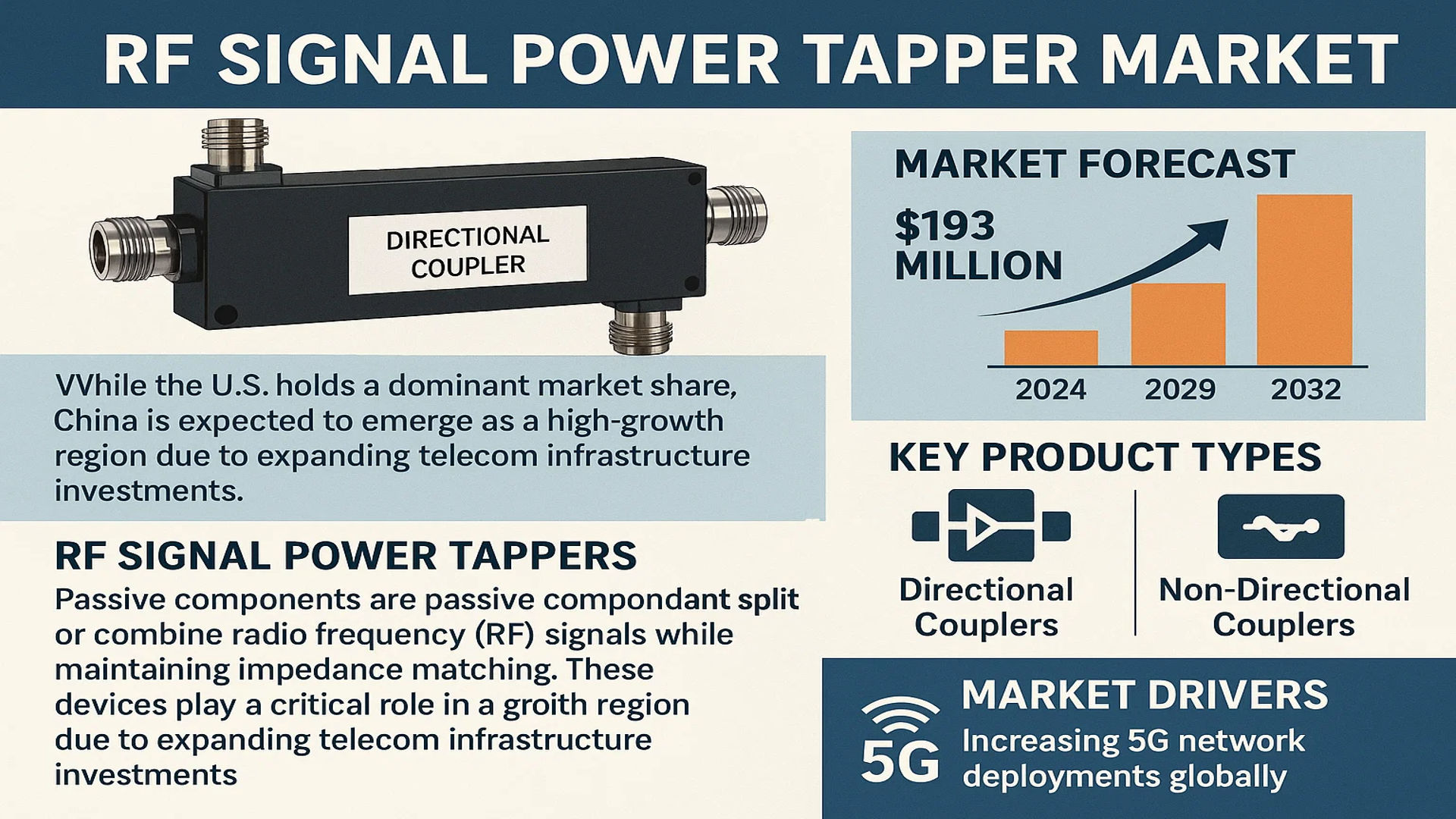
The global RF Signal Power Tapper Market was valued at 193 million in 2024 and is projected to reach US$ 250 million by 2032, at a CAGR of 3.8% during the forecast period. While the U.S. holds a dominant market share, China is expected to emerge as a high-growth region due to expanding telecom infrastructure investments.
RF signal power tappers are passive components that split or combine radio frequency (RF) signals while maintaining impedance matching. These devices play a critical role in wireless communication systems by enabling signal distribution without significant power loss. Key product types include directional couplers and non-directional couplers, each serving specific applications in telecom, broadcast, and military sectors.
The market growth is primarily driven by increasing 5G network deployments globally, which require precise signal management solutions. Furthermore, advancements in satellite communication and radar technologies are creating new opportunities. Leading manufacturers like Infinite Electronics and Mini-Circuits are focusing on developing low-loss, high-frequency power tappers to meet evolving industry requirements.
MARKET DYNAMICS
MARKET DRIVERS
Rising Demand for High-Frequency Communication Systems Accelerates Market Adoption
The global expansion of 5G networks and satellite communication systems is propelling demand for RF signal power tappers, as these devices play a critical role in signal distribution and monitoring. The number of 5G subscribers worldwide is projected to exceed 3 billion by 2026, creating substantial demand for reliable RF components. Signal power tappers enable efficient testing and optimization of these high-frequency networks while minimizing signal loss, making them indispensable for telecom infrastructure deployment. Additionally, advancements in satellite communications, particularly in LEO (Low Earth Orbit) constellations, further drive adoption as these systems require robust signal management solutions.
Military Modernization Programs Fuel Specialized RF Component Demand
Defense sectors globally are investing heavily in electronic warfare systems and radar technologies, which rely on precise RF signal management. Modern radar systems increasingly incorporate power tappers for signal monitoring and diagnostics without disrupting primary operations. The growing military expenditure on electronic warfare capabilities, projected to maintain steady growth through 2030, creates sustained demand for high-performance RF components. Power tappers with wide frequency ranges and minimal insertion loss are particularly sought after for these mission-critical applications, driving innovation in the sector.
Furthermore, the integration of power tappers in test and measurement equipment supports quality assurance across industries. As manufacturing of RF components grows more sophisticated, the need for precise signal monitoring during production testing increases proportionally.
➤ Directional couplers currently account for over 65% of the power tapper market due to their superior isolation characteristics and precise coupling factors.
The trend toward miniaturization in RF components also favors compact power tapper designs that maintain performance while reducing footprint, particularly for space-constrained applications in avionics and portable military systems.
MARKET RESTRAINTS
High Development Costs and Complex Manufacturing Processes Limit Market Penetration
While demand grows, the RF signal power tapper market faces constraints from the specialized nature of component manufacturing. Precision engineering requirements for maintaining tight tolerances across wide frequency ranges significantly increase production costs. The ceramic substrates and specialty metals used in high-performance models contribute substantially to manufacturing expenses, making commercial adoption challenging for price-sensitive applications. Furthermore, achieving consistent performance across temperature variations and environmental conditions requires rigorous quality control measures that add to operational costs.
Additional Constraints
Frequency-Specific Design Limitations
Most power tappers operate optimally within defined frequency bands, requiring customized solutions for different applications. This specialization limits economies of scale in production while increasing inventory complexity for manufacturers serving diverse market segments.
Thermal Management Challenges
High-power applications generate significant thermal loads that can affect component reliability over time. Designing power tappers that maintain performance characteristics under continuous high-power operation requires advanced materials and thermal mitigation strategies that add to product costs.
MARKET CHALLENGES
Supply Chain Vulnerabilities and Material Shortages Disrupt Production Stability
The RF components industry faces persistent challenges from global supply chain disruptions affecting specialty materials availability. Rare earth elements and high-performance substrate materials critical for power tapper manufacturing frequently experience supply constraints and price volatility. The semiconductor shortages that peaked in 2022-2023 demonstrated how dependent the electronics supply chain remains on limited sourcing options, with lead times for certain RF components extending beyond six months during peak shortages.
Technical Expertise Gap
RF engineering talent remains scarce relative to industry demand, particularly for engineers experienced in high-frequency circuit design. The specialized knowledge required to develop next-generation power tappers creates bottlenecks in innovation cycles and production scaling. Educational pipelines are struggling to keep pace with the industry’s need for RF specialists, delaying product development timelines.
Standardization vs. Customization Dilemma
Market demands pull manufacturers in opposing directions—toward standardized products for cost efficiency while simultaneously requiring application-specific customization. Balancing these competing priorities strains R&D resources and complicates inventory management, particularly for mid-sized component manufacturers.
MARKET OPPORTUNITIES
Emerging Millimeter-Wave Applications Open New Revenue Streams
The transition to higher frequency bands in 5G and satellite communications creates substantial opportunities for advanced power tapper designs. Millimeter-wave systems (24GHz and above) require components with exceptional precision and minimal loss characteristics—specifications that favor innovative power tapper architectures. The mmWave technology market is forecast to grow at nearly 30% CAGR through 2030, presenting manufacturers with a high-value segment for product development.
Additionally, the proliferation of IoT devices and smart city infrastructure drives demand for compact, cost-effective RF monitoring solutions. Integrated power tapper modules that combine signal splitting with analytics capabilities could capture significant market share in these emerging application areas.
Strategic partnerships between component manufacturers and systems integrators are accelerating technology adoption. Joint development agreements frequently yield application-optimized solutions that command premium pricing while strengthening customer relationships. The trend toward vertically integrated RF solutions also benefits power tapper specialists able to deliver complete signal chain subsystems.
RF SIGNAL POWER TAPPER MARKET TRENDS
Increasing Demand for High-Frequency Communication to Drive Market Growth
The RF signal power tapper market is experiencing steady growth due to the rising adoption of wireless communication technologies, particularly 5G and satellite communications. The global market was valued at approximately $193 million in 2024 and is projected to reach $250 million by 2032, reflecting a CAGR of 3.8%. The surge in demand for efficient signal distribution in telecommunication infrastructure is a key driver behind this growth. High-frequency applications, including millimeter-wave (mmWave) technologies for 5G networks, require precise power splitting to ensure minimal signal loss. This has prompted manufacturers to innovate with higher-performance directional and non-directional couplers that optimize signal integrity.
Other Trends
Expanding Military and Defense Applications
The military sector is increasingly leveraging RF power tappers for radar systems, electronic warfare, and secure communications. As defense budgets grow globally—particularly in the U.S. and China—investments in advanced signal processing equipment have surged. RF power tappers play a critical role in distributing signals across multi-antenna configurations, ensuring reliable data transmission in mission-critical environments. The directional coupler segment, in particular, is forecasted to see strong growth, driven by its use in phased-array radar systems, where signal accuracy is non-negotiable.
Technological Advancements in Broadcast and Satellite Communications
Broadcast and satellite communication networks are undergoing rapid evolution, with increasing reliance on high-efficiency RF components. Power tappers are essential in multi-channel broadcasting setups, ensuring uniform signal distribution without degradation. The shift towards over-the-top (OTT) and IPTV platforms has further intensified the demand for robust RF signal management solutions. Meanwhile, satellite operators are integrating advanced power tappers to improve signal routing in multi-beam satellite systems, enhancing coverage and reducing latency.
The market is also witnessing expansion in Asia-Pacific, with China positioned as a major consumer due to rapid 5G deployments and government-backed infrastructure projects. The U.S. remains a dominant player, largely driven by military spending and telecommunications upgrades. With key manufacturers such as Infinite Electronics, Mini-Circuits, and Spinner continuously refining their product portfolios, the competitive landscape is poised for further innovation and strategic collaborations.
COMPETITIVE LANDSCAPE
Key Industry Players
Market Leaders Accelerate Innovation to Address Growing RF Signal Distribution Needs
The global RF Signal Power Tapper market exhibits a moderately fragmented competitive environment, with established players competing alongside specialized manufacturers. Infinite Electronics holds a dominant position in the sector, commanding significant market share in 2024 due to its comprehensive product range and strong distribution channels across North America and Europe. The company’s recent expansion into high-frequency tappers for 5G applications has reinforced its leadership position.
Mini-Circuits and Spinner GmbH represent other major competitors, collectively accounting for a substantial portion of the market revenue. These companies have strengthened their market positions through continuous R&D investments, particularly in developing low-loss directional couplers that address the stringent requirements of military and telecom applications.
While the top five manufacturers currently control approximately 35-40% of the global market share, emerging players are making notable inroads through specialized offerings. Apex Microwave has recently gained traction with its compact, high-power handling tappers, while Hefei Maniron Electronic and Technology is expanding its footprint in the Asia-Pacific region through competitive pricing strategies.
The competitive intensity is further heightened by recent strategic moves such as Times Microwave Systems‘ acquisition of a smaller RF components manufacturer and Schomandl‘s partnership with a European telecom equipment provider. These developments reflect the industry’s push toward vertical integration and application-specific solutions to maintain growth momentum.
List of Key RF Signal Power Tapper Manufacturers
- Infinite Electronics (U.S.)
- Apex Microwave (U.S.)
- Hefei Maniron Electronic and Technology (China)
- Schomandl (Germany)
- Mini-Circuits (U.S.)
- Spinner GmbH (Germany)
- Times Microwave Systems (U.S.)
Segment Analysis:
By Type
Directional Coupler Segment Leads Due to High Precision in Signal Splitting
The market is segmented based on type into:
- Directional Coupler
- Subtypes: Single Directional, Dual Directional, and others
- Nondirectional Coupler
- Hybrid Coupler
- Others
By Application
Telecom Segment Dominates Owing to Rising Demand for Wireless Communication Infrastructure
The market is segmented based on application into:
- Telecom
- Broadcast
- Military
- Test & Measurement
- Others
By Frequency Range
1-10 GHz Segment Holds Major Share Due to Wide Applications in 5G Networks
The market is segmented based on frequency range into:
- Below 1 GHz
- 1-10 GHz
- Above 10 GHz
Regional Analysis: RF Signal Power Tapper Market
North America
The North American RF Signal Power Tapper market is characterized by high adoption of advanced wireless technologies and robust telecom infrastructure. With the U.S. leading the region, major telecom operators are investing heavily in 5G network expansions, driving demand for high-performance RF components. The U.S. accounts for the largest share of the regional market, supported by substantial defense spending on radar systems and satellite communication. Key players like Infinite Electronics and Mini-Circuits dominate the supply chain, focusing on low-insertion-loss and broadband power tappers. However, stringent FCC regulations on signal integrity and spectrum allocation complicate product certification, creating entry barriers for new suppliers.
Asia-Pacific
Asia-Pacific is the fastest-growing market for RF Signal Power Tappers, led by China’s aggressive rollout of 5G networks and India’s expanding telecom sector. China alone contributes over 40% of regional demand, driven by local manufacturers like Hefei Maniron Electronic and Technology. Japan and South Korea follow closely, with applications in automotive radar and IoT devices. While cost sensitivity favors low- to mid-tier products, rising R&D investments in defense and aerospace sectors are pushing demand for high-frequency directional couplers. The region’s growth is tempered by supply chain vulnerabilities, especially semiconductor shortages affecting production.
Europe
Europe’s market benefits from strong aerospace and automotive industries, where RF power tappers are critical for navigation and communication systems. Germany and the U.K. are key contributors, with stringent ETSI standards ensuring product reliability. The shift toward open RAN (Radio Access Networks) in telecom is creating opportunities for modular RF components, though high labor costs limit price competitiveness. European manufacturers, such as Schomandl and Spinner, emphasize miniaturization and energy efficiency to align with the EU’s Green Deal objectives. Brexit-related trade complexities, however, pose challenges for cross-border component sourcing.
Middle East & Africa
The MEA market is nascent but promising, with growth concentrated in GCC countries like the UAE and Saudi Arabia. Military modernization programs and smart city initiatives fuel demand for RF power tappers in surveillance and broadband applications. Limited local manufacturing capabilities force reliance on imports, primarily from North America and Europe. While oil-driven economies sustain investments, political instability in parts of Africa and budget constraints hinder widespread adoption. Nonetheless, partnerships with global players and gradual telecom infrastructure development offer long-term potential.
South America
South America remains a small but steady market, with Brazil and Argentina leading in telecom and broadcast applications. Economic volatility and currency fluctuations disrupt supply chains, making imports costly. Domestic production is minimal, with most RF components sourced from the U.S. and China. The region’s focus on rural connectivity projects provides niche opportunities, though slow regulatory approvals and underdeveloped R&D ecosystems limit innovation. Despite these hurdles, the growing demand for satellite TV and radio broadcasting ensures consistent baseline demand for RF power tappers.
Report Scope
This market research report provides a comprehensive analysis of the global RF Signal Power Tapper market, covering the forecast period 2024–2032. It offers detailed insights into market dynamics, technological advancements, competitive landscape, and key trends shaping the industry.
Key focus areas of the report include:
- Market Size & Forecast: Historical data and future projections for revenue, unit shipments, and market value across major regions and segments. The global RF Signal Power Tapper market was valued at USD 193 million in 2024 and is projected to reach USD 250 million by 2032, growing at a CAGR of 3.8% during the forecast period.
- Segmentation Analysis: Detailed breakdown by product type (Directional Coupler, Nondirectional Coupler) and application (Telecom, Broadcast, Military, Others) to identify high-growth segments.
- Regional Outlook: Insights into market performance across North America, Europe, Asia-Pacific, Latin America, and the Middle East & Africa. The U.S. market size is estimated at USD XX million in 2024, while China is projected to reach USD XX million.
- Competitive Landscape: Profiles of leading market participants including Infinite Electronics, Apex Microwave, Hefei Maniron Electronic and Technology, Schomandl, Mini-Circuits, Spinner, and Times Microwave Systems, covering their product offerings, market share, and recent developments.
- Technology Trends & Innovation: Assessment of emerging RF technologies, miniaturization trends, and advancements in signal processing techniques.
- Market Drivers & Restraints: Evaluation of factors driving market growth such as 5G deployment and wireless infrastructure expansion, along with challenges like supply chain constraints and technical complexity.
- Stakeholder Analysis: Insights for component suppliers, OEMs, system integrators, and investors regarding market opportunities and strategic positioning.
Primary and secondary research methods are employed, including interviews with industry experts and data from verified sources, to ensure the accuracy and reliability of the insights presented.
FREQUENTLY ASKED QUESTIONS:
What is the current market size of Global RF Signal Power Tapper Market?
-> RF Signal Power Tapper Market was valued at 193 million in 2024 and is projected to reach US$ 250 million by 2032, at a CAGR of 3.8% during the forecast period.
Which key companies operate in Global RF Signal Power Tapper Market?
-> Key players include Infinite Electronics, Apex Microwave, Hefei Maniron Electronic and Technology, Schomandl, Mini-Circuits, Spinner, and Times Microwave Systems.
What are the key growth drivers?
-> Key growth drivers include 5G network expansion, increasing defense spending on radar systems, and growing demand for RF test equipment.
Which region dominates the market?
-> North America currently leads in market share, while Asia-Pacific is expected to show the fastest growth during the forecast period.
What are the emerging trends?
-> Emerging trends include miniaturization of components, development of broadband power tappers, and integration with IoT systems.

Get Sample Report PDF for Exclusive Insights
Report Sample Includes
- Table of Contents
- List of Tables & Figures
- Charts, Research Methodology, and more...