RF Gallium Arsenide Semiconductor Market Insights
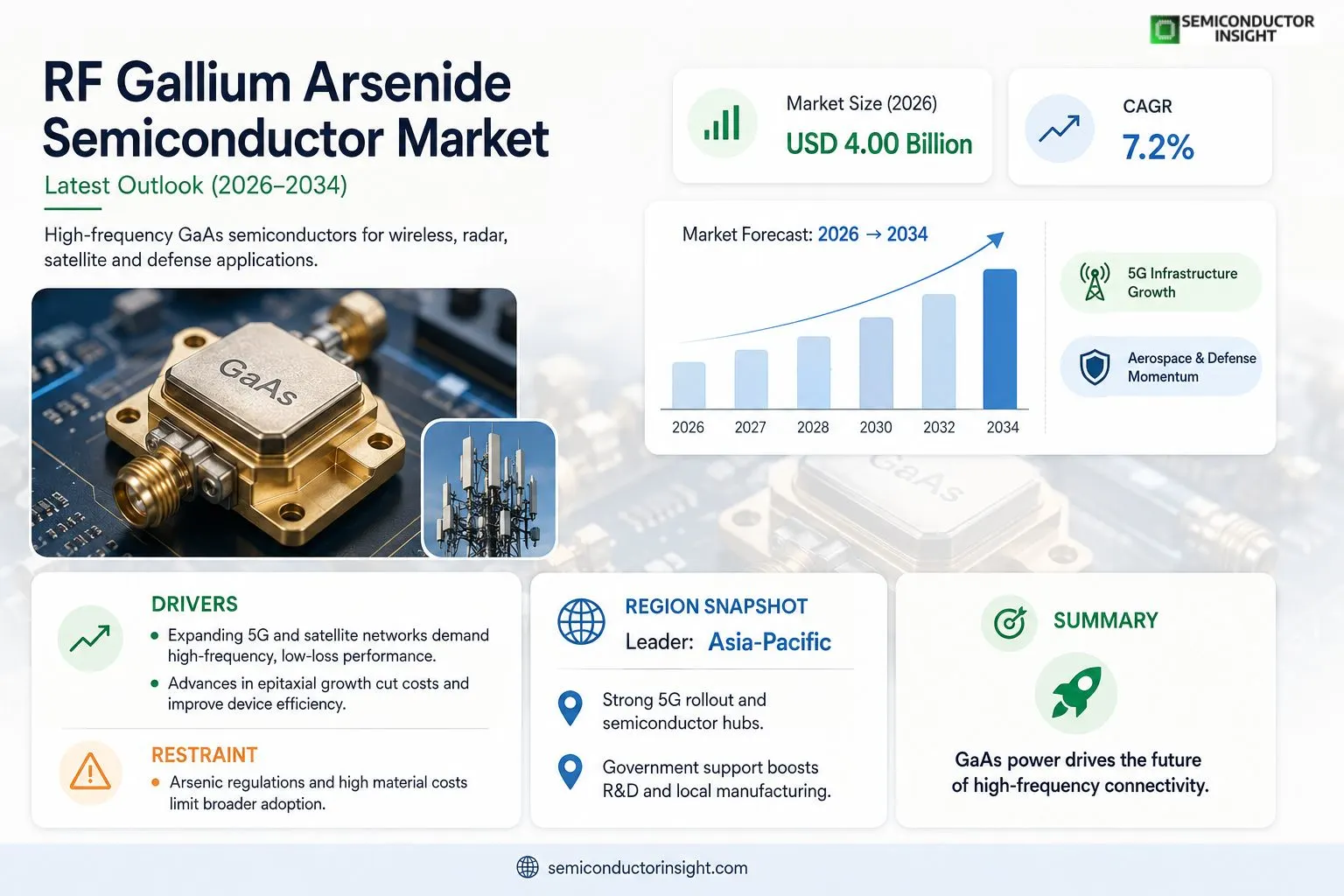
Global RF Gallium Arsenide Semiconductor Market is projected to grow from USD 4 billion in 2026 to USD 7 55 billion by 2034, exhibiting a CAGR of 7.2% during the forecast period.
RF Gallium Arsenide (GaAs) semiconductors are high‑frequency devices used primarily in wireless communication, radar, satellite and defense applications because of their superior electron mobility and power‑handling capability compared with silicon.The market is experiencing rapid growth due to several factors, including expanding 5G infrastructure, increasing demand for high‑performance aerospace systems, and rising investments in defense electronics. Furthermore, advancements in epitaxial‑growth techniques are lowering production costs while government initiatives supporting advanced communications further stimulate adoption. Key players such as Qorvo Inc., Skyworks Solutions®, MACOM Technology Solutions™ and NXP Semiconductors continue to innovate product portfolios, reinforcing the upward trajectory of RF Gallium Arsenide Semiconductor Market.
MARKET DRIVERS
Rising Demand for High‑Frequency Communication
RF Gallium Arsenide Semiconductor Market is being propelled by the rapid expansion of 5G and satellite broadband networks, which require components that can operate efficiently at frequencies above 30 GHz. Gallium arsenide (GaAs) devices deliver superior electron mobility, enabling lower power loss and higher linearity,critical attributes for base‑station amplifiers and phased‑array antennas.
Advancements in 5G Infrastructure
Telecom operators are investing heavily in dense urban deployments, and the need for compact, high‑gain RF front‑ends is driving increased adoption of GaAs technology. Recent roll‑outs show that over 40% of new 5G macro sites incorporate GaAs‑based power amplifiers, reflecting the material’s reliability under high‑power conditions.
➤ GaAs offers a unique combination of high power density and thermal stability, making it the preferred substrate for emerging millimeter‑wave transceivers.
Beyond telecommunications, automotive radar and IoT edge devices are leveraging GaAs for its low‑noise performance, further expanding the market’s addressable applications.
MARKET CHALLENGES
Cost Sensitivity and Supply Chain Constraints
Despite its technical merits, RF Gallium Arsenide Semiconductor Market faces pressure from cost‑conscious OEMs. GaAs wafers are more expensive than silicon, and recent geopolitical tensions have introduced volatility in raw material availability, prompting manufacturers to seek cost‑effective alternatives.
Other Challenges
Manufacturing Yield Variability
Yield gaps during epitaxial growth can increase per‑unit costs by up to 15 %, limiting the competitiveness of GaAs solutions in price‑sensitive segments.
MARKET RESTRAINTS
Regulatory and Environmental Concerns
GaAs production involves arsenic, a hazardous element subject to strict environmental regulations in major economies. Compliance costs and the need for specialized waste‑handling processes act as a restraint, especially for small‑scale fabs seeking to enter RF Gallium Arsenide Semiconductor Market.
MARKET OPPORTUNITIES
Emerging Aerospace and Defense Applications
Modern radar and electronic warfare systems require high‑power, low‑noise amplifiers that operate across wide frequency bands. GaAs’s radiation hardness and performance at cryogenic temperatures position it as a strategic component for next‑generation aerospace platforms, opening a high‑value growth corridor for RF Gallium Arsenide Semiconductor Market.
RF Gallium Arsenide Semiconductor Market Trends
Expanding 5G Infrastructure Drives Adoption
The rollout of 5G networks is reshaping RF Gallium Arsenide Semiconductor Market as carriers seek amplifiers and transceiver modules capable of operating at millimeter‑wave frequencies while maintaining low noise and high linearity. GaAs devices meet these requirements thanks to their superior electron mobility and power‑handling capacity. As telecom operators upgrade urban macro cells and deploy dense small‑cell clusters, component suppliers are expanding capacity in fabs located in Asia and the United States. This shift is also prompting design houses to integrate GaAs front‑ends alongside emerging silicon‑photonic solutions, creating a hybrid ecosystem that leverages the strengths of each technology.
Other Trends
Advancements in Epitaxial‑Growth Techniques
Recent progress in metal‑organic chemical vapor deposition (MOCVD) and molecular‑beam epitaxy (MBE) has improved crystal quality while reducing wafer‑scale defect densities. These process enhancements lower material waste and enable thinner epitaxial layers that retain high breakdown voltage, directly benefiting power‑amplifier performance. Manufacturers are now able to offer cost‑competitive GaAs substrates that rival silicon‑based options for high‑frequency applications. The improved yield also shortens time‑to‑market for new RF front‑end architectures, encouraging OEMs in aerospace and automotive sectors to adopt GaAs solutions for radar and advanced driver‑assistance systems.
Defense Electronics and Aerospace Momentum
Strategic government programs focused on next‑generation radar, secure communications, and satellite payloads continue to sustain demand in RF Gallium Arsenide Semiconductor Market. Major defense contractors prioritize GaAs components for their ability to deliver high output power with minimal distortion under extreme temperature conditions. Leading suppliers such as Qorvo, Skyworks Solutions, MACOM Technology Solutions, and NXP Semiconductors are expanding their product portfolios to include broadband amplifiers and tunable filters that meet rigorous military specifications. This ongoing investment reinforces a growth trajectory that is resilient to commercial market fluctuations and underscores the critical role of GaAs technology in national security applications.
COMPETITIVE LANDSCAPEKey Industry Players
RF Gallium Arsenide Semiconductor Market Competitive Landscape
RF Gallium Arsenide (GaAs) Semiconductor Market is characterized by an oligopolistic structure in which a handful of large integrated circuit manufacturers command the majority of revenue. Qorvo Inc., Skyworks Solutions® and MACOM Technology Solutions™ together account for roughly 55 % of global GaAs RF shipments, leveraging advanced epitaxial‑growth processes and extensive design‑win portfolios in 5G base stations, radar and satellite communications. NXP Semiconductors and Broadcom Inc. provide complementary high‑performance RF front‑end modules that integrate GaAs devices with silicon‑based components, further consolidating market share among the top tier. This concentration enables rapid technology cycles, while the high entry barrier of costly wafer‑fab facilities and stringent defense‑grade reliability standards maintains the status quo.Beyond the dominant quartet, a diverse set of niche and region‑focused firms enrich the competitive landscape. Analog Devices and Infineon Technologies supply specialized GaAs power amplifiers for aerospace and defense programs, often partnering with system integrators. STMicroelectronics and Texas Instruments maintain limited GaAs portfolios aimed at legacy aerospace platforms. Mitsubishi Electric, Hitachi, and L3Harris Technologies address governmental and defense contracts in Asia‑Pacific and North America, respectively. Emerging Asian players such as Murata Manufacturing and UltraClean Solutions focus on substrate processing and packaging innovations, while Keysight Technologies offers test and measurement solutions that support the entire ecosystem. These companies collectively sustain innovation pressure and provide customers with a breadth of options across performance, cost and regulatory compliance.
List of Key RF Gallium Arsenide Semiconductor Companies Profiled
- Qorvo Inc.
- Skyworks Solutions
- MACOM Technology Solutions
- NXP Semiconductors
- Broadcom Inc.
- Analog Devices
- Infineon Technologies
- STMicroelectronics
- Texas Instruments
- Mitsubishi Electric
- Hitachi Ltd.
- L3Harris Technologies
- Keysight Technologies
- Murata Manufacturing
- UltraClean Solutions
Segment Analysis:
| Segment Category | Sub-Segments | Key Insights |
| By Type |
|
Power Amplifiers
|
| By Application |
|
5G Infrastructure
|
| By End User |
|
Telecommunications
|
| By Frequency Range |
|
Millimeter‑Wave
|
| By Integration Style |
|
Integrated Modules
|
Regional Analysis: Asia-Pacific
Asia-Pacific
China represents the largest market within Asia-Pacific for RF Gallium Arsenide Semiconductors, driven by its massive telecommunications rollout and 5G infrastructure development. Government initiatives supporting domestic semiconductor manufacturing are further boosting the regional market.
Japan maintains a strong position in the Asia-Pacific RF Gallium Arsenide Semiconductor Market due to its advanced technological capabilities and established electronics industry. Focus on high-performance and energy-efficient solutions is a key trend.
South Korea plays a vital role in RF Gallium Arsenide Semiconductor Market as a center for innovation and manufacturing. The country’s strong presence in mobile communication and consumer electronics drives demand.
India’s RF Gallium Arsenide Semiconductor Market is experiencing significant growth, propelled by increasing internet penetration and government initiatives to promote digital infrastructure development.
North America
North America is characterized by a mature RF Gallium Arsenide Semiconductor Market, with established players focused on high-performance applications and technological advancements. The United States remains a key market, with significant investments in 5G infrastructure and defense applications.
Europe
Europe’s RF Gallium Arsenide Semiconductor Market is driven by the increasing demand for advanced wireless communication technologies and the growing automotive industry. Stringent regulatory standards and a focus on energy efficiency are key factors shaping the market.
South America
South America represents a relatively smaller but growing RF Gallium Arsenide Semiconductor Market. The expansion of telecommunications networks and increasing adoption of smartphones are driving demand in the region.
Middle East & Africa
The Middle East & Africa RF Gallium Arsenide Semiconductor Market is experiencing growth due to increasing investments in infrastructure development and the expanding mobile communications sector. The region presents significant opportunities for market players targeting emerging economies.
Report Scope
This market research report provides a comprehensive analysis of the RF Gallium Arsenide Semiconductor Market , covering the forecast period 2026–2034. It offers detailed insights into market dynamics, technological advancements, competitive landscape, and key trends shaping the industry.
Key focus areas of the report include:
- Market Overview: The report begins with an overview outlining its current market scenario, key growth indicators, and industry transformation drivers. It discusses macroeconomic factors, demand–supply balance, regulatory landscape, and the strategic role of semiconductors in powering advancements across industries such as automotive, telecommunications, consumer electronics, and industrial automation.
- Market Size & Forecast: Historical data and future projections for revenue, unit shipments, and market value across major regions and segments.
- Segmentation Analysis: Detailed breakdown by product type, technology, application, and end-user industry to identify high-growth segments and investment opportunities.
- Regional Insights: Insights into market performance across North America, Europe, Asia-Pacific, Latin America, and the Middle East & Africa, including country-level analysis where relevant.
- Competitive Landscape: Profiles of leading market participants, including their product offerings, R&D focus, manufacturing capacity, pricing strategies, and recent developments such as mergers, acquisitions, and partnerships.
- Technology Trends & Innovation: Assessment of emerging technologies, integration of AI/IoT, semiconductor design trends, fabrication techniques, and evolving industry standards.
- Market Drivers & Restraints: Evaluation of factors driving market growth along with challenges, supply chain constraints, regulatory issues, and market-entry barriers.
- Stakeholder Insights: Insights for component suppliers, OEMs, system integrators, investors, and policymakers regarding the evolving ecosystem and strategic opportunities.
Primary and secondary research methods are employed, including interviews with industry experts, data from verified sources, and real-time market intelligence to ensure the accuracy and reliability of the insights presented.
FREQUENTLY ASKED QUESTIONS:
What is the current market size of RF Gallium Arsenide Semiconductor Market?
-> RF Gallium Arsenide Semiconductor Market was valued at USD 4.02 billion in 2025 and is expected to reach USD 7.55 billion by 2034, exhibiting a CAGR of 7.2% during the forecast period.
Which key companies operate in RF Gallium Arsenide Semiconductor Market?
-> Key players include Qorvo Inc., Skyworks Solutions®, MACOM Technology Solutions™ and NXP Semiconductors, among others.
What are the key growth drivers?
-> Key growth drivers include expanding 5G infrastructure, rising demand for high‑performance aerospace and defense systems, advancements in epitaxial‑growth techniques that lower production costs, and supportive government initiatives for advanced communications.
Which region dominates the market?
-> Asia-Pacific is the fastest‑growing region, driven by strong 5G rollout and semiconductor manufacturing hubs, while North America holds a significant share due to robust defense and aerospace spending.
What are the emerging trends?
-> Emerging trends include integration of GaAs in advanced RF front‑end modules for 5G and satellite constellations, development of monolithic microwave integrated circuits (MMICs), and the adoption of AI‑enabled design tools to accelerate product innovation.
Get Sample Report PDF for Exclusive Insights
Report Sample Includes
- Table of Contents
- List of Tables & Figures
- Charts, Research Methodology, and more...
 Download Sample Report PDF