Market Insights
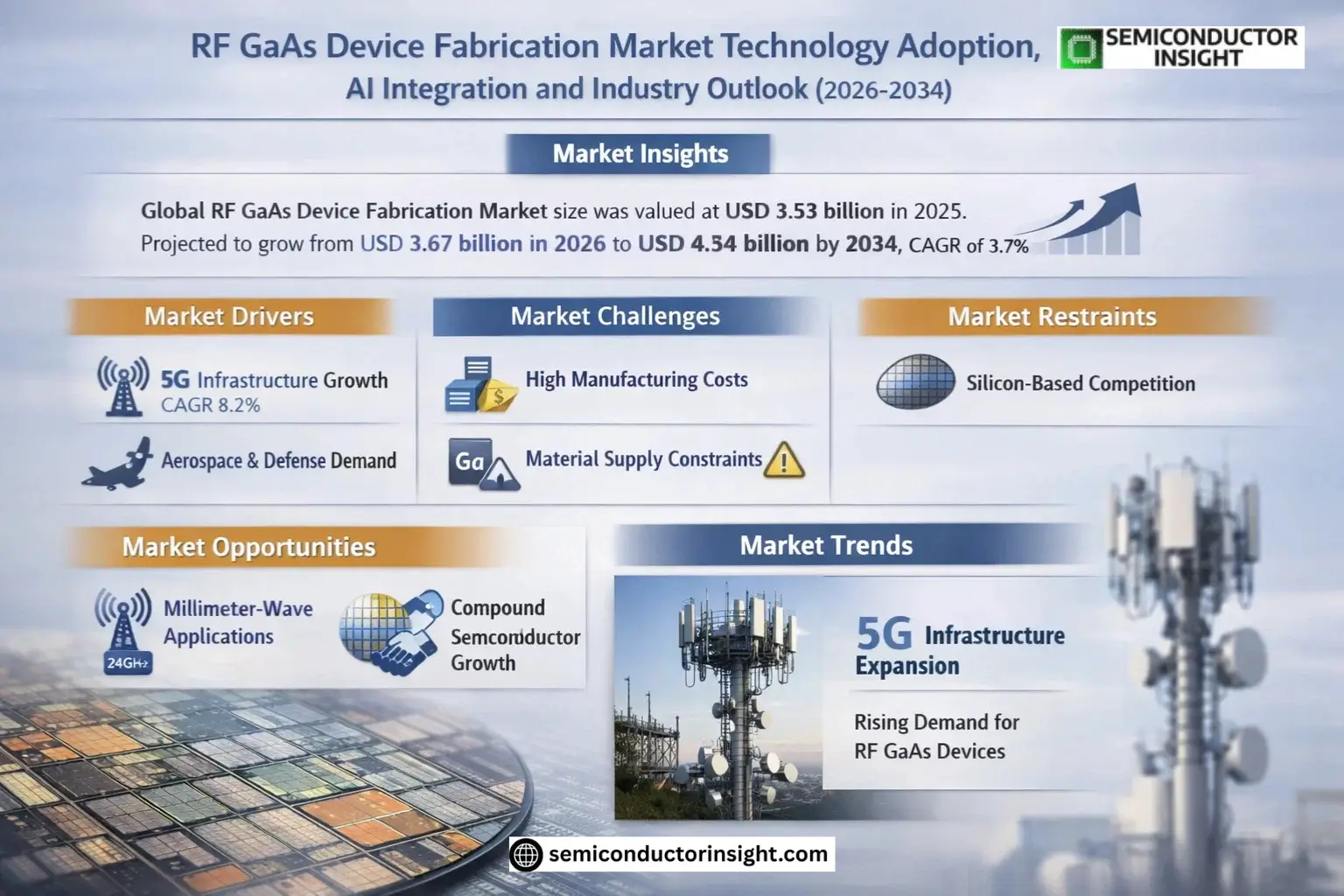
Global RF GaAs Device Fabrication Market size was valued at USD 3.53 billion in 2025. The market is projected to grow from USD 3.67 billion in 2026 to USD 4.54 billion by 2034, exhibiting a CAGR of 3.7% during the forecast period.
RF GaAs (Gallium Arsenide) devices are semiconductor components widely used in high-frequency applications such as wireless communication, radar systems, and satellite technology. These devices include power amplifiers, RF switches, filters, and low-noise amplifiers, which are critical for enhancing signal performance in modern electronics. The fabrication process involves specialized techniques like epitaxial growth and wafer processing to achieve superior electron mobility compared to silicon-based alternatives.
The market growth is driven by increasing demand for 5G infrastructure, aerospace & defense applications, and the proliferation of IoT devices. While the U.S. remains a key market due to its advanced telecommunications sector, China is rapidly expanding its production capabilities with companies like Sanan IC and Chengdu Hiwafer Semiconductor gaining prominence. Major players such as Skyworks and Qorvo continue to dominate the IDM (Integrated Device Manufacturer) segment, while foundries like WIN Semiconductors Corp. lead in pure-play GaAs fabrication services.
MARKET DRIVERS
Growing Demand for 5G Infrastructure
RF GaAs Device Fabrication Market is experiencing significant growth due to the rapid rollout of 5G networks worldwide. Gallium Arsenide (GaAs) devices offer superior high-frequency performance, making them essential for 5G base stations and mobile devices. The market is projected to grow at a CAGR of 8.2% as telecom operators invest heavily in next-generation infrastructure.
Expansion in Aerospace & Defense Applications
RF GaAs devices are critical for radar systems, satellite communication, and electronic warfare, driving demand from the aerospace and defense sectors. With increasing defense budgets globally, the market for high-performance RF components is expected to exceed USD 3.5 billion by 2026.
Emerging IoT and automotive radar applications further contribute to the sustained growth of RF GaAs device fabrication technologies.
MARKET CHALLENGES
High Manufacturing Costs
The complex fabrication process of RF GaAs devices results in higher production costs compared to silicon-based alternatives. This cost barrier limits adoption in price-sensitive consumer electronics segments.
Other Challenges
Material Supply Constraints
Gallium scarcity and fluctuating raw material prices pose risks to stable production volumes in the RF GaAs Device Fabrication Market.
MARKET RESTRAINTS
Competition from Silicon-Based Solutions
Advances in silicon-germanium (SiGe) and CMOS technologies are creating cost-effective alternatives for certain RF applications, particularly in the sub-6GHz range. This competition may restrain growth in traditional RF GaAs device segments.
MARKET OPPORTUNITIES
Emerging Millimeter-Wave Applications
The shift to higher frequency bands (24GHz and above) for 5G and automotive radar systems presents significant opportunities for RF GaAs Device Fabrication Market players. GaAs remains the preferred material for these high-frequency applications due to its superior electron mobility and thermal stability.
Growth in Compound Semiconductor Ecosystem
Strategic partnerships between foundries and RF component manufacturers are creating vertically integrated supply chains, enabling more efficient production of GaAs devices for specialized applications.
RF GaAs Device Fabrication Market Trends
Growth in 5G Infrastructure Driving RF GaAs Demand
RF GaAs Device Fabrication Market is experiencing significant growth due to accelerating 5G network deployments worldwide. Gallium arsenide components offer superior performance in high-frequency applications compared to silicon, making them essential for 5G base stations and mobile devices. Major foundries in Taiwan and China are expanding production capacity to meet this rising demand.
Other Trends
Shift Toward Pure-Play GaAs Foundry Model
The market is witnessing increased adoption of pure-play foundry services as fabless semiconductor companies seek to reduce capital expenditures. Companies like WIN Semiconductors and AWSC are emerging as key players in this segment, offering specialized RF GaAs fabrication for diverse applications.
Technological Advancements in Power Amplifiers
RF GaAs device manufacturers are focusing on developing advanced power amplifiers with improved efficiency and thermal performance. These components are critical for cellular infrastructure and are seeing growing adoption in aerospace and defense applications. The market for power amplifiers accounted for the largest share of RF GaAs device applications in recent years.
Increasing Competition from Alternative Technologies
While RF GaAs maintains dominance in high-frequency applications, the market faces competitive pressure from gallium nitride (GaN) and silicon-based solutions. Manufacturers are responding with innovations in GaAs process technologies to maintain performance advantages in key segments.
Regional Market Developments
Asia-Pacific continues to dominate RF GaAs device fabrication, with Taiwan and China serving as major production hubs. North America remains strong in RF GaAs IDM operations, led by companies like Skyworks and Qorvo. The European market is focusing on specialized applications in automotive and industrial sectors.
COMPETITIVE LANDSCAPE
Key Industry Players
RF GaAs Device Fabrication Market is Dominated by Specialized Foundries and IDMs
RF GaAs Device Fabrication Market is characterized by a mix of integrated device manufacturers (IDMs) and pure-play foundries. Skyworks and Qorvo lead the IDM segment with vertically integrated manufacturing capabilities, together holding significant market share. These companies specialize in high-performance RF solutions for wireless communications, defense, and aerospace applications. The pure-play foundry segment has witnessed rapid growth, particularly in Asia, with Taiwan-based WIN Semiconductors emerging as the world’s largest GaAs foundry.
Niche players like BAE Systems cater to specialized defense applications, while Chinese foundries such as Sanan IC and Chengdu Hiwafer Semiconductor are gaining traction in the domestic market. MACOM and Coherent Corporation serve as important suppliers for high-frequency applications, with strong positions in the telecom infrastructure market. The competitive landscape is further diversified by technology specialists like AMS Technologies in Europe and GCS in North America, which focus on customized RF solutions.
List of Key RF GaAs Device Fabrication Companies Profiled
- Skyworks
- Qorvo
- Coherent Corporation
- WIN Semiconductors Corp.
- AWSC
- Wavetek
- Sanan IC
- Chengdu Hiwafer Semiconductor
- MACOM
- BAE Systems
- GCS (Global Communication Semiconductors)
- AMS Technologies
- Sumitomo Electric Device Innovations
- M/A-COM Technology Solutions
- Advanced Semiconductor Materials International
Segment Analysis:
| Segment Category | Sub-Segments | Key Insights |
| By Type |
|
Pure-play GaAs Foundry segment demonstrates strong growth potential due to:
|
| By Application |
|
Power Amplifiers maintain dominance in the market with growing adoption due to:
|
| By End User |
|
Telecommunications sector drives majority demand as:
|
| By Technology Node |
|
Below 65nm technology gains traction due to:
|
| By Business Model |
|
Foundry Services model shows significant growth potential because:
|
Regional Analysis: Asia-Pacific RF GaAs Device Fabrication Market
China’s rapid 5G rollout has created unprecedented demand for RF GaAs power amplifiers and switches. Domestic base station deployments utilize locally fabricated GaAs devices meeting stringent efficiency requirements for massive MIMO applications across diverse terrains.
Major Chinese smartphone OEMs increasingly specify domestic GaAs components for front-end modules, driving yield improvements in fabrication. This vertical integration benefits from proximity between device manufacturers and system designers in Shenzhen’s electronics cluster.
Government-sponsored technology transfer programs have enabled Chinese foundries to accelerate GaAs process development, particularly in surface passivation techniques that improve device reliability for automotive radar applications.
Chinese research institutes are pioneering gallium arsenide-on-insulator (GaAs-OI) platform development, potentially enabling higher frequency device fabrication while reducing substrate costs through wafer reuse techniques.
South Korea
South Korea’s RF GaAs device fabrication benefits from symbiotic relationships between IDMs and consumer electronics giants. Samsung’s vertically integrated semiconductor operations include advanced GaAs processing capabilities optimized for smartphone RF front-end modules. The country leads in heterogeneous integration techniques combining GaAs with silicon technologies. Government R&D programs focus on next-generation millimeter-wave device fabrication, with specialized foundries developing GaAs processes for 28GHz 5G applications.
Japan
Japan maintains technological leadership in high-reliability GaAs device fabrication for aerospace and defense applications. Domestic foundries specialize in low-noise amplifiers and high-power switches with superior thermal management characteristics. The country’s materials science expertise enables development of advanced epitaxial structures, though production costs remain higher than regional competitors. Partnerships between equipment vendors and device manufacturers drive innovation in fabrication processes.
Taiwan
Taiwanese foundries have carved a niche in cost-competitive GaAs device fabrication for global RF supply chains. Advanced packaging capabilities complement front-end processing, enabling highly integrated front-end modules. The island’s semiconductor ecosystem facilitates technology transfer between silicon and compound semiconductor fabrication, with increasing investment in GaAs-on-silicon integration for next-generation devices.
India
India’s emerging RF GaAs fabrication capabilities focus on defense and space applications, supported by government initiatives to reduce import dependency. Domestic R&D centers are developing indigenous GaAs MMIC fabrication processes, though commercial-scale production remains limited. Recent policy measures aim to attract foreign semiconductor investment while developing local design expertise for RF components.
Report Scope
This market research report provides a comprehensive analysis of the RF GaAs Device Fabrication Market, covering the forecast period 2025–2034. It offers detailed insights into market dynamics, technological advancements, competitive landscape, and key trends shaping the industry.
Key focus areas of the report include:
- Market Overview: The report begins with an overview outlining its current market scenario, key growth indicators, and industry transformation drivers. It discusses macroeconomic factors, demand–supply balance, regulatory landscape, and the strategic role of semiconductors in powering advancements across industries such as telecommunications, consumer electronics, and industrial automation.
- Market Size & Forecast: Historical data and future projections for revenue, unit shipments, and market value across major regions and segments.
- Segmentation Analysis: Detailed breakdown by product type (Pure-play GaAs Foundry and GaAs IDM), technology, application (Power Amplifiers, RF Switches, Filters, Low Noise Amplifiers, Others), and end-user industry to identify high-growth segments and investment opportunities.
- Regional Insights: Insights into market performance across North America, Europe, Asia, South America, and Middle East & Africa, including country-level analysis where relevant.
- Competitive Landscape: Profiles of leading market participants, including their product offerings, R&D focus, manufacturing capacity, pricing strategies, and recent developments such as mergers, acquisitions, and partnerships.
- Technology Trends & Innovation: Assessment of emerging technologies in GaAs fabrication, semiconductor design trends, and evolving industry standards.
- Market Drivers & Restraints: Evaluation of factors driving market growth along with challenges, supply chain constraints, regulatory issues, and market-entry barriers.
- Stakeholder Insights: Insights for component suppliers, OEMs, system integrators, investors, and policymakers regarding the evolving ecosystem and strategic opportunities.
Primary and secondary research methods are employed, including interviews with industry experts, data from verified sources, and real-time market intelligence to ensure the accuracy and reliability of the insights presented.
FREQUENTLY ASKED QUESTIONS:
What is the current market size of RF GaAs Device Fabrication Market?
-> RF GaAs Device Fabrication Market size was valued at USD 3.53 billion in 2025. The market is projected to grow from USD 3.67 billion in 2026 to USD 4.54 billion by 2034, exhibiting a CAGR of 3.7% during the forecast period.
Which key companies operate in RF GaAs Device Fabrication Market?
-> Key players include Skyworks, Qorvo, Coherent Corporation, WIN Semiconductors Corp., AWSC, Wavetek, Sanan IC, Chengdu Hiwafer Semiconductor, MACOM, BAE Systems, and GCS (Global Communication Semiconductors), among others.
What are the key growth drivers?
-> Key growth drivers include increasing demand for high-frequency communication devices, advancements in semiconductor fabrication technologies, and growing applications in telecommunications and consumer electronics.
Which region dominates the market?
-> Asia is a dominant market, with key players located in China Taiwan, while North America remains a significant market with major players like Skyworks and Qorvo.
What is the expected CAGR?
-> The market is expected to grow at a CAGR of 3.7% during the forecast period (2025-2034).
Get Sample Report PDF for Exclusive Insights
Report Sample Includes
- Table of Contents
- List of Tables & Figures
- Charts, Research Methodology, and more...
 Download Sample Report PDF