Key Statistics
Key Takeaways
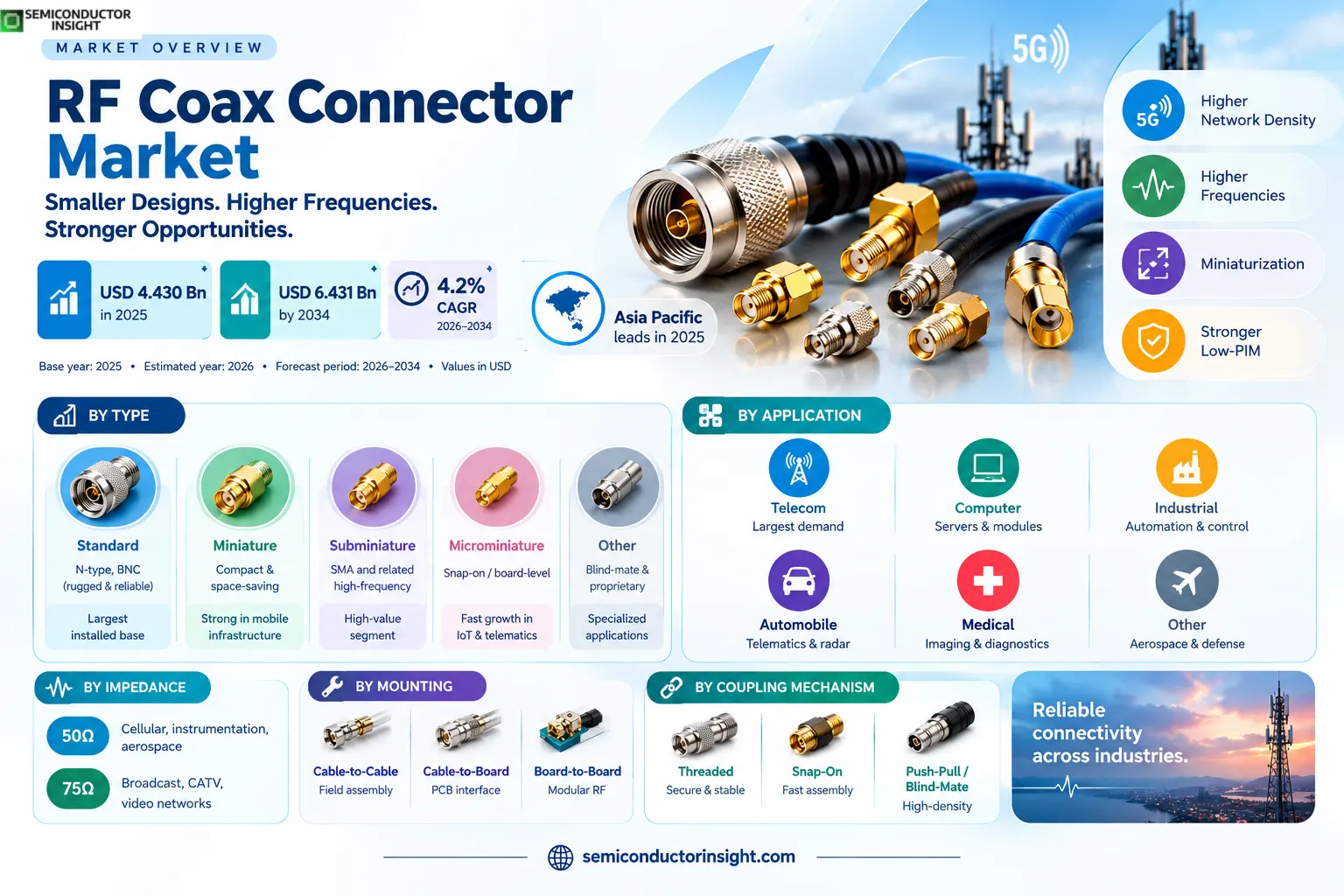
- Market size and growth: the market is valued at USD 4.430 billion in 2025 and is projected to reach USD 6.431 billion by 2034, with a 4.2% CAGR over 2026–2034.
- Standard leads by type because standard interfaces retain the broadest installed base across telecom, instrumentation and industrial RF systems.
- Telecom is the principal application because 5G radios, small cells, distributed antenna systems and network test equipment require large volumes of low-loss, stable-impedance RF interconnects.
- Asia Pacific is the largest regional market, while Asia Pacific has the strongest incremental growth profile.
- Primary driver: 5G, industrial wireless and connected vehicles are increasing both RF connector count and performance requirements
- Structural restraint: precision materials, tighter tolerances and price pressure make high-frequency connector manufacturing difficult to scale profitably
Market Overview
The RF coax connector market was valued at USD 4.430 billion in 2025 and is projected to reach USD 6.431 billion by 2034, expanding at a 4.2% CAGR over 2026–2034. Asia Pacific leads in 2025, while the market is being reshaped by 5G network density, higher-frequency operation, connector miniaturization and stronger low-PIM requirements..
RF coaxial connectors maintain controlled impedance between cables, boards, antennas and RF modules while minimizing insertion loss, reflection and electromagnetic leakage. Product families range from standard N-type and TNC interfaces to SMA, MCX, MMCX and newer compact telecom formats. Connector selection depends on frequency range, impedance, coupling mechanism, environmental sealing, power handling, passive intermodulation and the number of mating cycles expected over system life.
Wireless infrastructure is a major demand engine because 5G radios combine more antennas, more bands and denser installation footprints than earlier network generations. Amphenol RF’s 2.2-5 family demonstrates this trend: the interface is materially smaller than 4.3-10 while supporting DC to 20 GHz and very low passive intermodulation. Such designs reduce panel area without sacrificing signal integrity in small cells and distributed antenna systems.
Demand is also diversifying through automotive, medical and industrial electronics. Vehicle telematics, GNSS, radar and V2X systems require rugged connectors with stable performance under vibration and temperature cycling, while medical and test systems value repeatability and shielding. This broad application base protects the market from dependence on any single telecom investment cycle and supports premium niches for sealed, high-frequency and blind-mate products.
Segment Analysis: By Type
By type, the market is segmented into Standard, Miniature, Subminiature, Microminiature, Other. Standard leads the current mix, while suppliers differentiate through performance, reliability, manufacturability and system-level economics.
| Type | Function / role | Market position |
|---|---|---|
| Standard | Established interfaces such as N-type and BNC for rugged cable and panel connections. | Largest installed base across telecom, industrial and test systems. |
| Miniature | Compact connector families that reduce panel and cable footprint. | Strong in mobile infrastructure and equipment with moderate space constraints. |
| Subminiature | SMA and related small RF interfaces for higher-frequency electronics. | High-value segment in instrumentation, aerospace and compact RF modules. |
| Microminiature | Very small snap-on or board-level RF interconnects. | Fast growth in smartphones, telematics, IoT and dense multi-radio electronics. |
| Other | Application-specific, blind-mate and proprietary coax interfaces. | Used where power, environment or assembly requirements justify specialized formats. |
Commercial implications by type
Miniaturization does not remove the need for electrical margin. Smaller interfaces must still control impedance and shielding while handling installation tolerances, thermal cycling and repeated mating. Standard connectors remain important where power and ruggedness dominate, whereas microminiature and blind-mate designs gain value in compact radios, embedded systems and dense multi-channel test equipment.
Segment Analysis: By Application
By application, the market includes Telecom, Computer, Industrial, Automobile, Medical, Other. Telecom represents the largest demand pool because the technology directly affects system performance, reliability, power or cost.
| Application | Demand characteristics |
|---|---|
| Telecom | Largest application spanning base stations, small cells, DAS, antennas and RF test equipment. |
| Computer | Servers, storage, test platforms and high-speed wireless modules require board and cable RF interconnects. |
| Industrial | Instrumentation, automation, process control and machine vision use rugged coax connections. |
| Automobile | Telematics, GNSS, radar and V2X increase RF connector content per vehicle. |
| Medical | Imaging, diagnostic and therapeutic systems need reliable low-noise RF interfaces. |
| Other | Aerospace, defense, broadcast and scientific systems create specialized high-value demand. |
By Impedance
| Impedance | Commercial relevance |
|---|---|
| 50 Ohm | Dominant in cellular, instrumentation, aerospace and general RF systems. |
| 75 Ohm | Used heavily in broadcast, CATV and video-oriented networks. |
By Mounting
| Mounting | Commercial relevance |
|---|---|
| Cable-to-Cable | Field-assembled and equipment interconnects require durable cable terminations. |
| Cable-to-Board | Compact equipment uses direct PCB interfaces to reduce internal cabling. |
| Board-to-Board | Blind-mate and compression interfaces support modular RF assemblies. |
By Coupling Mechanism
| Coupling Mechanism | Commercial relevance |
|---|---|
| Threaded | SMA, N-type and similar interfaces prioritize secure mating and stable RF contact. |
| Snap-On | MCX/MMCX-style interfaces enable faster assembly in compact devices. |
| Push-Pull / Blind-Mate | High-density telecom and modular equipment benefit from fast service and tolerance to misalignment. |
 Regional Analysis
Asia Pacific leads the market because China, Japan and South Korea combine electronics manufacturing, telecom equipment production and high-volume connector supply chains. Asia Pacific has the strongest expansion profile as demand rises through 5G densification, industrial wireless, automotive connectivity and localized electronics production.
How does regional demand differ across this market?
Asia Pacific leads total volume through China and the broader electronics manufacturing ecosystem. North America remains important in telecom infrastructure, aerospace, defense and high-end test equipment, while Europe has strong automotive and industrial demand. South America and the Middle East & Africa are smaller but benefit from mobile-network investment and imported connected devices. Regional supplier selection balances RF performance with local cable assembly, distribution and technical support.
| Region | Position | Growth outlook | Demand profile | Supplier selection |
|---|---|---|---|---|
| Asia Pacific | Largest | Fastest | Telecom and electronics scale | Cost, local supply, low loss |
| North America | Second | Strong | Infrastructure, defense and test | Performance, durability, service |
| Europe | Third | Moderate | Automotive and industrial | Qualification, shielding, lifecycle |
| South America | Smaller | Moderate | Mobile networks and industry | Availability and cost |
| Middle East & Africa | Emerging | Strong | 5G and infrastructure | Ruggedness and support |
Competitive Landscape
Competition is concentrated among connector companies with broad interface portfolios, precision machining capability and long-standing relationships with telecom, automotive and aerospace OEMs.
Rosenberger, TE Connectivity, Amphenol, HUBER+SUHNER, Hirose and Radiall compete across standard and high-frequency interfaces. Large suppliers benefit from global cable-assembly operations and application engineering, allowing them to sell complete interconnect solutions rather than isolated connectors.
Telecom creates strong pressure toward smaller low-PIM designs. Amphenol RF’s 2.2-5 connector supports compact small-cell and 5G installations while maintaining low intermodulation, showing how mechanical miniaturization and RF performance are converging.
Automotive and board-level markets favor snap-on and microminiature interfaces, while aerospace and test equipment retain threaded precision formats. This segmentation rewards suppliers that can manage several manufacturing processes and material systems within one portfolio.
| Competitive tier | Representative participants | Competitive focus |
|---|---|---|
| Global leaders | Rosenberger, TE Connectivity, Amphenol, HUBER+SUHNER | Broad RF interfaces, global manufacturing and OEM relationships |
| Precision specialists | Hirose, Radiall, Telegärtner, I-PEX | Miniature, high-frequency and application-specific interconnects |
| Scaled regional suppliers | Molex, JAE, SMK, Foxconn, KingSignal | High-volume electronics and localized supply |
Companies Profiled
Rosenberger, TE Connectivity, HUBER+SUHNER, Amphenol, Hirose Electric, Radiall, Telegärtner, I-PEX, Molex, JAE, Samtec, SMK
Production Capacity Analysis
Capacity depends on precision-turned metal parts, plating, dielectric molding, center-contact forming, cable termination and RF test, with tolerances becoming tighter as frequency rises.
Standard connector production can be highly automated, but high-frequency products require stricter dimensional control because small geometry changes affect impedance and return loss. Plating thickness, dielectric concentricity and surface finish become increasingly important as designs move above 10 GHz.
Cable-assembly capacity is equally strategic. Many OEMs buy tested connector-cable assemblies rather than loose connectors, so crimping, soldering, overmolding and final RF verification must scale near customer production sites. Global suppliers use regional assembly plants to reduce lead time and support customization.
Market Dynamics
The market grows steadily as more wireless functions are integrated into infrastructure, vehicles and equipment, while connector value shifts toward smaller and more performance-sensitive formats.
Unit growth alone does not capture the market’s economics. A compact 5G or automotive connector can carry more engineering value than a larger legacy interface because it must deliver low loss, high shielding and mechanical reliability in less space. Suppliers that combine standardized families with application-specific cable assemblies are positioned to capture this mix shift.
Market Drivers
Drivers Impact Analysis
| Driver | Impact | Commercial mechanism |
|---|---|---|
| 5G infrastructure | High | Small cells, radios and distributed antenna systems require dense low-PIM RF connections. |
| Automotive connectivity | High | GNSS, telematics, radar and V2X increase RF interfaces per vehicle. |
| Industrial wireless | Medium | Private networks, sensors and instrumentation expand rugged connector demand. |
| Miniaturization | Medium | Compact electronics require smaller interfaces without sacrificing signal integrity. |
5G infrastructure
Small cells, radios and distributed antenna systems require dense low-PIM RF connections.
Automotive connectivity
GNSS, telematics, radar and V2X increase RF interfaces per vehicle.
Industrial wireless
Private networks, sensors and instrumentation expand rugged connector demand.
Miniaturization
Compact electronics require smaller interfaces without sacrificing signal integrity.
Market Restraints
Restraints Impact Analysis
| Restraint | Impact | Commercial mechanism |
|---|---|---|
| Precision manufacturing cost | High | High-frequency connectors need tight tolerances, controlled plating and RF testing. |
| Price pressure | High | High-volume telecom and electronics customers continuously push down component cost. |
| Alternative integration | Medium | Direct board integration and antenna-in-package approaches can eliminate some discrete coax connections. |
| Material volatility | Medium | Copper alloys, gold plating and engineering polymers affect bill-of-material cost. |
Precision manufacturing cost
High-frequency connectors need tight tolerances, controlled plating and RF testing.
Price pressure
High-volume telecom and electronics customers continuously push down component cost.
Alternative integration
Direct board integration and antenna-in-package approaches can eliminate some discrete coax connections.
Material volatility
Copper alloys, gold plating and engineering polymers affect bill-of-material cost.
Market Opportunities
Low-PIM 5G infrastructure
Compact connector families can reduce radio size while preserving intermodulation performance.
Automotive microminiature RF
Connected vehicles need space-efficient interfaces for cameras, antennas and telematics modules.
High-frequency test and aerospace
Precision SMA and smaller millimeter-wave interfaces support premium instrumentation and defense applications.
Blind-mate modular systems
Serviceable radio and test assemblies benefit from connectors that tolerate alignment variation and fast replacement.
Supply Chain Analysis
Brass, copper alloys, PTFE, engineering plastics
Machining, stamping, molding, plating
Crimping, soldering, overmolding, RF test
Telecom, automotive, industrial, medical, aerospace
Materials
Conductive alloys and low-loss dielectrics determine RF loss, power handling and mechanical durability.
Connector manufacturing
Precision geometry controls impedance while plating protects corrosion and contact resistance.
Cable assembly
The installed performance depends on termination quality as much as the connector itself, so tested assemblies capture additional value.
OEM integration
Design-in support, mechanical CAD and RF modeling help customers qualify connectors early in the system-development cycle.
Recent Developments
2026 — Amphenol RF expands compact 2.2-5 connector family
The connector family targets 5G, DAS and small-cell systems with DC–20 GHz operation and very low PIM in a smaller interface. Source
2026 — TE maintains broad high-frequency coax portfolio
TE’s SMA product range includes 27 GHz cable interfaces for compact high-frequency systems. Source
2026 — Amphenol NDX targets future high-bandwidth CATV
The NDX platform supports high-bandwidth CATV and future 5G/IoT network evolution with a snap-in interface. Source
Report Scope & Segmentation
| Attribute | Coverage |
|---|---|
| Market | RF Coax Connector |
| Base Year | 2025 |
| Estimated Year | 2026 |
| Forecast Period | 2026–2034 |
| 2025 Market Size | USD 4.430 billion |
| 2026 Estimated Size | USD 4.617 billion |
| 2034 Forecast Size | USD 6.431 billion |
| CAGR | 4.2% (2026–2034) |
| By Type | Standard, Miniature, Subminiature, Microminiature, Other |
| By Application | Telecom, Computer, Industrial, Automobile, Medical, Other |
| By Impedance | 50 Ohm, 75 Ohm |
| By Mounting | Cable-to-Cable, Cable-to-Board, Board-to-Board |
| By Coupling Mechanism | Threaded, Snap-On, Push-Pull / Blind-Mate |
| Regions | Asia Pacific, North America, Europe, South America, Middle East & Africa |
| Companies Profiled | Rosenberger, TE Connectivity, HUBER+SUHNER, Amphenol, Hirose Electric, Radiall, Telegärtner, I-PEX, Molex, JAE, Samtec, SMK |
Frequently Asked Questions
What is the RF coax connector market size in 2025?
The market is valued at USD 4.430 billion in 2025.
What is the projected market size by 2034?
The market is projected to reach USD 6.431 billion by 2034.
What is the CAGR from 2026 to 2034?
The market is expected to expand at a 4.2% CAGR over 2026–2034.
Which region leads the market?
Asia Pacific is the largest geographic market in 2025.
Which type leads the market?
Standard is the leading type.
Which application leads demand?
Telecom is the leading application.
What is the main growth driver?
5G, industrial wireless and connected vehicles are increasing both RF connector count and performance requirements.
What is the main restraint?
precision materials, tighter tolerances and price pressure make high-frequency connector manufacturing difficult to scale profitably.
Where are the strongest opportunities?
low-PIM 5G connectors, microminiature automotive interfaces and blind-mate modular RF systems.
Which companies are active in the market?
Rosenberger, TE Connectivity, HUBER+SUHNER, Amphenol, Hirose Electric, Radiall, Telegärtner, I-PEX.
Research Sources & Evidence Base
View primary and official evidence used in this overview
- Amphenol RF: 2.2-5 Connectors — Compact low-PIM connector performance and 5G applications.
- TE Connectivity: SMA Coax Connector 2081901-1 — 27 GHz SMA cable interface and precision RF specifications.
- Amphenol RF: NDX Connectors — High-bandwidth CATV connector design and future network applications.

Get Sample Report PDF for Exclusive Insights
Report Sample Includes
- Table of Contents
- List of Tables & Figures
- Charts, Research Methodology, and more...
 Download Sample Report PDF