Retail Automation Semiconductor Market Insights
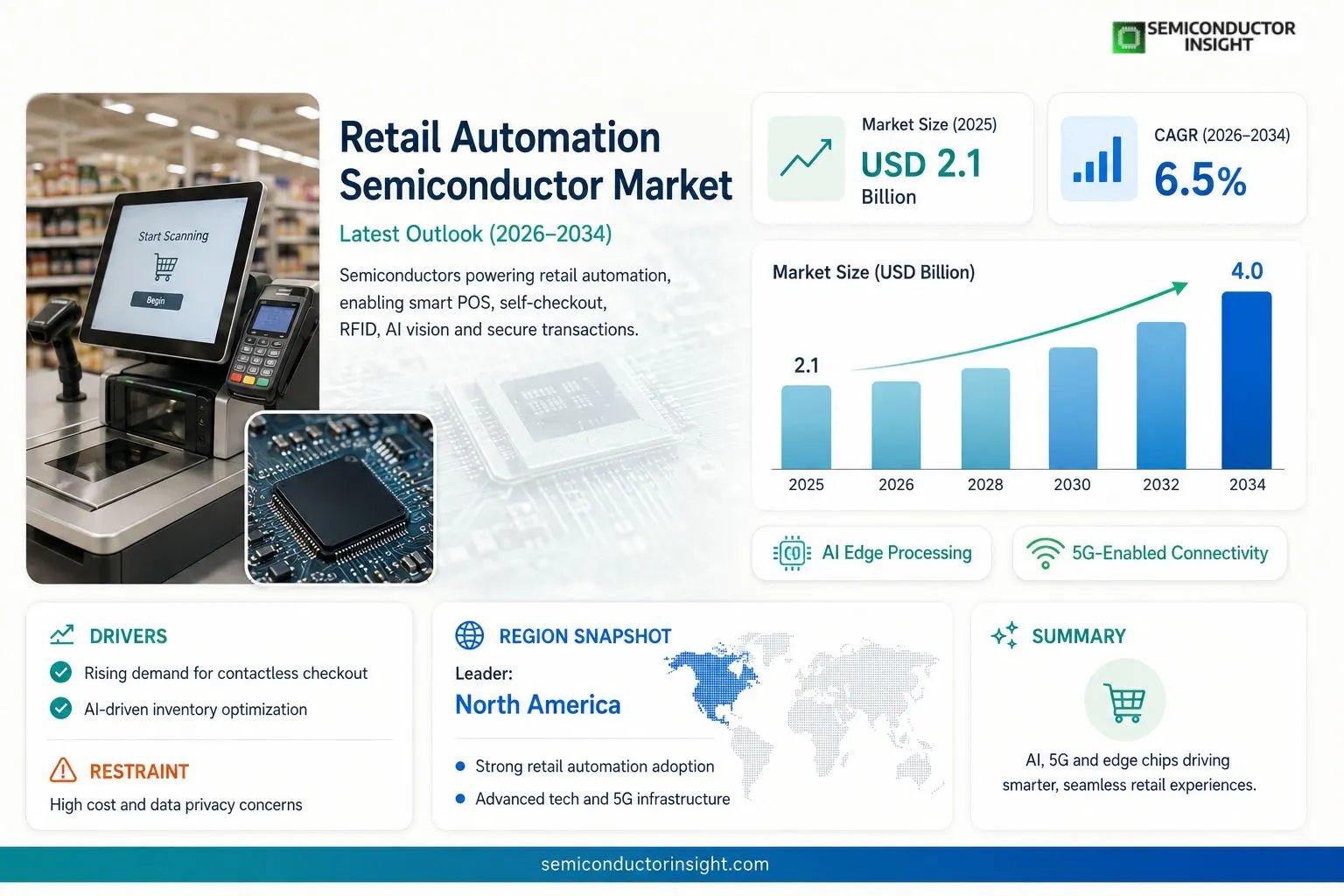
Global Retail Automation Semiconductor market size was valued at USD 2.1 billion in 2025. The market is projected to grow from USD 2.3 billion in 2026 to USD 4.0 billion by 2034, exhibiting a CAGR of 6.5% during the forecast period.
Retail automation semiconductors comprise integrated circuits and system‑on‑chip solutions that power point‑of‑sale terminals, self‑checkout kiosks, RFID readers, AI vision sensors and robotic inventory systems. These chips enable real‑time data processing, secure transactions and advanced analytics within modern retail environments.The market is accelerating because retailers are investing heavily in contactless checkout and omnichannel experiences, while AI‑driven inventory optimization drives demand for higher‑performance processors. Furthermore, the rollout of 5G connectivity enhances edge computing capabilities, prompting manufacturers such as NXP Semiconductors, Texas Instruments and STMicroelectronics to expand their product portfolios.
MARKET DRIVERS
Rising Demand for Integrated Checkout Solutions
Retail Automation Semiconductor Market is being propelled by the rapid rollout of integrated checkout systems that combine RFID, NFC, and AI capabilities. Retailers are seeking seamless, frictionless payment experiences, which require high‑performance, low‑power chips to process transactions in real time. This shift is driving manufacturers to innovate around system‑on‑chip (SoC) designs that can handle multiple protocols simultaneously.
Growth of AI‑Driven Inventory Management
AI algorithms embedded in edge processors enable predictive stock replenishment and dynamic pricing. The deployment of these processors in shelf sensors and smart carts demands semiconductor solutions that deliver robust AI inference with minimal latency. Consequently, the market is witnessing increased investment in neuromorphic and GPU‑accelerated chips tailored for retail environments.
➤ “Edge AI chips are the backbone of tomorrow’s autonomous stores, turning raw data into actionable insights within milliseconds.”
Overall, the convergence of contactless payments, AI analytics, and IoT connectivity is creating a virtuous cycle of demand that underpins the sustained growth of Retail Automation Semiconductor Market.
MARKET CHALLENGES
Escalating Component Costs
The cost of advanced semiconductor wafers has risen sharply due to supply‑chain constraints and heightened demand across multiple industries. Retailers, operating on thin margins, face pressure to balance the benefits of automation against higher capital expenditures for cutting‑edge chips.
Other Challenges
Supply Chain Vulnerabilities
Global geopolitical tensions and limited fab capacity have exposed retailers to lead‑time uncertainties. Delays in component delivery can stall rollout schedules for smart store initiatives, amplifying project risk.
MARKET RESTRAINTS
Regulatory and Data Privacy Concerns
Stringent data‑protection regulations, such as GDPR and emerging retail‑specific privacy laws, limit the type and amount of consumer data that can be collected by in‑store sensors. Semiconductor solutions must incorporate secure enclaves and encryption, adding design complexity and cost.
Standardization Gaps
Fragmented communication standards across RFID, BLE, and emerging 5G protocols impede seamless integration of heterogeneous devices. The lack of universal standards slows adoption and raises integration expenses for retailers.
Capital Expenditure Constraints
Mid‑size retailers often lack the financial bandwidth to invest in large‑scale automation projects, especially when the ROI horizon extends beyond typical budgeting cycles. This financial restraint dampens overall market acceleration.
MARKET OPPORTUNITIES
Emergence of Edge Computing in Retail
Edge computing platforms enable real‑time processing of sensor data within the store, reducing latency and reliance on cloud bandwidth. Semiconductor manufacturers that offer compact, power‑efficient edge AI chips stand to capture a sizable share of upcoming retail automation deployments.
5G Enablement for High‑Bandwidth Applications
The rollout of 5G networks provides the bandwidth required for high‑resolution video analytics and instant device‑to‑device communication. Chips optimized for 5G mmWave frequencies open new avenues for immersive shopper experiences and precise inventory tracking.
Focus on Sustainable Semiconductor Solutions
Retail brands are increasingly committing to sustainability goals, creating demand for semiconductor processes that reduce energy consumption and carbon footprints. Eco‑friendly chip designs, combined with recyclable packaging, present a differentiated value proposition for environmentally conscious retailers.
Retail Automation Semiconductor Market Trends
AI‑Enabled Edge Processing
Retail environments are increasingly reliant on semiconductor solutions that bring artificial‑intelligence inference to the point of sale. By embedding vision sensors and low‑latency processors directly into checkout stations, retailers achieve real‑time product recognition, dynamic pricing adjustments, and instantaneous fraud detection. These edge‑centric chips reduce dependence on central cloud services, improve response times, and lower operational bandwidth costs. The shift toward smarter edge devices is driven by the need for seamless omnichannel experiences and the expectation of instant, personalized service from consumers. As a result, semiconductor manufacturers are expanding their AI‑optimized portfolios to meet the growing demand for on‑device analytics within Retail Automation Semiconductor Market.
Other Trends
5G‑Driven Connectivity
The rollout of 5G networks is redefining data flow between in‑store devices and backend systems. High‑frequency, low‑latency links enable semiconductor‑based RFID readers and inventory robots to synchronize inventory status in near real time, supporting just‑in‑time replenishment strategies. Manufacturers such as NXP Semiconductors and Texas Instruments are integrating 5G modem capabilities into system‑on‑chip designs, allowing retailers to deploy dense sensor networks without the traditional wiring constraints. This connectivity boost also powers advanced analytics platforms that aggregate sales, foot‑traffic, and environmental data, giving retailers a holistic view of store performance while maintaining strict security protocols.
Secure Transaction Architectures
Security remains a central concern as transaction volumes shift toward contactless and mobile payment methods. Modern retail semiconductor solutions incorporate dedicated cryptographic engines and hardware‑rooted trust mechanisms that protect sensitive payment credentials at the chip level. These secure enclaves isolate encryption keys from the operating system, mitigating the risk of software‑based attacks. Additionally, the integration of trusted execution environments supports compliance with emerging data‑privacy regulations across multiple jurisdictions. By embedding robust security features directly into point‑of‑sale hardware, retailers can maintain consumer confidence while streamlining the checkout process, reinforcing the strategic importance of secure architectures within Retail Automation Semiconductor Market.
COMPETITIVE LANDSCAPEKey Industry Players
Retail Automation Semiconductor Market Competitive Landscape
Retail Automation Semiconductor Market is currently anchored by a handful of large, diversified semiconductor firms that leverage extensive analog‑mix and digital‑mix portfolios to address point‑of‑sale terminals, self‑checkout kiosks and RFID readers. NXP Semiconductors, Texas Instruments and STMicroelectronics dominate the segment through broad system‑on‑chip (SoC) families that combine low‑power CPUs, secure crypto engines and integrated radio modules, enabling retailers to deploy contact‑less checkout and edge‑analytics solutions at scale. These incumbents benefit from deep design expertise, global fabrication capacity and strong relationships with original equipment manufacturers (OEMs) that integrate their silicon into turnkey retail solutions. Their market share reflects a mature supply chain, high barriers to entry and the ability to rapidly adapt to emerging standards such as 5G‑enhanced edge computing.Complementing the tier‑one leaders, a set of niche but highly innovative players add depth to the competitive landscape. Infineon Technologies and Qualcomm focus on high‑performance AI vision sensors and secure connectivity, while MediaTek and ON Semiconductor provide cost‑effective processors for mass‑market self‑checkout devices. Renesas Electronics, Broadcom, Analog Devices, Microchip Technology, Skyworks Solutions and Silicon Labs specialize in power‑management ICs, RF front‑ends and mixed‑signal components that underpin RFID readers and robotic inventory systems. These companies differentiate through targeted IP blocks, rapid time‑to‑market for new retail use‑cases, and strategic partnerships with system integrators, thereby sustaining a vibrant ecosystem that drives the market’s projected CAGR of 6.5 % through 2034.
List of Key Retail Automation Semiconductor Companies Profiled
- NXP Semiconductors
- Texas Instruments
- STMicroelectronics
- Infineon Technologies
- Qualcomm
- MediaTek
- ON Semiconductor
- Renesas Electronics
- Broadcom
- Analog Devices
- Microchip Technology
- Skyworks Solutions
- Silicon Labs
- Cypress Semiconductor
- Murata Manufacturing
Segment Analysis:
| Segment Category | Sub-Segments | Key Insights |
| By Type |
|
System‑on‑Chip (SoC)
|
| By Application |
|
Self‑checkout kiosks
|
| By End User |
|
Large retail chains
|
| By Connectivity |
|
5G‑enabled modules
|
| By Functional Integration |
|
Edge AI processors
|
Regional Analysis: North America
United States
The adoption of computer vision and sensor technologies in retail is accelerating, enabling intelligent inventory tracking and personalized customer interactions. This trend is directly reliant on advanced semiconductor components for image processing and data analytics.
The complexities of modern retail supply chains necessitate robust semiconductor solutions for logistics optimization, warehouse management systems, and real-time tracking of goods. This demand is driving innovation in power management and connectivity semiconductors.
As retail operations become increasingly reliant on connected devices, ensuring cybersecurity is paramount. Secure semiconductor solutions are crucial for protecting sensitive customer data and preventing disruptions to automated systems.
The integration of AI and machine learning in retail automation is creating new demands for high-performance semiconductors capable of handling complex algorithms and vast datasets. This includes specialized processors for edge computing.
Europe
European markets are witnessing steady growth in the Retail Automation Semiconductor Market, driven by a focus on sustainable retail practices and increasing consumer demand for seamless shopping experiences. The emphasis on smart stores and efficient supply chains is fostering demand for semiconductors used in areas like RFID tracking, automated checkout systems, and predictive analytics. While adoption rates may lag slightly behind North America, the European market presents a significant long-term opportunity. Regional regulations concerning data privacy and security are influencing the development of semiconductor solutions. The market is characterized by a diverse range of players, including established semiconductor manufacturers and specialized system integrators.
Asia-Pacific
The Asia-Pacific region represents the fastest-growing segment of the Retail Automation Semiconductor Market. Rapid urbanization, a burgeoning middle class, and widespread e-commerce adoption are key drivers of this growth. Countries like China, Japan, and South Korea are leading the way in deploying retail automation technologies, creating substantial demand for semiconductors across various applications, including smart shelves, robotics, and point-of-sale systems. Government initiatives promoting technological advancement and infrastructure development further support market expansion. The competitive landscape is highly dynamic, with both domestic and international semiconductor companies vying for market share.
South America
The Retail Automation Semiconductor Market in South America is experiencing nascent growth. Increasing internet penetration and a growing adoption of digital payment systems are creating opportunities for automation in retail. However, challenges such as infrastructure limitations and economic instability present hurdles for widespread adoption. The demand for cost-effective semiconductor solutions is particularly strong in this region. Initial focus areas include inventory management systems and enhanced security solutions for retail outlets.
Middle East & Africa
The Retail Automation Semiconductor Market in the Middle East & Africa is poised for significant expansion in the coming years. Rapid urbanization, increasing disposable incomes, and government investments in retail infrastructure are driving demand for automation solutions. The growth of e-commerce and the increasing adoption of smart technologies are key factors contributing to this trend. The region presents a unique opportunity for semiconductor companies to cater to the specific needs of the rapidly evolving retail landscape. Focus areas include smart retail displays, inventory tracking systems, and customer analytics platforms.
Report Scope
This market research report provides a comprehensive analysis of the Retail Automation Semiconductor Market , covering the forecast period 2026–2034. It offers detailed insights into market dynamics, technological advancements, competitive landscape, and key trends shaping the industry.
Key focus areas of the report include:
- Market Overview: The report begins with an overview outlining its current market scenario, key growth indicators, and industry transformation drivers. It discusses macroeconomic factors, demand–supply balance, regulatory landscape, and the strategic role of semiconductors in powering advancements across industries such as automotive, telecommunications, consumer electronics, and industrial automation.
- Market Size & Forecast: Historical data and future projections for revenue, unit shipments, and market value across major regions and segments.
- Segmentation Analysis: Detailed breakdown by product type, technology, application, and end-user industry to identify high-growth segments and investment opportunities.
- Regional Insights: Insights into market performance across North America, Europe, Asia-Pacific, Latin America, and the Middle East & Africa, including country-level analysis where relevant.
- Competitive Landscape: Profiles of leading market participants, including their product offerings, R&D focus, manufacturing capacity, pricing strategies, and recent developments such as mergers, acquisitions, and partnerships.
- Technology Trends & Innovation: Assessment of emerging technologies, integration of AI/IoT, semiconductor design trends, fabrication techniques, and evolving industry standards.
- Market Drivers & Restraints: Evaluation of factors driving market growth along with challenges, supply chain constraints, regulatory issues, and market-entry barriers.
- Stakeholder Insights: Insights for component suppliers, OEMs, system integrators, investors, and policymakers regarding the evolving ecosystem and strategic opportunities.
Primary and secondary research methods are employed, including interviews with industry experts, data from verified sources, and real-time market intelligence to ensure the accuracy and reliability of the insights presented.
FREQUENTLY ASKED QUESTIONS:
What is the current market size of Retail Automation Semiconductor Market?
-> Retail Automation Semiconductor Market was valued at USD 2.1 billion in 2025 and is expected to reach USD 4.0 billion by 2034.
Which key companies operate in Retail Automation Semiconductor Market?
-> Key players include NXP Semiconductors, Texas Instruments, and STMicroelectronics, among others.
What are the key growth drivers?
-> Key growth drivers include contactless checkout adoption, omnichannel retail strategies, AI‑driven inventory optimization, and 5G‑enabled edge computing.
Which region dominates the market?
-> The source does not specify a dominant region for Retail Automation Semiconductor Market.
What are the emerging trends?
-> Emerging trends include integration of AI vision sensors, expansion of RFID and IoT‑enabled POS terminals, and the rollout of 5G connectivity to support edge‑based processing.
Get Sample Report PDF for Exclusive Insights
Report Sample Includes
- Table of Contents
- List of Tables & Figures
- Charts, Research Methodology, and more...
 Download Sample Report PDF