Key Statistics
Key Takeaways
- SMD Thin Film and Thick Film Resistors account for the largest installed demand because automated PCB assembly and miniaturization favor compact chip packages across consumer, computing, automotive and industrial electronics.
- Automotive Electronics is the strongest growth application as EV battery management, onboard charging, inverters, ADAS and zonal architectures increase demand for current-sense, pulse-resistant and high-reliability resistors.
- Asia Pacific leads the market through the concentration of electronics manufacturing and resistor production in China, Japan, South Korea and Taiwan, with Southeast Asia growing as supply chains diversify.
- Current-sense resistors are gaining strategic value because higher-current systems in EVs, robotics, power supplies and AI infrastructure require accurate low-ohmic measurement with minimal power loss.
- Power density is rising. Suppliers are introducing compact resistors with higher wattage, better thermal behavior and stronger pulse tolerance to reduce PCB area in power electronics.
- Precision and thermal modeling are becoming more important in high-reliability applications, with resistor vendors providing more detailed thermal and electrical models for automotive and industrial design workflows.
Resistors Market Overview
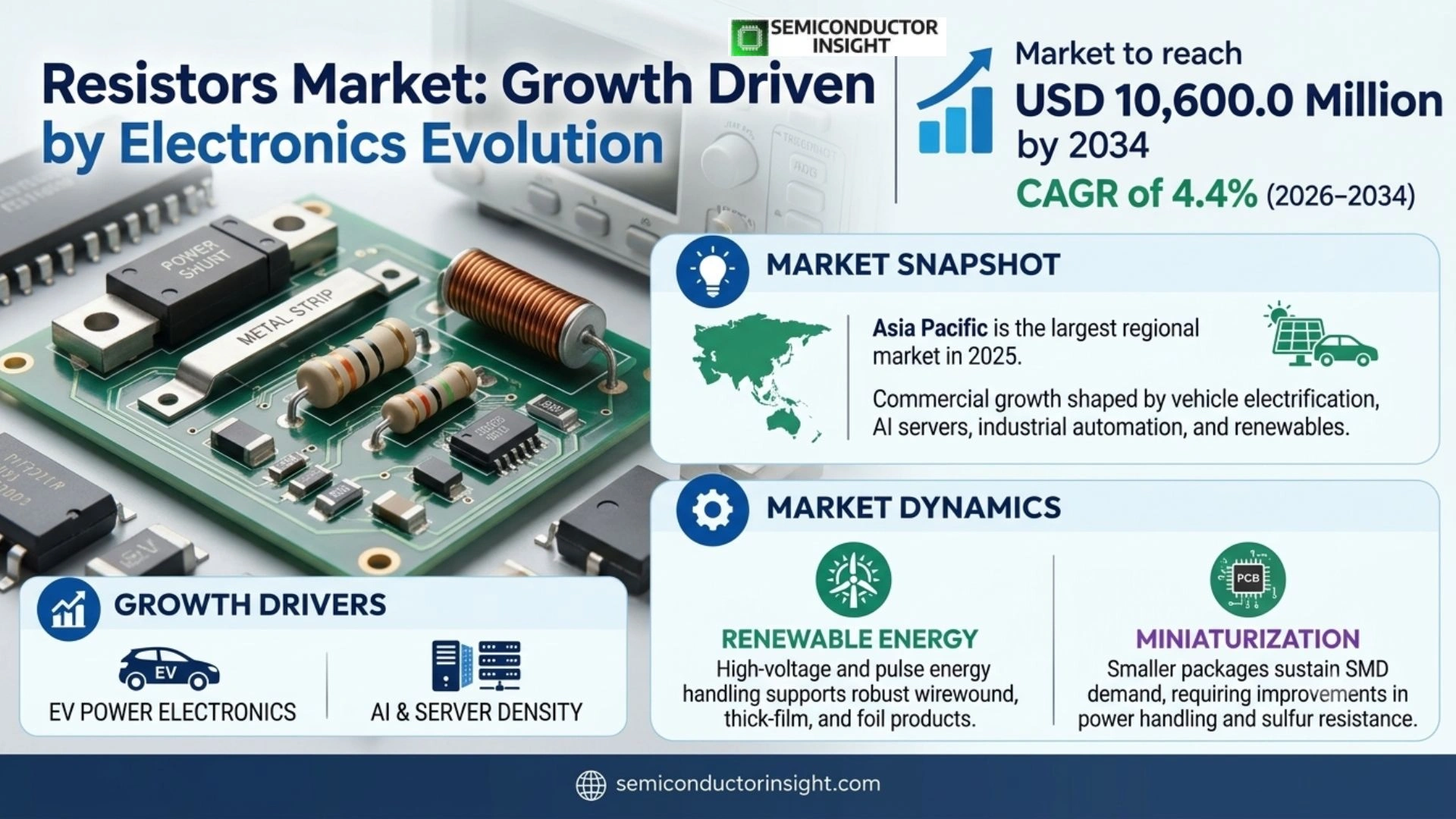
Resistors Market was valued at USD 7,210.0 million in 2025, is estimated at USD 7,525.4 million in 2026, and is projected to reach USD 10,600.0 million by 2034, representing a CAGR of 4.4% during 2026–2034. Asia Pacific is the largest regional market in 2025, while the commercial growth mechanism is increasingly shaped by vehicle electrification, AI servers, industrial automation, renewable-energy power electronics, precision current sensing, and continued SMD miniaturization.
Resistors are fundamental passive components used to limit current, divide voltage, sense current, bias active devices, terminate signals and dissipate electrical energy as heat. The market spans thin-film and thick-film chip resistors, metal current-sense elements, thermistors, variable resistors, wirewound devices, foil resistors and high-power constructions. Although individual unit prices are often low, resistors are used in very large quantities and are essential to the reliability of nearly every electronic system.
Demand is shifting toward higher-value designs as power density and sensing requirements increase. Electric vehicles need low-ohmic shunts for battery and inverter current measurement, industrial drives require pulse and surge capability, renewable-energy systems use high-power and discharge resistors, and AI servers place greater emphasis on power conversion and monitoring. These applications favor tighter tolerance, lower temperature coefficient, higher wattage and better thermal control than commodity consumer resistors.
At the same time, high-volume electronics continue to demand smaller SMD packages and lower cost. This creates a two-tier market: scale manufacturers compete aggressively in thick-film commodity components, while specialist suppliers defend margins in precision thin-film, metal foil, automotive current-sense and high-power products. Qualification, materials know-how and application engineering are increasingly important as resistor behavior becomes part of the system’s measurement accuracy and thermal design.
Segment Analysis: By Type
By type, the market includes SMD Thin Film Resistors, SMD Thick Film Resistors, Metal Current Sensing Resistors, Thermistors, and Variable Resistors. SMD resistors dominate overall demand because automated assembly and compact electronics favor chip packages. Metal current-sense resistors are a particularly strong growth area in electrified and high-current systems.
| Type | Technical role | Market position |
|---|---|---|
| SMD Thin Film Resistors | Thin-film deposition produces precise resistance values, low noise and tight temperature coefficients. Laser trimming and controlled film thickness support high accuracy in signal, RF, medical and instrumentation circuits. | A high-value precision segment. Demand is strongest where drift, tolerance and TCR directly affect system accuracy, with automotive and industrial qualification supporting premium pricing. |
| SMD Thick Film Resistors | Thick-film paste is printed and fired on ceramic substrates to create cost-effective chip resistors across a very broad resistance range and package size. | The largest volume segment. Consumer electronics, computing and general industrial systems use huge quantities, while automotive-grade and high-power variants create differentiated subsegments. |
| Metal Current Sensing Resistors | Low-ohmic metal strip, foil or alloy elements measure current through a predictable voltage drop. Four-terminal designs improve measurement accuracy by separating current and sense paths. | A strong growth segment in EV battery management, power conversion, robotics and servers. Lower resistance, higher wattage and tighter TCR are key competitive metrics. |
| Thermistors | Temperature-dependent resistors are used for sensing, compensation, inrush-current control and protection. NTC and PTC constructions serve different functions across electronics and power systems. | A broad application segment linked to thermal monitoring, battery safety, power supplies and industrial control. |
| Variable Resistors | Potentiometers, trimmers and adjustable resistive elements allow manual or electronic tuning of voltage, current or signal levels. | A mature segment with stable demand in controls, instrumentation and selected consumer and industrial products. |
Why are current-sense resistors moving to higher power ratings in smaller packages?
Higher current in EVs, servers, motor drives and power converters increases the heat dissipated in the sensing element. Designers want lower resistance to reduce power loss, but they also need enough signal voltage for accurate measurement. Wider terminals, metal-strip construction and improved thermal paths allow more wattage to be handled in smaller footprints. Four-terminal Kelvin connections further improve accuracy by removing lead and pad resistance from the sense measurement.
Segment Analysis: By Application
By application, the market is segmented into Automotive Electronics, Computers & Servers, Industrial Control, Photovoltaic and Wind Power, and Medical Equipment. Automotive electronics has the strongest innovation momentum, while AI servers and renewable-energy systems are increasing demand for high-power and current-sense products.
| Application | Demand characteristics | |
|---|---|---|
| Automotive Electronics | EV batteries, inverters, onboard chargers, ADAS, zonal controllers and power distribution use resistors for current measurement, pre-charge, discharge, signal conditioning and protection. AEC-Q200 qualification and long-term reliability are major purchasing criteria. | The strongest growth application because electrification increases both resistor count and value per vehicle. |
| Computers & Servers | AI servers and data-center power systems use resistors in voltage regulation, power monitoring, current sensing and protection. Higher rack power density creates demand for compact high-wattage and low-ohmic designs. | A growing high-value segment linked to AI infrastructure and high-current board architectures. |
| Industrial Control | Motor drives, PLCs, robotics, power supplies and factory automation require precision, surge-resistant and high-power resistors for control and energy dissipation. | A stable premium segment where reliability and long product lifecycles support differentiated products. |
| Photovoltaic and Wind Power | Inverters, energy-storage systems and grid equipment use high-power, pre-charge, discharge and current-sense resistors under high voltage and temperature variation. | An expanding energy application tied to renewable build-out and storage investment. |
| Medical Equipment | Diagnostics, imaging and monitoring systems use precision and high-reliability resistors where drift and failure can affect measurement accuracy. | A smaller but high-value segment with stringent quality and traceability requirements. |
Why does vehicle electrification increase resistor value per vehicle?
An EV contains high-current battery paths, traction inverters, onboard chargers, DC/DC converters and more electronic control units than a conventional powertrain. These systems require accurate current measurement, pre-charge and discharge functions, thermal sensing and fault protection. The result is not only more resistors but also a richer mix of low-ohmic shunts, high-power devices and automotive-qualified precision parts. Long qualification cycles further increase the value of a successful design win.
Regional Analysis
Asia Pacific leads the Resistors market because China, Japan, South Korea and Taiwan combine the largest electronics-manufacturing base with major global resistor suppliers and mature passive-component supply chains. North America and Europe are stronger in specialized automotive, aerospace, industrial and defense applications.
How do regional resistor markets differ in product mix?
Asia Pacific is dominated by high-volume SMD production and broad electronics demand, but it also contains leading Japanese precision suppliers. North America focuses more heavily on high-reliability, defense, medical and power electronics. Europe has a strong automotive and industrial mix. South America is more import dependent, while the Middle East and Africa are driven by infrastructure, energy and industrial applications.
| Region | Position | Growth outlook | Demand profile | What decides supplier selection |
|---|---|---|---|---|
| Asia Pacific | Largest | Steady to strong | High-volume electronics plus automotive and industrial | Cost, quality, scale and local supply |
| North America | Premium specialist market | Moderate | Aerospace, defense, AI servers, medical and EV | Reliability, precision and engineering support |
| Europe | Automotive & industrial specialist | Moderate | EVs, industrial power and precision electronics | AEC-Q200, thermal performance and lifecycle support |
| South America | Smaller import-dependent market | Selective | Industrial, telecom and vehicle electronics | Landed cost, distribution and service |
| Middle East & Africa | Emerging infrastructure market | Selective | Power, telecom, industrial and imported electronics | Availability, ruggedness and local channel support |
Competitive Landscape
The market includes Yageo, Vishay, KOA, Panasonic, Samsung Electro-Mechanics, UNI-ROYAL, TA-I Technology, Fenghua Advanced Technology, Cyntec, EVER OHMS, Susumu, ROHM, Isabellenhütte, TT Electronics and Bourns. Competition ranges from commodity thick-film scale to highly specialized current-sense and precision products.
Yageo, Vishay and KOA combine broad portfolios with automotive and industrial qualifications. Their scale supports high-volume SMD production, while precision and current-sense families allow them to participate in higher-margin applications. Japanese suppliers retain strong positions in high-stability and low-TCR products.
Bourns has expanded aggressively across current-sense, wirewound, thick-film and foil power resistors, including automotive-qualified designs. ROHM differentiates through current-sense technology and detailed thermal modeling, while Isabellenhütte is well known for precision shunt and alloy technology.
Chinese and Taiwanese suppliers compete strongly in commodity and mid-range chip resistors. As high-volume products face price pressure, established vendors increasingly focus on automotive, AI server, renewable energy and industrial applications where wattage, pulse handling, TCR and reliability provide clearer differentiation.
| Competitive tier | Representative companies | Commercial basis |
|---|---|---|
| Global diversified leaders | Yageo; Vishay Intertechnology; KOA Corporation; Panasonic; Samsung Electro-Mechanics | Scale, automotive qualification, broad SMD portfolios and global distribution. |
| Precision and power specialists | ROHM Semiconductor; Isabellenhütte; TT Electronics; Bourns; Susumu | Current sensing, low TCR, foil, wirewound and high-power products for demanding systems. |
| Regional high-volume suppliers | UNI-ROYAL; TA-I Technology; Fenghua Advanced Technology; Cyntec; EVER OHMS | Cost-competitive SMD production, regional customer proximity and growing high-power portfolios. |
Key Market Participants
Yageo, Vishay Intertechnology, KOA Corporation, Panasonic, Samsung Electro-Mechanics, UNI-ROYAL Corporation, TA-I Technology, GuangDong FengHua Advanced Technology, Cyntec, EVER OHMS, Susumu, Rohm Semiconductor, Isabellenhütte, TT Electronics, Bourns.
Production Capacity Analysis
Resistor capacity is distributed across ceramic substrates, metal alloys, resistive pastes, thin-film deposition, printing, firing, trimming and packaging. Commodity thick-film chip resistors can be produced at very high volume, while precision thin-film, foil and current-sense products require tighter material control and more extensive testing.
Thick-film production prints resistive paste onto ceramic substrates, fires the material and laser-trims each element to the target value before termination and singulation. High-volume factories optimize line speed and yield, making scale and materials procurement critical to commodity pricing.
Thin-film and metal-foil products use more controlled deposition or alloy processing to achieve tighter tolerance and lower TCR. These processes have lower volume but higher value because measurement, medical, aerospace and industrial applications require stability over temperature and time.
Current-sense resistors depend heavily on alloy composition, geometry and thermal design. Wide terminals, metal strips and four-terminal layouts reduce hot spots and measurement error. Automotive versions add AEC-Q200 testing and traceability, increasing both qualification time and production value.
| Capacity layer | Where it concentrates | Commercial constraint |
|---|---|---|
| Ceramic substrates & resistive materials | Japan, China, Taiwan, South Korea and global materials suppliers | Ceramic quality, metal/alloy pricing and paste formulation. |
| Thick-film / thin-film processing | Asia Pacific plus specialist North American and European plants | Deposition uniformity, firing control, laser trimming and yield. |
| Current-sense & power assembly | United States, Europe, Japan, Taiwan and global specialist sites | Alloy control, terminal design, thermal resistance and AEC-Q200 qualification. |
| Distribution & OEM qualification | Global electronics manufacturing hubs | Inventory availability, lot consistency and long-term supplier approval. |
Market Dynamics
Resistor demand grows with electronics content and power density rather than with a single end market. The main growth engines are EVs, AI infrastructure and renewable energy, while commodity SMD pricing remains competitive. Suppliers protect margins by moving toward current sensing, high-power, high-precision and automotive-qualified products.
Market Drivers
| Factor | Directional impact | Why it matters |
|---|---|---|
| Vehicle electrification | High | BMS, inverters and chargers require current sensing, pre-charge and power dissipation. |
| AI servers and high-current power systems | High | Higher board and rack power raises current monitoring and thermal requirements. |
| Renewable energy and storage | Medium-High | Inverters and storage systems use high-power, discharge and shunt resistors. |
| Electronics miniaturization | Medium | Smaller SMD packages support dense consumer and industrial boards. |
EV power electronics increases resistor content and value
Battery packs and traction systems need accurate current measurement, pre-charge and fault handling. Low-ohmic shunts must dissipate significant power while preserving measurement accuracy. This moves demand toward automotive-qualified metal-strip and four-terminal designs rather than only commodity chip resistors.
AI systems raise board-level power density
AI accelerators and servers draw very high current, increasing the importance of power monitoring and compact current sensing. Higher wattage in smaller packages helps designers reduce PCB area without paralleling multiple resistors. Precision thermal models also improve confidence in power-system design.
Renewable energy adds high-voltage duty cycles
Solar inverters, wind converters and energy-storage systems need pre-charge, discharge, snubber and current-sensing functions. These applications expose resistors to high voltage, pulse energy and temperature cycling, supporting robust wirewound, thick-film and foil products.
Miniaturization sustains SMD demand
Consumer and industrial electronics continue shrinking while adding functionality. Smaller packages and automated assembly maintain very high SMD volumes, although suppliers must improve power handling and sulfur resistance as component density rises.
Market Restraints
| Factor | Directional impact | Why it matters |
|---|---|---|
| Commodity price pressure | High | High-volume thick-film products face intense competition and limited pricing power. |
| Raw material volatility | Medium-High | Nickel, copper, ceramics and specialized alloys can affect cost and margin. |
| Miniaturization thermal limits | Medium-High | Smaller footprints make it harder to dissipate heat and maintain long-term stability. |
| Qualification cycles | Medium | Automotive and medical approvals can delay new-product revenue. |
Commodity SMD pricing remains structurally competitive
Standard thick-film resistors are produced by many Asian suppliers and are readily interchangeable after qualification. OEMs therefore negotiate aggressively on price and inventory terms. Premium suppliers must move toward tighter tolerance, higher power or automotive grades to protect margin.
Materials can pressure margins
Resistor performance depends on ceramic substrates, copper, nickel and proprietary alloys. Sudden material-price changes can be difficult to pass through in low-value components, particularly where customers have annual pricing agreements. Vertical integration and supplier diversification reduce exposure.
Power density creates thermal trade-offs
Smaller components save PCB space but run hotter at a given power. Higher temperature can shift resistance and reduce life. Suppliers use wider terminals, better ceramic substrates and metal-strip construction, but system designers still need careful derating and thermal analysis.
High-reliability qualification slows product transitions
Automotive and medical customers require extensive reliability data before approving a new resistor family. This creates stable design wins after qualification but delays revenue and increases development cost for new entrants.
Market Opportunities
High-power compact current sensing
EVs, robots and servers need accurate low-ohmic sensing in shrinking PCB areas. Metal-strip and four-terminal designs with better thermal paths can capture higher value per component.
AI server power distribution
Rapid growth in rack power creates opportunities in shunts, pre-charge, protection and current monitoring across server boards and power shelves.
Automotive 800V platforms
Higher-voltage EV systems need pulse-resistant and high-reliability resistors for charging, inverters and battery protection. Suppliers with AEC-Q200 portfolios are well placed.
Digital thermal models and co-design
Providing accurate electrical and thermal models helps customers optimize resistor placement and derating before prototypes. This strengthens design-in relationships and can differentiate otherwise similar components.
Supply Chain Analysis
Materials. Ceramic substrates provide insulation and thermal conduction, while metal films, thick-film pastes and precision alloys determine resistance and TCR. Material consistency is essential because small composition changes can affect millions of finished parts.
Resistor Fabrication. Thick-film lines prioritize scale and yield, while thin-film and foil processes prioritize precision. Laser trimming is widely used to bring resistance into tolerance after deposition or firing. Process stability determines how much trimming and final test is required.
Termination & Packaging. Chip resistors receive metallized terminations compatible with solder reflow, while power devices may use larger terminals, heat-sink packages or four-terminal Kelvin structures. Package design increasingly determines thermal performance and surge capability.
Distribution & OEM Use. Commodity products move through broad distribution, while automotive and industrial components often require direct technical qualification. Vendor-managed inventory and long-term availability are important because a simple passive-component shortage can stop an electronics production line.
Recent Developments in the Resistors Market
Developments tracked to September 2026. Entries are dated to the official publication date where available.
- 2 December 2025 Product
Bourns introduced four foil resistor series covering 6 W to 80 W and a wide resistance range. The launch expands precision and power options for applications that require low drift and stable performance. Source - 24 November 2025 Product
Bourns launched the Riedon BRF precision power foil resistor family for high-energy pulse applications. Power ratings reach 2500 W, supporting demanding industrial and power-conversion designs. Source - 20 November 2025 Design tools
ROHM expanded high-accuracy thermal models for PMR and PSR shunt resistors and integrated them into Siemens Simcenter Flotherm. Better simulation data helps designers predict temperature and current-sense accuracy in automotive and industrial systems. Source - 16 October 2025 Automotive
Bourns introduced the CSS4C-1216 AEC-Q200 four-terminal shunt resistor series. The devices target EV, BMS and power-electronics applications that need accurate current measurement and robust thermal performance. Source - 1 October 2025 Current sensing
Vishay launched the WSLF1206 Power Metal Strip current-sense resistor with power up to 5 W in a compact 1206 package. The design addresses increasing board-level current and power density in automotive, industrial and computing applications. Source
Report Scope & Segmentation
| Attribute | Coverage |
|---|---|
| Report title | Resistors Market, Trends, Business Strategies 2026-2034 |
| Base / estimate / forecast | 2025 base year; 2026 estimated year; 2034 forecast end year; CAGR measured for 2026–2034. |
| By Type | SMD Thin Film Resistors; SMD Thick Film Resistors; Metal Current Sensing Resistors; Thermistors; Variable Resistors |
| By Application | Automotive Electronics; Computers & Servers; Industrial Control; Photovoltaic and Wind Power; Medical Equipment |
| By End User | OEM Electronics Manufacturers; Industrial Equipment Makers; Automotive Tier 1 Suppliers; Consumer Electronics Brands |
| By Technology | Thin Film Technology; Thick Film Technology; Wirewound Technology; Metal Foil Technology |
| By Package Type | SMD/Chip Resistors; Through-Hole Resistors; Power Resistor Packages; Specialty Configurations |
| Regions | North America, Europe, Asia-Pacific, South America, and Middle East & Africa, with country-level analysis across the principal national markets. |
| Companies | Yageo, Vishay Intertechnology, KOA Corporation, Panasonic, Samsung Electro-Mechanics, UNI-ROYAL Corporation, TA-I Technology, GuangDong FengHua Advanced Technology, Cyntec, EVER OHMS, Susumu, Rohm Semiconductor, Isabellenhütte, TT Electronics, Bourns |
| Customization Scope | Free report customization (equivalent to up to 4 analyst working days) with purchase. Addition or alteration to country, regional and segment scope. |
Frequently Asked Questions
What is the size of the Resistors market?
The global Resistors market is valued at USD 7,210.0 million in 2025, is estimated at USD 7,525.4 million in 2026, and is projected to reach USD 10,600.0 million by 2034, representing a 4.4% CAGR during 2026–2034.
Which region leads the Resistors market?
Asia Pacific leads because China, Japan, South Korea and Taiwan combine the largest electronics-manufacturing base with major passive-component suppliers and mature resistor production ecosystems.
Which resistor types are most important?
The market includes SMD thin-film, SMD thick-film, metal current-sense, thermistors and variable resistors. SMD chip resistors dominate volume, while current-sense and precision products are gaining value in EV, industrial and AI power systems.
Which application is growing fastest?
Automotive Electronics is one of the strongest growth applications because EV batteries, inverters, chargers, ADAS and zonal control systems require more current sensing, pulse handling and high-reliability passive components.
Why are current-sense resistors important?
Current-sense resistors create a small, predictable voltage proportional to current so that control electronics can measure battery, motor or converter current. Low resistance minimizes power loss, while four-terminal layouts improve accuracy by excluding terminal and PCB resistance from the measurement.
How are AI servers affecting resistor demand?
AI servers raise board and rack power density, increasing demand for current monitoring, power conversion and protection. Compact high-wattage resistors help designers manage higher current without using multiple parallel components.
What are the main restraints on resistor market growth?
The main restraints are commodity price competition, raw-material volatility, thermal limits as packages shrink and long qualification cycles in automotive and medical applications.
Who are the major Resistors companies?
Major companies include Yageo, Vishay, KOA, Panasonic, Samsung Electro-Mechanics, UNI-ROYAL, TA-I Technology, Fenghua Advanced Technology, Cyntec, EVER OHMS, Susumu, ROHM, Isabellenhütte, TT Electronics and Bourns.
What technologies are used to make resistors?
Major technologies include thin film, thick film, wirewound and metal foil. Each offers a different balance of precision, power handling, cost, noise and thermal stability.
Where are the strongest future opportunities?
The strongest opportunities are in high-power current sensing, AI server power distribution, 800V EV platforms, renewable-energy power electronics and digital thermal co-design.
Research Sources & Evidence Base
Get Sample Report PDF for Exclusive Insights
Report Sample Includes
- Table of Contents
- List of Tables & Figures
- Charts, Research Methodology, and more...
 Download Sample Report PDF