
MARKET INSIGHTS
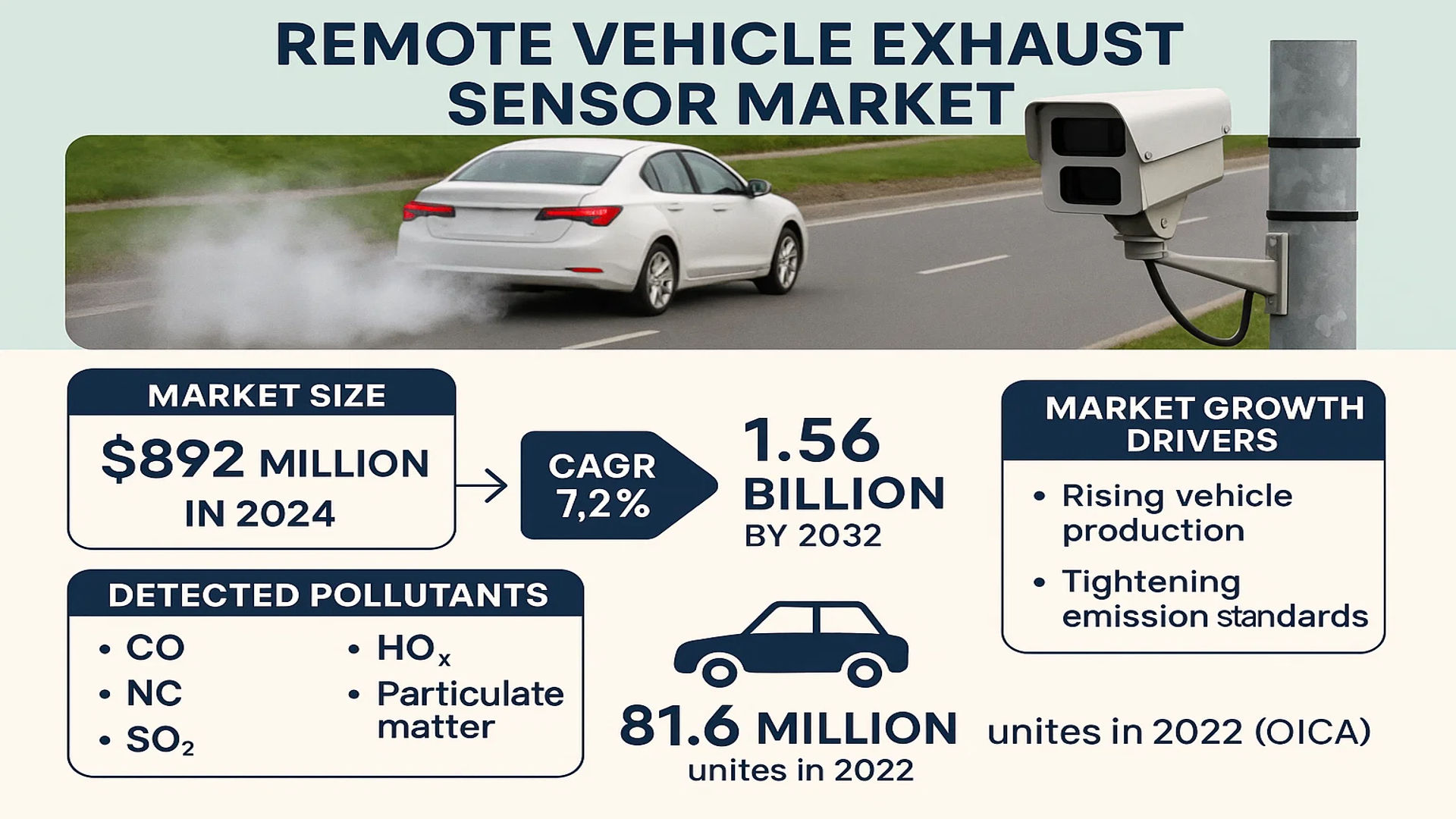
The global Remote Vehicle Exhaust Sensor Market size was valued at US$ 892 million in 2024 and is projected to reach US$ 1.56 billion by 2032, at a CAGR of 7.2% during the forecast period 2025-2032.
Remote vehicle exhaust sensors are advanced emission monitoring devices that detect and measure pollutants from vehicle exhaust systems without direct contact. These sensors utilize infrared or ultraviolet spectroscopy to analyze key pollutants including carbon monoxide (CO), hydrocarbons (HC), nitrogen oxides (NOx), sulfur dioxide (SO2), and particulate matter. The technology enables real-time monitoring of vehicle emissions for compliance with stringent environmental regulations.
The market growth is driven by increasing global vehicle production which reached 81.6 million units in 2022 according to OICA data, coupled with tightening emission standards worldwide. Asia dominates the automotive sector, accounting for 56% of global vehicle production, creating significant demand for emission control technologies. Key players like Opus Group AB and Hager Environmental are developing innovative sensor solutions to meet evolving regulatory requirements, with recent advancements focusing on improved detection accuracy and cloud-based data analytics capabilities.
MARKET DYNAMICS
MARKET DRIVERS
Stringent Emission Regulations Driving Adoption of Remote Exhaust Sensors
Global governments are implementing increasingly strict vehicle emission standards to combat air pollution, creating strong demand for remote exhaust sensing technologies. The Euro 6 standards in Europe and EPA Tier 3 regulations in North America require real-time monitoring of pollutants including nitrogen oxides (NOx) and particulate matter. Vehicle emissions account for approximately 50% of urban air pollution, prompting authorities to adopt remote sensing as a cost-effective compliance monitoring solution. China’s recent adoption of China VI standards, considered the world’s strictest, has particularly accelerated demand for advanced exhaust monitoring systems in the world’s largest automotive market.
Rise of Smart Cities and Connected Vehicle Infrastructure Boosts Market Growth
The global smart city initiative wave is creating substantial opportunities for remote exhaust sensor integration into urban infrastructure. Many municipalities are installing fixed roadside sensors that can monitor passing vehicles’ emissions without direct contact, enabling large-scale fleet monitoring. The connected vehicle ecosystem, which is projected to grow significantly by 2030, synergizes perfectly with remote exhaust sensing technologies. This integration allows for real-time pollution mapping and targeted enforcement of emission standards, while also providing data for urban planning and environmental policy decisions.
Technological Advancements Enhancing Sensor Capabilities
Recent innovations in sensor technology are dramatically improving the accuracy and functionality of remote exhaust monitoring systems. Modern sensors can now detect multiple pollutants simultaneously with precision levels exceeding 95%, while advanced algorithms can identify individual vehicle emissions at highway speeds. These improvements have expanded applications from simple compliance monitoring to comprehensive air quality management systems. The development of more durable and weather-resistant sensor components has also increased deployment options in challenging urban environments.
MARKET RESTRAINTS
High Deployment Costs Limit Market Penetration
While remote exhaust sensing offers significant advantages, the substantial initial investment required for system deployment acts as a major market restraint. A single high-accuracy remote sensing unit can cost over tens of thousands of dollars, making widespread adoption challenging for many municipalities and agencies. Maintenance and calibration expenses add to the total cost of ownership, particularly in harsh environmental conditions. These financial barriers are especially pronounced in developing markets where budgets for environmental monitoring are often limited.
Technical Limitations in Extreme Conditions
Remote exhaust sensors face performance challenges in certain environmental conditions that can affect market growth. Dense fog, heavy rain, or extreme temperatures can temporarily reduce measurement accuracy or require more frequent maintenance. Additionally, the technology struggles with accurately measuring emissions from hybrid or electric vehicles in electric mode, presenting challenges as these vehicle types gain market share. These limitations require ongoing technological improvements to maintain system reliability across diverse operating conditions.
MARKET OPPORTUNITIES
Integration with Vehicle Telematics Creates New Applications
The convergence of remote exhaust sensing with vehicle telematics systems presents significant growth opportunities. By combining roadside sensor data with onboard vehicle diagnostics, authorities and fleet operators can gain comprehensive insights into real-world emissions performance. This hybrid approach enables more accurate identification of high-emitting vehicles while providing data for predictive maintenance programs. The commercial vehicle sector, in particular, shows strong potential for this integrated monitoring approach as fleet operators seek to optimize fuel efficiency and reduce emissions.
Expansion in Emerging Markets Offers Significant Growth Potential
Developing nations with rapidly growing vehicle fleets and worsening air quality represent untapped markets for remote exhaust sensing technology. Many Asian and South American cities facing severe pollution problems are beginning to implement emission monitoring programs, creating demand for cost-effective solutions. Local manufacturing and government partnerships could help overcome cost barriers in these price-sensitive markets, potentially unlocking substantial growth opportunities for sensor providers.
REMOTE VEHICLE EXHAUST SENSOR MARKET TRENDS
Stringent Emission Regulations Accelerate Adoption of Remote Exhaust Sensors
The global push toward stricter emission standards is driving significant demand for remote vehicle exhaust sensors. Governments worldwide are implementing more rigorous environmental policies, such as Euro 6 standards in Europe and China 6 regulations, which mandate real-time monitoring of vehicle emissions. Remote sensors enable authorities to measure pollutants like nitrogen oxides (NOx) and particulate matter (PM) without direct vehicle contact, revolutionizing compliance monitoring. By 2030, over 60% of major cities are expected to deploy remote sensing technologies as part of their emission control strategies. The integration of IoT and wireless communication in these sensors further enhances their ability to provide instant, actionable data to regulatory bodies.
Other Trends
Growth in Electric Vehicles Challenges Traditional Market Dynamics
While the rise of electric vehicles (EVs) could potentially reduce demand for exhaust monitoring, hybrid vehicles and legacy fleets ensure sustained sensor relevance. Currently, EVs account for only 14% of global vehicle sales, leaving combustion engines dominant in commercial and passenger segments. Remote sensors remain critical for monitoring aging vehicle fleets, particularly in developing nations where electrification adoption lags. China, despite leading in EV production, still requires advanced exhaust monitoring for its 290 million combustion-engine vehicles on the road.
Technological Advancements Enhance Sensor Capabilities
Innovations in laser spectroscopy and artificial intelligence are transforming remote exhaust sensing. Cutting-edge sensors now detect pollutants at parts-per-billion concentrations with 95%+ accuracy, a dramatic improvement over earlier technologies. AI-driven analysis allows for real-time identification of emission cheating patterns, addressing post-Dieselgate concerns. Furthermore, miniaturization enables mobile deployment – a key advantage for urban enforcement. Companies are investing heavily in R&D, with 45% of industry leaders allocating over 20% of revenue to develop next-generation sensors.
COMPETITIVE LANDSCAPE
Key Industry Players
Technological Innovation and Regulatory Compliance Drive Market Competition
The global remote vehicle exhaust sensor market features a mix of established automotive suppliers and specialized emission monitoring technology providers. The competitive landscape remains dynamic, with companies investing heavily in R&D to meet stringent emission standards like Euro 6 and China 6. According to industry analysis, the top five players accounted for approximately 42% of the global market revenue in 2024, reflecting moderate concentration with opportunities for emerging players.
Opus Group AB leads the market through its advanced remote sensing technology deployed across major European and North American cities. The company’s proprietary RSD 5000 systems have become industry benchmarks for real-time vehicle emissions monitoring. While Opus dominates stationary monitoring systems, Hager Environmental & Atmospheric Technologies has strengthened its position in mobile sensing platforms, particularly for urban air quality management programs.
Asian manufacturers are gaining traction through competitive pricing and localized solutions. Anhui Baolong Environmental Protection Technology, for instance, has captured nearly 15% of China’s domestic market through government partnerships and tailored solutions for high-density traffic monitoring. Similarly, Hangzhou Chunlai Technology has expanded its footprint across Southeast Asia by offering modular systems compatible with smart city infrastructure.
The market is witnessing increasing collaboration between sensor manufacturers and automotive OEMs. Several leading companies are developing integrated solutions that combine onboard diagnostics (OBD) with remote sensing capabilities. This convergence addresses the growing demand for comprehensive emissions monitoring across vehicle fleets.
List of Key Remote Vehicle Exhaust Sensor Companies Profiled
- Opus Group AB (Sweden)
- Hager Environmental & Atmospheric Technologies (U.S.)
- Anhui Baolong Environmental Protection Technology Co., Ltd. (China)
- Hangzhou Chunlai Technology Co., Ltd. (China)
- Environnement S.A. (France)
- ETG Risorse S.r.l. (Italy)
- HORIBA, Ltd. (Japan)
- Sensors, Inc. (U.S.)
- Maha Maschinenbau Haldenwang GmbH & Co. KG (Germany)
Segment Analysis:
By Type
Nitrogen Oxides Sensors Dominate Due to Strict Emission Regulations Globally
The market is segmented based on type into:
- Carbon Monoxide
- Subtypes: Electrochemical, Infrared, and others
- Hydrocarbons
- Nitrogen Oxides
- Subtypes: NOx sensors with urea injection and others
- Sulfur Dioxide
- Lead Containing Compounds
- Others
By Application
Passenger Vehicle Segment Leads Due to Higher Vehicle Production Volume
The market is segmented based on application into:
- Passenger Vehicle
- Subtypes: Sedans, SUVs, Hatchbacks, and others
- Commercial Vehicle
By Technology
Non-Dispersive Infrared (NDIR) Technology Gains Traction for High Accuracy
The market is segmented based on technology into:
- Electrochemical
- Non-Dispersive Infrared (NDIR)
- Paramagnetic
- Zirconia
By Detection Method
Remote Sensing Detection Gains Importance for Emission Monitoring
The market is segmented based on detection method into:
- Point Detection
- Remote Sensing Detection
- Subtypes: Active and Passive remote sensing
Regional Analysis: Remote Vehicle Exhaust Sensor Market
Asia-Pacific
The Asia-Pacific region dominates the global remote vehicle exhaust sensor market, accounting for approximately 56% of the worldwide automotive production. China, the world’s largest vehicle manufacturer with a 32% market share, drives significant demand for exhaust monitoring solutions to comply with increasingly stringent emission norms. Countries like India and Japan are implementing Bharat Stage VI (BS-VI) and JP-2018 regulations respectively, creating strong market pull for advanced detection technologies. The region benefits from localized manufacturing capabilities of key players like Anhui Baolong Environmental Protection Technology and rapid adoption in commercial fleets. However, price sensitivity remains a challenge for premium sensor adoption in emerging markets.
North America
Stringent EPA regulations under the Clean Air Act and California’s Advanced Clean Cars program mandate precise emissions monitoring, fueling adoption of remote exhaust sensing technologies. The U.S. represents the largest regional market with numerous roadside emissions testing programs utilizing remote sensors. Canada’s growing focus on decarbonizing transport through initiatives like the Zero-Emission Vehicle Infrastructure Program is creating new opportunities. Major industry players have established strong R&D centers in the region to develop next-generation laser-based and infrared detection systems. Market growth is somewhat constrained by the relatively slower turnover rate of vehicle fleets compared to Asia.
Europe
European nations lead in regulatory stringency with Euro 6d standards requiring real-world emissions testing, creating robust demand for remote sensing solutions. Germany and France are at the forefront of adopting these technologies for both passenger and commercial vehicle monitoring. The EU’s commitment to carbon neutrality by 2050 is accelerating investments in advanced emissions detection infrastructure. Key challenges include complex cross-border regulatory harmonization and high costs associated with cutting-edge optical sensing technologies. Several EU-funded projects like CENSE are actively developing standardized remote sensing methodologies for widespread deployment across member states.
South America
Brazil and Argentina are emerging markets for vehicle exhaust sensors, driven by adopting cleaner fuel standards and growing environmental awareness. The PROCONVE L-8 regulation in Brazil is creating new compliance requirements that remote sensing technologies can address. Infrastructure limitations and economic volatility have slowed large-scale deployments, though urban air quality monitoring initiatives in cities like São Paulo present growth opportunities. Local manufacturing remains underdeveloped, creating import reliance that affects product affordability and service networks. The commercial vehicle segment shows particular promise as fleets modernize to meet logistics efficiency targets.
Middle East & Africa
This region represents a developing market where remote exhaust sensing adoption is primarily driven by oil-rich nations addressing urban air quality concerns. The UAE and Saudi Arabia have implemented emissions testing programs in major cities, though coverage remains limited compared to mature markets. Africa presents long-term potential as vehicle ownership grows, but currently lacks the regulatory framework and infrastructure for widespread sensor deployment. International partnerships are helping build capabilities, such as Dubai’s collaboration with European technology providers for smart city initiatives. The market currently focuses on port emissions monitoring and high-value fleet operations rather than comprehensive national programs.
Report Scope
This market research report provides a comprehensive analysis of the global Remote Vehicle Exhaust Sensor market, covering the forecast period 2024–2032. It offers detailed insights into market dynamics, technological advancements, competitive landscape, and key trends shaping the industry.
Key focus areas of the report include:
- Market Size & Forecast: Historical data and future projections for revenue, unit shipments, and market value across major regions and segments. The global market was valued at US$ 892 million in 2024 and is projected to reach US$ 1.56 billion by 2032.
- Segmentation Analysis: Detailed breakdown by product type (Carbon Monoxide, Hydrocarbons, Nitrogen Oxides, Sulfur Dioxide, Lead Containing Compounds, Others) and application (Passenger Vehicle, Commercial Vehicle) to identify high-growth segments.
- Regional Outlook: Insights into market performance across North America, Europe, Asia-Pacific, Latin America, and Middle East & Africa, with country-level analysis of major automotive markets.
- Competitive Landscape: Profiles of leading market participants including Opus Group AB, Hager Environmental & Atmospheric Technologies, Anhui Baolong Environmental Protection Technology Co., Ltd., and Hangzhou Chunlai Technology Co., Ltd.
- Technology Trends & Innovation: Assessment of emerging sensor technologies, integration with vehicle telematics systems, and evolving emissions monitoring standards.
- Market Drivers & Restraints: Evaluation of factors including stringent emissions regulations, automotive production trends, and technological adoption rates.
- Stakeholder Analysis: Insights for automotive OEMs, sensor manufacturers, regulatory bodies, and environmental agencies regarding market opportunities and challenges.
The research methodology combines primary interviews with industry experts and secondary data from verified sources, ensuring the accuracy and reliability of market insights.
FREQUENTLY ASKED QUESTIONS:
What is the current market size of Global Remote Vehicle Exhaust Sensor Market?
->Remote Vehicle Exhaust Sensor market size was valued at US$ 892 million in 2024 and is projected to reach US$ 1.56 billion by 2032, at a CAGR of 7.2% during the forecast period 2025-2032.
Which key companies operate in Global Remote Vehicle Exhaust Sensor Market?
-> Key players include Opus Group AB, Hager Environmental & Atmospheric Technologies, Anhui Baolong Environmental Protection Technology Co., Ltd., and Hangzhou Chunlai Technology Co., Ltd.
What are the key growth drivers?
-> Key growth drivers include stringent emissions regulations worldwide, increasing vehicle production, and technological advancements in sensor accuracy.
Which region dominates the market?
-> Asia-Pacific leads the market due to high vehicle production volumes, particularly in China which accounts for about 32% of global automobile production.
What are the emerging trends?
-> Emerging trends include integration with vehicle telematics systems, development of multi-gas detection sensors, and increasing adoption in commercial vehicle fleets.

Get Sample Report PDF for Exclusive Insights
Report Sample Includes
- Table of Contents
- List of Tables & Figures
- Charts, Research Methodology, and more...
 Download Sample Report PDF


