RC Transmitter Market Insights
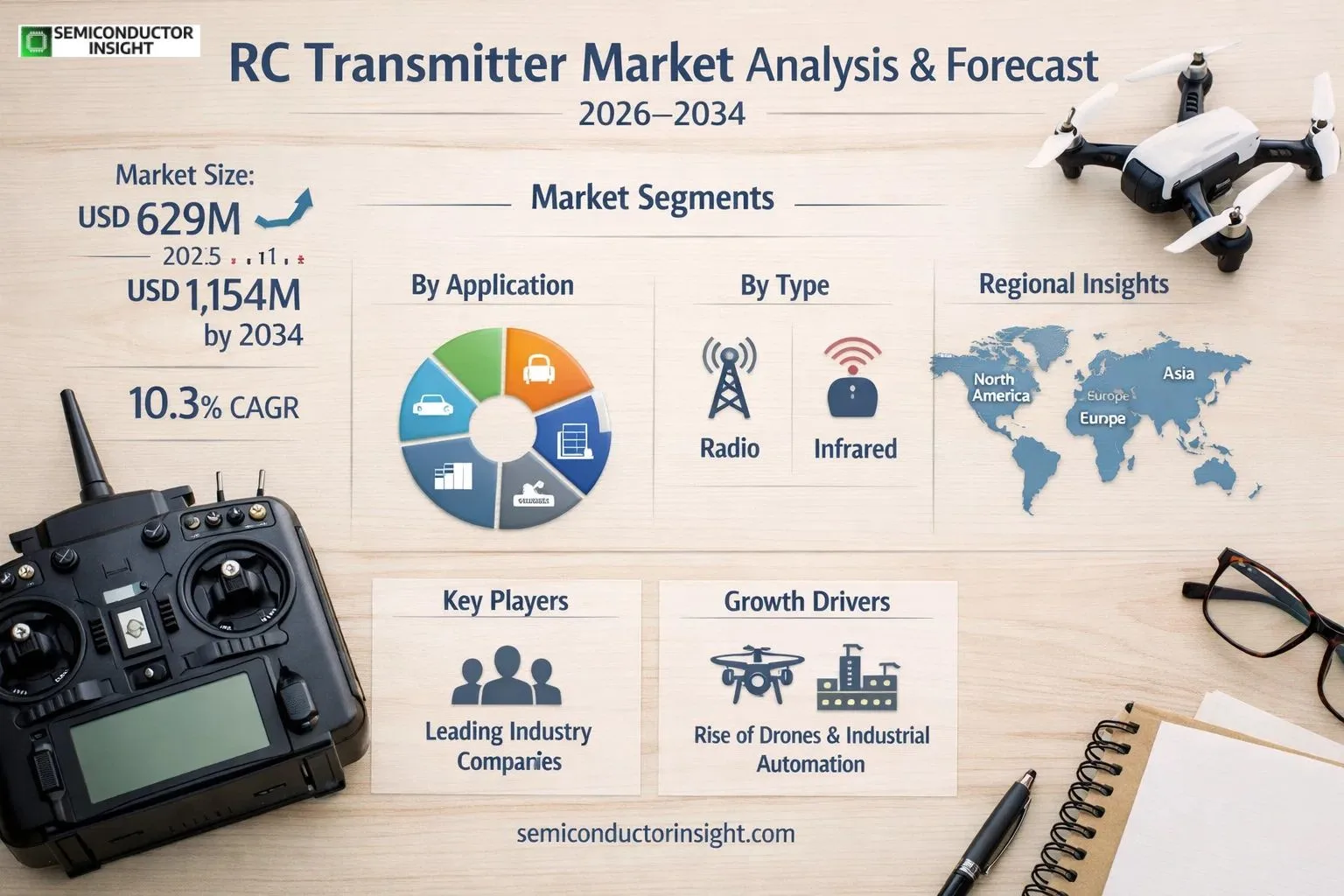
Global RC transmitter market size was valued at USD 629 million in 2025. The market is projected to grow from USD 693 million in 2026 to USD 1,154 million by 2034, exhibiting a CAGR of 10.3% during the forecast period.
A remote control (RC) transmitter is a handheld wireless device used to command and operate model vehicles, aircraft, drones, boats, and various industrial machinery. This unit communicates via radio frequency (RF) or infrared signals with a paired receiver installed in the target device, translating user inputs into precise control over movement and functions. Core product segments include Radio and Infrared transmitters.
The market is experiencing robust growth driven by several key factors, including the surging popularity of hobbyist drones and RC vehicles, alongside increasing adoption of wireless control systems in industrial automation and material handling. Furthermore, technological advancements such as the integration of 2.4GHz spread spectrum technology, which offers improved signal reliability and reduced interference, are significantly enhancing product appeal. The expansion of application areas into consumer electronics, aerospace equipment, and automobiles for testing and teleoperation is also contributing to market expansion. Initiatives by key players focusing on ergonomic design, longer battery life, and enhanced connectivity protocols are expected to fuel further growth. For instance, leading manufacturers like SPEKTRUM, known for their DSMX technology, and Danfoss, which provides robust industrial radio remote controls, continuously innovate to capture market share. Other significant players operating globally with diverse portfolios include Applied Wireless, Tele Radio Group, and RF Solutions.
MARKET DRIVERS
Technological Advancements and Protocol Evolution
The proliferation of advanced protocols like ExpressLRS and Crossfire is a primary driver for the RC Transmitter Market. These systems offer ultra-low latency and long-range connectivity, significantly enhancing the user experience for FPV drone racing and long-range flight applications. This technical arms race compels enthusiasts and professionals to upgrade their equipment, directly stimulating market growth for modern RC transmitter units.
Expanding Applications in Commercial and Hobbyist Sectors
Beyond traditional hobbyist RC cars and planes, the RC Transmitter Market is being propelled by diversification into commercial drone operations. Applications in agriculture, surveying, and search-and-rescue require reliable, professional-grade transmitters with advanced telemetry and control features. This dual demand from hobby and professional sectors broadens the overall addressable market considerably.
➤ The shift towards open-source firmware, particularly EdgeTX, has fundamentally changed the RC transmitter landscape. It allows for extensive customization and module compatibility, making high-end features accessible on mid-range hardware and fostering a vibrant ecosystem of third-party support and development.
Finally, the integration of high-resolution color touchscreens, haptic feedback, and ergonomic, customizable gimbals creates a premium user experience. These features are no longer just nice-to-haves but are becoming standard expectations, driving replacement cycles and allowing manufacturers to capture higher value per unit in the RC transmitter segment.
MARKET CHALLENGES
Technical Complexity and User Fragmentation
A significant challenge in the RC Transmitter Market is the steep learning curve associated with modern systems. The configuration of complex protocols, OpenTX/EdgeTX firmware, and module settings can be daunting for new entrants, potentially limiting market expansion beyond the core enthusiast base. This complexity creates a barrier to entry for casual users.
Other Challenges
Regulatory Compliance and Spectrum Congestion
Manufacturers and users in the RC Transmitter Market must navigate varying international radio frequency (RF) regulations. Spectrum congestion in popular bands, especially for FPV video transmission, leads to interference issues, complicating product design and requiring sophisticated frequency management solutions, which increases development costs.
Intense Price Competition and Hardware Commoditization
The market faces intense pressure from low-cost manufacturers, particularly from certain regions, offering functionally similar RC transmitters at aggressive price points. This trend risks commoditizing entry-level hardware, squeezing margins for established brands, and potentially impacting investment in long-term R&D for innovative features.
MARKET RESTRAINTS
High Product Longevity and Extended Replacement Cycles
A key restraint for the RC Transmitter Market is the inherent durability and longevity of quality transmitters. Unlike consumer electronics with short lifecycles, a well-built RC transmitter can remain functionally relevant for many years with only minor receiver updates. This reduces the frequency of repeat purchases and caps market growth velocity, as the installed base upgrades slowly despite new feature introductions.
Supply Chain Volatility for Critical Components
The production of advanced RC transmitters is dependent on the stable supply of specialized components, including high-precision gimbal sensors, RF chipsets, and touchscreen displays. Disruptions in Global semiconductor and electronics supply chain can lead to production delays, increased manufacturing costs, and inventory shortages, directly restraining market availability and growth.
MARKET OPPORTUNITIES
Growth in Simulator-Based Training and Gaming Integration
The RC Transmitter Market finds a significant opportunity in the convergence with PC-based flight simulators. High-fidelity transmitters that double as USB controllers for simulators lower the barrier to skill development, acting as a gateway product for new hobbyists. This creates a new sales channel and can drive initial hardware purchases that later translate into real-world RC ecosystem spending.
Development of Smart Ecosystem and Integrated Telemetry
There is a substantial opportunity to evolve the RC transmitter from a simple control device into the hub of a smart ecosystem. Integrating advanced telemetry dashboards, AI-assisted flight modes (like auto-leveling or position hold), and direct cloud-based data logging for fleet management in commercial applications can create new, high-value market segments and foster brand loyalty through proprietary software platforms.
Expansion into Emerging Niche and Educational Sectors
Targeting emerging applications such as robotics competitions, STEM education kits, and light commercial drone fleets presents a clear avenue for growth. Developing ruggedized, simplified RC transmitter solutions tailored for educational institutions or specific industrial uses can open entirely new customer bases outside the traditional hobbyist RC transmitter market.
RC Transmitter Market Trends
Advancements in Control Protocol Technology
The RC Transmitter Market is experiencing significant transformation driven by the evolution of communication protocols. The industry-wide shift from traditional radio systems to more sophisticated digital 2.4GHz frequency-hopping spread spectrum (FHSS) technology represents a dominant trend. This transition reduces interference, improves signal reliability, and allows multiple models to operate simultaneously, which is critical for both hobbyist and professional applications. Further innovation is seen in the integration of low-latency digital signal processing, enhancing the responsiveness and precision of control for high-speed vehicles, drones, and industrial machinery. These technological improvements are fundamentally expanding the application scope and reliability of RC transmitter systems.
Other Trends
Application-Specific Transmitter Development
Manufacturers are increasingly designing transmitters for specialized segments within the RC Transmitter Market. Distinct models are being engineered with unique ergonomics and control schemes for aerial drones, industrial robotics, and high-performance car racing. This specialization includes programmable multi-function switches, high-resolution gimbals, and telemetry systems that provide real-time data feedback on parameters like battery voltage and motor temperature. The demand in the consumer electronics and industrial machinery sectors is pushing this trend, as users require tailored interfaces for complex operational tasks beyond basic remote control.
Consolidation and Strategic Focus Among Key Manufacturers
The competitive landscape is marked by strategic movements from key global players such as SPEKTRUM, Tele Radio Group, and Applied Wireless. Activities including mergers, acquisitions, and focused R&D investments are common as companies aim to consolidate market share and expand their technological portfolios. A clear trend is the vertical integration of transmitter and receiver ecosystems to create proprietary, seamless control environments. Simultaneously, manufacturers based in Asia, including Shenzhen Goldbridge Industrial Co.,Ltd, are strengthening their presence by offering competitively priced, feature-rich products, thereby intensifying competition and driving innovation across the entire RC Transmitter Market.
COMPETITIVE LANDSCAPE
Key Industry Players
A consolidated landscape with prominent leaders and specialized niche participants
Global RC transmitter market features a moderately concentrated competitive structure, with the top five players accounting for a significant revenue share as of 2025. The market is led by established players like SPEKTRUM, a dominant name in the hobbyist and professional radio control segment known for its advanced 2.4GHz technology and telemetry systems, and Danfoss, a major industrial powerhouse providing robust wireless control solutions for industrial machinery and automation. These leaders compete on the basis of technological innovation, reliability, brand reputation, and channel strength, catering to both high-end consumer electronics (like drones and model vehicles) and critical industrial applications. The competitive dynamics are shaped by the ongoing transition from traditional radio frequency systems to more sophisticated digital protocols offering enhanced range, interference resistance, and data feedback.
Beyond the top-tier companies, the market includes a substantial number of specialized and regional manufacturers that address specific niches. Companies like Tele Radio Group and Scanreco are key players in industrial remote controls for cranes and heavy machinery, emphasizing safety and durability. Meanwhile, manufacturers concentrated in Asia, such as Shenzhen Goldbridge Industrial Co.,Ltd. and Shenzhen GC Electronics Co.,Ltd., are pivotal in the supply chain, offering cost-effective solutions and serving the vast consumer electronics segment. Other significant participants, including RF Solutions and JAY Electronique, focus on specialized modules and OEM components, supplying the underlying RF technology to various integrators. This diverse ecosystem ensures competition across all price points and application verticals, from aerospace equipment testing to consumer-grade RC hobbies.
List of Key RC Transmitter Companies Profiled
- SPEKTRUM
- Danfoss
- Applied Wireless
- RF Solutions
- JAY Electronique
- Tele Radio Group
- Scanreco
- Con-Tech Manufacturing
- Shenzhen Goldbridge Industrial Co.,Ltd
- Shenzhen GC Electronics Co.,Ltd.
- Microtronics LLC
- Qinuo Electronics Co.,Ltd
- Futaba Corporation
- FrSky Electronic Co., Ltd.
- Graupner GmbH & Co. KG
Segment Analysis:
| Segment Category | Sub-Segments | Key Insights |
| By Type |
|
Radio transmitters are the undisputed bedrock of the market, offering superior range and robust performance across diverse operating environments. This dominance is driven by their application versatility, from consumer hobbies to industrial machinery, and evolving features supporting high-speed data protocols for complex multi-channel control systems. The segment benefits from continuous innovation in frequency management and signal security, directly addressing the rising complexity of advanced model vehicles and automated systems. |
| By Application |
|
Consumer Electronics represents the highest-volume segment, fueled by the expansive hobbyist and enthusiast community for drones, model aircraft, cars, and boats. Its growth is underpinned by technological accessibility and the integration of sophisticated user interfaces, making advanced control features available to a broad audience. The segment is characterized by rapid product refresh cycles, intense competition on features, and a strong aftermarket for customization, driving continuous demand for new and upgraded transmitter systems. |
| By End User |
|
Hobbyists & Enthusiasts are the primary demand drivers, creating a dynamic and innovation-focused end-user base. This segment prioritizes features, ergonomics, and customization, pushing manufacturers to develop transmitters with programmable controls, telemetry feedback, and enhanced connectivity. Their demand is less price-sensitive for premium features, fostering a market for high-end, brand-loyal products. The community-driven nature of this segment also amplifies trends and accelerates the adoption of new control technologies. |
| By Control Technology |
|
Spread Spectrum Technology is becoming the leading standard, particularly for high-performance and commercial applications, due to its superior interference immunity and signal security. This technology allows multiple systems to operate simultaneously in crowded radio environments, a critical requirement at public flying fields and industrial sites. Its adoption reflects a market-wide shift towards reliability and data integrity, with manufacturers integrating these advanced protocols to meet the demands of both professional operators and serious enthusiasts. |
| By Channel Configuration |
|
Mid-Range Channel transmitters represent the sweet spot for market growth, balancing capability with accessibility. They offer sufficient control for complex models like drones and scale aircraft, which require multiple channels for flight controls, camera gimbals, and payload functions, without the cost and complexity of professional-grade systems. This segment’s expansion is directly tied to the proliferation of feature-rich consumer drones and sophisticated RC models, where users demand more precise and programmable control from a single, ergonomic unit. |
Regional Analysis: RC Transmitter Market
A robust hobbyist ecosystem, significant investments in drone technology, and a culture of competitive racing drive premium transmitter sales. High discretionary income allows enthusiasts to prioritize advanced features, reliability, and brand reputation over cost, fueling market growth.
Segments are distinctly defined by hobby aircraft, surface vehicles, and professional/commercial drone applications. The market for transmitters supporting long-range flight and sophisticated autonomous functions in commercial UAVs represents a particularly high-value and expanding niche.
The region is a primary hub for technological innovation, with companies pioneering new communication protocols like ELRS and Crossfire. These developments cater directly to the demands of FPV pilots and racers for failsafe links and minimal signal latency.
Established regulatory frameworks from bodies like the FAA provide a structured environment for the RC Transmitter Market, particularly for drone operations. This clarity fosters responsible innovation and market stability for compliant devices.
Europe
Europe holds a significant and sophisticated share of the RC Transmitter Market, supported by a strong heritage in precision engineering and model building. The region shows a balanced demand between high-precision transmitters for scale aerobatics and sailplanes, and robust systems for crawlers and rock racers. Stringent EU-wide regulations regarding radio spectrum use and device compliance create a standardized but demanding market for manufacturers. European hobbyists are known for a preference for craftsmanship, modularity, and long-term product support, driving demand for transmitters with high-quality gimbals and extensive aftermarket support networks. The competitive drone racing scene, especially in Northern and Western Europe, complements the traditional modeling clubs, ensuring steady demand across both legacy and cutting-edge segments of the radio control ecosystem.
Asia-Pacific
The Asia-Pacific region represents the fastest-growing segment of the RC Transmitter Market, fueled by massive manufacturing bases and an exploding domestic consumer base for hobby-grade drones and RC vehicles. While a hub for volume production, the region is also seeing rapid growth in its own high-end consumer market, particularly in countries like Japan, South Korea, and Australia. Local brands are increasingly competing on innovation, offering feature-packed transmitters at competitive price points, which accelerates market penetration. Growing middle-class populations with rising disposable incomes, coupled with government initiatives promoting STEM education and local drone industries, are key regional dynamics shaping demand. This combination of manufacturing prowess and burgeoning local consumption makes Asia-Pacific a critical region for both supply and demand in Global RC Transmitter Market.
South America
The RC Transmitter Market in South America is in a growth phase, primarily driven by hobbyist communities in major urban centers and a growing interest in drone applications for agriculture and photography. Economic volatility in some countries can affect the pace of adoption for premium equipment, creating a market with strong demand for durable, mid-range transmitters that offer good value. Local clubs and competitions are vital for community building and driving interest. The market potential is significant, with a focus on entry-level and intermediate systems that can withstand varied climates and usage conditions. Import dynamics and local distributor networks play a crucial role in product availability, influencing regional market trends and brand presence across the continent.
Middle East & Africa
The RC Transmitter Market in the Middle East & Africa is diverse and developing. In the Middle East, high disposable income in Gulf nations fuels a niche but lucrative market for luxury, high-performance RC products, including transmitters for premium drones and scale models. Across Africa, the market is more nascent, with growth linked to educational initiatives, commercial drone adoption for agriculture and surveying, and the hobbyist community. Affordability and ruggedness are key considerations for a broader consumer base. The region presents a long-term growth opportunity as infrastructure improves and awareness of RC technology expands beyond traditional hobby circles into practical commercial and industrial applications.
Report Scope
This market research report provides a comprehensive analysis of the RC Transmitter Market , covering the forecast period 2026–2034. It offers detailed insights into market dynamics, technological advancements, competitive landscape, and key trends shaping the industry.
Key focus areas of the report include:
- Market Overview: The report begins with an overview outlining its current market scenario, key growth indicators, and industry transformation drivers. It discusses macroeconomic factors, demand–supply balance, regulatory landscape, and the strategic role of semiconductors in powering advancements across industries such as automotive, telecommunications, consumer electronics, and industrial automation.
- Market Size & Forecast: Historical data and future projections for revenue, unit shipments, and market value across major regions and segments.
- Segmentation Analysis: Detailed breakdown by product type, technology, application, and end-user industry to identify high-growth segments and investment opportunities.
- Regional Insights: Insights into market performance across North America, Europe, Asia-Pacific, Latin America, and the Middle East & Africa, including country-level analysis where relevant.
- Competitive Landscape: Profiles of leading market participants, including their product offerings, R&D focus, manufacturing capacity, pricing strategies, and recent developments such as mergers, acquisitions, and partnerships.
- Technology Trends & Innovation: Assessment of emerging technologies, integration of AI/IoT, semiconductor design trends, fabrication techniques, and evolving industry standards.
- Market Drivers & Restraints: Evaluation of factors driving market growth along with challenges, supply chain constraints, regulatory issues, and market-entry barriers.
- Stakeholder Insights: Insights for component suppliers, OEMs, system integrators, investors, and policymakers regarding the evolving ecosystem and strategic opportunities.
Primary and secondary research methods are employed, including interviews with industry experts, data from verified sources, and real-time market intelligence to ensure the accuracy and reliability of the insights presented.
FREQUENTLY ASKED QUESTIONS:
What is the current market size of RC Transmitter Market?
-> Global RC Transmitter Market was valued at USD 629 million in 2025 and is projected to reach USD 1154 million by 2034, growing at a CAGR of 10.3% during the forecast period.
Which key companies operate in RC Transmitter Market?
-> Key players include Applied Wireless, SPEKTRUM, Danfoss, RF Solutions, JAY Electronique, Con-Tech Manufacturing, Tele Radio Group, Scanreco, Shenzhen Goldbridge Industrial Co.,Ltd, and Shenzhen GC Electronics Co.,Ltd., among others.
What are the key market segments?
-> The market is segmented by Type (Radio, Infrared) and by Application (Consumer Electronics, Industrial Machinery, Aerospace Equipment, Automobiles, and Other).
Which region is analyzed in this report?
-> The report provides analysis across North America, Europe, Asia, South America, and the Middle East & Africa, with country-level insights for key markets like the U.S., China, Germany, and Japan.
What does this report cover?
-> This report provides quantitative and qualitative analysis of the RC Transmitter market, including competitive landscape, market share data, sales and revenue forecasts, segmentation analysis, and profiles of key manufacturers to help readers develop business strategies and make informed decisions.

Get Sample Report PDF for Exclusive Insights
Report Sample Includes
- Table of Contents
- List of Tables & Figures
- Charts, Research Methodology, and more...
 Download Sample Report PDF