
MARKET INSIGHTS
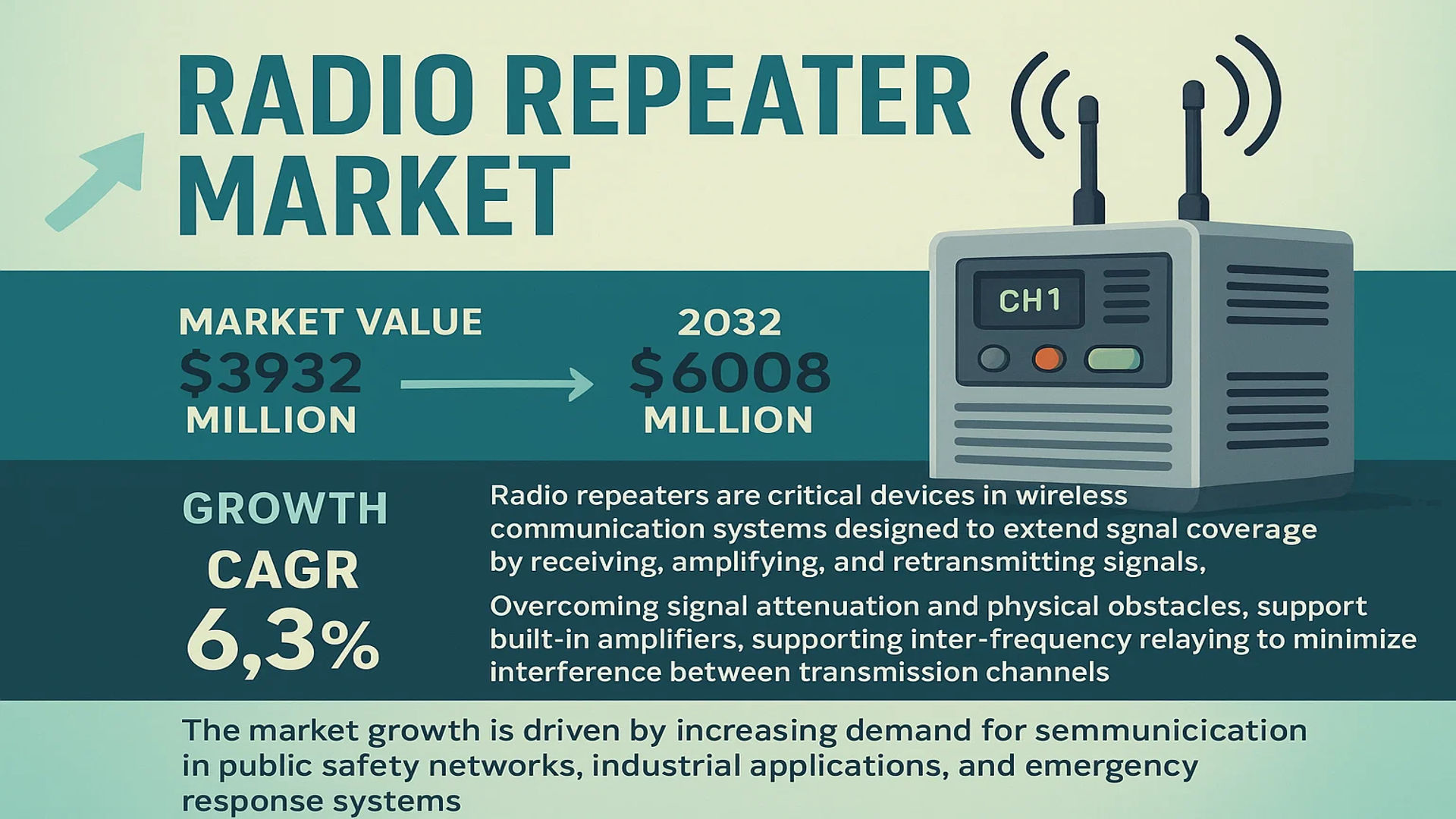
The global Radio Repeater market was valued at 3932 million in 2024 and is projected to reach US$ 6008 million by 2032, at a CAGR of 6.3% during the forecast period.
Radio repeaters are critical devices in wireless communication systems designed to extend signal coverage by receiving, amplifying, and retransmitting signals. These devices play a vital role in overcoming signal attenuation and physical obstacles, ensuring reliable communication across long distances or challenging environments. The technology utilizes built-in amplifiers to boost weak incoming signals before retransmitting them, with advanced models supporting inter-frequency relaying to minimize interference between transmission and reception channels.
The market growth is driven by increasing demand for seamless communication in public safety networks, industrial applications, and emergency response systems. While North America currently dominates the market due to robust public safety infrastructure investments, Asia-Pacific is expected to witness the fastest growth due to rapid urbanization and expanding industrial sectors. Key players like Motorola Solutions, Hytera, and Kenwood are innovating with digital repeaters that offer enhanced features such as encryption and network integration, further propelling market expansion.
MARKET DYNAMICS
MARKET DRIVERS
Expanding Public Safety Communications Fueling Radio Repeater Demand
The global radio repeater market is experiencing robust growth primarily driven by the increasing adoption in public safety communications. Emergency response teams, including police, fire departments, and medical services, rely heavily on radio repeaters to maintain seamless communication during critical operations. The market has witnessed nearly 12% year-over-year growth in public safety applications, as governments worldwide continue to invest in modernizing their communication infrastructure. With natural disasters and security threats becoming more frequent, the need for reliable, interference-free communication systems has never been higher.
Industrial Digitization Creating New Application Horizons
Industrial sectors are increasingly adopting radio repeaters as part of their digital transformation initiatives. Manufacturing plants, oil rigs, and mining operations require robust communication systems that can function in challenging environments where traditional networks fail. The industrial segment now accounts for approximately 28% of total radio repeater deployments globally. Advancements in IoT integration and the emergence of private LTE networks are creating new use cases for radio repeaters in predictive maintenance and real-time equipment monitoring.
Furthermore, the development of cross-frequency repeaters capable of bridging different communication standards has significantly expanded market potential. These hybrid solutions allow legacy analog systems to interoperate with modern digital networks, extending the lifespan of existing infrastructure while enabling digital migration.
MARKET CHALLENGES
Spectrum Congestion Creating Technical Hurdles
While demand for radio repeaters grows, the market faces substantial challenges from increasing spectrum congestion. The limited availability of frequency bands has led to interference issues in urban environments, affecting signal quality and reliability. Recent technical reports indicate that interference-related service disruptions have increased by approximately 18% over the past three years in metropolitan areas. This congestion problem is particularly acute in the UHF and VHF bands traditionally used for critical communications.
Other Challenges
Power Consumption Constraints
Modern digital repeaters require significantly more power than their analog predecessors, creating deployment challenges in remote locations. Battery technology has not kept pace with the power demands of advanced digital signal processing, forcing operators to make difficult trade-offs between performance and operational duration.
Legacy System Compatibility
The transition from analog to digital systems presents technical challenges in maintaining backward compatibility. Many organizations operate mixed fleets of radios, requiring repeaters to support multiple protocols simultaneously. This complexity increases development costs and can lead to interoperability issues if not properly implemented.
MARKET RESTRAINTS
Regulatory Compliance Burden Slowing Market Expansion
Stringent certification requirements across different regions pose a significant restraint to market growth. Each country maintains its own set of technical standards and certification processes for radio equipment, forcing manufacturers to maintain multiple product variants. The certification process alone can add 6-9 months to product development cycles and increase costs by 15-20%. Emerging markets in particular are implementing stricter local content requirements that further complicate market entry strategies.
Additionally, spectrum allocation policies in many developing nations remain fragmented and outdated, creating artificial barriers to modern communication system deployments. This regulatory uncertainty discourages investment in next-generation repeater technologies that could otherwise improve network efficiency and capacity.
MARKET OPPORTUNITIES
5G Network Integration Opening New Possibilities
The ongoing rollout of 5G networks presents significant opportunities for radio repeater manufacturers. While 5G operates primarily in higher frequency bands with limited range, repeaters can play a crucial role in extending coverage, particularly in indoor environments and rural areas. Early trials of 5G repeaters have shown promising results, with some deployments achieving coverage improvements of up to 40% in challenging terrain. The ability to seamlessly integrate with both standalone and non-standalone 5G architectures makes repeaters a versatile solution for network operators.
Moreover, the development of AI-powered smart repeaters capable of dynamically adjusting parameters based on network conditions could revolutionize the market. These intelligent systems can optimize spectrum utilization in real-time, potentially doubling network capacity in dense urban environments. As private 5G networks gain traction across various industries, the demand for specialized industrial-grade repeaters is expected to surge.
➤ The development of self-configuring mesh networks using intelligent repeaters represents one of the most promising opportunities in the sector, potentially transforming how wireless coverage is delivered in both urban and rural environments.
RADIO REPEATER MARKET TRENDS
Demand for Reliable Long-Range Communication Systems Drives Market Expansion
The global radio repeater market is witnessing significant growth, fueled by the increasing need for uninterrupted long-range communication across industries like public safety, transportation, and defense. Radio repeaters play a critical role in mitigating signal attenuation caused by geographical obstacles or interference, ensuring seamless communication. With an expected CAGR of 6.3% from 2024 to 2032, the market is projected to grow from $3,932 million in 2024 to $6,008 million by 2032. Emerging technologies, including digital signal processing (DSP) and software-defined radio (SDR), are enhancing repeater efficiency, reducing latency, and improving signal clarity. The integration of hybrid repeater systems, which combine traditional analog with digital repeaters, is gaining traction for balanced performance and cost-effectiveness.
Other Trends
Increasing Adoption in Public Safety and Emergency Communications
The rising demand for robust public safety networks is accelerating the deployment of radio repeaters, especially in mission-critical environments. Emergency response teams, law enforcement, and disaster management agencies prioritize durable, high-performance communication systems to maintain connectivity in challenging conditions. Governments worldwide are investing in resilient communication infrastructure, with North America and Europe leading deployments due to stringent safety regulations. Additionally, advancements in LTE-based repeaters are bridging the gap between legacy analog systems and modern digital networks, ensuring interoperability and extended coverage.
Industrial and Commercial Applications Fuel Market Growth
Industrial sectors, including oil & gas, mining, and construction, rely on radio repeaters to facilitate real-time communication in remote or hazardous locations. The growing emphasis on worker safety and operational efficiency is driving demand, particularly for explosion-proof and ruggedized repeater models. Similarly, commercial enterprises, such as logistics and transportation, utilize repeaters for fleet coordination and warehouse management. In 2024, same-frequency repeaters accounted for over 40% of the market share, favored for their simplicity and cost-effectiveness. However, cross-frequency repeaters are gaining ground in environments requiring minimal interference and extended range. Innovations like intelligent signal routing and IoT-enabled repeaters are set to redefine industrial communication ecosystems.
COMPETITIVE LANDSCAPE
Key Industry Players
Manufacturers Focus on Technological Advancements to Maintain Market Leadership
The global radio repeater market features a moderately competitive landscape with established telecommunications giants and specialized radio communication providers vying for market share. Motorola Solutions currently dominates the industry, holding approximately 18% of the global market revenue in 2024 according to analyst estimates. The company’s leadership stems from its comprehensive product range spanning public safety, commercial, and industrial applications, coupled with strong distribution networks across North America and Europe.
Hytera Communications and JVCKENWOOD have emerged as significant challengers, particularly in the Asia-Pacific region where they’ve captured nearly 12% and 9% market share respectively. These companies have gained traction through competitive pricing strategies and localized product development tailored to regional frequency regulations. Their success highlights the growing importance of emerging markets in the radio repeater industry.
Market participants are actively pursuing multiple growth strategies including product innovation in digital signal processing, strategic acquisitions, and expansion into underserved vertical markets. The recent introduction of LTE-capable repeaters by several manufacturers reflects the industry’s shift toward hybrid analog-digital solutions. However, varying spectrum allocation policies across regions continue to present standardization challenges for global players.
Smaller specialized manufacturers like BridgeCom Systems and RFinder are carving out niche positions through customer-specific solutions and value-added services. Meanwhile, infrastructure providers such as L3Harris Technologies and Cisco are incorporating repeater technology into broader communication ecosystems, creating new partnership opportunities across the value chain.
List of Key Radio Repeater Manufacturers Profiled
- Motorola Solutions, Inc. (U.S.)
- Hytera Communications Corporation (China)
- JVCKENWOOD Corporation (Japan)
- ICOM Inc. (Japan)
- Tait Communications (New Zealand)
- Simoco Wireless Solutions (UK)
- BridgeCom Systems, Inc. (U.S.)
- RFinder (U.S.)
- L3Harris Technologies, Inc. (U.S.)
- Cisco Systems, Inc. (U.S.)
Segment Analysis:
By Type
Same Frequency Segment Dominates Due to Cost Efficiency and Simplified Deployment
The market is segmented based on type into:
- Same Frequency Repeaters
- Subtypes: Analog, Digital, and others
- Cross Frequency Repeaters
- Subtypes: Single-band, Multi-band, and others
By Application
Public Safety Communications Segment Leads Due to Critical Infrastructure Needs
The market is segmented based on application into:
- Public Safety Communications
- Industrial and Commercial Applications
- Emergency Communications
- Personal Use
- Others
By End User
Government Sector Dominates Due to Investments in Communication Infrastructure
The market is segmented based on end user into:
- Government
- Enterprises
- Telecom Service Providers
- Individuals
By Technology
Digital Technology Segment Grows Rapidly Due to Superior Signal Quality
The market is segmented based on technology into:
- Analog Repeaters
- Digital Repeaters
- Subtypes: DMR, TETRA, P25, and others
- Hybrid Repeaters
Regional Analysis: Radio Repeater Market
North America
The North American radio repeater market is one of the most advanced globally, driven by strong demand from public safety communications and industrial applications. The U.S. leads the region, with significant investments in emergency response infrastructure and the modernization of two-way radio networks. Regulatory policies, including FCC spectrum allocations, support the deployment of repeater systems. Leading manufacturers like Motorola Solutions and L3Harris Technologies dominate the market, focusing on high-performance, interoperable solutions for first responders and critical industries. While digital repeaters are gaining traction, analog systems remain prevalent in legacy networks, particularly in rural areas with limited infrastructure.
Europe
Europe’s radio repeater market is characterized by strict compliance with standardization and spectrum efficiency regulations. The European Telecommunications Standards Institute (ETSI) mandates ensure seamless integration of repeaters in public safety and commercial networks. Countries like Germany and the U.K. lead in adopting digital repeaters for mission-critical communications, while Eastern Europe sees gradual upgrades from analog to digital systems. Cross-frequency repeaters are increasingly used to optimize spectrum usage. However, fragmentation in regulatory frameworks across EU member states presents challenges for uniform market growth. Nonetheless, advancements in TETRA and DMR technologies continue to drive demand.
Asia-Pacific
As the fastest-growing region, the Asia-Pacific radio repeater market is propelled by rapid urbanization and large-scale infrastructure projects. China and India account for substantial demand due to expanding public safety networks and industrial applications. Low-cost analog repeaters dominate emerging economies, while Japan and South Korea lead in digital repeater adoption. The region also benefits from local manufacturers like Hytera and ICOM, which provide cost-effective solutions tailored to regional needs. However, inconsistent regulatory policies and spectrum allocation challenges in some countries hinder seamless market expansion. The shift toward 5G backhaul solutions is expected to influence future repeater designs.
South America
The South American market is developing steadily, with growing demand from mining, oil & gas, and transportation sectors. Brazil and Argentina represent key markets, but economic volatility limits large-scale investments in advanced repeater systems. Analog repeaters remain dominant due to cost considerations. Public safety agencies are gradually upgrading to digital solutions, though progress is slow owing to budget constraints. Local players like EF Johnson Technologies have a strong presence, but limited spectrum availability and regulatory uncertainties pose challenges for market growth.
Middle East & Africa
The Middle East & Africa region shows long-term growth potential, driven by infrastructure development in GCC countries. Oil & gas operations and public safety initiatives in the UAE and Saudi Arabia boost demand for rugged, high-power repeaters. Analog systems are prevalent, but digital migration is slowly gaining traction. Africa faces significant hurdles, including limited telecom infrastructure and inadequate spectrum management. However, private sector investments in commercial radio networks and the emergence of local distributors are gradually expanding market opportunities.
Report Scope
This market research report provides a comprehensive analysis of the global and regional Radio Repeater markets, covering the forecast period 2024–2032. It offers detailed insights into market dynamics, technological advancements, competitive landscape, and key trends shaping the industry.
Key focus areas of the report include:
- Market Size & Forecast: Historical data and future projections for revenue, unit shipments, and market value across major regions and segments. The global Radio Repeater market was valued at USD 3,932 million in 2024 and is projected to reach USD 6,008 million by 2032, at a CAGR of 6.3% during the forecast period.
- Segmentation Analysis: Detailed breakdown by product type (Same Frequency, Cross Frequency), application (Public Safety Communications, Industrial and Commercial Applications, Emergency Communications, Personal, Others), and end-user industry to identify high-growth segments and investment opportunities.
- Regional Outlook: Insights into market performance across North America, Europe, Asia-Pacific, Latin America, and the Middle East & Africa, including country-level analysis. The U.S. and China are key markets, with significant growth potential.
- Competitive Landscape: Profiles of leading market participants, including their product offerings, R&D focus, manufacturing capacity, pricing strategies, and recent developments such as mergers, acquisitions, and partnerships. Key players include Motorola Solutions, Hytera, Kenwood, ICOM, and Tait Communications.
- Technology Trends & Innovation: Assessment of emerging technologies, integration of AI/IoT in radio communication systems, advancements in repeater design, and evolving industry standards.
- Market Drivers & Restraints: Evaluation of factors driving market growth (increasing demand for reliable communication in public safety and industrial sectors) along with challenges (regulatory issues, spectrum allocation constraints).
- Stakeholder Analysis: Insights for component suppliers, OEMs, system integrators, investors, and policymakers regarding the evolving ecosystem and strategic opportunities in the Radio Repeater market.
Primary and secondary research methods are employed, including interviews with industry experts, data from verified sources, and real-time market intelligence to ensure the accuracy and reliability of the insights presented.
FREQUENTLY ASKED QUESTIONS:
What is the current market size of Global Radio Repeater Market?
-> Radio Repeater market was valued at 3932 million in 2024 and is projected to reach US$ 6008 million by 2032, at a CAGR of 6.3% during the forecast period.
Which key companies operate in Global Radio Repeater Market?
-> Key players include Motorola Solutions, Hytera, Kenwood, ICOM, Tait Communications, Simoco Wireless Solutions, JVCKENWOOD, Yaesu, BridgeCom Systems, and RFinder, among others.
What are the key growth drivers?
-> Key growth drivers include increasing demand for public safety communications, expansion of industrial and commercial applications, and advancements in wireless communication technologies.
Which region dominates the market?
-> North America is the largest market, while Asia-Pacific is expected to witness the highest growth during the forecast period.
What are the emerging trends?
-> Emerging trends include integration of AI in repeater systems, development of compact and energy-efficient repeaters, and increasing adoption of digital radio technologies.

Get Sample Report PDF for Exclusive Insights
Report Sample Includes
- Table of Contents
- List of Tables & Figures
- Charts, Research Methodology, and more...






