MARKET INSIGHTS
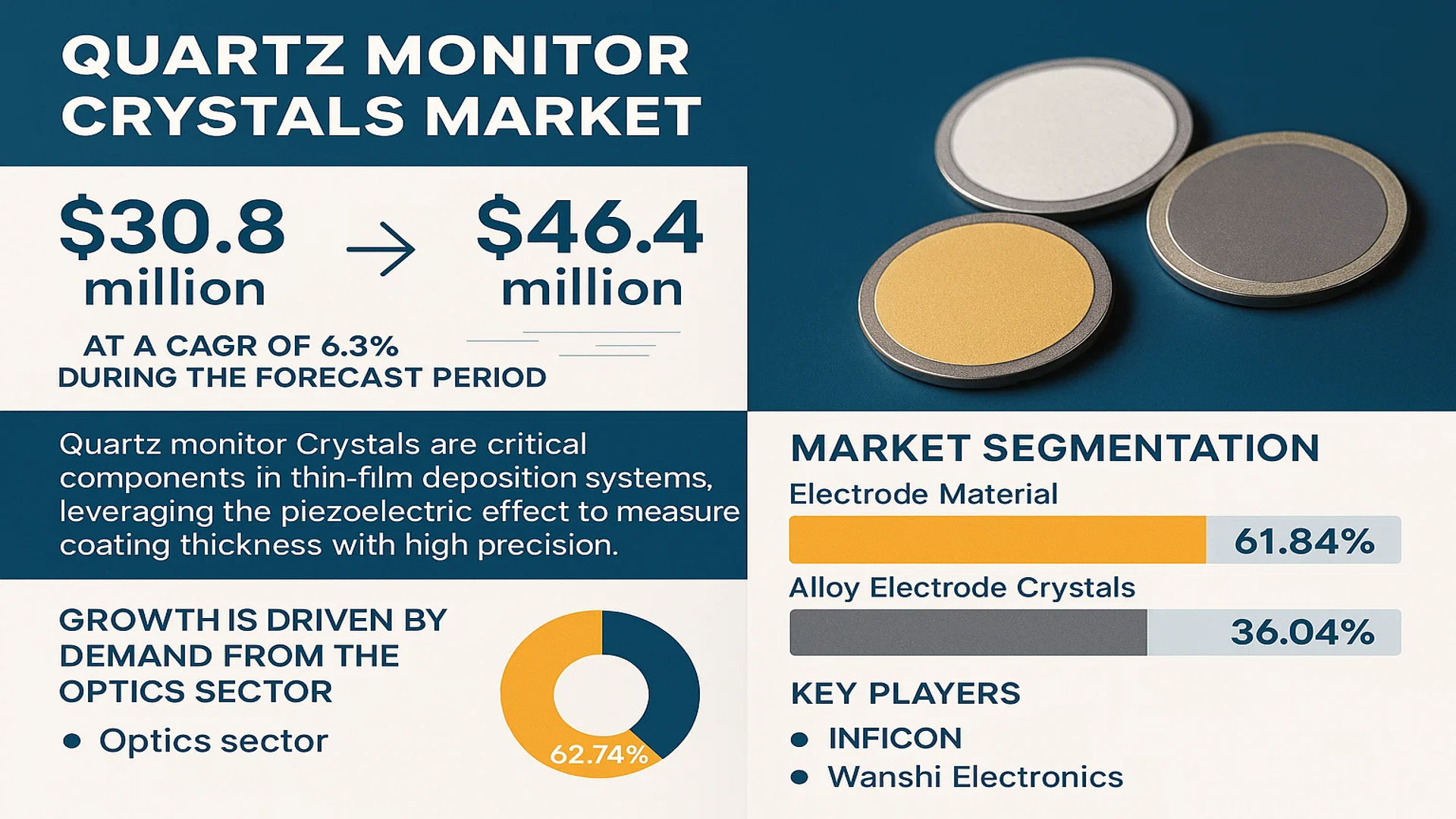
The global Quartz Monitor Crystals Market was valued at 30.8 million in 2024 and is projected to reach US$ 46.4 million by 2032, at a CAGR of 6.3% during the forecast period.
Quartz Monitor Crystals are critical components in thin-film deposition systems, leveraging the piezoelectric effect to measure coating thickness with high precision. These crystals vibrate at frequencies like 5MHz or 6MHz, depending on regional standards, enabling real-time monitoring in applications ranging from semiconductor manufacturing to optical coatings. The market is segmented by electrode material, with Gold Electrode Crystals dominating at 61.84% share in 2024, followed by Alloy Electrode Crystals at 36.04%.
Growth is driven by demand from the optics sector (62.74% market share) and emerging technologies like 5G and OLED displays. Key players such as INFICON and Wanshi Electronics collectively hold 73% of the market, capitalizing on advancements in atomic-layer deposition (ALD) and IoT-enabled miniaturization. While Asia-Pacific leads in adoption due to semiconductor manufacturing hubs, North America remains pivotal for optical applications, reflecting the industry’s dual reliance on regional standards and global innovation.
MARKET DYNAMICS
MARKET DRIVERS
Expanding Semiconductor and Optics Industries Fuel Quartz Monitor Crystal Demand
The global quartz monitor crystals market is experiencing robust growth, primarily driven by the expanding semiconductor and optics industries. These crystals play a critical role in thin-film deposition processes, which are fundamental to semiconductor manufacturing. With the semiconductor market projected to exceed $1 trillion by 2030, the need for precise deposition monitoring solutions like quartz crystals has significantly increased. The optics sector, accounting for over 62% of quartz monitor crystal applications, relies on these components for producing anti-reflective coatings and optical filters with nanometer-level precision.
5G Network Rollout Accelerates Market Expansion
The global rollout of 5G networks is creating substantial demand for quartz monitor crystals in radio frequency component manufacturing. These crystals are essential for producing the high-precision thin films used in 5G filters and resonators. With more than 300 commercial 5G networks already deployed worldwide and investments in 5G infrastructure expected to top $400 billion annually by 2025, the need for reliable deposition monitoring solutions continues to grow. The telecommunications sector’s transition to higher frequency bands necessitates even more precise thin-film controls, further driving quartz crystal adoption.
Technological Advancements in Thin-Film Deposition Processes
Recent advancements in deposition technologies like atomic layer deposition (ALD) and plasma-enhanced chemical vapor deposition (PECVD) have significantly increased the precision requirements for deposition monitoring. Quartz monitor crystals have evolved to meet these demands, with modern systems offering frequency stability within ±0.01%. The development of advanced electrode materials, including gold electrode crystals which dominate 61.8% of the market, has enhanced performance durability and measurement accuracy. These technological improvements are crucial for next-generation applications in flexible electronics and medical device coatings.
MARKET RESTRAINTS
High Production Costs and Material Constraints Limit Market Penetration
The quartz monitor crystal market faces significant challenges from rising raw material costs and complex manufacturing processes. High-purity quartz, a key material requirement, has seen price fluctuations of 15-20% annually due to supply chain disruptions. Gold electrode crystals, while offering superior performance, are particularly affected by volatile precious metal prices. These cost pressures make it difficult for manufacturers to maintain competitive pricing while ensuring profitability, especially in price-sensitive emerging markets.
Technical Limitations in Extreme Deposition Environments
Quartz monitor crystals face operational challenges in extreme deposition environments such as high-temperature sputtering processes. Temperature-induced frequency drifts can reduce measurement accuracy by up to 30% in applications exceeding 200°C. While advanced temperature compensation techniques have been developed, they add complexity and cost to monitoring systems. These limitations create barriers for adoption in emerging deposition technologies that require operation under extreme conditions.
MARKET CHALLENGES
Standardization Differences Between Regional Markets
The quartz monitor crystal market contends with significant regional standardization challenges that complicate global operations. The divergence between 5MHz standards dominant in Asian semiconductor manufacturing and 6MHz standards prevalent in North American optical applications creates supply chain inefficiencies. Manufacturers must maintain separate production lines for different frequency specifications, increasing inventory costs by an estimated 10-15%. This fragmentation also slows the adoption of universal best practices across the industry.
Competition from Alternative Deposition Monitoring Technologies
Emerging optical monitoring technologies present growing competition to quartz crystal-based systems. Advanced spectral reflectometry systems now offer deposition rate measurement accuracy comparable to quartz monitors in certain applications. While quartz systems maintain advantages in real-time monitoring and cost-effectiveness for many processes, continuous improvements in alternative technologies could erode the quartz crystal’s dominant market position. Manufacturers must invest in R&D to maintain technological leadership.
MARKET OPPORTUNITIES
Growing Medical Device Manufacturing Creates New Applications
The expanding medical device sector presents significant growth opportunities for quartz monitor crystal manufacturers. Biomedical applications such as surgical instrument coatings and implantable device manufacturing require ultra-precise thickness control. The global medical device market, projected to reach $800 billion by 2030, increasingly adopts quartz crystal monitoring for producing biocompatible coatings with sub-nanometer precision. This market segment is expected to grow at 8% annually, outpacing the overall industry average.
Emerging Flexible Electronics Market Drives Innovation
The rapid development of flexible electronics creates new opportunities for quartz monitor crystal applications. Flexible displays and wearable devices require specialized thin-film depositions that can benefit from advanced monitoring solutions. The market for flexible electronics is forecast to grow at 12% CAGR through 2030, driven by demand for foldable smartphones and flexible solar panels. Quartz monitor manufacturers are developing specialized crystal configurations to meet the unique requirements of roll-to-roll deposition processes used in flexible electronics production.
Integration of IoT and Industry 4.0 Technologies
The incorporation of IoT connectivity in deposition monitoring systems enables predictive maintenance and process optimization. Modern quartz crystal monitors now feature network connectivity for remote monitoring, with some systems offering cloud-based data analytics. This digital transformation allows manufacturers to reduce downtime by up to 30% through early fault detection. As Industry 4.0 adoption accelerates across manufacturing sectors, smart quartz monitoring systems are becoming essential components of connected production environments.
QUARTZ MONITOR CRYSTALS MARKET TRENDS
Rising Demand from Semiconductor and Optics Industries Drives Market Growth
The global Quartz Monitor Crystals (QMC) market is experiencing significant growth, primarily driven by increasing demand from the semiconductor and optics industries. These crystals play a pivotal role in thin-film deposition processes, enabling precise measurement and control in manufacturing environments. With advancements in semiconductor fabrication techniques, particularly in 5G, IoT, and AI chip production, the need for high-precision monitoring solutions has surged. The global QMC market, valued at $30.8 million in 2024, is projected to reach $46.4 million by 2032, growing at a CAGR of 6.3%. This growth is underpinned by expanding applications in atomic-layer deposition (ALD) and plasma-enhanced chemical vapor deposition (PECVD) processes, where quartz crystals provide critical thickness monitoring capabilities.
Other Trends
Shift Toward Miniaturization in Electronics Manufacturing
The trend toward miniaturization in electronics is accelerating demand for precision monitoring solutions. As device components shrink to nanometer scales, manufacturers increasingly rely on quartz monitor crystals to ensure coating uniformity. The 5MHz crystals dominate semiconductor and LED applications due to their compatibility with Japanese manufacturing standards, holding over 60% market share in these segments. Meanwhile, 6MHz crystals maintain strong adoption in optical coatings, particularly in North American markets.
Technological Advancements in Frequency Stability and IoT Integration
Recent developments in frequency stability and IoT connectivity are transforming quartz monitor crystal applications. Enhanced thermal compensation techniques now allow crystals to maintain stability across wider temperature ranges, critical for demanding industrial environments. The integration of smart monitoring capabilities enables real-time data transmission, allowing for predictive maintenance and process optimization. These innovations are particularly valuable in sectors requiring continuous operation, such as solar panel manufacturing where coating consistency directly impacts energy conversion efficiency.
COMPETITIVE LANDSCAPE
Key Industry Players
Technological Leadership and Regional Specialization Define Market Competition
The global quartz monitor crystals market exhibits a semi-consolidated structure, dominated by specialized manufacturers with strong technological capabilities in piezoelectric materials and thin-film deposition monitoring. INFICON leads the competitive landscape, controlling approximately 28% of the 2024 market share through its precision instrumentation solutions for semiconductor and optical coating applications. The company’s strategic focus on 6MHz crystals aligns with North American and European manufacturing standards, giving it a stronghold in high-end optical applications.
Chinese manufacturers Wanshi Electronics and Jiaxing Jingkong Eletronic (JJK) collectively account for nearly 31% of global supply, specializing in cost-competitive 5MHz solutions preferred by Asian semiconductor fabs. Their growth reflects the regional manufacturing ecosystem, where Japanese and South Korean vacuum coating equipment manufacturers predominantly integrate 5MHz monitoring systems.
The competitive dynamics are further shaped by technological specialization – while Western players focus on high-frequency stability for research-grade applications, Asian manufacturers optimize production-scale solutions. Recent capacity expansions by Tieway Technology in Shenzhen and OTWOCOM’s (OTC) new cleanroom facility in Suzhou demonstrate this regional divergence in production strategies.
Emerging competition comes from hybrid solution providers like Colnatec, which combines quartz monitoring with complementary thin-film characterization technologies. Likewise, TAITIEN Electronics has strengthened its position through vertical integration, producing both crystals and oscillation circuits for turnkey monitoring solutions.
List of Key Quartz Monitor Crystal Companies
- INFICON (Switzerland)
- Wanshi Electronics (China)
- Jiaxing Jingkong Eletronic (JJK) (China)
- Tieway Technology (China)
- OTWOCOM (OTC) (China)
- TAITIEN Electronics (Taiwan)
- Piezo Parts Co., Ltd. (Japan)
- Colnatec (USA)
- Shalom Denshi Co., Ltd. (Japan)
Segment Analysis:
By Type
Gold Electrode Crystals Lead the Market Due to High Electrical Conductivity and Durability
The market is segmented based on electrode material type into:
- Gold Electrode Crystals
- Alloy Electrode Crystals
- Silver Electrode Crystals
The market is also segmented by frequency type into:
- 5MHz Quartz Monitor Crystals
- 6MHz Quartz Monitor Crystals
By Application
Optics Segment Dominates Owing to Widespread Use in Thin-Film Coatings
The market is segmented based on application into:
- Optics
- LED
- OLED
- Semiconductor
- Others
By End-User Industry
Semiconductor Manufacturing Sector Drives Demand for Precise Thickness Monitoring
The market is segmented based on end-user industries into:
- Semiconductor Manufacturing
- Consumer Electronics
- Optoelectronics
- Biomedical Devices
- Solar Energy
Regional Analysis: Quartz Monitor Crystals Market
Asia-Pacific
The Asia-Pacific region dominates the global Quartz Monitor Crystals market, accounting for over 48% of total revenue in 2024. This leadership position stems from the concentrated semiconductor and optics manufacturing hubs in countries like China, Japan, South Korea, and Taiwan. The region’s strong adoption of 5MHz crystals aligns with its thriving semiconductor industry, where manufacturers prefer Japanese-standard vacuum coating machines. China’s growing investments in 5G infrastructure and display technologies (OLED/LED) further propel demand. However, increasing environmental regulations, particularly in developed markets like Japan and South Korea, are forcing local manufacturers to invest in cleaner production processes for quartz crystals.
North America
North America holds the second-largest share in the Quartz Monitor Crystals market, primarily driven by advanced optics applications and semiconductor R&D. The U.S. leads in 6MHz crystal adoption, supported by its strong optical coating industry for defense, aerospace, and telecommunications applications. California’s Silicon Valley and Arizona’s semiconductor clusters create consistent demand. Stringent quality standards for thin-film deposition in biomedical devices and the growing Photovoltaics industry present new opportunities. However, higher production costs compared to Asian manufacturers remain a challenge for local suppliers.
Europe
Europe maintains a technologically advanced Quartz Monitor Crystals market, with Germany, France, and the UK as key consumers. The region focuses on high-precision applications in automotive sensors, industrial coatings, and renewable energy technologies. Environmental regulations like REACH influence material choices, favoring gold and alloy electrode crystals over silver. While European manufacturers emphasize quality and precision, they face stiff competition from Asian suppliers in price-sensitive segments. Collaborative R&D between academic institutions and industry players drives innovations in frequency stability for next-generation applications.
South America
The South American market shows gradual growth potential, with Brazil and Argentina emerging as focal points. Increasing investments in telecommunications infrastructure and local semiconductor packaging facilities create demand opportunities. However, the region mainly relies on imports from Asia and North America due to limited local manufacturing capabilities. Economic volatility and fluctuating currency values occasionally disrupt supply chains, leading end-users to maintain higher inventory buffers. The growing solar energy sector may drive future demand for coating monitoring solutions.
Middle East & Africa
This region represents a developing market for Quartz Monitor Crystals, with growth concentrated in Israel, Turkey, and South Africa. Israel’s strong high-tech sector creates specialized demand for crystal monitors in defense and medical applications. The Gulf Cooperation Council (GCC) countries are investing in local semiconductor test and assembly facilities, which could boost future demand. However, the limited local production base and preference for cost-effective solutions currently restrain market expansion. As infrastructure development continues, particularly in smart cities and renewable energy projects, adoption rates are expected to gradually increase.
Report Scope
This market research report provides a comprehensive analysis of the Global Quartz Monitor Crystals Market, covering the forecast period 2025–2032. It offers detailed insights into market dynamics, technological advancements, competitive landscape, and key trends shaping the industry.
Key focus areas of the report include:
- Market Size & Forecast: Historical data and future projections for revenue, unit shipments, and market value across major regions and segments. The market was valued at USD 30.8 million in 2024 and is projected to reach USD 46.4 million by 2032 at a CAGR of 6.3%.
- Segmentation Analysis: Detailed breakdown by electrode material (Gold, Alloy, Silver), frequency (5MHz, 6MHz), and application (Optics, LED, OLED, Semiconductor) to identify high-growth segments.
- Regional Outlook: Insights into market performance across North America, Europe, Asia-Pacific, Latin America, and Middle East & Africa. Asia-Pacific leads with 61.84% share in 2024.
- Competitive Landscape: Profiles of leading players including INFICON, Wanshi Electronics, JJK, Tieway Technology, and OTWOCOM which collectively hold 73% market share.
- Technology Trends & Innovation: Assessment of piezoelectric applications, atomic-layer deposition monitoring, and integration with 5G/IoT technologies.
- Market Drivers & Restraints: Evaluation of semiconductor industry growth, thin-film deposition demands, and supply chain challenges for quartz materials.
- Stakeholder Analysis: Strategic insights for crystal manufacturers, semiconductor equipment providers, and research institutions regarding emerging opportunities.
Research methodology combines primary interviews with industry experts and validated secondary data from trade associations, company reports, and government publications to ensure accuracy.
FREQUENTLY ASKED QUESTIONS:
What is the current market size of Global Quartz Monitor Crystals Market?
-> Quartz Monitor Crystals Market was valued at 30.8 million in 2024 and is projected to reach US$ 46.4 million by 2032, at a CAGR of 6.3% during the forecast period.
Which key companies operate in this market?
-> Major players include INFICON, Wanshi Electronics, Jiaxing Jingkong Eletronic (JJK), Tieway Technology, and OTWOCOM (OTC).
What are the key growth drivers?
-> Growth is driven by semiconductor industry expansion, 5G deployment, and increasing demand for precision thin-film deposition across multiple industries.
Which region dominates the market?
-> Asia-Pacific holds the dominant position with 61.84% market share, followed by North America.
What are the emerging trends?
-> Key trends include miniaturization of electronics, IoT integration in monitoring systems, and development of advanced alloy electrodes.

Get Sample Report PDF for Exclusive Insights
Report Sample Includes
- Table of Contents
- List of Tables & Figures
- Charts, Research Methodology, and more...
 Download Sample Report PDF