MARKET INSIGHTS
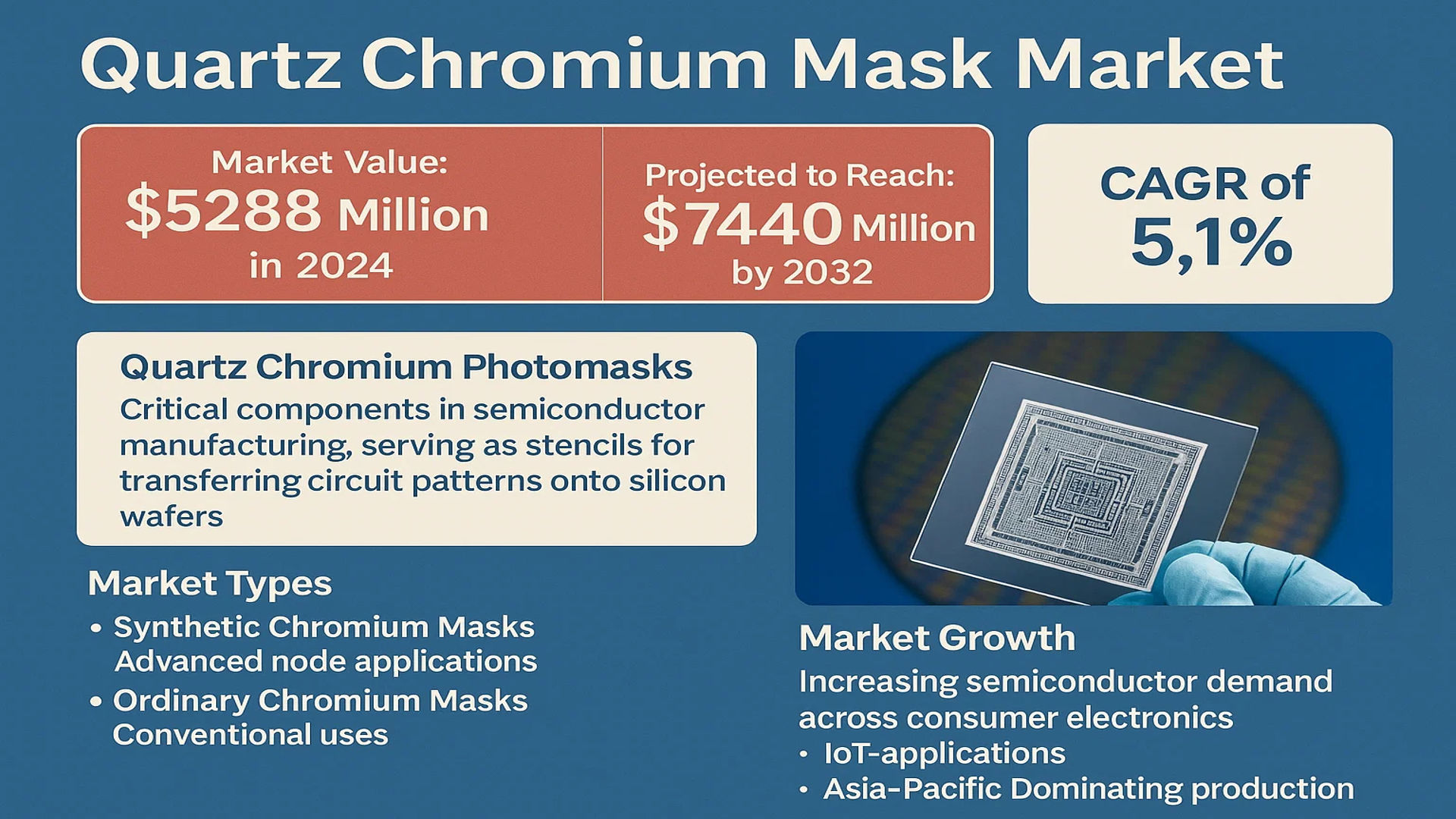
The global Quartz Chromium Mask Market was valued at 5288 million in 2024 and is projected to reach US$ 7440 million by 2032, at a CAGR of 5.1% during the forecast period.
Quartz Chromium Photomasks are critical components in semiconductor manufacturing, serving as stencils for transferring circuit patterns onto silicon wafers. These high-precision masks consist of a quartz substrate coated with a chromium layer, enabling nanoscale pattern definition through photolithography processes. The market offers two primary types: synthetic chromium masks for advanced node applications and ordinary chromium masks for conventional uses.
The market growth is driven by increasing semiconductor demand across consumer electronics, automotive, and IoT applications, with Asia-Pacific dominating production. However, supply chain complexities and the transition to EUV lithography present challenges. Key players like Photronics and Toppan are investing in next-generation mask technologies to maintain competitiveness in this precision-driven industry.
MARKET DYNAMICS
MARKET DRIVERS
Semiconductor Industry Expansion Driving Demand for Quartz Chromium Photomasks
The global semiconductor industry’s continued expansion acts as a primary driver for quartz chromium photomask demand, with semiconductor manufacturing expected to grow at a compound annual growth rate of 6-8% through 2030. Quartz chromium photomasks serve as critical patterning tools in semiconductor fabrication, enabling the production of increasingly complex integrated circuits. The transition to smaller process nodes below 7nm requires higher precision photomasks, creating sustained demand for advanced quartz chromium solutions. Emerging technologies like 5G infrastructure and automotive semiconductors further accelerate this trend.
Automation and Smart Device Proliferation Expanding Market Opportunities
Global automation trends across manufacturing sectors coupled with rising smart device adoption are generating substantial demand for quartz chromium photomasks. The consumer electronics market, projected to exceed $1.5 trillion by 2030, requires photomasks for display production and touch panel manufacturing. Industrial automation systems increasingly incorporate semiconductor components that rely on photomask technology. This dual growth across consumer and industrial segments creates a robust demand environment for photomask manufacturers.
Technological Advancements in Photomask Fabrication Enhancing Market Growth
Recent breakthroughs in photomask fabrication technologies are enabling higher resolution patterns and improved defect control. The development of advanced deposition techniques and superior chromium-etching processes has increased photomask performance while reducing production costs. Modern photomask writers with improved placement accuracy below 5nm are facilitating the creation of more precise masks. These technological improvements are making quartz chromium photomasks more cost-effective for mass production while maintaining strict quality standards required by advanced semiconductor nodes.
MARKET RESTRAINTS
High Production Costs and Capital Requirements Limiting Market Expansion
The quartz chromium photomask market faces significant growth restraints due to the high cost of production equipment and operational expenses. Establishing a photomask fabrication facility requires capital investments exceeding $100 million for basic infrastructure, with advanced mask shops needing significantly higher investments. The specialized materials, including high-purity quartz substrates and chromium layers, contribute substantially to production costs. These financial barriers make market entry challenging for new players and limit capacity expansion among existing manufacturers.
Complexity of Advanced Node Photomasks Creating Technical Barriers
As semiconductor nodes shrink below 7nm, quartz chromium photomask complexity increases exponentially. The requirement for tighter critical dimension control below 10nm and improved pattern placement accuracy presents significant technical challenges. Mask error enhancement factors (MEEF) become more pronounced at advanced nodes, requiring innovative computational lithography techniques to compensate. These technical complexities increase development timelines and raise qualification costs, potentially delaying photomask supply for new semiconductor products.
Supply Chain Vulnerabilities Impacting Market Stability
Global supply chain disruptions continue to affect the quartz chromium photomask market, particularly for specialized materials and equipment. The limited number of suppliers for high-grade synthetic quartz substrates creates potential bottlenecks. Equipment lead times for advanced mask writers and inspection tools can exceed 12 months, constraining production capacity expansions. These vulnerabilities in the supply chain create uncertainties in photomask delivery schedules and potentially impact semiconductor manufacturing timelines.
MARKET CHALLENGES
Intellectual Property Protection Presenting Legal Complexities
The quartz chromium photomask industry faces growing intellectual property challenges as semiconductor designs become more complex. Photomasks often contain proprietary circuit patterns that require robust protection against unauthorized replication. The global nature of semiconductor manufacturing creates jurisdictional complexities in IP enforcement. These challenges are particularly acute for foundries serving multiple customers, requiring sophisticated data management systems to prevent IP leakage through photomask handling processes.
Talent Shortage Impacting Industry Growth Potential
A critical shortage of skilled professionals continues to challenge the photomask industry. The specialized nature of photomask technology requires expertise spanning optics, materials science, and semiconductor processing. The limited pool of experienced photomask engineers, combined with the time-intensive training requirements for new personnel, creates operational constraints. Industry surveys indicate that over 40% of photomask professionals are approaching retirement age, exacerbating the talent pipeline challenges.
Environmental Regulations Increasing Compliance Costs
Stringent environmental regulations governing chromium handling and chemical usage present ongoing challenges for photomask manufacturers. The industry must comply with increasingly strict wastewater treatment requirements for chromium compounds and solvent disposal. These regulatory demands require substantial investments in emission control systems and waste treatment facilities. The cumulative effect of compliance costs potentially impacts the economic viability of smaller photomask operations.
MARKET OPPORTUNITIES
Emerging Memory Technologies Creating New Application Areas
The development of novel memory technologies presents significant opportunities for quartz chromium photomask manufacturers. Emerging memory architectures such as MRAM, ReRAM, and FeRAM require specialized photomask solutions for their unique material stacks and 3D structures. The memory market is projected to require increasingly sophisticated photomasks as these technologies move from research to volume production. This transition creates opportunities for photomask suppliers to develop specialized solutions tailored for next-generation memory applications.
Advanced Packaging Technologies Driving Photomask Innovation
The rapid adoption of advanced packaging techniques like wafer-level packaging and 3D IC integration is generating demand for specialized photomask solutions. These packaging approaches often require unique mask designs with specific optical characteristics different from conventional IC photomasks. The advanced packaging market is expected to grow at double-digit rates, creating corresponding demand for packaging photomasks. This represents a substantial growth avenue for photomask providers capable of developing custom solutions for heterogeneous integration applications.
Regional Semiconductor Expansion Offering Geographical Growth Potential
Government initiatives to strengthen regional semiconductor capabilities in various countries present location-specific growth opportunities. Subsidy programs and national semiconductor strategies are driving new fab construction across multiple regions. Each new fabrication facility represents potential demand for quartz chromium photomasks, creating opportunities for both global and regional photomask suppliers. The geographical diversification of semiconductor manufacturing helps mitigate risks associated with single-region market concentration.
QUARTZ CHROMIUM PHOTOMASK MARKET TRENDS
Growing Semiconductor Industry Driving Demand for High-Precision Photomasks
The global semiconductor industry remains the primary growth driver for the quartz chromium photomask market, with the sector’s valuation surpassing $600 billion in 2024. As chip manufacturers push towards smaller node sizes (sub-7nm and below), the need for high-precision photomasks with superior pattern accuracy has intensified. Leading foundries are increasingly adopting advanced photolithography techniques like extreme ultraviolet (EUV) lithography, which requires corresponding advancements in photomask technology. This demand is particularly strong in memory and logic IC production, where pattern fidelity directly impacts device performance and yield rates. The transition to more complex device architectures (FinFET, GAA) has further amplified specifications for defect-free masks with sub-nanometer precision.
Other Trends
Expansion in Display Technologies
The rapid growth of OLED and micro-LED displays for consumer electronics and automotive applications represents another significant opportunity for quartz chromium photomasks. Panel makers require large-area photomasks (up to Gen 10.5 for TV production) with enhanced durability to withstand repeated exposure cycles. The increasing adoption of high-resolution displays (8K and beyond) and foldable screen technologies has created additional demand for photomasks capable of precise patterning over flexible substrate areas. This trend coincides with major display manufacturers accelerating their production capacity expansions across Asia, particularly in China and South Korea.
Technological Advancements in Photomask Fabrication
The photomask industry continues to evolve with the introduction of multi-beam mask writers that significantly reduce writing times for complex patterns while improving placement accuracy. Recent developments in inspection systems leveraging machine learning algorithms have enhanced defect detection capabilities, crucial for maintaining yield in advanced node manufacturing. Mask shops are increasingly adopting hybrid manufacturing approaches, combining optical and e-beam technologies to optimize cost and performance. The growing emphasis on mask lifetime extension has also spurred innovations in pellicle technology and cleaning processes, particularly for EUV applications where mask contamination poses severe yield risks.
Supply Chain Diversification and Regional Market Dynamics
Recent geopolitical factors have accelerated supply chain realignments in the photomask industry, with manufacturers establishing additional production capacity outside traditional hubs. While Asia maintains its dominance with over 75% of global photomask production, North American and European fabs are increasing their regional sourcing to mitigate trade risks. The Chinese market shows particularly strong growth potential as domestic semiconductor producers work to reduce import dependence, with several new mask shops entering operation within the last two years. This regional expansion coincides with increased R&D spending on next-generation packaging technologies (3D IC, chiplets) that require novel photomask solutions.
COMPETITIVE LANDSCAPE
Key Industry Players
Technological Innovation and Regional Dominance Shape Market Competition
The global quartz chromium photomask market exhibits a moderately consolidated competitive structure, with key players maintaining strong positions through technological expertise and strategic supply chain relationships. Photronics, Inc. leads the market with an estimated 18-20% revenue share in 2024, driven by its extensive manufacturing footprint across North America, Europe, and Asia. The company recently expanded its advanced photomask production facility in Korea to address growing semiconductor demand.
Toppan Printing Co., Ltd. and Dai Nippon Printing (DNP) collectively account for nearly 30% of global sales, leveraging their dominance in the Asian semiconductor ecosystem. Both companies have intensified R&D spending on extreme ultraviolet (EUV) lithography-compatible masks, with Toppan announcing a 15% year-over-year investment increase in 2023.
Meanwhile, Hoya Corporation has strengthened its position through vertical integration, controlling critical quartz substrate supply chains. The company’s recent acquisition of a German specialty glass manufacturer indicates strategic moves to secure raw material advantages.
Emerging players like ShenZheng QingVi and Taiwan Mask Corporation are gaining traction through cost-competitive offerings, particularly in the touch industry and mid-range semiconductor segments. These regional specialists have captured 12-15% combined market share in Asia-Pacific, challenging established players through aggressive pricing and rapid prototyping capabilities.
List of Key Quartz Chromium Photomask Companies Profiled
- Photronics, Inc. (U.S.)
- Toppan Printing Co., Ltd. (Japan)
- Dai Nippon Printing Co., Ltd. (DNP) (Japan)
- Hoya Corporation (Japan)
- SK-Electronics Co., Ltd. (South Korea)
- LG Innotek (South Korea)
- ShenZheng QingVi (China)
- Taiwan Mask Corporation (Taiwan)
- Nippon Filcon (Japan)
- Compugraphics Photomask Solutions (UK)
- Newway Photomask (China)
Segment Analysis:
By Type
Synthetic Chromium Masks Lead the Market Due to Superior Optical Properties and Precision in High-Tech Applications
The market is segmented based on type into:
- Synthetic Chromium Masks
- Ordinary Chromium Masks
By Application
Semiconductor Sector Dominates Owing to Increasing Demand for Miniaturized Electronic Components
The market is segmented based on application into:
- Semiconductor
- Flat Panel Display
- Touch Industry
- Circuit Board
By End-User
Electronics Manufacturers Hold Largest Share Due to Rising Demand for Smart Devices and IoT Technologies
The market is segmented based on end-user into:
- Electronics Manufacturers
- Subtypes: Consumer Electronics, Industrial Electronics, and Others
- Display Panel Producers
- Semiconductor Foundries
Regional Analysis: Quartz Chromium Photomask Market
Asia-Pacific
The Asia-Pacific region dominates the global Quartz Chromium Photomask market, accounting for the highest production and consumption volumes. This supremacy is driven by China’s semiconductor boom, Japan’s precision manufacturing ecosystem, and South Korea’s display panel industry. The region benefits from concentrated supply chains, with Taiwan’s TSMC and China’s SMIC fueling photomask demand for advanced nodes (below 7nm). Government initiatives like China’s $150 billion semiconductor investment plan and India’s $10 billion chip manufacturing incentives are accelerating market growth. However, geopolitical tensions and export restrictions pose challenges for technology transfers in this critical fabrication material segment.
North America
North America remains the second-largest market, with innovation leadership in extreme ultraviolet (EUV) lithography technologies. The U.S. CHIPS Act’s $52 billion funding for domestic semiconductor production is driving photomask demand, particularly for military/aerospace applications requiring ITAR-compliant masks. Major fab expansions by Intel in Arizona ($20 billion) and Ohio ($100 billion) will significantly boost consumption. The region specializes in high-end synthetic chromium masks for cutting-edge IC designs, though reliance on Asian mask shops for volume production creates supply chain vulnerabilities that the industry is addressing through strategic partnerships.
Europe
Europe maintains a strong position in specialty photomasks for automotive and industrial applications, with Germany’s Carl Zeiss and ASML’s EUV technology enabling advanced mask production. The EU Chips Act’s €43 billion investment aims to double Europe’s semiconductor market share, potentially creating new demand. The region excels in mask blank production (Malta’s U.S. Photronics facility) and inspection equipment, but limited domestic volume manufacturing forces reliance on imports. Strict environmental regulations on chromium processing are pushing development of next-generation mask materials with lower ecological impact.
South America
The South American market remains nascent but shows growth potential through emerging PCB industries in Brazil and Argentina. Local demand primarily stems from consumer electronics assembly rather than advanced semiconductor fabs, keeping mask specifications at mainstream technology nodes. Economic instability and import dependency (90% of photomasks are sourced from Asia) constrain market expansion. However, recent trade agreements with China for electronics manufacturing could stimulate demand for basic chromium masks in the coming decade.
Middle East & Africa
This region represents the smallest but fastest-growing market, with strategic investments in semiconductor infrastructure. Saudi Arabia’s $100 million collaboration with Chinese mask makers and Israel’s specialized fab facilities drive regional demand. The lack of indigenous mask production capabilities creates import-driven market dynamics, though the UAE’s economic zones are attracting photomask service providers. Given the minimal environmental regulations, the region could become a destination for conventional chromium mask production as other markets transition to advanced alternatives.
Report Scope
This market research report provides a comprehensive analysis of the global and regional Quartz Chromium Photomask markets, covering the forecast period 2025–2032. It offers detailed insights into market dynamics, technological advancements, competitive landscape, and key trends shaping the industry.
Key focus areas of the report include:
- Market Size & Forecast: Historical data and future projections for revenue, unit shipments, and market value across major regions and segments. The global Quartz Chromium Photomask market was valued at USD 5,288 million in 2024 and is projected to reach USD 7,440 million by 2032, growing at a CAGR of 5.1%.
- Segmentation Analysis: Detailed breakdown by product type (Synthetic Chromium Masks, Ordinary Chromium Masks), application (Semiconductor, Flat Panel Display, Touch Industry, Circuit Board), and end-user industry to identify high-growth segments.
- Regional Outlook: Insights into market performance across North America, Europe, Asia-Pacific, Latin America, and the Middle East & Africa. Asia-Pacific dominates with the largest market share, followed by North America.
- Competitive Landscape: Profiles of leading market participants, including Photronics, Toppan, DNP, Hoya, SK-Electronics, LG Innotek, ShenZheng QingVi, Taiwan Mask, Nippon Filcon, Compugraphics, and Newway Photomask, covering their product portfolios, market strategies, and recent developments.
- Technology Trends & Innovation: Assessment of emerging fabrication techniques, advancements in photomask materials, and evolving semiconductor design standards.
- Market Drivers & Restraints: Evaluation of factors such as rising demand for consumer electronics, semiconductor industry growth, and automation trends, along with challenges like supply chain constraints and regulatory hurdles.
- Stakeholder Analysis: Strategic insights for semiconductor manufacturers, photomask suppliers, investors, and policymakers regarding market opportunities and challenges.
The research methodology combines primary interviews with industry experts and comprehensive secondary research from verified sources to ensure data accuracy and reliability.
FREQUENTLY ASKED QUESTIONS:
What is the current market size of Global Quartz Chromium Photomask Market?
-> Quartz Chromium Mask Market was valued at 5288 million in 2024 and is projected to reach US$ 7440 million by 2032, at a CAGR of 5.1% during the forecast period.
Which key companies operate in Global Quartz Chromium Photomask Market?
-> Key players include Photronics, Toppan, DNP, Hoya, SK-Electronics, LG Innotek, ShenZheng QingVi, Taiwan Mask, Nippon Filcon, Compugraphics, and Newway Photomask.
What are the key growth drivers?
-> Key growth drivers include rising demand for semiconductors, expansion of consumer electronics, and increasing adoption of automated systems across industries.
Which region dominates the market?
-> Asia-Pacific holds the largest market share, driven by semiconductor manufacturing hubs in China, Japan, and South Korea.
What are the emerging trends?
-> Emerging trends include advancements in photomask materials, increasing miniaturization in semiconductor devices, and growing demand for high-precision photomasks.

Get Sample Report PDF for Exclusive Insights
Report Sample Includes
- Table of Contents
- List of Tables & Figures
- Charts, Research Methodology, and more...
 Download Sample Report PDF