Pre-Bias Bipolar Transistor Market MARKET INSIGHTS
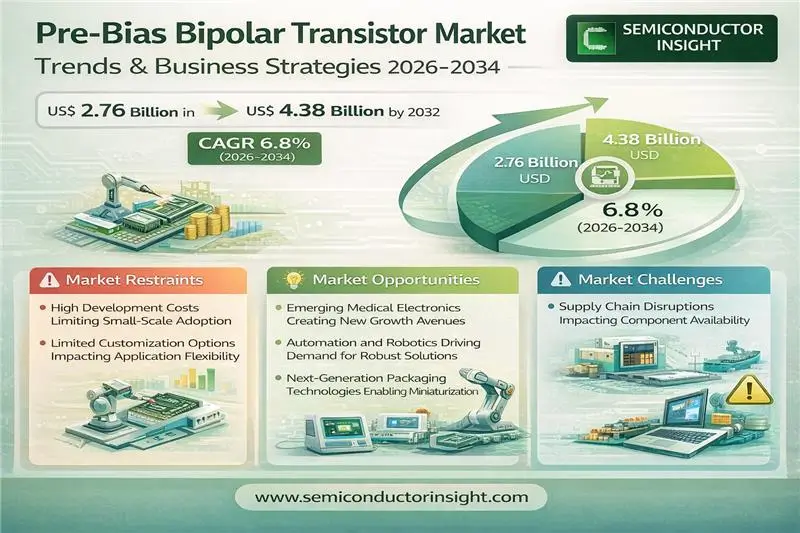
Global Pre-Bias Bipolar Transistor Market size was valued at USD 2.76 billion in 2024 and is projected to reach USD 4.38 billion by 2032, at a CAGR of 6.8% during the forecast period 2025-2032
Pre-biased bipolar transistors are specialized semiconductor devices with integrated resistors that maintain operational stability without requiring external biasing circuits. These components enhance circuit efficiency by minimizing distortion while reducing design complexity and manufacturing costs. The market primarily segments into NPN and PNP configurations, catering to diverse applications ranging from industrial automation to consumer electronics.
Market growth is driven by increasing demand for compact electronic designs and energy-efficient solutions across industries. The NPN segment dominates with over 60% market share in 2024 due to widespread adoption in switching applications. Geographically, Asia-Pacific leads with 42% market share, fueled by robust electronics manufacturing in China and South Korea. Key players including Diodes Incorporated and Infineon Technologies are expanding production capacities to meet growing demand from automotive and IoT sectors, where these transistors enable reliable signal amplification in space-constrained environments.
Pre-Bias Bipolar Transistor Market MARKET DYNAMICS
Pre-Bias Bipolar Transistor Market MARKET DRIVERS
Growing Demand for Energy-Efficient Electronics to Propel Market Growth
Pre-Bias Bipolar Transistor Market is experiencing significant growth due to rising demand for energy-efficient electronic components across multiple industries. With global energy consumption projected to increase by nearly 50% by 2050, manufacturers are actively seeking solutions that improve power efficiency without compromising performance. Pre-biased transistors offer precisely this advantage – their integrated resistor network reduces power losses by up to 30% compared to conventional transistor configurations. This efficiency gain is particularly crucial in battery-operated devices where power optimization directly translates to longer operational life.
Expansion of IoT and Smart Devices Creating New Demand
The proliferation of IoT devices, expected to exceed 29 billion connected units globally by 2030, is creating substantial demand for space-saving semiconductor solutions. Pre-biased transistors, with their compact design that eliminates multiple external components, perfectly address this need. Their ability to provide stable biasing while reducing PCB footprint by approximately 40% makes them the preferred choice for smart home devices, wearables, and industrial sensors. Major manufacturers are reporting 25-35% annual growth in orders for pre-biased components from IoT device makers, indicating strong market traction.
Automotive Electrification Driving Component Innovation
As the automotive industry shifts toward electrification, demand for reliable power management solutions has intensified. Pre-biased transistors play a critical role in various automotive applications including battery management systems, lighting controls, and infotainment systems. With the electric vehicle market projected to grow at 20% CAGR through 2030, component suppliers are ramping up production of pre-biased solutions specifically designed for automotive-grade requirements such as extended temperature ranges and enhanced durability.
Pre-Bias Bipolar Transistor Market MARKET RESTRAINTS
High Development Costs Limiting Small-Scale Adoption
While pre-biased bipolar transistors offer clear advantages, their development and manufacturing processes involve sophisticated technologies that increase production costs significantly. The specialized wafer fabrication processes required for integrated resistors can increase manufacturing costs by 25-35% compared to standard transistors. This cost premium poses a barrier for price-sensitive applications and has slowed adoption in some consumer electronics segments where component cost remains the primary purchasing criterion.
Limited Customization Options Impacting Application Flexibility
The integrated nature of pre-biased transistors, while offering space and efficiency benefits, also presents limitations in design flexibility. Unlike discrete solutions where designers can select optimal resistor values, pre-biased transistors provide fixed configurations. This limitation affects their suitability for applications requiring precise tuning or specialized biasing configurations. Industry reports indicate approximately 15% of potential designs currently cannot employ pre-biased solutions due to these inherent limitations.
Technical Challenges in High-Frequency Applications
While pre-biased transistors perform well in low-to-medium frequency applications, they face technical constraints in RF and high-speed switching environments. The integrated resistor networks can introduce parasitic effects that degrade performance at frequencies above 500MHz. This limitation makes conventional transistor configurations preferable for communications equipment, high-speed data interfaces, and RF power amplifiers, creating a market segment where pre-biased solutions struggle to compete.
Pre-Bias Bipolar Transistor Market MARKET OPPORTUNITIES
Emerging Medical Electronics Creating New Growth Avenues
The medical device industry presents significant growth potential for pre-biased bipolar transistors as portable and implantable medical technologies advance. With the medical electronics market projected to exceed D 50 billion by 2026, component manufacturers are developing specialized pre-biased transistors that meet stringent medical reliability and safety standards. These components are finding increasing application in patient monitoring systems, portable imaging devices, and drug delivery systems where power efficiency and reliability are paramount.
Automation and Robotics Driving Demand for Robust Solutions
Industrial automation and robotics represent another high-growth sector for pre-biased transistors, particularly as factories increasingly adopt smart manufacturing technologies. The robotics market is expected to maintain 15% annual growth through the decade, creating demand for power components that can withstand harsh industrial environments while providing consistent performance. Manufacturers are responding with ruggedized pre-biased transistor designs featuring enhanced thermal management and vibration resistance.
Next-Generation Packaging Technologies Enabling Miniaturization
Advancements in semiconductor packaging are opening new possibilities for pre-biased transistors. Emerging packaging technologies like wafer-level packaging and 3D integration allow further reductions in component size while improving thermal and electrical performance. These developments are particularly relevant for space-constrained applications in consumer electronics and mobile devices, where the market is seeing an estimated 20% annual increase in demand for ultra-compact power solutions.
Pre-Bias Bipolar Transistor Market MARKET CHALLENGES
Supply Chain Disruptions Impacting Component Availability
Global semiconductor industry continues to face supply chain challenges that affect the pre-biased transistor market. While overall supply has improved since the peak disruptions of 2021, lead times for specialty semiconductor components remain extended, averaging 16-20 weeks compared to historical norms of 8-12 weeks. These constraints are particularly impactful for customized pre-biased solutions and automotive-grade components where production flexibility is limited.
Intellectual Property Protection Creating Market Barriers
The specialized designs of pre-biased transistors involve significant intellectual property, creating challenges for manufacturers entering the market. Established players maintain extensive patent portfolios covering key fabrication techniques and circuit designs. This creates barriers to entry that limit competition and can constrain innovation in certain market segments. Recent legal disputes in the industry highlight these tensions, with several cases involving alleged IP infringement reaching settlement in 2023.
Technical Skills Gap Affecting Design Adoption
Despite their advantages, pre-biased transistors require specialized knowledge for optimal implementation in circuit designs. Industry surveys indicate nearly 40% of design engineers lack familiarity with these components’ unique characteristics and design considerations. This knowledge gap leads to underutilization of pre-biased solutions in applications where they could provide significant benefits, representing a persistent challenge for broader market adoption.
PRE-BIAS BIPOLAR TRANSISTOR MARKET TRENDS
Growing Demand for Miniaturization and Energy Efficiency Drives Market Expansion
Global Pre-Bias Bipolar Transistor Market, valued at D XX million in 2024, is witnessing steady growth due to increasing demand for compact and energy-efficient electronic components. These transistors, which incorporate built-in bias resistors, eliminate the need for external components, reducing both circuit complexity and overall system costs. The market is projected to grow at a compound annual growth rate (CAGR) of X%, reaching D XX million by 2032. This surge is particularly evident in regions like North America and Asia-Pacific, where rapid industrialization and technological advancements are fueling adoption across multiple industries.
Other Trends
Industrial Automation and Robotics Adoption
The rise in industrial automation and robotics applications presents a significant opportunity for pre-bias bipolar transistors. These components are widely used in control circuits, motor drivers, and sensor interfaces, where their built-in bias resistors enhance reliability and simplify PCB design. With the robotics market expected to expand at a CAGR of X% through 2030, demand for efficient transistors is set to rise substantially. Furthermore, advancements in Industry 4.0 and IoT-enabled devices are accelerating their deployment in smart manufacturing environments.
Medical and Aerospace Applications Push Innovation
Pre-bias bipolar transistors are increasingly being adopted in medical devices and aerospace systems, where precision and reliability are paramount. In medical equipment, they are utilized in diagnostic instruments and patient monitoring systems, offering stable performance in low-power applications. The aerospace sector, meanwhile, leverages these components for avionics and communication systems due to their ability to operate under extreme conditions. With the global medical electronics market projected to exceed D XX billion by 2028, manufacturers are investing in enhanced transistor designs to meet stringent industry standards.
COMPETITIVE LANDSCAPE
Key Industry Players
Semiconductor Giants Compete Through Innovation and Strategic Expansion in Pre-Bias Bipolar Transistor Market
Global Pre-Bias Bipolar Transistor Market features a dynamic competitive landscape where established semiconductor leaders and specialized manufacturers vie for market share. Infineon Technologies leads this space with a robust 18% revenue share in 2024, driven by its comprehensive product portfolio and strong foothold in automotive and industrial applications. The company’s recent investment of D 120 million in wafer fabrication expansion underscores its commitment to maintaining technological leadership.
Meanwhile, Nexperia USA Inc. and Rohm Semiconductor collectively hold about 25% of the market, benefiting from their focus on miniaturized components for space-constrained applications. Rohm’s development of ultra-compact VML0806 package transistors in Q3 2023 demonstrates the ongoing innovation driving competition in this sector. While both companies initially focused on consumer electronics, their strategic pivot towards industrial automation has yielded significant growth.
Additionally, Japanese contender Panasonic Electronic Components has strengthened its position through a unique “design-in” strategy, working closely with OEMs to develop application-specific pre-bias solutions. This approach helped the company capture 12% of the medical electronics segment, particularly in imaging equipment applications where reliability is paramount.
New entrants like Yangzhou Yangjie Electronic Technology represent the changing dynamics of the market, leveraging cost advantages to secure contracts in China’s expanding robotics sector. However, established players counter this through vertical integration – Onsemi recently expanded its Thailand packaging facility to reduce production costs by approximately 15%, demonstrating how incumbents adapt to pricing pressures.
List of Key Pre-Bias Bipolar Transistor Manufacturers
- Infineon Technologies (Germany)
- Nexperia USA Inc. (Netherlands)
- Rohm Semiconductor (Japan)
- Panasonic Electronic Components (Japan)
- Onsemi (U.S.)
- Diodes Incorporated (U.S.)
- Comchip Technology (Taiwan)
- Micro Commercial Co (U.S.)
- Yangzhou Yangjie Electronic Technology Co., Ltd. (China)
- Renesas Electronics America Inc (Japan)
- Toshiba Semiconductor and Storage (Japan)
- NXP USA Inc. (Netherlands)
Segment Analysis:
By Type
NPN Pre-Bias Segment Leads Due to High Adoption in Power Electronics and Switching Applications
The market is segmented based on type into:
- NPN Pre-Bias
- PNP Pre-Bias
By Application
Aerospace Segment Dominates Owing to Critical Voltage Regulation Requirements
The market is segmented based on application into:
- Aerospace
- Medical Apparatus and Instruments
- Robot
- Other Industrial Applications
By End-User
Semiconductor Industry Holds Major Share Due to Increasing Miniaturization Trends
The market is segmented based on end-user into:
- Semiconductor Manufacturers
- Electronic Component Suppliers
- OEMs (Original Equipment Manufacturers)
- Research and Development Institutions
Regional Analysis: Pre-Bias Bipolar Transistor Market
North America
The North American Pre-Bias Bipolar Transistor Market is driven by cutting-edge semiconductor applications and reliance on high-performance electronics. The presence of major industry leaders such as Onsemi, Diodes Incorporated, and NXP in the U.S. strengthens the region’s dominance in innovation and production. Rising demand from aerospace, robotics, and medical instrumentation sectors, coupled with stable economic conditions and stringent regulatory standards, ensures sustained adoption of NPN and PNP Pre-Bias transistors. Moreover, federal investments in infrastructure modernization, particularly in automation and smart devices, provide a growth runway for the market.
Europe
Europe holds a significant share of the Pre-Bias Bipolar Transistor Market due to its strong industrial and automotive sectors, where these components are critical for precision electronics. Germany and France lead in adoption, supported by high R&D investments from companies like Infineon Technologies and STMicroelectronics. The European Union’s focus on technological sovereignty and miniaturization of electronic devices further drives market expansion. However, supply chain dependencies on Asian semiconductor manufacturers pose challenges in terms of lead times and pricing volatility. Stringent environmental and safety regulations for electronics manufacturing also shape regional dynamics.
Asia-Pacific
Asia-Pacific is the largest and fastest-growing market for Pre-Bias Bipolar Transistors, fueled by mass production of consumer electronics, automotive electronics, and industrial automation in China, Japan, and South Korea. The region benefits from cost-effective manufacturing ecosystems and accelerating demand for energy-efficient semiconductors. Companies like Rohm Semiconductor and Toshiba Semiconductor reinforce technological advancements. However, geopolitical tensions and trade restrictions occasionally disrupt supply chains, requiring manufacturers to diversify procurement strategies. The increasing adoption of AI-driven robotics and IoT applications presents long-term opportunities.
South America
The market in South America is emerging, with Brazil as the key consumer of Pre-Bias Bipolar Transistors, primarily for automotive and industrial applications. Limited local semiconductor production results in reliance on imports, subjecting the region to price fluctuations and supply bottlenecks. Economic instability in countries like Argentina and Venezuela restricts widespread adoption of advanced semiconductor solutions. Nonetheless, gradual digital transformation in manufacturing and renewable energy infrastructure projects offer niche growth prospects for NPN and PNP transistor suppliers.
Middle East & Africa
The Pre-Bias Bipolar Transistor Market in the Middle East & Africa is still in its nascent phase, yet expanding due to growing needs in medical technology and telecommunications. Countries like the UAE and Israel invest in local semiconductor assembly to reduce dependency on imports, supported by favorable government policies. However, infrastructural limitations and lower technical expertise hinder rapid adoption compared to other regions. The increasing push for automation in oil & gas and smart city projects fosters gradual market penetration opportunities.
Report Scope
This market research report provides a comprehensive analysis of the global and regional Pre-Bias Bipolar Transistor Markets, covering the forecast period 2025–2032. It offers detailed insights into market dynamics, technological advancements, competitive landscape, and key trends shaping the industry.
Key focus areas of the report include:
- Market Size & Forecast: Historical data and future projections for revenue, unit shipments, and market value across major regions and segments. The Global Pre-Bias Bipolar Transistor Market was valued at USD 2.76 billion in 2024 and is projected to reach USD 4.38 billion by 2032.
- Segmentation Analysis: Detailed breakdown by product type (NPN Pre-Bias, PNP Pre-Bias), application (Aerospace, Medical Apparatus and Instruments, Robot, Others), and end-user industry to identify high-growth segments and investment opportunities.
- Regional Outlook: Insights into market performance across North America (U.S. estimated at USD million in 2024), Europe, Asia-Pacific (China to reach USD million), Latin America, and the Middle East & Africa, including country-level analysis.
- Competitive Landscape: Profiles of leading market participants including Comchip Technology, Diodes Incorporated, Infineon Technologies, NXP USA Inc., and Rohm Semiconductor, covering their product offerings, market share (global top five held approximately % in 2024), and recent developments.
- Technology Trends & Innovation: Assessment of emerging semiconductor design trends, integration with modern electronics, and advancements in transistor fabrication techniques.
- Market Drivers & Restraints: Evaluation of factors driving market growth including demand for efficient circuit design and cost reduction, along with challenges such as supply chain constraints and technical limitations.
- Stakeholder Analysis: Strategic insights for component suppliers, OEMs, system integrators, and investors regarding market opportunities and the evolving electronics ecosystem.
Primary and secondary research methods are employed, including interviews with industry experts, manufacturer surveys, and data from verified sources to ensure the accuracy and reliability of the insights presented.
FREQUENTLY ASKED QUESTIONS:
What is the current market size of Global Pre-Bias Bipolar Transistor Market?
-> Pre-Bias Bipolar Transistor Market size was valued at USD 2.76 billion in 2024 and is projected to reach USD 4.38 billion by 2032, at a CAGR of 6.8% during the forecast period 2025-2032
Which key companies operate in Global Pre-Bias Bipolar Transistor Market?
-> Key players include Comchip Technology, Diodes Incorporated, Infineon Technologies, NXP USA Inc., Onsemi, and Rohm Semiconductor, among others.
What are the key growth drivers?
-> Key growth drivers include increasing demand for compact electronics, need for circuit design simplification, and cost reduction in electronic component manufacturing.
Which region dominates the market?
-> Asia-Pacific shows strong growth potential, while North America remains a significant market with the U.S. estimated at USD million in 2024.
What are the emerging trends?
-> Emerging trends include miniaturization of electronic components, integration with IoT devices, and development of high-efficiency transistors.
Get Sample Report PDF for Exclusive Insights
Report Sample Includes
- Table of Contents
- List of Tables & Figures
- Charts, Research Methodology, and more...
 Download Sample Report PDF