MARKET INSIGHTS
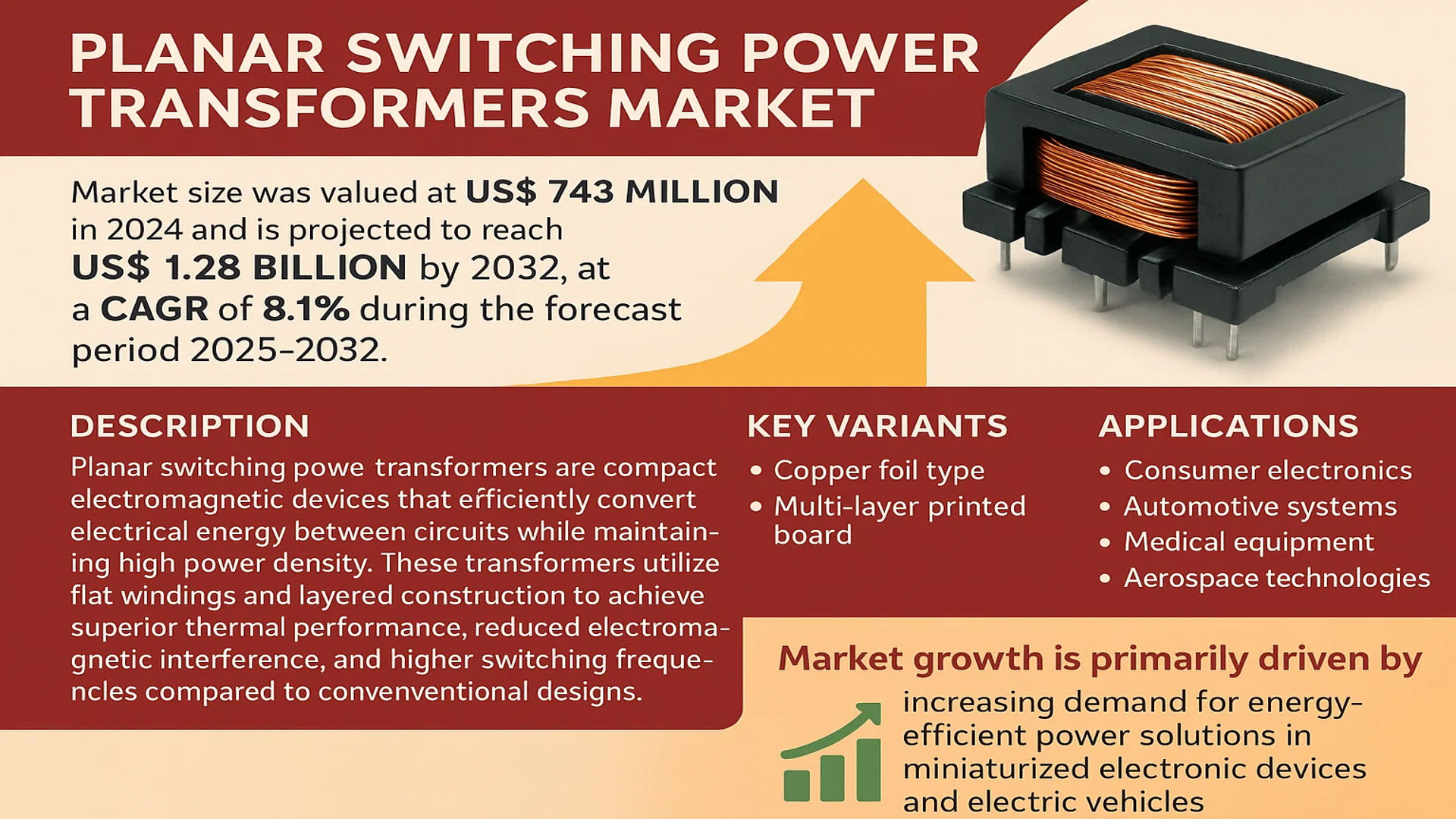
The global Planar Switching Power Transformers Market size was valued at US$ 743 million in 2024 and is projected to reach US$ 1.28 billion by 2032, at a CAGR of 8.1% during the forecast period 2025-2032. The U.S. market accounted for 32% of global revenue in 2024, while China is expected to register the highest CAGR of 9.7% through 2032.
Planar switching power transformers are compact electromagnetic devices that efficiently convert electrical energy between circuits while maintaining high power density. These transformers utilize flat windings and layered construction to achieve superior thermal performance, reduced electromagnetic interference, and higher switching frequencies compared to conventional designs. Key variants include copper foil type and multi-layer printed board configurations, with applications spanning consumer electronics, automotive systems, medical equipment, and aerospace technologies.
The market growth is primarily driven by increasing demand for energy-efficient power solutions in miniaturized electronic devices and electric vehicles. Furthermore, advancements in 5G infrastructure and renewable energy systems are creating new deployment opportunities. Recent industry developments include Vishay Intertechnology’s 2024 launch of a new high-frequency planar transformer series for EV charging stations, demonstrating the technology’s growing relevance in power conversion applications.
MARKET DYNAMICS
MARKET DRIVERS
Rising Demand for Energy-Efficient Power Solutions to Fuel Market Growth
The global shift towards energy efficiency is significantly driving demand for planar switching power transformers. These transformers offer superior efficiency compared to traditional counterparts, with typical conversion efficiencies exceeding 95%. As energy regulations tighten worldwide, manufacturers across industries are adopting these compact, high-performance components. The consumer electronics sector alone accounts for over 40% of total demand, driven by the need for smaller, more efficient power supplies in devices like smartphones and laptops. This trend is expected to accelerate as 5G technology deployment creates additional demand for compact power solutions in network infrastructure.
Expansion of Electric Vehicle Infrastructure Creates New Demand
The rapid growth of electric vehicle charging infrastructure presents a major opportunity for planar transformer manufacturers. Modern DC fast chargers require high-frequency power conversion that planar transformers are uniquely suited to provide. With global EV sales projected to grow at a compound annual rate of nearly 30% through 2030, the supporting charging infrastructure market is expected to see corresponding expansion. Transformer manufacturers are responding by developing specialized products capable of handling the high power densities required by next-generation charging stations while maintaining optimal thermal performance.
Miniaturization Trend Across Industries Boosts Adoption
The relentless push for smaller, lighter electronic devices across multiple industries continues to drive innovation in planar transformer technology. The aerospace and defense sectors in particular are benefiting from the compact form factor of these components, where every gram and cubic centimeter counts. Planar transformers typically offer up to 50% size reduction compared to conventional designs while maintaining equivalent power ratings. This advantage is especially critical in applications like drone avionics and satellite systems where power density is paramount. Medical device manufacturers are similarly adopting these transformers for portable diagnostic equipment and implantable devices.
MARKET RESTRAINTS
High Initial Costs Limit Adoption in Price-Sensitive Markets
While planar switching power transformers offer numerous technical advantages, their higher production costs compared to traditional designs remain a significant barrier to wider adoption. The precision manufacturing processes and specialized materials required can increase unit costs by 20-30% over conventional transformers. This presents particular challenges in consumer markets where price competition is intense. Manufacturers are responding with design innovations to reduce material costs while maintaining performance, but the premium pricing structure continues to limit market penetration in some segments.
Other Restraints
Thermal Management Challenges
The compact design of planar transformers presents unique thermal management requirements that can complicate system integration. Without proper thermal design, the higher power densities can lead to operating temperatures that reduce reliability and lifespan. These challenges are particularly acute in high-power applications like industrial equipment where heat dissipation is critical.
Design Complexity
The sophisticated multilayer designs required for optimal planar transformer performance demand specialized engineering expertise that remains relatively scarce. This design complexity can lead to longer development cycles and higher R&D costs for new product introductions compared to conventional transformer technologies.
MARKET CHALLENGES
Supply Chain Disruptions Impact Material Availability
The planar transformer market continues to face significant supply chain challenges, particularly regarding the availability of specialized magnetic materials and laminates. Recent geopolitical tensions and trade restrictions have created bottlenecks in the supply of key raw materials, leading to extended lead times and price volatility. These disruptions particularly affect manufacturers serving high-reliability markets like aerospace and medical where material certifications and quality standards limit substitution options. Industry analysts estimate that material shortages added an average of 4-6 weeks to delivery times across the sector last year.
Other Challenges
Standardization Issues
The lack of industry-wide standardization for planar transformer designs creates interoperability challenges for end users. Unlike conventional transformers that follow well-established form factors and specifications, planar designs often require custom solutions that can complicate system integration and limit second-source options.
Skilled Labor Shortages
The specialized knowledge required for designing and manufacturing planar transformers remains concentrated among a relatively small pool of experienced engineers. As demand grows, companies are facing increasing difficulty in recruiting and retaining qualified personnel, particularly in regions with strong semiconductor and power electronics industries competing for the same talent pool.
MARKET OPPORTUNITIES
Emerging Wide Bandgap Semiconductor Technologies Create New Possibilities
The development of next-generation power semiconductors based on silicon carbide and gallium nitride presents significant opportunities for planar transformer innovation. These wide bandgap devices operate at higher frequencies and temperatures than conventional silicon, enabling transformer designs with further improved power density and efficiency. Leading manufacturers are already developing transformer solutions specifically optimized for these new semiconductor technologies, creating potential for market leadership in emerging high-performance applications.
Renewable Energy Integration Drives Demand for Advanced Power Conversion
The global transition to renewable energy sources is creating strong demand for advanced power conversion solutions where planar transformers play an increasingly important role. Solar microinverters and energy storage systems in particular benefit from the compact size and high efficiency of planar designs. As grid-scale battery storage deployments accelerate, transformers capable of handling bidirectional power flow at high frequencies are becoming critical components. Industry projections suggest the renewable energy sector could account for over 25% of the planar transformer market by 2030, up from about 15% today.
Industrial IoT Adoption Creates New Application Areas
The rapid expansion of Industrial Internet of Things (IIoT) infrastructure presents new opportunities for planar transformer manufacturers. The proliferation of smart sensors, edge computing devices, and industrial automation systems requires reliable, compact power solutions that can operate in harsh environments. Planar transformers are particularly well-suited for these applications due to their vibration resistance and consistent performance across wide temperature ranges. As factory automation investments continue to grow, particularly in advanced manufacturing sectors, the demand for ruggedized power components is expected to increase significantly.
PLANAR SWITCHING POWER TRANSFORMERS MARKET TRENDS
Increasing Demand for High-Efficiency Power Solutions Drives Market Growth
The global planar switching power transformer market is experiencing significant growth due to rising demand for compact and high-efficiency power solutions across various industries. These transformers, known for their low-profile design and superior thermal performance, are increasingly replacing traditional wire-wound transformers in applications requiring high power density. The market is projected to grow at a CAGR of 6.8% from 2024 to 2032, reaching a valuation of $980 million by 2032. The adoption of planar magnetics technology is particularly strong in sectors like telecommunications and automotive electronics, where space constraints and energy efficiency are critical considerations. Additionally, the shift towards renewable energy systems has further accelerated demand, as these transformers offer improved performance in solar inverters and wind power converters.
Other Trends
Expansion in 5G Infrastructure Deployment
The rapid rollout of 5G networks worldwide is creating substantial opportunities for planar switching power transformer manufacturers. These components are essential in powering base stations and small cell equipment, where their compact size and high frequency operation (typically between 500kHz to 2MHz) make them ideal for 5G applications. With telecom operators investing heavily in network infrastructure, the segment is expected to account for over 25% of total market demand by 2027. The ability of planar transformers to minimize electromagnetic interference (EMI) while handling high power levels has made them particularly valuable in sensitive communication equipment.
Automotive Electrification Creates New Growth Opportunities
The automotive industry’s transition towards electrification is significantly impacting the planar switching power transformer market. These components are increasingly used in electric vehicle (EV) charging systems, onboard chargers, and DC-DC converters. With global EV sales projected to reach 30 million units annually by 2030, automakers are prioritizing power solutions that offer high efficiency in compact form factors. Planar transformers meet these requirements while providing better thermal management compared to conventional designs. Furthermore, the push towards 800V battery systems in premium EVs is driving innovation in high-voltage planar transformer designs capable of operating efficiently at these elevated power levels.
COMPETITIVE LANDSCAPE
Key Industry Players
Strategic Innovation and Market Consolidation Drive Competition
The global Planar Switching Power Transformers market exhibits a moderately consolidated structure, dominated by established players with strong technological capabilities and regional penetration. Vishay Intertechnology, Inc. leads the market with its extensive product range and global distribution network, capturing a significant revenue share in 2024. The company’s focus on high-efficiency transformers for automotive and industrial applications has strengthened its market position.
Standex Electronics and Pulse Electronics maintain robust market shares through continuous R&D investments and customized product solutions. Their expertise in copper foil and multi-layer printed board type transformers makes them preferred suppliers for consumer electronics and medical applications. Recent collaborations with OEMs have further expanded their customer base.
Meanwhile, Coilcraft and PREMO are rapidly gaining traction through strategic acquisitions and vertical integration. Coilcraft’s recent expansion of its planar transformer production line in Asia demonstrates the growing importance of regional manufacturing hubs. These players compete intensely on parameters like power density, thermal performance, and size minimization – critical factors for modern electronics applications.
List of Key Planar Switching Power Transformer Manufacturers
- Vishay Intertechnology, Inc. (U.S.)
- Standex Electronics (U.S.)
- Pulse Electronics (U.S.)
- Payton Planar (Israel)
- Himag Planar Magnetics (U.K.)
- MPS Industries (U.S.)
- PREMO (Spain)
- Coilcraft (U.S.)
- Schukat electronic (Germany)
- INDUCTIVE SYSTEMS EUROPE (Netherlands)
- INRCORE (U.S.)
- ECI (U.S.)
Segment Analysis:
By Type
Copper Foil Type Segment Dominates Due to High Efficiency and Compact Design
The market is segmented based on type into:
- Copper Foil Type
- Subtypes: Single-layer Copper Foil, Multi-layer Copper Foil
- Multi-layer Printed Board Type
- Subtypes: Standard PCB-based, High-Frequency PCB-based
- Others
By Application
Consumer Electronics Segment Leads Owing to Widespread Use in Compact Devices
The market is segmented based on application into:
- Consumer Electronics
- Aerospace
- Automotive
- Medical
- Others
By Power Capacity
Medium Power Segment Holds Significant Share Due to Balanced Performance Requirements
The market is segmented based on power capacity into:
- Low Power (Below 100W)
- Medium Power (100W-1kW)
- High Power (Above 1kW)
Regional Analysis: Planar Switching Power Transformers Market
Asia-Pacific
The Asia-Pacific region dominates the global Planar Switching Power Transformers market, with China, Japan, and South Korea leading in both production and consumption. China’s robust electronics manufacturing sector and increasing investments in electric vehicles drive substantial demand, accounting for over 40% of regional market share. The country benefits from strong government support for semiconductor and renewable energy industries, accelerating the adoption of advanced power conversion solutions. Meanwhile, Japan’s reputation for high-quality electronic components and South Korea’s leadership in consumer electronics contribute significantly to the market’s growth trajectory, with the latter seeing a 12% annual increase in demand for compact power solutions.
North America
North America maintains technological leadership in the Planar Switching Power Transformers sector, particularly in high-frequency and high-power-density applications. The U.S. market is propelled by defense contracts, medical equipment manufacturing, and data center expansions, with California and Texas emerging as key hubs for innovation. Stringent energy efficiency standards like DOE Level VI and growing investments in 5G infrastructure are reshaping product requirements. Major players such as Coilcraft and Pulse Electronics continue to drive R&D, focusing on miniaturization and thermal management solutions to meet the demands of aerospace and telecommunications sectors.
Europe
Europe shows steady growth in the Planar Switching Power Transformers market, particularly in Germany and the Nordic countries where industrial automation and renewable energy systems are prioritized. The EU’s emphasis on energy-efficient power conversion aligns with the transformers’ advantage of low electromagnetic interference. Automotive manufacturers are notably increasing adoption as electric vehicle production expands, with European OEMs specifying planar transformers for onboard chargers. However, higher production costs compared to Asian counterparts create pricing pressures, prompting local players to emphasize customization and reliability as key differentiators.
South America
The South American market remains nascent but demonstrates potential, particularly in Brazil’s growing industrial electronics sector. While economic volatility limits large-scale adoption, increasing foreign investments in manufacturing facilities are gradually expanding market access. Local demand primarily stems from medical equipment and telecommunications infrastructure, with imports currently fulfilling the majority of regional requirements. Government initiatives to boost domestic electronics production could stimulate future market development, though challenges persist regarding component standardization and technical expertise.
Middle East & Africa
Across the Middle East and Africa, the market is characterized by selective adoption in specialized applications such as oilfield equipment and military systems. The UAE and Saudi Arabia lead in infrastructure spending, creating opportunities for power supply solutions in smart city projects. Africa’s market largely depends on imports, though localized assembly is emerging in South Africa and Egypt. Limited manufacturing capabilities and price sensitivity slow commercialization, but the region presents long-term potential as industrial diversification and energy transition initiatives gain momentum.
Report Scope
This market research report provides a comprehensive analysis of the global Planar Switching Power Transformers market, covering the forecast period 2024–2032. It offers detailed insights into market dynamics, technological advancements, competitive landscape, and key trends shaping the industry.
Key focus areas of the report include:
- Market Size & Forecast: Historical data and future projections for revenue, unit shipments, and market value across major regions and segments. The global Planar Switching Power Transformers market was valued at US$ 743 million in 2024 and is projected to reach US$ 1.28 billion by 2032, with a notable CAGR of 8.1% during the forecast period.
- Segmentation Analysis: Detailed breakdown by product type (Copper Foil Type, Multi-layer Printed Board Type) and application (Consumer Electronics, Aerospace, Automotive, Medical, Others) to identify high-growth segments and investment opportunities.
- Regional Outlook: Insights into market performance across North America, Europe, Asia-Pacific, Latin America, and the Middle East & Africa, with the U.S. market size estimated at USD million in 2024 and China projected to reach USD million.
- Competitive Landscape: Profiles of leading market participants, including Schukat, Standex Electronics, Vishay, Payton Planar, ECI, Pulse, Himag Planar Magnetics, MPS Industries, PREMO, and Coilcraft, among others. The global top five players held approximately % revenue share in 2024.
- Technology Trends & Innovation: Assessment of emerging technologies, efficiency improvements, miniaturization trends, and evolving industry standards in planar transformer design.
- Market Drivers & Restraints: Evaluation of factors driving market growth along with challenges such as supply chain constraints, raw material pricing, and technical barriers.
- Stakeholder Analysis: Insights for component suppliers, OEMs, system integrators, investors, and policymakers regarding the evolving ecosystem and strategic opportunities.
Primary and secondary research methods are employed, including interviews with industry experts, data from verified sources, and real-time market intelligence to ensure the accuracy and reliability of the insights presented.
FREQUENTLY ASKED QUESTIONS:
What is the current market size of Global Planar Switching Power Transformers Market?
-> Planar Switching Power Transformers Market size was valued at US$ 743 million in 2024 and is projected to reach US$ 1.28 billion by 2032, at a CAGR of 8.1% during the forecast period 2025-2032.
Which key companies operate in Global Planar Switching Power Transformers Market?
-> Key players include Schukat, Standex Electronics, Vishay, Payton Planar, ECI, Pulse, Himag Planar Magnetics, MPS Industries, PREMO, and Coilcraft, among others.
What are the key growth drivers?
-> Key growth drivers include increasing demand for compact power solutions, growth in consumer electronics, and adoption in automotive and medical applications.
Which region dominates the market?
-> Asia-Pacific shows the fastest growth, while North America and Europe remain significant markets.
What are the emerging trends?
-> Emerging trends include higher frequency operation, integration with power electronics, and advanced thermal management solutions.

Get Sample Report PDF for Exclusive Insights
Report Sample Includes
- Table of Contents
- List of Tables & Figures
- Charts, Research Methodology, and more...
 Download Sample Report PDF